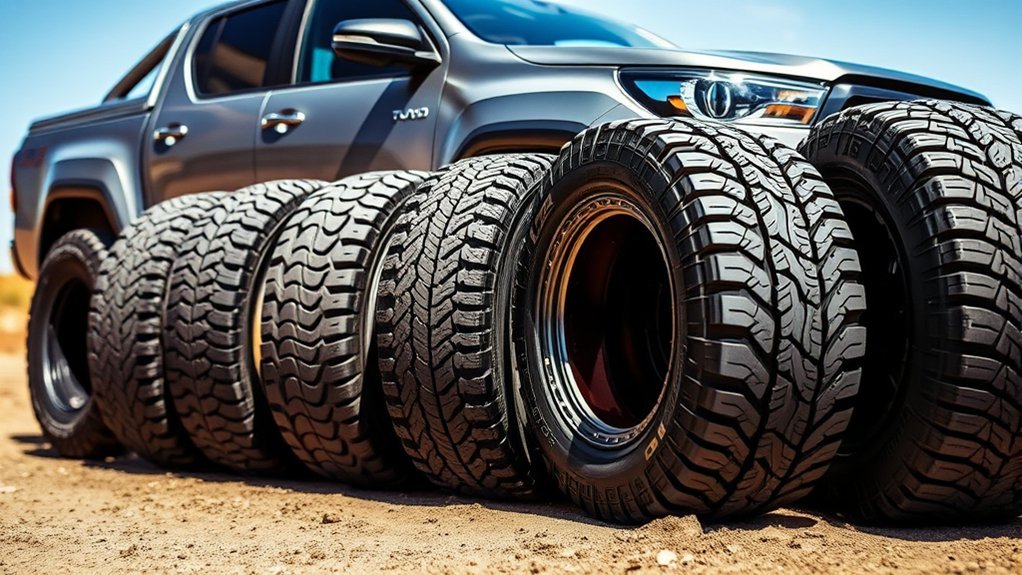
Choosing tires for a lifted Toyota Hilux is not just about picking the biggest tire that will fit. The best setup starts with fitment, load rating, and legal clearance, then matches the tread pattern to how you actually drive. A daily-driven Hilux that sees weekend trails usually needs a different tire than a Hilux built for mud, rocks, touring weight, or remote overlanding.
Quick Answer
For most lifted Toyota Hilux builds, a quality all-terrain or rugged-terrain tire in a legal, load-rated size is the best choice. Choose mud-terrain tires only if you spend more time in mud, rocks, ruts, or deep off-road conditions than on highways.
Key Takeaways
- Always check the tire placard, owner’s manual, load index, and local modification rules before upsizing.
- Many current Hilux grades use 265/65R17 or 265/60R18 from the factory, but the correct size depends on model, market, and trim.
- A 33-inch-class tire is a common goal for lifted Hilux builds, but rubbing, offset, trimming, and speedometer error still need to be checked.
- A 35-inch-class tire can deliver more clearance, but it usually needs more serious supporting modifications.
- Do not let tire size reduce safety: towing, payload, braking, stability control, and on-road pressure still matter.
At a Glance
| Time Required | 30–60 minutes to shortlist sizes; longer if you need a tire shop to test-fit wheels and check clearance. |
| Difficulty | Moderate. The tread choice is easy; confirming safe fitment is the important part. |
| Tools Needed | Door placard, owner’s manual, tape measure, tire size calculator, tire pressure gauge, and a trusted tire shop for final test fitment. |
| Cost | Varies by country, tire size, and brand. Budget for tires, fitting, balancing, alignment, speedometer correction, spare fitment, and possible trimming. |
Warning: Oversized tires can affect braking, steering, gearing, fuel use, stability control, speedometer accuracy, legality, insurance, and warranty coverage. Confirm your setup with a qualified tire shop or engineer before driving on-road.
How to Choose the Right Tire Size for Your Lifted Toyota Hilux
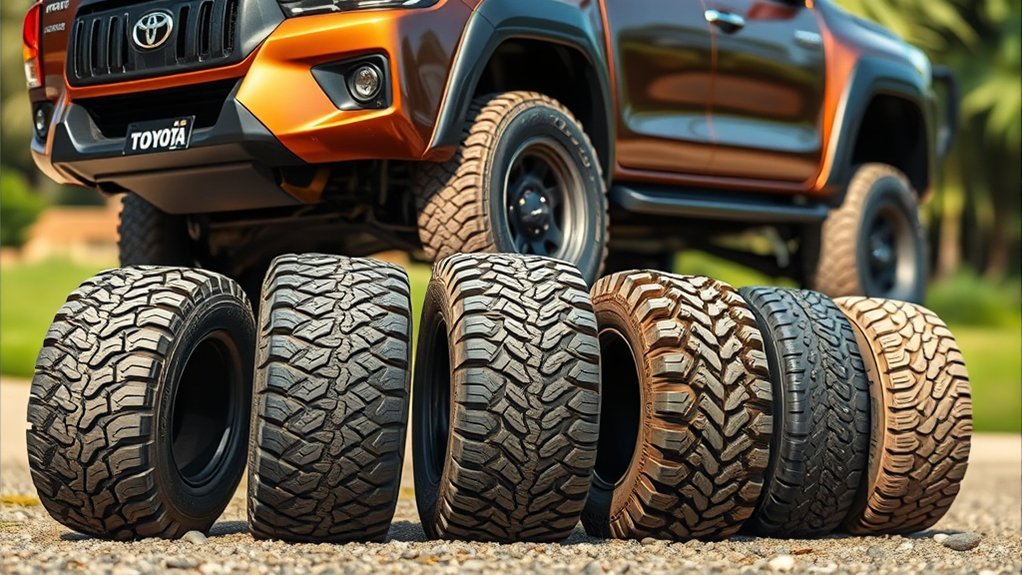
Start with your exact Hilux model, year, trim, and market. For example, current Toyota Australia HiLux specifications list common factory sizes such as 265/65R17 and 265/60R18, depending on grade. Your own door placard is still the source that matters most for your vehicle.
Use these checks before buying larger tires:
- Confirm placard size, load index, and speed rating. The replacement tire should meet or exceed the factory load and speed requirements unless a qualified professional confirms an approved alternative.
- Measure full-lock clearance. Turn the steering from lock to lock and check the front guard liner, mud flap, body mount, upper control arm, and inner guard.
- Check compression clearance. A tire that clears in the driveway may rub when the suspension compresses on a trail.
- Match tire width to rim width. Every tire has an approved rim-width range. Do not mount a tire on a wheel outside that range.
- Check offset and backspacing. The same tire can rub badly on one wheel and fit cleanly on another because offset changes where the tire sits.
- Plan the spare. A full-size spare may not fit in the factory spare location, and using a smaller spare with larger tires can stress the drivetrain.
- Recheck speedometer accuracy. Larger tires travel farther per revolution, so your speedometer and odometer may read low.
| Tire Size Range | Best For | Fitment Notes |
|---|---|---|
| 265/65R17 or 265/60R18 | Factory-style replacement, towing, daily driving | Usually the least complicated choice. Confirm your exact placard size. |
| 265/70R17 or similar mild upsize | Slight clearance gain with fewer compromises | Often easier than a 33-inch build, but still check legality, rubbing, and speedometer error. |
| 33-inch class | Balanced off-road clearance and daily usability | May need suspension lift, correct offset, trimming, and alignment changes. |
| 35-inch class | Serious off-road builds and maximum clearance | Usually requires more lift, trimming, gearing consideration, speedometer correction, and legal approval. |
Pro Tip: Do not buy tires based only on diameter. A wider tire can rub more than a taller narrow tire, especially near the body mount, upper control arm, and front mud flap.
Why Tire Selection Is Essential for Off-Road Performance
The right tire changes how your Hilux grips, steers, brakes, and carries weight. Larger tires can improve ground clearance and approach angles, but they also add rotating weight and can reduce acceleration, braking feel, and fuel economy. That is why a smart tire upgrade balances clearance with drivability.
For off-road use, focus on three things: tread design, sidewall strength, and load capacity. A high-void mud-terrain tire can clear mud and bite into soft ground, while an all-terrain tire usually gives better road manners, wet-road comfort, and tread life. If your Hilux carries camping gear, tools, drawers, water, fuel, or towing weight, load rating becomes just as important as tread pattern.
The best Hilux tire is not always the largest one. It is the largest legal, load-rated tire that clears properly and still suits your real driving mix.
Essential Features of Off-Road Tires for Hilux Builds
When comparing off-road tires for a lifted Toyota Hilux, look beyond the brand name. The details below make the biggest difference on trails and long trips:
- Load index: Choose a tire that can safely carry the vehicle, accessories, passengers, cargo, and towing load.
- Sidewall construction: Strong sidewalls help resist cuts, bruising, and impact damage from rocks and ruts.
- Tread voids: Larger voids help mud and gravel clear from the tread, while tighter patterns are usually quieter on highways.
- Wet-road performance: Aggressive tread is useful off-road, but your Hilux still needs predictable braking on sealed roads.
- Weight: Heavier tires can affect ride quality, acceleration, braking, and suspension wear.
- Availability: Pick a size and model you can replace easily, especially before remote travel.
For example, Toyo lists the Open Country M/T as a mud-terrain tire aimed at maximum off-road traction, while the Open Country A/T III is positioned as an all-terrain option with lower noise and longer tread life.
[Products Worth Considering]

Measure tire tread depth quickly and accurately with this LUMITECO dial gauge that reads in 1/32" increments up to 14/32". The color-coded green/yellow/red zones make it easy to judge tire wear and know when replacement is needed. A rugged, compact design with a protective pouch helps keep the gauge ready for use on cars, trucks, motorcycles, and more.

Monitor tire tread wear with a smart, color-coded depth gauge that shows clear condition ranges at a glance. The bar is range marked for fast, easy readings, helping you maintain safer traction and performance. Each gauge is portable with a pocket clip, and the set includes 20 units for daily use and sharing.

This tire inflator with pressure gauge delivers long-lasting performance with a durable rubber-protected gauge and sturdy build. The longer hose and 360 swivel air chuck help you seal the valve securely and keep your hands free while measuring, inflating, or deflating. It’s battery-free for reliable use and provides ±2 PSI accuracy in the mid-range for most typical tires, with universal compatibility for 1/4 NPT compressor outputs.
Mud-Terrain vs. All-Terrain Tires: Which Is Best?
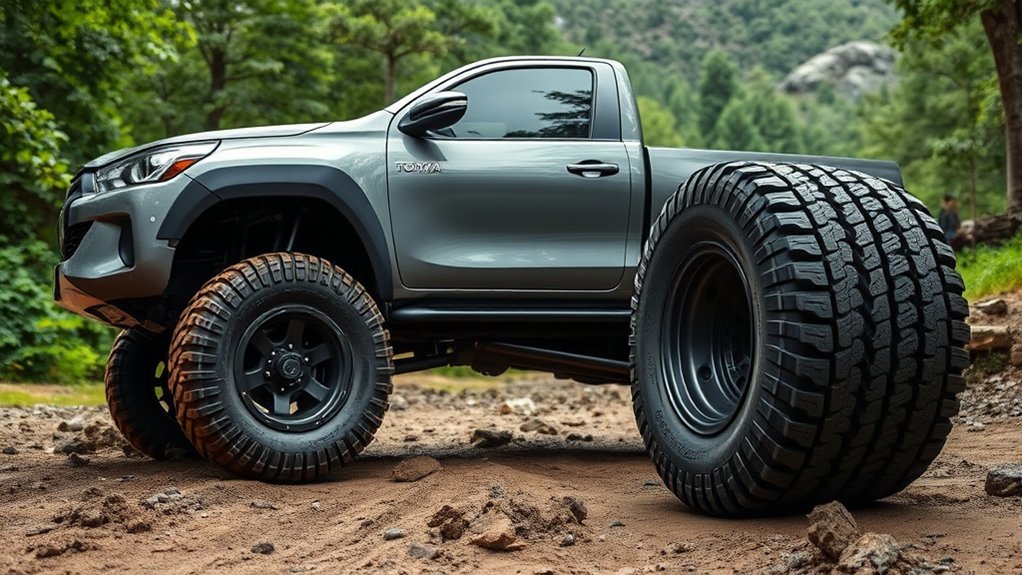
All-terrain tires are usually the best choice for a Hilux that splits time between pavement, gravel, touring, towing, and weekend trails. Mud-terrain tires make sense when your build sees deep mud, rocky tracks, steep ruts, or soft terrain often enough to accept more road noise, weight, and faster wear.
| Tread Type | Best For | Trade-Offs |
|---|---|---|
| All-Terrain | Daily driving, gravel, touring, light mud, beach access | Less bite than mud-terrain in deep mud and slick ruts. |
| Rugged-Terrain / Hybrid | Drivers who want more off-road grip without going full mud-terrain | Usually noisier and heavier than all-terrain tires. |
| Mud-Terrain | Mud, rocks, ruts, steep trails, low-speed off-road use | More road noise, more weight, shorter tread life, and less comfort on highways. |
[Products Worth Considering]
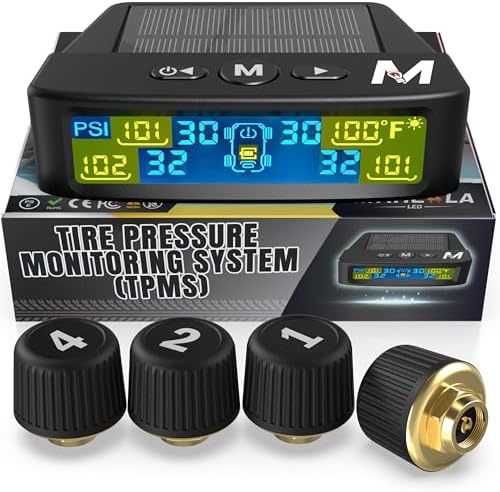
Marcala’s TPMS set of four sensors helps you monitor tire pressure and temperature in real time while driving, with updates every second. The bright color LCD uses auto-dimming for easy viewing, powered by dual solar and USB charging, and offers six alarm modes. Built for trailers, RVs, campers, trucks, and towing setups, the sensors support monitoring 1-4 wheels up to 98 PSI with IP67 waterproof protection.

Accurately measure tire tread depth with a calibrated gauge marked from 0 to 1 inch in 1/32 inch increments. The color-coded bar helps you quickly identify tread condition ranges, supporting safe driving for trucks, motorcycles, automobiles, and passenger vehicles.

Keep your tires properly inflated with this analog VONDIOR tire pressure gauge, designed for fast, easy readings without batteries. The swiveling, two-axis hose and large glow dial help you measure at any tire angle with instant visibility. Built with a protective rubber shield, it supports durable, low-maintenance use for cars and trucks.
Choosing the Best Tire Tread Pattern
The tread pattern should match the surface you drive most often. A tire that looks aggressive in the parking lot may be tiring on the highway, while a quiet highway-friendly all-terrain may not clear mud well enough for serious tracks.
All-Terrain Versatility
All-terrain tires are the best starting point for most lifted Hilux builds. They provide a useful blend of road comfort, gravel strength, and trail grip. Look for strong shoulders, siping for wet-road grip, and a load rating that matches your vehicle’s use.
Modern all-terrain options such as the BFGoodrich All-Terrain T/A KO3 focus on durability, gravel performance, and all-terrain traction. If your preferred KO3 size is not available in your market yet, compare equivalent all-terrain options from reputable brands and confirm fitment before buying.
Mud-Terrain Performance
Mud-terrain tires use larger tread blocks and wider voids to dig into mud, rocks, and loose surfaces. They can be excellent for a Hilux that spends a lot of time off-road, but they are not always the best tire for a daily driver.
The Toyo Open Country M/T is one example of a heavy-duty mud-terrain tire. Toyo’s official specifications list an LT315/75R16 version at about 886 mm overall diameter, which places it in the 35-inch class. That size should be treated as a serious fitment change, not a simple bolt-on upgrade.
Highway Comfort Considerations
If your Hilux covers long highway distances, a quieter tire matters. Tighter tread spacing, lighter tire weight, and a less aggressive shoulder can improve comfort and fuel economy. That is why many touring builds use all-terrain or rugged-terrain tires instead of full mud-terrain tires.
Note: Tire noise usually increases as tread blocks become larger and more open. A tire that is acceptable on short trips may feel loud on long highway drives.
Why Sidewall Strength Matters for Off-Road Adventures
Sidewall strength matters because the sidewall is exposed to rocks, roots, sticks, ruts, and sharp trail edges. A stronger sidewall can reduce the risk of cuts and bruises, especially when the tire is aired down for low-speed off-road use.
Enhanced Impact Resistance
Reinforced sidewalls help the tire survive impacts that would damage a lighter highway tire. This matters on rocky trails, corrugations, and tracks where the sidewall can be pinched between the rim and an obstacle.
Improved Traction Performance
When aired down correctly for off-road conditions, a strong sidewall can help the tire conform to uneven ground while keeping the carcass stable. This improves grip, ride comfort, and control at low speeds.
Reduced Risk of Punctures
A strong sidewall does not make a tire puncture-proof, but it reduces risk. For remote travel, inspect sidewalls after every tough section and carry a repair kit, compressor, pressure gauge, and full-size spare.
Top Tire Brands for Toyota Hilux Builds
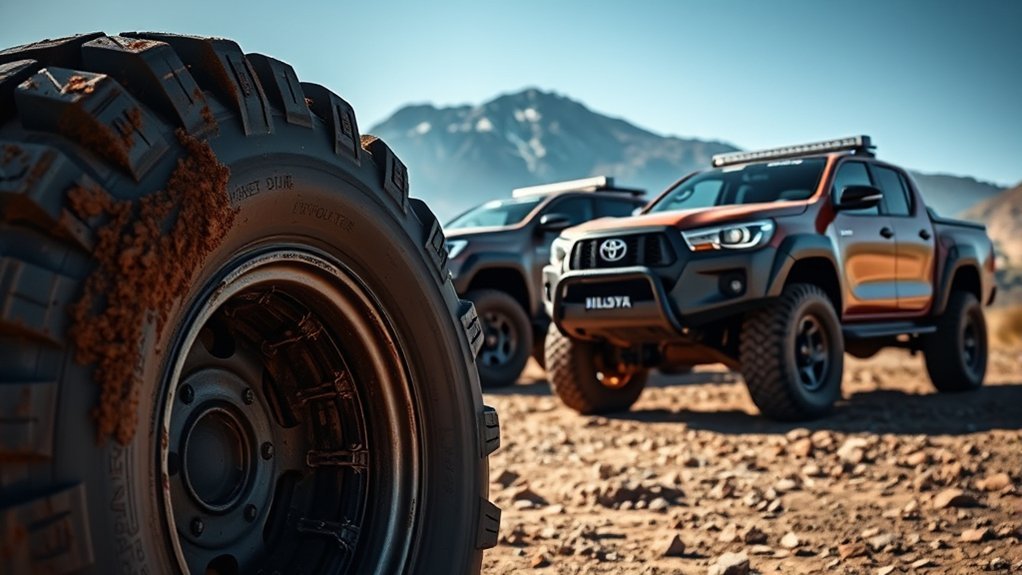
There is no single best tire brand for every Hilux. The right choice depends on your terrain, tire size, load needs, local availability, and budget. These brands and models are common starting points for lifted Hilux builds:
- Toyo Open Country A/T III: A strong all-terrain choice for touring, gravel, light mud, and daily driving.
- Toyo Open Country R/T: A hybrid rugged-terrain option for drivers who want more aggression than an all-terrain without going full mud-terrain.
- Toyo Open Country M/T: A mud-terrain option for serious off-road traction and stronger sidewall performance.
- BFGoodrich All-Terrain T/A KO3: A current all-terrain option focused on durability, grip, and long-wear design.
- Cooper Discoverer STT Pro: A mud-terrain-style option for drivers who prioritize off-road bite and sidewall toughness.
- Michelin LTX A/T2: A better fit for drivers who value longevity, road comfort, and lighter all-terrain use.
Before choosing any tire, confirm that the exact size is available in your country and that its load index, speed rating, approved rim width, and overall diameter suit your Hilux.
[Products Worth Considering]

Replace worn or malfunctioning GM TPMS sensors with this 433MHz pre-programmed sensor set designed for compatibility with many Chevrolet, Buick, GMC, and Cadillac models. It includes guidance for proper OBDII relearning/pairing after installation and supports reliable long-term operation with a high-performance CR2032 battery. Quality tested for durability and performance to help restore accurate tire pressure monitoring.

The SAFELIFE dial tire tread depth gauge measures tread depth in 1/32 inch increments with clear, easy-to-read 2-inch dial face. Color zones using a traffic light system help you quickly judge whether tread is low, marginal, or ample for safer driving. Built with a durable zinc cast body and a metal detect probe for precise, comfortable use across cars, motorcycles, trucks, and buses.
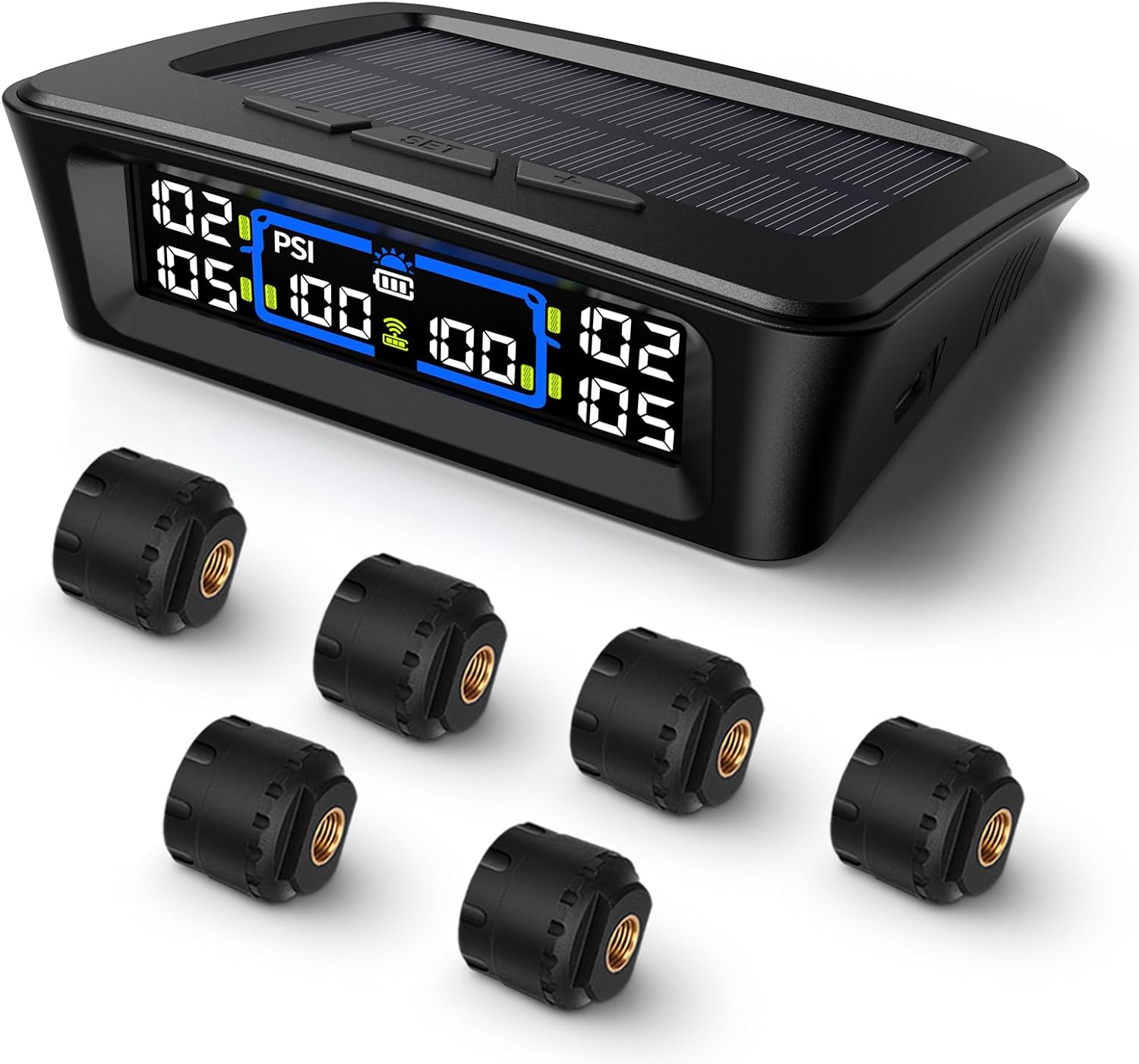
The Tymate TM12 RV TPMS delivers real-time tire pressure and temperature monitoring with a stable 433Hz display for safer long-distance driving. It supports simultaneous monitoring across vehicle and trailer zones, includes six alarm modes for pressure, temperature, leakage, battery, and signal loss, and features easy DIY installation with auto calibration. Power is supplied via USB-C charging or solar recharging, with a wide 0–144 PSI range and up to 50 ft signal coverage for RVs and towable trailers.
Balancing Cost and Performance for Hilux Tires
The cheapest tire is rarely the cheapest long-term choice. A poor fit can create rubbing, fast wear, alignment issues, weak wet-road braking, or premature suspension wear. A very aggressive tire can also cost more over time through fuel use, noise, and shorter tread life.
| Budget Item | Why It Matters |
|---|---|
| Tires | Larger LT tires cost more than standard replacement sizes. |
| Mounting and balancing | Heavy off-road tires need proper balancing to avoid vibration. |
| Wheel alignment | Important after lifts, control arm changes, and larger tire fitment. |
| Trimming or guard work | May be needed for 33-inch and larger setups. |
| Speedometer correction | Larger tires can make the speedometer and odometer inaccurate. |
| Full-size spare | A mismatched spare can be a problem off-road and on 4WD drivetrains. |
Fitment, Legal, and Safety Checks Before You Buy
A lifted Hilux with larger tires can be safer and more capable when built correctly. It can also become unsafe or illegal when tire size, offset, and suspension changes are guessed. Before you buy, check these points:
- Local modification rules: Tire diameter and track-width rules vary by country, state, and inspection system.
- Insurance: Declare tire and suspension changes if your insurer requires it.
- GVM and GCM: Tire upgrades do not increase Toyota’s rated payload or towing capacity.
- Tow-ball download: Heavy towing reduces available payload and affects rear axle load.
- Brake performance: Larger, heavier tires can increase braking distance if the rest of the setup is not matched.
- Stability systems: Major diameter changes can affect electronic safety systems.
- TPMS: If your Hilux has a tire pressure monitoring system, make sure sensors and warning thresholds still work correctly.
Warning: Do not assume larger tires increase towing ability. Toyota’s braked towing ratings depend on the exact model and must still be used with GVM, GCM, axle-load, payload, and tow-ball download limits.
Maintaining Off-Road Tires on Your Lifted Hilux
Off-road tires work hard. They carry more load, run on sharper surfaces, flex more when aired down, and often weigh more than factory tires. Good maintenance helps them last longer and keeps your Hilux safer.
Tire Pressure Management
Use the vehicle placard pressure for normal on-road driving unless your tire professional recommends a different pressure for your exact tire and load. Off-road, lowering pressure can improve grip and ride comfort, but only at reduced speeds and with enough load capacity.
BFGoodrich advises that pressures lower than 20 psi may be used off-road only when speed is reduced and the tire has adequate load-carrying capacity, and that tires must be reinflated before returning to sealed roads. Keep a reliable gauge and compressor in the vehicle.
Warning: Never drive at highway speed on aired-down tires. Low pressure builds heat, reduces handling, and can cause tire failure.
Regular Tread Inspection
Inspect tread and sidewalls after every hard trail day. Look for cuts, exposed cords, punctures, missing chunks, uneven wear, shoulder damage, and sidewall bubbles. Replace tires earlier for wet-road, towing, snow, or off-road use instead of waiting for the legal minimum.
As a practical guide, Tire Rack notes that 2/32 inch is a common legal worn-out depth in many places, but recommends replacement around 4/32 inch for wet conditions and about 5/32 inch for snow. Off-road and towing use often justify replacing before a tire is near its minimum depth.
Rotation, Alignment, and Balancing
Rotate tires regularly, especially if you use heavy LT tires or drive long gravel roads. A five-tire rotation is ideal when your spare matches the other four. Also check alignment after suspension changes, new upper control arms, hard impacts, or uneven wear.
Elevate Your Overland Experience With the Right Tires
The right tire turns a lifted Hilux into a more confident touring and trail vehicle. The wrong tire creates rubbing, noise, poor braking, weak wet-road grip, or load problems. Choose tire size first by safe fitment, then choose tread by terrain, then choose brand by proven performance and availability.
For most owners, the best answer is a strong all-terrain or rugged-terrain tire in a legal, load-rated size. Choose mud-terrain tires when the terrain truly demands them. Choose 35-inch-class tires only when the rest of the Hilux build is ready for that level of modification.
Frequently Asked Questions
Can you fit 33s on a Hilux?
Yes, many lifted Hilux builds run 33-inch-class tires, but fitment depends on the exact tire, wheel offset, suspension setup, alignment, body mount clearance, and trimming. Always test-fit and check local modification rules before buying.
Can you fit 35s on a Hilux?
A 35-inch-class tire can fit some Hilux builds, but it is usually not a simple bolt-on upgrade. Expect to check lift height, wheel offset, guard clearance, body mount clearance, gearing, braking, speedometer correction, legality, and spare storage.
Will 265/70R17 fit a Hilux?
A 265/70R17 is a common mild upsize from 265/65R17, but fitment still depends on your exact Hilux, wheel offset, suspension, and local rules. Check the door placard, load rating, speedometer change, and full-lock clearance.
Which is better, the 2.4 or 2.8 Hilux?
For tire selection, engine size matters less than placard size, load rating, legal limits, and how much weight the vehicle carries. The 2.8 is generally preferred for heavier touring and towing, while the 2.4 may suit lighter daily use, but tire fitment must still be checked separately.
What is the best tire for a Toyota Hilux?
For mixed use, a quality all-terrain tire is usually the best choice. For mud, ruts, and rocky low-speed tracks, a mud-terrain tire may be better. For touring and daily driving, choose the quietest load-rated tire that still gives enough off-road grip.
Are mud-terrain tires bad for daily driving?
Not always, but they are usually louder, heavier, and less comfortable than all-terrain tires. They may also wear faster on pavement. If your Hilux is mostly a daily driver, start with an all-terrain or rugged-terrain tire.
Do larger tires affect the speedometer?
Yes. A larger tire travels farther with each rotation, so the speedometer and odometer can read lower than the vehicle’s true speed and distance. Check the percentage change and recalibrate when needed.
Conclusion
The best tires for a lifted Toyota Hilux are the ones that fit safely, carry the load correctly, suit your terrain, and stay legal on the road. Start with your tire placard and load rating, then decide whether you need all-terrain, rugged-terrain, or mud-terrain tread. A well-chosen 33-inch-class setup can be a strong balance for many builds, while 35-inch-class tires should be reserved for Hilux owners ready to support them with the right lift, clearance, gearing, and compliance checks.
Sources
- Toyota Australia HiLux Specifications — factory tire sizes, towing notes, and model-specific specification guidance.
- Toyota Australia HiLux Range — current model and towing-capacity context.
- Toyo Open Country M/T — mud-terrain tire positioning and off-road use case.
- Toyo Open Country A/T III — all-terrain tire positioning for low noise, road manners, and off-road capability.
- BFGoodrich All-Terrain T/A KO3 — current all-terrain tire features, tread design, and sidewall technology.
- Tire Rack Tread Depth Guide — tread-depth safety guidance for wet and winter conditions.