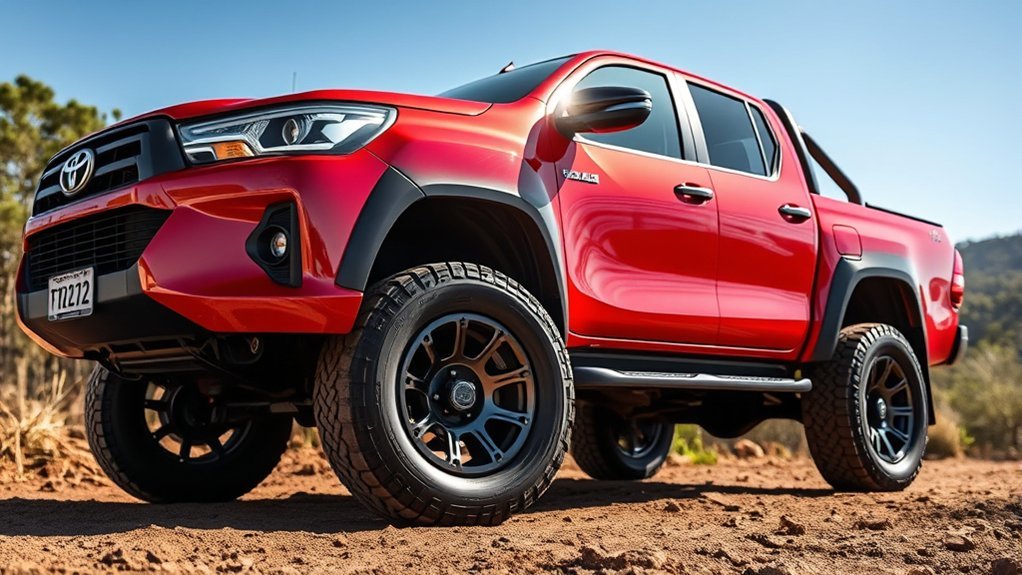
The correct tire fitment for a Toyota Hilux TRD depends on the vehicle’s model year, sales market, model code, trim, wheel size, brake package, and normal load. You should begin with the driver-side tire-pressure label and the owner’s manual rather than relying on one size or pressure range published for every Hilux. This guide explains how to verify the factory setup, compare larger tires, avoid clearance problems, and change a tire safely.
Quick Answer
Use the tire size, load rating, wheel specification, and cold pressure listed for your exact Hilux on its pressure label and in its owner’s manual. Toyota-documented Hilux fitments include 265/65R17 and 265/60R18, but larger sizes such as 265/70R17 or nominal 33-inch tires require clearance, calibration, load, and legal checks.
Key Takeaways
- A “Hilux TRD” badge alone does not identify the correct tire. Confirm the year, market, model code, trim, brake package, and factory wheel.
- Use the vehicle’s cold-pressure label, not the maximum pressure molded into the tire sidewall.
- Match or exceed the original tire’s load index and use a wheel with an adequate load rating.
- Larger tires can affect rubbing clearance, gearing, indicated speed, braking, fuel use, stability systems, and spare-tire compatibility.
- A nominal 33-inch tire is not a guaranteed bolt-on upgrade. Test the complete wheel-and-tire assembly at full steering lock and suspension travel.
Last updated: July 17, 2026. Specifications in this guide are examples from official Toyota documents and must be checked against your exact vehicle.
Warning: Do not install a tire or wheel solely because another Hilux owner reports that it fits. The wrong size, load rating, offset, nut seat, or brake clearance can damage the vehicle, reduce stability, or interfere with safety systems.
Understanding the Importance of Tire Fitment for the Toyota Hilux TRD
Tire fitment affects more than whether a tire can be mounted on a wheel. The complete setup influences steering response, braking, load capacity, ride quality, fuel use, ground clearance, speedometer accuracy, suspension clearance, and the operation of electronic safety systems.
The term Toyota Hilux TRD can describe different special editions in different markets and years. Newer performance-focused Hilux models may instead use names such as GR Sport. For example, Toyota Australia documents 265/65R17 all-terrain tires on its Hilux GR Sport. Toyota documents from other markets also list 265/60R18 and other sizes. That variation makes your vehicle’s own label and manual the safest starting point.
Before ordering tires or wheels, record the following information:
- Model year and sales market: Specifications can change between countries and production periods.
- Model code and trim: Look for a code such as GUN125 or GUN126 on the vehicle identification plate or official records.
- Factory tire and wheel size: Check the pressure label, current tire sidewall, and manual.
- Load index and speed rating: Replacement tires should meet the vehicle manufacturer’s requirements.
- Brake package: Larger calipers may prevent a smaller wheel from clearing even when the bolt pattern matches.
- Typical load: A lightly used truck and a fully loaded work vehicle may require different cold pressures.
Recommended Tire Sizes for Optimal Performance
No single tire size can be recommended for every Hilux TRD. The safest choice is the exact size printed on the vehicle’s pressure label or another size approved by Toyota for that model. The table below compares common sizes discussed by Hilux owners, but it is a dimensional comparison rather than approval for your vehicle.
| Tire Size | Approx. Diameter | Change vs. 265/65R17 | Fitment Meaning |
|---|---|---|---|
| 265/70R16 | 777 mm / 30.6 in. | About +0.1% | Nearly the same nominal diameter, but a 16-inch wheel must clear the brakes and meet all wheel specifications. |
| 265/65R17 | 776 mm / 30.6 in. | Baseline | A Toyota-documented size on several recent Hilux configurations, including some GR Sport models. |
| 265/60R18 | 775 mm / 30.5 in. | About -0.1% | Another Toyota-documented Hilux size with less sidewall than the equivalent 17-inch setup. |
| 265/75R16 | 804 mm / 31.6 in. | About +3.6% | Larger than the baseline. Clearance, indicated-speed, gearing, spare-wheel, and legal checks are required. |
| 265/70R17 | 803 mm / 31.6 in. | About +3.4% | May fit some combinations, but it is not guaranteed to clear every stock Hilux TRD or GR Sport. |
| 285/75R16 | 834 mm / 32.8 in. | About +7.4% | A nominal 33-inch-class setup that commonly requires substantial fitment and calibration evaluation. |
| 285/70R17 | 831 mm / 32.7 in. | About +7.0% | Another 33-inch-class option. Wheel width, offset, body-mount clearance, suspension travel, and legality must be checked. |
Nominal diameter is calculated from the size code. Actual mounted diameter varies by tire model, wheel width, pressure, load, and tread depth.
[Products Worth Considering]

The Gurduenon scissor car jack tire changing kit is designed for quick flat-tire replacement with a lifting capacity of 2.5 tons and a scissor-lift range sized for many vehicles. The complete emergency set includes a ratchet wrench, lug wrench, gloves, a pencil tire pressure gauge, and a storage bag for convenient trunk or garage use. Universal compatibility makes it suitable for cars, SUVs, and other vehicles roadside assistance needs.

These aluminum alloy tire valve stem caps with an O-ring seal help protect valve stems from corrosion while adding a clean, stylish look to your vehicle. The universal fit works across cars, trucks, motorcycles, bicycles, and more, making them an easy upgrade for everyday driving and off-road use. Installation is quick, and the included four-pack keeps all your tires dressed and protected.

This metal-free wheel and tire cleaning brush uses dense, fluffy synthetic wool to safely clean rims, spokes, fenders, and engine areas without worrying about damaging surfaces. Its flexible, comfortable design helps you reach detailed areas while maintaining durability, and the extra absorbent fibers work well with wheel spray cleaners for faster cleanup. Reusable and washable performance helps prevent grime and build-up for cleaner vehicles and easier maintenance at home.
Popular Tire Sizes
265/65R17 and 265/60R18 have almost identical overall diameters. The 17-inch setup provides more sidewall, which can improve impact compliance and wheel protection on rough roads. The 18-inch setup has less sidewall and may feel more direct on pavement, although ride and handling also depend on tire construction and pressure.
265/70R16 is also close in diameter, but that does not make every 16-inch wheel suitable. You still need the correct wheel width, load rating, hub fit, nut seat, offset, and brake clearance.
Larger sizes such as 265/75R16, 265/70R17, 285/75R16, and 285/70R17 should be treated as modifications rather than automatic upgrades. A wider or taller tire may improve clearance or flotation in a specific off-road situation, but it can also increase weight, steering effort, braking demand, rubbing, road noise, and fuel use.
Performance Considerations
Check these specifications before selecting a replacement:
- Load index: The tire must safely support the axle load and normal payload. Do not downgrade from the original requirement.
- Speed rating: Use a rating appropriate for the vehicle and local regulations.
- Tire construction: Passenger, LT, and commercial tires can have different load and pressure requirements even when the size numbers appear similar.
- Wheel load rating: An aftermarket wheel must be rated for the Hilux’s axle loads and intended use.
- Overall diameter: A larger diameter travels farther per revolution, so the vehicle may be moving faster than the speedometer indicates.
- Rotating mass: Heavy wheels and tires can reduce acceleration, increase braking demand, and make the suspension work harder.
The official Toyota Hilux owner’s manual for one recent configuration instructs owners not to mix tire construction or tire categories and not to use non-specified tires or wheels. Apply the requirements in the manual issued for your exact vehicle.
Off-Road Compatibility
Choose tread type according to where you drive most often:
- Highway or touring tires: Best for frequent paved-road use, lower noise, predictable wet-road behavior, and fuel efficiency.
- All-terrain tires: A balanced choice for mixed road, gravel, dirt, and moderate trail use.
- Rugged-terrain tires: More aggressive than many all-terrain designs but usually quieter and more road-friendly than full mud-terrain tires.
- Mud-terrain tires: Designed for loose mud, deep ruts, and demanding trails. They commonly produce more noise, weight, vibration, and wet-pavement trade-offs.
Tread pattern alone does not determine performance. Tire compound, casing strength, width, load, pressure, vehicle weight, and the driving surface all matter.
Note: Lowering pressure can improve compliance and traction on some off-road surfaces, but no single aired-down pressure is safe for every tire, wheel, load, or terrain. Reduce pressure only off-road with suitable equipment and experience, avoid excessive speed, and reinflate to the vehicle’s required cold-road pressure before returning to pavement.
How to Check Your Current Tire Size
Check both the tire sidewall and the vehicle information label. The sidewall tells you what is installed now. The label and owner’s manual tell you what the manufacturer specified for the vehicle.
Inspect the Tire Sidewall
A code such as 265/65R17 112S contains several pieces of information:
- 265: Nominal tire width in millimeters.
- 65: Sidewall height as a percentage of the tire width.
- R: Radial construction.
- 17: Required wheel diameter in inches.
- 112: Load index.
- S: Speed rating.
Also inspect the sidewall for LT or commercial markings, the full tire identification code, damage, and the manufacturing date code. The final four digits of a DOT-style date code represent the production week and year where that marking system is used.
Check the Door-Jamb Sticker and Owner’s Manual
Open the driver’s door and look for the tire-pressure or vehicle-information label. It normally identifies the original tire size and recommended cold pressure. Some Hilux markets place the label in a slightly different location, so consult the manual when necessary.
NHTSA tire-safety guidance also recommends buying the original tire size or another size approved by the vehicle manufacturer. The recommended vehicle pressure is not the maximum pressure molded into the tire sidewall.
Which Tire Type Is Best for My Driving Conditions?
Your normal driving environment should guide the decision. Choosing an aggressive tire for appearance alone can add noise, weight, and fuel consumption without delivering a useful benefit.
| Driving Pattern | Suitable Tire Type | Main Trade-Off |
|---|---|---|
| Mostly paved commuting and highway travel | Highway or touring | Less traction in deep mud and severe off-road terrain |
| Pavement, gravel roads, campsites, and moderate trails | All-terrain | More noise and weight than a road-focused tire |
| Frequent rocky or difficult trails with regular road use | Rugged-terrain | Heavier and more aggressive than most all-terrain designs |
| Frequent mud, deep ruts, and dedicated trail use | Mud-terrain | Higher road noise, weight, rolling resistance, and possible wet-road compromises |
| Heavy loads, work sites, or harsh casing demands | Correctly rated LT or commercial tire | Firmer ride and different pressure requirements |
[Products Worth Considering]

The Dr.Roc spare tire tool kit helps you release, lower, or raise your spare tire with reliable extension tools and a lug nut wrench. It is made from rustproof automotive-grade steel and includes an organized carry case for convenient storage. Designed for compatibility with select GM models from the late 1990s through 2019, it uses upgraded extension components to install and remove spare tires with less hassle.

Steelman white tire marking crayons provide high-contrast, semi-permanent marks for repairing and inspecting tires and equipment. They write on wet or dry, smooth or coarse surfaces including rubber, metal, glass, and wood, making them ideal for puncture location and damage outlining. The lead- and zinc-free crayons resist weather and fading yet wipe away when you no longer need the marks.

This tire inflator with pressure gauge delivers long-lasting performance with a durable rubber-protected gauge and sturdy build. The longer hose and 360 swivel air chuck help you seal the valve securely and keep your hands free while measuring, inflating, or deflating. It’s battery-free for reliable use and provides ±2 PSI accuracy in the mid-range for most typical tires, with universal compatibility for 1/4 NPT compressor outputs.
Proper Tire Pressure for Your Toyota Hilux
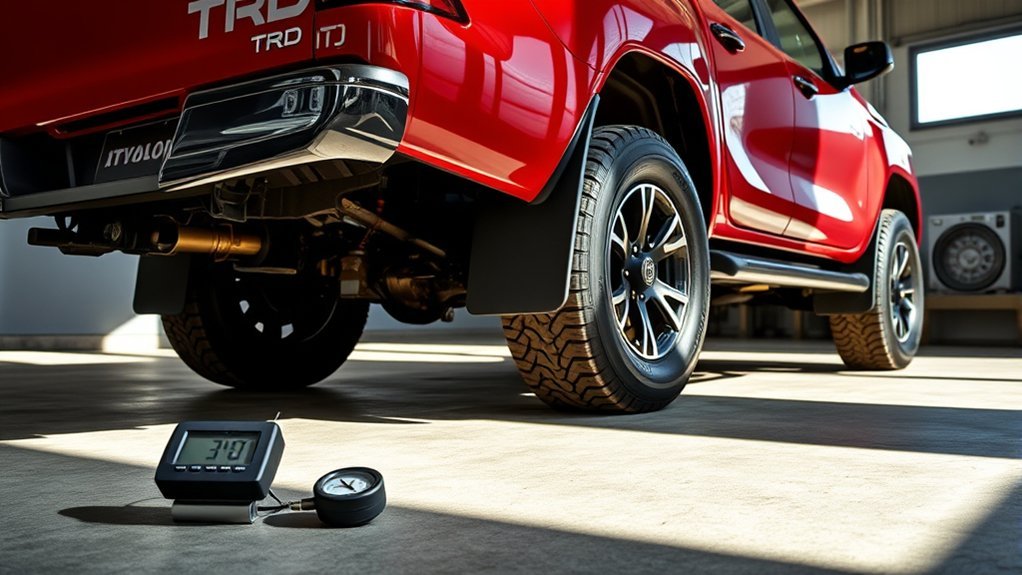
The correct Hilux tire pressure is the cold pressure printed on the vehicle’s label or specified in its owner’s manual. It is not one universal 29–35 psi range, and the front and rear values may change when the vehicle is loaded.
For example, the cited 2024 Japanese-market Toyota Hilux manual lists the following pressures for its documented configurations:
| Tire | Condition | Front | Rear |
|---|---|---|---|
| 265/65R17 112S | Unloaded | 200 kPa / 2.0 bar / 29 psi | 200 kPa / 2.0 bar / 29 psi |
| Loaded | 230 kPa / 2.3 bar / 33 psi | 250 kPa / 2.5 bar / 36 psi | |
| 265/60R18 110H | Unloaded | 210 kPa / 2.1 bar / 30 psi | 200 kPa / 2.0 bar / 29 psi |
| Loaded | 230 kPa / 2.3 bar / 33 psi | 250 kPa / 2.5 bar / 36 psi |
These figures are examples, not replacements for the label on your vehicle. A Hilux sold in another market or equipped with another tire construction may require different values.
The vehicle manufacturer’s cold-pressure specification controls. The number molded into the tire sidewall is not your everyday inflation target.
For an accurate reading:
- Check the tires before driving or after the vehicle has been parked for at least three hours.
- Use a reliable gauge and check all road tires plus the spare.
- Adjust the front and rear tires to the values required for the current load.
- Inspect for punctures, valve leakage, cracks, bulges, or repeated pressure loss.
- Recheck after a major temperature change, a long trip, or a change in payload.
How to Change Your Hilux Tires: A Step-by-Step Guide
You can replace a flat Hilux tire with the supplied spare when the vehicle is in a firm, level, safe location and the correct tools are available. Roadside conditions can make the job dangerous, so call roadside assistance when traffic, soft ground, a slope, poor visibility, or physical limitations prevent a safe change.
At a Glance
| Time Required | About 20–30 minutes in safe conditions; longer for an inexperienced owner or difficult roadside location |
| Difficulty | Moderate; requires safely lifting a heavy vehicle |
| Tools Needed | Correct spare, Toyota-specified jack and handle, wheel-nut wrench, wheel chock, pressure gauge, and preferably a torque wrench |
| Cost | No purchase when using the supplied spare and tools; tire repair or replacement cost varies |
Required Tools and Equipment
- The correct spare tire and wheel
- The vehicle’s supplied jack and jack handle
- Wheel-nut wrench
- Wheel chock or a strong purpose-made substitute
- Tire-pressure gauge
- Torque wrench for final tightening
- Gloves, reflective vest, and warning triangle where available
Inspect the spare periodically. A full-size spare may need a different pressure from the road tires, and a temporary spare can have strict speed and distance limits.
Safety Precautions to Follow
Warning: Never place any part of your body beneath a vehicle supported only by its emergency jack. Use only the designated lifting point, keep passengers away from traffic, and stop immediately if the jack tilts, sinks, or becomes unstable.
Move the Hilux onto firm, level ground as far from traffic as possible. Apply the parking brake, select Park on an automatic or an appropriate gear on a manual, stop the engine, and activate the hazard lights. Chock the wheel diagonally opposite the flat tire.
Step-by-Step Process
- Secure the area: Set out a warning triangle when safe and move passengers to a protected location.
- Prepare the vehicle: Apply the parking brake, select Park or gear, stop the engine, and switch on the hazard lights.
- Chock the opposite wheel: Prevent the vehicle from rolling in either direction.
- Remove the spare and tools: Confirm that the spare is usable and correctly inflated.
- Loosen the wheel nuts: With the tire still on the ground, loosen each nut approximately one turn. Do not remove them yet.
- Position the jack: Use the exact lifting point shown in the owner’s manual. Raise the vehicle only far enough for the flat tire to clear the ground.
- Remove the wheel: Remove the nuts, support the wheel with both hands, and pull it straight from the hub.
- Install the spare: Seat the spare against the hub and hand-tighten the nuts with the correct tapered or flat seat facing the wheel.
- Pre-tighten in a crossing pattern: Snug the nuts evenly rather than tightening one completely at a time.
- Lower and torque: Lower the vehicle until the tire contacts the ground, tighten the nuts in a crossing pattern, then lower fully and torque them to the specification for your exact model.
- Finish the check: Confirm the spare pressure, store the flat tire and tools securely, and arrange repair or replacement promptly.
One official 2024 Japanese Hilux manual lists 105 N·m for its documented wheel configurations. Do not assume that value applies to every Hilux wheel, aftermarket nut, or market. Verify the specification in your own manual and recheck the installation as directed by the wheel or vehicle manufacturer.
How to Upgrade Tires After Lifting Your Hilux
A suspension lift can create more static space above a tire, but it does not automatically solve clearance at the body mount, inner fender, control arms, sway bar, chassis, bumper, or mud flaps. It also does not change brake-caliper clearance inside the wheel.
Before purchasing a larger setup, complete this checklist:
- Record the baseline: Note the factory tire, wheel diameter, wheel width, offset, load rating, and current clearances.
- Calculate diameter change: Compare the proposed tire with the original size rather than relying only on the advertised “32-inch” or “33-inch” label.
- Verify the wheel: Confirm wheel width, offset, backspacing, hub fit, stud pattern, nut seat, and load rating.
- Check the brakes: Use a manufacturer brake template or physically test fit the wheel before mounting tires when possible.
- Test steering clearance: Turn from lock to lock while checking both sides of the vehicle.
- Test suspension travel: Check compression and articulation with realistic payload, not only while parked on level ground.
- Check the spare: Make sure a matching or operationally compatible spare fits its storage location.
- Check calibration: Determine whether the speedometer, odometer, transmission behavior, or driver-assistance systems need recalibration.
- Align the vehicle: Complete a professional wheel alignment after suspension or wheel changes.
- Verify legality: Check local modification, inspection, fender-coverage, tire-diameter, insurance, and registration rules.
Pro Tip: Test the exact wheel and tire model whenever possible. Two tires carrying the same printed size can differ in measured diameter, tread width, shoulder shape, and clearance.
A spacer is not an automatic solution to rubbing. Moving a wheel outward may improve inner clearance while creating new contact at the fender, bumper, mud flap, or body mount. It can also affect stud engagement, bearing load, scrub radius, steering feel, and legal compliance.
Avoid Common Fitment Problems With Wheel Sizes
A wheel can share the expected stud pattern and still be unsuitable. Do not assume that one bolt pattern, centre bore, or offset range guarantees fitment across every Hilux TRD, N80, or GR Sport configuration.
Verify all of these measurements:
- Stud pattern and stud size: The wheel must match the exact hub and studs.
- Centre bore and hub fit: The wheel must seat correctly without relying on incorrect or damaged locating components.
- Wheel width: The selected tire must be approved for that rim-width range.
- Offset and backspacing: These control inner suspension clearance and outer fender position.
- Spoke and barrel clearance: The wheel must clear the brake caliper and disc.
- Nut-seat design: Tapered, radius, and flat-seat nuts are not interchangeable.
- Wheel load rating: The wheel must support the Hilux’s axle load and intended payload.
- Tire-to-body clearance: Check at full steering lock and through suspension movement on both sides.
Some Hilux variants have been sold with 16-inch wheels, but that does not mean every 16-inch aftermarket wheel clears every N80 brake package. Toyota Australia documents larger 338 mm front brakes on its wide-track Hilux GR Sport, showing why brake clearance must be confirmed for the exact trim.
[Products Worth Considering]

ETENWOLF T300 is a calibrated digital tire pressure gauge for accurate readings from 3 to 200 PSI across light and heavy-duty vehicles. It includes thermal compensation for reliable performance in extreme cold or heat, with an auto shut-off to extend battery life and an LED for easier reading. The sturdy design supports rugged everyday use, making it ideal for pickups, RVs, and industrial applications.

This professional wheel and rim cleaning brush set lifts brake dust, grime, and dirt with soft, scratch-free microfiber and synthetic wool fibers. The rim brush bends up to 360 degrees for easy access to hard-to-reach areas around spokes, lips, and faces. Ideal for thorough cleaning of car, truck, motorcycle, bicycle, RV, and more wheel and tire surfaces.

The Topeak SmartGauge D2 delivers precise digital tire pressure readings for bikes, motorcycles, and sports equipment up to 250 psi (17 bar). Its rotating SmartHead works with both Presta and Schrader valves, so you can check pressure quickly without adapters. The LCD display makes it easy to read results in psi, bar, or kg/cm² with an included CR2032 battery for immediate use.
Signs It’s Time to Replace Your Tires
Replace or professionally inspect a tire when you notice any of the following:
- Tread has reached the molded wear indicators or the legal minimum in your country.
- Cuts, exposed cords, sidewall bulges, deep cracks, or impact damage appear.
- The tire repeatedly loses pressure.
- A puncture is in an area that cannot be repaired safely.
- Uneven wear suggests an alignment, pressure, suspension, or balance problem.
- The vehicle develops unexplained vibration, pulling, noise, or reduced wet-road traction.
- The tire is old enough to require inspection or replacement under the tire or vehicle manufacturer’s age guidance.
NHTSA uses 2/32 inch, approximately 1.6 mm, in its U.S. consumer guidance and recommends checking tread and pressure monthly. Your local law may define the measurement area differently, so do not treat one country’s rule as universal.
Tread depth is not the only replacement trigger. A tire with adequate tread can still be unsafe because of cracking, impact damage, separation, age, or structural deterioration. NHTSA notes that some vehicle and tire manufacturers recommend replacement after six to ten years regardless of remaining tread. Follow the instructions from your tire manufacturer and Toyota.
How to Use the Hilux Community for Tire Fitment Tips
Owner communities can help you identify combinations worth researching, but a forum post should not replace physical measurements or manufacturer specifications. Fitment reports become much more useful when the vehicles truly match.
When asking for advice, include:
- Model year and country
- Exact trim and model code
- Engine and drivetrain
- Factory brake package
- Current wheel diameter, width, and offset
- Current and proposed tire sizes
- Suspension lift height and components
- Body-mount, fender, bumper, or mud-flap modifications
- Normal payload and towing use
- Whether the reported setup was tested at full lock and full articulation
Use community reports to build a shortlist. Confirm the final setup with Toyota documentation, a qualified tire professional, and local modification rules before buying.
Frequently Asked Questions
Can you fit 33-inch tires on a Toyota Hilux?
Some Hilux builds can use a nominal 33-inch tire, but it is not a universal bolt-on fit. Sizes such as 285/75R16 and 285/70R17 are approximately 7% larger than 265/65R17. They may require suitable wheels, suspension and body clearance work, alignment, calibration, a compatible spare, and legal approval.
What size tires can I put on my Hilux?
Start with the size on the driver-side pressure label and in the owner’s manual. Toyota-documented examples include 265/65R17 and 265/60R18, but your exact size depends on year, market, trim, model code, wheel, brakes, and load requirement.
Will 265/70R17 tires fit a Hilux?
A 265/70R17 tire is approximately 3.4% larger in diameter than 265/65R17. It may fit some Hilux wheel and suspension combinations, but it can rub on others. Check wheel width and offset, brakes, full steering lock, suspension compression, payload, spare compatibility, and local rules.
Can you fit 16-inch rims on an N80 Hilux?
Some N80 variants have used 16-inch wheels, but that does not prove that every 16-inch wheel clears every N80 brake package. Confirm the exact trim, brake diameter, wheel barrel and spoke shape, width, offset, load rating, hub fit, and nut seat before purchasing.
What tire pressure should a Hilux TRD use?
Use the cold pressure printed on your vehicle’s label. Pressure may differ between the front and rear and between unloaded and loaded driving. Do not use the tire sidewall’s maximum pressure as the normal vehicle setting.
Do larger tires affect the Hilux speedometer?
Yes. A larger overall diameter travels farther per wheel revolution, so the vehicle can move faster than the speedometer indicates. Larger tires may also affect gearing, acceleration, transmission behavior, odometer readings, braking, and electronic safety systems.
Should all four Hilux tires match?
Use matching tires as required by the owner’s manual. The cited Toyota manual instructs owners not to mix tire construction or seasonal categories and calls for tires without significant differences in wear. Matching size, construction, tread type, and similar wear helps protect handling and the drivetrain.
Sources
- Toyota Hilux Owner’s Manual, Japan — documented tire sizes, loaded and unloaded cold pressures, tire warnings, emergency tire changing, and wheel-nut torque for the covered configuration
- Toyota Australia Hilux GR Sport specifications — 265/65R17 tire fitment and GR Sport brake information
- Toyota Australia Hilux range specifications — examples of different wheel and tire sizes used across Hilux variants
- Toyota Brazil Hilux specifications — market-specific examples including 265/65R17 and 265/60R18
- NHTSA TireWise — replacement-size, cold-pressure, tread, damage, rotation, and tire-aging guidance
Conclusion
The safest Toyota Hilux TRD tire choice starts with the exact vehicle rather than a generic list of popular sizes. Confirm the model code, factory tire, cold pressure, load rating, wheel specifications, brake clearance, and normal payload before ordering anything.
Factory-equivalent sizes usually create the fewest problems. A larger tire can provide useful clearance or off-road benefits, but only when the complete wheel-and-tire package clears the vehicle, supports its load, preserves safe handling, and complies with local rules. Measure first, verify the manual, and use a qualified tire or 4WD specialist when the setup moves beyond Toyota’s documented specifications.