
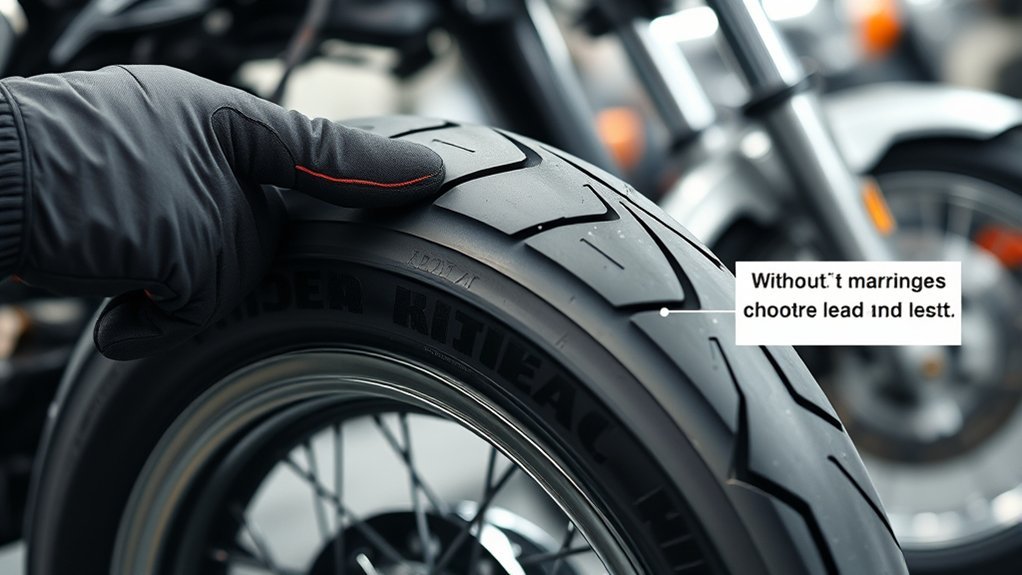
To read a motorcycle tire size, start with the approved sidewall size, such as 180/55ZR17, then verify M/C, construction, load index, speed symbol, TL or TT, DOT/TIN date code, sidewall pressure limit, tread wear indicators, front/rear position, rim-width fitment, and rotation arrow. Those markings tell you whether the tire fits your rim, supports your motorcycle’s load, and matches how the bike was designed to steer, brake, and lean.
Last updated: July 7, 2026. Reviewed against NHTSA, 49 CFR 574.5, Michelin, Dunlop, and Mitas tire-marking guidance.
Quick Answer
To read a motorcycle tire, decode the size first, such as 180/55ZR17. Then check M/C, construction, load index, speed symbol, TL or TT, DOT/TIN date code, maximum sidewall PSI, tread wear bars, front/rear position, rim-width fitment, and rotation arrow. Always match the tire to your owner’s manual or the tire maker’s fitment guide.
Key Takeaways
- Read the tire size first: width, aspect ratio, construction marking, and rim diameter must match your motorcycle’s approved fitment.
- Use the final service description, such as 73W or (73W), to confirm load index and speed symbol.
- M/C means motorcycle tire, TL means tubeless, and TT means tube type.
- The DOT/TIN date code shows the week and year of manufacture, which helps you judge tire age.
- The PSI on the sidewall is usually a maximum tire limit, not your everyday riding pressure.
- Replace tires when wear bars are level with the tread, when damage appears, or when age and manufacturer guidance say the tire is no longer safe.
At a Glance
| Time Required | 5 to 10 minutes per tire |
| Difficulty | Easy, if you compare each marking with your owner’s manual |
| Tools Needed | Flashlight, tire pressure gauge, owner’s manual, and a clear view of both sidewalls |
| Cost | Free, unless you need a gauge, inspection, mounting, or replacement tire |
What Do Motorcycle Tire Codes Mean?
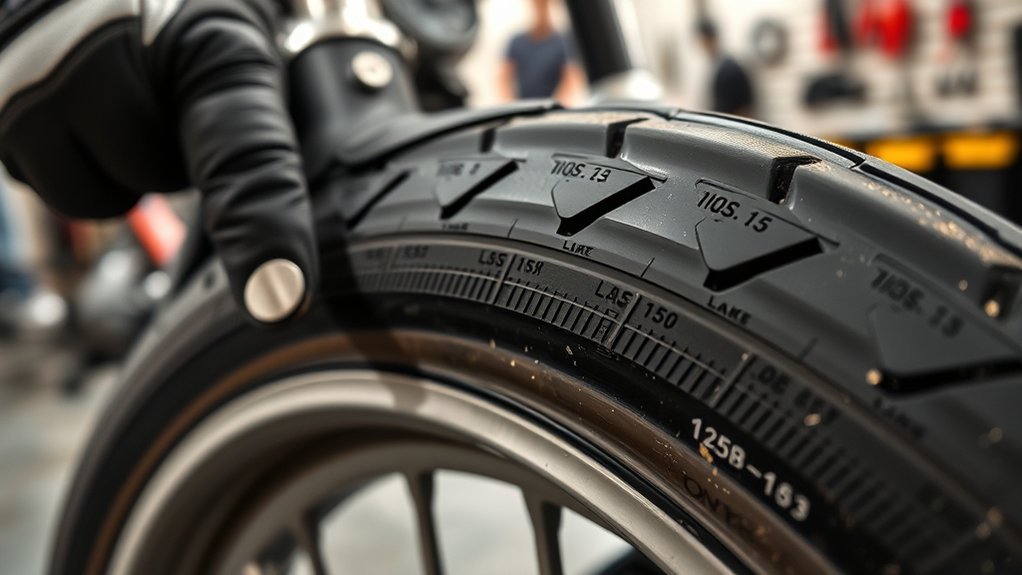
A motorcycle tire code gives you the tire’s fitment and safety limits in a compact sidewall marking. Most modern street tires use metric sizing, such as 180/55ZR17 M/C (73W). That code tells you the tire width, sidewall profile, construction type, rim diameter, motorcycle designation, load index, and speed symbol.
Do not read the tire code as a suggestion. The numbers must match what your motorcycle maker approves. A tire with the wrong size, load rating, speed symbol, rim fitment, construction, tube requirement, position marking, or rotation direction can change steering feel, reduce clearance, affect ABS or traction-control behavior, and create mounting problems.
For safety, use the sidewall code as the tire’s identity card, then compare it with your motorcycle owner’s manual, tire information label, service manual, or a tire manufacturer fitment guide. If those sources disagree, do not guess. Ask a qualified motorcycle tire technician before mounting the tire.
Warning: Never choose a motorcycle tire by appearance alone. A tire can look close to the right size but still have the wrong load index, speed symbol, tube requirement, rim compatibility, front/rear position, or rotation direction.
Motorcycle Tire Sidewall Marking Cheat Sheet
Use this quick table before you inspect the detailed code. Not every tire shows every marking in the same order, so check both sidewalls and rotate the wheel if part of the code is hard to see.
| Marking | What it tells you | What to do with it |
|---|---|---|
| 180/55ZR17 | Width, aspect ratio, construction, and rim diameter | Match your approved tire size exactly |
| M/C | Motorcycle tire designation | Confirm the tire is made for motorcycle use |
| 73W or (73W) | Load index and speed symbol | Meet or exceed the motorcycle maker’s requirement |
| TL or TT | Tubeless or tube-type construction | Match the tire, rim, tube, and valve setup |
| DOT/TIN | U.S. tire identification code and manufacture date | Use the final four digits to read week and year |
| Rotation arrow | Required rolling direction | Mount the tire so the arrow follows forward wheel rotation |
| TWI | Tread wear indicator location | Replace when tread is level with the wear bars |
Where Do You Find Your Motorcycle’s Approved Tire Size?
Before you decode a replacement tire, find the motorcycle’s approved front and rear tire specifications. Check the owner’s manual first. Then look for a tire information label, swingarm sticker, service manual, or manufacturer fitment chart. Some bikes use different front and rear sizes, and many do not allow a simple front-to-rear swap.
Match more than the first size number. Confirm the approved rim diameter, rim width range, construction type, load index, speed symbol, tube requirement, and recommended cold pressure. If you ride with a passenger or luggage, use the loaded-pressure guidance in the manual.
[Products Worth Considering]

ETENWOLF’s tire pressure gauge helps you quickly and accurately check tire PSI across cars, trucks, motorcycles, bikes, and more. It’s manually calibrated to ANSI B40.1 Grade A for reliable readings, includes a large glow dial for easy nighttime viewing, and features a 360-degree swivel chuck for use at any valve angle. The gauge also works consistently in extreme hot or cold weather.

Vigorder rubber cement glue delivers superior adhesion and cures quickly within about 30 seconds for seamless rubber bonding. Once cured, it helps provide a strong, durable, waterproof seal that holds up to vehicle weight, pressure, and heat. Suitable for cars, motorcycles, trucks, bicycles, and off-road tires, it’s designed for emergency patch and maintenance repairs.

Steelman white tire marking crayons provide high-contrast, semi-permanent marks for repairing and inspecting tires and equipment. They write on wet or dry, smooth or coarse surfaces including rubber, metal, glass, and wood, making them ideal for puncture location and damage outlining. The lead- and zinc-free crayons resist weather and fading yet wipe away when you no longer need the marks.
How Do You Read 180/55ZR17?
Start with the main tire size on the sidewall. A common rear sportbike size is 180/55ZR17. Read it from left to right:
| 180 | Nominal tire width in millimeters |
| 55 | Aspect ratio, meaning the sidewall height is 55% of the tire width |
| ZR | High-speed radial marking. Use the final service description for the actual load and speed check. |
| 17 | Rim diameter in inches |
The rim diameter must match exactly. A 17-inch tire belongs on a 17-inch rim, not a 16-inch or 18-inch rim. Width and aspect ratio also matter because they affect clearance, profile, lean behavior, speedometer accuracy, and electronic systems on some motorcycles.
You may also see a service description after the size, such as 180/55ZR17 M/C (73W). In that example, 73 is the load index and W is the speed symbol. A W without parentheses is commonly listed for 270 km/h or 168 mph, while (W) means the tire is rated above that category when the tire maker’s technical data confirms it.
What Do R, B, ZR, and Dash Construction Markings Mean?
The construction marking tells you how the tire carcass is built. R means radial. B usually means bias-belted. A dash in a size such as 130/90-16 commonly points to bias-ply construction rather than radial construction. Some older or specialty tires may use different formatting, so verify the tire maker’s data before replacing a non-metric or older tire.
ZR is a high-speed radial-style marking that appears inside the size code. Do not treat ZR alone as the final speed rating. Use the service description after the size, such as 73W or (73W), and compare it with the motorcycle manufacturer’s requirement.
Do not mix radial, bias-ply, or bias-belted tires unless the motorcycle manufacturer or tire maker specifically approves that combination for your model. Mixing constructions can change steering response, stability, warm-up behavior, and feedback at lean.
How Do Load Index and Speed Ratings Work?
After you confirm size and construction, check the load index and speed rating. These markings usually appear after the size code, such as 73W, (73W), or 67H. The number tells you the maximum load the tire can carry when used correctly. The letter tells you the certified speed category under the tire maker’s test conditions.
For example, load index 73 equals 365 kg or 805 lb. Load index 72 equals 355 kg or 783 lb. A W speed symbol is commonly listed as 270 km/h or 168 mph, while (W) indicates above that category when the tire maker specifies it. Those numbers do not mean you should ride at that speed. They mean the tire is rated for that category only when the tire is properly fitted, inflated, loaded, maintained, and used within its intended service.
| Example marking | What it means | What to verify |
|---|---|---|
| 67H | Load index 67 with H speed symbol | Matches your motorcycle’s manual and tire position |
| 72W | Load index 72 with W speed symbol | Enough capacity for bike, rider, passenger, and luggage |
| (73W) | High-speed service description with load index 73 | Tire maker’s technical data and bike approval |
Choose a load index and speed symbol that meet or exceed the motorcycle manufacturer’s requirement. Do not downgrade a tire because it is cheaper or easier to find. If you ride with a passenger, luggage, hard cases, or touring gear, the load rating becomes even more important.
What Are Metric, Inch, and Alpha Motorcycle Tire Codes?
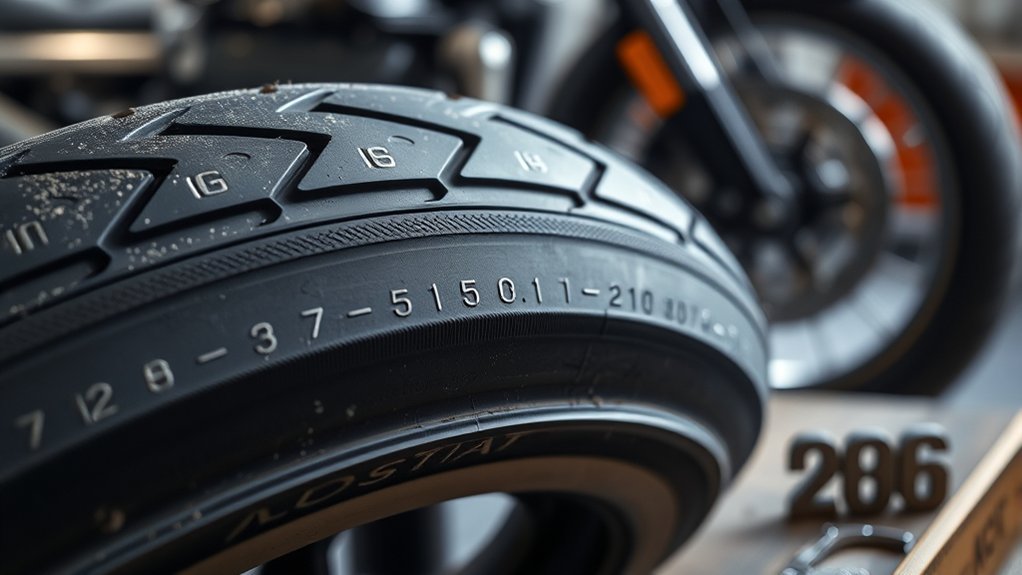
You may see three common motorcycle tire code formats: metric, inch, and alpha. Metric sizing is common on modern street bikes. Inch sizing appears on some older, classic, cruiser, scooter, and off-road applications. Alpha sizing uses letters for part of the size code and still needs a manual or conversion chart before replacement.
Metric Tire Codes
Metric tire codes are the easiest to decode because the width is shown in millimeters. A marking such as 130/90-16 M/C 67H means the tire is 130 mm wide, has a 90% aspect ratio, fits a 16-inch rim, is made for motorcycles, and carries a 67H service description.
| 130 | Tire width in millimeters |
| 90 | Aspect ratio |
| 16 | Rim diameter in inches |
| M/C | Motorcycle tire designation |
| 67H | Load index and speed symbol |
Inch Tire Codes
Inch tire codes use inch-based width and rim measurements. A marking like 3.00-16 means the tire has an inch-based section width and fits a 16-inch rim. Some inch-code tires also show a speed symbol or ply-rating style marking, such as 4PR.
Do not convert inch sizes by guesswork. Inch-code tires may not match a modern metric size exactly, and rim width still matters. Use your manual, the tire maker’s application data, or a motorcycle tire professional when replacing older inch-size tires.
Alpha Tire Codes
Alpha tire codes use letters as part of the size. A common example is MT90B16. In that style, M identifies motorcycle use, the next letter helps identify width, 90 is the aspect ratio, B indicates bias-belted construction, and 16 is the rim diameter.
| Alpha example | Meaning |
|---|---|
| M | Motorcycle tire |
| T | Alpha width code, not a millimeter width |
| 90 | Aspect ratio |
| B | Bias-belted construction |
| 16 | Rim diameter in inches |
What Do M/C, TL, and TT Mean?
M/C means the tire is made for motorcycle use. That matters because motorcycle tires carry different shape, casing, bead, and handling requirements than car tires. Do not mount a non-motorcycle tire on a motorcycle unless the motorcycle and tire manufacturer specifically approve that application.
TL means tubeless. A tubeless tire is designed to hold air without an inner tube when mounted on a compatible tubeless rim. TT means tube type. A tube-type tire needs an inner tube to hold air.
Tube and tubeless markings also depend on the wheel. Many spoked motorcycle wheels require tubes unless they are designed and sealed for tubeless tires. Some tubeless tires may be used with tubes in certain approved applications, but you should confirm that with the tire maker and wheel maker before mounting.
Note: TL and TT are not styling choices. They affect the tire, rim, valve stem, mounting method, puncture behavior, and repair options.
How Do Front, Rear, Rim Fitment, and Rotation Markings Work?
Some motorcycle tires are marked for front, rear, or a specific direction. A front tire handles heavy braking and steering loads. A rear tire handles drive force, acceleration, and different wear forces. Do not move a tire to the other position unless the tire maker clearly approves that use.
Rim diameter must match, but rim width also matters. A tire mounted on a rim that is too narrow or too wide can change the tread profile, bead seating, sidewall shape, and contact patch. That can make the motorcycle feel nervous, slow to turn, or unstable at lean.
Before mounting, compare the tire size with the wheel size and the motorcycle’s approved fitment data. After mounting, confirm the rotation arrow, valve stem, bead seating, balance weights, and tire pressure before the first ride.
How Do You Read the DOT Date Code?
The DOT date code helps you confirm when a tire was made. In the United States, the tire identification number, or TIN, includes a final four-digit date code. The first two digits identify the manufacturing week, and the last two digits identify the year, as described in 49 CFR 574.5.
For example, 2910 means the tire was made in the 29th week of 2010. 0326 means the tire was made in the third week of 2026. If you cannot find the full DOT/TIN on one sidewall, check the other side of the tire because the full code may not appear on both sides.
Tire age matters because rubber and internal materials change over time. NHTSA TireWise notes that some vehicle and tire manufacturers recommend replacing tires that are six to 10 years old, regardless of treadwear. For motorcycles, follow the tire maker’s age guidance and inspect more often if the bike sits unused, stays outdoors, or runs in hot climates.
How Should You Read PSI and Directional Markings?
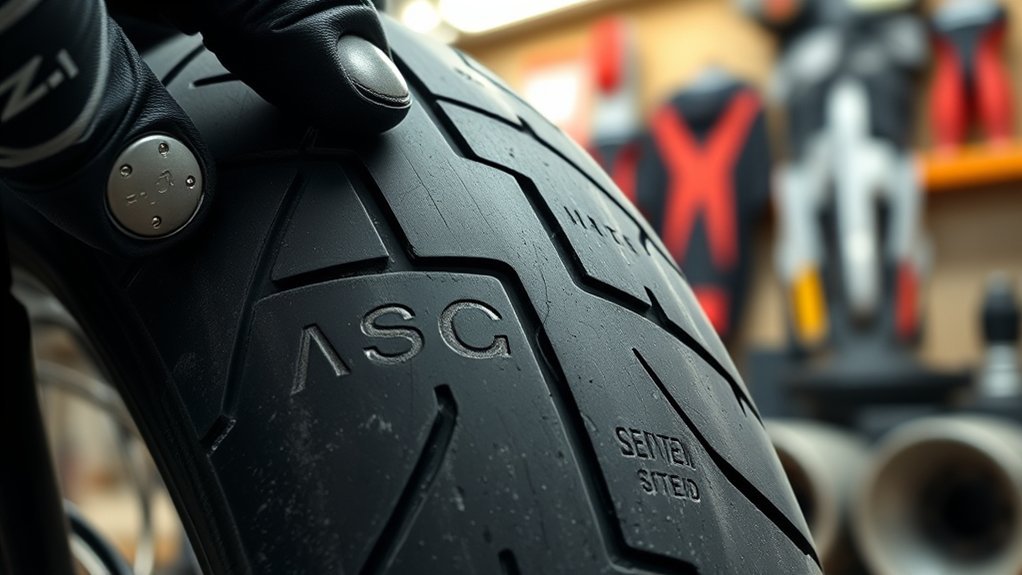
The PSI number molded on the sidewall is usually the tire’s maximum cold inflation pressure. It is not automatically the pressure you should use for daily riding. Use the motorcycle manufacturer’s recommended cold tire pressure from the owner’s manual, tire information label, or swingarm sticker. NHTSA also warns that the correct pressure is the vehicle manufacturer’s listed pressure, not the number printed on the tire itself.
PSI Versus Recommended Pressure
Motorcycle tire pressure affects grip, ride quality, braking, heat buildup, tread wear, and stability. Check pressure when the tire is cold, before a ride or after the bike has been parked long enough for the tire to cool. If you carry luggage or a passenger, follow the loaded-pressure guidance in your manual.
Underinflation can create excess heat and sidewall flex. Overinflation can reduce the contact patch and accelerate center wear. Both conditions can make the motorcycle feel unstable. A small pressure gauge is inexpensive, and it gives you a better answer than judging the tire by sight.
Directional Arrow Alignment
Many motorcycle tires have a directional arrow on the sidewall. That arrow must point in the direction the tire rotates when the motorcycle moves forward. Direction matters because the tread pattern and casing are designed to handle braking, acceleration, water evacuation, and load in a specific direction.
If a directional tire is mounted backward, wet grip, braking feel, and wear may suffer. Before the wheel goes back on the bike, check the sidewall arrow against the wheel’s forward rotation. This quick check can catch a costly mounting mistake.
How Do Tread Wear Markers and Tire Age Affect Replacement?
Tread wear indicators, often marked as TWI, are small raised bars inside the tread grooves. When the surrounding tread wears level with those bars, the tire has reached its wear indicator and should be replaced. NHTSA says tires are not safe and should be replaced when tread is worn down to 2/32 inch, and it also points to built-in treadwear indicators as a replacement signal.
Motorcycle tire replacement can depend on the tire type, local law, riding conditions, and manufacturer guidance, so do not rely on one number alone. Replace the tire sooner if you see cracks, cuts, exposed cords, bulges, repeated air loss, puncture damage outside the repairable area, or uneven wear across the profile.
- Measure tread across the whole profile, not only the center strip.
- Check both front and rear tires because they wear differently.
- Look for cupping, flat spots, cracks, cuts, dry rot, or sidewall bulges.
- Check the DOT date code before buying a new tire or installing an older tire.
- Inspect tires before long rides, after hard impacts, and after storage.
A motorcycle tire can still have visible tread and still be unsafe if it is old, cracked, damaged, underinflated, overloaded, mounted backward, or mismatched to the motorcycle.
How Do You Choose Tires That Fit Your Bike?
Choosing the right motorcycle tire starts with matching every important sidewall marking to your motorcycle’s requirements. Check the approved front and rear sizes, rim diameter, rim-width range, construction type, load index, speed symbol, tube requirement, and pressure guidance.
Do not assume the front and rear tires use the same size or construction. Many motorcycles use different front and rear sizes, and some models require a specific radial or bias-ply setup. Mixing tire constructions, profiles, brands, or wear levels can change handling. Follow the bike maker’s guidance unless a tire manufacturer has a specific approved fitment for your motorcycle.
Pro Tip: When replacing tires, take a clear photo of the old tire’s full sidewall code before ordering. Then compare that photo with your owner’s manual and the new tire listing before you buy.
[Products Worth Considering]

This 61-piece tire repair screw kit helps you fix punctures quickly by aligning the screw plugs and twisting clockwise, finishing the repair in seconds. The self-sealing plugs create a reliable seal for many roadside situations without needing a jack, wrench, or glue. It includes two plug sizes and a screwdriver in a portable case, making it a convenient option for cars, motorcycles, trucks, bikes, ATVs, and tractors.

This Hycline 2-pack mountain bike tire set delivers durable, puncture-resistant performance with a high-grip, aggressive tread designed for traction on hard surfaces and confident handling through mud and soil. Includes matching inner tubes and tire levers for easier everyday maintenance and quicker installation after folding storage. Built for a range of riding conditions with reinforced rubber and nylon cord for wear-resistant reliability.

Replace worn wheelbarrow, mower, or hand truck inner tubes with the TICONN 4.80/4.00-8 tube designed for 8-inch rims. Built from 100% natural rubber, it helps improve durability, impact absorption, and air retention while supporting self-sealing leak protection. The TR-13 straight valve stem makes it a straightforward fit for common yard equipment wheels.
Should You Buy New Old Stock or Used Motorcycle Tires?
A tire can be unused and still be old. Before you buy, check the DOT/TIN date code, inspect both sidewalls, and confirm the seller stored the tire away from heat, sunlight, ozone, and chemical exposure. Be cautious with “new old stock” if the date code is near or beyond the tire maker’s age guidance.
Used motorcycle tires need even more care. Reject any tire with plugs in unsafe areas, sidewall repairs, exposed cords, cracks, bulges, bead damage, uneven wear, punctures near the shoulder, or an unknown service history. A motorcycle has only two contact patches, so a questionable tire is not worth the risk.
If you buy tires online, compare the listing’s size, service description, tube marking, and position marking with your manual before installation. After delivery, inspect the actual tire, not just the product listing.
[Products Worth Considering]

ETENWOLF’s calibrated digital tire pressure gauges deliver accurate readings across a wide pressure range, from below 12 PSI to above 140 PSI. The built-in thermal compensation helps maintain performance in extreme cold and hot conditions, while the LED light improves visibility for quick checks. Includes replaceable AAA batteries for long-lasting use and convenience for everyday tire monitoring.

The Topeak SmartGauge D2 delivers precise digital tire pressure readings for bikes, motorcycles, and sports equipment up to 250 psi (17 bar). Its rotating SmartHead works with both Presta and Schrader valves, so you can check pressure quickly without adapters. The LCD display makes it easy to read results in psi, bar, or kg/cm² with an included CR2032 battery for immediate use.

This Dr.Roc tire valve stem puller tools set helps install or remove snap-in tubeless valve stems safely and efficiently. It includes ozone-resistant EPDM snap-in valve stems, a valve stem installer, and a valve core remover for quick core removal or installation during tire service. Designed for reliable tubeless tire repair on motorcycles, ATVs, lawn equipment, cars, and trucks.
Motorcycle Tire Sidewall Checklist
Use this quick checklist when you inspect a tire at home, in a shop, or before ordering online.
- Find the main tire size. Confirm width, aspect ratio, construction marking, and rim diameter.
- Check M/C. Make sure the tire is intended for motorcycle use.
- Confirm the service description. Match load index and speed symbol to your manual.
- Check front or rear position. Some motorcycle tires are marked for front, rear, or both positions.
- Read TL or TT. Match the tire to the wheel’s tube or tubeless setup.
- Find the DOT/TIN date code. Check the week and year of manufacture.
- Check pressure guidance. Use the motorcycle maker’s recommended pressure, not the sidewall maximum.
- Find the rotation arrow. Confirm the tire will roll in the correct direction.
- Inspect tread and sidewalls. Look for wear bars, cracks, cuts, bulges, punctures, and uneven wear.
- Check rim compatibility. Confirm the rim width and wheel type work with the tire.
- Check for recalls. Use the tire brand, size, and DOT/TIN if you suspect a safety issue or buy older stock.
What Should You Check After Mounting a Tire?
After a tire is mounted, check it before the first ride. Make sure the bead is seated evenly, the valve stem is secure, the wheel is balanced, the axle hardware is tightened correctly, and the rotation arrow points forward. Then set cold pressure to the motorcycle maker’s recommendation.
Ride gently at first after a tire change. New tires, freshly handled wheels, and recently adjusted pressures can feel different. If the motorcycle shakes, pulls, loses air, or feels unstable, stop riding and have the tire and wheel inspected.
Common Motorcycle Tire Marking Mistakes to Avoid
The most common motorcycle tire mistakes come from treating one sidewall marking as the whole answer. A tire can have the right width and still be wrong for the bike because the load index, speed symbol, rim width, construction, tube marking, position marking, or rotation direction does not match.
- Using the sidewall PSI as riding pressure: The sidewall number is a maximum limit, not your recommended cold pressure.
- Ignoring the final service description: The load index and speed symbol matter as much as the tire size.
- Mounting a directional tire backward: Always check the rotation arrow before reinstalling the wheel.
- Assuming TL and TT are interchangeable: Confirm tire, tube, rim, and valve compatibility first.
- Buying old “new” tires: Check the DOT date code before installation.
- Copying another rider’s setup: Their tire choice may not match your motorcycle, load, riding style, or rim.
- Ignoring front and rear markings: A tire approved for one position may not be safe in the other position.
How Do You Check Tire Recalls?
If a tire looks unusual, loses air repeatedly, or came from older inventory, check whether it has a recall. NHTSA’s recall search covers vehicles, tires, car seats, and other equipment. You can also register new tires with the manufacturer or retailer so recall notices can reach you.
The DOT/TIN helps identify the tire production group. Keep a photo of the code with your maintenance records, especially after installing new tires. NHTSA also advises owners to register vehicles, tires, car seats, and equipment and check recalls twice a year.
Frequently Asked Questions
How do you decode motorcycle tire sizes?
Read the size from left to right. In 180/55ZR17, 180 is the width in millimeters, 55 is the aspect ratio, ZR marks a high-speed radial tire, and 17 is the rim diameter in inches. Then check M/C, the load index, speed symbol, TL or TT, DOT/TIN date code, PSI guidance, position marking, tread wear indicators, and rotation arrow.
How do you read tire size and load index?
Use the main size code for physical fitment, then use the service description for load and speed. For example, in 180/55ZR17 M/C (73W), 73 is the load index and W is the speed symbol. Compare both with your motorcycle owner’s manual before buying or mounting the tire.
What is the 3 tire rule?
The “3 tire rule” is not a standard motorcycle tire-sidewall rule. For motorcycles, a better rule is to check three things before mounting: size fitment, service rating, and condition. That means the tire must match the approved size, meet the required load and speed rating, and pass inspection for age, wear, damage, and correct mounting direction.
What does 72W mean on a motorcycle tire?
72W is the service description. The number 72 is the load index, which equals 355 kg or 783 lb. The W is the speed symbol, commonly listed as 270 km/h or 168 mph. You still need the correct size, pressure, condition, motorcycle approval, and tire maker’s guidance for safe use.
What does ZR mean on a motorcycle tire?
ZR is a high-speed radial-style marking inside the tire size. It does not replace the final service description. Always check the load index and speed symbol after the size, such as 73W or (73W), and compare that rating with your motorcycle’s approved tire specification.
Is the PSI on a motorcycle tire the pressure I should use?
No. The PSI molded on the tire sidewall is usually the maximum cold inflation pressure for the tire. Use the motorcycle manufacturer’s recommended cold pressure from the owner’s manual, tire information label, or swingarm sticker. Adjust for passenger or luggage loads only as the manual directs.
Can you put a tube in a tubeless motorcycle tire?
Sometimes, but only when the tire maker, wheel maker, and motorcycle application allow it. TL means tubeless, and TT means tube type. A tube, rim strip, valve, bead seat, and wheel design all need to work together, so confirm compatibility before mounting.
How old is too old for a motorcycle tire?
There is no single age limit that fits every tire, storage condition, and motorcycle. NHTSA notes that some vehicle and tire manufacturers recommend replacement at six to 10 years regardless of treadwear. For motorcycles, inspect regularly and follow the tire maker’s and motorcycle maker’s guidance.
Can you use a car tire on a motorcycle?
Do not use a car tire on a motorcycle unless the motorcycle manufacturer and tire manufacturer specifically approve that application. Motorcycle tires have different profiles, sidewall behavior, bead design, lean-angle demands, and handling requirements than car tires.
Conclusion
Reading a motorcycle tire is easier when you follow a fixed order. Start with the size, then verify M/C, construction, load index, speed symbol, TL or TT, DOT/TIN date code, PSI guidance, tread wear indicators, front/rear position, rim fitment, and rotation direction. Each marking answers a different safety question.
The most important step is not decoding the tire in isolation. Match the code to your motorcycle’s approved specifications. When the tire size, service description, age, pressure, condition, position, and mounting direction all check out, you can buy or mount the tire with far more confidence.
Sources
- NHTSA TireWise — supports tire pressure, treadwear indicators, tire aging, tire maintenance, and general tire-safety guidance.
- 49 CFR 574.5 Tire Identification Requirements — supports DOT/TIN structure and week/year manufacturing-code rules.
- NHTSA Recalls — supports tire recall search, recall alerts, and safety-defect checking.
- Michelin: How to Read Motorcycle Tyre Size — supports 180/55 ZR 17 M/C (73W) tire-size decoding.
- Michelin: Motorcycle Tyre Speed Rating and Load Rating — supports load-rating and W versus (W) speed-symbol guidance.
- Dunlop: How to Read a Motorcycle Tire Sidewall — supports sidewall-size, service-description, and motorcycle tire marking explanations.
- Mitas: Tire Designations — supports tire sidewall designations, TWI, DOT, tube/tubeless, and rotation marking checks.

