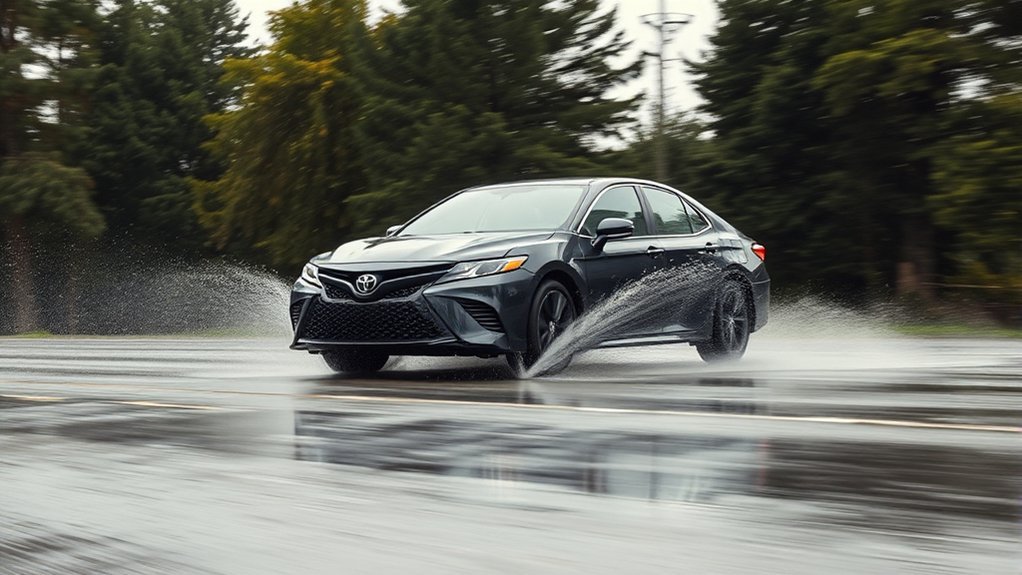
A Toyota Camry can aquaplane when its tires cannot move water away quickly enough to maintain contact with the road. You may notice unusually light steering, reduced braking response, wheelspin, or a floating sensation. Your safest defenses are suitable speed, good tire condition, correct inflation, extra following distance, and smooth control inputs.
Quick Answer
To reduce Toyota Camry aquaplaning risk, slow down before reaching pooled water, switch off cruise control, increase your following distance, and maintain correctly inflated tires with healthy tread. If the car starts to float, ease off the accelerator, hold the steering wheel steady, avoid hard braking, and wait for traction to return.
Key Takeaways
- Aquaplaning can occur at moderate speeds when water, worn tread, or incorrect tire pressure prevents the tires from maintaining road contact.
- A tread depth of 2/32 inch is a replacement threshold, not an ideal target for frequent wet-weather driving.
- Use the cold-tire pressure on your Camry’s driver-door placard, not the maximum pressure molded into the tire sidewall.
- If traction disappears, ease off the accelerator and avoid sudden steering, acceleration, or braking.
- AWD, ABS, traction control, and new tires may help in some situations, but none can eliminate aquaplaning.
Safety note: This guide provides general wet-weather driving information. Tire specifications, pressures, rotation schedules, and vehicle systems vary by Camry year and trim. Follow your driver-door placard, owner’s manual, local laws, and qualified tire or vehicle professionals.
What Is Aquaplaning and How Does It Affect Your Toyota Camry?
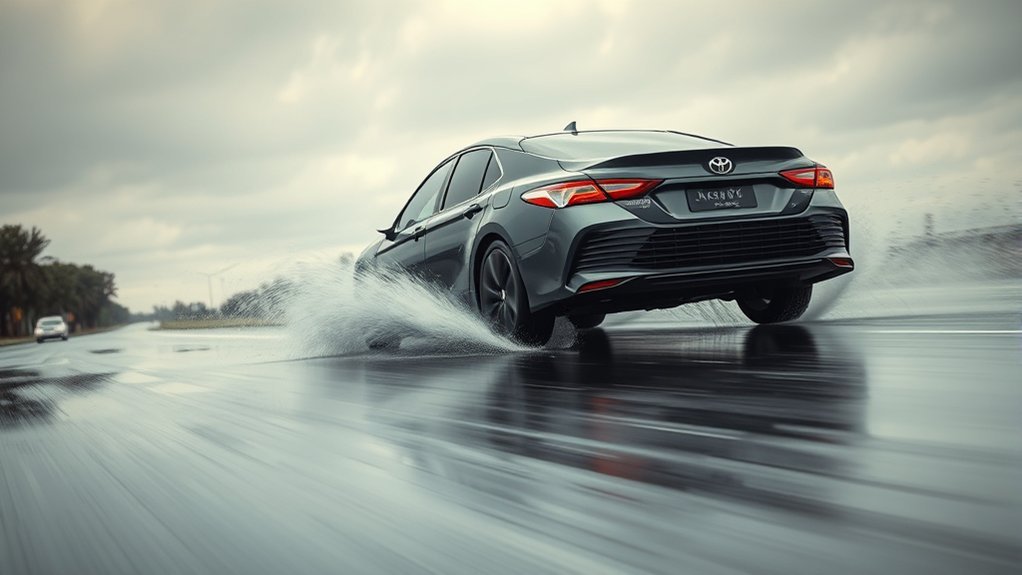
Aquaplaning, also called hydroplaning, happens when a layer of water separates one or more tires from the road. The tire may ride partly or completely on that water instead of gripping the pavement.
When this happens, your Camry may not respond normally to steering, braking, or acceleration. Electronic systems such as anti-lock brakes, traction control, and stability control can assist only when the tires have enough contact with the road to generate usable grip.
Hydroplaning can be partial. You may feel only a brief change in steering weight or a small loss of traction. During more severe hydroplaning, the steering may feel unusually light, the engine speed may rise, and the vehicle may drift even though you have not intentionally changed direction.
Government driving guidance warns that hydroplaning can occur at speeds as low as approximately 35 mph under some conditions, particularly when tires are worn. That figure is not a universal cutoff. Water depth, tread design, tire pressure, pavement shape, speed, and rainfall intensity all affect when traction is lost.
Critical Factors That Raise Aquaplaning Risk
Your Camry is more likely to hydroplane when several risk factors occur together. A worn tire may still feel acceptable on dry pavement but struggle to clear water during heavy rain.
| Risk Factor | Why It Matters | Safer Response |
| Higher speed | The tire has less time to move water away from its contact patch. | Reduce speed before pooled water, curves, or lane changes. |
| Low tread depth | Shallow grooves cannot evacuate as much water as deeper, healthy tread. | Measure every tire and replace unsafe or damaged tires. |
| Incorrect pressure | Underinflation or overinflation can alter the contact patch and create uneven wear. | Set cold pressure to the driver-door placard specification. |
| Standing water | Deeper or fast-building water can overwhelm the tire’s drainage channels. | Avoid pooled water when you can do so safely. |
| Sudden inputs | Abrupt braking, steering, or acceleration can destabilize the car when grip is limited. | Use smooth, gradual control movements. |
Tire Condition and Tread Depth
Tread grooves move water away from the part of the tire touching the road. As those grooves wear down, the tire’s ability to resist hydroplaning and stop on wet pavement decreases.
The National Highway Traffic Safety Administration says tires should be replaced when their tread reaches 2/32 inch. Treat that figure as a replacement threshold rather than a wet-weather performance target.
In AAA wet-pavement testing, passenger-car tires worn to 4/32 inch needed an average of 87 additional feet to stop from 60 mph and showed a 33% reduction in handling ability compared with new tires.
The AAA test does not mean every tire will produce the same distance. Tire model, temperature, pavement, water, vehicle condition, and test method affect the result. It does show why a tire can remain legal while providing much less wet-weather performance than it did when new.
Measure tread in several grooves across each tire. Uneven results may point to alignment, inflation, balance, or suspension problems. Replace tires that show exposed cords, bulges, deep cracks, separated tread, or other structural damage regardless of measured tread depth.
Vehicle Speed, Water, and Load
Higher speed increases risk because the tire has less time to push water aside. However, no fixed speed guarantees that your Camry will or will not hydroplane. Heavy rain, worn tires, rutted pavement, and pooled water can cause traction loss at speeds that normally feel comfortable.
Vehicle weight alone does not make one car safe from hydroplaning. Added passengers or cargo change tire loading and braking distance, but tire condition, pressure, speed, road shape, and water remain critical.
All-wheel drive can help a Camry accelerate when some traction remains. It does not force water out of the tire grooves, shorten every wet stop, or prevent all four tires from hydroplaning.
Road Surface and Rainfall
Water often collects in wheel tracks, depressions, bridge approaches, poorly drained lanes, and low areas. Watch vehicles ahead for heavy spray because it can reveal deeper water before you reach it.
The beginning of rain after a dry period can be especially slippery as water mixes with oil and other residue on the pavement. Reduce speed early instead of waiting until the steering begins to feel light.
Essential Tire Maintenance for Preventing Aquaplaning
Good tire maintenance cannot remove every wet-road risk, but it gives your Camry a better chance of maintaining contact with the pavement.
- Check pressure when the tires are cold. Use the recommended pressure on the driver-door Tire and Loading Information label. Do not use the maximum pressure molded into the tire sidewall as your normal setting.
- Inspect all four tires monthly. Look for low tread, cuts, cracks, objects, bulges, and uneven wear.
- Measure more than one location. Check several grooves around each tire because one area may wear faster than another.
- Follow the correct rotation schedule. Use the maintenance guide for your Camry’s exact model year, drivetrain, wheel setup, and operating conditions.
- Correct alignment or suspension problems. A rotation cannot repair the cause of severe one-sided, cupped, or patchy wear.
- Replace unsuitable tires. Do not continue driving on tires that have reached their wear indicators or have structural damage.
Pro Tip: Check pressure before driving, ideally after the car has been parked for several hours. Driving heats the tires and raises the displayed pressure, which can lead you to release air from a correctly inflated tire.
You can find year-specific specifications and maintenance publications through the Toyota Owners manual library.
[Products Worth Considering]

Measure tire tread depth quickly and accurately with this LUMITECO dial gauge that reads in 1/32" increments up to 14/32". The color-coded green/yellow/red zones make it easy to judge tire wear and know when replacement is needed. A rugged, compact design with a protective pouch helps keep the gauge ready for use on cars, trucks, motorcycles, and more.

Monitor tire tread wear with a smart, color-coded depth gauge that shows clear condition ranges at a glance. The bar is range marked for fast, easy readings, helping you maintain safer traction and performance. Each gauge is portable with a pocket clip, and the set includes 20 units for daily use and sharing.

The SAFELIFE dial tire tread depth gauge measures tread depth in 1/32 inch increments with clear, easy-to-read 2-inch dial face. Color zones using a traffic light system help you quickly judge whether tread is low, marginal, or ample for safer driving. Built with a durable zinc cast body and a metal detect probe for precise, comfortable use across cars, motorcycles, trucks, and buses.
Why Speed Matters on Wet Roads
Your tires must move water away continuously to maintain road contact. As speed rises, the amount of water they must clear each second also rises. Deep tread and a wet-capable design can delay hydroplaning, but they cannot make high-speed driving through standing water safe.
Some government guidance notes that hydroplaning can begin at approximately 35 mph when conditions are unfavorable. Do not treat 35 mph as a target or guaranteed boundary. A much lower speed may be necessary during heavy rain, poor visibility, worn pavement, sharp curves, or visible pooling.
Choose a speed that lets you see, steer, and stop within the available distance. Increase your following gap well beyond what you use in dry weather, and begin slowing before curves or water rather than braking sharply after entering them.
Best Practices for Driving Safely in Rainy Weather
Before Driving
- Check your tires, wiper blades, exterior lights, brakes, and windshield washer fluid.
- Clean the inside and outside of the windshield to reduce glare.
- Confirm that the front and rear defogging systems work.
- Plan extra travel time so you do not feel pressured to maintain a dry-road pace.
- Check for road closures or flooding during severe weather.
While Driving
- Switch off cruise control. Manual control lets you respond more directly when traction or visibility changes.
- Slow down smoothly. Avoid abrupt accelerator, brake, or steering inputs.
- Increase following distance. Wet pavement reduces available grip and can lengthen stopping distance.
- Use your headlights as required. They help other road users see your Camry.
- Avoid pooled water. Change lanes only when the path is clear and the movement can be completed smoothly.
- Stay out of another vehicle’s blind spray. Heavy spray can reduce visibility and hide deeper water.
- Keep both hands available for steering. Do not allow a phone or other distraction to delay your response.
When Visibility or Water Becomes Dangerous
If rain becomes so heavy that you cannot see lane markings, vehicles, or hazards far enough ahead to stop safely, leave the roadway at a safe location. Avoid stopping in a travel lane or under a location where other drivers may not expect a stationary vehicle.
Warning: Never drive into a flooded roadway or moving water when you cannot verify its depth and the condition of the pavement underneath. Floodwater can move a vehicle, hide a washed-out road, damage electrical components, or stall the engine. Turn around and use another route.
The NHTSA severe-weather guide recommends slower driving, greater following distance, and turning around instead of entering flooded roads.
What to Do When Your Toyota Camry Aquaplanes
Your first goal is to avoid adding another sudden force while the tires have limited contact with the road.
- Stay calm and look where you want to go. Keep both hands on the steering wheel and continue scanning for vehicles, barriers, and open space.
- Ease off the accelerator. Lift your foot smoothly instead of snapping it off or pressing harder.
- Hold the steering wheel steady. Keep the wheels generally pointed along your intended path. Make only small, smooth corrections.
- Avoid hard braking. Sudden braking may destabilize the vehicle while traction is limited. If braking becomes necessary, use gentle, controlled pressure. Do not pump the brake pedal in an ABS-equipped Camry.
- Wait for traction to return. Steering weight and response should begin to feel normal again as speed falls and the tires reconnect with the road.
- Continue at a lower speed. Increase your following distance and avoid the water that caused the event.
If the rear of the car begins to slide after traction changes, look toward your intended path and steer gently in the direction needed to realign the vehicle. Avoid a large countersteering movement because overcorrection can send the car into a second skid.
Official guidance is not identical about light braking during hydroplaning. The safest common principle is to avoid sudden braking and allow the car to slow gradually. The California Driver’s Handbook advises slowing gradually and avoiding braking while the vehicle is actively hydroplaning.
What to Check Afterward
Once you are safely parked, inspect the tires if the event involved a pothole, curb strike, hard impact, or unusual vibration. Check for a pressure warning, visible tire damage, bent wheels, steering pull, or a steering wheel that is no longer centered.
Have the vehicle inspected if you notice vibration, pulling, unusual noise, damaged tread, a bulge, or repeated loss of traction in conditions other vehicles handle normally.
Choosing Tires for Your Toyota Camry in Wet Conditions
Choose tires that match your Camry’s specified size, load rating, speed rating, wheel size, and operating conditions. The correct specifications appear on the driver-door label and in the owner’s manual for your model year.
- Confirm the exact fitment. Camry tire sizes differ by year, trim, wheel package, and market.
- Review credible wet-braking tests. Do not rely only on a product name containing words such as “performance,” “touring,” or “all-season.”
- Look for effective water channels. Circumferential grooves, lateral channels, and sipes can help move water, although the complete tire design determines performance.
- Consider your climate. A balanced all-season tire may suit mild conditions, while dedicated winter or summer products may be appropriate in more specialized climates.
- Check the UTQG traction grade when available. NHTSA grades AA, A, B, and C indicate straight-line wet-braking performance under a specified test. The grade does not measure every aspect of cornering or hydroplaning resistance.
- Do not ignore age or damage. A tire with usable-looking tread may still need professional evaluation if it is old, cracked, punctured, or repeatedly losing pressure.
When replacing fewer than four tires, follow the tire manufacturer’s placement guidance and consider the requirements of your drivetrain. Installing mismatched tires can affect handling, stability systems, and AWD operation on Camry models equipped with all-wheel drive.
[Products Worth Considering]

Accurately measure tire tread depth with a calibrated gauge marked from 0 to 1 inch in 1/32 inch increments. The color-coded bar helps you quickly identify tread condition ranges, supporting safe driving for trucks, motorcycles, automobiles, and passenger vehicles.

This 100-piece set of snap-in tubeless tire valve stems is designed for standard 0.453 in (11.5 mm) rim holes and helps maintain reliable, steady tire pressure. Made with ozone-resistant rubber and brass cores, the valves are built for durability and long-term use. Easy to install by hand, they support safe driving and are suitable for cars, light trucks, trailers, and more.

The Airmoto portable tire inflator quickly and accurately fills car, truck, SUV, motorcycle, and bicycle tires up to 120 PSI with auto shut-off when your target pressure is reached. Its large LCD, multi-unit pressure display, and digital gauge make it easy to dial in settings and verify readings, while the built-in LED flashlight helps in low light. The included polyurethane hard carrying case and storage mesh pocket keep the inflator and accessories protected and organized.
Don’t Fall for These Aquaplaning Myths
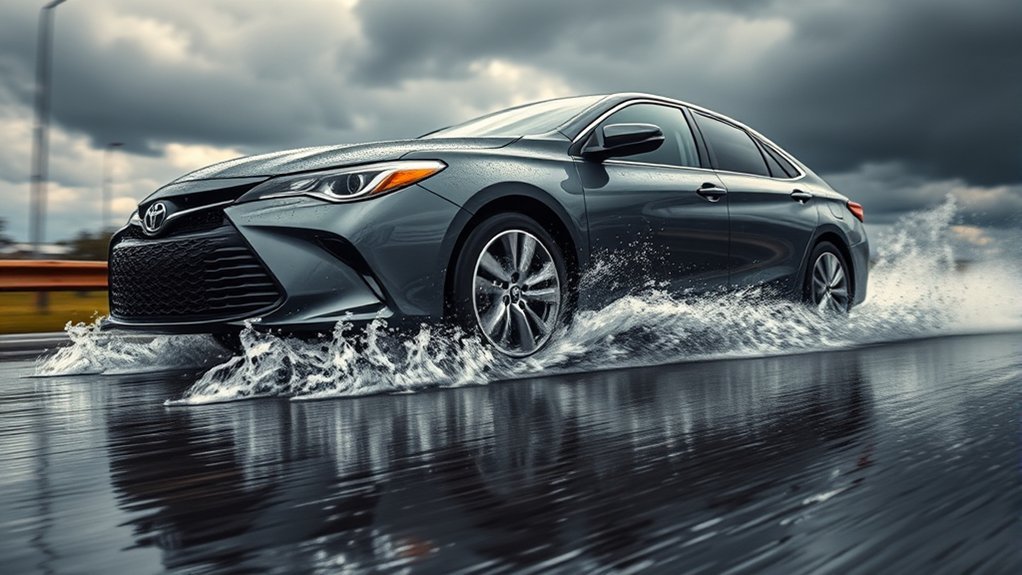
Myth: Aquaplaning Only Happens at Highway Speed
Hydroplaning can occur at moderate speeds when water is deep enough or the tires are worn, damaged, or incorrectly inflated. Speed is important, but it is only one part of the risk.
Myth: New Tires Make Aquaplaning Impossible
New tires usually clear water better than worn tires of the same design. They can still lose contact with the road when speed, water depth, pressure, or driving input exceeds their capability.
Myth: AWD Prevents Hydroplaning
AWD distributes propulsion among more wheels. It does not prevent a water layer from separating the tires from the pavement and does not guarantee shorter braking distances.
Myth: ABS Can Stop a Hydroplaning Car Immediately
ABS helps prevent wheel lock when the tires have braking traction. It cannot create normal braking grip while a tire is riding on water.
Myth: Wider Tires Are Always Better in Rain
Width alone does not determine wet performance. Tread pattern, compound, pressure, load, water depth, and the tire’s complete design matter.
Myth: Light Rain Is Always Safe
The start of rain after a dry period may mix water with residue on the road, producing a slick surface before heavier rainfall washes some of it away.
Signs Your Tires May Be Prone to Aquaplaning
- The tread is close to the wear bars. Tires at 2/32 inch have reached NHTSA’s replacement threshold.
- Tread measures near 4/32 inch and you drive frequently in heavy rain. Wet performance may already be substantially lower than when the tire was new.
- Wear is uneven. One edge, the center, or scattered patches may have less water-clearing ability than the rest of the tire.
- The pressure frequently changes. A leak, damaged wheel, valve problem, or temperature-related pressure change needs attention.
- You see cracks, cuts, bulges, or exposed material. These are reasons for prompt professional inspection.
- The car pulls or vibrates. Alignment, balance, wheel, suspension, or tire problems may be affecting road contact.
- Steering repeatedly feels light in ordinary rain. Reduce speed and have the tires and vehicle checked instead of treating the sensation as normal.
[Products Worth Considering]
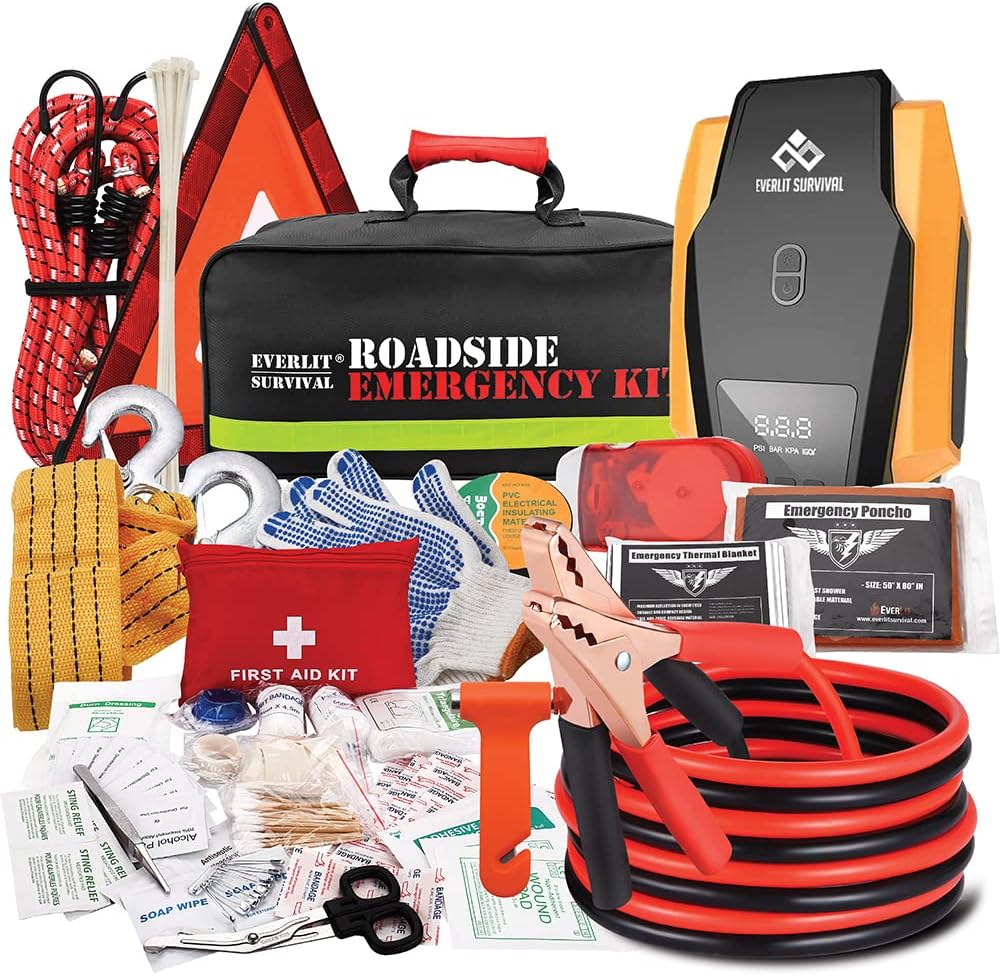
The Everlit Road Guardian emergency kit is designed for roadside breakdowns, combining essential safety gear and roadside tools in one compact bag. It includes a digital 12V auto tire inflator with preset and auto shutoff, plus 12-foot 8-gauge jumper cables to get you moving again. You also get a full 108-piece first aid kit, reflective warning tools, safety gloves, and emergency convenience items for safer travel.

Upgrade your Toyota tire setup with these corrosion-resistant, leak-proof valve stem caps designed to help protect the valve core from water, snow, and road grime. The caps feature a snug rubber seal and durable copper alloy construction to resist rust and oxidation while maintaining stable tire pressure. Ideal for replacing worn original caps and keeping your wheels looking clean and stylish.

Steelman white tire marking crayons provide high-contrast, semi-permanent marks for repairing and inspecting tires and equipment. They write on wet or dry, smooth or coarse surfaces including rubber, metal, glass, and wood, making them ideal for puncture location and damage outlining. The lead- and zinc-free crayons resist weather and fading yet wipe away when you no longer need the marks.
Frequently Asked Questions
How can I prevent my Toyota Camry from aquaplaning?
Reduce speed before pooled water, keep cruise control off in wet conditions, increase following distance, and use smooth steering and braking. Check tire pressure, tread, damage, alignment, and rotation according to your Camry’s placard and maintenance guide.
Can a Camry hydroplane at 35 mph?
Yes. Government driving guidance states that hydroplaning can occur at approximately 35 mph under some conditions, especially with worn tires. It can also happen at a lower or higher speed depending on water, tread, pressure, pavement, and rainfall.
Should I brake if my Toyota Camry starts hydroplaning?
Do not slam on the brakes. Ease off the accelerator, hold the steering wheel steady, and allow speed to fall gradually. If braking is necessary, use gentle, controlled pressure as traction begins returning. Do not pump the brakes in an ABS-equipped Camry.
Is 2/32 inch of tread enough for driving in heavy rain?
Two-thirty-seconds of an inch is a replacement threshold, not an ideal wet-weather goal. AAA testing found major wet-braking and handling losses at 4/32 inch. Consider your rainfall, driving speed, tire design, and professional advice before waiting for the wear bars.
Does AWD stop a Toyota Camry from aquaplaning?
No. AWD can improve acceleration when traction is available, but it cannot keep a tire connected to the pavement when water lifts it from the road. AWD Camry drivers still need suitable speed, healthy tires, correct pressure, and extra stopping distance.
Why should I switch off cruise control in rain?
Manual speed control helps you react directly when water depth, visibility, or traction changes. Switching cruise control off also reduces the chance of an automatic throttle response occurring when you need to slow smoothly.
What does aquaplaning feel like?
The steering may suddenly feel light, the car may drift, the engine speed may rise, or braking may feel less effective. Even a brief floating sensation is a warning to ease off the accelerator and avoid abrupt control movements.
Conclusion
Aquaplaning is not limited to one Camry model, tire type, water depth, or speed. It becomes more likely when higher speed, standing water, low tread, incorrect pressure, or abrupt control inputs occur together.
Keep your tires properly maintained, slow down before reaching water, turn off cruise control, and leave extra space around your vehicle. If your Camry begins to float, ease off the accelerator, keep the steering steady, and avoid hard braking until the tires regain contact with the road.
Sources
- National Highway Traffic Safety Administration: TireWise — tire pressure, tread depth, wear indicators, tire selection, and wet-traction ratings.
- National Highway Traffic Safety Administration: Driving in Severe Weather — rain, following distance, visibility, and flooded-road safety.
- Oregon Department of Transportation: Be Ready for Rain — hydroplaning speed context, cruise control, road residue, and wet-weather driving.
- AAA: Tread Lightly, Worn Tires Put Drivers at Risk — wet braking and handling test results for tires worn to 4/32 inch.
- California Department of Motor Vehicles: Safe Driving — hydroplaning prevention and recovery guidance.
- Toyota Owners: Manuals and Warranty Guides — model-year-specific tire, maintenance, warning, and vehicle information.