Your Toyota Camry’s grip in rain depends on more than whether the tires still look usable. Tread depth, groove design, compound formulation, cold inflation pressure, vehicle speed, and standing water all affect how much contact the tires maintain with the road. Regular checks and smoother driving can reduce hydroplaning risk, but no tire or electronic safety system can overcome excessive speed or deep water.
Quick Answer
Your Toyota Camry’s wet traction depends most on tire condition, correct cold pressure, speed, and water depth. Use the factory-specified tire size and pressure, monitor tread before it reaches the legal minimum, slow down before standing water, and replace damaged or poorly performing tires before rain exposes their limitations.
Key Takeaways
- Grooves, channels, and sipes help move water away from the contact patch, but the complete tire design matters more than one tread feature.
- Use the cold tire pressure printed on your Camry’s driver-side doorjamb label, not the maximum pressure molded on the tire.
- The U.S. minimum tread depth is 2/32 inch, but wet braking can deteriorate well before a tire reaches that limit.
- Slow down, increase following distance, and avoid abrupt braking, acceleration, or steering during rain.
- If hydroplaning begins, ease off the accelerator, keep the wheel steady, and wait for the tires to regain contact before making a gentle correction.
Last reviewed for accuracy: July 17, 2026
How Tire Tread Design Affects Wet Traction
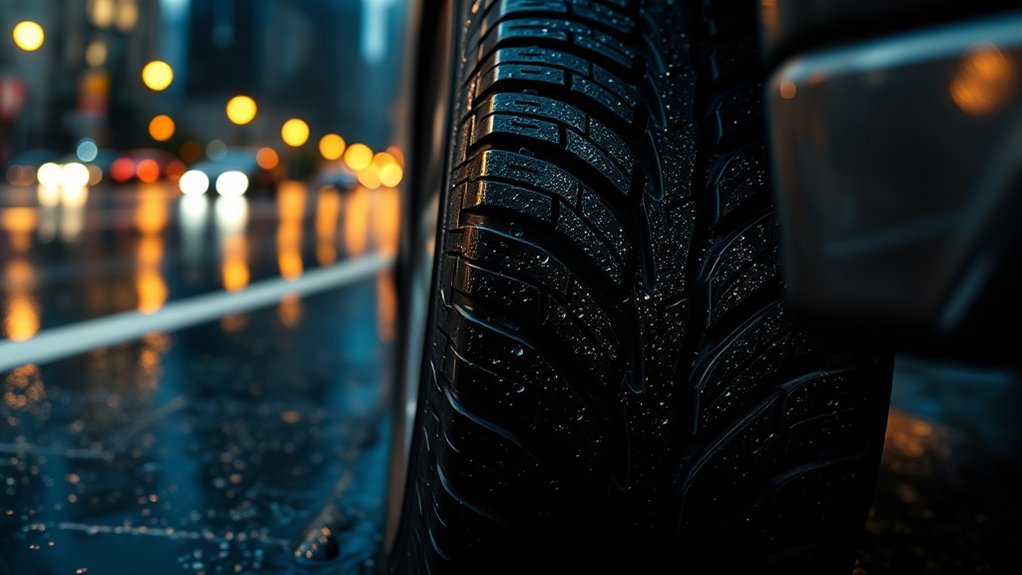
Tire tread has two main wet-weather jobs: maintaining usable road contact and creating paths through which water can escape. Circumferential grooves move water around the tire, while lateral channels help direct it toward the shoulders. Sipes, which are thin cuts in the tread blocks, create additional edges and help break through the surface film of water.
Michelin’s tire-design guidance explains that groove size, groove placement, tread shape, and siping all influence water evacuation. A directional V-shaped pattern can work well in rain, but it is not automatically better than every asymmetric or symmetric design. Overall engineering and verified wet-braking performance matter more than appearance alone.
- Circumferential grooves: Provide primary channels for water moving beneath the tire.
- Lateral grooves: Help discharge water toward the tire’s outer edges.
- Sipes: Add small biting edges and help the tread interact with the wet surface.
- Tread-block stability: Helps the tire remain predictable while braking and cornering.
Note: Wider grooves are not automatically better. Increasing empty space in the tread can affect noise, wear, dry handling, and block stability. Compare complete tire test results rather than judging one design feature.
[Products Worth Considering]

The SAFELIFE dial tire tread depth gauge measures tread depth in 1/32 inch increments with clear, easy-to-read 2-inch dial face. Color zones using a traffic light system help you quickly judge whether tread is low, marginal, or ample for safer driving. Built with a durable zinc cast body and a metal detect probe for precise, comfortable use across cars, motorcycles, trucks, and buses.

Monitor tire tread wear with a smart, color-coded depth gauge that shows clear condition ranges at a glance. The bar is range marked for fast, easy readings, helping you maintain safer traction and performance. Each gauge is portable with a pocket clip, and the set includes 20 units for daily use and sharing.

Black Magic Tire Wet delivers a deep wet-look shine that makes tires appear dark, rich, and freshly detailed. Its long-lasting formula helps resist rain, dust, and road grime for weeks of glossy protection, not days. Apply by spraying onto clean, dry tires—no buffing or wiping required—with a low-sling design to reduce splatter on paint and wheels.
How Tire Composition Impacts Grip in Rain
Wet traction also depends on how the rubber behaves at the road temperature. A tire compound must remain flexible enough to follow small surface irregularities while staying stable during braking and cornering. Manufacturers balance grip, tread life, rolling resistance, heat control, and seasonal performance when formulating the compound.
Tire Rubber Composition
It is too simple to say that a softer tire always grips better in rain. Modern compounds may use silica and specially formulated synthetic rubber to support wet grip without making the tread excessively soft. According to the Michelin tire glossary, silica-based tread compounds can support grip on cold and wet surfaces while also contributing to durability.
Temperature still matters. A summer tire may provide strong warm-weather wet grip but become less suitable in near-freezing conditions. An all-season tire covers a broader temperature range, while a winter tire is designed for cold weather, snow, and ice. Choose a category that matches your climate rather than relying only on marketing terms such as “soft compound.”
Tread Depth Influence
As tread wears, the grooves have less capacity to move water away from the contact patch. This can increase stopping distance and reduce steering response in heavy rain. Measure tread in several main grooves across each tire because wear may be greater on one shoulder or in the center.
| Measured Tread | What It Means for Wet Driving |
| Above 4/32 inch | Continue monthly checks. Wet performance still varies by tire design, condition, pressure, temperature, and road conditions. |
| Around 4/32 inch | Consider replacement planning if you regularly drive in heavy rain. Wet braking and handling may be substantially weaker than when the tire was new. |
| 2/32 inch | This is the U.S. minimum identified by NHTSA. Replace the tire rather than continuing to use it in wet conditions. |
AAA testing found that passenger-car tires worn to 4/32 inch required an average of 87 additional feet to stop from 60 mph on wet pavement compared with new tires.
The AAA result does not mean every tire performs identically or that 4/32 inch is the legal minimum. It shows why drivers who face frequent rain may benefit from replacing tires before reaching 2/32 inch.
Siping Design Advantages
Sipes open slightly as a tread block enters the contact patch, creating additional edges that interact with the road. They can improve wet and snow traction and help disrupt the thin water film on the pavement. However, excessive or poorly supported siping can also reduce tread-block stiffness, so manufacturers use different sipe shapes and locking structures to balance grip and stability.
Do not add aftermarket cuts to a normal passenger tire unless the tire manufacturer and a qualified tire professional specifically approve the procedure. Factory siping is engineered into the tire’s tread construction.
The Role of Tire Pressure in Enhancing Traction
Correct pressure helps a tire maintain its intended shape, load capacity, heat control, and contact behavior. Both underinflation and overinflation can reduce performance. Correct pressure cannot prevent every hydroplaning event, but it allows the tread to work as designed.
Check all four tires when they are cold, meaning the Camry has been parked for at least three hours or driven only a very short distance. NHTSA recommends checking tire pressure at least monthly and before long trips.
- Find the correct specification: Read the Tire and Loading Information label on the driver-side doorjamb or consult the manual for your exact Camry model year.
- Use a dependable gauge: Check each tire before adding air.
- Adjust to the listed cold pressure: Front and rear specifications may differ on some vehicles.
- Reinstall the valve caps: Caps help keep dirt and moisture away from the valve core.
- Investigate repeated pressure loss: A tire that repeatedly loses air may have a puncture, valve problem, wheel leak, or damage.
Warning: Do not inflate your Camry’s tires to the maximum pressure printed on the sidewall unless that number independently matches the vehicle placard. The sidewall number is a tire limit, not the normal vehicle inflation target.
The Tire Pressure Monitoring System is a warning system, not a substitute for a pressure gauge. The light may not illuminate until a tire is already significantly underinflated.
Hydroplaning: Causes and Safety Tips
Hydroplaning occurs when water builds beneath a tire faster than the tread can disperse it. The tire can partially or completely lose contact with the pavement, reducing steering, braking, and acceleration control. Risk rises with speed, standing water, worn tread, incorrect pressure, poor drainage, and abrupt inputs.
Possible warning signs include unusually light steering, rising engine speed without matching acceleration, a sudden water noise, a flashing slip indicator, or a feeling that the car is drifting despite steady steering.
What to Do if Your Camry Starts Hydroplaning
- Stay calm and look where you want to go.
- Ease off the accelerator gradually. Let the vehicle slow naturally.
- Hold the steering wheel steady. Avoid sharp or rapid corrections.
- Do not slam the brakes. Abrupt braking can make the loss of control worse. Use emergency braking if a collision is otherwise unavoidable.
- Wait for grip to return. When steering response comes back, make any needed correction smoothly.
- Continue at a lower speed. Avoid the same standing-water path when it is safe to do so.
These steps follow current heavy-rain and hydroplaning guidance from Continental.
Warning: Do not drive through floodwater or a puddle when you cannot judge its depth or see the roadway. Water may hide a washed-out surface, damage the engine or electrical system, or move the vehicle away from the road.
Adjust Your Driving Habits for Better Wet Traction
The safest wet-weather technique is to reduce the amount of traction you demand from the tires. Braking, acceleration, and steering all use the available grip. Combining them abruptly can exceed what the road and tires can provide.
- Reduce speed before standing water: Slowing after the tires lose contact is much harder than slowing beforehand.
- Increase your following distance: Leave substantially more room than you would on dry pavement.
- Brake earlier and progressively: Avoid waiting until the last moment and then applying heavy pressure.
- Use smooth steering: Enter curves more slowly and avoid sudden lane changes.
- Avoid hard acceleration: Gentle throttle inputs reduce wheelspin and stability-control intervention.
- Consider switching off cruise control in heavy rain: Manual speed control lets you respond more directly to changing water depth and traction.
- Use low-beam headlights and effective wipers: Visibility gives you more time to react.
The first rainfall after a dry period can be especially slippery because water mixes with oil, dust, and other surface contamination. Slow down before the road appears dangerous rather than waiting for the tires to slip.
Should Traction Control Stay On?
Leave traction control and Vehicle Stability Control on during normal rain driving. Toyota’s Camry system can reduce wheelspin and help correct certain stability problems, and the slip indicator may flash while the systems are working. However, TRAC, VSC, ABS, and other driver-assistance systems cannot create traction when the tires are badly worn or separated from the road by water.
Consult the Toyota Camry owner’s manual for the controls and indicators fitted to your model year. Turning traction control off may be useful in limited situations such as freeing a stuck vehicle, but it is not a normal rain-driving strategy.
Essential Tire Maintenance for Wet Weather Performance
A new tire can still perform poorly if it is underinflated, damaged, overloaded, or installed on a misaligned vehicle. Use a consistent inspection routine rather than relying only on the dashboard warning light.
- Check cold pressure monthly: Adjust it to the driver-door placard specification.
- Measure tread in several places: Check the inner edge, center, and outer edge of every tire.
- Inspect for damage: Look for cuts, cracks, bulges, exposed cords, punctures, and objects embedded in the tread.
- Watch for uneven wear: One-sided wear may indicate alignment or suspension problems. Center or shoulder wear may indicate pressure or load issues.
- Rotate tires on schedule: Follow the maintenance guide for your Camry and the recommendations of the tire manufacturer.
- Balance and align when necessary: Seek inspection after a hard pothole impact, steering pull, abnormal vibration, or irregular wear.
- Check tire age: Read the last four digits of the DOT Tire Identification Number to identify the manufacturing week and year.
Pro Tip: Record each tire’s tread depth and pressure in your phone every month. A gradual difference between tires can reveal a slow leak, alignment problem, or unusual wear before it becomes obvious.
How to Choose Rain-Ready Tires for a Toyota Camry
Begin with the tire specifications listed on the Camry’s doorjamb label and in its owner’s manual. Replacement tires should meet the recommended size, load index, and speed rating unless Toyota or a qualified tire professional approves another specification.
[Products Worth Considering]

Milton S-921 pencil tire pressure gauge helps you maintain optimal tire pressure for passenger cars with accurate readings in PSI and kPa. It features a built-in deflator valve for convenient pressure adjustments, plus a single chuck head and nylon indicator bar for easy use on the go. Built from durable plated brass and designed for reliable performance, it’s a practical road trip and cold-weather maintenance tool.

These universal tire valve stem caps help protect valve cores from dust, debris, and moisture while helping maintain stable tire pressure. The corrosion-resistant metal construction and sealed design provide reliable protection in road grime, mud, and winter conditions. Twist-on installation makes them quick to fit on cars, SUVs, trucks, and motorcycles.

Accurately measure tire tread depth with a calibrated gauge marked from 0 to 1 inch in 1/32 inch increments. The color-coded bar helps you quickly identify tread condition ranges, supporting safe driving for trucks, motorcycles, automobiles, and passenger vehicles.
Compare More Than the Tread Pattern
Look for independent wet-braking tests, resistance to hydroplaning, wet cornering behavior, comfort, wear, and performance at the temperatures in which you drive. The Uniform Tire Quality Grading traction mark may provide one comparison point. NHTSA grades wet-pavement stopping traction from AA to C, but the grade should not be treated as a complete measure of hydroplaning resistance or wet cornering.
Match the Tire Category to Your Climate
- All-season tires: Suitable for many drivers who encounter moderate seasonal changes.
- Summer tires: Often emphasize warm-weather dry and wet performance but are unsuitable for freezing conditions.
- Winter tires: Designed for cold temperatures, snow, and ice, including conditions where an all-season compound may harden.
Replace Four Tires When Possible
Installing four matching tires provides the most consistent wet grip and handling. If only two tires are replaced, USTMA recommends installing the newer pair on the rear axle. Stronger rear traction helps reduce the chance of oversteer and loss of stability on wet roads.
Do not mix incompatible sizes, construction types, or load capabilities. On all-wheel-drive Camry models, large tread-depth differences may also affect drivetrain operation, so follow Toyota’s model-specific requirements.
When to Replace Tires for Optimal Wet Weather Safety

Do not use tread depth as the only replacement test. A tire may need replacement because of damage, age, repeated air loss, vibration, irregular wear, or a noticeable decline in wet performance.
- Tread reaches 2/32 inch: Replace the tire. This is the minimum identified by NHTSA for U.S. passenger vehicles.
- Tread approaches 4/32 inch: Plan ahead if you frequently drive in heavy rain or have noticed longer stopping distances.
- Wear is uneven: Have the alignment, suspension, pressure history, and tire condition inspected.
- Cracks, cuts, bulges, or exposed cords appear: Stop using the tire and seek professional inspection.
- The tire repeatedly loses pressure: Have it checked for punctures, wheel damage, bead leaks, or valve problems.
- The tire is aging: NHTSA notes that some vehicle and tire manufacturers recommend replacement between six and ten years, regardless of remaining tread. Follow Toyota and the tire manufacturer’s guidance.
- Wet grip has noticeably declined: Do not wait for the legal minimum when the tire no longer provides predictable braking or steering.
Check the full DOT Tire Identification Number on both sidewalls if necessary. The final four digits identify the manufacturing date. For example, “1824” means the tire was manufactured during the eighteenth week of 2024.
[Products Worth Considering]

Measure tire tread depth quickly and accurately with this LUMITECO dial gauge that reads in 1/32" increments up to 14/32". The color-coded green/yellow/red zones make it easy to judge tire wear and know when replacement is needed. A rugged, compact design with a protective pouch helps keep the gauge ready for use on cars, trucks, motorcycles, and more.
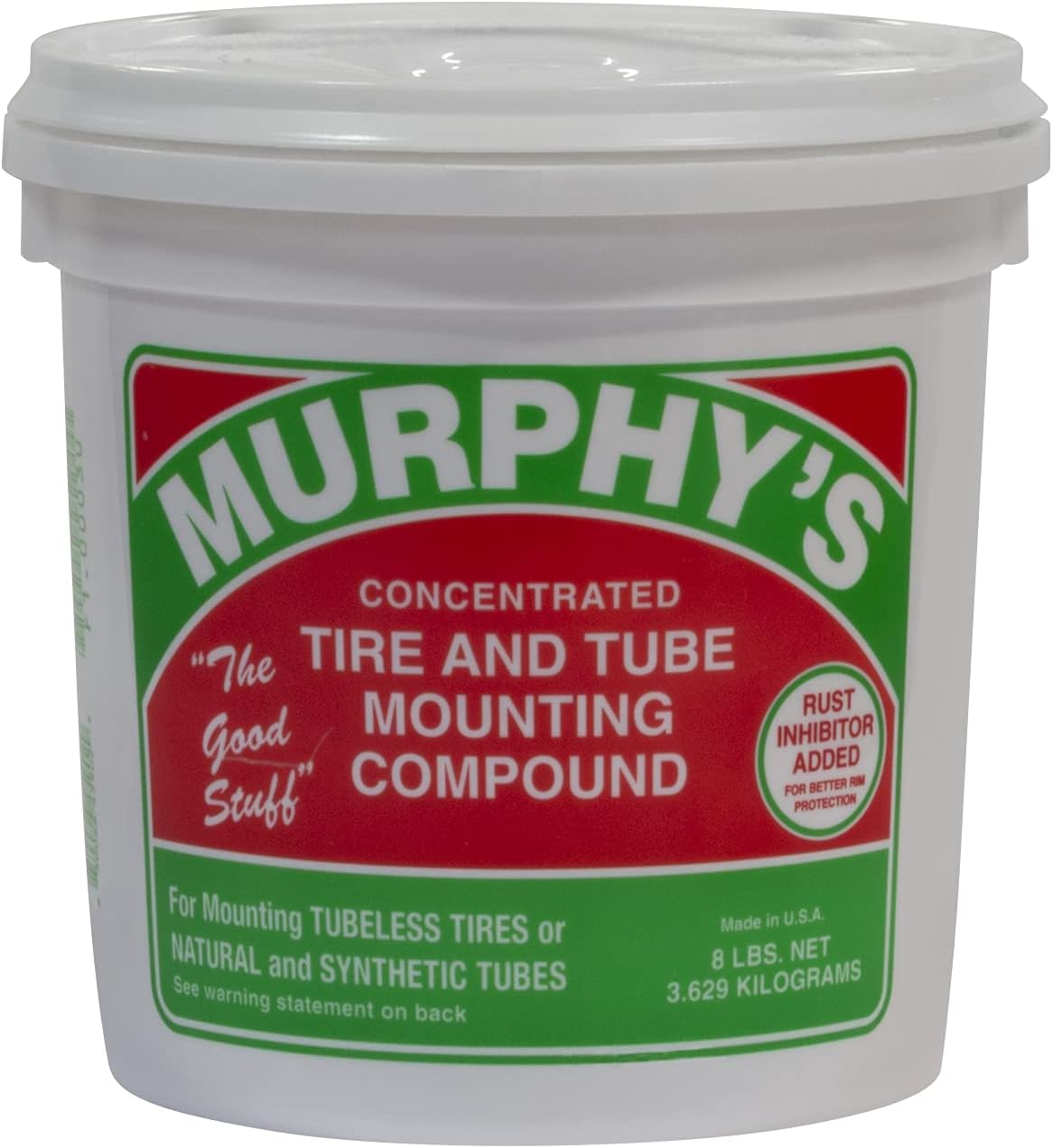
A concentrated tire and tube mounting compound designed to help simplify mounting rubber tires and tubes on passenger, semi truck, construction, and OTR applications. Its ultra-thick formula packs beads effectively and includes rust inhibitors to help protect against corrosion during use.

TIRESHIELD PRO RV tire covers in a set of four deliver year-round protection against UV rays, cracking, fading, water, and snow. The StormLock-System helps keep the covers securely fastened through high wind, while heavy-duty, double-stitched construction supports long-lasting performance. Designed for universal fit, they’re intended for RV, camper, truck, car, and trailer tires within the 26–28.75 inch diameter range, with easy wipe-clean care and storage in the included bag.
Frequently Asked Questions
How can you tell if your Camry’s tires are losing grip on a wet road?
Warning signs include frequent traction-control activation, longer stopping distances, wheelspin during gentle acceleration, light steering through standing water, or the vehicle drifting more than expected. Check pressure, tread depth, damage, and wear immediately. A professional inspection is appropriate if the behavior continues.
Should you drive with traction control on in the rain?
Yes. Leave Toyota’s TRAC and VSC systems on during normal wet-weather driving. They can reduce wheelspin and assist stability, but they cannot overcome worn tires, excessive speed, deep water, or abrupt steering and braking.
Should you replace Camry tires at 4/32 inch or 2/32 inch?
In the United States, 2/32 inch is the minimum identified by NHTSA. However, wet-weather performance may decline substantially before that point. Consider planning replacement around 4/32 inch when frequent rain, highway driving, or weaker wet braking makes additional tread important.
Should you lower tire pressure for better grip in rain?
No. Do not intentionally lower pressure for rain. Inflate cold tires to the specification on the Camry’s driver-door placard. Lowering pressure can increase heat, alter handling, reduce load capacity, and prevent the tread from operating as intended.
What tire tread pattern is best for wet roads?
No single visible pattern is best in every situation. Directional and asymmetric designs can both provide strong water evacuation. Compare verified wet-braking and hydroplaning tests, the compound, tread depth, temperature range, and the correct Camry specification.
What should you do if your Camry hydroplanes?
Ease off the accelerator, keep the steering wheel steady, and avoid sudden braking or sharp steering. Let the vehicle slow until the tires regain contact. Once steering response returns, correct your path smoothly and continue at a lower speed.
Conclusion
Your Toyota Camry’s wet traction depends on the complete tire and driving system, not one tread feature. Maintain the cold pressure shown on the doorjamb placard, check tread and damage monthly, slow down before standing water, and leave TRAC and VSC enabled during normal rain driving. Treat 2/32 inch as a minimum rather than a wet-performance target, and consider earlier replacement when rain grip has noticeably declined.
If hydroplaning begins, ease off the accelerator, hold the wheel steady, and avoid abrupt inputs until grip returns. Timely tire replacement and smooth driving give the Camry’s braking and stability systems the best opportunity to help you remain in control.
Sources
- National Highway Traffic Safety Administration: TireWise — tire pressure, tread minimums, UTQG traction grades, inspections, and tire-age guidance.
- AAA: Tread Lightly, Worn Tires Put Drivers at Risk — wet braking and handling tests involving tires worn to 4/32 inch.
- Toyota Camry Owner’s Manual — TRAC, VSC, ABS, slip indicators, and warning indicators.
- U.S. Tire Manufacturers Association: Replacing Tires — replacement specifications and rear-axle placement when replacing two tires.
- Michelin: How Tires Are Made — tread grooves, siping, and water-evacuation design.
- Continental: Driving in Heavy Rain — hydroplaning prevention, warning signs, and recovery actions.