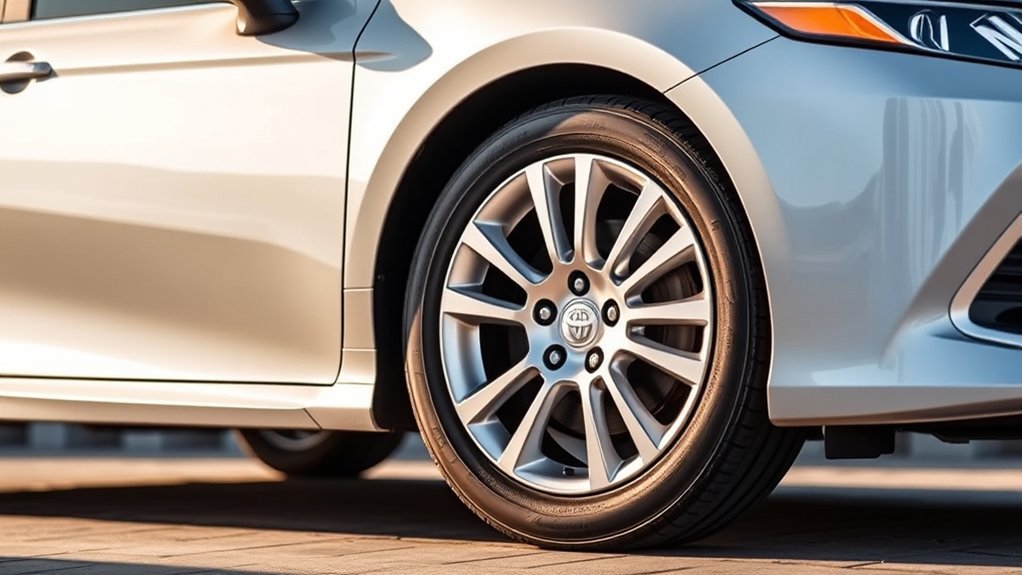
The right Toyota Camry LE tire size depends on the model year, trim, drivetrain, and sometimes the wheel package. The safest answer is always the tire information placard on the driver-side door jamb, followed by the owner’s manual. General charts are useful for shopping, but your vehicle’s placard is the final authority.
Quick Answer
Most recent Toyota Camry LE models use 205/65R16 or 215/55R17, depending on year and hybrid/gas configuration. The 2025–2026 Camry LE is commonly listed with 205/65R16 tires, while many 2018–2024 gas LE models use 215/55R17. Always confirm the exact size on your door-jamb placard before buying tires.
Key Takeaways
- Early U.S. Camry LE models were commonly fitted with smaller 13- and 14-inch tires, not the same sizes used on modern LE models.
- The 2025–2026 Camry LE is hybrid-only in the U.S. lineup and is commonly listed with 205/65R16 tires.
- Many 2018–2024 gas Camry LE models use 215/55R17, while 2018–2024 Hybrid LE models commonly use 205/65R16.
- Do not use the tire sidewall’s maximum pressure as your normal inflation target; use the vehicle placard pressure instead.
- When changing tire size, match or exceed the original load index and speed rating, keep overall diameter close to stock, and verify clearance with a tire professional.
At a Glance
| Time Required | 5–10 minutes to confirm your size before shopping |
| Difficulty | Easy |
| Tools Needed | Driver-side door placard, owner’s manual, tire sidewall, tire pressure gauge, tread-depth gauge |
| Cost | Free to confirm; replacement cost depends on tire size, brand, and installation |
The Evolution of Toyota Camry Tire Sizes by Generation

Toyota Camry tire sizes have changed because the car itself has changed. Earlier Camry LE models used smaller wheels and taller tire sidewalls for comfort and everyday economy. Newer models use larger wheels, different suspension tuning, hybrid efficiency targets, and trim-specific tire packages.
For example, early U.S. Camry LE listings show 185/70R13 on 1983 models, while modern LE sizes commonly include 205/65R16 and 215/55R17 depending on the model year. The latest 2025–2026 Camry LE is commonly listed with 205/65R16 tires, while sportier or higher trims may use 235/45R18 or 235/40R19.
Note: Tire charts are helpful for research, but Toyota, tire retailers, and safety agencies all point drivers back to the vehicle placard and owner’s manual for the exact pressure, load, and fitment information for a specific car.
Key Tire Sizes for the Camry LE (1983–2026)
The Camry LE does not have one single tire size across all years. The size changed by generation, and some years also differ between gasoline LE and Hybrid LE. Use the table below as a practical research guide, then confirm your exact vehicle before ordering.
| Model year range | Common Camry LE tire size | Important notes |
|---|---|---|
| 1983–1985 | 185/70R13 | Common early U.S. LE listing; market and body-style differences can exist. |
| 1986–1991 | 185/70R14 or other package-specific sizes | Some databases list multiple stock sizes for these years. Check the placard carefully. |
| 1992–1996 | 195/70R14 | V6 and higher trims may differ. |
| 1997–2001 | 195/70R14 | LE V6 examples may use 205/65R15. |
| 2002–2006 | 205/65R15 | A common comfort-focused LE size for this generation. |
| 2007–2011 | 215/60R16 | SE and other trims may use different 17- or 18-inch sizes. |
| 2012–2017 | 205/65R16 | Hybrid LE examples in this range also commonly use 205/65R16. |
| 2018–2024 gas LE | 215/55R17 | This is the common gas LE size; do not confuse it with SE/XLE/XSE sizes. |
| 2018–2024 Hybrid LE | 205/65R16 | Hybrid LE often used the smaller 16-inch tire for efficiency and ride comfort. |
| 2025–2026 LE | 205/65R16 | The U.S. Camry lineup is hybrid-only for these years; LE is commonly listed with 205/65R16. |
Stock Tire Sizes Overview
Stock tire size means the tire size Toyota designed for that trim and wheel package when the vehicle was built. For the Camry LE, stock sizes have ranged from early 13-inch and 14-inch fitments to modern 16-inch and 17-inch fitments. The most common recent LE sizes are 205/65R16 and 215/55R17.
Do not assume that a size from a sportier Camry trim fits your LE. A 235/45R18 tire may be correct for some SE or XLE-style fitments, but that does not make it the correct stock size for an LE. The same applies to 235/40R19, which is commonly associated with sportier or higher trims.
Tire Size Trends Over Generations
The long-term trend is not simply “bigger every year.” Instead, Toyota has balanced ride comfort, fuel economy, steering response, wheel styling, braking hardware, and hybrid efficiency. That is why a newer LE can use a 16-inch tire while a previous gas LE used a 17-inch tire.
The best tire size for a Camry LE is not the widest tire that fits. It is the size that matches the vehicle placard, load rating, speed rating, and wheel package.
Why Your Toyota Camry Tire Size Matters
Your Camry’s tire size affects more than appearance. It influences steering feel, ride comfort, braking, traction, fuel economy, speedometer accuracy, and how the tire clears the fender liner, suspension, and brake components.
A taller sidewall, such as on many 16-inch Camry LE fitments, can help absorb road imperfections and support a quieter, more comfortable ride. A wider, lower-profile tire can sharpen steering response, but it may also ride firmer, cost more, and be more vulnerable to pothole damage.
Warning: Never inflate tires to the maximum pressure printed on the tire sidewall for normal driving unless the vehicle placard specifically calls for it. Use the cold tire pressure shown on the driver-side door placard or owner’s manual.
How to Read a Camry Tire Size
A tire size such as 205/65R16 tells you the tire’s basic dimensions:
- 205 means the tire is about 205 mm wide from sidewall to sidewall.
- 65 is the aspect ratio. The sidewall height is 65% of the tire width.
- R means radial construction.
- 16 means the tire fits a 16-inch wheel.
You may also see a load index and speed rating after the size, such as 205/65R16 95H. When replacing tires, match or exceed the original load index and speed rating unless a qualified tire professional confirms a safe alternative.
How to Find Your Toyota Camry LE’s Exact Tire Size
Use this order when confirming your Camry LE tire size. It prevents the most common mistake: buying a tire based only on a year range or a tire chart.
Check Door Sticker
Open the driver-side door and look for the tire and loading information placard on the door jamb. This placard usually lists the original tire size, cold tire pressure, seating/load information, and sometimes spare tire information. For your own car, this is the most important source.
Refer Owner’s Manual
Your owner’s manual explains tire care, tire pressure, tire rotation, warning lights, and size-related information. Toyota’s online owner resources are also useful for late-model Camry manuals. For example, Toyota’s 2025 Camry tire section explains checking treadwear indicators and replacing tires when wear indicators show.
Check the Current Tire Sidewall
The sidewall shows the size currently installed on the car. This is useful, but it is not always proof of the correct OE size because a previous owner may have installed a different size. Compare the current sidewall to the door placard before ordering replacements.
Confirm Trim and Drivetrain
Camry LE, Hybrid LE, SE, XLE, XSE, and TRD trims can use different tire sizes in the same model year. AWD and optional wheel packages can also matter. When shopping online, choose the exact year, trim, drivetrain, and wheel diameter.
Choosing the Best Tire Size for Your Camry Model
For most Camry LE owners, the best choice is the original size shown on the placard. That size was chosen to work with the car’s suspension, speedometer calibration, braking system, load capacity, and ride-quality targets.
If you want a different wheel or tire size, treat it as a fitment change, not a simple cosmetic swap. You need to verify:
- Overall tire diameter compared with the original size
- Wheel width and offset
- Load index and speed rating
- Brake and suspension clearance
- Fender and inner-liner clearance at full steering lock
- TPMS compatibility
- ABS, traction-control, and speedometer impact
Pro Tip: If you drive in snow, a narrower winter tire on the correct wheel size can sometimes perform better than a wider tire because it can cut through snow more effectively. Always use a size approved for your Camry and match the correct load rating.
[Products Worth Considering]

This heavy-duty tire pressure gauge combines measurement, inflation, and deflation in one compact tool for quick roadside and garage use. Its dual-head chuck helps reach inner and outer dual-wheel positions, while the clear indicator bar makes readings easy to see. Built for durability, it supports a wide pressure range and works across cars, trucks, RVs, SUVs, and motorcycles.

Keep your tires properly inflated with this analog VONDIOR tire pressure gauge, designed for fast, easy readings without batteries. The swiveling, two-axis hose and large glow dial help you measure at any tire angle with instant visibility. Built with a protective rubber shield, it supports durable, low-maintenance use for cars and trucks.

Measure tire tread depth quickly and accurately with this LUMITECO dial gauge that reads in 1/32" increments up to 14/32". The color-coded green/yellow/red zones make it easy to judge tire wear and know when replacement is needed. A rugged, compact design with a protective pouch helps keep the gauge ready for use on cars, trucks, motorcycles, and more.
Common Tire Sizes for the Camry LE Trims

These examples show why trim accuracy matters. A 2024 Camry LE and a 2024 Camry Hybrid LE may not use the same tire size, even though they share the Camry name. A 2026 Camry LE and a 2026 Camry SE also differ.
| Example model | Common listed tire size | What to remember |
|---|---|---|
| 2002 Camry LE | 205/65R15 | Do not confuse with SE or XLE sizes from the same year. |
| 2007 Camry LE | 215/60R16 | A common sixth-generation LE size. |
| 2015 Camry LE | 205/65R16 | Many SE/XLE examples use different 17- or 18-inch sizes. |
| 2020 Camry LE | 215/55R17 | 235/45R18 is not the usual LE size; it is associated with other trims. |
| 2024 Camry Hybrid LE | 205/65R16 | Different from many 2024 gas LE listings. |
| 2025–2026 Camry LE | 205/65R16 | Latest LE fitment is focused on hybrid efficiency and comfort. |
When and Why to Adjust Your Camry Tire Size
You might consider changing tire size if you are installing a different wheel package, building a winter tire setup, replacing unavailable older sizes, or trying to change ride and handling feel. However, tire-size changes can create problems if they are not calculated correctly.
Plus sizing means using a larger wheel with a lower-profile tire while keeping the overall tire diameter close to the original. This can improve steering response and appearance, but it can also reduce ride comfort. Tire Rack explains that plus sizing is based on maintaining overall tire diameter to preserve ground clearance, gearing, and speedometer accuracy.
Minus sizing is the opposite: using a smaller wheel with a taller-sidewall tire, often for winter use when approved for the vehicle. This can improve pothole resistance and reduce winter-tire cost, but it must still clear the brakes and match the vehicle’s required load rating.
Warning: Do not mix different tire sizes on the same axle. If your Camry has a nonstandard setup, AWD, or a recent tire replacement on only two wheels, ask a qualified tire shop to verify that all four tires are compatible.
[Products Worth Considering]

Monitor tire tread wear with a smart, color-coded depth gauge that shows clear condition ranges at a glance. The bar is range marked for fast, easy readings, helping you maintain safer traction and performance. Each gauge is portable with a pocket clip, and the set includes 20 units for daily use and sharing.

The SAFELIFE dial tire tread depth gauge measures tread depth in 1/32 inch increments with clear, easy-to-read 2-inch dial face. Color zones using a traffic light system help you quickly judge whether tread is low, marginal, or ample for safer driving. Built with a durable zinc cast body and a metal detect probe for precise, comfortable use across cars, motorcycles, trucks, and buses.

Accurately measure tire tread depth with a calibrated gauge marked from 0 to 1 inch in 1/32 inch increments. The color-coded bar helps you quickly identify tread condition ranges, supporting safe driving for trucks, motorcycles, automobiles, and passenger vehicles.
Performance Differences Between Tire Sizes in the Camry
Tire size changes can be felt immediately from behind the wheel. The difference is not only the width; sidewall height, tire model, tread compound, wheel weight, and inflation pressure all matter.
Handling and Stability
A wider or lower-profile tire can reduce sidewall flex and make steering feel quicker. This is one reason sportier Camry trims often use larger wheels and lower-profile tires than the LE. The tradeoff is that the ride may feel firmer, and the tire may be more sensitive to potholes and rough pavement.
Ride Comfort Differences
A taller sidewall, such as on 205/65R16 tires, generally gives the tire more cushioning over bumps. That can help explain why many LE and Hybrid LE fitments use practical 16-inch tires. A 215/55R17 tire can still ride comfortably, but it has less sidewall than a 205/65R16.
Fuel Economy and Road Noise
Wider tires and heavier wheels can increase rolling resistance and weight, which may reduce fuel economy. The 2026 Camry’s all-hybrid powertrain is rated by Toyota at up to 51 combined EPA-estimated mpg, and the LE’s smaller tire/wheel setup helps support that efficiency-focused mission.
Essential Tips for Maintaining and Replacing Camry Tires
Correct size is only part of tire safety. Tire pressure, tread depth, rotation, alignment, and age all affect how your Camry drives.
- Check pressure when tires are cold. Use the pressure on the door placard, not the maximum pressure on the tire sidewall.
- Rotate tires on schedule. Toyota’s 2025 Camry maintenance guide recommends scheduled maintenance every 5,000 miles or six months and shows tire rotation at 5,000-mile intervals.
- Inspect treadwear indicators. Toyota’s owner information says to replace tires if the treadwear indicators are showing.
- Check for uneven wear. Feathering, cupping, or one-edge wear may point to alignment, suspension, or inflation problems.
- Replace damaged tires. Bulges, exposed cords, sidewall cuts, separation, and repeated pressure loss are safety issues.
- Use matching tires when possible. For best balance, use four tires of the same size, type, and similar tread depth.
NHTSA’s TireWise guidance also recommends checking tire pressure, inspecting for irregular wear or damage, and using the vehicle manufacturer’s recommended pressure.
[Products Worth Considering]

The UYYE TPMS relearn tool helps activate and relearn tire pressure monitor sensors quickly, typically in minutes. It supports TPMS learn mode resetting using a simple three-step process: enter learn mode, position the tool near the valve stem, and press the learn button. Designed for specific GM models, it streamlines sensor programming and reduces trips to dealers or tire shops.

This manual duck head tire changer kit makes tire installation and removal simpler by letting you embed the duck head into the tire with applied pressure. The integrated design and durable steel construction help reduce friction and improve efficiency and safety during use. Suitable for 16–21 inch wheels, it’s convenient for cars, trucks, SUVs, and ATV tires, with 24-hour after-sales support.

These universal tire valve stem caps help protect valve cores from dust, debris, and moisture while helping maintain stable tire pressure. The corrosion-resistant metal construction and sealed design provide reliable protection in road grime, mud, and winter conditions. Twist-on installation makes them quick to fit on cars, SUVs, trucks, and motorcycles.
Model-Year Examples and Common Questions
Here are a few quick examples that correct the most common Camry LE tire-size mixups:
- 1983 Camry LE: commonly listed as 185/70R13 for U.S. LE sedan and hatchback examples.
- 2007 Camry LE: commonly listed as 215/60R16.
- 2015 Camry LE: commonly listed as 205/65R16.
- 2020 Camry LE: commonly listed as 215/55R17, not 235/45R18.
- 2024 Camry Hybrid LE: commonly listed as 205/65R16.
- 2025–2026 Camry LE: commonly listed as 205/65R16.
Because old vehicles may have replacement wheels and newer vehicles may have options, always verify your own placard before purchase.
Frequently Asked Questions
Can I use different tire sizes on my Camry LE?
Yes, but only if the alternative size is compatible with your wheel, suspension, brakes, load rating, speed rating, and overall tire diameter. For most drivers, the safest choice is the original size shown on the door placard. If you want a different size, have a tire professional verify the fitment before installation.
How do I know if my tires are compatible?
Start with the driver-side door placard. Then confirm the tire size, load index, speed rating, wheel diameter, and tire type. If the size differs from the placard, check overall diameter, wheel width, offset, and clearance. Do not rely only on the current tire sidewall because previous owners may have installed a non-original size.
What is the impact of tire pressure on performance?
Low tire pressure can reduce fuel economy, increase heat buildup, wear the tire shoulders, and make handling feel sluggish. Overinflation can reduce ride comfort and concentrate wear near the center of the tread. Use the cold tire pressure shown on the vehicle placard or owner’s manual.
Are all Camry LE tires all-season, or can I use winter tires?
Many replacement tires sold for the Camry LE are all-season touring tires, but you can use winter tires if they match an approved size, load index, and speed rating. Winter tires are often the better choice for regular snow, ice, and freezing temperatures.
How often should I rotate my Camry’s tires?
For the 2025 Camry, Toyota’s maintenance guide shows scheduled maintenance every 5,000 miles or six months and tire rotation at 5,000-mile intervals. Older Camry models may have different guidance, so follow your exact owner’s manual.
What tire size is on a 2026 Toyota Camry LE?
The 2026 Toyota Camry LE is commonly listed with 205/65R16 tires. Other 2026 Camry trims use different sizes, so do not buy based on “Camry” alone. Confirm LE trim and check the door placard.
What tire size is on a 2024 Toyota Camry LE?
A 2024 gas Camry LE is commonly listed with 215/55R17 tires, while a 2024 Camry Hybrid LE is commonly listed with 205/65R16 tires. This is why it is important to confirm whether the car is gas or hybrid.
Conclusion
Finding the right Toyota Camry LE tire size is simple once you use the correct source. Start with the driver-side door placard, confirm the owner’s manual, and then use year-by-year charts only as a shopping guide. Early LE models commonly used smaller 13- and 14-inch tires, many 2018–2024 gas LE models use 215/55R17, and the 2025–2026 Camry LE is commonly listed with 205/65R16. When in doubt, choose the factory size and have a qualified tire professional verify any change.
Sources
- Toyota Owners — Camry Manuals and Warranties — official owner manual access and Toyota maintenance resources.
- Toyota 2025 Camry Warranty & Maintenance Guide — scheduled maintenance intervals and tire rotation guidance.
- NHTSA TireWise — tire pressure, tire inspection, loading, and tire safety guidance.
- TireSize.com Toyota Camry Tire Size Listings — model-year and trim-specific tire-size lookup examples used for cross-checking Camry LE sizes.
- Toyota 2026 Camry Official Page — current Camry hybrid lineup and EPA-estimated efficiency context.
- Tire Rack Plus Sizing Guide — explanation of maintaining overall tire diameter when changing wheel and tire sizes.