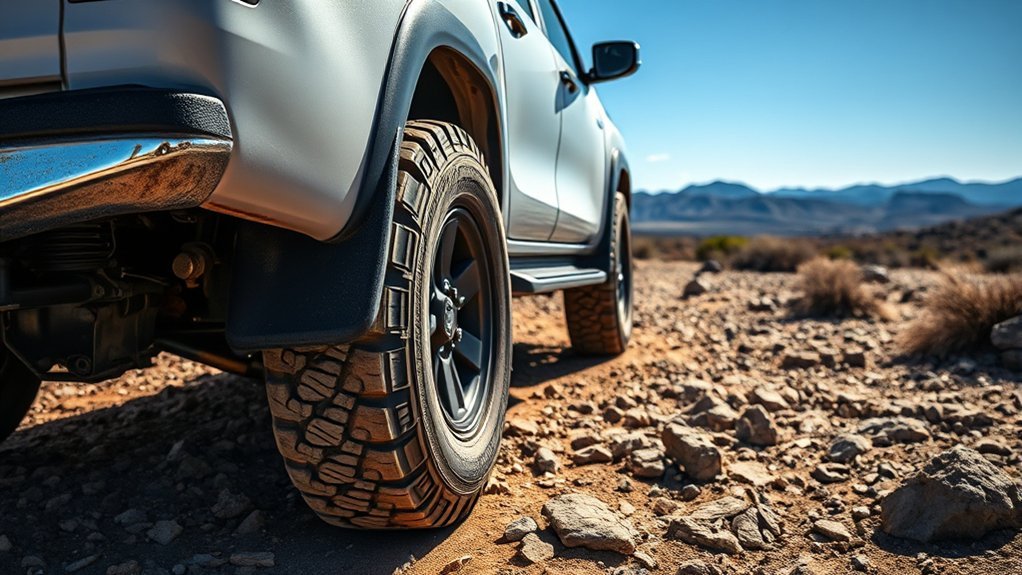
Choosing tires for a Toyota Hilux overlanding setup is not just about picking the most aggressive tread. The best choice depends on your factory tire size, payload, wheel clearance, road mileage, terrain, and how far you travel between service stops. For most long-distance Hilux builds, a quality all-terrain or hybrid all-terrain tire in a size close to the factory placard is the safest starting point.
Quick Answer
For most Toyota Hilux overlanding trips, choose a light-truck-rated all-terrain tire in a factory-approved or near-factory size, such as 265/65R17 where listed for your model. Go mud-terrain only if deep mud, ruts, or sharp rocky tracks matter more than highway noise, wet-road comfort, and fuel economy.
Key Takeaways
- Start with your Hilux door placard, owner’s manual, or official local specification sheet before changing tire size.
- All-terrain tires are the best fit for mixed highway, gravel, sand, and moderate trail use.
- Mud-terrain tires add bite in mud and loose ground, but usually bring more noise, weight, rolling resistance, and wet-road compromise.
- Match or exceed the original load rating, especially if you carry drawers, canopy, rooftop tent, water, recovery gear, or extra fuel.
- After airing down off-road, reinflate before returning to paved-road speeds.
At a Glance
| Time Required | 30–60 minutes to compare sizes, load ratings, wheels, and terrain needs before ordering. |
| Difficulty | Easy to moderate. Fitment checks become more important if you upsize or change wheel offset. |
| Tools Needed | Owner’s manual or tire placard, tire-pressure gauge, tread-depth gauge, tape measure, and a portable compressor for trips. |
| Cost | Varies by market. Budget for four or five tires, fitting, balancing, valve or TPMS service, alignment, and possible spare-wheel upgrades. |
Why Tire Selection Matters for Toyota Hilux Overlanding
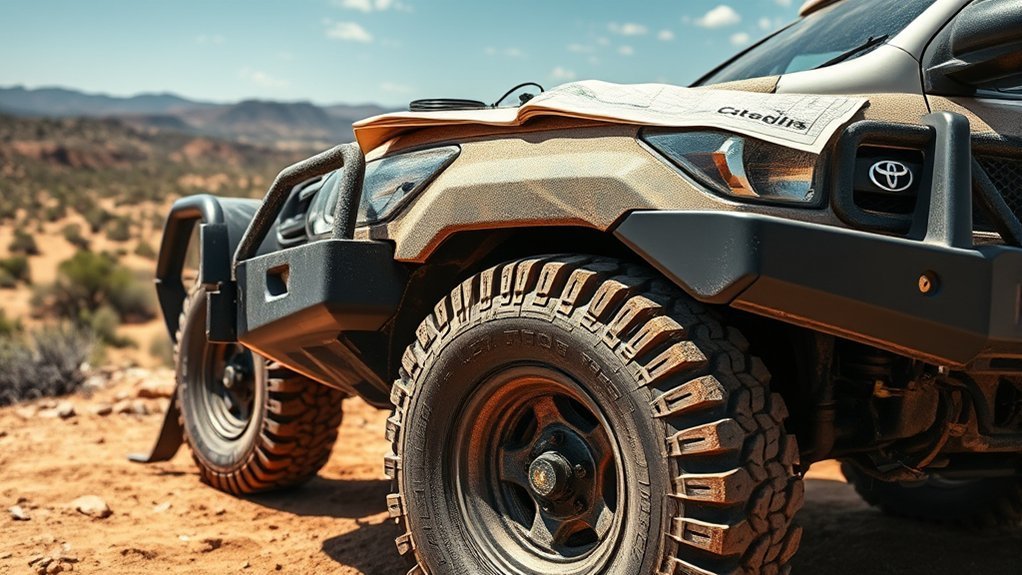
Your tires are the only part of the Hilux touching the ground, so they affect grip, braking, steering, load carrying, ride comfort, puncture resistance, and fuel use. A tire that works well for weekend mud may be a poor choice for a 3,000-kilometer road-and-track journey. A tire that feels smooth on the highway may not have enough sidewall protection for rocky trails.
The goal is balance. A long-distance overlanding Hilux usually needs a tire that can handle sealed roads, corrugations, gravel, rain, sand, and campsite tracks without wearing quickly or tiring you out with noise. That is why all-terrain tires are so common on touring builds.
Before choosing a size, check your vehicle’s tire placard, owner’s manual, or local Toyota specifications. Current Hilux specifications vary by region and grade. For example, Toyota UK lists 265/65R17 for some grades and 265/60R18 for others in its Hilux technical specifications. That does not mean every Hilux should use the same size; it means the factory data is your starting point.
Warning: Never choose tires by appearance alone. A tire that is too tall, too wide, under-rated for load, or incompatible with your wheels can cause rubbing, poor braking, speedometer error, tire damage, or insurance and roadworthiness problems.
Mud-Terrain vs. All-Terrain Tires for a Hilux
The best tread pattern depends on where the Hilux spends most of its time. For many overlanders, that means long stretches of pavement between dirt roads, campsites, and remote trails. In that use case, a good all-terrain tire is usually the smarter choice than a full mud-terrain tire.
| Tire Type | Best For | Trade-Offs |
|---|---|---|
| All-terrain (A/T) | Highway touring, gravel, sand, dry tracks, light mud, daily driving, long-distance travel. | Less self-cleaning bite than mud-terrain tires in deep mud or sticky clay. |
| Hybrid rugged terrain | Drivers who want stronger shoulders and more off-road grip than a mild A/T, while keeping better road manners than a true M/T. | Usually heavier, louder, and less efficient than mild all-terrain tires. |
| Mud-terrain (M/T) | Deep mud, ruts, loose rock, sharp trails, low-speed technical off-road work. | More road noise, more weight, faster uneven wear if neglected, and weaker wet-road comfort on many models. |
An all-terrain such as the BFGoodrich All-Terrain T/A KO3 is built for trucks, SUVs, and overland vehicles that need road and trail ability. The General Grabber AT3 is another all-terrain option marketed for off-road traction and rough-terrain use. If your route includes more mud and sharper off-road work, tires such as the Goodyear Wrangler DuraTrac RT or Kumho Road Venture MT51 show the kind of heavier-duty tread designs you may consider.
[Products Worth Considering]
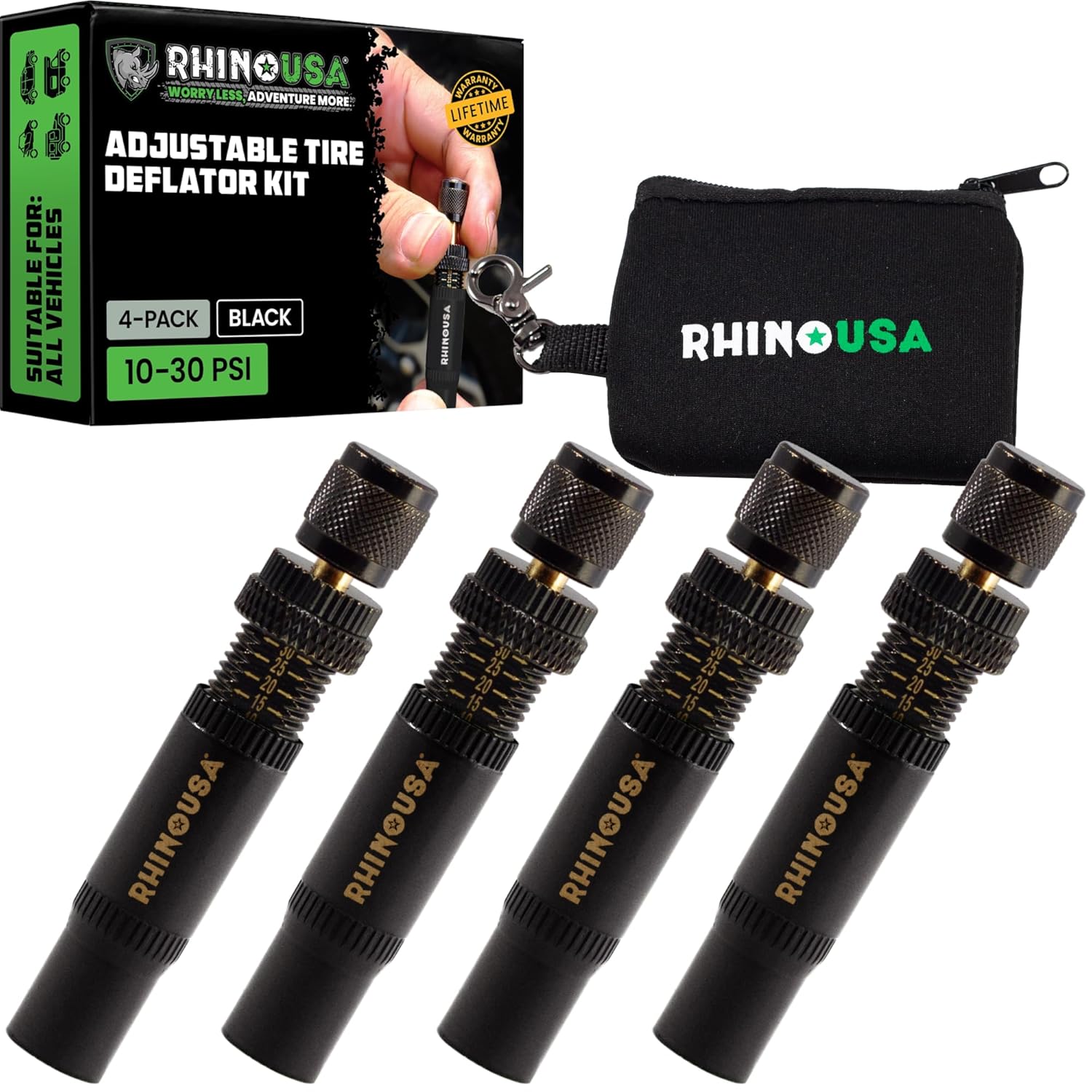
Use the Rhino USA adjustable tire deflators to air down all four tires at once by screwing one deflator onto each valve stem, letting you step away while the tires reach your preset pressure. Each deflator independently adjusts across a 10–30 PSI range with laser-etched indicators for quick setup and verification, making it ideal for beach, sand, and rocky off-road trails.

These aluminum alloy tire valve stem caps with an O-ring seal help protect valve stems from corrosion while adding a clean, stylish look to your vehicle. The universal fit works across cars, trucks, motorcycles, bicycles, and more, making them an easy upgrade for everyday driving and off-road use. Installation is quick, and the included four-pack keeps all your tires dressed and protected.

Keep your tires properly inflated with this analog VONDIOR tire pressure gauge, designed for fast, easy readings without batteries. The swiveling, two-axis hose and large glow dial help you measure at any tire angle with instant visibility. Built with a protective rubber shield, it supports durable, low-maintenance use for cars and trucks.
Essential Features for Durable Overlanding Tires
Durability is more than tread depth. For a loaded Hilux, the most important features are load rating, sidewall strength, casing construction, tread pattern, heat resistance, wet-road grip, and size compatibility.
[Products Worth Considering]
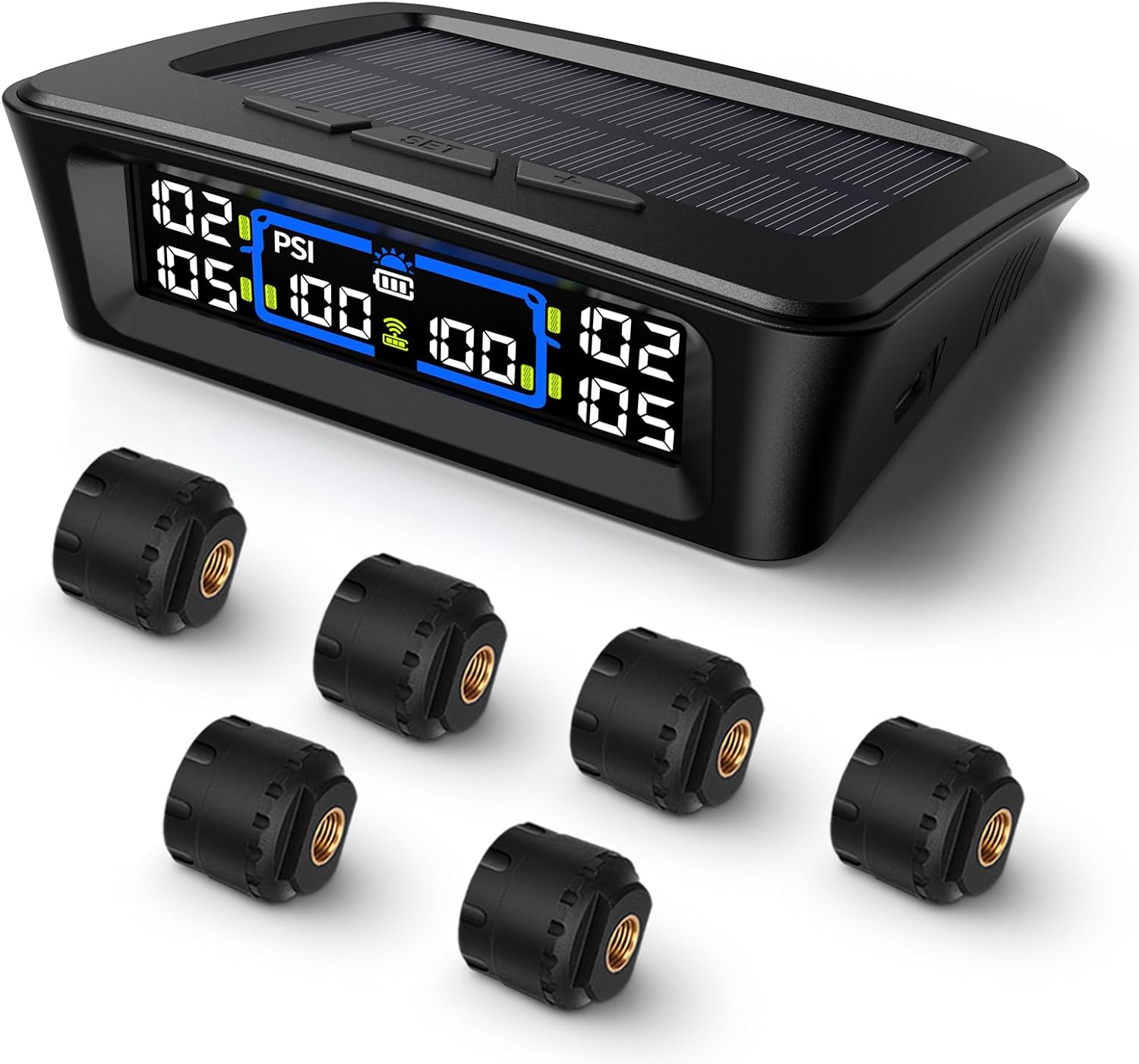
The Tymate TM12 RV TPMS delivers real-time tire pressure and temperature monitoring with a stable 433Hz display for safer long-distance driving. It supports simultaneous monitoring across vehicle and trailer zones, includes six alarm modes for pressure, temperature, leakage, battery, and signal loss, and features easy DIY installation with auto calibration. Power is supplied via USB-C charging or solar recharging, with a wide 0–144 PSI range and up to 50 ft signal coverage for RVs and towable trailers.

Measure tire tread depth quickly and accurately with this LUMITECO dial gauge that reads in 1/32" increments up to 14/32". The color-coded green/yellow/red zones make it easy to judge tire wear and know when replacement is needed. A rugged, compact design with a protective pouch helps keep the gauge ready for use on cars, trucks, motorcycles, and more.

The Airmoto portable tire inflator quickly and accurately fills car, truck, SUV, motorcycle, and bicycle tires up to 120 PSI with auto shut-off when your target pressure is reached. Its large LCD, multi-unit pressure display, and digital gauge make it easy to dial in settings and verify readings, while the built-in LED flashlight helps in low light. The included polyurethane hard carrying case and storage mesh pocket keep the inflator and accessories protected and organized.
Load Rating
Match or exceed the original equipment load rating shown on your tire placard or manual. This is especially important if your Hilux carries a canopy, drawers, fridge, spare fuel, water, rooftop tent, recovery boards, winch, bull bar, or a constant heavy payload. A tire that looks strong but has the wrong load index is not a safe overlanding tire.
Sidewall Strength
Look for light-truck construction where appropriate for your model and route. Stronger sidewalls can help resist bruising and cuts on rock, corrugations, and gravel, but heavier construction can make the ride firmer. Choose the tire that matches your load, not just the toughest-looking option.
Wet-Road and Highway Behavior
Overlanding often includes more highway mileage than trail mileage. A tire that is predictable in rain and stable at speed can matter more than maximum mud bite. Check independent test data, manufacturer details, and real owner reports for wet braking, road noise, and tread wear.
Availability on the Route
For long-distance travel, avoid rare sizes unless you carry a full-size matching spare and know where replacements are available. A common Hilux size is easier to replace in regional towns than an unusual oversized fitment.
Pro Tip: For serious trips, buy five matching tires instead of four. Rotating the spare into service keeps tread depth closer across the set and gives you a proper backup if one tire is damaged beyond repair.
Ideal Tire Sizes for Your Toyota Hilux Overlanding Setup
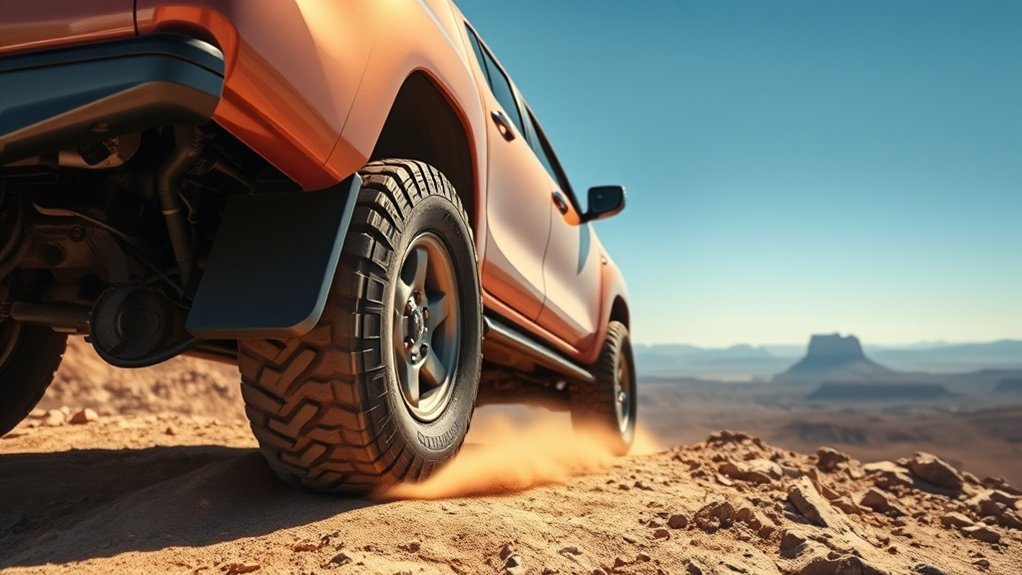
For many Hilux models, 265/65R17 is a common factory-style size and a sensible overlanding baseline. It keeps the tire close to factory diameter, helps preserve gearing and speedometer accuracy, and reduces the chance of rubbing compared with bigger upgrades. Some trims use 265/60R18 from the factory, so always confirm your exact model.
Upsizing to 265/70R17 can add a little sidewall height and ground clearance, but it may also increase tire weight, change speedometer reading, affect fuel economy, and cause rubbing at full lock or suspension compression. Whether it fits depends on the Hilux generation, trim, suspension, wheel offset, mud flap position, and how much weight is carried.
| Size | Why It Works | Watch For |
|---|---|---|
| 265/65R17 | Common factory-style Hilux size on many grades; good balance of clearance, comfort, and availability. | Still check load rating, speed rating, and local placard requirements. |
| 265/70R17 | More sidewall and slightly more clearance for rough roads and aired-down comfort. | May need clearance checks, alignment, trimming, or suspension changes depending on setup. |
| 265/60R18 | Factory-style size for some higher grades with 18-inch wheels. | Less sidewall than a 17-inch setup; check availability if travelling remotely. |
Note: A larger tire is not always better. If it adds too much weight, rubs under load, or reduces braking and acceleration, it can make a touring Hilux less reliable rather than more capable.
[Products Worth Considering]

The SAFELIFE dial tire tread depth gauge measures tread depth in 1/32 inch increments with clear, easy-to-read 2-inch dial face. Color zones using a traffic light system help you quickly judge whether tread is low, marginal, or ample for safer driving. Built with a durable zinc cast body and a metal detect probe for precise, comfortable use across cars, motorcycles, trucks, and buses.

This VEVOR tire bead breaker uses a slide-hammer impact and wedge tip to separate tire beads from rims quickly and efficiently without damaging hub surfaces. The long handle and sturdy steel construction help reduce user strain while providing reliable, portable tire changing for cars, trucks, and more. Ideal for home mechanics and repair shops handling multiple vehicle tire sizes.

Monitor tire tread wear with a smart, color-coded depth gauge that shows clear condition ranges at a glance. The bar is range marked for fast, easy readings, helping you maintain safer traction and performance. Each gauge is portable with a pocket clip, and the set includes 20 units for daily use and sharing.
Choosing the Right Rims for Overlanding
Rims matter because they control tire fitment, brake clearance, bead retention, track width, offset, and repairability. Older advice often suggests 15- or 16-inch steel wheels for remote travel, but many modern Hilux trims are designed around 17- or 18-inch wheels. Before downsizing, confirm brake clearance and legal fitment.
Steel rims are often cheaper and may be easier to repair in remote areas. Alloy rims are lighter and can dissipate heat well, but damage can be harder to fix in the field. Neither is automatically best; the right choice depends on load, budget, road conditions, and parts availability.
Offset and Width
Changing wheel offset can push the tire outward, which may improve stance but can also increase guard contact, steering load, bearing stress, and road spray. Keep wheel width within the tire manufacturer’s approved range and check clearance at full steering lock and full suspension compression.
Beadlock Wheels
Beadlocks can help hold the tire bead at very low off-road pressure, but they are not necessary for most touring Hilux builds. They may also be restricted for road use in some areas. For normal long-distance overlanding, a legal, strong wheel with sensible offset is usually the better choice.
How to Read Tire Specs for Performance
A tire size such as 265/65R17 tells you three things: width, sidewall aspect ratio, and rim diameter. The numbers after the size, such as a load index and speed symbol, are just as important for safety.
Understanding Tire Metrics
In 265/65R17, “265” is the approximate tire width in millimeters, “65” means the sidewall height is 65% of the tire width, “R” means radial construction, and “17” is the wheel diameter in inches. A taller sidewall can improve ride comfort and off-road flexibility, but too much tire diameter can affect clearance, gearing, and speedometer accuracy.
Load Ratings Explained
The load index shows how much weight each tire can carry when properly inflated. For overlanding, do not rely on the tire’s rugged appearance. Compare the load index against the vehicle placard, axle limits, gross vehicle weight rating, and the tire maker’s load-and-inflation data.
Speed Ratings Matter Too
The speed symbol shows the tire’s maximum rated speed under specified conditions. Aggressive off-road tires can have lower speed ratings than highway tires. Choose a rating suitable for your vehicle and local road rules, and remember that heat, load, low pressure, and damage reduce safety margins.
A Simple Step-by-Step Tire Selection Process
- Check factory data first: confirm tire size, load rating, speed rating, and recommended cold pressure from the placard, manual, or official local Toyota specs.
- Weigh your real payload: include passengers, canopy, drawers, water, fridge, tools, fuel, recovery gear, roof load, and trailer tongue weight if towing.
- Choose tread type: pick A/T for mixed touring, hybrid rugged terrain for tougher trails, or M/T for frequent mud and technical terrain.
- Confirm wheel compatibility: verify rim width, offset, brake clearance, and legal fitment.
- Check clearance: test full lock, reverse, compression, and load. Look near mud flaps, inner guards, body mounts, and upper control arms.
- Plan the spare: carry a full-size matching spare wherever possible, plus a repair kit, gauge, valve cores, and compressor.
- Recheck after fitting: get a wheel alignment, retorque wheel nuts as specified, and inspect for rubbing after the first drive and first off-road trip.
Maintenance Tips for Long-Lasting Overlanding Tires
Good tires can fail early if they are overloaded, underinflated, misaligned, or neglected. The U.S. National Highway Traffic Safety Administration’s TireWise guidance explains that proper tire pressure affects safety, durability, and fuel consumption, and that the correct pressure comes from the vehicle label or owner’s manual, not the maximum pressure molded on the tire sidewall.
Regular Pressure Checks
Check all tires, including the spare, when cold before a trip. Cold means the vehicle has not been driven for at least a few hours. On the highway, use the Toyota placard or owner’s manual pressure for your load. Off-road, you may temporarily lower pressure to improve comfort and traction, but the safe number depends on load, tire construction, wheel type, speed, and terrain.
Warning: Do not drive at highway speed on aired-down tires. Low pressure builds heat, reduces handling, and can damage the tire. Reinflate before returning to sealed roads or faster gravel sections.
Tire Rotation Schedule
Rotate tires regularly according to Toyota’s maintenance schedule or your tire maker’s guidance. For loaded overlanding use, many owners rotate more often than they would on a commuter vehicle. A five-tire rotation can help keep the spare close in diameter to the rest of the set, which is useful for long trips.
Tread and Damage Checks
Inspect tread depth, sidewalls, valve stems, and bead areas before and after off-road travel. Look for cuts, bulges, exposed cords, embedded stones, missing lugs, uneven wear, and punctures. NHTSA advises replacing tires when tread is worn to 2/32 inch and checking tread at least monthly along with pressure.
Cleaning After Mud and Sand
After muddy or sandy trips, rinse the tires and wheels thoroughly. Mud packed inside wheels can cause vibration, and stones trapped in tread blocks can drill deeper over time. Cleaning also makes it easier to spot cuts, nails, and sidewall damage before the next journey.
Real User Experiences: What Works Best for Overlanding
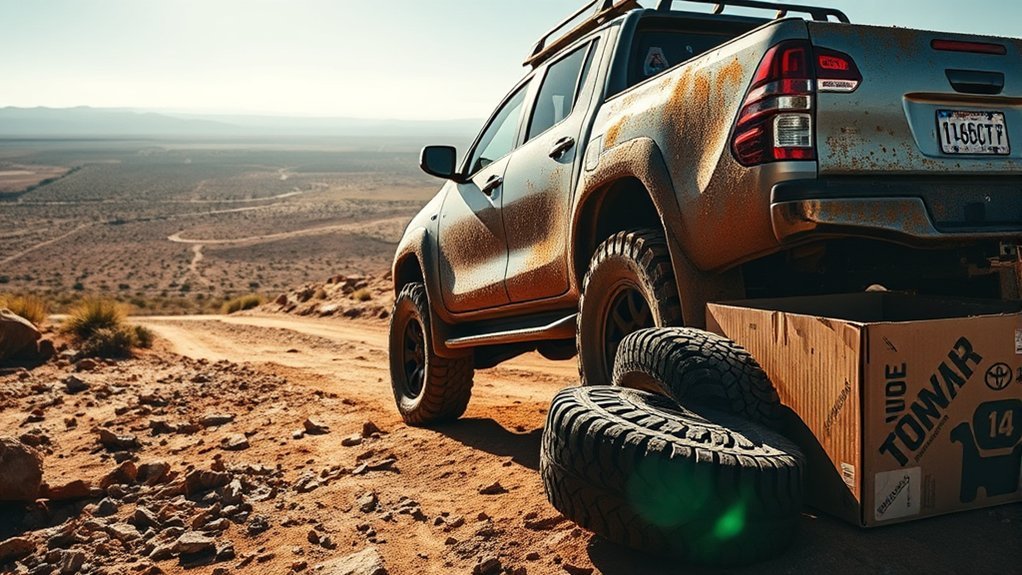
Hilux owners who travel long distances often favor all-terrain tires because they reduce the compromise between road comfort and trail confidence. A/T tires tend to be easier to live with on long highway days, while still giving enough grip for gravel, fire roads, sand, and light mud.
BFGoodrich all-terrains are popular because of their long-standing overlanding reputation, and the current KO3 is backed by a mileage warranty in many markets. General Grabber AT3 tires are often considered by drivers who want all-terrain grip with everyday usability. Goodyear Wrangler DuraTrac RT-style rugged tires suit drivers who need more shoulder bite and sidewall strength. Kumho Road Venture MT51-style mud-terrain tires make more sense when mud, rock, and low-speed traction matter more than quiet touring.
The best real-world feedback is not just “which tire lasted longest?” Ask owners with a similar Hilux, similar payload, similar roads, and similar driving speed. A tire that performs well on a lightly loaded daily driver may wear or heat differently on a fully loaded touring truck.
The best overlanding tire is the one that safely carries your real load, fits without rubbing, survives your terrain, and remains comfortable enough for the long road sections between camps.
Frequently Asked Questions
Is the Toyota Hilux good for overlanding?
Yes. The Toyota Hilux is popular for overlanding because it has a strong ladder-frame design, good payload potential, broad parts availability in many regions, and proven durability. Tire choice still matters because a heavily loaded Hilux needs the right load rating, tread pattern, and pressure for the route.
Is the Toyota Hilux good for long distances?
Yes, the Hilux can be a strong long-distance touring vehicle when it is maintained well and not overloaded. For comfort and safety, choose tires that balance road noise, wet grip, heat resistance, load capacity, and off-road durability.
What size tires are best for Toyota Hilux overlanding?
For many Hilux models, a factory-style size such as 265/65R17 is a practical starting point, but some trims use 265/60R18 or other sizes. Check your exact tire placard or official local specifications first. Upsizes such as 265/70R17 can work on some builds, but they require clearance, load-rating, and legal checks.
Is the Toyota Hilux good off-road?
Yes, the Hilux is capable off-road, especially with suitable tires, correct pressure, sensible recovery gear, and careful driving. Tires make a major difference: all-terrains suit mixed touring, while mud-terrains are better for frequent deep mud and slow technical tracks.
Should I choose all-terrain or mud-terrain tires for a Hilux?
Choose all-terrain tires if your trip includes a lot of highway, gravel, sand, and general touring. Choose mud-terrain tires if you regularly drive deep mud, ruts, loose rock, or remote tracks where maximum self-cleaning traction matters more than road noise and wet-road comfort.
Do I need LT-rated tires for overlanding?
Light-truck construction is often a good choice for loaded overlanding because it can provide stronger casing and sidewall support. However, the key rule is to match or exceed the original load rating and choose a tire that suits your actual vehicle weight and terrain.
Conclusion
The best Toyota Hilux overlanding tires are not always the biggest or most aggressive ones. For most long-distance trips, a high-quality all-terrain tire in a factory-approved or near-factory size gives the best mix of comfort, durability, load capacity, and off-road grip. Move toward hybrid or mud-terrain tires only when your terrain justifies the added noise, weight, and road compromise.
Start with your Hilux placard, confirm load rating, choose a tread pattern for your real route, keep a full-size spare, and maintain pressure, rotation, and tread depth carefully. That approach gives you a safer and more reliable setup for long roads, rough tracks, and remote camps.
Sources
- Toyota UK Hilux Technical Specifications — supports factory wheel and tire size examples by grade.
- NHTSA TireWise Tire Safety — supports tire-pressure, tread-depth, tire-size, and maintenance safety guidance.
- BFGoodrich All-Terrain T/A KO3 — supports current all-terrain product example and warranty positioning.
- General Tire Grabber AT3 — supports all-terrain product example for 4×4 and SUV use.
- Goodyear Wrangler DuraTrac RT — supports rugged terrain tire features such as three-ply sidewall and off-road tread design.
- Kumho Road Venture MT51 — supports mud-terrain tire example for rocks, mud, and snow-focused traction.