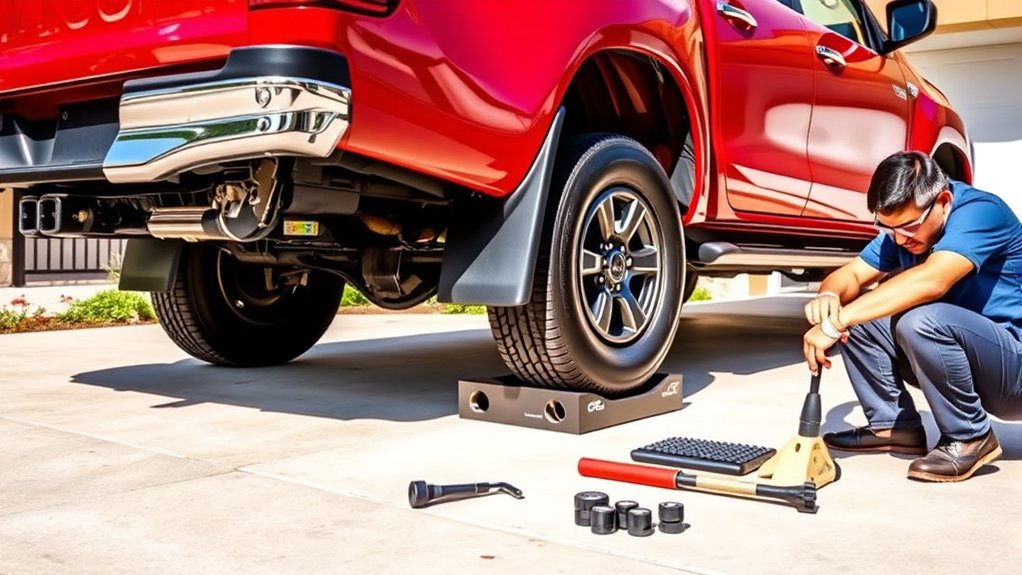
Changing a tire on a Toyota Hilux is straightforward when the vehicle is stable, the jack is placed correctly, and you work away from moving traffic. The safest approach is to stop on hard, level ground, use the Hilux jack points listed in your owner’s manual, loosen the wheel nuts before lifting, and raise the vehicle only high enough for the wheel to clear the ground.
Quick Answer
To safely lift a Toyota Hilux for a tire change, stop on hard, flat ground, switch on the hazard lights, set the parking brake, chock the opposite wheel, loosen the lug nuts slightly, place the jack only at the correct Hilux jacking point, then lift just until the tire clears the ground.
Key Takeaways
- Use the Toyota-supplied jack or a properly rated workshop jack, and place it only on the jacking point shown in your owner’s manual.
- Never change a tire on a slope, soft shoulder, sand, mud, or close to fast-moving traffic.
- Loosen the lug nuts before lifting, then tighten them in a criss-cross pattern after the spare is fitted.
- Check the spare tire pressure and get the damaged tire inspected or replaced as soon as possible.
At a Glance
| Time Required | 15–30 minutes if the spare, jack, and lug wrench are ready |
| Difficulty | Easy to moderate, depending on road conditions and wheel-nut tightness |
| Tools Needed | Spare tire, jack, lug wrench, wheel chocks, tire-pressure gauge, flashlight, gloves, and torque wrench if available |
| Cost | Usually $0 with the factory kit; allow extra for a tire gauge, chocks, or professional repair afterward |
According to NHTSA TireWise, poor tire maintenance can lead to flats, blowouts, or tread separation, and tire-related crashes caused 511 deaths in 2024.
Selecting a Safe and Level Spot for Tire Changes

Before lifting your Toyota Hilux, choose the safest place available. Look for a hard, flat surface such as asphalt or concrete, and move as far from traffic as possible. If the shoulder is narrow, sloped, soft, or exposed to fast traffic, do not risk the repair on the roadside. Call roadside assistance instead.
Warning: Never crawl under a Hilux that is supported only by a jack. A jack is for lifting, not for safely supporting a vehicle while you work underneath it.
Once you are stopped, turn on the hazard lights, set the parking brake, switch off the engine, and place the transmission in Park for an automatic or Reverse for a manual. Move passengers to a safe area away from the vehicle and traffic. Use wheel chocks or sturdy wheel wedges on the wheel diagonally opposite the flat tire to help prevent movement.
Essential Tools You’ll Need to Change a Tire
Gather everything before you loosen the wheel nuts. At a minimum, you need the spare tire, the Toyota jack or a properly rated jack, the lug wrench, and the jack handle. For a safer and smoother tire change, also keep wheel chocks, gloves, a flashlight, a reflective triangle or vest, a tire-pressure gauge, and a torque wrench in the vehicle.
- Spare tire: Confirm it is present, inflated, and usable before lifting the Hilux.
- Jack: Use the Toyota-supplied jack for roadside changes, or a workshop jack that is rated for the load and can safely reach the correct jacking point.
- Lug wrench: Make sure it fits the Hilux lug nuts and that any wheel-lock key is available.
- Wheel chocks: Place them around the wheel diagonally opposite the flat tire.
- Tire-pressure gauge: Use it to check the spare before driving away.
Note: Current Toyota Australia HiLux specifications show that weight varies by grade and body style. Do not choose a jack from a generic weight estimate; confirm your model’s manual, placard, and jack rating.
[Products Worth Considering]

This 1/2-inch drive breaker bar delivers powerful leverage for loosening and tightening stubborn lug nuts and automotive fasteners. The 180-degree flex head helps you reach tight spaces at the angle you need, making tire and brake jobs easier. A spring-loaded ball detent design holds 1/2-inch sockets securely while the chrome-moly head provides durable strength for everyday use.

The Dr.Roc spare tire tool kit helps you release, lower, or raise your spare tire with reliable extension tools and a lug nut wrench. It is made from rustproof automotive-grade steel and includes an organized carry case for convenient storage. Designed for compatibility with select GM models from the late 1990s through 2019, it uses upgraded extension components to install and remove spare tires with less hassle.

This spare tire tool kit is designed for the 2004 to 2018 Ford F-150 to help you loosen and tighten wheel lug nuts and manage the spare tire and provided jack functions from underneath the vehicle. It includes the lug nut wrench and extension pieces plus a convenient storage carrying case for organized transport. The jack itself is not included.
Before You Lift: Safety Setup Checklist
Follow this order before the jack touches the vehicle:
- Stop on hard, level ground and stay as far from traffic as possible.
- Turn on the hazard lights and set up a reflective warning triangle if it is safe to do so.
- Set the parking brake firmly.
- Shift to Park for an automatic Hilux or Reverse for a manual Hilux.
- Turn off the engine and keep passengers away from the roadside work area.
- Chock the wheel diagonally opposite the flat tire.
- Take out the spare tire, jack, lug wrench, and wheel-lock key if fitted.
- Check the spare tire for visible damage before installing it.
Where to Place the Jack on a Toyota Hilux
The correct jacking point depends on the Hilux model year, market, cab style, and drivetrain, so check the Toyota owner’s manual portal or your printed owner’s manual before lifting. Toyota’s Hilux manual guidance for a flat tire starts with stopping in a safe place on a hard, flat surface, setting the parking brake, and using the emergency flashers.
Place the jack only where the manual shows a reinforced lifting point. Do not place the jack under plastic trim, thin body panels, suspension arms, the differential housing, or any point that is not identified for lifting in your manual. If the jack leans, sinks, shifts, or makes unstable contact, lower the vehicle immediately and reset the position.
Pro Tip: On a firm but slightly uneven surface, a thick, flat wooden board can help spread the load under the jack. Do not use small rocks, bricks, or stacked objects because they can crack, roll, or slip.
[Products Worth Considering]

The Trivd Frol 1/2" air impact wrench delivers high performance torque up to 1500 ft-lbs with a twin hammer impact mechanism for strong, balanced blows. It features an ergonomic grip, compact lightweight design, and quick-stop control with 3 forward speeds up to 8000 RPM plus a reverse speed. Built for demanding automotive repair and tire shop work, the rear exhaust helps keep debris away from the surface.

This 3-ton scissor car jack tire changing kit helps you lift cars and SUVs with a wide range to reach low sedans or higher vehicles. The set includes a ratchet wrench, multi-size lug wrench, gloves, a tire pressure gauge, and a storage bag for quick emergency repairs. Built for stable, secure lifting and universal compatibility, it’s ready for flat tires and roadside wheel changes.

This ecocstm ratchet wrench is designed to make emergency and routine tire changes faster with a 360° rotating head and quick forward/reverse switching. The extended handle provides extra leverage to reduce effort and hand fatigue, while the adapter helps fit many scissor jacks on cars, SUVs, trucks, and vans. Built for reliable performance with durable construction, it’s a practical travel essential for on-the-road preparedness.
How to Lift Your Toyota Hilux for a Tire Change
Before raising the vehicle, break the lug nuts loose while the tire is still touching the ground. Turn each lug nut counterclockwise about a half-turn. Do not remove the nuts yet; the wheel should stay seated until the Hilux is lifted.
- Position the jack squarely under the correct Hilux jacking point.
- Make sure the jack head contacts the reinforced point cleanly and vertically.
- Raise the Hilux slowly while watching for movement, leaning, or sinking.
- Lift only until the flat tire clears the ground and the inflated spare can fit.
- Stop lifting as soon as you have enough clearance.
You do not need to raise the vehicle six inches unless the spare tire requires that much clearance. Lifting higher than necessary can make the vehicle less stable. For workshop work, jack stands can be used on approved support points, but for a roadside tire swap, keep the job limited to removing the flat tire and installing the spare.
[Products Worth Considering]

This car D-wheel lock nut key provides an anti-theft solution for D-shaped wheel lock bolts, helping keep your wheels secure. It features a flower-shaped internal pattern that resists micro-adjustment theft while allowing removal and mounting of compatible locking nuts. Made for reliable performance under high torque, it’s easy to use with standard socket wrench turning for quick tire maintenance and emergency repairs.

Yieokei Tesla jack pads are molded rubber lifting pucks designed for 2016-2026 Model 3/Y/S/X, including Juniper, to fit securely in the jack hole. They cushion the underframe and help position the jack precisely at the factory jack points to reduce risk of battery, paint, or chassis damage. The set also includes a tire repair tool kit for emergency roadside fixes and comes with a portable storage case to keep everything organized.

Secure your trailer or RV tires with a scissor-style wheel chock stabilizer that applies opposing force to help prevent wheel shift. It fits tight wheel gaps from 3.5 inches up to 12 inches and works for travel trailers, campers, fifth wheels, toy haulers, and heavy-duty trucks. The surface uses new electrophoretic technology to help prevent rust for reliable travel use.
Remove and Install the Tire Correctly
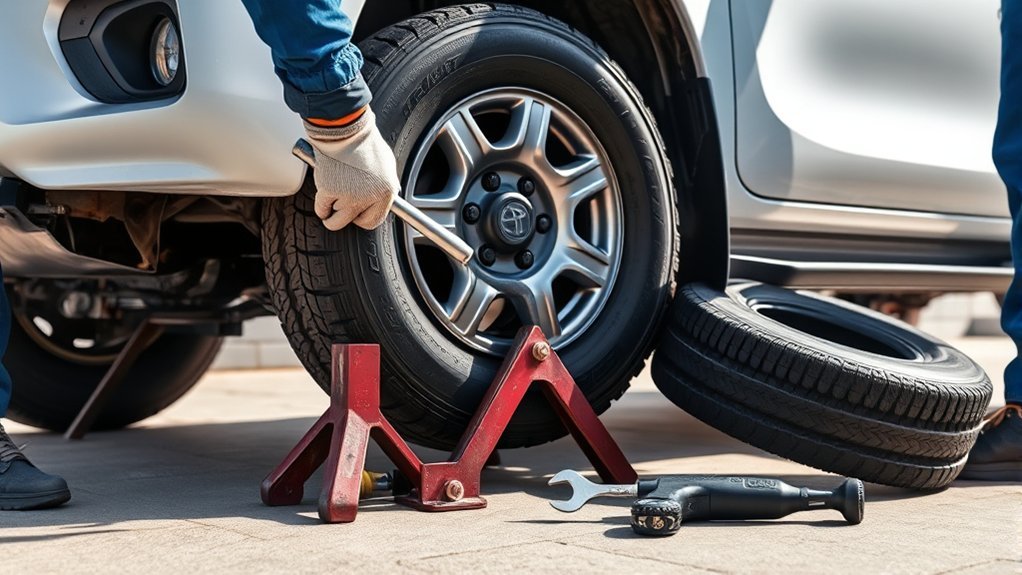
Once the flat tire is off the ground, remove the loosened lug nuts and place them somewhere clean where they cannot roll away. Pull the flat tire straight off the hub. If the wheel sticks, do not put any part of your body under the vehicle; apply controlled outward pressure from a safe position and call for help if it will not release.
Lift the spare tire onto the hub and align the wheel holes with the studs. Push the wheel fully against the mounting surface, then install the lug nuts by hand. Hand-threading helps prevent cross-threading. Tighten the nuts lightly in a criss-cross or star pattern so the wheel seats evenly.
Lower the Hilux until the spare tire just touches the ground and cannot spin. Tighten the lug nuts further in a criss-cross pattern. Then lower the vehicle completely, remove the jack, and make the final tightening pass with a torque wrench set to the specification in your owner’s manual. Do not guess the torque, and do not lubricate the wheel studs unless the manual specifically says to do so.
Post-Tire Change Safety Checks and Considerations
After the spare is installed and the Hilux is fully back on the ground, take a few minutes to check your work before driving. Recheck every lug nut in the correct pattern. Confirm that the flat tire, jack, tools, and chocks are secured in the vehicle so they cannot move around while driving.
Use a tire-pressure gauge to check the spare tire. NHTSA tire-pressure guidance says the recommended inflation pressure is listed on the tire information placard, certification label, or owner’s manual, and that cold pressure is the proper reference. If the tire is a temporary spare, follow the speed and distance limits printed on the spare tire sidewall and in the owner’s manual.
Drive slowly at first and listen for vibration, thumping, or pulling. Stop in a safe place and recheck the wheel if anything feels wrong. Arrange repair or replacement of the damaged tire as soon as possible, because a spare tire is not a long-term substitute for a sound road tire.
Common Problems and Safe Fixes
- The lug nuts will not loosen: Keep the tire on the ground and use steady pressure on the wrench. Do not jump on the wrench; if the nuts remain stuck, call roadside assistance.
- The jack sinks into the ground: Lower the vehicle and move to a harder surface. A flat wooden board can help on firm ground, but mud, sand, and gravel shoulders are unsafe.
- The vehicle shifts while lifting: Stop, lower it, reset the chocks, and reposition the jack. Do not continue with a leaning jack.
- The spare is flat or damaged: Do not install it. Call roadside assistance or arrange towing.
- The wheel lock key is missing: Do not force the lock nut with the wrong tool. Contact roadside assistance or a tire shop.
- The wheel is stuck to the hub: Avoid crawling under the Hilux or using unsafe impact methods. Get professional help if controlled movement does not free it.
When to Call Roadside Assistance
Changing the tire yourself is not worth the risk in every situation. Call roadside assistance if the Hilux is on a narrow shoulder, close to fast traffic, parked on a slope, sitting on soft ground, missing a usable spare, fitted with stuck lug nuts, or carrying a load that makes the vehicle unstable. Professional help is also the better choice at night, in heavy rain, or anywhere you cannot work safely away from traffic.
Frequently Asked Questions
How much should I lift a Toyota Hilux for a tire change?
Lift it only until the flat tire clears the ground and the inflated spare can slide onto the wheel studs. For a tire change, you do not need a 2-inch or 3-inch suspension lift; that is a separate modification topic.
Can you lift a WorkMate Hilux to change a tire?
Yes. A WorkMate Hilux can be lifted for a tire change using the Toyota-supplied jack or a correctly rated workshop jack. The key is to use the jacking point shown in the owner’s manual and keep the vehicle on hard, level ground.
Can I use a hydraulic jack on a Toyota Hilux?
Yes, if the hydraulic jack is correctly rated, fits the lifting point, and is used on firm, level ground. For roadside use, the factory jack is usually designed to work with the Hilux jacking points. Never rely on a hydraulic jack alone if you need to work under the vehicle.
Where are the Toyota Hilux jacking points?
The exact jacking points vary by Hilux model year, cab style, and market. Check the diagram in your owner’s manual before lifting. Do not use body panels, plastic trim, suspension parts, or the differential unless the manual specifically identifies that point for lifting.
What torque should Toyota Hilux lug nuts be tightened to?
Use the torque specification in the owner’s manual for your exact model year and wheel type. If you do not have a torque wrench at the roadside, tighten the nuts securely in a criss-cross pattern, drive cautiously, and have the torque checked as soon as possible.
Do I need jack stands for a Hilux tire change?
For a simple roadside tire change, you normally lift the vehicle only long enough to swap the wheel, and you should never place yourself under the vehicle. Jack stands are recommended for workshop tasks where the vehicle must stay raised for longer, but they must be placed only on approved support points.
Conclusion
Safely lifting a Toyota Hilux for a tire change comes down to three rules: choose a safe, level location; use the correct jacking point; and lift only as high as needed. Take your time, keep passengers clear, chock the opposite wheel, tighten the lug nuts in a criss-cross pattern, and check the spare tire pressure before driving. If the location, tools, or spare tire are not safe, roadside assistance is the right choice.
Sources
- Toyota Europe Owner Manuals — supports checking the official Hilux manual for model-specific jacking points and tire-change instructions.
- Toyota Motor Europe Hilux Owner’s Manual PDF — supports owner-manual guidance for flat-tire procedures, jack use, and emergency setup.
- Toyota Australia HiLux Specification Sheet — supports current HiLux model weight and specification caveats.
- NHTSA TireWise — supports tire-maintenance safety risks and tire-related crash data.
- NHTSA Tire Safety Brochure — supports tire-pressure, placard, cold-pressure, and tire inspection guidance.
- AAA Club Alliance: How to Change a Tire — supports general flat-tire safety, tool checklist, star-pattern tightening, and when to call roadside assistance.