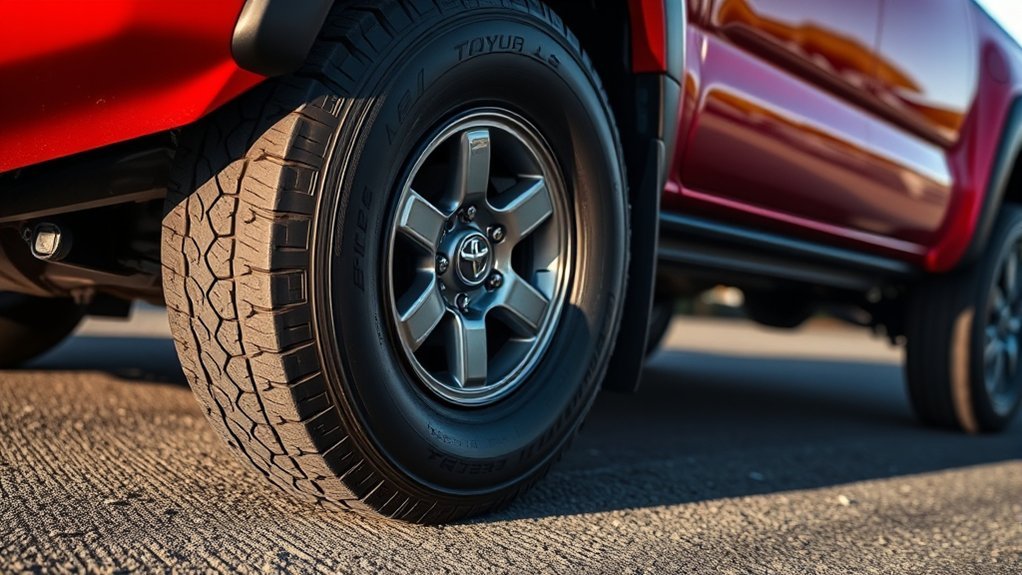
Using different tire sizes on a Toyota Tacoma can create more than a cosmetic mismatch. Different rolling circumferences make the wheels turn at different speeds, which can change handling, confuse wheel-speed-based safety systems, and add drivetrain stress on a 4WD truck. The safest choice is to use the tire size and ratings listed for your exact year and trim.
Quick Answer
Do not routinely run mismatched tire sizes on a Toyota Tacoma. Use four tires that match the size, construction, load rating, type, and preferably model specified for your truck. A factory spare may carry a different size code, so follow its label and your owner’s manual rather than a universal percentage or inch rule.
Key Takeaways
- Check the driver-side tire placard and the owner’s manual for your Tacoma’s approved tire size and cold pressure.
- A 4WD Tacoma benefits from four closely matched tires because tire circumference and tread wear affect wheel speed.
- Do not treat a 3% or 3/8-inch difference as a universal safe limit. Toyota’s instructions for your exact truck take priority.
- A factory spare can have a different printed size from the road tires while maintaining a suitable rolling diameter.
- If warning lights, pulling, binding, vibration, or uneven wear appear after a tire change, stop using 4WD and have the setup inspected.
Last reviewed: July 17, 2026.
Warning: Do not engage 4WD on a high-traction surface when your Tacoma has an unapproved tire mismatch. Drivetrain wind-up or binding can occur even with correctly matched tires if part-time 4WD is used on dry pavement.
The Risks of Mismatched Tire Sizes on Your Tacoma
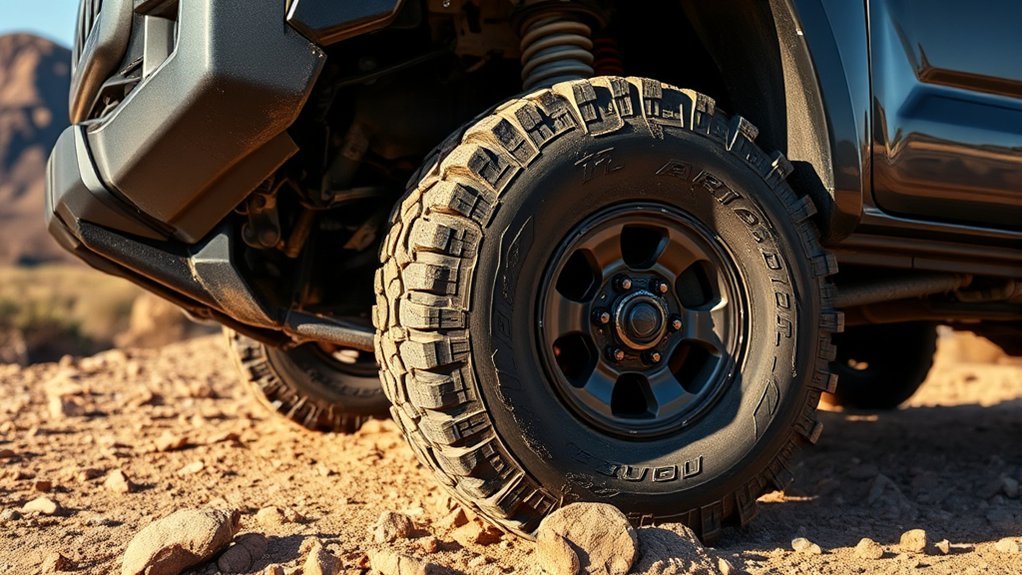
Your Tacoma’s wheels should cover nearly the same distance with each revolution unless Toyota designed the truck with a specific alternate fitment. When one tire has a different rolling circumference, it turns faster or slower than the others at the same road speed.
On a 4WD Tacoma, that difference can keep the front and rear driveline components from rotating at compatible speeds. The result may be binding, extra heat, accelerated wear, or damage to the transfer case and differentials. The risk depends on the truck’s year, drivetrain, road surface, tire construction, inflation, and the size of the mismatch.
A mismatch can also affect steering response, braking balance, and stability. ABS, traction control, and vehicle stability control compare wheel-speed signals. A tire that rotates at an unexpected rate may cause unwanted intervention, a warning light, or reduced system accuracy.
The sidewall size is only the starting point. Tire model, tread depth, pressure, load, and actual revolutions per mile also affect rolling circumference.
What Counts as a Mismatched Tire?
A mismatch is not limited to two visibly different size codes. Tires can create an operating mismatch when they differ in one or more of these areas:
- Size designation: Examples include 245/70R17 and 265/70R17.
- Overall rolling circumference: Two nominally similar sizes may travel different distances per revolution.
- Tread depth: A new tire is effectively taller than a heavily worn tire of the same model.
- Construction: Do not mix radial and non-radial tires.
- Tire type: Mixing all-terrain, all-season, winter, or summer tires can create traction imbalance.
- Load index and speed rating: Replacement tires should meet the ratings specified for the truck.
- Inflation pressure: Underinflation changes the tire’s loaded radius and load capacity.
Matching the printed size alone does not guarantee identical behavior. For the most consistent response, use the same brand, model, size, load index, speed rating, construction, and similar tread depth at all four positions.
Understanding How Tire Size Affects Performance
Changing tire size changes more than ground clearance. It can alter several parts of the driving experience:
- Drivetrain load: Different wheel speeds can create continuous correction inside the differential or transfer system.
- Handling and stability: Different grip levels can make the front and rear axles respond differently during turns or emergency maneuvers.
- Braking and safety systems: A changed rolling circumference can alter the wheel-speed signals used by ABS and stability control.
- Speedometer and odometer readings: A larger or smaller overall diameter can change displayed speed and distance.
- Clearance: A wider or taller tire may rub the body, suspension, mud flaps, or brake components.
- Load capacity and pressure: A replacement tire must support the truck’s required load at an appropriate pressure. Learn more about tire sizing and load capacity.
Maintaining an OEM-equivalent diameter is useful, but it is not the only requirement. Wheel width, offset, load rating, brake clearance, tire construction, and Toyota’s specifications must also match the application.
What Toyota and Tire-Safety Guidance Say
NHTSA advises drivers to buy the same tire size as the vehicle’s original tires or another size recommended by the vehicle manufacturer. The correct size and cold pressure appear on the driver-side Tire and Loading Information label and in the owner’s manual.
Toyota Tacoma tire sizes vary by model year, trim, wheel package, and drivetrain. For example, Toyota’s 2024 Tacoma specifications list several road-tire sizes, including 245/70R17, 265/70R17, and 265/65R18 for different configurations. That is why a size that is factory-correct for one Tacoma may be wrong for another.
Recommended Tire Specifications
Before buying or installing a replacement, confirm all of the following:
- The tire size matches the placard or a Toyota-approved option for your exact truck.
- The wheel diameter and approved rim-width range are compatible.
- The load index meets or exceeds the vehicle requirement.
- The speed rating meets the vehicle specification unless Toyota or a qualified tire professional approves an exception.
- The tire type and construction match the other tires.
- The cold inflation pressure follows the vehicle placard, not the maximum pressure molded into the tire sidewall.
Why the 3% or 3/8-Inch Rule Is Not Enough
Online tire calculators often compare a proposed size with the original and show a percentage difference. That is useful for screening, but it is not a Toyota approval. A calculated difference does not account for actual tire dimensions, tread wear, inflation, wheel offset, suspension clearance, or drivetrain requirements.
Do not rely on a universal 3%, 3/8-inch, or 1-inch rule for a Tacoma. Check the owner’s manual and tire placard, then ask a qualified tire professional to verify fitment and actual circumference when changing from the specified size.
Pro Tip: When replacing one tire on a 4WD Tacoma, compare the new tire’s measured tread depth and published revolutions per mile with the remaining three. A matching size code can still hide a meaningful circumference difference.
Safe Practices for Using a Spare Tire
Do not assume the spare must carry the exact same sidewall size as the road tires. Toyota may specify a different spare size that has a similar rolling diameter. In the 2024 Tacoma specifications, some 265/70R17 and 265/65R18 configurations use a 245/75R17 spare, while other configurations use a matching full-size spare.
Use these steps when a spare is installed:
- Read the spare’s label. Follow its speed, distance, pressure, and service restrictions.
- Check the owner’s manual. Spare design and restrictions differ by Tacoma year and configuration.
- Inflate it correctly. Check the spare when cold and use the pressure Toyota specifies. The recommended pressure may differ from the road tires.
- Drive gently. Avoid hard acceleration, abrupt steering, heavy loads, towing, and high speeds unless the manual explicitly allows them.
- Use 4WD only as directed. If the spare label or manual restricts 4WD operation, remain in 2WD and travel only as needed for repair.
- Repair the regular tire promptly. A spare is not permission to continue normal use with an improvised mismatch.
Note: “Drive under 50 miles” is not a universal Tacoma rule. The correct limit is the one printed on the spare and stated in the owner’s manual for your truck.
[Products Worth Considering]

Steelman white tire marking crayons provide high-contrast, semi-permanent marks for repairing and inspecting tires and equipment. They write on wet or dry, smooth or coarse surfaces including rubber, metal, glass, and wood, making them ideal for puncture location and damage outlining. The lead- and zinc-free crayons resist weather and fading yet wipe away when you no longer need the marks.

Monitor tire tread wear with a smart, color-coded depth gauge that shows clear condition ranges at a glance. The bar is range marked for fast, easy readings, helping you maintain safer traction and performance. Each gauge is portable with a pocket clip, and the set includes 20 units for daily use and sharing.

These aluminum alloy tire valve stem caps with an O-ring seal help protect valve stems from corrosion while adding a clean, stylish look to your vehicle. The universal fit works across cars, trucks, motorcycles, bicycles, and more, making them an easy upgrade for everyday driving and off-road use. Installation is quick, and the included four-pack keeps all your tires dressed and protected.
How to Spot Problems Caused by Mismatched Tires
Problems can appear immediately or develop over time. Inspect the truck if any symptom starts after a tire replacement, rotation, wheel change, or spare installation.
Handling and Stability Issues
- The truck pulls during acceleration or braking.
- Steering response feels different in left and right turns.
- The rear feels loose or the front pushes wide on wet roads.
- The truck feels as if it is hopping, scrubbing, or resisting a turn in 4WD.
- New vibration appears at a certain road speed.
A pull or vibration can also come from pressure, balance, bent wheels, alignment, or suspension wear. A professional wheel alignment and tire inspection can separate those causes from a size mismatch.
Uneven Tire Wear
Compare tread depth across all four tires and across the inner, center, and outer portions of each tread. Watch for cupping, feathering, bald shoulders, or one tire wearing faster than the others. Uneven wear can change rolling circumference and make an existing mismatch worse.
Safety-System Warnings
ABS, traction-control, stability-control, and tire-pressure warning lights may appear when the truck detects unexpected wheel behavior. A warning light does not prove tire size is the cause, but it should not be ignored. Scan the truck for diagnostic codes and inspect tire size, pressure, sensors, and wheel-speed components.
Drivetrain Binding or Noise
Stop using 4WD and arrange an inspection if you notice binding during turns, clunking, driveline vibration, unusual heat, or a burning smell. Continuing to drive can turn a correctable fitment problem into an expensive drivetrain repair.
Can You Replace Only One or Two Tacoma Tires?
Replacing all four with a matched set gives the most consistent result. This matters most on 4WD models, where large differences in tread depth or circumference can keep the driveline under continuous stress.
If you must replace fewer than four tires, follow Toyota’s instructions first. USTMA recommends that replacement tires match the specified size, load index, and speed rating. When replacing only two, it recommends installing the new pair on the rear axle to improve wet-road stability.
A single replacement should match the other tires as closely as possible in brand, model, size, construction, and tread depth. A tire shop may recommend replacing all four or professionally shaving a matching new tire when the remaining tires are substantially worn. Do not move a random mismatched tire to a “non-driven” axle and assume the risk disappears.
[Products Worth Considering]

Measure tire tread depth quickly and accurately with this LUMITECO dial gauge that reads in 1/32" increments up to 14/32". The color-coded green/yellow/red zones make it easy to judge tire wear and know when replacement is needed. A rugged, compact design with a protective pouch helps keep the gauge ready for use on cars, trucks, motorcycles, and more.

Upgrade your 2024-2026 Tesla Model 3 Highland with REEVAA all-weather mud flaps designed for seamless fit along the original body lines. The set of four delivers strong splash protection against mud, gravel, and road debris while using OEM-grade durable materials. Installation is non-destructive with original hole positions and snap-in clips, and the aerodynamic design helps minimize impact on efficiency.

Measure tyre tread depth precisely with a digital gauge that reads in both MM and inches, helping you monitor safe driving conditions. The large LCD screen is easy to operate, and the compact tool fits for cars, trucks, and motorcycles. It provides high accuracy with a 0-25.4mm range and includes a 1-year warranty for added peace of mind.
How to Compare Tire Diameter Before Installation
You can estimate a metric tire’s unloaded diameter with this formula:
Estimated diameter = wheel diameter + 2 × (section width × aspect ratio ÷ 25.4)
For a 265/70R17 tire, the estimated sidewall height is 265 × 0.70 ÷ 25.4, or about 7.3 inches. Adding two sidewalls to the 17-inch wheel gives an estimated unloaded diameter of about 31.6 inches.
This calculation is only an estimate. Use the tire manufacturer’s actual diameter and revolutions-per-mile data when available. Then confirm wheel width, offset, load rating, fender clearance, suspension clearance, and brake clearance on the truck.
[Products Worth Considering]

This spare tire tool kit is designed for the 2004 to 2018 Ford F-150 to help you loosen and tighten wheel lug nuts and manage the spare tire and provided jack functions from underneath the vehicle. It includes the lug nut wrench and extension pieces plus a convenient storage carrying case for organized transport. The jack itself is not included.

The 22800 wheel stud installer makes replacing wheel studs quick and secure, saving time and effort during tire service. It uses a ratchet or impact wrench to pull new studs firmly into place, helping when existing studs are too long. Compatible with most automotive wheels and light-duty truck wheel studs, it’s designed for easy, tool-assisted installation.

The SAFELIFE dial tire tread depth gauge measures tread depth in 1/32 inch increments with clear, easy-to-read 2-inch dial face. Color zones using a traffic light system help you quickly judge whether tread is low, marginal, or ample for safer driving. Built with a durable zinc cast body and a metal detect probe for precise, comfortable use across cars, motorcycles, trucks, and buses.
Best Practices for Tacoma Tire Maintenance
- Check pressure monthly: Measure all road tires and the spare when cold. Use the pressure on the vehicle placard.
- Rotate as Toyota specifies: Regular tire rotation helps control uneven wear, but the correct pattern and interval depend on the truck.
- Measure tread depth: NHTSA states that tires should be replaced when tread reaches 2/32 inch. Replace earlier when damage, weather, or performance needs justify it.
- Balance and align: Address vibration, pulling, or irregular wear promptly.
- Inspect tire age and damage: Check for cracks, bulges, cuts, punctures, and aging. Learn how tire age affects safety.
- Use four matching seasonal tires: Do not mix winter tires on one axle with all-season tires on the other. Review the differences between all-season and all-weather tires before choosing a set.
Common Tacoma Owner Mistakes to Avoid
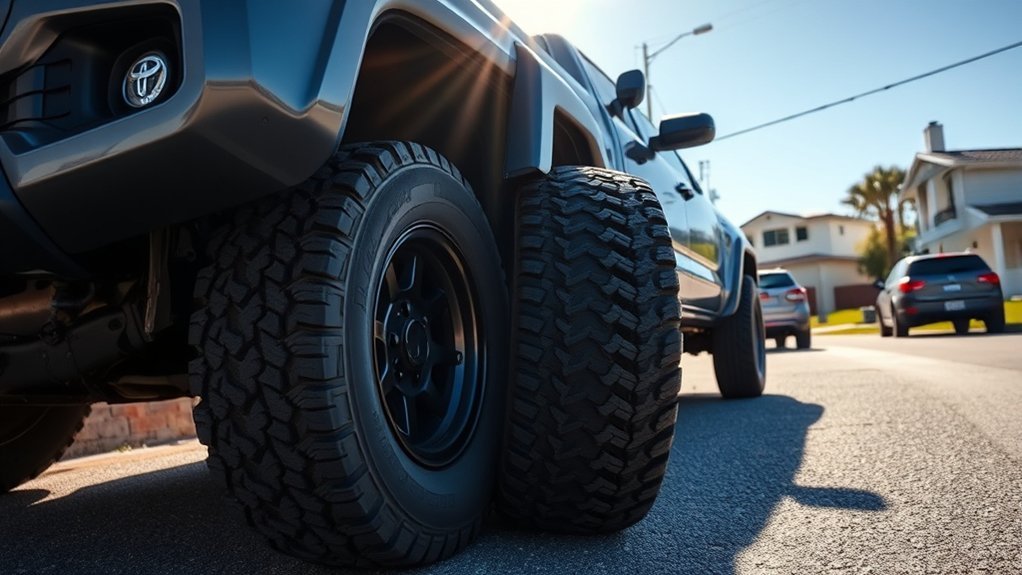
Owner forums can help you identify possible rubbing points or real-world fitment concerns, but one owner’s setup does not prove that a size is safe for your truck. Wheel offset, tire model, suspension height, alignment, cargo, body trim, and tread width can change the result.
- Do not assume two sizes are compatible because an online calculator shows a small percentage difference.
- Do not assume a tire fits every Tacoma because it fits one year or trim.
- Do not place mismatched tires on a different axle and treat the problem as solved.
- Do not use only two winter or all-terrain tires when the other axle has a different tire type.
- Do not copy another owner’s pressure setting. Use your placard or a professionally calculated setting for an approved alternate size.
Use community experience to create a list of questions, then confirm the answer with Toyota documentation and a qualified tire professional who can inspect the actual truck.
Frequently Asked Questions
Will a 265/70R17 tire fit a Toyota Tacoma?
It fits some Tacoma configurations and is a factory-listed size on certain 2024 models. It is not a universal fit for every year, trim, wheel, offset, or suspension setup. Check your door placard and owner’s manual, then verify clearance before installation.
Can a Tacoma use different tire sizes on the front and rear?
Do not create a staggered setup unless Toyota specifies or approves it for your exact truck. Different rolling circumferences can affect handling, wheel-speed systems, and the 4WD drivetrain.
Can you mix tire brands if all four tires show the same size?
It is better to use the same brand and model on all four positions. Tires with the same size code can differ in actual diameter, tread design, compound, load behavior, and revolutions per mile. Matching is especially important on a 4WD Tacoma.
Is a 3% tire-diameter difference safe on a Tacoma?
Do not treat 3% as a universal safe limit. It is a calculator guideline, not Toyota approval. Use the size listed for your truck or have an alternate fitment verified for load, circumference, pressure, clearance, and system compatibility.
Can you drive in 4WD with a mismatched spare?
Follow the spare label and the owner’s manual. A Toyota-specified spare may have a different printed size but a suitable rolling diameter. An improvised spare with an unknown mismatch should not be used in 4WD on high-traction surfaces.
Conclusion
Mismatched tire sizes can change how your Toyota Tacoma steers, brakes, and distributes load through its drivetrain. The risk is greater on a 4WD model, but a mismatch can affect any Tacoma. Use the tire placard and owner’s manual as your starting point, keep all four tires closely matched, and verify any alternate size before driving.
If a mismatch is temporary because of a flat tire, follow the factory spare instructions and repair the regular tire promptly. If you notice binding, warning lights, vibration, pulling, or unusual wear, avoid 4WD and have the tires and drivetrain inspected.
Sources
- Toyota 2024 Tacoma Owner’s Manual: Tires and Wheels — factory tire sizes, spare sizes, pressures, and wheel specifications.
- NHTSA TireWise — replacement size, pressure, tread, rotation, and tire-maintenance guidance.
- U.S. Tire Manufacturers Association: Replacing Tires — replacement size, load index, speed rating, and two-tire placement guidance.
- Michelin: Mixing Tires — matching tire type, size, tread, and 4WD considerations.
- Toyo Tires Safety Information — tire-mixing, load, construction, clearance, and 4WD guidance.