
Replacing one damaged tire on a Toyota 4Runner may be possible, but the correct choice depends on your model year, drivetrain, tire specifications and the wear on the other three tires. A replacement that differs significantly in size, construction, tread design or rolling circumference can affect handling and may place unnecessary stress on a four-wheel-drive system.
Quick Answer
You can sometimes replace just one 4Runner tire when the new tire exactly matches the required size, construction, load rating, speed rating and tread design, and its rolling circumference closely matches the other tires. If the remaining tires have substantial wear, a shaved replacement or a complete set may be safer.
Key Takeaways
- Toyota does not publish one universal 4/32-inch matching rule for every 4Runner model and drivetrain.
- Check the owner’s manual for your exact model year before replacing fewer than four tires.
- Match tire size, construction, load index, speed rating, make, model and tread pattern as closely as possible.
- The 2/32-inch tread figure is a general worn-tire replacement point, not a universal 4WD matching tolerance.
- A professionally shaved new tire is generally more predictable than an unknown used tire.
- Have a qualified tire professional measure all four tires and inspect the damaged tire before ordering replacements.
Can You Replace Just One 4Runner Tire?
Yes, replacing one tire can be acceptable in some situations. It is most practical when the other three tires are still relatively new and an exact or approved matching tire is available.
The replacement should match the vehicle’s approved tire size and meet the required load index, speed rating and construction. On a 4WD 4Runner, it should also match the existing make, model and tread pattern whenever possible. The remaining tread depth and actual rolling circumference must be close enough to satisfy the applicable vehicle and tire-manufacturer guidance.
Replacing all four tires is usually the better choice when the existing set has substantial wear, the original tire has been discontinued, multiple tires are damaged or a suitable circumference match cannot be achieved.
| Situation | Likely Best Option |
|---|---|
| The other three tires are nearly new and an identical replacement is available | One matching tire may be acceptable after measurements and a professional check. |
| The other tires are moderately worn but remain serviceable | Consider professionally shaving an otherwise identical new tire to the required depth. |
| The matching tire has been discontinued | Replace the full set unless Toyota and the tire manufacturer approve another combination. |
| The remaining tires are close to their replacement point | Replace all four instead of sacrificing tread from a new tire. |
| More than one tire has damage, irregular wear or questionable repairs | Replace the affected set and correct the cause of the abnormal wear. |
Warning: Do not assume that a tread-depth number found for another vehicle brand applies to your 4Runner. Follow the manual for your model year and obtain written guidance from Toyota or the tire manufacturer when the allowed difference is unclear.
Why Matched Tires Matter on a 4Runner
A tire with a larger rolling circumference travels farther during each revolution than a smaller tire. When different-sized tires are mechanically connected through a 4WD system, the drivetrain may need to accommodate the speed difference continuously instead of only during turns or brief wheel slip.
That does not mean every small tread difference causes immediate damage. The effect depends on the drivetrain design, operating mode, tire construction, inflation pressure, load, road surface and size of the mismatch. However, using closely matched tires reduces unnecessary drivetrain activity and gives you more consistent braking, steering and traction.
Tire pressure also affects rolling radius. Before comparing tread measurements or circumference, inflate all tires to the cold pressure listed on the driver’s door placard. Do not use the maximum pressure printed on the tire sidewall as the vehicle’s normal setting.
Know Which 4Runner Drivetrain You Have
Not every Toyota 4Runner has the same four-wheel-drive hardware. Toyota’s current lineup includes 2WD, part-time 4WD and full-time 4WD configurations. The 2026 Toyota 4Runner drivetrain overview states that full-time 4WD and a locking center differential are limited to specific applications, while other trims use part-time 4WD or 2WD.
- 2WD models: Tire matching remains important for predictable handling, braking and traction, but there is no four-wheel-drive transfer case connecting all four wheels.
- Part-time 4WD models: These systems are designed for appropriate low-traction surfaces when 4WD is engaged. Tire mismatch can add to driveline windup, especially when 4WD is used on high-traction pavement.
- Full-time 4WD models: The center differential accommodates normal front-to-rear speed differences, but significantly different tire circumferences can make it work more than intended.
Check the badges, transfer-case controls and owner’s manual rather than assuming that your vehicle has a Torsen differential or the same system as another 4Runner generation.
What Toyota Actually Says About Tire Matching
Toyota’s guidance focuses on matching the tires rather than establishing one numerical tread-depth rule for every 4Runner. In its 2025 4Runner owner’s manual guidance, Toyota tells 4WD owners not to mix tires of different makes, models, tread patterns or treadwear.
The wording “different treadwear” does not create a universal Toyota 4/32-inch limit. The allowable difference may depend on the specific model, tire and service guidance. A dealership or tire manufacturer may also evaluate actual tire circumference or revolutions per mile instead of relying only on tread depth.
Note: A tire’s labeled size does not guarantee that every brand and model has precisely the same mounted circumference. Tread design, casing construction, inflation pressure and load can produce small differences.
Minimum Tread Depth Is Not a Matching Tolerance
The National Highway Traffic Safety Administration advises replacing tires when tread reaches 2/32 inch. Its TireWise guidance also recommends monthly tread, pressure and damage checks.
That 2/32-inch figure describes a worn tire’s general replacement point. It does not mean that a 2/32-inch difference between two 4Runner tires is always approved, and it does not prove that a larger difference will automatically damage the drivetrain.
For a one-tire replacement, you need two separate decisions:
- Is each existing tire still safe and serviceable? Check tread depth, age, damage, repairs and irregular wear.
- Are the four tires matched closely enough for the vehicle? Follow the model-specific manual and obtain professional guidance when no numerical tolerance is provided.
How to Decide Whether One Tire Can Be Replaced
1. Determine Whether the Damaged Tire Can Be Repaired
A puncture does not always require replacement. A qualified technician should remove the tire from the wheel and inspect its interior. A small puncture in an approved section of the tread may be repairable, while sidewall damage, shoulder damage, internal separation, severe run-flat damage or an oversized puncture usually requires replacement.
Repairing the original tire, when it can be repaired correctly, preserves the existing tire match and may be the simplest solution.
2. Record the Correct Tire Specifications
Check the driver’s door placard, owner’s manual and tire sidewall. Record:
- Tire size.
- Load index or load range.
- Speed rating.
- Radial or other construction.
- Make and model.
- Tread pattern and tire category, such as all-season or all-terrain.
- Original tread depth and current remaining depth.
- Any Toyota-approved alternative tire size.
The U.S. Tire Manufacturers Association replacement guidance says replacement tires should meet the vehicle or tire manufacturer’s recommended size, load index and speed-rating requirements.
3. Measure All Four Tires
Measure the inner, center and outer main grooves on every tire. Record the lowest valid reading for each tire and note any shoulder wear, cupping or feathering.
If one edge is much more worn than the center, the problem may involve alignment, suspension wear, pressure or rotation history. Replacing a tire without correcting the cause may quickly damage the new tire.
4. Compare More Than Tread Depth
Tread depth is a convenient screening measurement, but circumference or manufacturer-published revolutions per mile may provide a better comparison when tolerances are tight.
A tire professional can measure the mounted tire circumference under consistent pressure and load conditions. They can also confirm whether the proposed tire is compatible with the vehicle’s ABS, traction-control and TPMS systems.
5. Choose One Tire, Shaving or a Full Set
A single unshaved replacement is most reasonable when the other three tires have little wear. A shaved tire can be considered when the tires have useful life remaining but a new tire would be significantly taller. Replace the full set when the remaining tires are substantially worn or a proper match cannot be created.
Pro Tip: Ask the shop to write the measured tread depth of all four tires on the work order. Also request the replacement tire’s exact make, model, size, load index, speed rating and final shaved depth, when applicable.
How Tread-Depth Differences Affect 4WD
As tread wears away, a tire’s outside diameter and circumference gradually decrease. A newer tire may therefore complete slightly fewer revolutions per mile than a worn tire of the same nominal size.
In a part-time 4WD system, using 4WD on dry, high-traction pavement can already create driveline windup because the front and rear axles cannot freely rotate at different average speeds. A tire mismatch can add another source of speed difference.
In full-time 4WD, the center differential is designed to accommodate normal differences during turning. A persistent tire-circumference difference can make the system compensate more often than intended.
The practical response is not to panic over every small measurement difference. Instead, confirm your drivetrain, follow the manual and compare the replacement with all three remaining tires before installation.
Tire Shaving: Process, Cost and Limitations
Tire shaving removes tread rubber from a new tire using specialized equipment. The goal is to bring the new tire’s remaining tread and rolling circumference closer to the tires already on the vehicle.
Tire Rack’s tire-shaving guidance explains that a tire lathe can remove rubber while preserving the general tread profile. Service pricing, availability and shipping charges vary, so obtain a current quote before ordering.
A shaved new tire gives you a known casing, known history and controlled tread depth, which is usually more predictable than purchasing an unknown used tire.
Tire shaving makes sense only when:
- The new tire is otherwise an approved match.
- The existing tires are safe and have meaningful service life remaining.
- A professional determines the required final tread depth.
- Removing the required rubber will not leave the new tire too close to replacement.
- The tire manufacturer does not prohibit the procedure for that tire.
Shaving is less attractive when the remaining tires are already heavily worn. In that case, replacing all four may provide better wet traction, longer service life and more consistent handling.
[Products Worth Considering]

The Ziopetru adjustable magnetic wheel alignment tool helps you check and restore camber and caster positioning after removing and reinstalling undercarriage components. With a clear leveling/bubble measurement system and an easy zeroing adjustment knob, it supports precise horizontal angle checking. The strong magnetic base mounts to metal surfaces for convenient use at home on cars, motorcycles, trucks, vans, and SUVs.

Monitor tire tread wear with a smart, color-coded depth gauge that shows clear condition ranges at a glance. The bar is range marked for fast, easy readings, helping you maintain safer traction and performance. Each gauge is portable with a pocket clip, and the set includes 20 units for daily use and sharing.

The SAFELIFE dial tire tread depth gauge measures tread depth in 1/32 inch increments with clear, easy-to-read 2-inch dial face. Color zones using a traffic light system help you quickly judge whether tread is low, marginal, or ample for safer driving. Built with a durable zinc cast body and a metal detect probe for precise, comfortable use across cars, motorcycles, trucks, and buses.
Finding and Vetting a Used Tire for Your 4Runner
A used tire may appear to match perfectly, but its history is often unknown. It may have been overloaded, underinflated, driven while flat, repaired incorrectly or stored in damaging conditions.
The USTMA used-tire guidance warns that some serious defects cannot be identified from exterior photographs. The tire may need to be removed from the wheel so a qualified technician can inspect its inner liner and previous repairs.
[Products Worth Considering]

Measure tire tread depth quickly and accurately with this LUMITECO dial gauge that reads in 1/32" increments up to 14/32". The color-coded green/yellow/red zones make it easy to judge tire wear and know when replacement is needed. A rugged, compact design with a protective pouch helps keep the gauge ready for use on cars, trucks, motorcycles, and more.

Accurately measure tire tread depth with a calibrated gauge marked from 0 to 1 inch in 1/32 inch increments. The color-coded bar helps you quickly identify tread condition ranges, supporting safe driving for trucks, motorcycles, automobiles, and passenger vehicles.

This tire inflator with pressure gauge delivers long-lasting performance with a durable rubber-protected gauge and sturdy build. The longer hose and 360 swivel air chuck help you seal the valve securely and keep your hands free while measuring, inflating, or deflating. It’s battery-free for reliable use and provides ±2 PSI accuracy in the mid-range for most typical tires, with universal compatibility for 1/4 NPT compressor outputs.
Used-Tire Inspection Checklist
- Confirm the exact size, load index, speed rating, make, model and construction.
- Measure tread depth at the inner, center and outer grooves.
- Check the DOT date code and inspect for age-related cracking.
- Reject exposed cords, bulges, cuts, sidewall punctures or signs of separation.
- Reject tires with irregular wear that cannot be explained and corrected.
- Have the tire demounted to inspect the inner liner.
- Confirm that any repair follows current tire-industry procedures.
- Do not rely only on marketplace ratings, photographs or a seller’s tread estimate.
A used tire with an unknown history is not automatically a bargain. Professional inspection, mounting, balancing and potential replacement can eliminate much of the initial saving.
Shaved vs. Used: Which Single-Tire Fix Is Better?
A shaved new tire is generally the more predictable option because you know the tire’s age, construction and service history. You can order the correct model and have its tread reduced to a professionally selected depth.
A used tire preserves its existing tread without sacrificing new rubber, but it introduces more uncertainty. Even a tire with the correct tread depth may have hidden damage or an improper internal repair.
| Factor | Shaved New Tire | Used Tire |
|---|---|---|
| Service history | Known | Often incomplete or unknown |
| Tread matching | Can be cut to a requested depth | Limited to the tire as found |
| Hidden damage risk | Low before installation | Requires careful internal inspection |
| Availability | Depends on tire and shaving service | Exact match may be difficult to find |
| Best use | Preserving a safe, moderately worn matching set | Only when professionally inspected and closely matched |
[Products Worth Considering]
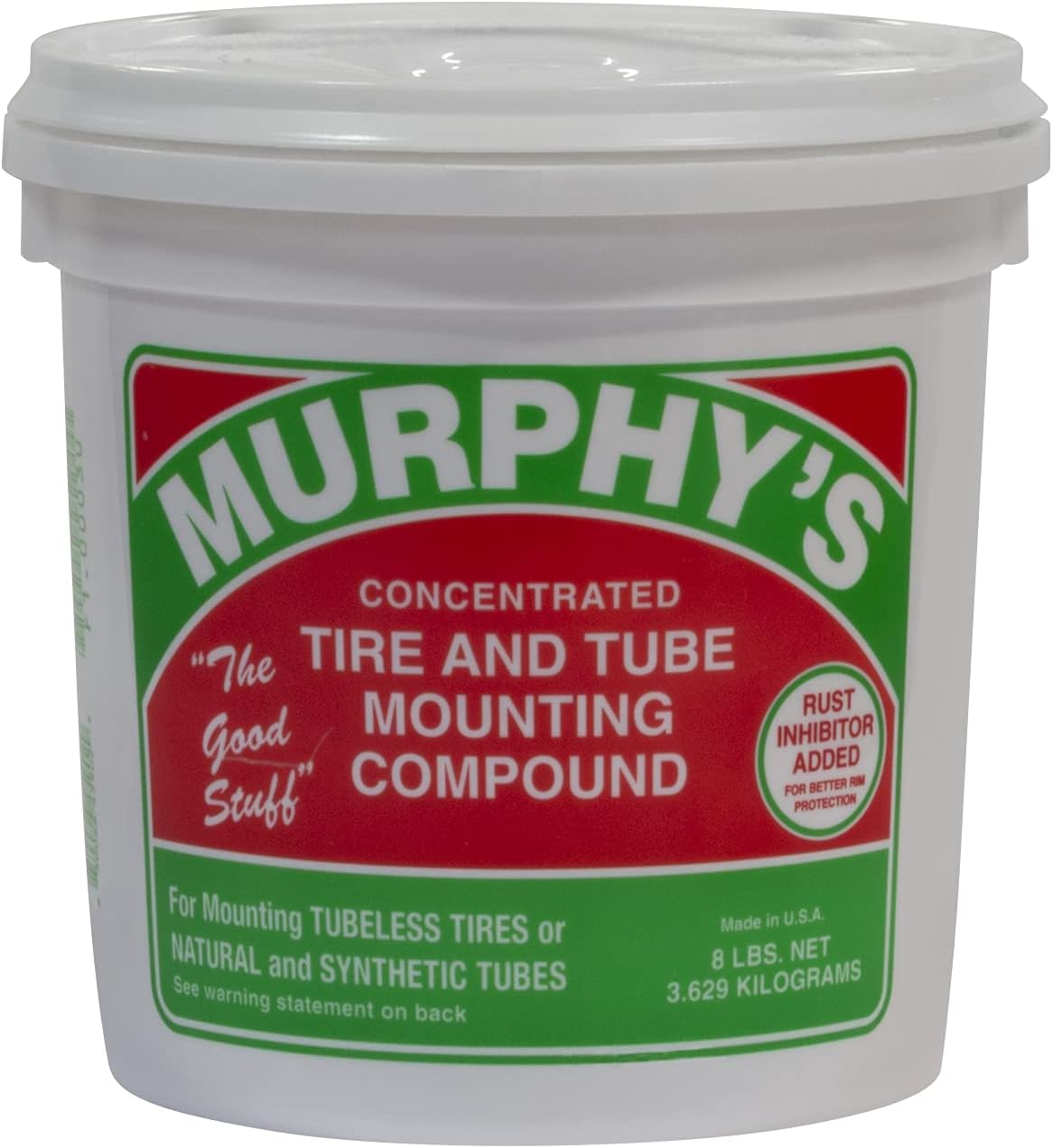
A concentrated tire and tube mounting compound designed to help simplify mounting rubber tires and tubes on passenger, semi truck, construction, and OTR applications. Its ultra-thick formula packs beads effectively and includes rust inhibitors to help protect against corrosion during use.
This flat-free TICONN wheelbarrow tire features durable polyurethane foam construction that never needs inflation, helping prevent punctures and reducing maintenance on rough outdoor terrain. With a 300 lb max load capacity and stable steel rim design, it supports safer transport for yard work and hauling tasks. An adapter kit with ball bearings and nylon spacers is included for easier fit and customization across common wheelbarrow and cart axle setups.
This TPMS relearn tool helps you quickly activate, match, and reset GM tire pressure sensors to keep the vehicle monitoring system working properly. It clears tire pressure alarms and dashboard warning lights after sensor replacement or tire rotation, and supports learning for common 315/433 MHz TPMS sensors. Designed for simple one-button operation, it can help you avoid unnecessary trips to repair shops.
How to Measure 4Runner Tire Tread Depth
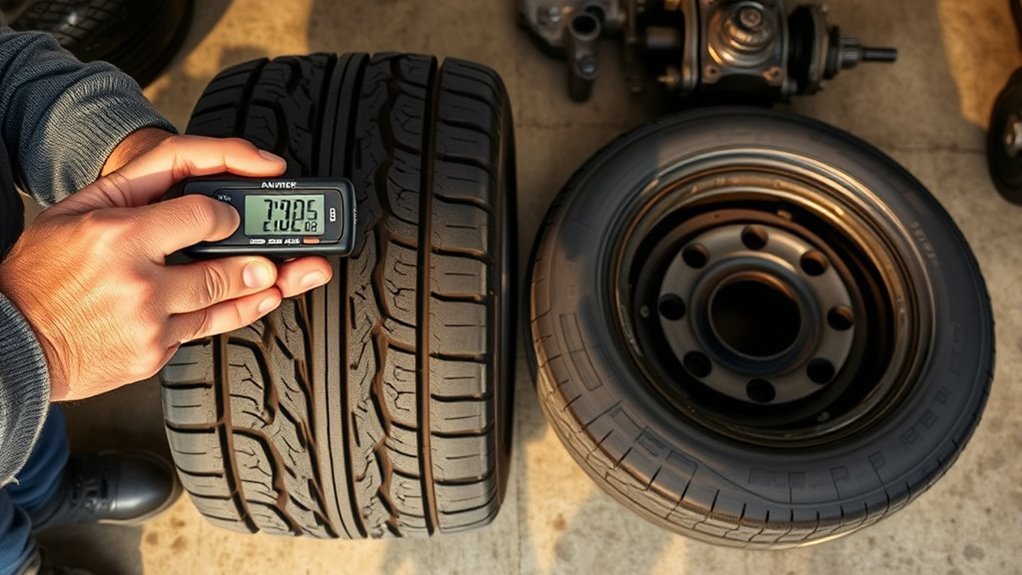
A tread-depth gauge provides the precision needed for comparing tires. A penny test can identify a tire that has reached approximately 2/32 inch, but it is not precise enough to make a close 4WD matching decision.
Use a Tread-Depth Gauge
- Park on a level surface and set the parking brake.
- Check and adjust cold tire pressure first.
- Remove stones or debris from the main tread grooves.
- Insert the gauge into an inner, center and outer groove.
- Repeat the measurements at several points around the tire.
- Record the lowest consistent reading for each area.
- Repeat the process on all four tires.
A single reading from the center groove can hide alignment or shoulder-wear problems. Multiple measurements show whether the tire is wearing evenly.
Use the Penny Test as a Basic Safety Check
Insert a penny into a main tread groove with Lincoln’s head pointing down. If the top of Lincoln’s head remains visible, the tread is approximately 2/32 inch or less and the tire should be replaced.
The penny test cannot determine whether a replacement tire is closely matched enough for a particular 4WD system. Use a gauge for that comparison.
Compare All Four Tires
Create a simple record with one row for each wheel position. Include the inner, center and outer tread measurements, tire pressure and any visible wear pattern.
- Front left.
- Front right.
- Rear left.
- Rear right.
- Full-size spare, if it is included in the normal rotation pattern.
If one tire has significantly different wear across its width, have the alignment, suspension and wheel balance inspected before installing a replacement.
Match More Than Tread Depth
Tread depth is only one part of a correct replacement. Verify all of the following:
- Size: Use the size listed on the vehicle placard or an approved alternative.
- Load capability: Do not install a tire with less load-carrying capacity than required.
- Speed rating: Meet the vehicle and tire manufacturer’s specification.
- Construction: Do not mix incompatible constructions.
- Tire category: Avoid mixing all-season, all-terrain, summer and winter designs unless explicitly approved.
- Make and model: Use an identical tire whenever possible on a 4WD 4Runner.
- Tread pattern: Different patterns can respond differently during braking and cornering.
- Inflation pressure: Compare tires only after setting the correct cold pressure.
- Actual circumference: Measure when tread-depth comparison alone does not provide enough certainty.
TPMS and Installation Considerations
A tire replacement may require inspection or transfer of the tire-pressure warning valve and transmitter. A damaged sensor, unregistered replacement sensor or incorrect initialization can cause the warning light to flash or remain illuminated.
Ask the installer to:
- Inspect the TPMS valve and seal.
- Use the correct mounting procedure.
- Balance the wheel and tire assembly.
- Confirm the correct cold inflation pressure.
- Register or relearn the sensor when required.
- Check that the warning light turns off normally.
Using a Temporary Spare
A compact spare or temporary spare is designed for limited emergency use. Its size, pressure and speed restrictions may differ from the normal tires.
Warning: Follow the spare tire’s printed limits and your 4Runner owner’s manual. Avoid unnecessary distance, high speed, towing or 4WD operation with a mismatched temporary spare unless the manual specifically permits it.
Replace or repair the normal tire as soon as practical. Do not treat a temporary spare as a permanent way to avoid matching the full-size tires.
Warning Signs That Need Professional Diagnosis
A tire mismatch can contribute to drivability symptoms, but the same symptoms can also come from wheel balance, alignment, brakes, bearings, driveshafts, CV joints or transfer-case problems.
Stop and obtain professional help if you notice:
- Binding, hopping or unusual resistance during turns.
- New vibration that changes with vehicle speed.
- Shuddering during acceleration.
- Grinding, whining or clunking from the driveline.
- A burning smell or excessive heat near a differential or transfer case.
- ABS, traction-control, 4WD or tire-pressure warnings.
- A rapid pressure loss, bulge, exposed cord or tread separation.
Do not assume that replacing another tire will correct these symptoms. The vehicle may need a complete tire, wheel and drivetrain inspection.
What Mismatched-Tire Damage Can Cost
Transfer-case and differential repairs can be expensive, but no single price range applies to every 4Runner. Cost depends on the model year, drivetrain, damaged component, part availability, labor rate and whether the assembly can be repaired or must be replaced.
Potential expenses may include:
- Diagnosis and fluid inspection.
- Wheel alignment or suspension repair.
- Wheel bearing, axle or driveshaft work.
- Differential repair or replacement.
- Transfer-case repair or replacement.
- Replacement tires, mounting, balancing and TPMS service.
Matching the tires correctly is inexpensive compared with diagnosing a persistent driveline problem. However, avoid assuming that every tire difference has already damaged the vehicle.
Frequently Asked Questions
Can I replace only one tire on a Toyota 4Runner?
Sometimes. The replacement must meet the required specifications and closely match the other tires in tread design, wear and rolling circumference. Have all four tires measured and check the manual for your exact model year before proceeding.
Does Toyota have a 4/32-inch rule for every 4Runner?
No universal Toyota 4/32-inch rule was found for every 4Runner generation and drivetrain. Toyota warns against mixing significantly different treadwear, makes, models and tread patterns. Use model-specific guidance rather than another manufacturer’s numerical limit.
Do all Toyota 4Runners have a Torsen differential?
No. The 4Runner has been offered with different 2WD, part-time 4WD and full-time 4WD systems depending on the year and trim. Confirm your vehicle’s system through its owner’s manual and drivetrain controls.
Is tire shaving safe for a street-driven 4Runner?
Professional tire shaving can be a practical way to match an otherwise correct new tire to a safe, partially worn set. The tire must remain suitable after shaving, and a qualified provider should determine the final depth.
Is a matching used tire better than a shaved new tire?
A shaved new tire is normally more predictable because its age and service history are known. A used tire may work only when it is an exact match and passes a professional internal and external inspection.
What does the 2/32-inch tread measurement mean?
It is the general U.S. replacement point identified by treadwear indicators and the penny test. It is not a universal rule defining how much tread-depth difference every 4WD drivetrain can tolerate.
Conclusion
You do not automatically need four new tires every time one 4Runner tire is damaged. A single replacement may work when it meets every required specification and closely matches the remaining tires. When the existing set is more worn, a professionally shaved new tire may preserve the set without introducing the uncertainty of an unknown used tire.
Do not rely on a supposed universal Toyota 4/32-inch rule or assume that every 4Runner uses the same differential. Identify your drivetrain, inspect the damaged tire, measure all four tires and follow the owner’s manual. When the correct tolerance is unclear, obtain guidance from Toyota and the tire manufacturer before installation.
Sources
- Toyota USA Newsroom: 2026 Toyota 4Runner — current drivetrain configurations and trim-specific 4WD information.
- Toyota 2025 4Runner Owner’s Manual: Winter Driving Tips — Toyota guidance on matching makes, models, tread patterns and treadwear.
- NHTSA TireWise — tread-depth replacement point, penny test and routine tire inspections.
- U.S. Tire Manufacturers Association: Replacing Tires — replacement specifications and guidance when replacing fewer than four tires.
- U.S. Tire Manufacturers Association: Used Tires — hidden damage and professional inspection concerns.
- Tire Rack: Tire Shaving for AWD and 4WD Vehicles — shaving process and matching applications.
