

Driving with mismatched tires can reduce predictable grip and handling, and on some AWD or 4WD vehicles it can also put extra stress on drivetrain components. The safest setup is the tire configuration specified by your vehicle manufacturer. If you must replace fewer than four tires, match the required size, construction, load capacity, speed capability, and tread characteristics as closely as possible.
Quick Answer
Mismatched tires are not automatically unsafe in every situation, but differences in size, construction, season, tread depth, or performance can change how a vehicle handles. AWD and 4WD vehicles are especially sensitive to rolling-diameter differences. Follow the tire placard and owner’s manual before replacing one or two tires.
Key Takeaways
- A matched set of four tires gives the most consistent traction, braking, and handling.
- Replacement tires must meet the size, load-capacity, construction, and speed requirements specified by the vehicle manufacturer.
- AWD and 4WD vehicles may have strict limits on tread-depth or rolling-circumference differences, so check the owner’s manual before replacing fewer than four.
- If two tires are replaced, industry guidance generally places the newer pair on the rear axle for better wet-road stability unless the vehicle manufacturer specifies otherwise.
- If one tire must be replaced, pair it with the existing tire that has the deepest tread and place that pair on the rear when the vehicle manufacturer permits single-tire replacement.
- Do not confuse the 2/32-inch U.S. tread wear limit with an allowable difference between tires; those are separate measurements.
What Mismatched Tires Mean
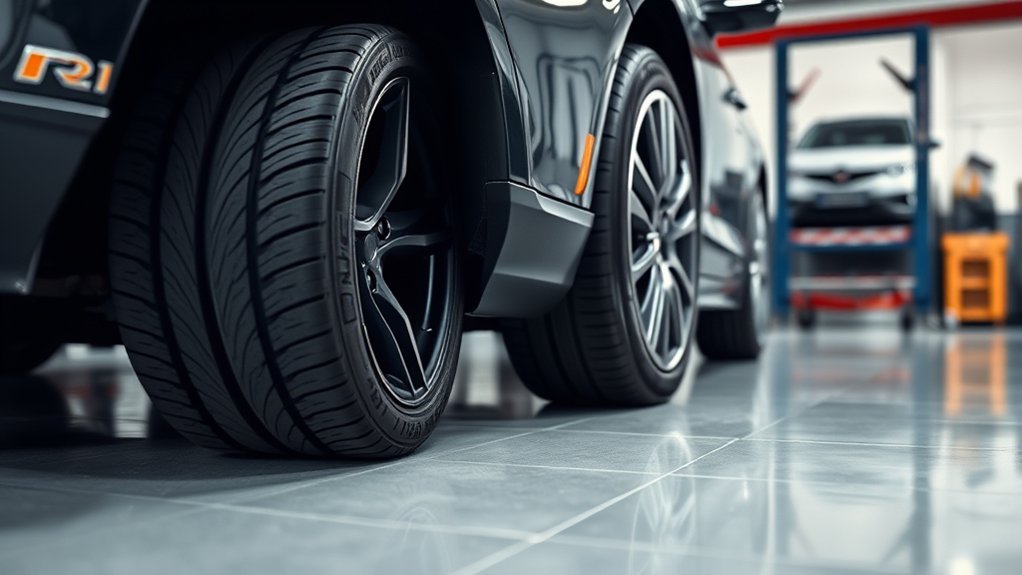
Mismatched tires are tires on the same vehicle that differ in characteristics that can affect fit, traction, or handling. Differences may include brand, model, tread pattern, tire size, construction, season category, load index, speed rating, or remaining tread depth.
Not every visual difference means the setup is wrong. Some vehicles are designed from the factory with different tire sizes on the front and rear axles. These are called staggered fitments, and they are acceptable when they match the specifications on the tire placard and in the owner’s manual.
Problems are more likely when a vehicle that was designed for four similar tires is fitted with tires that have meaningfully different rolling diameters or traction characteristics. The result can be less consistent steering, braking, cornering, wet-road grip, and electronic stability-system behavior.
The tire size printed on the sidewall is only part of the picture. Two different tire models with the same nominal size can have small differences in actual dimensions, tread design, casing construction, and new-tread depth. That is one reason matching the exact brand and model is preferred when replacing only one tire.
Warning: Never install a tire with a size or load-carrying capacity below what your vehicle manufacturer specifies. On AWD and 4WD vehicles, do not assume a replacement is compatible simply because the sidewall size matches. Check the owner’s manual for allowable tread-depth or circumference differences.
Why Mismatched Tires Are Unsafe
Your vehicle is tuned around a specific tire configuration. When tire characteristics differ too much, the front and rear axles or the left and right sides may develop different amounts of grip.
That imbalance matters most during emergency braking, hard cornering, rain, snow, or other low-traction conditions. A tire with deeper tread may clear water more effectively than a heavily worn tire, while different compounds and tread patterns can respond differently as the road surface changes.
- Different sizes or rolling diameters: can change wheel-rotation speeds and may affect AWD/4WD components or wheel-speed-dependent systems.
- Different tire categories: summer, winter, all-season, and all-terrain tires can provide very different traction in the same conditions.
- Different tread depths: can create uneven wet grip and different rolling circumferences.
- Insufficient load index: may leave a tire unable to safely carry the load required by the vehicle.
- Different construction: such as radial and non-radial tires, can produce substantially different handling characteristics.
For that reason, the U.S. Tire Manufacturers Association recommends using replacement tires that meet the vehicle or tire manufacturer’s size, load-index, and speed-rating requirements.
Are Mismatched Tires Ever Okay?
Yes, some limited mismatches can be acceptable, but the vehicle manufacturer’s specifications come first. A matched set of four remains the preferred arrangement for consistent performance.
For example, a two-wheel-drive vehicle may sometimes use one tire model on the front axle and another on the rear if the tires meet the required size, construction, load, and speed specifications. That does not mean every combination will handle equally well.
Same Axle Matching
Tires on the same axle should match as closely as possible because they work together during braking, cornering, and load transfer. Using the same brand and model on an axle is the best way to obtain similar tread design, casing behavior, and dimensions.
- Use the manufacturer-specified tire size.
- Meet or exceed the required load index.
- Meet the manufacturer’s speed-rating requirement.
- Use compatible construction and tire type.
- Keep tread depth reasonably close and follow any vehicle-specific limit.
If the exact original tire is unavailable, choose a replacement in the same performance category and consult a qualified tire professional if compatibility is uncertain.
Limited Safe Exceptions
A mismatch may be acceptable when it is specifically allowed by the vehicle manufacturer. Common examples include factory-staggered tire sizes or replacing fewer than four tires on a two-wheel-drive vehicle while keeping each axle properly matched.
Another limited case is a single replacement on a vehicle whose other tires are still close to new. Some tire companies use about 2/32 inch of tread-depth variance as a practical guideline for certain applications, but that number is not a universal rule, especially for AWD and 4WD vehicles.
If the remaining tires are too worn to match a new tire and the vehicle manufacturer permits it, a tire specialist may sometimes shave a new matching tire to a compatible tread depth. This is a specialist solution, not something to assume is appropriate for every vehicle.
Pro Tip: Before ordering one replacement tire, measure the tread depth of all four tires and check the exact brand, model, size, load index, and speed rating. Then compare those measurements with the limits in your owner’s manual.
Can You Mix Different Tire Brands or Models?
Different tire brands or models can sometimes be used on the same vehicle, but a complete matched set is preferred. Tires that share the same printed size may still differ in actual outside diameter, tread pattern, rubber compound, sidewall stiffness, and wet or dry grip.
If mixing brands is unavoidable, keep the same brand and model together on each axle whenever possible. Also make sure every tire meets the vehicle manufacturer’s required size, construction, load capacity, and speed capability.
Michelin’s tire-mixing guidance recommends matching tires as closely as possible because construction and traction differences become more noticeable during emergency maneuvers or poor weather.
Can You Mix Winter, All-Season, Run-Flat, or Conventional Tires?
Avoid mixing tire categories unless the vehicle or tire manufacturer specifically approves the combination.
- Winter and non-winter tires: Winter tires should normally be installed at all four wheel positions. Fitting winter tires to only one axle can create a strong front-to-rear traction imbalance.
- Summer and all-season tires: Their compounds and temperature ranges differ, so mixing them can produce inconsistent traction.
- All-terrain and highway/all-season tires: Their tread patterns and handling characteristics can differ substantially.
- Run-flat and conventional tires: Do not mix them for normal use unless the vehicle or tire manufacturer specifically permits it. Their sidewall construction and behavior after pressure loss are different.
- Radial and non-radial tires: Modern passenger vehicles normally use radial tires. Follow the manufacturer’s instructions and do not mix constructions on an axle.
USTMA specifically recommends winter/snow tires on all wheel positions for balanced mobility and control and warns against installing winter tires only on the front axle.
[Products Worth Considering]

This 3-ton scissor car jack tire changing kit helps you lift cars and SUVs with a wide range to reach low sedans or higher vehicles. The set includes a ratchet wrench, multi-size lug wrench, gloves, a tire pressure gauge, and a storage bag for quick emergency repairs. Built for stable, secure lifting and universal compatibility, it’s ready for flat tires and roadside wheel changes.

Measure tire tread depth quickly and accurately with this LUMITECO dial gauge that reads in 1/32" increments up to 14/32". The color-coded green/yellow/red zones make it easy to judge tire wear and know when replacement is needed. A rugged, compact design with a protective pouch helps keep the gauge ready for use on cars, trucks, motorcycles, and more.

Monitor tire tread wear with a smart, color-coded depth gauge that shows clear condition ranges at a glance. The bar is range marked for fast, easy readings, helping you maintain safer traction and performance. Each gauge is portable with a pocket clip, and the set includes 20 units for daily use and sharing.
Factory-Staggered Tire Sizes Are Different
Some sports cars, performance vehicles, and other models leave the factory with wider or differently sized tires on the rear than on the front. That setup is intentional and should not be treated as an unsafe mismatch.
For a staggered vehicle, match the sizes shown on the tire placard and follow the manufacturer’s front/rear specifications. Do not copy a same-size-all-around recommendation from another vehicle.
Staggered fitments can also limit tire rotation because front and rear tires may not be interchangeable. NHTSA advises checking the owner’s manual for the correct rotation pattern and notes that some vehicles with different front and rear sizes cannot use a normal rotation pattern.
Which Tires Must Match on AWD Cars?
On an AWD vehicle, all four tires should normally be matched very closely in size, construction, tread design, and rolling circumference. Using the exact same brand and model at all four positions is the simplest way to reduce variation.
AWD systems allow temporary differences in wheel speed while turning, but a permanent diameter difference can make some differentials, couplings, or transfer components work continuously. Over time, that may cause unnecessary heat, wear, or malfunction.
On AWD and 4WD vehicles, the acceptable difference between tires is vehicle-specific. A tread-depth number that works for one model may exceed the allowable rolling-circumference difference on another.
Check:
- Exact tire size shown on the placard.
- Brand and model where the manufacturer requires close matching.
- Load index and speed rating.
- Tread pattern and construction.
- Remaining tread depth.
- Any circumference or outside-diameter limit in the owner’s manual.
The USTMA Tire Care and Safety Guide warns that even small outside-diameter differences can cause drivetrain damage or mechanical malfunction on some AWD and 4WD vehicles.
Do not automatically replace all four tires without checking the manual, but do not automatically replace only one either. The correct choice depends on the remaining tread depth and your vehicle maker’s limit.
[Products Worth Considering]

Steelman white tire marking crayons provide high-contrast, semi-permanent marks for repairing and inspecting tires and equipment. They write on wet or dry, smooth or coarse surfaces including rubber, metal, glass, and wood, making them ideal for puncture location and damage outlining. The lead- and zinc-free crayons resist weather and fading yet wipe away when you no longer need the marks.

Accurately measure tire tread depth with a calibrated gauge marked from 0 to 1 inch in 1/32 inch increments. The color-coded bar helps you quickly identify tread condition ranges, supporting safe driving for trucks, motorcycles, automobiles, and passenger vehicles.

A concentrated tire and tube mounting compound designed to help simplify mounting rubber tires and tubes on passenger, semi truck, construction, and OTR applications. Its ultra-thick formula packs beads effectively and includes rust inhibitors to help protect against corrosion during use.
Can You Drive FWD or 4WD on Mismatched Tires?
With a front-wheel-drive vehicle, all four tires still affect braking and cornering even though the front axle provides engine power. Keep each axle closely matched, and when replacing two tires, industry guidance generally places the newer pair on the rear axle to reduce the risk of rear-axle traction loss on wet roads.
That recommendation can seem counterintuitive because the front tires steer and drive the car, but deeper rear tread helps the rear resist hydroplaning and oversteer. Always follow a conflicting vehicle-manufacturer instruction if your manual specifies a different arrangement.
With 4WD vehicles, diameter differences can be more serious because driveline components may connect the front and rear axles mechanically. Avoid mixing tire sizes, constructions, and markedly different tread patterns unless the vehicle manufacturer expressly allows it.
Part-time 4WD systems also should not be treated as immune simply because the vehicle can operate in two-wheel drive. Fit the tires according to the manufacturer’s specifications before relying on 4WD operation.
[Products Worth Considering]

Add style while helping protect your tire valve stems with handmade crystal rhinestone caps and a durable plastic insert. These caps resist corrosion and help keep out rain, snow, and muddy water, extending tire life. Textured non-slip design makes them easy to grip for quick install and removal when checking tire pressure.

Replace worn tires quickly with this universal 4.80/4.00-8 tire and inner tube set designed for wheelbarrows and outdoor utility carts. The ribbed tread helps reduce turf damage while the natural rubber construction supports longer service life. Compatible with 15.5-inch outer diameter, 4-inch width, and 8-inch rim diameter wheels, it uses a straight TR-13 valve stem for easy installation. For best results, inflate with a manual pump and do not exceed 25 PSI.

Replace worn wheelchair rear tires with a universal 24x1 no-flat polyurethane foam option designed to mount tightly on 24-inch rims without the tire falling off. Installation is made easier with included tools and multiple methods, including using a pry bar or softening the tire in hot water to reduce resistance. The package includes two tires plus tie ropes for convenient fitting and handling.
How Tire Size and Tread Affect Handling
Tire size and tread design directly affect steering response, gearing, grip, braking, and rolling circumference. A tire that is taller or shorter than specified rotates at a different rate for a given road speed.
- Different overall diameter can change wheel-speed relationships and may affect drivetrain or electronic systems.
- Different width or sidewall profile can change steering response, ride, clearance, and contact-patch behavior.
- Different tread patterns can provide different levels of water evacuation, snow traction, noise, and cornering response.
- Different tire compounds may grip differently as temperature and road conditions change.
Do not choose a substitute size simply because it fits the wheel. NHTSA recommends replacement tires in the original size or another size approved by the vehicle manufacturer.
How Wear and Rotation Affect Safety
Tread depth affects how well a tire can maintain traction, particularly in rain or snow. Tires with substantially different wear levels may not respond the same way during braking or cornering.
Regular rotation, where permitted, helps keep wear more even. It also makes it less likely that you will later face a large tread-depth difference when one tire is damaged and needs replacement.
Tread Depth Differences
There is no universal rule saying that a specific small difference, such as 1/16 inch, automatically makes a set unsafe. The importance of the difference depends on the vehicle, drivetrain, tire design, road conditions, and manufacturer specifications.
What is clear is that deeper tread generally provides more room to channel water, while very worn tread offers less wet-weather margin. NHTSA says tires should be replaced when tread reaches 2/32 inch remaining.
Note: The 2/32-inch figure is a tread-wear replacement limit, not a universal allowable difference between two tires. AWD/4WD matching limits may be tighter and should come from the vehicle manufacturer.
- Measure tread depth in several grooves on each tire.
- Compare all four tire measurements.
- Look for uneven shoulder, center, or edge wear.
- Check the owner’s manual before fitting one new tire to a worn AWD/4WD set.
If one tire is much more worn than the others, wet traction and steering response may become less consistent. Uneven wear can also point to inflation, alignment, suspension, or rotation problems that should be corrected.
Rotation Schedule Importance
A consistent rotation schedule can help distribute tread wear more evenly. NHTSA says that, when rotation is recommended by the vehicle manufacturer, a common interval is 5,000 to 8,000 miles or sooner if uneven wear appears. Some vehicles use different schedules or cannot follow a normal rotation pattern, so the owner’s manual remains the primary reference.
| Checkpoint | Why It Matters |
|---|---|
| Rotation timing | Helps limit front-to-rear tread-depth differences. |
| Even wear | Supports more consistent handling and makes future tire replacement easier. |
| Wet traction | Helps prevent one axle from becoming much more worn than the other. |
| Early inspection | Can reveal alignment, inflation, balance, or suspension problems. |
| Tire life | More even wear can help you use the available tread more consistently across the set. |
Uneven Wear Risks
Uneven tire wear can reduce available traction and make one tire reach its replacement point earlier than the rest of the set. Common causes include incorrect pressure, alignment problems, worn suspension parts, imbalance, and missed rotation intervals.
- Check the tread-wear indicators on every tire.
- Measure tread depth at several points across the tread.
- Compare left-to-right and front-to-rear wear.
- Investigate rapid or one-sided wear rather than simply rotating the tire to another position.
If the vehicle pulls, vibrates, wears one edge rapidly, or repeatedly loses pressure, have the tire and vehicle inspected instead of assuming the symptoms come only from tire mismatch.
When You Can Replace Just One Tire
Replacing one tire may be reasonable when the replacement closely matches the remaining tires and the vehicle manufacturer allows it. This is most practical when the other tires have very little wear.
The replacement should meet the correct size, construction, load index, and speed-rating requirements. Ideally, use the same brand and model as the remaining tires.
If a single replacement is unavoidable, USTMA recommends pairing the new tire with the existing tire that has the deepest tread and installing that pair on the rear axle. Vehicle-specific instructions take priority.
For AWD and 4WD vehicles, measure before buying. Some manufacturers specify a maximum difference in tread depth, while others use outside circumference or another standard. If a full-depth new tire exceeds that limit, the practical options may include replacing more tires or having a matching new tire professionally shaved if that approach is permitted.
Replace One, Two, or Four Tires?
| Situation | Best Next Step |
|---|---|
| One tire damaged; other three nearly new | A single matching tire may be possible if tread/diameter differences remain within the vehicle maker’s limit. |
| Two tires need replacement on a 2WD vehicle | Use a matched pair and generally install the newer pair on the rear unless the manufacturer directs otherwise. |
| One tire damaged on AWD/4WD | Measure all tires and check the manufacturer’s maximum tread-depth or circumference difference before deciding. |
| Remaining tires are substantially worn | Replacing all four may provide the most consistent performance and may be required on some AWD/4WD vehicles. |
| Vehicle has factory-staggered sizes | Follow the front and rear sizes specified by the manufacturer rather than trying to make all four identical. |
Temporary Spare and Emergency Mismatch
A temporary spare is a special exception, not a normal replacement tire. Compact spares may differ from the other tires in size, construction, inflation pressure, and permitted speed or distance.
Follow the instructions printed on the spare and in the owner’s manual. Use a temporary spare only for its intended emergency purpose and replace or repair the normal road tire as soon as practical.
AWD and 4WD owners should pay special attention to spare-tire instructions because some manufacturers restrict where a compact spare can be installed or how the drivetrain may be used while it is fitted.
How To Spot Unsafe Tire Mismatch Signs
Even when a replacement appears compatible, keep checking the vehicle after installation. A new vibration, pull, unusual noise, warning light, or sudden change in steering feel deserves attention.
After a tire replacement, watch for new vibration, pulling, noise, warning lights, or unusual steering response instead of assuming the setup is correct because the tire fits.
- Set all four tires to the vehicle manufacturer’s recommended cold inflation pressures.
- Measure tread depth on every tire.
- Confirm the installed tire sizes against the door placard and owner’s manual.
- Check for new vibration or pulling on a smooth, level road.
- Inspect the tires again after several trips for abnormal wear.
A tire that runs unusually hot, repeatedly loses pressure, or develops rapid wear needs professional inspection. Those symptoms can also come from alignment, wheel, brake, bearing, suspension, or inflation problems.
Frequently Asked Questions
Is It Okay to Run Mismatched Tires?
A matched set of four is preferred, but some limited mismatches can be acceptable when the tires meet the vehicle manufacturer’s size, construction, load, speed, and tread requirements. AWD and 4WD vehicles often require closer matching than two-wheel-drive vehicles.
Is It Okay to Drive With Two Different Tires?
It depends on what is different. Two different brands may be workable on separate axles if all required specifications are met, but two substantially different tires on the same axle can create inconsistent handling. If replacing two tires, use a matched pair.
Is It Illegal to Drive With Mismatched Tires?
There is no single worldwide rule covering every type of tire mismatch. Equipment and inspection laws vary by country, state, and province. A setup can also violate vehicle-manufacturer requirements even when local law does not specifically prohibit different brands. Check the rules where the vehicle is registered and driven.
Is It Okay to Drive With One Different Tire?
Sometimes, but the replacement should match the remaining tires as closely as possible. If a single replacement is permitted, USTMA recommends pairing it with the existing tire that has the deepest tread and putting that pair on the rear. AWD/4WD owners must first check the manufacturer’s allowable diameter or tread-depth difference.
Can I Mix Tire Brands if They Are the Same Size?
The same nominal size does not guarantee identical performance or actual rolling dimensions. A different brand may be acceptable in some applications, but matching the exact brand and model is preferable, especially on the same axle and on AWD/4WD vehicles.
Do I Have to Replace All Four Tires on an AWD Vehicle?
Not automatically. Some AWD vehicles can accept one or two replacement tires when all four remain within the manufacturer’s specified circumference or tread-depth limit. If the remaining tires are too worn to meet that limit, replacing all four may be necessary.
Can I Put Winter Tires on Only Two Wheels?
It is not recommended. Winter tires are intended to provide balanced cold-weather traction at all four wheel positions. Installing them on only one axle can create a major front-to-rear grip imbalance during braking or cornering.
Can I Mix Run-Flat and Regular Tires?
Normally, no. Run-flat and conventional tires have different construction and low-pressure behavior. Mixing them for normal use can change handling. Follow the vehicle and tire manufacturer’s instructions, using a conventional tire only as a temporary emergency substitute when specifically permitted.
Conclusion
Mismatched tires are not a simple yes-or-no issue. A different brand may be manageable in one vehicle, while a small rolling-diameter difference may be unacceptable on another AWD system. The safest approach is to use a matched set and treat the vehicle’s tire placard and owner’s manual as the final authority.
If one tire fails, compare the remaining tread depths before ordering a replacement. If two need replacement, use a matched pair and generally place the newer pair on the rear unless your manufacturer specifies otherwise. On AWD or 4WD vehicles, confirm the permitted tread-depth or circumference difference before driving on a mixed-wear set.
Sources
- National Highway Traffic Safety Administration — TireWise — tire size, tread depth, inspection, and rotation guidance.
- U.S. Tire Manufacturers Association — Replacing Tires — replacement specifications and guidance for replacing one or two tires.
- U.S. Tire Manufacturers Association — Tire Care and Safety Guide — AWD/4WD, winter-tire, and fewer-than-four replacement guidance.
- Michelin — Mixing Tires — tire-brand, tire-type, tread, winter-tire, and AWD considerations.
- Michelin — Changing Tire Sizes — manufacturer-approved sizes, staggered fitments, speed ratings, and four-wheel-drive guidance.

