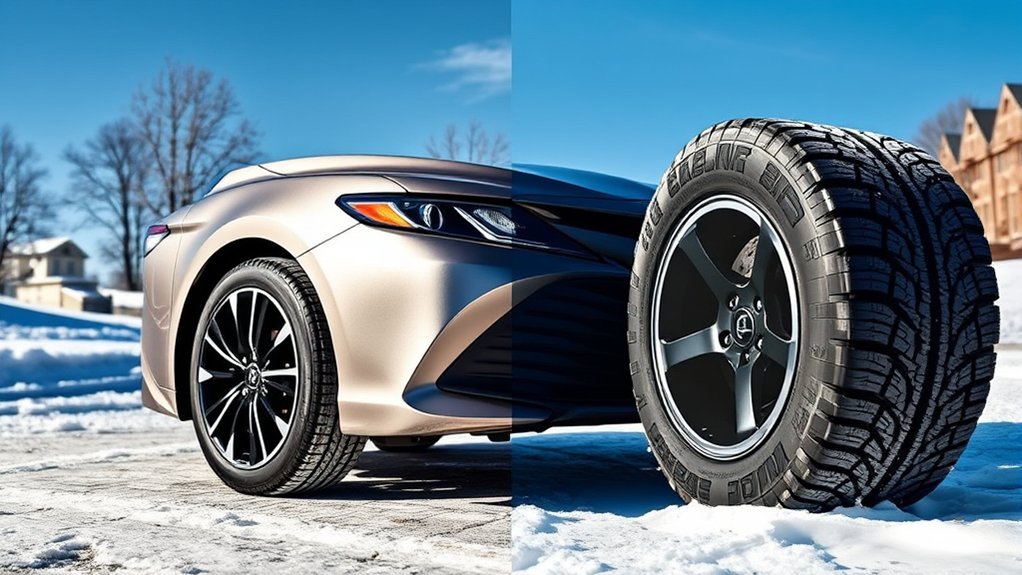
Choosing between all-season and winter tires for your Toyota Camry depends on more than snowfall. You should consider how often temperatures stay below 45°F, whether you regularly face ice or packed snow, and how much seasonal convenience matters to you. The right choice can improve braking, steering response, and predictability in the conditions you actually drive through.
Quick Answer
Choose all-season tires for a Toyota Camry driven mainly in mild temperatures, rain, and occasional light snow. Choose four matching winter tires when temperatures regularly approach or fall below 45°F and you expect snow, slush, or ice. A 3PMSF-rated all-weather tire can provide a practical middle ground.
Key Takeaways
- All-season tires suit mild climates and provide convenient year-round performance, but their grip can decline in sustained cold, deep snow, and ice.
- Winter tires use cold-weather compounds and tread designs that improve traction, braking, and control in severe winter conditions.
- Install winter tires as a set of four. Mixing winter and all-season tires can create unbalanced handling.
- Use your Camry’s driver-door tire label and exact-year owner’s manual to confirm tire size, load capacity, pressure, and other fitment requirements.
- Switch according to sustained temperatures and forecasts rather than relying on one universal month.
Toyota Camry All-Season vs. Winter Tires
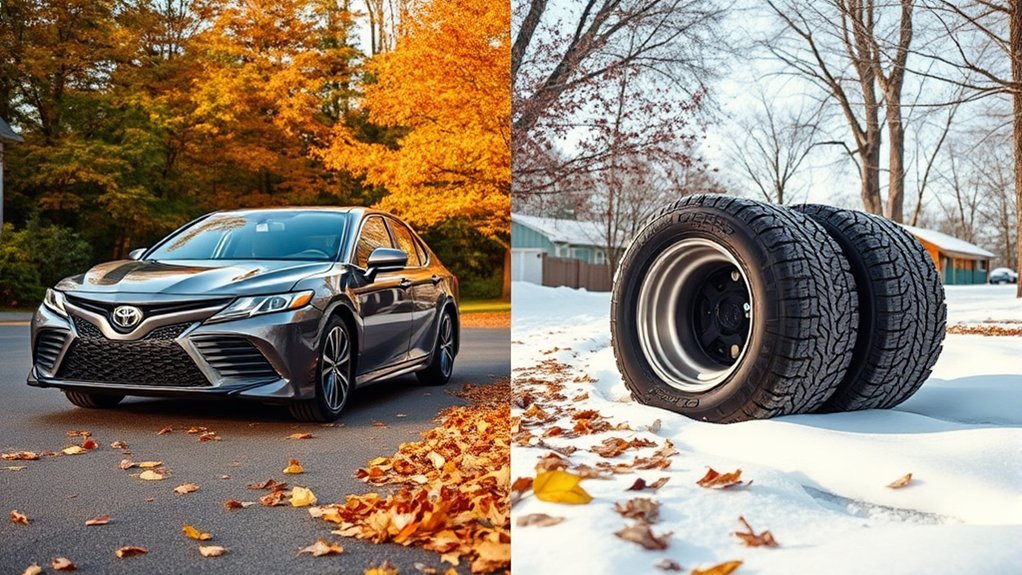
All-season tires are designed to balance dry-road comfort, wet traction, tread life, and limited cold-weather ability. They work well for Camry drivers who experience mostly moderate temperatures and only occasional light snow.
Winter tires focus more heavily on cold-weather performance. Their rubber compounds remain more flexible in low temperatures, while their tread blocks and sipes create additional biting edges for snow, slush, and icy surfaces. According to Transport Canada, all-season and summer tires begin losing elasticity below approximately 7°C or 45°F, while winter tires retain useful flexibility at lower temperatures.
| Factor | All-Season Tires | Winter Tires |
|---|---|---|
| Best conditions | Mild temperatures, dry roads, rain, and occasional light snow | Sustained cold, snow, slush, freezing rain, and ice |
| Cold-weather grip | Adequate in mild winters but generally weaker as temperatures fall | Designed to remain flexible and responsive in low temperatures |
| Deep snow and ice | Limited capability, depending on the specific tire and tread condition | Usually provides better starting, braking, and cornering traction |
| Warm-weather use | Designed for year-round use in moderate climates | Can wear faster and feel less precise when used in sustained warm weather |
| Seasonal work | No scheduled seasonal change in a suitable climate | Requires seasonal installation, removal, and storage |
| Best for | Drivers who rarely encounter severe winter roads | Drivers who regularly travel in cold, snowy, or icy conditions |
[Products Worth Considering]

Upgrade your Toyota’s wheels with durable aluminum alloy valve stem caps that help protect valve cores from corrosion and direct exposure to road grime, clay, water, and snow. Rubber rings improve sealing to help prevent air leakage and maintain stable tire pressure for safer driving. These caps are easy to install or remove without tools and add a unique, stylish look to your car.

These universal tire valve stem caps help protect valve cores from dust, debris, and moisture while helping maintain stable tire pressure. The corrosion-resistant metal construction and sealed design provide reliable protection in road grime, mud, and winter conditions. Twist-on installation makes them quick to fit on cars, SUVs, trucks, and motorcycles.

The Kurgo Seasonal Tire Tote helps protect your car interior, clothes, and garage from tire grime, brake dust, and residue during seasonal tire changes. Its universal design fits most passenger tires between 22" and 31" in diameter, making storage and transport simpler with less mess. Built for rugged, repeated use, it’s machine washable for easy care and comes with a lifetime warranty.
Advantages of Winter Tires in Cold Conditions
Winter tires provide their biggest advantage when the road is cold and traction is limited. Their specialized compounds remain pliable, and their tread patterns include numerous edges that can grip snow and help move water and slush away from the contact area.
These features can improve:
- Braking: A suitable winter tire can stop more effectively than a typical all-season tire on cold, slippery surfaces.
- Acceleration: Extra snow traction reduces wheelspin when you pull away.
- Cornering: More consistent grip helps your Camry respond predictably when you steer.
- Stability: Four matching winter tires help balance front- and rear-axle traction.
- Cold, dry-road control: Winter compounds can remain more responsive even before snow reaches the road.
The 45°F or 7°C guideline is a useful changeover signal, but your road conditions, forecasts, tire design, and driving routine should determine the final decision.
Warning: Do not install winter tires only on the front wheels of a front-wheel-drive Camry. The front may gain traction while the rear remains more likely to slide. Use four compatible winter tires for balanced braking, steering, and stability.
How All-Season Tires Perform in Different Weather
All-season tires combine characteristics needed for dry roads, rain, moderate temperatures, and limited snow. They usually provide a quieter ride, longer warm-weather tread life, and greater convenience than maintaining two tire sets.
NHTSA notes that all-season tires can handle a range of road conditions and have some mud-and-snow capability. However, NHTSA also distinguishes them from winter tires, which are more effective in deep snow.
When All-Season Tires Make Sense
All-season tires may be the better option when:
- Your winters are mild and temperatures rarely remain below 45°F.
- Snowfall is light, roads are cleared quickly, and you can avoid driving during severe storms.
- You mainly drive on treated urban or suburban roads.
- You have reliable alternative transportation when ice or heavy snow arrives.
- You value year-round convenience more than maximum winter capability.
All-season does not mean equally capable in every season. Performance varies widely among tire models, and remaining tread depth strongly affects rain and snow traction.
Are All-Weather Tires a Middle-Ground Option?
All-weather tires are designed for year-round use while providing more winter capability than a typical all-season tire. Many carry the Three-Peak Mountain Snowflake symbol, meaning they have met a defined severe-snow traction requirement.
A 3PMSF-rated all-weather tire may suit you if your area has moderate winter weather but you do not want to store and change two complete sets. Dedicated winter tires generally remain the stronger choice for frequent ice, deep snow, mountain travel, or prolonged subfreezing weather.
How to Read Winter Tire Markings
Do not judge winter capability only by an aggressive-looking tread. Check the tire’s sidewall and product documentation for recognized markings:
- 3PMSF: The Three-Peak Mountain Snowflake symbol shows that the tire meets a standardized performance requirement for severe-snow traction. Transport Canada recommends looking for this symbol when shopping for winter tires.
- M+S: Mud and Snow markings appear on many all-season tires. M+S alone does not confirm that the tire passed the severe-snow test used for 3PMSF certification.
- Ice Grip marking: Some newer tires may display a separate marking associated with tested ice performance. Availability depends on the tire and market.
Note: A 3PMSF marking confirms a minimum level of severe-snow traction. It does not mean every certified tire performs equally well on wet roads, dry roads, deep snow, or polished ice.
Camry Fitment Rules Before You Buy

Toyota Camry tire sizes vary by model year, trim, wheel package, and drivetrain. Do not assume that a tire advertised for one Camry will fit every Camry.
Before buying, check the Tire and Loading Information label on the driver’s door opening and consult the Toyota manuals and warranties portal for your exact model year. The label or manual identifies the original tire size and recommended cold inflation pressure.
The U.S. Tire Manufacturers Association advises replacement-tire buyers to use the size, load index, and speed-rating designation recommended by the vehicle or tire manufacturer. A replacement should not have less load-carrying capacity than Toyota specifies.
[Products Worth Considering]

Monitor tire tread wear with a smart, color-coded depth gauge that shows clear condition ranges at a glance. The bar is range marked for fast, easy readings, helping you maintain safer traction and performance. Each gauge is portable with a pocket clip, and the set includes 20 units for daily use and sharing.

Steelman white tire marking crayons provide high-contrast, semi-permanent marks for repairing and inspecting tires and equipment. They write on wet or dry, smooth or coarse surfaces including rubber, metal, glass, and wood, making them ideal for puncture location and damage outlining. The lead- and zinc-free crayons resist weather and fading yet wipe away when you no longer need the marks.

The UYYE TPMS relearn tool helps activate and relearn tire pressure monitor sensors quickly, typically in minutes. It supports TPMS learn mode resetting using a simple three-step process: enter learn mode, position the tool near the valve stem, and press the learn button. Designed for specific GM models, it streamlines sensor programming and reduces trips to dealers or tire shops.
Camry Winter Tire Checklist
- Use four winter tires of the same category and compatible construction.
- Confirm the correct diameter, width, aspect ratio, and wheel size.
- Meet or exceed the required load capacity.
- Confirm that the tire’s speed rating is appropriate for the vehicle and winter use.
- Maintain the cold pressure printed on the vehicle label, not the maximum pressure molded on the tire sidewall.
- Check wheel clearance before selecting an alternate winter wheel size.
- Confirm TPMS sensor compatibility if you buy a separate winter wheel set.
- Follow local rules for studded tires, chains, and seasonal tire requirements.
Warning: Do not mix winter and all-season tires on opposite axles. Different traction levels can make the Camry react unpredictably during emergency braking or abrupt steering.
Which Tire Is Better for Your Driving?
Use your normal winter conditions, not the most extreme day of the year, to choose between tire categories.
| Your Conditions | Best Starting Point | Why |
|---|---|---|
| Mild winter, rare snow, mostly rain | Quality all-season tire | Provides year-round convenience without maintaining two sets |
| Regular cold, occasional snow, limited storage | 3PMSF-rated all-weather tire | Offers certified severe-snow capability with year-round use |
| Frequent snow, ice, slush, or freezing rain | Dedicated winter tires | Prioritizes low-temperature traction, braking, and control |
| Mountain roads, rural travel, or roads cleared slowly | Dedicated winter tires | Provides greater reserve traction when conditions deteriorate |
| You can avoid driving whenever severe weather occurs | All-season or all-weather, depending on temperature | Your ability to postpone travel reduces exposure to the worst roads |
Front-wheel drive and all-wheel drive can help a Camry move forward, but they do not create tire grip. The tires still determine how effectively the car brakes and turns. An AWD Camry can therefore benefit from winter tires under the same cold and slippery conditions as a front-wheel-drive model.
[Products Worth Considering]

The SAFELIFE dial tire tread depth gauge measures tread depth in 1/32 inch increments with clear, easy-to-read 2-inch dial face. Color zones using a traffic light system help you quickly judge whether tread is low, marginal, or ample for safer driving. Built with a durable zinc cast body and a metal detect probe for precise, comfortable use across cars, motorcycles, trucks, and buses.

Measure tire tread depth quickly and accurately with this LUMITECO dial gauge that reads in 1/32" increments up to 14/32". The color-coded green/yellow/red zones make it easy to judge tire wear and know when replacement is needed. A rugged, compact design with a protective pouch helps keep the gauge ready for use on cars, trucks, motorcycles, and more.

TIRESHIELD PRO RV tire covers in a set of four deliver year-round protection against UV rays, cracking, fading, water, and snow. The StormLock-System helps keep the covers securely fastened through high wind, while heavy-duty, double-stitched construction supports long-lasting performance. Designed for universal fit, they’re intended for RV, camper, truck, car, and trailer tires within the 26–28.75 inch diameter range, with easy wipe-clean care and storage in the included bag.
When to Switch: Use Temperature, Not One Month
November can be a reasonable changeover month in some regions, but it is not a universal deadline. October may be appropriate in a colder area, while a warmer climate may not need winter tires at all.
Use these practical timing rules:
- Install winter tires: When average daily temperatures are consistently near or below 45°F and colder weather is expected to continue.
- Do not wait for the first major storm: Tire shops become busy after the first snowfall, and cold-road benefits can begin before snow arrives.
- Switch back: Return to all-season or summer tires when temperatures consistently remain above approximately 45°F.
- Watch the forecast: A brief warm or cold day should not determine the entire season.
- Follow local law: Mandatory winter-tire and studded-tire dates vary by location.
Pro Tip: Book your seasonal appointment before temperatures reach the changeover range. You will have more appointment choices and avoid making the decision after roads have already become slippery.
Tire Pressure, Tread, Rotation, and Storage
Check Pressure When the Tires Are Cold
Air pressure falls as outside temperatures drop. Check all four tires at least monthly and before long winter trips. Measure pressure before driving or after the vehicle has been parked long enough for the tires to cool.
Use the pressure on your Camry’s driver-door label. Do not use the maximum pressure molded on the tire sidewall as the normal inflation target. NHTSA’s winter-driving guidance also recommends inspecting pressure, tread, sidewalls, and tire condition before winter travel.
Do Not Rely Only on the Legal Minimum
NHTSA identifies 2/32 inch as the minimum tread threshold for road use, but a tire can lose useful snow performance before reaching that limit. Transport Canada advises against using tires close to 4 mm, or approximately 5/32 inch, on snow-covered roads.
Check tread at several points across each tire. Uneven wear may indicate an inflation, alignment, suspension, or rotation problem.
Follow the Correct Rotation Schedule
Do not rely on one universal 5,000-to-7,500-mile rule for every Camry and tire. Follow your exact-year Toyota maintenance guide and the tire manufacturer’s warranty requirements. Rotate sooner when you see uneven wear or when a qualified tire professional recommends it after inspection.
Directional tires, staggered wheel setups, and some winter tire designs may require a specific rotation pattern. Confirm the pattern before service.
Store the Off-Season Set Correctly
Clean and dry each tire before storage. Keep the set in a cool, dry location away from direct sunlight, heat sources, electric motors, solvents, and standing water. Mark each tire’s previous wheel position so the next rotation can be planned correctly.
Complete wheel-and-tire assemblies can usually be stacked or stored on a suitable rack. Unmounted tires are generally stored upright and rotated slightly during long storage periods. Protect TPMS-equipped wheels from impact and moisture.
Note: Some insurers or jurisdictions may offer a winter-tire discount, but eligibility is not automatic. Ask your insurer which tire markings, installation dates, receipts, or declarations it requires before assuming you will save money.
Frequently Asked Questions
Is October too early to put winter tires on a Toyota Camry?
October is not too early when average temperatures in your area are consistently approaching or falling below 45°F and colder weather is expected to continue. In a warm climate, October may be unnecessarily early. Use sustained temperatures and forecasts rather than the calendar alone.
Do I need four winter tires on a front-wheel-drive Camry?
Yes. Four matching winter tires provide more balanced traction during braking, steering, and cornering. Installing winter tires only on the front can leave the rear axle with less grip and increase the chance of a rear-end slide.
Does an AWD Toyota Camry still benefit from winter tires?
Yes. All-wheel drive can help distribute power while accelerating, but it cannot replace the traction needed for braking and turning. Four suitable winter tires can improve the AWD Camry’s control on cold, snowy, or icy roads.
Can I leave winter tires on my Camry all year?
Winter tires can physically operate in warm weather, but they are not designed for sustained heat. Warm pavement can increase wear and reduce steering precision. Change back once temperatures consistently remain above the winter-tire range unless the manufacturer specifically approves year-round use.
Is an M+S tire the same as a winter tire?
Not necessarily. M+S appears on many all-season tires and does not by itself confirm severe-snow testing. Look for the Three-Peak Mountain Snowflake symbol when you want a tire that meets a defined severe-snow traction requirement.
Do winter tires require a separate set of wheels?
No. A tire shop can mount winter tires on compatible existing wheels. However, a separate wheel set can make seasonal changes simpler and reduce repeated mounting. Confirm wheel size, offset, brake clearance, load capacity, and TPMS compatibility for your exact Camry year and trim.
Conclusion
All-season tires are the practical choice for a Toyota Camry driven mainly in mild weather, rain, and occasional light snow. Dedicated winter tires are the stronger choice when you regularly encounter sustained cold, snow, slush, freezing rain, or ice. A 3PMSF-rated all-weather tire can offer a useful compromise in moderate winter climates.
Whichever category you choose, use four compatible tires, verify the exact Camry fitment, maintain the door-label pressure, and monitor tread condition. Base seasonal changes on sustained temperatures and road conditions rather than assuming November and May work everywhere.
Sources
- Toyota Manuals and Warranties — exact-year Camry owner manuals, specifications, and maintenance information.
- NHTSA TireWise — tire selection, pressure, tread, labeling, and replacement safety guidance.
- NHTSA Winter Weather Driving Tips — cold tire-pressure checks, tread inspection, and winter vehicle preparation.
- Transport Canada: Using Winter Tires — 7°C guidance, 3PMSF identification, four-tire installation, tread, and pressure recommendations.
- U.S. Tire Manufacturers Association: Replacing Tires — size, load index, speed rating, and four-tire replacement guidance.
- Michelin USA: Summer, Winter, and All-Season Tires — seasonal tire differences, temperature-based timing, markings, and all-weather options.