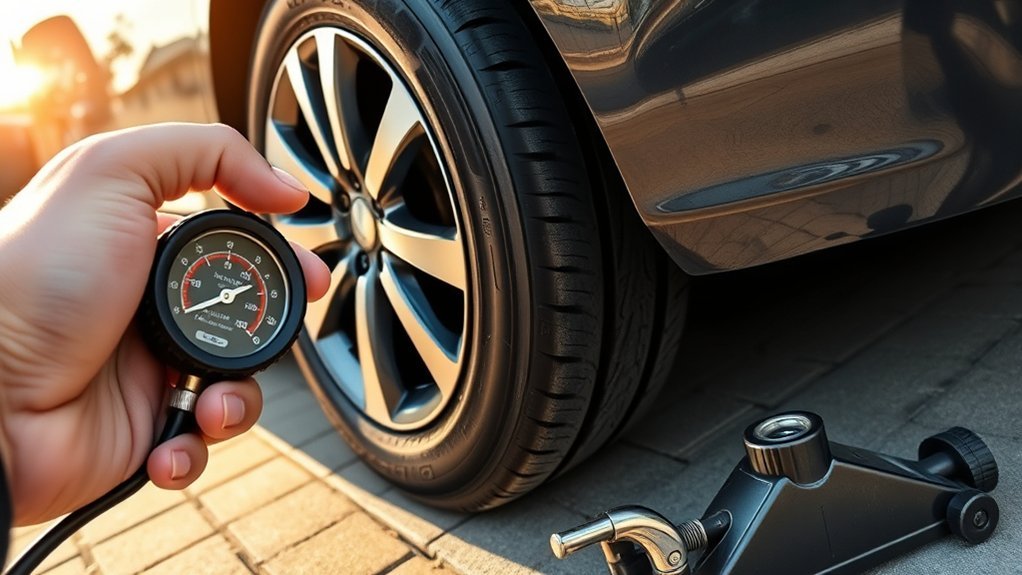
Before a road trip, your Toyota Camry’s tires deserve more than a quick glance. A safe tire check means inspecting tread depth, pressure, sidewall condition, tire age, uneven wear, and the spare tire or repair kit before you load the trunk and leave town.
Quick Answer
To check your Toyota Camry’s tire condition before a road trip, inspect tread depth with a penny or tread gauge, check cold tire pressure using the driver-side placard, look for cracks, bulges, punctures, and uneven wear, verify tire age, and confirm that your spare tire or repair kit is ready.
Key Takeaways
- Check tire pressure when the tires are cold, and use the PSI listed on your Camry’s door-jamb placard or owner’s manual.
- Replace tires when treadwear indicators show, the penny test fails, cords are visible, or sidewall damage appears.
- Use a tread depth gauge for the most accurate reading, especially before long highway trips or wet-weather driving.
- Do not rely only on the tire pressure monitoring system; Toyota advises regular checks with a gauge.
- Check your spare tire, jack, lug wrench, wheel-lock key, or tire repair kit before you need them on the shoulder of the road.
At a Glance
| Time Required | 10–15 minutes |
| Difficulty | Easy; no mechanical experience required |
| Tools Needed | Tire pressure gauge, penny, tread depth gauge if available, flashlight, gloves, and your Camry’s owner’s manual or driver-side tire placard |
| Cost | Free if you already have a gauge; usually under $15 for a basic tire pressure gauge or tread depth gauge |
Why Tire Condition Matters for Your Road Trip

Your tires are the only parts of your Camry that touch the road. Poor tire maintenance can affect braking, steering, ride comfort, fuel economy, and tire life. The National Highway Traffic Safety Administration warns that low pressure, poor rotation habits, and worn tires can lead to flats, blowouts, and tread separation.
NHTSA reported 511 motor vehicle traffic fatalities in tire-related crashes in 2024, which makes tire checks a real safety step—not just routine maintenance.
Proper inflation also saves fuel. According to FuelEconomy.gov, under-inflated tires can lower gas mileage by about 0.2% for every 1 psi drop in the average pressure of all tires. Keeping tires at the correct pressure can improve gas mileage by 0.6% on average and up to 3% in some cases.
Inspect Tread Depth With the Penny Test and a Gauge
Tread depth helps your tires grip the road, move water away from the contact patch, and stop more predictably in rain. The penny test is a quick roadside check, but a tread depth gauge gives the most accurate reading.
- Park safely on level ground. Set the parking brake and turn the steering wheel slightly so you can see the front tread better.
- Use the penny test. Place a penny into a main tread groove with Lincoln’s head facing down. If you can see all of Lincoln’s head, the tread is at or near the common 2/32-inch replacement point.
- Check several spots. Measure the inner, center, and outer grooves on each tire. Uneven readings can point to alignment, suspension, or inflation problems.
- Look for treadwear indicators. Toyota’s tire guidance says to replace tires when treadwear indicators are showing on the tire.
- Use a tread depth gauge before long trips. For wet-weather driving, do not wait until the last possible moment. AAA testing found that tires worn to 4/32 inch perform worse on wet roads than new tires, so plan replacement early if you often drive in rain.
Pro Tip: Keep a low-cost tread depth gauge in your glove box. The penny test is useful, but a gauge tells you the actual depth in 32nds of an inch so you can track wear before a trip.
Identify Common Tire Damage Before You Drive
A tire can have enough tread and still be unsafe. Walk around your Camry slowly and inspect each tire with a flashlight. Look at the tread face, shoulder, and sidewall.
| Damage Type | Signs to Look For | Action Required |
|---|---|---|
| Cracks or cuts | Visible cracking, deep cuts, or weather-checking on the sidewall | Have the tire inspected; replace it if the damage reaches the cords or sidewall structure |
| Bulges or blisters | Raised areas on the sidewall or tread | Do not start a road trip on this tire; replace it |
| Punctures or embedded objects | Nails, screws, glass, or slow leaks | Have a tire professional inspect and repair or replace it before the trip |
| Worn tread | Penny test fails or treadwear indicators are flush with the tread | Replace the tire |
| Uneven wear | One edge is smooth, center is worn, cupping, feathering, or patchy wear | Check tire pressure, alignment, balance, and suspension |
Warning: Do not take a road trip on a tire with a sidewall bulge, exposed cords, severe cracking, or a tire that loses air repeatedly. Install the spare if safe to do so, use roadside assistance, or have the tire replaced before driving highway speeds.
[Products Worth Considering]

The SAFELIFE dial tire tread depth gauge measures tread depth in 1/32 inch increments with clear, easy-to-read 2-inch dial face. Color zones using a traffic light system help you quickly judge whether tread is low, marginal, or ample for safer driving. Built with a durable zinc cast body and a metal detect probe for precise, comfortable use across cars, motorcycles, trucks, and buses.

The TYAMATE TM8 solar-powered wireless TPMS delivers real-time tire pressure and temperature monitoring with six alarm modes for safer driving. A vibrant color LCD display shows readings clearly while windshield mounting keeps it hands-free and easy to read. With a wide 0–87 PSI range, strong 433.92 MHz signal transmission, and quick sensor pairing, it’s ideal for RV, sedan, SUV, MPV, and truck use.

Milton S-921 pencil tire pressure gauge helps you maintain optimal tire pressure for passenger cars with accurate readings in PSI and kPa. It features a built-in deflator valve for convenient pressure adjustments, plus a single chuck head and nylon indicator bar for easy use on the go. Built from durable plated brass and designed for reliable performance, it’s a practical road trip and cold-weather maintenance tool.
Is Your Tire Pressure Ready for the Road?
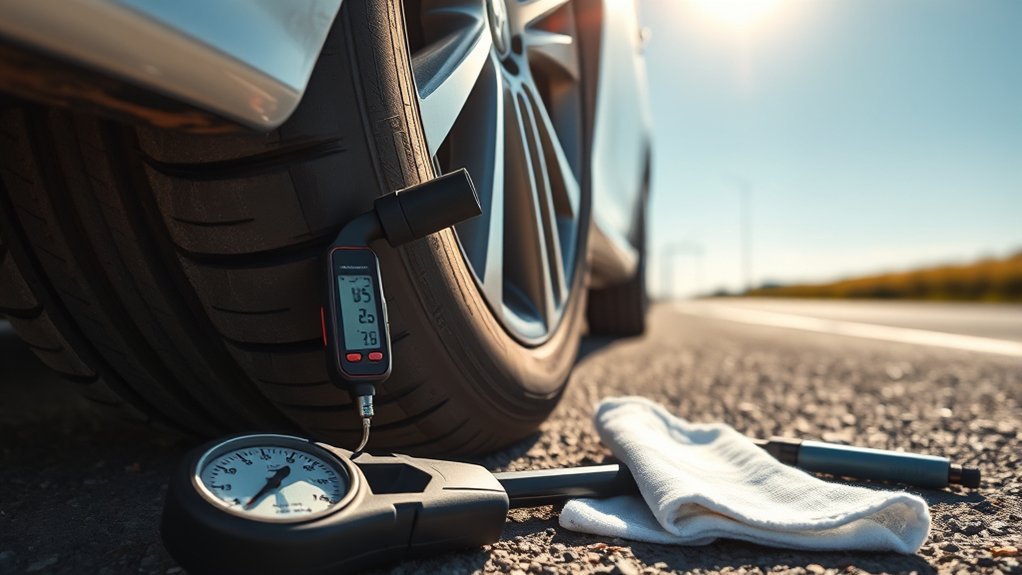
Tire pressure should be checked when the tires are cold. NHTSA defines cold tires as tires on a vehicle that has not been driven for at least three hours. This matters because pressure rises as tires heat up during driving.
Find the Correct Camry Tire Pressure
Do not guess, and do not use the maximum PSI printed on the tire sidewall. For a Toyota Camry, use the tire and loading information label on the driver-side door edge or door post, or check the specifications section of your owner’s manual. Toyota’s support guidance also directs owners to the Tire Information placard or owner’s manual for the correct pressure.
| Tire Location | Correct Pressure Source | What to Do |
|---|---|---|
| Front tires | Driver-side tire placard or owner’s manual | Inflate or deflate to the listed cold PSI |
| Rear tires | Driver-side tire placard or owner’s manual | Match the listed cold PSI for your trim, tire size, and load |
| Spare tire, if equipped | Spare tire label, owner’s manual, or tire placard | Inflate to the specified pressure before the trip |
How to Check and Adjust Pressure
- Check pressure in the morning or after the Camry has been parked for at least three hours.
- Remove the valve cap and press the tire pressure gauge firmly onto the valve stem.
- Compare the reading with the cold PSI on the door-jamb placard or owner’s manual.
- Add air if the tire is low, or release air carefully if it is overinflated.
- Recheck with the gauge after every adjustment.
- Replace the valve cap to help keep dirt and moisture out of the valve stem.
- Repeat the process for all four tires and the spare tire if your Camry has one.
Note: A Toyota tire pressure monitoring system can warn you when pressure is critically low, but Toyota says tire pressure should still be checked regularly with a gauge. Treat TPMS as a backup warning, not your only inspection method.
Check Tire Age and Date Code
Tread depth is not the only reason to replace a tire. Rubber ages even when the tire is not driven much. NHTSA says some vehicle and tire manufacturers recommend replacing tires that are six to 10 years old, regardless of treadwear.
To check age, look for the DOT Tire Identification Number on the sidewall. The last four digits show the week and year the tire was made. For example, a code ending in “2519” means the tire was made in the 25th week of 2019. If the code is hard to see, check the other side of the tire or ask a tire shop to inspect it.
Why You Should Rotate and Align Your Tires
Rotation and alignment help your Camry’s tires wear evenly. Even wear gives the tread a better chance to maintain traction, reduce vibration, and last longer.
Tire Rotation for Even Wear
Follow Toyota’s maintenance schedule for your model year and tire type. NHTSA says that if the vehicle manufacturer recommends tire rotation, it is often done every 5,000 to 8,000 miles or sooner if uneven wear appears. Toyota’s tire guidance also says to replace or rotate tires according to maintenance schedules and treadwear.
Alignment and Balance Warning Signs
Schedule a tire or alignment inspection before your road trip if you notice any of these signs:
- The Camry pulls left or right on a straight, level road.
- The steering wheel vibrates at highway speed.
- One tire edge wears faster than the other.
- The tread looks cupped, scalloped, or patchy.
- The steering wheel is off-center when driving straight.
Fuel Efficiency and Tire Maintenance
Correct inflation reduces rolling resistance and helps your Camry use fuel more efficiently. FuelEconomy.gov says properly inflated tires are safer, last longer, and can improve gas mileage by 0.6% on average. For a road trip, that is a simple check with real payoff.
How to Know When Your Tires Need Replacing
Replace or professionally inspect your tires before a long drive if any safety threshold is reached. Do not wait until the car feels unstable at highway speed.
| Condition | What It Means | Best Next Step |
|---|---|---|
| Penny test fails | Tread is at or near the common 2/32-inch replacement point | Replace the tire |
| Treadwear indicators show | The tire has reached its wear indicator limit | Replace the tire |
| Around 4/32 inch tread before heavy rain driving | Wet-road safety margin is reduced | Plan replacement soon, especially before a rainy road trip |
| Sidewall bulge or blister | Possible internal tire damage | Do not drive a long distance; replace the tire |
| Repeated pressure loss | Leak, puncture, valve issue, or wheel problem | Have it inspected and repaired before travel |
| Six to 10 years old | Age-related tire degradation may be a concern | Ask a tire professional whether replacement is needed |
[Products Worth Considering]

This roadside assistance kit helps drivers and passengers in urgent situations after an accident or breakdown, providing practical support while waiting for help. It includes a lightweight, compact tire inflator for fast inflation of standard vehicle tires, plus reinforced jumper cable protection for safer handling. Ideal for winter weather, road trips, camping, and travel, with everything stowed neatly in a trunk bag.

Monitor tire tread wear with a smart, color-coded depth gauge that shows clear condition ranges at a glance. The bar is range marked for fast, easy readings, helping you maintain safer traction and performance. Each gauge is portable with a pocket clip, and the set includes 20 units for daily use and sharing.

This tire inflator with pressure gauge delivers long-lasting performance with a durable rubber-protected gauge and sturdy build. The longer hose and 360 swivel air chuck help you seal the valve securely and keep your hands free while measuring, inflating, or deflating. It’s battery-free for reliable use and provides ±2 PSI accuracy in the mid-range for most typical tires, with universal compatibility for 1/4 NPT compressor outputs.
Getting Your Spare Tire Ready for Emergencies

Your Camry may have a temporary spare tire, a full-size spare, or a tire repair kit depending on model year, trim, and market. Confirm what is in your trunk before the trip. Finding out after a blowout is too late.
| Task | What to Check |
|---|---|
| Spare tire pressure | Inflate the spare to the pressure listed on the spare, placard, or owner’s manual. |
| Spare tire condition | Check tread, sidewall cracks, punctures, bulges, and age. |
| Jack and lug wrench | Make sure the jack, handle, lug wrench, and any wheel-lock key are present and usable. |
| Repair kit, if equipped | Check the inflator, sealant expiration date, power cord, hose, and instructions. |
| Temporary spare limits | Follow the speed, distance, and placement limits printed on the spare tire or in your owner’s manual. |
Note: A compact spare is meant to help you reach a safe repair location. It is not a permanent replacement for a road-trip tire.
[Products Worth Considering]

Stay on top of tire pressure with a factory-calibrated digital gauge accurate to ±1 PSI and readable in 0.1 increments. It features a bright backlit LCD plus a illuminated nozzle for easy readings in low light, with auto-off power saving for longer battery life. Switch quickly between PSI, Bar, Kgf/cm², and KPA using a single button, and cover most everyday vehicles with a 0–150 PSI range.

Measure tire tread depth quickly and accurately with this LUMITECO dial gauge that reads in 1/32" increments up to 14/32". The color-coded green/yellow/red zones make it easy to judge tire wear and know when replacement is needed. A rugged, compact design with a protective pouch helps keep the gauge ready for use on cars, trucks, motorcycles, and more.

The Dr.Roc spare tire tool kit helps you release, lower, or raise your spare tire with reliable extension tools and a lug nut wrench. It is made from rustproof automotive-grade steel and includes an organized carry case for convenient storage. Designed for compatibility with select GM models from the late 1990s through 2019, it uses upgraded extension components to install and remove spare tires with less hassle.
Final Checklist: Are Your Tires Road Trip Ready?
Use this checklist the day before your trip, then do one quick visual walkaround before leaving.
- Check tread depth on all four tires with a penny or tread depth gauge.
- Inspect wear bars and replace tires if treadwear indicators are showing.
- Measure cold tire pressure and match the driver-side placard or owner’s manual.
- Inspect for visible damage such as cuts, cracks, bulges, punctures, and exposed cords.
- Look for uneven wear that may require alignment, balancing, suspension repair, or tire rotation.
- Check tire age using the DOT Tire Identification Number.
- Confirm spare tire or repair kit readiness before packing the trunk.
- Pack safety basics such as gloves, flashlight, reflective triangles, and roadside assistance information.
- Schedule service before you leave if the Camry pulls, vibrates, loses air, or has questionable tire damage.
Frequently Asked Questions
How do I check Toyota Camry tires before a road trip?
Check tread depth, cold tire pressure, sidewall condition, punctures, uneven wear, tire age, and the spare tire or repair kit. Use the PSI listed on your Camry’s driver-side placard or owner’s manual, not the maximum pressure printed on the tire sidewall.
Is the penny test enough for a Toyota Camry tire check?
The penny test is a useful quick check for very low tread, but it is not the most precise method. Use a tread depth gauge when possible, and check multiple grooves on every tire because uneven wear can hide on the inner or outer edge.
What tire pressure should I use for my Toyota Camry?
Use the cold tire pressure listed on your specific Camry’s Tire Information placard, usually on the driver-side door post, or in the owner’s manual. Tire pressure varies by model year, tire size, trim, and load, so avoid using a generic number.
Can I rely on the tire pressure monitoring system before a road trip?
No. Toyota says the tire pressure monitor alerts the driver when pressure is critically low, but pressure should still be checked regularly with a gauge for best tire wear and performance.
When should I replace my Camry tires before a trip?
Replace tires if treadwear indicators show, the penny test fails, cords are visible, a sidewall bulge appears, the tire repeatedly loses air, or a tire professional says age-related cracking makes the tire unsafe. For wet-weather trips, consider replacing tires before they reach the legal minimum.
Conclusion
Checking your Toyota Camry’s tires before a road trip is a simple way to reduce preventable risk. Start with tread depth, inspect for visible damage, check cold tire pressure with a gauge, confirm tire age, and make sure your spare tire or repair kit is ready. If you find bulges, exposed cords, severe cracking, repeated air loss, or unsafe tread, fix the problem before you drive.
Sources
- NHTSA TireWise — tire pressure, rotation, tire aging, maintenance, and tire-related crash safety data.
- FuelEconomy.gov: Keeping Your Vehicle in Shape — fuel-economy impact of proper tire inflation.
- Toyota Support: Recommended Tire Pressure — Toyota guidance to use the owner’s manual or Tire Information placard.
- Toyota Support: Tire Pressure Monitor — TPMS limitation and gauge-check guidance.
- Toyota Owners Manual: 2025 Camry Hybrid Tires — treadwear indicators, uneven wear, tire rotation, and spare tire condition guidance.
- AAA All-Season Tire Testing Report — wet-road performance comparison for new tires and tires worn to 4/32 inch.