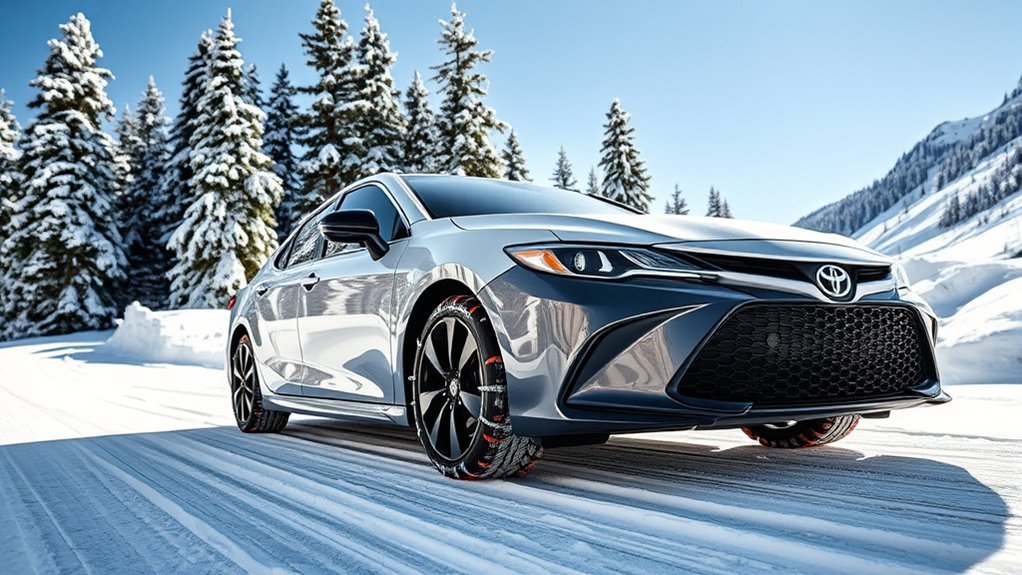
Your Toyota Camry does not automatically need snow chains every time it snows. You need a traction device when road signs or local rules require one, when deep snow or ice makes normal tires unsafe, and only when your Camry’s owner’s manual allows chains on its exact wheel and tire setup. Model year, wheel size, drivetrain, and available clearance all matter.
Quick Answer
A Toyota Camry may need snow chains or an approved traction device during severe snow, ice, or posted chain controls. Check your exact owner’s manual first. On compatible Camry setups, Toyota commonly directs you to fit chains to the front tires only, drive slowly, and remove them on clear pavement.
Key Takeaways
- Check the owner’s manual, tire sidewall, and local chain-control rules before buying or installing anything.
- Do not assume every Camry wheel size accepts chains. Some larger wheel and tire packages have too little clearance.
- For compatible front-wheel-drive Camry models, chains normally go on the front tires, not all four.
- Use four matching winter tires when you need regular cold-weather traction. Chains are temporary tools for severe conditions.
- Follow the chain maker’s speed limit or the vehicle manual’s lower limit, avoid sudden inputs, and remove chains on bare pavement.
At a Glance
| Time Required | About 10 to 20 minutes after you have practiced |
| Difficulty | Beginner to moderate, depending on the device |
| Tools Needed | Correct-size chains or cables, gloves, kneeling mat, flashlight, and tensioners if required |
| Cost | Varies by tire size, device type, and local availability |
Do You Need Snow Chains for Your Camry?
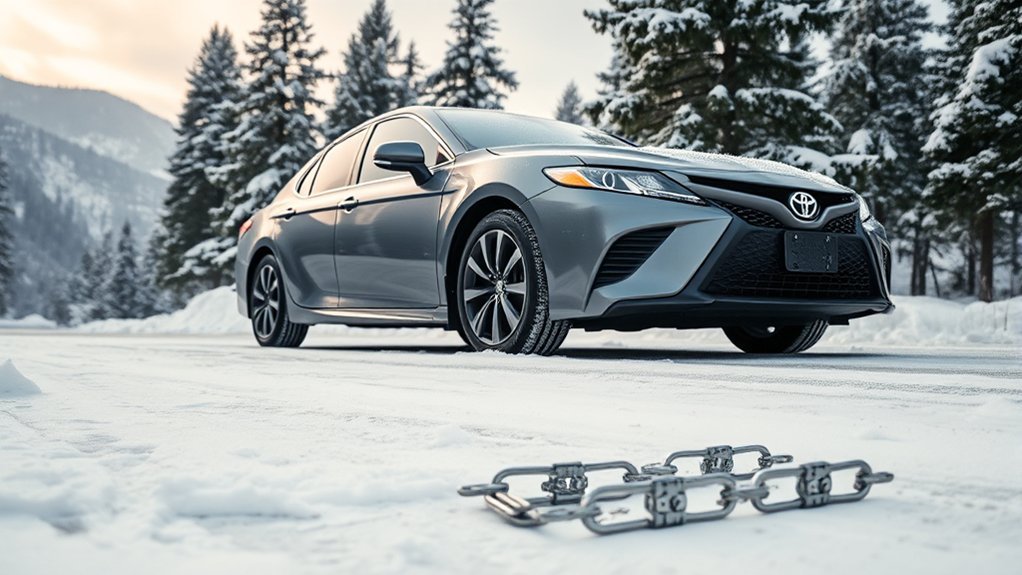
You may need chains when snow is deep, ice is widespread, a mountain road has posted chain controls, or your tires cannot maintain safe traction. You may not need them for a light dusting on treated roads, especially when you already use four suitable winter tires.
The deciding factor is not just the Camry badge. Use the Toyota owner’s manual for your exact model year, then compare its guidance with the tire size printed on your sidewall and the tire-information label on the driver’s door frame.
Warning: Do not install chains simply because a package claims to fit your tire size. A device can fit the tire but still contact the strut, brake line, wheel well, fender liner, or suspension if your Camry lacks enough clearance.
Check Model Year, Wheel Size, and Drivetrain
A 2009 Camry LE may use 215/60R16 tires, but you should never assume that size without checking the vehicle. Different trims, optional wheels, replacement wheels, and prior tire changes can alter what is fitted.
Newer Camry generations may also restrict chains on larger wheels. If the manual says chains cannot be mounted, use approved winter tires or another manufacturer-approved traction device instead of forcing a conventional chain into a tight wheel well.
What Are Snow Chains and How Do They Work?
Snow chains are temporary traction devices that wrap around a tire. Their cross links or cables bite into packed snow and ice, giving the drive tires more grip during acceleration, braking, and low-speed climbing.
Common choices include link chains, cable-style devices, and textile traction devices. Each design has different clearance needs, traction performance, ride quality, and legal acceptance. The best option is the one allowed by both your Camry’s manual and the road authority where you will drive.
- Link chains: Strong traction in severe snow, but they usually need more clearance.
- Cable devices: Lower profile and often easier to handle, but they may provide less bite in deep snow.
- Textile devices: Light and compact, but legal approval and durability vary by location.
- Winter tires: Best for routine winter use because they improve traction on all four corners without repeated installation.
Benefits of Snow Chains in Winter Driving
Properly fitted chains can improve low-speed traction on packed snow and ice. They can help a Camry climb a snowy grade, move through an unplowed section, and comply with a posted chain-control requirement.
Chains do not make winter driving normal. Steering and braking limits remain much lower than on dry pavement, and abrupt acceleration can still cause wheelspin or damage the device.
- More drive-wheel grip in deep or packed snow
- Better low-speed climbing ability on steep roads
- Shorter wheelspin periods when starting gently
- Compliance with road signs that require an approved traction device
- Extra mobility when winter tires alone are not enough
Chains add temporary traction, but your speed, following distance, tire condition, and steering inputs still determine whether the trip is safe.
When Snow Chains Are Crucial: Heavy Snow and Icy Roads
Chains become most useful when snow is deep enough to pack under the tires, ice covers a grade, or authorities activate a chain law. They can also help when a front-wheel-drive Camry cannot move safely with its current tires.
Postpone nonessential travel during a blizzard, freezing rain, a road closure, or near-zero visibility. The National Highway Traffic Safety Administration advises drivers to slow down, increase following distance, prepare the vehicle, and check conditions before leaving.
- Obey chain-control signs and instructions from road crews.
- Install the device in a safe pull-off, never in an active traffic lane.
- Use smooth throttle, steering, and braking.
- Avoid potholes, curbs, and high-speed lane changes.
- Remove chains after the road is clear and the control zone has ended.
Do You Have to Use Chains Where You Live?
Chain laws vary by state, province, road, vehicle type, drivetrain, tire rating, and current weather. A rule may require you to carry chains, install them on drive tires, use an approved alternative, or turn around when your vehicle cannot accept a legal device.
For example, Caltrans chain controls use several restriction levels and posted instructions. Colorado’s traction and chain laws also change with road conditions. Check the official DOT or 511 service for every state on your route shortly before departure.
Note: A legal requirement does not override a vehicle clearance restriction. If your Camry’s manual prohibits conventional chains, confirm which approved alternative devices are legal before entering a chain-control area.
Choosing Snow Chains for Your Camry
Start with the exact tire code, such as 215/60R16. The first number is tire width in millimeters, the second is the sidewall aspect ratio, and the final number is wheel diameter in inches. Match the full code, not just the wheel diameter.
[Products Worth Considering]

This manual duck head tire changer kit makes tire installation and removal simpler by letting you embed the duck head into the tire with applied pressure. The integrated design and durable steel construction help reduce friction and improve efficiency and safety during use. Suitable for 16–21 inch wheels, it’s convenient for cars, trucks, SUVs, and ATV tires, with 24-hour after-sales support.
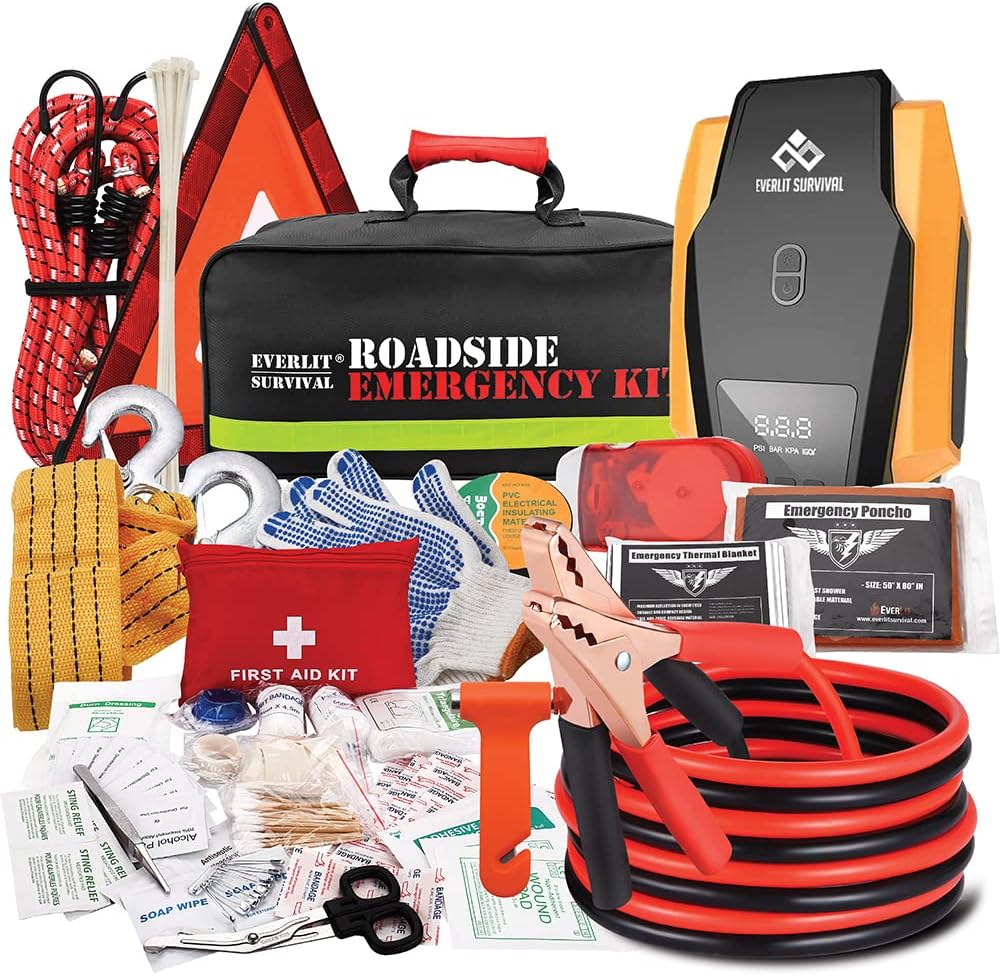
The Everlit Road Guardian emergency kit is designed for roadside breakdowns, combining essential safety gear and roadside tools in one compact bag. It includes a digital 12V auto tire inflator with preset and auto shutoff, plus 12-foot 8-gauge jumper cables to get you moving again. You also get a full 108-piece first aid kit, reflective warning tools, safety gloves, and emergency convenience items for safer travel.

Measure tyre tread depth precisely with a digital gauge that reads in both MM and inches, helping you monitor safe driving conditions. The large LCD screen is easy to operate, and the compact tool fits for cars, trucks, and motorcycles. It provides high accuracy with a 0-25.4mm range and includes a 1-year warranty for added peace of mind.
Use This Fit Checklist
- Read the winter-driving and tire-chain section in your exact Camry owner’s manual.
- Confirm the tire size on all four sidewalls and the driver-door tire label.
- Check whether the manual bans chains on your wheel size or requires a low-clearance design.
- Choose a device listed for that exact tire size.
- Verify that the device is legal where you plan to drive.
- Test-fit it at home before the trip.
Do Not Assume Cable Chains Always Fit
Cable chains are often slimmer than link chains, but “cable” does not automatically mean safe for every Camry. The cable diameter, connector shape, tensioner, and inside clearance still matter.
Choose a complete pair for the driven axle, inspect all connectors, and keep the manufacturer’s instructions in the storage bag. Never mix two different chain designs on the same axle.
How to Install Snow Chains on Your Camry
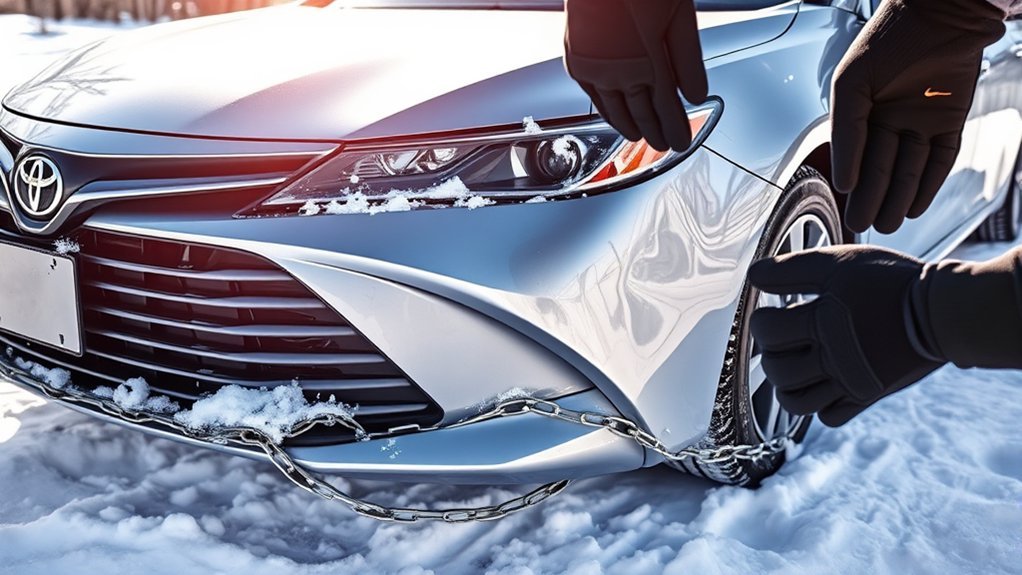
Practice once on a dry driveway while wearing the same gloves you will carry in the car. The exact fastening method varies, so use the device maker’s instructions as the final authority.
[Products Worth Considering]

Milton S-921 pencil tire pressure gauge helps you maintain optimal tire pressure for passenger cars with accurate readings in PSI and kPa. It features a built-in deflator valve for convenient pressure adjustments, plus a single chuck head and nylon indicator bar for easy use on the go. Built from durable plated brass and designed for reliable performance, it’s a practical road trip and cold-weather maintenance tool.

This car emergency kit keeps essential roadside tools organized in a durable, portable bag so you can respond quickly during common driving emergencies. It includes battery jumper cables, a bright LED headlight, first aid supplies, a tire pressure gauge, and safety essentials like gloves and an emergency poncho. Designed for trunk or storage use, it helps you be prepared for dead batteries, minor malfunctions, and unexpected roadside issues.

Monitor tire tread wear with a smart, color-coded depth gauge that shows clear condition ranges at a glance. The bar is range marked for fast, easy readings, helping you maintain safer traction and performance. Each gauge is portable with a pocket clip, and the set includes 20 units for daily use and sharing.
Preparation Steps Before Installation
- Move completely off the roadway onto a flat, stable area.
- Turn on the hazard lights and set the transmission to Park.
- Apply the parking brake unless ice or local conditions make doing so unsafe.
- Confirm the correct pair of tires using your owner’s manual.
- Untangle the chains and inspect for broken links, bent hooks, worn cables, or damaged tensioners.
- Place the chains with the correct side facing the tire and sharp connector edges facing away from the sidewall.
Proper Chain Installation Technique
- Drape the device evenly: Center it over the tread so both sides hang by a similar amount.
- Connect the inside fastener: Reach behind the tire carefully and secure the inner connection first if the instructions require it.
- Connect the outside fastener: Pull the device snug and attach the outer connector.
- Add the tensioner: Install any rubber adjuster or self-tensioning part exactly as directed.
- Check clearance: Turn the steering wheel gently while stationary, where safe, and confirm no part touches the body, brake hose, strut, or suspension.
- Move a short distance: Drive forward slowly, stop in a safe place, and inspect the fit.
- Retighten: Recheck the tension after the distance stated by Toyota and the chain manufacturer. Many Toyota manuals call for another check after roughly 1/4 to 1/2 mile.
Pro Tip: Keep waterproof gloves, a kneeling pad, a headlamp, a small towel, and the printed installation sheet in the chain bag. Cold hands and poor visibility cause many installation mistakes.
Warning: Stop immediately if you hear repeated knocking, scraping, or slapping. A loose or broken chain can damage the tire, wheel, brake components, wiring, and bodywork.
How Fast Can You Drive With Chains?
Use the lowest limit stated by the chain manufacturer, your Camry owner’s manual, or posted road signs. Toyota manuals commonly cap chain use at 30 mph or the chain maker’s lower limit, while some chain-control areas post 25 mph.
Drive more slowly when traction, visibility, or chain condition is poor. Avoid cruise control, sudden braking, hard acceleration, sharp steering, and advanced lane-centering functions if your manual tells you not to use them with chains.
Alternatives to Snow Chains: What Are Your Options?
The right alternative depends on whether you need everyday winter grip, emergency mobility, or legal compliance in a chain-control zone.
- Four winter tires: The best choice for frequent cold, snow, and ice. NHTSA notes that winter tires are more effective than all-season tires in deep snow.
- Cable-style traction devices: A lower-profile option when the vehicle manual and local law allow them.
- Approved textile devices: Easy to store and install, but acceptance varies by road authority.
- Traction mats: Useful for getting unstuck at very low speed, not for normal road travel.
- Sand or cat litter: Can add temporary grip under a spinning tire when you are stuck.
Do not add heavy objects to a Camry’s trunk as a general traction strategy. A front-wheel-drive Camry needs grip at the front axle, and extra rear weight can alter handling, increase stopping distance, and consume payload capacity.
[Products Worth Considering]

The SAFELIFE dial tire tread depth gauge measures tread depth in 1/32 inch increments with clear, easy-to-read 2-inch dial face. Color zones using a traffic light system help you quickly judge whether tread is low, marginal, or ample for safer driving. Built with a durable zinc cast body and a metal detect probe for precise, comfortable use across cars, motorcycles, trucks, and buses.

Upgrade your wheels with MIKKUPPA M12x1.5 mag seat lug nuts built for secure, corrosion-resistant performance. These closed-end chrome lug nuts are a direct replacement for select Toyota models, including Camry, Corolla, RAV4, Sienna, Avalon, Highlander, Matrix, Venza, and Prius. Triple-chromium plating and cold-forged, heat-treated steel help deliver strength for daily driving and replacement needs.

This compact tire repair kit includes a heavy-duty universal plug kit for fast roadside puncture repairs in most tubeless tires. It comes with a durable MOLLE storage pouch so you can keep the tools organized and easily store them in your UTV, ATV, truck, motorcycle, RV, or overlanding gear. Ideal for getting back on the road, trail, or job site with confidence.
How to Maintain Your Snow Chains
Inspect the set before winter and after every use. Replace it if you find cracked links, frayed cables, distorted hooks, missing cross members, damaged tensioners, or severe corrosion.
- Rinse off road salt, mud, and grit after use.
- Dry the device fully before storing it.
- Repair only with parts approved by the chain manufacturer.
- Store the pair together with instructions, gloves, and tensioners.
- Test-fit the set again after changing tires or wheels.
- Do not keep using a chain that has struck the vehicle or broken under load.
Five Checks Before You Rely on Chains
Use this final check before a winter trip:
- Compatibility: The exact Camry model year, wheel size, and tire size accept the device.
- Placement: You know which axle the owner’s manual specifies.
- Condition: Both devices are complete, untangled, and free from serious wear.
- Practice: You can install and remove them without guessing.
- Road rules: You checked current DOT, 511, weather, and chain-control information.
Frequently Asked Questions
Is a Toyota Camry weak in snow?
A Camry is not automatically poor in snow, but tire type, tread depth, tire pressure, ground clearance, and driver inputs matter. Four suitable winter tires usually improve cold-weather traction more consistently than relying on chains only during emergencies.
Do you need snow chains on all four tires or just two?
Use the placement stated in your exact owner’s manual. For compatible Camry configurations, Toyota commonly specifies chains on the front tires only and no chains on the rear. This is different from winter tires, which should be installed as a matching set of four.
How do you put a Toyota Camry in Snow mode?
Only use Snow mode if your model year and trim actually include it. Follow the owner’s manual and the labeled switch or drive-mode menu. Snow mode can soften power delivery, but it does not replace winter tires, chains, safe speed, or required traction devices.
Can every Toyota Camry use tire chains?
No. Chain compatibility varies by model year and wheel size. Some Camry manuals prohibit chains on larger wheel and tire packages because clearance is too tight. Check the exact manual before buying a device.
Are cable chains better for a Camry?
Cable devices may offer more clearance and easier handling, but they are not automatically approved for every Camry. Use a device that matches the tire size, meets the manual’s clearance rules, and is legal on your route.
Can you drive with snow chains on clear roads?
No. Remove chains when pavement is clear and the control zone has ended. Bare pavement quickly wears traction devices and can damage the tires, wheels, suspension, and body.
What should you carry with snow chains?
Carry gloves, a headlamp, kneeling pad, reflective vest, scraper, shovel, blanket, water, phone charger, basic tools, and a printed instruction sheet. Check road conditions and your emergency kit before leaving.
Conclusion
Your Toyota Camry needs snow chains only when conditions or road rules call for them and the exact vehicle setup permits them. Start with the owner’s manual and tire size, choose a legal low-clearance device when required, practice installation, and fit it to the specified axle.
Use four winter tires for regular winter driving, keep chains for temporary severe conditions, and postpone travel when visibility or road conditions are unsafe. No traction device can replace slower speed, longer following distance, and smooth control inputs.
Sources
- Toyota Manuals and Warranties — model-specific chain compatibility, placement, speed, and winter-driving instructions
- Caltrans Chain Controls and Installation — posted chain levels, legal requirements, installation areas, and chain-control speeds
- Colorado Passenger Vehicle Traction and Chain Laws — current Colorado traction-device requirements
- NHTSA Winter Weather Driving Tips — vehicle preparation, tire checks, speed, following distance, and emergency planning
- NHTSA TireWise — winter-tire and tire-maintenance guidance
- National Weather Service Winter Safety — weather checks, route planning, and winter emergency-kit guidance