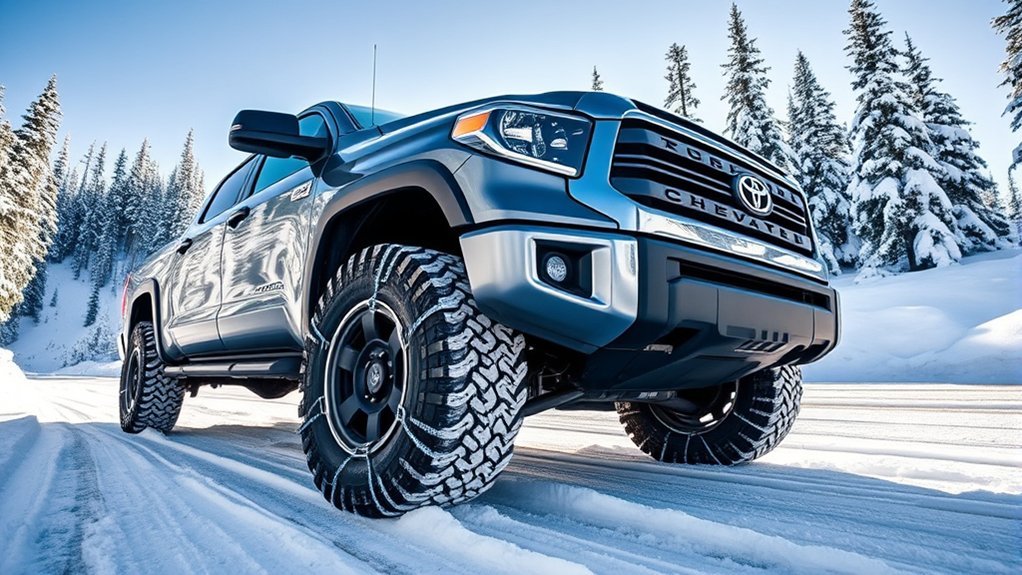
For most Toyota Tundra 4×4 owners, the safest starting point is to put snow chains on the rear tires, then confirm that choice against your exact owner’s manual, tire size, chain instructions, and local chain-control signs. The Tundra is a rear-drive-based truck, so rear chains usually give the best balance of traction and stability without creating front-wheel clearance problems.
Quick Answer
Put snow chains on the rear tires of a Tundra 4×4 unless your exact owner’s manual, tire-chain instructions, or posted chain-control signs say otherwise. Use front chains only if your Tundra has enough clearance and the manual allows it. Use four chains only when approved and truly needed.
Key Takeaways
- Rear tires are the normal first choice for a Tundra 4×4 because they support rear-axle drive traction and help reduce fishtailing.
- Do not assume front chains are safe. They can rub steering, brake, suspension, or fender parts if clearance is tight.
- Four chains can help in severe snow, but only if your owner’s manual and chain manufacturer allow front use on your tire size.
- Follow posted chain-control rules. Road authorities can require chains or traction devices even on 4WD vehicles.
- Remove chains once roads are clear to avoid chain, tire, wheel, and road damage.
At a Glance
| Time Required | 10–25 minutes the first time; 5–10 minutes after practice |
| Difficulty | Beginner to moderate, depending on chain style and weather |
| Tools Needed | Correct-size chains or cables, gloves, flashlight, towel or kneeling pad, tensioners if required by the chain maker |
| Cost | No labor cost if you install them yourself; chain and cable prices vary by tire size, rating, and brand |
Warning: Your owner’s manual, tire-chain instructions, and posted chain-control signs override general advice. If your exact Tundra trim, wheel size, tire size, or suspension setup does not allow chains on a certain axle, do not force them on.
Check Your Manual and Tire Size First
Before you buy or install chains, check three things: your Toyota owner’s manual, the tire size printed on your tire sidewall, and the chain maker’s fit chart. Do not rely only on “Toyota Tundra” as the fitment. A Tundra can have different wheel sizes, tire sizes, trims, and suspension clearances.
Look for the full tire size, such as the numbers and letters on the sidewall, then match that exact size to the chain or cable package. If your truck has aftermarket wheels, oversized tires, a lift, wheel spacers, or a modified suspension, test-fit the chains in a safe place before you need them on a snowy shoulder.
Note: Some areas require you to carry chains even when your 4WD truck has snow-rated tires. Caltrans and Yosemite/NPS both advise that 4WD or AWD vehicles may still need to carry traction devices in chain-control areas.
Why Rear Tires Are Usually Best for Snow Chains on a Tundra 4×4
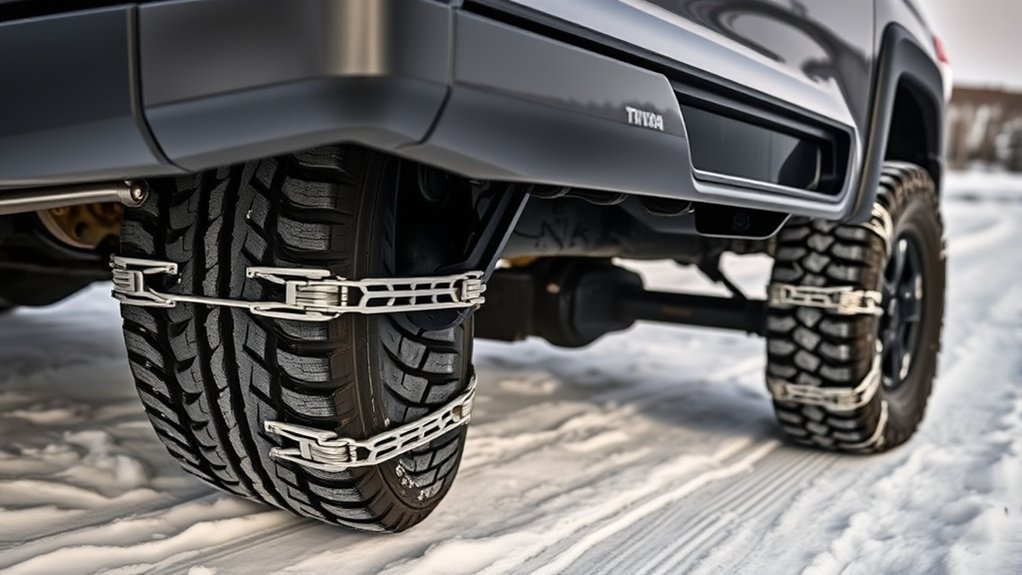
On most Tundra 4×4 setups, rear chains are the right first choice because the truck is rear-drive based and the rear axle needs strong bite for climbing, pulling, and keeping the back of the truck from stepping out. When the rear tires lose traction on snow or ice, the truck can fishtail, especially on hills, curves, or when towing light loads.
Rear chains also help with acceleration from a stop. This matters when you are starting on a snowy grade, pulling out of a turnout, or driving through packed snow. Because rear tires do not steer, they usually have fewer chain-clearance problems than the front tires.
Road authorities also commonly describe chain placement in terms of drive wheels. For a rear-drive-based truck like the Tundra, that is why rear placement is the safest default unless your exact manual or a posted requirement says something different.
What to Watch Out for With Front Tire Chains on Your Tundra
Front chains can improve steering bite in deep snow, but they are not automatically safe on a Tundra. The front wheels turn left and right, move through suspension travel, and sit close to steering, brake, and suspension parts. That makes clearance more critical than on the rear axle.
Use front chains only when your exact Tundra manual, tire size, and chain manufacturer all allow front-axle installation.
Watch for these risks before using front chains:
- Steering clearance: Chains may rub when the wheel is turned near full lock.
- Brake and suspension contact: Loose or oversized chains can strike brake lines, control arms, or other front-end parts.
- Fender and liner damage: Larger tires or aftermarket wheels can reduce space inside the wheel well.
- Handling imbalance: If only the front tires have chains, the rear of the truck can still slide or fishtail.
- Manual restrictions: Some tire and wheel combinations may not be approved for front chains.
If you test-fit front chains, turn the steering wheel slowly from side to side while parked and check for contact. Then roll forward a short distance at very low speed and check again. If you hear rubbing, feel thumping, or see contact marks, remove the chains and do not drive with them installed.
[Products Worth Considering]

Adam’s Pro Tire Hex Grip applicators are molded foam sponges designed for precise, even tire dressing application. The ergonomic grip helps you spread product without overapplying, reducing sling that can splash onto paint and helping keep your hands clean during wheel and trim detailing. They’re durable, washable, and reusable for repeated detailing sessions.

These universal tire valve stem caps help protect valve cores from dust, debris, and moisture while helping maintain stable tire pressure. The corrosion-resistant metal construction and sealed design provide reliable protection in road grime, mud, and winter conditions. Twist-on installation makes them quick to fit on cars, SUVs, trucks, and motorcycles.

These aluminum alloy tire valve stem caps with an O-ring seal help protect valve stems from corrosion while adding a clean, stylish look to your vehicle. The universal fit works across cars, trucks, motorcycles, bicycles, and more, making them an easy upgrade for everyday driving and off-road use. Installation is quick, and the included four-pack keeps all your tires dressed and protected.
Rear, Front, or Four Chains: Which Setup Should You Use?
The best setup depends on road conditions, local law, tire clearance, and the chain type. Use this simple guide before you install anything:
- Rear chains only: Best default for most Tundra 4×4 drivers. It improves drive traction and rear stability with fewer front-clearance risks.
- Front chains only: Usually not the best choice for a Tundra unless a specific instruction or condition calls for it and clearance is confirmed.
- All four chains: Can improve steering, braking, and climbing in severe snow, but only if your manual and chain maker allow front chains on your tire size.
- No chains: Only when roads are clear, signs do not require them, and your tires meet local traction rules.
Pro Tip: Practice installing the rear chains at home before the trip. It is much easier to learn in your driveway than on a dark, snowy shoulder with cold hands.
[Products Worth Considering]

This 3-piece wheel brush set makes it easy to clean wheels and tires with soft, scratch-free brushes designed for lifting brake dust and grime. The flexible rim brush bends up to 360 degrees to reach hard-to-access areas for a thorough clean, while the comfortable grip helps control during detailing. A dedicated detailing brush supports gentle cleaning for sensitive surfaces, including interior use.

This professional wheel and rim cleaning brush set lifts brake dust, grime, and dirt with soft, scratch-free microfiber and synthetic wool fibers. The rim brush bends up to 360 degrees for easy access to hard-to-reach areas around spokes, lips, and faces. Ideal for thorough cleaning of car, truck, motorcycle, bicycle, RV, and more wheel and tire surfaces.

Replace or upgrade your zero-turn lawn mower tires with a universal fit flat-free tire and wheel assembly in a convenient 2-pack. Smooth tread front-caster style helps turning with reduced turf damage, while flat-free design eliminates the maintenance and downtime of air-filled flats. The included adapter kit supports 5/8-inch axles and hub lengths from 3.4 to 5 inches for compatibility across most ZTR mowers.
When to Use Snow Chains on All Four Tires in Severe Conditions
Using chains on all four tires can give a Tundra 4×4 more balanced grip in deep snow, icy ruts, or steep mountain conditions. The benefit is simple: the rear chains help the truck move, while front chains can add steering and braking grip.
That does not mean all-four chaining is always legal, required, or safe. Some public-road chain controls require chains or traction devices on the drive wheels, and some 4WD rules describe chaining two wheels rather than all four. For example, Yosemite National Park explains that under its “no exceptions” R-3 condition, chains go on the drive wheels, described as two wheels of a four-wheel-drive vehicle.
Use four chains only when all of these are true:
- Your owner’s manual allows front chain use for your exact tire size.
- The chain maker approves the chains for front and rear use.
- You have enough clearance at full steering lock and through suspension movement.
- Road or trail conditions are severe enough to need the extra grip.
- You can drive slowly and remove the chains when the snow or ice ends.
If any of those points are not true, use the rear chains only or choose an approved traction device that fits your truck.
[Products Worth Considering]

This manual duck head tire changer kit makes tire installation and removal simpler by letting you embed the duck head into the tire with applied pressure. The integrated design and durable steel construction help reduce friction and improve efficiency and safety during use. Suitable for 16–21 inch wheels, it’s convenient for cars, trucks, SUVs, and ATV tires, with 24-hour after-sales support.

This professional wheel and rim brush kit makes it easy to lift brake dust, grime, and dirt from wheels and tires without scratching finishes. The brushes feature soft, metal-free wool heads and a flexible 360-degree rim brush design for reaching hard-to-clean areas. Includes multiple brush types plus accessories for thorough car, motorcycle, and general vehicle detailing.

Black Magic Intense Foam Wheel & Tire Cleaner uses a high-foaming action to lift away dirt, grime, and brake dust without scrubbing. The color-changing formula helps show contaminants being dissolved as foam turns from white to brown. Safe for all wheel types and even wheel wells, it leaves a like-new, slick finish with a fresh cherry scent.
Understanding Chain-Control Laws and 4WD Exemptions
Chain rules vary by state, province, park, and mountain road. Do not assume a Tundra 4×4 is always exempt. Caltrans lists several chain-control levels, including conditions where chains or traction devices are required on all vehicles, and it also notes that 4WD and AWD vehicles must carry traction devices in chain-control areas.
In many mountain areas, signs tell you when chains are required and where to install them. Caltrans says drivers should pull completely off the roadway to the right before installing chains and should remove them only after driving beyond the “End of Chain Control” signs to a safe pull-off area.
The safest rule is simple: carry the right chains before you enter snow country, follow posted signs, and follow any instructions from road officials at chain-control checkpoints.
Safe Installation and Removal of Snow Chains
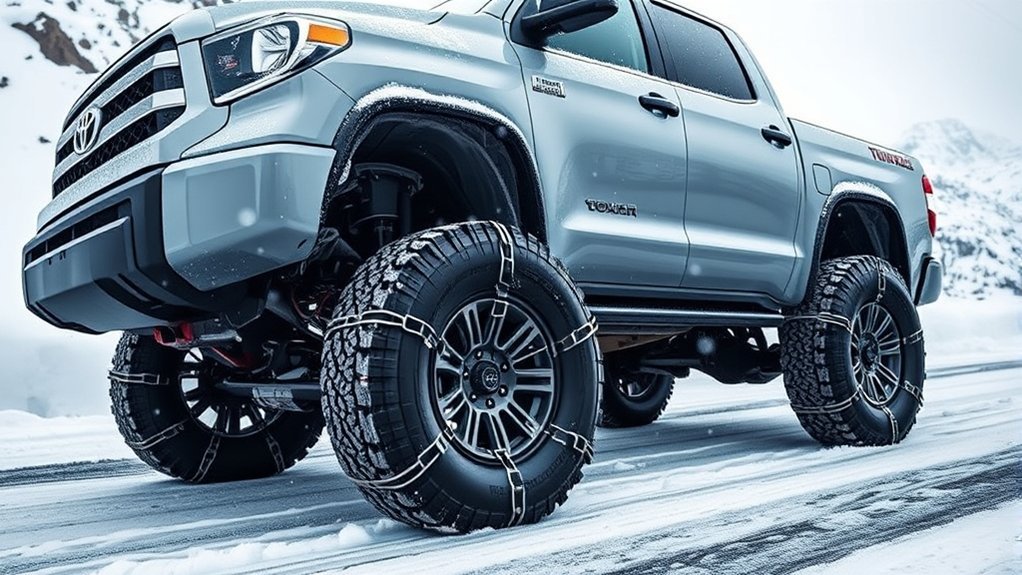
Install chains before you lose traction, not after you are already stuck. Choose a flat, safe pull-off area away from traffic. Turn on your hazard lights, set the parking brake, and keep your body away from the traffic side of the truck as much as possible.
- Confirm the tire size: Match the chains to the exact size printed on the tire sidewall.
- Lay the chains flat: Remove twists, tangles, and damaged links before placing them on the tire.
- Install on the rear tires first: Center the chains over the tread unless your manual or road rules require another placement.
- Connect the inside fastener: Secure the inner side first so the chain sits evenly behind the tire.
- Connect the outside fastener: Pull the chain snug, then attach the outside latch or tensioning system.
- Add tensioners if required: Use only the tensioning method approved by the chain manufacturer.
- Roll forward slowly: Move a short distance, then stop safely and recheck tightness.
- Check for rubbing: Look behind the tire and around the wheel well before driving farther.
To remove chains, drive to a safe pull-off beyond the chain-control area or onto clear ground. Release the tensioner, disconnect the fasteners, lay the chains flat, and drive off them slowly. Shake off snow and ice, then dry and store them after the trip to reduce rust.
Essential Driving Tips for Using Chains in Snowy Conditions
Chains improve grip, but they do not make a Tundra stop or turn like it would on dry pavement. Keep your speed low, leave extra following distance, and avoid sudden steering, braking, and throttle inputs. In many California chain-control areas, the posted chain speed is 25 or 30 mph. Yosemite lists 25 mph inside its chain-control areas.
Use these driving habits with chains:
- Stay below the posted or chain-maker speed limit. If the chain package gives a lower limit, follow that lower limit.
- Accelerate gently. Spinning the tires can loosen or damage chains.
- Brake early. Snow and ice increase stopping distance even with chains.
- Avoid dry pavement. Chains wear quickly and can damage tires or roads when there is no snow or ice.
- Listen for slapping or rubbing. Stop safely and inspect the chains if you hear unusual noise.
- Do not use cruise control. Keep direct control of speed in slippery conditions.
Warning: If a chain breaks, comes loose, or starts hitting the truck, stop as soon as it is safe. A loose chain can damage brake lines, wheels, fenders, suspension parts, and the inside of the wheel well.
Troubleshooting Common Snow Chain Problems
If the truck shakes, pulls, or makes loud chain noise, do not keep driving and hope it fixes itself. Stop in a safe pull-off and inspect the chains.
- Chain feels loose: Recenter it on the tire and retighten it. Make sure the tensioner is installed correctly.
- Chain rubs the wheel well: Remove it and confirm the size, chain class, and clearance. Do not keep driving with rubbing chains.
- Truck vibrates heavily: One chain may be twisted, off-center, or mounted tighter than the other side.
- Chain hits brake or suspension parts: Remove it immediately. The chain may not be approved for that tire or axle.
- Traction is still poor: Slow down, use 4H or 4L only as conditions require, avoid sudden throttle, and consider waiting for plows or safer conditions.
Frequently Asked Questions
Can I use snow chains on my Tundra’s all-season tires?
Yes, you can use snow chains on all-season tires if the chains match your exact tire size and your owner’s manual allows them. However, all-season tires are not the same as dedicated winter tires. In chain-control areas, check whether your tires meet local snow-tire or traction-device rules.
How do I choose the right size snow chains for my Tundra?
Read the full tire size on the tire sidewall, then match that exact size to the chain maker’s fit chart. Also check your owner’s manual for clearance limits and approved traction-device types. If your Tundra has aftermarket wheels or oversized tires, test-fit the chains before your trip.
Are there specific brands recommended for Tundra 4×4 snow chains?
Toyota and road agencies generally do not recommend one universal brand for every Tundra. Choose chains or cables that match your tire size, vehicle weight, clearance needs, and local legal requirements. Common brands include Peerless, Security Chain Company, Konig, and other traction-device makers, but fitment matters more than the name.
What is the maximum speed limit while using snow chains?
Follow the lowest limit from three places: the posted road sign, the chain-control rule, and the chain manufacturer’s instructions. Many California chain-control areas list 25 or 30 mph, while Yosemite lists 25 mph. Slow down more if visibility, ice, traffic, or chain noise makes that speed unsafe.
Can snow chains damage my Tundra’s wheels or tires?
Yes. Chains can damage wheels, tires, fenders, brake lines, and suspension parts if they are the wrong size, installed loosely, driven too fast, or used on dry pavement. Install them snugly, recheck after a short distance, and remove them when roads are clear.
Do I need chains if my Tundra has 4WD?
Sometimes, yes. Four-wheel drive helps you move, but it does not remove the need to follow chain-control laws. In some areas, 4WD vehicles with proper snow tires may be exempt from installing chains under certain conditions, but they may still have to carry chains.
Should I use snow cables instead of chains on a Tundra?
Snow cables can be easier to install and may need less clearance than link chains, but they may not provide the same bite in deep snow. Use the traction device approved for your tire size, truck weight, owner’s manual, and local chain-control rules.
Conclusion
For a Toyota Tundra 4×4, put snow chains on the rear tires first unless your exact manual, chain instructions, or posted road signs tell you otherwise. Rear chains usually give the best mix of forward traction, rear stability, and clearance. Front or all-four chains can help in severe conditions, but only when your truck has enough clearance and the setup is approved.
Before winter travel, buy chains that match your exact tire size, practice installation at home, carry gloves and a light, and check current road rules before entering snow country. Once the road is clear, remove the chains to protect your tires, wheels, and truck.
Sources
- Toyota Manuals and Warranties — official owner’s manual access for model-specific tire-chain and traction-device guidance.
- Caltrans Chain Controls / Chain Installation — chain-control levels, 4WD/AWD traction-device carrying rules, installation location, and chain-control speed guidance.
- Caltrans Winter Driving Tips — winter trip preparation, proper chain sizing, drive-wheel placement, and snow-driving safety tips.
- National Park Service: Yosemite Tire Chain Requirements — chain/cable definitions, drive-wheel placement, 4WD requirements, R-1/R-2/R-3 explanations, and 25 mph chain-control speed guidance.