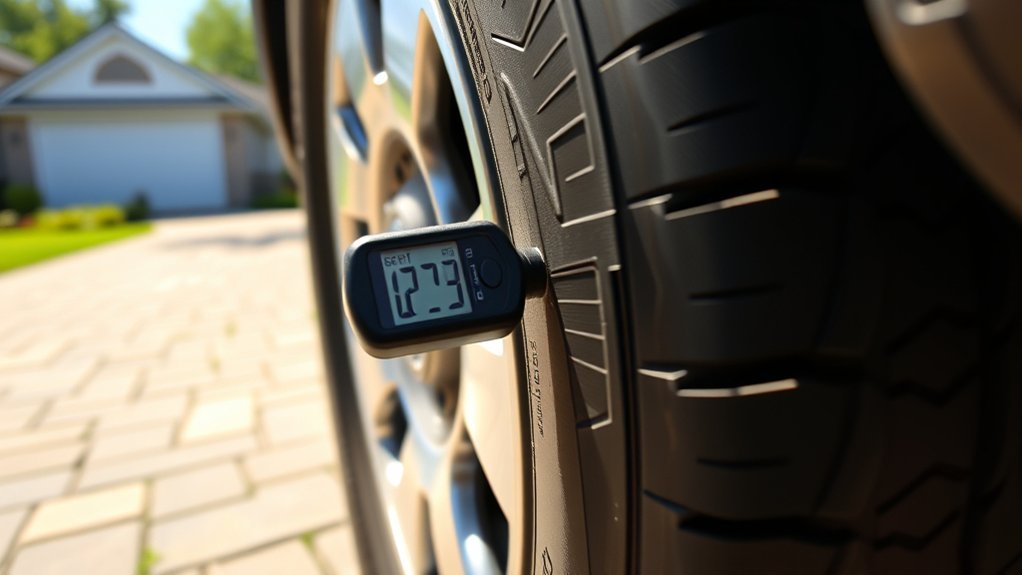
Maintaining Toyota Tacoma tire pressure is one of the simplest ways to protect traction, handling, tire life, and fuel economy. The safest rule is to use the cold PSI printed on your Tacoma’s driver-side Tire and Loading Information label, then check all tires with a reliable gauge before driving or after the truck has been parked long enough for the tires to cool.
Quick Answer
To maintain tire pressure on a Toyota Tacoma, check the tires cold at least once a month, set each tire to the PSI on the driver-side door label, reinstall the valve caps, and recheck any tire that keeps losing air. Do not use the tire sidewall maximum as your target pressure.
Key Takeaways
- Use your Tacoma’s door-jamb Tire and Loading Information label or owner’s manual for the correct cold PSI.
- Check pressure when tires are cold, before driving or after the truck has been parked for several hours.
- A TPMS light means you should check pressure with a gauge; TPMS is not a replacement for regular manual checks.
- Check the spare tire too, but do not assume it needs 60 PSI unless the spare or manual says so.
- Recheck pressure before road trips, towing, heavy hauling, big weather changes, and after off-road airing down.
At a Glance
| Time Required | 5 to 10 minutes for four tires; a little longer if you also inflate the spare |
| Difficulty | Easy beginner maintenance |
| Tools Needed | Accurate tire pressure gauge, air compressor or gas-station air pump, valve caps, optional soapy water for leak checks |
| Cost | Usually free if you already own a gauge; about $5 to $20 for a basic gauge |
Why Tire Pressure Matters for Tacoma Safety
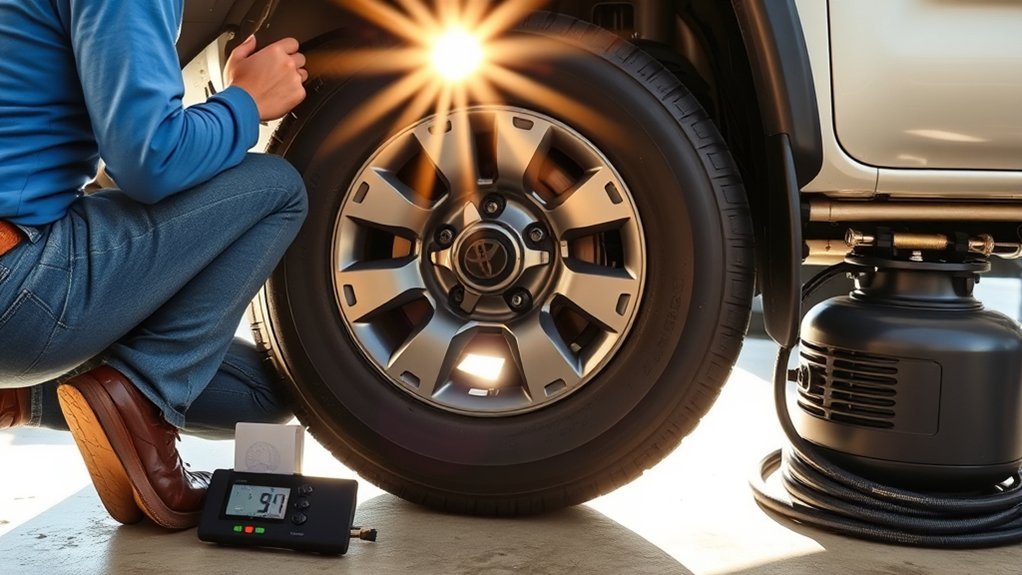
Proper tire pressure helps your Tacoma keep the right tire shape on the road. That affects steering response, braking, traction, ride comfort, tire temperature, tread wear, and fuel use. Underinflated tires flex too much, build heat, and can wear along the shoulders. Overinflated tires can ride harshly, reduce contact patch quality, and wear more quickly near the center of the tread.
The National Highway Traffic Safety Administration warns that poor tire maintenance, including not having enough air in the tires, can contribute to flats, blowouts, and tread separation. That is why you should treat tire pressure as a safety check, not just a fuel-economy habit.
NHTSA reported 511 motor vehicle traffic fatalities in tire-related crashes in 2024, making routine tire checks a practical safety habit.
Find the Correct Tire Pressure for Your Tacoma
The best tire pressure for your Toyota Tacoma is the cold tire inflation pressure listed on your specific truck, not a universal online number. Open the driver’s door and look for the Tire and Loading Information label on the doorjamb or B-pillar. You can also check your Toyota owner’s manual for model-specific tire and maintenance information.
Warning: Do not inflate your Tacoma’s tires to the maximum PSI printed on the tire sidewall unless a tire professional or the vehicle manufacturer specifically instructs you to do so. The sidewall number is a tire limit, not the normal target pressure for your truck.
| Best PSI source | Driver-side Tire and Loading Information label |
| Backup source | Toyota owner’s manual for your model year |
| Do not use as target | Maximum PSI printed on the tire sidewall |
| Aftermarket tires | Ask a tire professional to confirm pressure if tire size, load range, or wheel size changed from stock |
Many stock Tacoma setups fall somewhere in the high-20s to mid-30s PSI range when cold, but the correct number depends on year, trim, tire size, wheel package, and load rating. Always follow your own label first.
How to Check Your Tacoma’s Tire Pressure Accurately
Check your Tacoma’s tire pressure when the tires are cold. A cold tire reading means the truck has been parked for at least three hours or has been driven only a very short distance at low speed. Driving warms the tires and raises the reading, which can make a low tire look normal.
- Park your Tacoma on a level surface and let the tires cool.
- Find the recommended cold PSI on the driver-side door label.
- Remove the valve cap from one tire and press the gauge firmly onto the valve stem.
- Read the PSI and compare it with the label.
- Repeat the process for all four tires and the spare.
- Reinstall every valve cap to help keep dirt and moisture out of the valve stem.
Pro Tip: Keep a pencil gauge or digital gauge in the glove box. Gas-station gauges can be worn or inaccurate, so your own gauge helps you get consistent readings.
[Products Worth Considering]

These aluminum alloy tire valve stem caps with an O-ring seal help protect valve stems from corrosion while adding a clean, stylish look to your vehicle. The universal fit works across cars, trucks, motorcycles, bicycles, and more, making them an easy upgrade for everyday driving and off-road use. Installation is quick, and the included four-pack keeps all your tires dressed and protected.

ETENWOLF T300 is a calibrated digital tire pressure gauge for accurate readings from 3 to 200 PSI across light and heavy-duty vehicles. It includes thermal compensation for reliable performance in extreme cold or heat, with an auto shut-off to extend battery life and an LED for easier reading. The sturdy design supports rugged everyday use, making it ideal for pickups, RVs, and industrial applications.
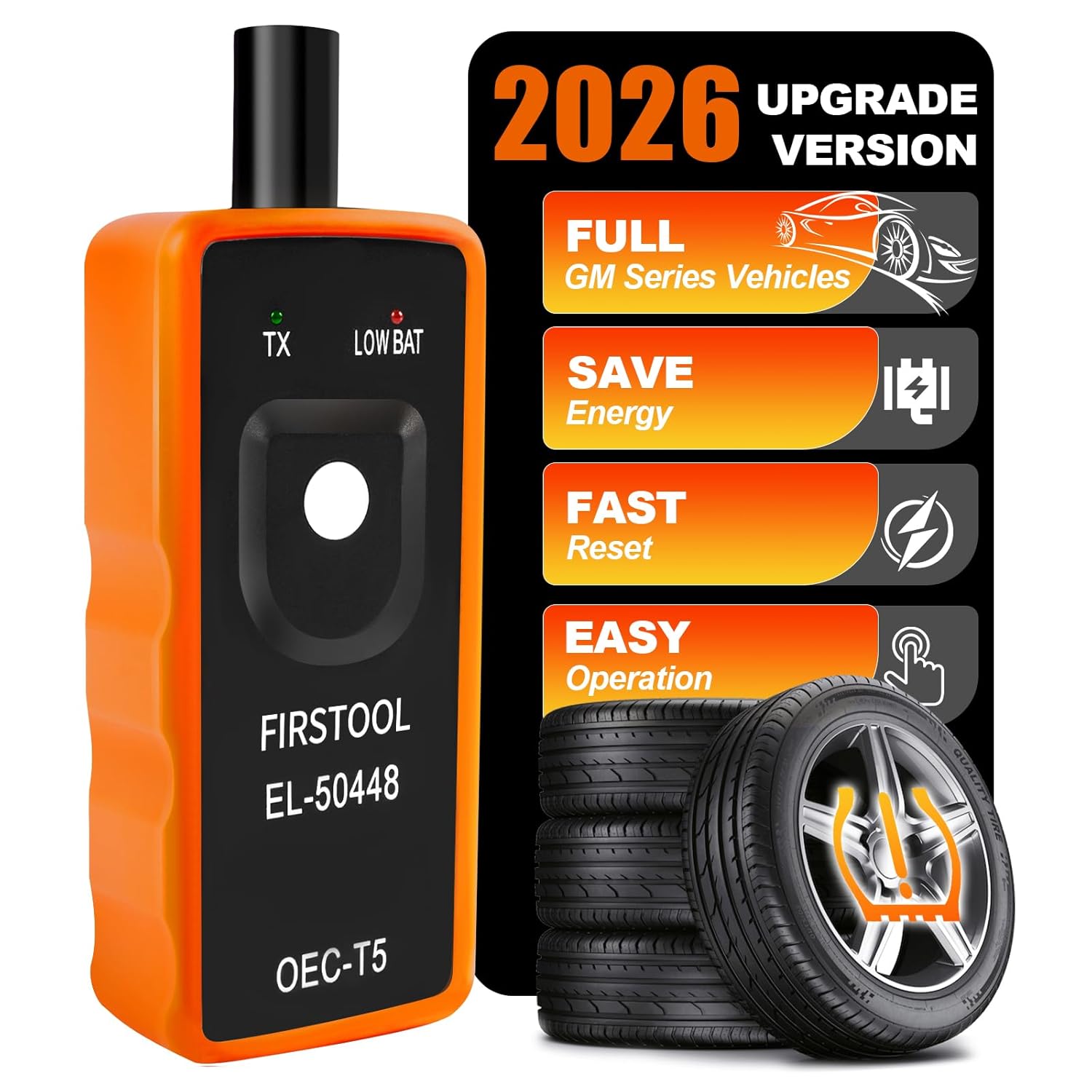
This TPMS relearn tool helps you quickly activate, match, and reset GM tire pressure sensors to keep the vehicle monitoring system working properly. It clears tire pressure alarms and dashboard warning lights after sensor replacement or tire rotation, and supports learning for common 315/433 MHz TPMS sensors. Designed for simple one-button operation, it can help you avoid unnecessary trips to repair shops.
Adjusting Tire Pressure: Step-by-Step Guide
Once you know the current PSI, adjust each tire to match the label. Add air if the tire is low. Release air slowly if it is high. Recheck with the gauge after every adjustment because a few seconds of air can change the reading quickly.
[Products Worth Considering]

The VEHLIVE SU-50448 II TPMS relearn tool provides a fast activation reset to restore accurate tire pressure monitoring after sensor replacement or tire rotation. It supports 315 MHz and 433 MHz GM series sensors and helps clear dashboard pressure warnings. With simple two-button operation and horn-confirmed relearning order, you can reprogram sensors conveniently at home.

Measure tire tread depth quickly and accurately with this LUMITECO dial gauge that reads in 1/32" increments up to 14/32". The color-coded green/yellow/red zones make it easy to judge tire wear and know when replacement is needed. A rugged, compact design with a protective pouch helps keep the gauge ready for use on cars, trucks, motorcycles, and more.

Milton S-921 pencil tire pressure gauge helps you maintain optimal tire pressure for passenger cars with accurate readings in PSI and kPa. It features a built-in deflator valve for convenient pressure adjustments, plus a single chuck head and nylon indicator bar for easy use on the go. Built from durable plated brass and designed for reliable performance, it’s a practical road trip and cold-weather maintenance tool.
Essential Tools Needed
- Tire pressure gauge: Use a gauge you trust and check it against another gauge occasionally.
- Air compressor: A home compressor, portable 12-volt inflator, or gas-station pump will work.
- Valve caps: Replace missing caps so debris does not get into the valve stem.
- Soapy water: Use it to check for small valve-stem or bead leaks if one tire keeps losing air.
Proper Pressure Measurement
Press the gauge straight onto the valve stem. If you hear air hissing, the gauge is not seated correctly. Remove it, reset the gauge if needed, and try again. Record the PSI for each tire so you can spot patterns, such as one tire dropping faster than the others.
Adjusting for Conditions
Adjust pressure to the cold PSI on the label for normal street driving. If you are checking warm tires during a trip, do not bleed air just because the number is above the cold rating. Warm tires naturally read higher. Recheck and fine-tune when the tires are cold again.
Note: If one tire is repeatedly 2 to 4 PSI lower than the others, inspect it for a nail, screw, valve-stem leak, rim leak, or slow bead leak instead of simply refilling it every week.
Handling Your TPMS Light Activation
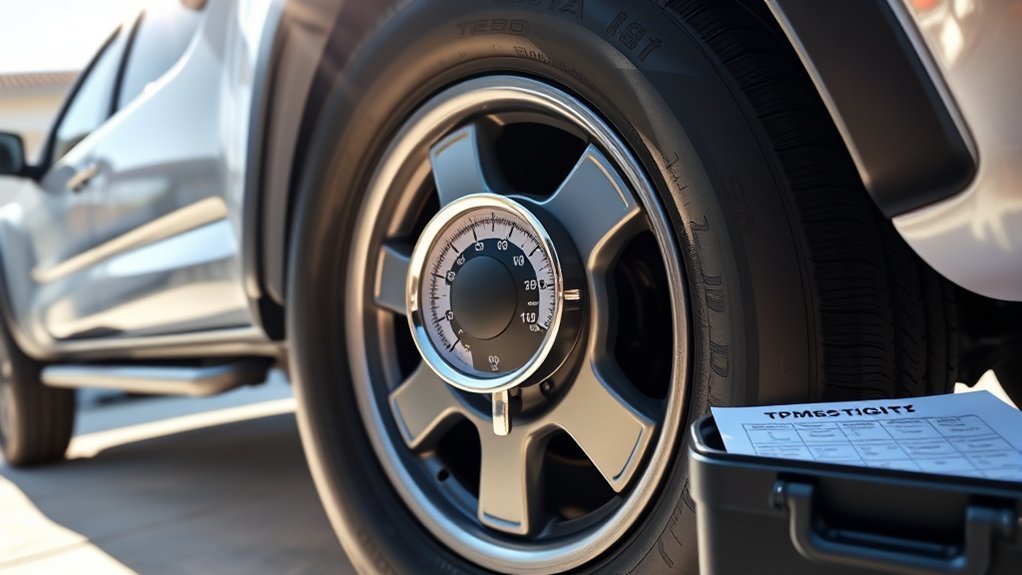
Your Tacoma’s TPMS light is a warning, not a pressure gauge. Under federal rules, a TPMS must warn when one or more tires are significantly underinflated, but the system is not meant to replace monthly pressure checks with a gauge. If the light turns on, check all four tires and the spare if your system monitors it.
| Solid TPMS light | At least one tire may be low. Stop when safe, check pressure, inflate to the placard PSI, and recheck after driving. |
| Flashing, then solid | The TPMS may have a malfunction, dead sensor battery, unregistered sensor, or wheel/tire compatibility issue. Have it inspected. |
| Light after tire rotation | Some systems need a relearn or short drive cycle. Follow the owner’s manual or ask the tire shop. |
| Light on cold mornings | Pressure may be near the warning threshold. Check cold PSI and inflate to the label instead of waiting for the light to turn off. |
Warning: Do not reset TPMS just to turn off the light. First confirm the tires are inflated correctly and that no tire is damaged or leaking.
[Products Worth Considering]

This TPMS sensor training and relearn reset tool is customized for Ford, Lincoln, and Mercury vehicles to help activate tire pressure programming after sensor replacement or tire rotation. It can activate individual tire pressure sensors with one-button operation, helping prevent TPMS warning light illumination. It is not a sensor programming tool and cannot program replacement sensors—use it to trigger/activate sensors only.

The Tymate TM2 RV tire pressure monitoring system keeps you informed with a color LCD display, automatic backlight, and solar charging for dependable operation. It supports up to 10 tire positions with four pre-paired sensors, while offering multiple alarm modes for fast leak detection, pressure extremes, temperature alerts, and low-signal warnings. Built-in monitoring uses accurate readings and reliable 433.92MHz communication to help protect your RV, trailer, truck, or SUV.

Steelman white tire marking crayons provide high-contrast, semi-permanent marks for repairing and inspecting tires and equipment. They write on wet or dry, smooth or coarse surfaces including rubber, metal, glass, and wood, making them ideal for puncture location and damage outlining. The lead- and zinc-free crayons resist weather and fading yet wipe away when you no longer need the marks.
Keep Your Spare Tire Ready: Monthly Checks Matter
A spare tire is easy to forget because it is usually hidden under the truck, but it can lose air over time. Check it at least once a month and before long trips. Use the pressure listed for your specific spare tire or in your Tacoma’s owner’s manual.
Do not assume every spare tire needs 60 PSI. Some temporary compact spares are labeled near 60 PSI, but many Tacoma models use a full-size spare that may follow a different pressure recommendation. The correct answer is the label, the tire marking, or the owner’s manual.
| Check Frequency | Task |
| Monthly | Check spare tire pressure with a gauge |
| Monthly | Look for cracks, cuts, bulges, dry rot, or exposed cords |
| Before road trips | Confirm the spare, jack, lug wrench, and lock key are present |
| After use | Repair or replace the damaged tire and return the spare to proper storage |
Seasonal Tire Pressure Adjustments
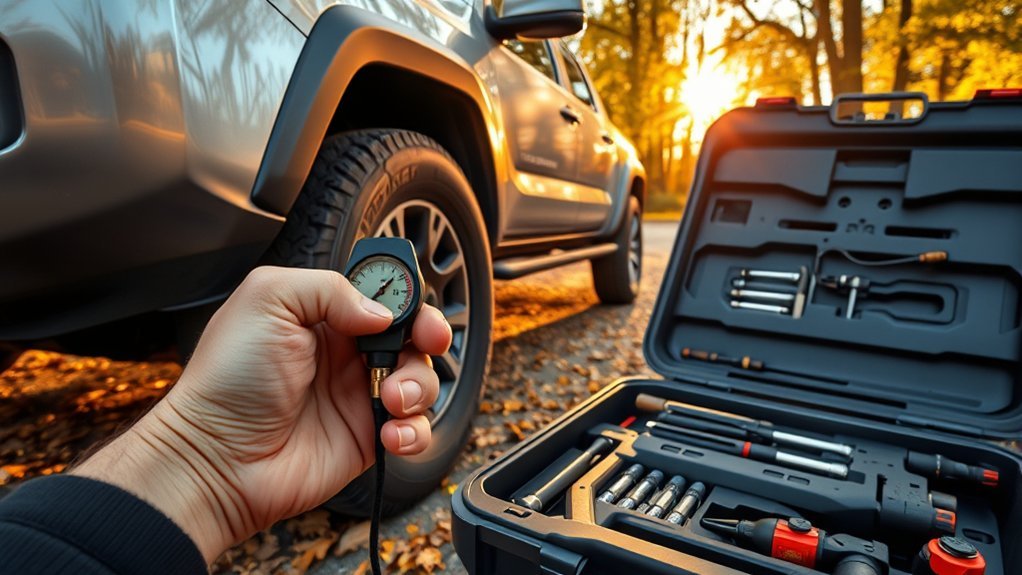
Seasonal temperature changes can move your Tacoma’s tire pressure enough to trigger a TPMS warning or affect tire wear. Cold weather often lowers pressure, while heat and driving can raise warm tire readings. The safest approach is simple: check pressure cold when the weather changes and reset each tire to the PSI on the label.
- Cold weather: Check more often when overnight temperatures drop because pressure can fall as the air contracts.
- Hot weather: Check in the morning before driving instead of bleeding air from warm tires after highway use.
- Road trips: Check before leaving, especially if you are carrying passengers, tools, camping gear, or a trailer.
- Storage: Recheck pressure before driving a Tacoma that has sat for several weeks.
Load, Towing, and Off-Road Pressure Notes
A Tacoma often sees heavier use than a regular commuter vehicle, so pressure checks matter before hauling, towing, trail driving, or long highway trips. Stay within the payload and towing limits listed for your truck, and follow the vehicle label and owner’s manual for tire and load guidance.
Note: If you air down for sand, rocks, washboard roads, or snow, re-inflate before normal pavement speeds. Driving fast on underinflated tires can build heat and damage the tire.
- Heavy loads: Check pressure before loading the truck and again before the return trip.
- Towing: Check truck tires and trailer tires separately. Trailer tire pressure is based on the trailer tire label, not the Tacoma label.
- Off-road use: Airing down can improve comfort and traction off pavement, but it also increases sidewall flex and heat. Reinflate before highway driving.
- Aftermarket tires: If you changed size or load range, ask a tire professional to calculate a safe cold pressure for your setup.
Common Tire Pressure Issues and Solutions
Most tire-pressure problems come from slow leaks, temperature changes, damaged valve stems, punctures, bead leaks, or incorrect pressure after service. Use this table to narrow down the issue before it becomes a roadside problem.
| Issue | Likely Cause | Best Fix |
| One tire keeps losing air | Puncture, valve leak, bead leak, cracked rim | Inspect for nails, use soapy water, and have the tire repaired or replaced |
| All tires are low | Cold weather, long time since last check, normal seepage | Inflate cold to the door-label PSI and check monthly |
| Center tread wearing fast | Possible overinflation or alignment/tire issue | Set correct PSI and inspect alignment and tire condition |
| Outer shoulders wearing fast | Possible underinflation, hard cornering, or alignment issue | Correct PSI, rotate tires, and check alignment |
| TPMS light stays on after filling | Sensor relearn needed, wrong pressure, malfunction, or slow leak | Recheck cold pressure, drive as the manual requires, then inspect TPMS if it remains on |
Tire Pressure Maintenance Schedule
For normal driving, check Tacoma tire pressure at least once a month. Check sooner if you see the TPMS light, notice a low tire, hit a pothole, drive off-road, tow, carry a heavy load, or see a major weather change.
- Monthly: Check all four tires and the spare when cold.
- Before long trips: Check tire pressure, tread depth, visible damage, and spare-tire readiness.
- After tire service: Confirm all tires were set to the correct PSI.
- After off-road driving: Reinflate to road pressure before highway speeds.
- When TPMS turns on: Stop when safe and check with a gauge.
Frequently Asked Questions
What’s the best tire pressure for a Toyota Tacoma?
The best tire pressure is the cold PSI printed on your Tacoma’s driver-side Tire and Loading Information label. Many stock Tacomas fall in the high-20s to mid-30s PSI range, but the exact number depends on model year, trim, tire size, and load rating.
How do you maintain tire pressure?
Check the tires cold at least once a month, compare each reading to the door-label PSI, add or release air as needed, reinstall the valve caps, and check the spare. Also recheck before road trips, towing, hauling, and seasonal temperature changes.
Should I use the PSI printed on the tire sidewall?
No. The sidewall PSI is usually the tire’s maximum pressure limit, not the normal pressure target for your Tacoma. Use the vehicle label or owner’s manual unless a qualified tire professional gives you a different pressure for an aftermarket tire setup.
Why does my TPMS light come on during cold weather?
Cold air can lower tire pressure enough to trigger the warning. Check the tires cold with a gauge and inflate them to the label PSI. Do not ignore the light just because it turns off after the tires warm up.
What does a flashing TPMS light mean?
A flashing TPMS light that later stays solid often points to a TPMS malfunction, such as a dead sensor battery, unregistered sensor, or wheel/tire compatibility issue. Check tire pressure first, then have the system inspected if the warning continues.
Does TPMS monitor the spare tire?
It depends on the model year and system. Some vehicles monitor the spare and some do not. Check your owner’s manual and inspect the spare manually every month because TPMS should not be your only spare-tire check.
Conclusion
Maintaining proper tire pressure on your Toyota Tacoma starts with one simple rule: use the cold PSI on your truck’s door label. Check all tires monthly, include the spare, respond quickly to TPMS warnings, and inspect any tire that keeps losing air. With a reliable gauge and a few minutes of routine care, you can improve safety, reduce tire wear, and keep your Tacoma ready for daily driving, hauling, towing, and trail use.
Sources
- Toyota Owners Manuals and Warranties — official access point for Tacoma owner’s manual and maintenance information.
- NHTSA TireWise: Tire Safety Ratings and Awareness — tire-pressure maintenance, monthly checks, TPMS limits, tire safety, and spare-tire guidance.
- 49 CFR § 571.138: Tire Pressure Monitoring Systems — federal TPMS warning and owner-manual language requirements.
- FuelEconomy.gov: Keeping Your Vehicle in Shape — fuel-economy effect of properly inflated tires and warning not to use sidewall max PSI as the target.