
To keep your Toyota Tacoma stable, predictable, and easy on tires, rotate the tires on a regular schedule and use the pattern that matches your tire type. Most Tacoma owners should plan on a rotation about every 5,000 to 7,500 miles, but towing, hauling, gravel roads, and off-road driving can shorten that interval. Before you start, check tread depth, tire pressure, sidewall condition, wheel fitment, and your owner’s manual for the correct pressure, torque, and TPMS procedure for your exact year and trim.
Quick Answer
For a Toyota Tacoma, rotate tires every 5,000 to 7,500 miles, or sooner if you tow, haul, drive off-road, or see uneven tread wear. Use the pattern that matches your tires: directional tires move front-to-back on the same side, while uniform non-directional tires usually use a cross pattern based on drivetrain and owner’s-manual guidance.
Key Takeaways
- Use your Tacoma owner’s manual and driver-door tire label as the final authority for pressure, torque, and TPMS steps.
- Do not assume one Tacoma tire rotation pattern fits every setup. Tire direction, tire size, drivetrain, and spare-tire type all matter.
- Check tread depth, sidewalls, tire pressure, and lug nuts before every rotation.
- Never work under a Tacoma supported only by a jack. Use rated jack stands on solid, level ground.
- After rotating, set cold tire pressure, torque the lug nuts correctly, and confirm the TPMS light stays off.
At a Glance
| Time Required | 30 to 60 minutes for a careful DIY rotation |
| Difficulty | Moderate, mainly because the truck must be lifted and supported safely |
| Tools Needed | Floor jack, rated jack stands, wheel chocks, lug wrench or impact wrench, torque wrench, tire pressure gauge, tread depth gauge, and tire chalk |
| Cost | Usually free if you already own the tools; often a low-cost service at a tire shop or Toyota dealer |
Understanding the Tire Rotation Pattern for Tacoma
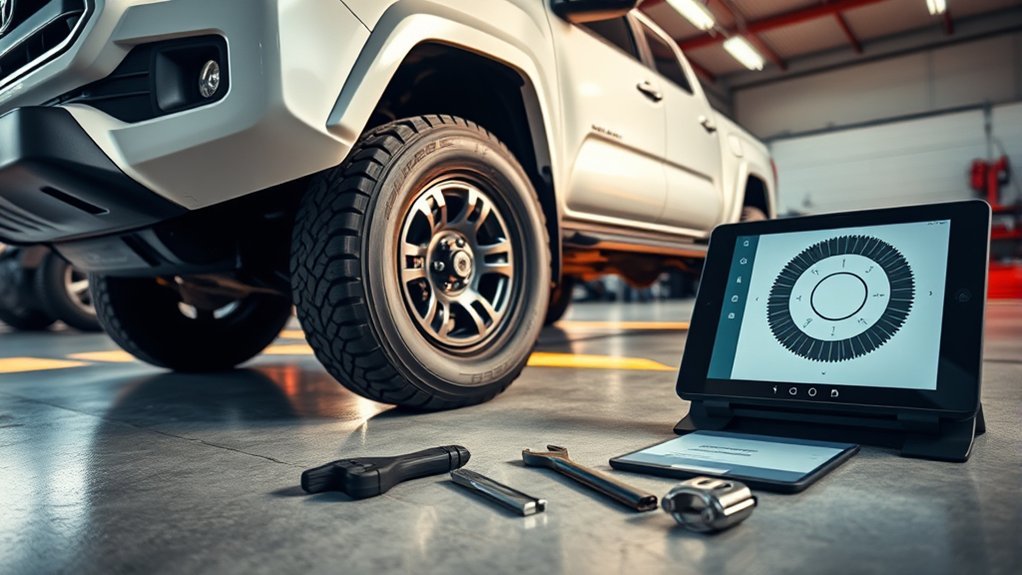
The right Toyota Tacoma tire rotation pattern depends on the tires and wheels on your truck. Start with your owner’s manual, which you can find through Toyota’s official manuals and warranties page. Then check the sidewalls for direction arrows, confirm whether all four tires are the same size, and look at whether your spare is full-size and matching.
For many Tacoma setups with four matching, non-directional tires, a cross pattern is commonly used to spread wear between the front and rear axles. For directional tires, you should keep each tire on the same side of the truck and move it only front-to-back. If your truck has different front and rear tire sizes, do not rotate them front-to-rear unless the tire maker and vehicle manual allow it.
Note: The pressure number molded into the tire sidewall is not the recommended Tacoma inflation pressure. Use the cold tire pressure on the driver-door tire label or in the owner’s manual.
Tacoma Tire Rotation Pattern Table
Use this table as a practical starting point, then confirm it against your exact tire type and owner’s manual.
| Tacoma Setup | Best Rotation Pattern | What To Watch |
|---|---|---|
| Four matching, non-directional tires | Use the owner’s-manual pattern. For many rear-drive or 4WD light trucks, a rearward cross or X-pattern may be used. | Do not cross tires if the tire sidewall has a directional arrow. |
| Directional tires | Front left to rear left, rear left to front left; front right to rear right, rear right to front right. | Keep each tire on the same side unless the tire is dismounted and remounted correctly. |
| Different front and rear tire sizes | Do not rotate front-to-rear unless the tire maker and vehicle manual allow it. | A 5-tire rotation is not for staggered or different-size setups. |
| Matching full-size spare | Use a 5-tire pattern only if the spare matches the other tires in size, type, load rating, and wheel fitment. | TPMS registration may be needed if the spare has a sensor. |
| Temporary spare | Do not include it in normal tire rotation. | Use it only as a temporary emergency tire. |
How to Inspect Tires Before Rotation
Before you rotate your tires, check for visible damage, measure tread depth, and verify cold tire pressure. NHTSA TireWise recommends checking tire pressure at least monthly when the tires are cold and reminds drivers that TPMS is not a substitute for regular tire maintenance.
Visual Damage Assessment
Start with a slow visual inspection of every tire. Look for cuts, punctures, bulges, exposed cords, sidewall cracking, missing chunks, and nails or screws in the tread. Sidewall bulges and exposed cords are serious safety concerns, so do not rotate that tire and keep driving as if nothing happened. Have it inspected by a tire professional.
Also look for uneven wear. Heavy wear on both outer shoulders can point to underinflation. Heavy center wear can point to overinflation. Feathering, cupping, or one-sided wear can point to alignment, balance, suspension, or shock issues.
Tread Depth Check
Use a tread depth gauge for the most accurate reading. You can also use the penny test: place a penny into the tread with Lincoln’s head upside down. If you can see the top of Lincoln’s head, the tire is at or near the replacement point. NHTSA says tires should be replaced when tread is worn to 2/32 inch.
For wet roads, snow, towing, and trail use, consider replacing tires before they reach the bare legal minimum. Less tread means less ability to move water, mud, and loose surface material away from the contact patch.
Tire Pressure Verification
Check pressure when the tires are cold, meaning the truck has been parked for at least three hours or has been driven only a short distance at low speed. Use a digital tire pressure gauge and compare each tire to the driver-door tire label or your owner’s manual. Check the spare as well if it is part of your rotation or your emergency gear.
When to Rotate Your Tires for Best Results
For most Tacoma owners, a good target is every 5,000 to 7,500 miles. This often lines up with routine service, which makes the habit easier to follow. NHTSA says to check the owner’s manual for the correct interval and pattern, and if rotation is recommended, 5,000 to 8,000 miles is a common range.
Rotate sooner if you notice uneven wear, new vibration, steering pull, heavy shoulder wear, or a major difference in tread depth between front and rear tires. If you tow, haul, drive gravel roads, air down for trails, or run larger all-terrain tires, inspect more often and shorten the interval when wear starts to show.
Consistent tire rotation helps even out tread wear, but it cannot fix a bad alignment, worn suspension part, damaged tire, or wrong tire pressure.
How to Rotate Tacoma Tires Step by Step
If you have the right tools and a safe work area, a Tacoma tire rotation is a manageable DIY job. Work slowly and do not skip the support steps.
Warning: Never rely on a floor jack alone. Park on level ground, set the parking brake, chock the wheels, lift only at approved jack points, and support the Tacoma with properly rated jack stands before removing wheels.
- Park safely. Choose a flat, solid surface. Set the parking brake and place wheel chocks where needed.
- Confirm the pattern. Check whether your tires are directional, non-directional, staggered, or part of a 5-tire rotation with a matching spare.
- Mark the tires. Use chalk labels such as LF, RF, LR, and RR before removal so you do not lose track.
- Loosen lug nuts slightly. Break each lug nut loose while the tire is still on the ground. Do not remove them yet.
- Lift and support the truck. Lift one end or one corner at a time using approved lift points, then place rated jack stands under the truck.
- Remove and inspect each wheel. Check tread, sidewalls, valve stems, wheel damage, and brake-area concerns while each wheel is off.
- Move each tire to its new position. Follow the correct rotation pattern for your setup.
- Hand-start lug nuts. Thread each lug nut by hand first to avoid cross-threading.
- Snug in a star pattern. Tighten the lug nuts evenly while the tire is raised, then lower the truck enough for the tire to touch the ground.
- Torque to spec. Use a torque wrench and the owner’s-manual specification. Recheck torque after a short drive if your manual, wheel maker, or tire shop recommends it.
- Set cold tire pressure. Adjust each tire to the driver-door label or owner’s manual.
- Confirm TPMS status. Follow the Tacoma TPMS procedure for your model year if the system needs reset, registration, or relearn.
Pro Tip: Take a photo of the tire sidewall and tread before you rotate. It gives you a quick record of tire position, wear pattern, date, and mileage for the next service.
[Products Worth Considering]

These aluminum alloy tire valve stem caps with an O-ring seal help protect valve stems from corrosion while adding a clean, stylish look to your vehicle. The universal fit works across cars, trucks, motorcycles, bicycles, and more, making them an easy upgrade for everyday driving and off-road use. Installation is quick, and the included four-pack keeps all your tires dressed and protected.

This TPMS sensor training and relearn reset tool is customized for Ford, Lincoln, and Mercury vehicles to help activate tire pressure programming after sensor replacement or tire rotation. It can activate individual tire pressure sensors with one-button operation, helping prevent TPMS warning light illumination. It is not a sensor programming tool and cannot program replacement sensors—use it to trigger/activate sensors only.

The VEHLIVE SU-50448 II TPMS relearn tool provides a fast activation reset to restore accurate tire pressure monitoring after sensor replacement or tire rotation. It supports 315 MHz and 433 MHz GM series sensors and helps clear dashboard pressure warnings. With simple two-button operation and horn-confirmed relearning order, you can reprogram sensors conveniently at home.
Why TPMS Matters After Tire Rotation
Your Tacoma’s Tire Pressure Monitoring System helps warn you when a tire is significantly underinflated, but it does not replace a gauge check. After rotation, set all tires to the correct cold pressure first. Then follow the TPMS instructions in your owner’s manual or instrument-cluster menu if your model requires initialization, position registration, or a drive cycle.
Importance of Accurate Readings
Accurate tire pressure helps your Tacoma track straight, brake predictably, and wear tires evenly. Underinflation can build heat and damage a tire. Overinflation can reduce the contact patch and increase center tread wear. The best routine is simple: check cold pressure with a gauge, adjust to the placard, then use TPMS as a backup warning system.
Preventing Warning Light Issues
If the TPMS light stays on after rotation, do not ignore it. Recheck all four tires and the spare if it is monitored. If the pressures are correct and the light remains on, the truck may need a sensor relearn, sensor registration, or sensor service. A Toyota dealer or tire shop can check sensor IDs, batteries, and signal issues.
Ensuring Optimal Performance
Good tire maintenance is a system. Rotation, pressure checks, tread checks, balance, alignment, and suspension condition all work together. If your Tacoma still pulls, shakes, or wears tires unevenly after a correct rotation, schedule an inspection instead of simply rotating the tires more often.
Avoid These Tire Rotation Mistakes
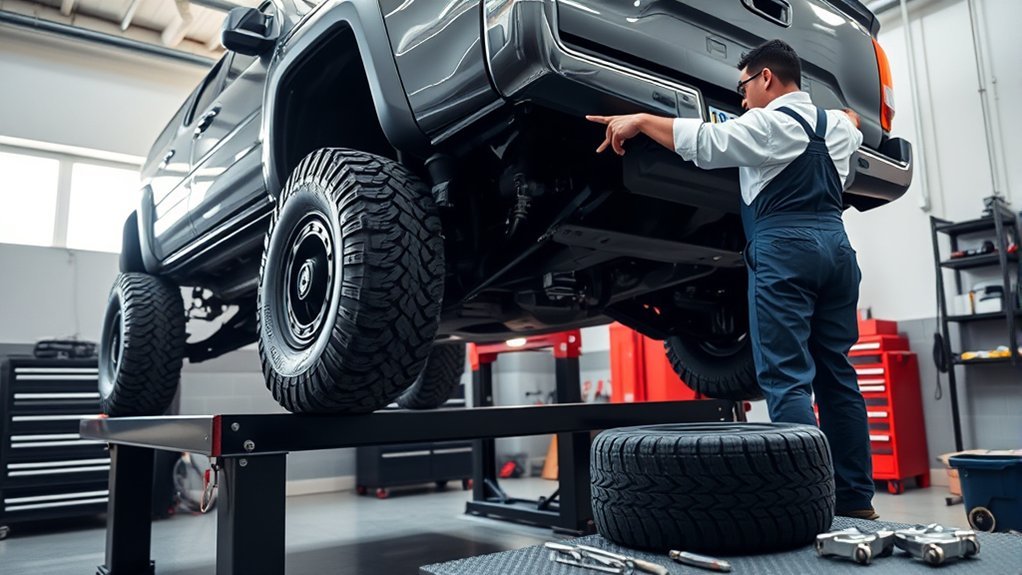
Many tire rotation problems come from rushing the job or using the wrong pattern. Avoid these common mistakes:
- Using one pattern for every Tacoma: Tire type and setup matter. Directional tires, staggered sizes, and full-size spares all change the process.
- Crossing directional tires: If the tire sidewall shows a direction arrow, keep that tire on the same side unless it is remounted correctly.
- Including a temporary spare: Temporary spares are not part of normal rotation.
- Skipping tire pressure: Rotation does not help much if the tires are underinflated or overinflated.
- Guessing lug torque: Always use a torque wrench and the correct Tacoma specification for your year, wheels, and lug hardware.
- Ignoring uneven wear: Rotation spreads normal wear. It does not solve bad alignment, worn shocks, damaged suspension parts, or bent wheels.
- Working without jack stands: A jack is a lifting tool, not a support stand.
Essential Tools for DIY Tire Rotation
Proper tire rotation requires the right equipment. Do not start unless your tools are rated for the Tacoma’s weight and you have a safe, level place to work.
| Tool | Purpose | What To Check |
|---|---|---|
| Floor jack | Lifts the Tacoma | Use a rated jack and approved lift points |
| Jack stands | Support the truck while wheels are off | Use stands rated for the vehicle weight |
| Wheel chocks | Reduce the chance of rolling | Place them before lifting |
| Torque wrench | Tightens lug nuts correctly | Set it to the manual’s lug nut torque spec |
| Tire pressure gauge | Checks cold tire pressure | Compare readings to the door placard |
| Tread depth gauge | Measures remaining tread | Check several grooves on each tire |
[Products Worth Considering]

The Trivd Frol 1/2" air impact wrench delivers high performance torque up to 1500 ft-lbs with a twin hammer impact mechanism for strong, balanced blows. It features an ergonomic grip, compact lightweight design, and quick-stop control with 3 forward speeds up to 8000 RPM plus a reverse speed. Built for demanding automotive repair and tire shop work, the rear exhaust helps keep debris away from the surface.

These M14x1.5 closed-end chrome lug nuts are a one-piece replacement designed for secure fitment on compatible GM, Ford, and select Chrysler/Dodge models. Featuring a 60-degree conical seat and anti-rust chrome plating, they help resist corrosion and maintain a bright look for everyday driving. Built for long-term durability, they include OEM-style part references and are backed by 12 months of support.

The SAFELIFE dial tire tread depth gauge measures tread depth in 1/32 inch increments with clear, easy-to-read 2-inch dial face. Color zones using a traffic light system help you quickly judge whether tread is low, marginal, or ample for safer driving. Built with a durable zinc cast body and a metal detect probe for precise, comfortable use across cars, motorcycles, trucks, and buses.
How to Connect With Tacoma Owners for Tire Maintenance Advice
Other Tacoma owners can help you spot common wear patterns for your tire size, lift height, wheel offset, and driving style. Their advice is useful, but it should not replace the owner’s manual, tire maker guidance, or a professional inspection.
- Join Tacoma owner forums and search for your exact tire size, trim, and generation before asking a new question.
- Ask whether other owners are running directional tires, all-terrain tires, lifted suspension, or aftermarket wheels.
- Compare rotation intervals for similar use, such as daily driving, towing, trail use, or winter driving.
- Use photos when asking about uneven wear so others can see the tread pattern clearly.
- Confirm any advice with a trusted tire shop or Toyota service department if safety is involved.
Real-World Experiences: Tacoma Owners Share Their Rotation Insights
Many Tacoma owners rotate tires around the same time as oil changes because it is easy to remember. Owners who drive mostly pavement often stay near the 5,000 to 7,500 mile range. Owners who tow, haul, run aggressive all-terrain tires, or spend time on gravel and trails often inspect tires sooner and rotate when the tread starts showing uneven wear.
The most useful real-world habit is tracking mileage and wear. Write down the tire positions, tread depth, pressure, and rotation date. If one tire keeps wearing faster in a new position, the issue may be alignment, balance, suspension, or wheel damage rather than rotation interval.
When Not to Rotate Tacoma Tires Yourself
Skip the DIY job and get professional help if you see sidewall bulges, exposed cords, cracked tires, a bent wheel, damaged lug studs, seized lug nuts, vibration after a previous rotation, or uneven wear that keeps returning. You should also use a professional if your Tacoma has specialty wheels, beadlock-style wheels, unusual tire sizes, or a TPMS issue that needs sensor registration.
[Products Worth Considering]

Upgrade your wheels with MIKKUPPA closed-end lug nuts designed for reliable fit and corrosion resistance. The one-piece, cold-forged and heat-treated steel construction helps resist rust and stripping, while the integrated finish delivers a durable black appearance. Built to OEM standards with a conical 60-degree seat, these nuts provide a secure solution for compatible Ford, Honda, Jeep, and Chevrolet models.

This TPMS relearn tool helps you quickly activate, match, and reset GM tire pressure sensors to keep the vehicle monitoring system working properly. It clears tire pressure alarms and dashboard warning lights after sensor replacement or tire rotation, and supports learning for common 315/433 MHz TPMS sensors. Designed for simple one-button operation, it can help you avoid unnecessary trips to repair shops.

Measure tire tread depth quickly and accurately with this LUMITECO dial gauge that reads in 1/32" increments up to 14/32". The color-coded green/yellow/red zones make it easy to judge tire wear and know when replacement is needed. A rugged, compact design with a protective pouch helps keep the gauge ready for use on cars, trucks, motorcycles, and more.
Frequently Asked Questions
Is 3,000 miles too soon to rotate Tacoma tires?
No. It is not too soon if your Tacoma sees towing, heavy loads, off-road trails, gravel roads, or visible uneven wear. For normal street use, many owners can follow the 5,000 to 7,500 mile range, but tire condition matters more than the calendar.
What is the best tire rotation pattern for a Toyota Tacoma?
The best pattern depends on your tire type and setup. Directional tires move front-to-back on the same side. Matching non-directional tires may use a cross pattern based on drivetrain and owner’s-manual guidance. Different-size front and rear tires may not be rotatable front-to-rear.
Should I include the spare tire in the rotation?
Include the spare only if it is a matching full-size tire and wheel with the same size, type, load rating, and fitment as the other tires. Do not include a temporary spare in normal rotation.
Do I need to reset TPMS after rotating Tacoma tires?
Maybe. Some Tacoma systems may only need correct tire pressure and a short drive, while others may need initialization, registration, or a relearn procedure. Follow your owner’s manual. If the TPMS light stays on after pressures are correct, have the system checked.
Can tire rotation fix uneven wear?
Rotation can slow normal uneven wear by spreading tire positions over time. It cannot fix bad alignment, bad balance, worn shocks, worn suspension parts, incorrect pressure, or a damaged tire.
Conclusion
A good Tacoma tire rotation routine is simple: rotate about every 5,000 to 7,500 miles, inspect sooner after rough use, choose the correct pattern for your tire setup, and set cold tire pressure after the job. Do not treat front-to-back same-side rotation as a universal Tacoma rule. Use it for directional tires, but follow your owner’s manual and tire type for the final pattern. With careful lifting, correct torque, and regular tread checks, you can extend tire life and keep your Tacoma safer on pavement, gravel, and trails.
Sources
- Toyota Manuals and Warranties — official owner manual lookup for Tacoma-specific tire, torque, and TPMS instructions.
- NHTSA TireWise — tire pressure, tread depth, TPMS, tire rotation, and tire safety guidance.
- Michelin Tire Rotation Guide — rotation intervals, drivetrain patterns, directional tire rules, and tire care basics.
- Bridgestone Tire Rotation Guide — pattern guidance for RWD, 4WD/AWD, directional tires, and spare-tire rotation.
- Toyota Tire Center — Toyota tire service and safety information.
