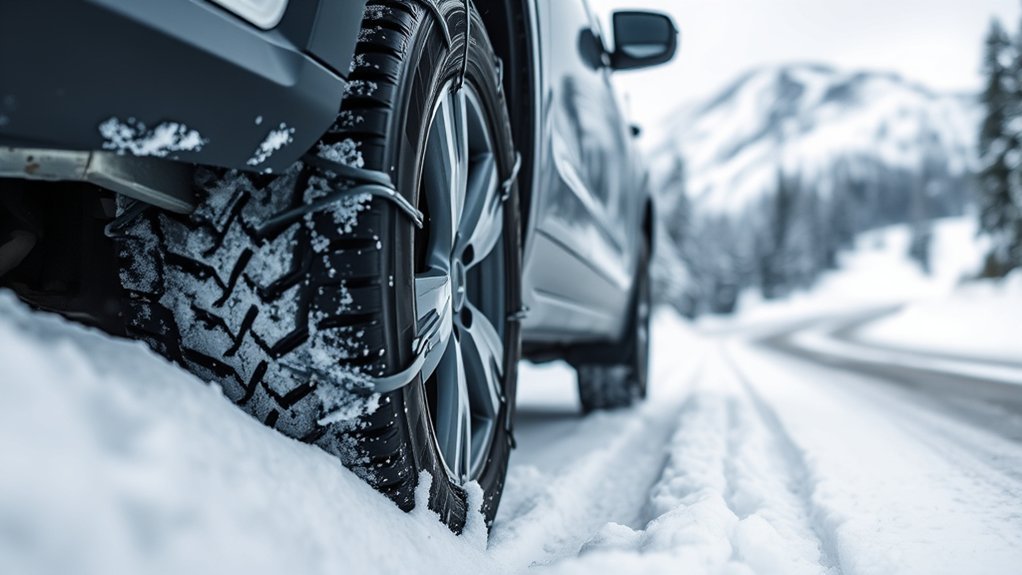
You usually do not need snow chains on all four tires. On most conventional front-wheel-drive and rear-wheel-drive vehicles, one correctly sized pair goes on the drive axle. AWD and 4WD are different: the correct axle and number of traction devices can vary by vehicle. Before installing anything, check your owner’s manual, the traction-device instructions, and the chain-control rules for the road you are driving.
Quick Answer
No—not automatically. On most FWD and RWD vehicles, one pair goes on the drive axle: front for FWD and rear for RWD. AWD and 4WD are vehicle-specific, so some models use one axle while others have different requirements. Always follow your owner’s manual and any posted chain-control rules.
Key Takeaways
- Front-wheel-drive vehicles normally use chains on the front drive tires when the vehicle manufacturer allows them.
- Rear-wheel-drive vehicles normally use chains on the rear drive tires.
- For AWD or 4WD, do not assume that two chains or four chains are automatically correct. Follow the vehicle manual.
- Posted chain-control rules can require you to carry or install traction devices even if you drive AWD or 4WD.
- A 30-mph maximum is common for tire chains, but a lower product, vehicle, road-condition, or posted limit takes priority.
- Remove chains when they are no longer required and you reach clear pavement where their use is not appropriate.
At a Glance
| Time Required | Varies by chain design and experience; practice installation before winter travel. |
| Difficulty | Moderate the first time; easier after a practice installation. |
| Tools Needed | Correctly sized traction devices, gloves, a waterproof mat or tarp, and any tensioner required by the chain maker. |
| Cost | Varies by tire size and device type; confirm fit, clearance, and legal acceptance before buying. |
Do You Need Chains on All 4 Tires?
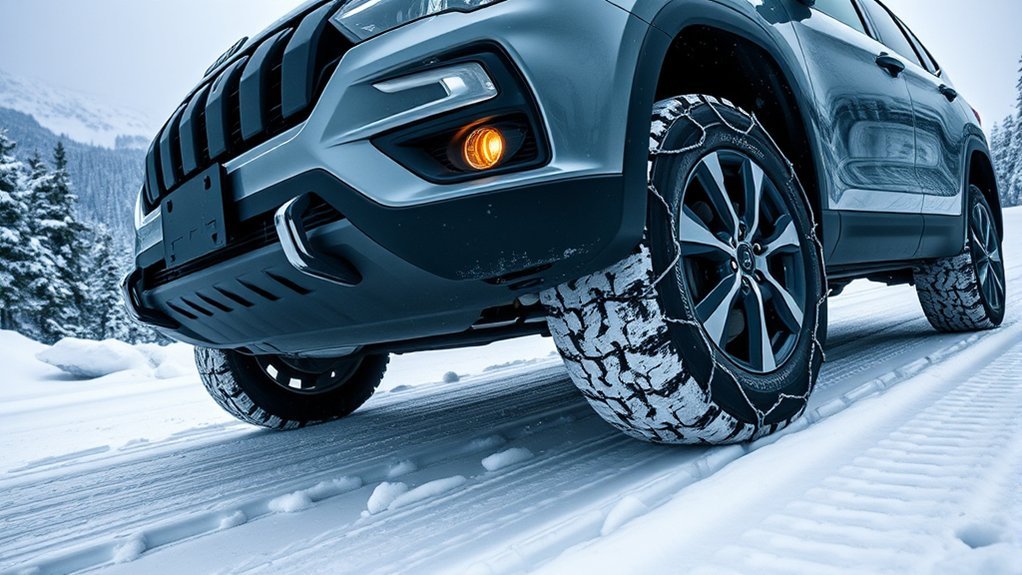
Not always. Whether you need two or four traction devices depends on the vehicle, drivetrain, available wheel-well clearance, the chain manufacturer’s instructions, and the road rules where you are driving.
For a conventional two-wheel-drive vehicle, the basic placement rule is simple: put the approved traction devices on the drive axle. That normally means the front tires on a front-wheel-drive vehicle and the rear tires on a rear-wheel-drive vehicle.
AWD and 4WD vehicles require more care. Do not assume that every AWD vehicle needs four chains, and do not assume that every one can safely use just one pair. The manufacturer may specify a particular axle, a particular low-clearance device, or restrictions on conventional metal chains.
| Drivetrain | Typical starting point | What controls the final decision |
|---|---|---|
| FWD | Front tires | Vehicle manual, device instructions, and road rules |
| RWD | Rear tires | Vehicle manual, device instructions, and road rules |
| AWD / 4WD | Vehicle-specific | Owner’s manual first; posted chain-control requirements still apply |
The safest answer is not “always two” or “always four.” It is the chain configuration approved for your exact vehicle, tire size, and road restriction.
Warning: Never force conventional chains onto a tire when your owner’s manual says clearance is insufficient. A chain that contacts a brake hose, suspension component, wheel, fender, or body panel can damage the vehicle or fail while you are moving.
Use the tire size printed on the sidewall to select the correct device, but do not rely on tire size alone. Two vehicles with the same tire size can have different clearance restrictions.
Before winter travel, test-fit the chains in dry conditions, carry gloves and a waterproof mat, and learn how the fasteners and tensioning system work. After installation, drive a short distance in a safe area and recheck the fit as directed by the chain manufacturer.
When One Axle Is Enough
One pair of chains is commonly used on two-wheel-drive passenger vehicles because it covers the primary drive axle. However, “one axle is enough” should not be decided by guessing how severe the snow looks.
Use one axle when that configuration is permitted by your vehicle manufacturer, supported by the traction-device instructions, and sufficient under the posted road restriction.
Drive Axle Placement
On a front-wheel-drive vehicle, the front axle sends engine torque to the road, so approved chains normally go on the front tires. Those tires also steer the vehicle, which makes correct sizing and secure installation especially important.
On a rear-wheel-drive vehicle, the rear axle provides propulsion, so approved chains normally go on the rear tires. The front tires still handle steering, which is one reason you must drive gently and avoid assuming rear chains make the entire vehicle immune to sliding.
- Front-wheel drive: normally chain the front drive tires.
- Rear-wheel drive: normally chain the rear drive tires.
- All-wheel drive or 4WD: follow the exact vehicle-manufacturer instructions.
- Every drivetrain: match the device to the tire size and required clearance.
Oregon DOT, for example, states that light-duty FWD vehicles use chains on one tire on each side of the primary front drive axle, while light-duty RWD vehicles use them on the primary rear drive axle. That is a useful illustration of the drive-axle principle, but rules in another state may differ.
Traction and Control
Chains increase available traction at the tires where they are installed, but their effect depends on axle placement.
On FWD, front chains support propulsion and can help the tires maintain useful grip for steering. On RWD, rear chains primarily improve the driven axle’s ability to move the vehicle without excessive wheelspin.
Braking and cornering still depend on the traction available at all four tire contact patches. A chained axle does not make the unchained axle grip like the chained one.
That is why smooth inputs remain essential. Accelerate gently, brake early, steer progressively, and leave substantially more room than you would on dry pavement.
Chains improve available grip, but they do not remove the traction limits created by snow and ice.
Why 4WD Still Needs Chains
Four-wheel drive and all-wheel drive can distribute drive torque to more tires, which often helps you get moving. They cannot create friction that the road surface does not provide.
On packed snow or ice, all four tires can still reach their traction limits. AWD or 4WD also does not shorten every winter stopping distance simply because more wheels receive engine power.
Traction Limits in 4WD
If the road is covered with snow or ice, each tire still relies on the small contact patch between the tread and the surface. Electronic traction control can reduce wheelspin and redistribute torque, but it cannot manufacture grip on a surface with very little friction.
- AWD and 4WD can improve the ability to move forward.
- They do not make icy braking or cornering risk disappear.
- Weight transfer can change available traction during acceleration, braking, and turning.
- Approved chains or alternative traction devices can add mechanical grip when conditions or road rules call for them.
Oregon DOT specifically warns that even four-wheel drive provides limited help on ice unless the tires have enough traction.
Chain Requirements for Safety
AWD and 4WD vehicles are not automatically exempt from chain controls. A road authority can require drivers to carry traction devices or install them when conditions become severe.
California, for example, says 4WD vehicles entering a chain-control area must carry a set of chains for one drive axle even when current conditions allow them to proceed without installing the chains. Under more restrictive conditions, installation may be required.
Colorado can activate its Passenger Vehicle Chain Law during severe winter storms. When that restriction is in effect, every vehicle must have chains or an approved alternative traction device.
The practical rule is simple: AWD changes how your vehicle delivers power; it does not cancel posted chain-control requirements.
Front Tires or Rear Tires?
For a typical front-wheel-drive vehicle, install approved chains on the front drive tires when the owner’s manual permits them. Those tires provide both propulsion and steering, so a secure, centered fit matters.
For a typical rear-wheel-drive vehicle, install them on the rear drive tires. The rear tires transmit engine torque, so adding traction there helps reduce drive-wheel spin when starting or climbing.
- FWD: front drive tires are normally the chained pair.
- RWD: rear drive tires are normally the chained pair.
- AWD/4WD: placement is vehicle-specific.
- Never choose an axle solely from a generic online chart when the owner’s manual gives different instructions.
Do not randomly mix left/right placement or install only one chain from a pair unless an official vehicle or traction-device instruction specifically calls for that configuration. Passenger-car chain setups normally use matching traction devices on both sides of the required axle.
If you do not know whether your vehicle is FWD, RWD, AWD, or 4WD, confirm the drivetrain before buying chains.
Check Your Owner’s Manual
Your owner’s manual is the most important vehicle-specific source because it tells you whether traction devices are permitted, which tires may use them, and whether the vehicle has wheel-well clearance restrictions.
The manual may specify:
- Which axle should receive traction devices.
- Whether conventional link chains are prohibited.
- Whether low-profile cables or another approved device are required.
- Maximum chain dimensions or clearance classifications.
- A vehicle-specific speed limit.
- Special instructions for AWD, 4WD, performance, or electric vehicles.
Some vehicles have little clearance around the tire, suspension, brake components, or body. In those cases, a chain that technically fits the tire size can still be wrong for the vehicle.
If the manual calls for an SAE Class S-style low-clearance device or another restricted design, follow that requirement. Do not substitute a larger link chain merely because it fits around the tire.
Note: A road authority may require an approved traction device even when your vehicle cannot use conventional metal chains. In that situation, check whether your vehicle manual and the jurisdiction permit a compatible cable, textile, or other approved alternative. If no compliant device can be fitted, do not enter a road where one is mandatory.
Know Your State’s Chain Laws
Chain laws are not uniform across the United States. Requirements can change by state, highway, vehicle weight, towing status, weather, and the restriction currently displayed on roadside signs.
Check the transportation department or highway authority for every state you will cross. Do this shortly before the trip because chain controls can change with weather and road conditions.
| Example | What the current guidance shows |
|---|---|
| California | Chain controls can require vehicles to carry or install traction devices. Caltrans says AWD/4WD vehicles entering a chain-control area must carry chains even when an exemption allows them to continue without installing them. |
| Oregon | Light-duty FWD and RWD vehicles use chains on the primary drive axle under minimum-chain placement rules. Stricter conditional closures can apply during severe conditions. |
| Colorado | During the Passenger Vehicle Chain Law, every vehicle must use chains or an approved alternative traction device. |
| Washington | Traction requirements vary by posted restriction, and extreme conditions can trigger chain requirements even when AWD/4WD vehicles previously qualified for an exception. |
Before entering a controlled road:
- Check the state transportation department’s current road conditions.
- Read every chain-control sign rather than relying on yesterday’s report.
- Confirm whether carrying chains is mandatory even if installation is not currently required.
- Check separate requirements if you are towing a trailer.
- Verify whether the alternative traction device you carry is legally accepted.
Warning: Towing can change chain requirements. Some jurisdictions require additional chains on the tow vehicle or on an axle of a braked trailer. Check the exact rule before towing through a snow zone.
Pick Chains for Snow or Ice
Choose a traction device that fits your exact tire size, clears the vehicle’s suspension and bodywork, is allowed by the owner’s manual, and meets the legal requirement for your route.
Do not buy solely on the words “snow chain” printed on a package. Different vehicles can require conventional link chains, low-profile cables, textile devices, or another specific design.
[Products Worth Considering]

This manual duck head tire changer kit makes tire installation and removal simpler by letting you embed the duck head into the tire with applied pressure. The integrated design and durable steel construction help reduce friction and improve efficiency and safety during use. Suitable for 16–21 inch wheels, it’s convenient for cars, trucks, SUVs, and ATV tires, with 24-hour after-sales support.

This tire inflator with pressure gauge delivers long-lasting performance with a durable rubber-protected gauge and sturdy build. The longer hose and 360 swivel air chuck help you seal the valve securely and keep your hands free while measuring, inflating, or deflating. It’s battery-free for reliable use and provides ±2 PSI accuracy in the mid-range for most typical tires, with universal compatibility for 1/4 NPT compressor outputs.
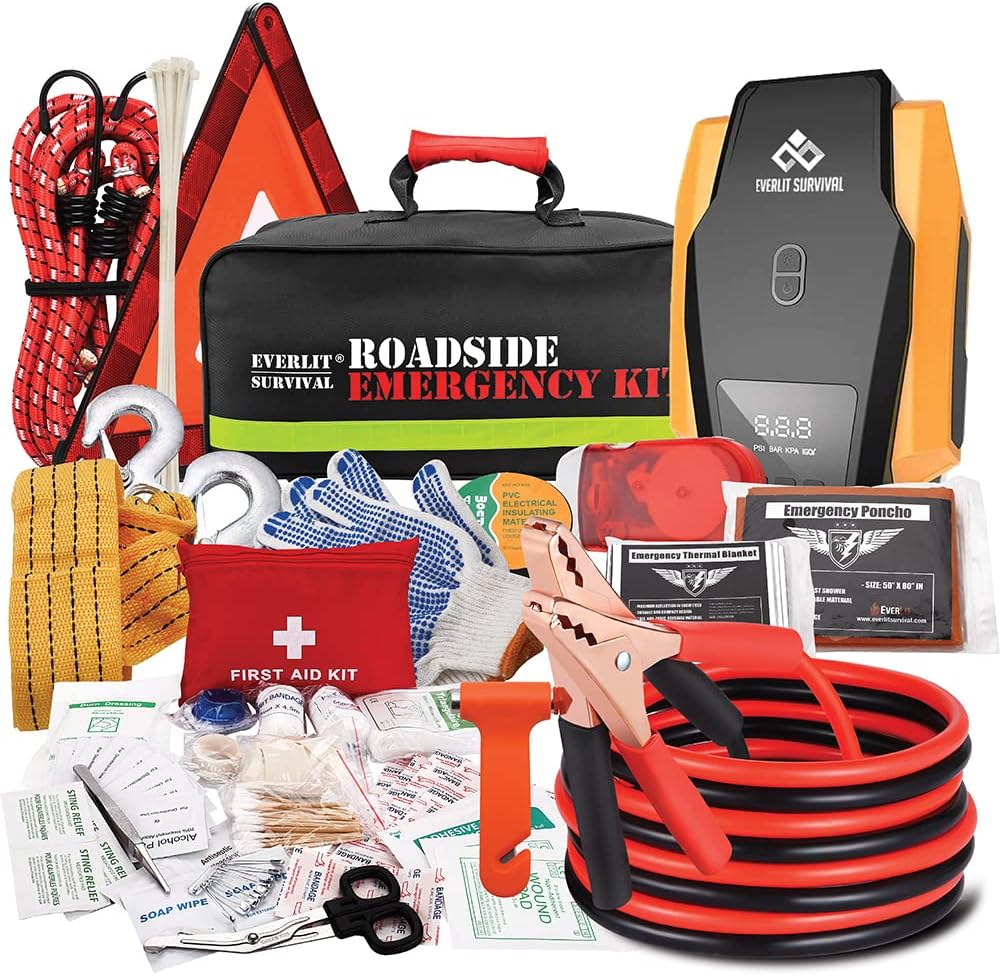
The Everlit Road Guardian emergency kit is designed for roadside breakdowns, combining essential safety gear and roadside tools in one compact bag. It includes a digital 12V auto tire inflator with preset and auto shutoff, plus 12-foot 8-gauge jumper cables to get you moving again. You also get a full 108-piece first aid kit, reflective warning tools, safety gloves, and emergency convenience items for safer travel.
Tire Coverage Basics
Start with the tire-size code on the sidewall, then use the traction-device manufacturer’s fit chart. Test-fit the device before your trip because manufacturing differences and vehicle clearance can affect the final fit.
- Match the chain or traction-device size to the tire.
- Confirm clearance around brakes, suspension, fenders, and bodywork.
- Test-fit the devices before winter travel.
- Inspect links, cables, connectors, and tensioners for damage.
- Do not deflate a tire simply to make a chain fit.
A chain that is too loose can strike the vehicle. A device that is too tight or incorrectly sized can damage the tire or mounting hardware.
Drive Wheel Priority
On most conventional two-wheel-drive vehicles, the primary drive axle gets the traction devices because that is where engine torque reaches the road.
That means front tires on FWD and rear tires on RWD unless the vehicle manufacturer specifies otherwise.
Installing chains only on a non-drive axle may fail to provide the propulsion benefit you expected and can create an undesirable traction imbalance. Follow the approved placement rather than improvising.
For AWD and 4WD, power can reach both axles, so the simple two-wheel-drive rule is not enough. Use the manufacturer’s specified placement.
Traction Conditions Matter
Chains and approved traction devices are intended for winter surfaces and chain-control conditions, not ordinary clear pavement.
Packed snow and ice are common situations where chains can add useful mechanical grip, but do not decide whether to install them from snow type alone. Grade, tire condition, vehicle requirements, weather, and posted controls all matter.
- Ice can produce extremely low tire grip.
- Packed snow can make starting, climbing, braking, and turning more difficult.
- Deep or drifting snow can also overwhelm ordinary tire traction.
- Slush and changing surfaces require lower speeds and smooth control inputs.
- On clear pavement, remove chains when it is safe and legal to do so.
If a road sign says chains are required, follow the posted requirement rather than waiting for the vehicle to begin slipping.
Compare Chain Types
The best traction device is the one that fits your vehicle, meets its clearance requirements, is approved for the road you are using, and provides suitable winter traction. Do not assume one construction is automatically best for every vehicle.
| Type | Advantages | Check before using |
|---|---|---|
| Link chains | Traditional metal construction; available in many patterns and heavy-duty designs. | Wheel-well clearance, vehicle approval, size, and road requirements. |
| Cable devices | Lower-profile designs can suit some vehicles with tighter clearance. | Whether the vehicle and jurisdiction allow that cable design for the current restriction. |
| Textile / snow-sock devices | Lightweight and useful for some low-clearance applications. | The exact product must be accepted by the vehicle maker and road authority when chains are legally required. |
| Other approved traction devices | Can provide an alternative where a jurisdiction recognizes the device. | Approval is product- and jurisdiction-specific; never assume every alternative qualifies. |
Whatever type you choose, do not continue driving on bare pavement simply because the device feels smoother than a conventional chain. Winter traction devices can wear rapidly or damage tires, roads, or vehicle components when used on an unsuitable surface.
[Products Worth Considering]

MORNYRAY universal tire covers help protect RV, truck, SUV, trailer, and camper tires from sun, rain, and snow with waterproof, anti-UV fabric and a soft inner lining. Elasticized bands and windproof buckle design help keep covers securely in place for easy on and off use. The set includes a storage bag for convenient handling when not in use.

A concentrated tire and tube mounting compound designed to help simplify mounting rubber tires and tubes on passenger, semi truck, construction, and OTR applications. Its ultra-thick formula packs beads effectively and includes rust inhibitors to help protect against corrosion during use.

This universal wheel alignment tool helps you accurately restore tire tilt angles after tire or suspension repairs using an adjustable camber gauge. It features a powerful magnetic base that firmly attaches to brake rotors for stationary, slip-free readings, improving consistency during measurement. Built from durable PC plastic, it resists wear and corrosion and is compact enough for car, truck, RV, and motorcycle alignment tasks.
Install Chains the Right Way
Proper installation matters as much as choosing the correct chain. Practice before your trip so your first attempt is not beside a snowy highway in poor visibility.
- Pull completely off the travel lane. Use a safe, level chain-up area whenever one is available.
- Set the parking brake. Follow your vehicle’s instructions before working around the wheels.
- Lay the chains out. Remove twists and inspect them for damaged links, cables, hooks, or fasteners.
- Position the device on the approved tires. Center it across the tread according to the manufacturer’s directions.
- Connect the fasteners in the specified order. Do not force hardware that does not align.
- Set the correct tension. Use any tensioner or self-tightening mechanism exactly as instructed.
- Check clearance. Make sure no part of the device contacts brake, suspension, steering, body, or wheel components.
- Drive a short distance and recheck. Stop safely and retighten if the traction-device instructions call for it.
Pro Tip: Practice the full installation at home while the pavement is dry. Keep the chains, waterproof gloves, a kneeling mat or tarp, and a flashlight together so you are not searching through the vehicle during a storm.
If a chain becomes loose, begins striking the vehicle, or breaks, pull over safely and stop. Do not keep driving with a failed chain because a loose section can damage the tire, brake components, suspension, or bodywork.
[Products Worth Considering]

Replace worn or missing TPMS sensors with a pre-programmed 4-pack designed for compatible GM vehicles. These 315MHz sensors provide real-time tire pressure monitoring and alert you if pressure is too high, too low, or if a rapid air leak occurs. Most installations are ready with minimal relearn effort after mounting, helping improve safety and driving confidence.
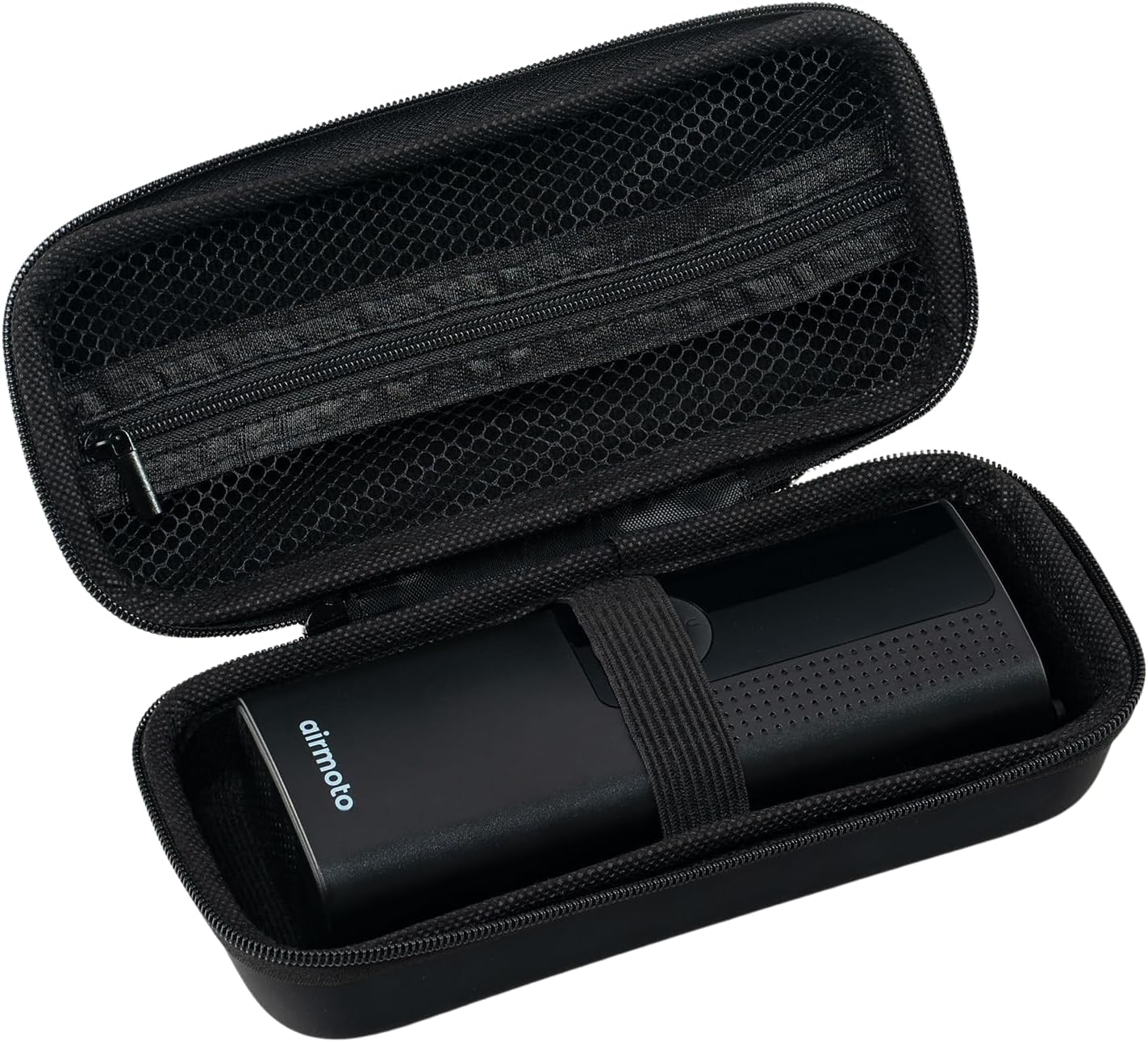
Protect and organize your Airmoto tire inflator with a purpose-designed carrying case made for a precise fit. The durable polyurethane shell and soft interior help guard against cuts, tears, and road wear, while a mesh pocket stores connectors and accessories. This travel box measures 7.5*3.5*2.8 inches and can work with most handheld portable air compressor models; this listing includes the case only.

The Mothers wheel and fender brush is designed for gentle, scratch-free scrubbing to remove road grime and brake dust. Its ergonomic shape and soft triple-flagged bristles deliver maximum coverage, including hard-to-reach wheel wells and undercarriage areas. With rubberized gripping and a protective rubber bumper, it helps clean safely while protecting delicate finishes on wheels, fenders, and bumpers.
Drive Safely With Chains On
With chains installed, drive slowly and make every control input smooth. Avoid hard acceleration, sudden braking, sharp steering, spinning the tires, and striking curbs.
Thirty mph is a common maximum, not a universal target speed. Oregon DOT tells drivers not to exceed 30 mph with chains, and major chain manufacturers publish similar limits. California chain-control areas may post 25- or 30-mph limits. Your actual safe speed may be much lower.
Follow whichever limit is lowest:
- The posted road speed.
- The traction-device manufacturer’s maximum.
- The vehicle manufacturer’s limit.
- A lower speed required by snow, ice, traffic, visibility, or chain condition.
Leave extra following distance and expect longer stopping distances. Watch and listen for unusual vibration, slapping, scraping, or a sudden change in handling that could indicate a loose or damaged device.
After a short initial drive, stop in a safe location and inspect the chains if the manufacturer requires a tension check.
When the road becomes clear and chain controls end, remove the devices as soon as you can do so safely. Continuing to drive chains on unsuitable bare pavement accelerates wear and can damage the vehicle or road surface.
Frequently Asked Questions
Can I Use Cable Chains Instead of Regular Chains?
Sometimes. Cable traction devices are legal and suitable in many situations, and their lower profile can help on vehicles with limited clearance. However, confirm that your owner’s manual permits them and that the road authority accepts that device for the current chain restriction.
How Fast Can I Drive With Snow Chains Installed?
Do not treat 30 mph as a guaranteed safe speed. Thirty mph is a common maximum in government and chain-manufacturer guidance, but posted chain-control speeds or your vehicle/device instructions may require less. Slow down further for ice, poor visibility, curves, traffic, or rough chain operation.
Do Snow Socks Replace Tire Chains in Emergencies?
An approved textile traction device can legally satisfy some chain requirements, but not every snow sock automatically qualifies. Approval depends on the specific product and jurisdiction. Colorado, for example, recognizes approved alternative traction devices. Check your vehicle manual and the road authority before relying on a textile device instead of chains.
Will Chains Damage My Tires or Wheels?
They can if the device is the wrong size, lacks adequate clearance, is installed loosely, breaks, or is driven too fast or on unsuitable bare pavement. Correct sizing, proper tension, low speeds, inspection, and prompt removal when chains are no longer needed reduce the risk.
Should I Practice Installing Chains Before a Storm?
Yes. Practice lets you confirm that the chains actually fit your tires and helps you learn the fasteners before you are working in snow, darkness, or traffic. Oregon DOT specifically recommends practicing at home before chains are needed on the road.
Do AWD or 4WD Vehicles Need Chains on All Four Tires?
Not necessarily. AWD and 4WD chain placement is vehicle-specific. Some vehicles permit or specify one axle, while other configurations may use a different arrangement. Follow the owner’s manual instead of assuming that every AWD or 4WD vehicle should receive either two or four chains.
What If My Owner’s Manual Says Not to Use Conventional Chains?
Do not force conventional chains onto the vehicle. Check whether the manufacturer permits a low-clearance cable, textile device, or another approved traction device. Then verify that the alternative is accepted under the road restriction. If you cannot equip the vehicle with a compliant device, avoid entering a chain-required road.
Conclusion
You do not automatically need snow chains on all four tires. For most conventional FWD vehicles, the front drive tires are the normal location; for RWD, it is the rear drive tires. AWD and 4WD need a vehicle-specific answer from the owner’s manual rather than a blanket two-chain or four-chain rule.
Before winter travel, confirm tire size and clearance, test-fit the traction devices, check current state and highway requirements, and practice installation. Once chains are on, drive slowly, avoid abrupt inputs, stop if a device loosens or breaks, and remove the chains when you reach clear pavement and they are no longer required.
The right setup is the one that satisfies all three requirements at the same time: your vehicle manufacturer, your traction-device manufacturer, and the law for the road you are driving.
Sources
- California Department of Transportation — Chain Requirements — AWD/4WD chain-control rules, carrying requirements, and drive-axle placement.
- California Department of Transportation — Winter Driving Tips — chain controls, installation safety, and posted chain-control speeds.
- Oregon Department of Transportation — Tire Chains — practice installation, fit, retightening, and 30-mph guidance.
- Oregon Department of Transportation — Snow Zone Signs — light-duty drive-axle placement and Oregon snow-zone terminology.
- Colorado Department of Transportation — Passenger Vehicle Traction and Chain Laws — Passenger Vehicle Chain Law and approved alternative traction devices.
- Washington State Patrol — Rules of the Road — traction requirements and AWD/4WD chain-control exceptions.