
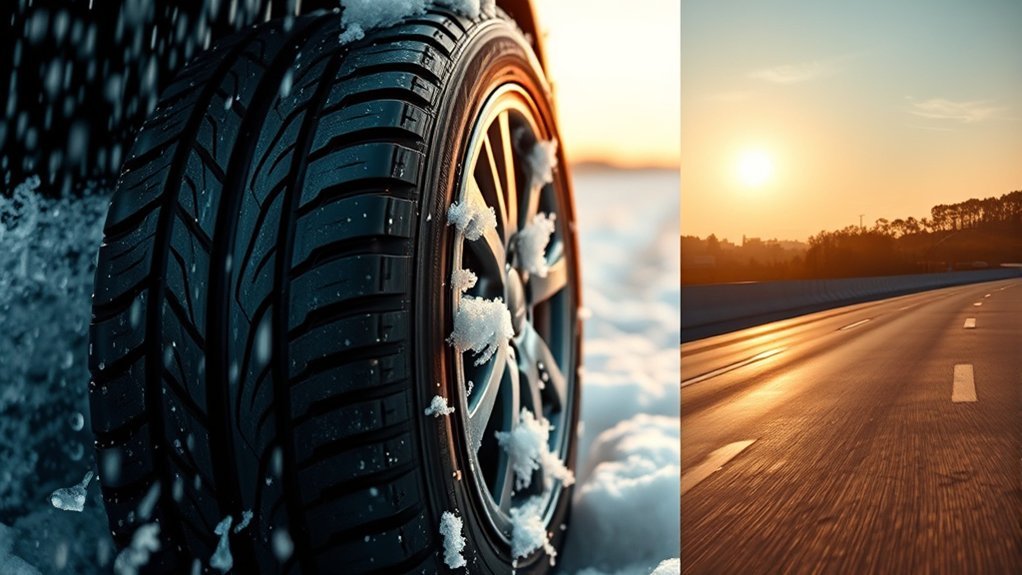
Rain, snow, ice, cold, and heat can all change how much grip your tires can produce. Water and frozen surfaces reduce available friction, cold weather lowers inflation pressure and can stiffen some tire compounds, and sustained heat increases tire temperature and wear. Your tire type, tread depth, speed, load, and correct cold inflation pressure all affect how safely the tire can respond.
Quick Answer
Weather affects tire traction by changing road friction, tire temperature, and inflation pressure. Rain raises hydroplaning risk, snow and ice sharply reduce available grip, cold lowers tire pressure, and sustained heat increases tire stress and wear. Correct cold PSI, adequate tread, suitable tires, and lower speeds help preserve control.
Key Takeaways
- Rain reduces the tire’s direct contact with pavement and can lead to hydroplaning when speed and water depth overwhelm the tread’s ability to move water.
- Snow and ice provide far less friction than dry pavement, so braking, acceleration, and steering require more distance and smoother inputs.
- Winter tires use tread patterns and compounds designed to remain effective in severe cold and snow; all-season tires are a compromise across a wider range of conditions.
- Cold weather lowers inflation pressure, while driving and hot weather raise tire temperature and pressure. Check and adjust pressure when tires are cold.
- Heat, high speed, heavy loads, and underinflation can increase tire temperature and accelerate wear or damage.
How Weather Changes Tire Traction
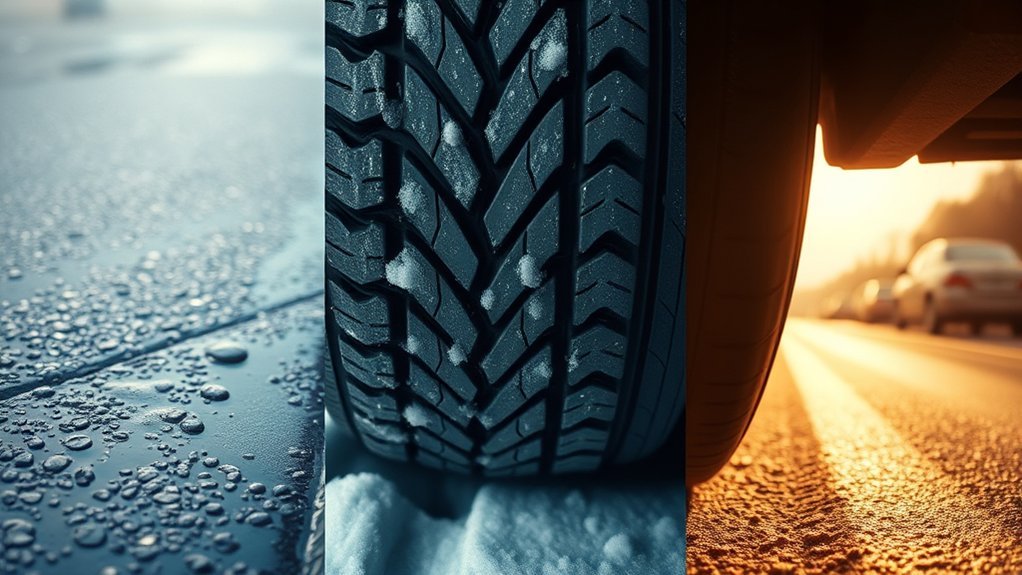
Weather changes tire traction by changing the road surface, tire temperature, and the tire’s ability to maintain a stable contact patch. On wet roads, water must be pushed away through the tread. If the tire cannot clear water fast enough, grip falls and hydroplaning risk rises.
Tread depth and tread design matter because grooves provide paths for water and slush. Speed matters just as much: the faster you travel through standing water, the less time the tread has to evacuate it.
In cold conditions, inflation pressure falls as the air inside the tire cools. Some tire compounds also become less flexible as temperatures fall, which is one reason tire type matters in winter.
Snow and ice reduce the friction available for braking, turning, and acceleration. The National Highway Traffic Safety Administration (NHTSA) advises drivers to slow down and increase following distance because vehicles are harder to control or stop on slick and snow-covered roads.
Heat creates a different problem. Sustained high tire temperatures can accelerate deterioration, especially when combined with underinflation, heavy loads, high speed, or long-distance driving.
Why Tire Pressure Drops in Cold Weather
When outside temperature falls, the air inside your tires cools and the measured PSI falls. This can happen even when there is no puncture or leak.
The exact pressure change depends on starting temperature, tire pressure, and operating conditions, so do not rely on a calculation alone. Use an accurate gauge and compare each cold tire with the vehicle manufacturer’s recommended pressure on the driver-door placard or in the owner’s manual.
NHTSA recommends checking all tires at least monthly when they are cold, meaning the vehicle has not been driven for at least three hours.
Cold Air Pressure Drop
A cold morning can make a properly sealed tire show a lower pressure than it showed in warmer weather. That change can affect steering response, tire flex, fuel economy, and the way the tread meets the road.
If pressure drops far enough, the TPMS may trigger. NHTSA notes that a TPMS light can appear on cold mornings when a marginally low tire drops below the warning threshold and then turn off as the tire warms.
You should still check the tire with a gauge. TPMS is a warning system, not a substitute for monthly pressure checks.
PSI Changes With Temperature
Temperature-related PSI changes are normal, but your target remains the vehicle manufacturer’s specified cold inflation pressure. Do not use the maximum pressure molded on the tire sidewall as the normal operating target.
Follow three checks:
- Measure pressure at least monthly when the tires are cold.
- Recheck before long trips and after major seasonal temperature changes.
- Inflate to the pressure listed on the vehicle placard or in the owner’s manual.
Correct inflation helps the tire carry its load as designed and reduces unnecessary flex and irregular wear.
Warning: Do not bleed air from a hot tire simply because its pressure is above the placard’s cold-PSI number. Pressure normally rises as tires warm during driving. Recheck and make final adjustments when the tires are cold.
How Heat Changes Rubber Grip
Heat changes tire behavior, but “hotter means more grip” is too simple. Tire compounds are engineered for operating ranges, and road surface, tire type, load, speed, and inflation all influence traction.
As a tire warms during driving, its internal air pressure rises. Sustained high temperature can also accelerate rubber deterioration. NHTSA’s tire guidance notes that long-distance driving in hot weather can expose tires to sustained heat that contributes to deterioration, tread separation, or blowout risk.
| Heat effect | Result |
|---|---|
| Warmer tire and air | Pressure rises during operation |
| Hot pavement | Greater thermal load on the tread |
| Sustained speed or heavy load | More heat generation |
| Underinflation | More flexing and heat buildup |
| Excessive heat exposure | Faster deterioration and wear |
During long drives, inspect your tires for visible damage and keep the vehicle within its load limits. Use the placard pressure when the tires are cold rather than trying to “correct” normal hot-tire pressure increases during a trip.
Rain, Hydroplaning, and Wet Roads
When roads are wet, water reduces direct tire-to-pavement contact and lowers the grip available for braking and cornering. Standing water increases the risk further because the tread must move a larger volume of water out of the contact area.
Hydroplaning occurs when a tire rides on a layer of water instead of maintaining effective contact with the road. Speed, water depth, tread condition, and tire inflation all influence the risk.
Tread channels help by giving water a path out from under the tire. Worn tread reduces that drainage capacity, especially in deeper water.
Wet Road Grip Loss
There is no single reliable percentage for how much traction rain removes. Wet-road grip varies with pavement texture, water depth, tire construction, tread depth, speed, and vehicle load. The original claim that wet asphalt always retains about 80% of dry traction is too broad to use as a general rule.
What is clear is that wet pavement provides less safety margin than dry pavement and that adequate tread matters. NHTSA says tires should be replaced when tread reaches 2/32 inch, and it recommends checking tread at least monthly.
- Check tread depth and wear indicators routinely.
- Replace tires at 2/32 inch or when wear bars show the tread is at its minimum; consider replacing earlier if wet- or snow-weather performance has become poor.
- Keep tires at the vehicle manufacturer’s recommended cold inflation pressure.
Even with good tires, reduce speed when water is standing on the road.
Hydroplaning Risk Factors
Hydroplaning risk rises when conditions make it harder for the tread to clear water. The biggest practical factors you can control are speed and tire condition.
- Speed: Higher speed gives the tire less time to move water away.
- Standing water: Deeper water is harder for the tread to evacuate.
- Tread depth: Worn grooves have less water-moving capacity.
- Inflation: Significant underinflation or overinflation can change the tire’s shape and handling, so use the vehicle placard specification.
Do not deliberately overinflate tires to fight hydroplaning. Correct cold inflation is the safe baseline.
Tread Channels And Drainage
Tread channels are a major defense against hydroplaning because they move water away from the contact area and help the rubber maintain useful road contact.
- Wide circumferential and lateral grooves provide paths for water.
- Sipes create additional edges that can help on wet, snowy, and icy surfaces, depending on the tire design.
- Adequate tread depth keeps those channels from becoming too shallow to work effectively.
NHTSA’s penny test is a simple minimum-tread check: insert a penny with Lincoln’s head upside down. If the top of Lincoln’s head is visible, the tread is at or below the replacement point.
Pro Tip: Do your pressure and tread checks together once a month. A good tread-depth gauge is more precise than a coin test and makes it easier to spot uneven wear across the tire.
Snow and Ice Reduce Tire Contact
Snow and ice sharply reduce the friction available between the tire and the road. Snow, slush, and ice can also interfere with how the tread engages the pavement, so braking and steering reserves become much smaller than on a dry surface.
On ice, very little friction may be available, so abrupt steering, throttle, or braking inputs can overwhelm the tire quickly. This is why you should slow down, increase following distance, and make smooth control inputs.
Cold temperature also affects tire compounds differently. Tires designed for winter use rely on compounds and tread features intended to remain useful in severe cold and on snow or ice.
If roads are snow-covered or icy, treat the condition itself as the traction limit. Four-wheel drive or all-wheel drive can help a vehicle accelerate, but it does not create extra tire grip for braking or cornering.
Why Winter Tires Outperform All-Seasons
Winter tires are designed specifically for severe cold, snow, and ice. Their tread patterns use more biting edges, and their rubber compounds are formulated to remain more pliable in low temperatures than many warm-weather designs.
Winter tires can provide better snow and ice traction because their tread and rubber are designed specifically for cold-weather grip.
NHTSA states that winter tires are more effective than all-season tires in deep snow. Bridgestone’s winter-tire guidance also describes aggressive block edges for snow, specialized tread patterns, and rubber formulated to stay pliable in subzero temperatures.
- Deeper and more open tread features help handle snow and slush.
- Extra biting edges can improve grip on packed snow and ice.
- Cold-focused compounds are designed to remain flexible in low temperatures.
There is no universal temperature at which every tire suddenly “loses traction.” The transition depends on the tire compound and design. Follow the tire manufacturer’s temperature and seasonal-use guidance for the exact tire fitted to your vehicle.
The Federal Highway Administration reports an average of about 745,000 weather-related crashes per year for 2019–2023, showing why weather-adjusted speed and tire condition matter.
[Products Worth Considering]

Milton S-921 pencil tire pressure gauge helps you maintain optimal tire pressure for passenger cars with accurate readings in PSI and kPa. It features a built-in deflator valve for convenient pressure adjustments, plus a single chuck head and nylon indicator bar for easy use on the go. Built from durable plated brass and designed for reliable performance, it’s a practical road trip and cold-weather maintenance tool.

Keep your tires properly inflated with this analog VONDIOR tire pressure gauge, designed for fast, easy readings without batteries. The swiveling, two-axis hose and large glow dial help you measure at any tire angle with instant visibility. Built with a protective rubber shield, it supports durable, low-maintenance use for cars and trucks.

Add style while helping protect your tire valve stems with handmade crystal rhinestone caps and a durable plastic insert. These caps resist corrosion and help keep out rain, snow, and muddy water, extending tire life. Textured non-slip design makes them easy to grip for quick install and removal when checking tire pressure.
How Heat and Speed Wear Tires Faster
High tire temperatures increase stress on rubber and internal tire components. Hot pavement, sustained highway driving, heavy loads, and incorrect inflation can combine to raise operating temperature further.
Higher speed also increases the rate of tire flexing and heat generation. That does not mean tread wear always rises by a fixed percentage; wear varies widely with tire construction, alignment, road surface, load, driving style, and temperature.
Heat also raises pressure while the tire is operating. That increase is normal, which is why pressure adjustments should be based on a cold reading.
Heat Stresses Tire Rubber
Heat can accelerate tread wear and rubber aging, especially during long drives on hot pavement. NHTSA’s temperature grading information specifically warns that sustained high temperature can cause tire deterioration and contribute to blowouts or tread separation.
- Check pressure when tires are cold before a long drive.
- Inspect tread and sidewalls for cuts, bulges, cracks, or irregular wear.
- Do not exceed the vehicle’s load rating or the tire’s rated capabilities.
Underinflation is especially important because excess sidewall flex generates heat. Regular pressure checks reduce that avoidable stress.
Speed Increases Tread Wear
Higher speeds increase tire flexing, frictional losses, and temperature, which can contribute to faster tire temperature buildup and tread wear.
The draft’s claim that tread wear rises by “25% or more” at higher speed is not reliable as a general figure. There is no single percentage that applies across tires, vehicles, roads, loads, and driving conditions.
For consistent performance, obey speed limits, avoid sustained excessive speed, maintain correct inflation, and address alignment or suspension problems that create uneven wear.
Inflation Affects Hot Tires
Tire pressure rises as the tire heats during driving. This does not mean the tire should be reduced to the placard’s cold-pressure number while it is hot.
- Set pressure before driving, when tires are cold.
- If a tire looks low while hot, add enough air for safe operation rather than bleeding pressure.
- Recheck and make the final adjustment after the tire has cooled.
If tires are underinflated, they flex more and can build extra heat. If they are overinflated, handling and wear can also be affected. Correct cold inflation is the target.
Seasonal Potholes and Tire Damage
Seasonal potholes often develop where water enters pavement, freezes, expands, and contributes to cracking and breakup. A hard pothole impact can damage a tire or wheel, especially when the tire is already underinflated or the impact is severe.
Treat potholes as a structural hazard, not just a comfort problem. Impact forces can damage sidewalls, wheels, alignment, or suspension components.
Keep tire pressure within the manufacturer’s specified range because underinflation increases sidewall flex and can make impact damage more likely.
After a hard pothole strike, inspect for cuts, bulges, vibration, pulling, air loss, or uneven tread wear. These symptoms can indicate tire, wheel, alignment, or suspension damage.
If you see a bulge, exposed cords, rapid pressure loss, or strong vibration, stop using the tire and have the vehicle inspected by a qualified tire professional.
Check Tires Before Weather Changes
Before a major seasonal change, check tire pressure, tread depth, and visible condition. Cold weather can lower inflation pressure, while hot-weather driving raises tire temperature and pressure during use.
Check tire pressure and tread depth before major weather changes so your tires start the season at the correct cold pressure and with enough usable tread.
Compare pressure with the manufacturer’s recommended cold PSI. For tread, NHTSA says tires are not safe once they are worn to 2/32 inch. Wet- and snow-weather performance can become less reassuring before the legal or minimum replacement point, so consider your actual driving conditions rather than waiting for the last usable fraction of tread.
Look for cracks, bulges, punctures, embedded objects, exposed cords, and uneven wear.
- Measure tire pressure when the tires are cold.
- Check tread depth at several points across each tire.
- Inspect sidewalls and tread for visible damage.
- Verify that your tire type is suitable for the season and local conditions.
This routine helps preserve predictable braking, steering, and tire life.
[Products Worth Considering]

The Tymate TM12 RV TPMS delivers real-time tire pressure and temperature monitoring with a stable 433Hz display for safer long-distance driving. It supports simultaneous monitoring across vehicle and trailer zones, includes six alarm modes for pressure, temperature, leakage, battery, and signal loss, and features easy DIY installation with auto calibration. Power is supplied via USB-C charging or solar recharging, with a wide 0–144 PSI range and up to 50 ft signal coverage for RVs and towable trailers.

Monitor tire tread wear with a smart, color-coded depth gauge that shows clear condition ranges at a glance. The bar is range marked for fast, easy readings, helping you maintain safer traction and performance. Each gauge is portable with a pocket clip, and the set includes 20 units for daily use and sharing.

The SAFELIFE dial tire tread depth gauge measures tread depth in 1/32 inch increments with clear, easy-to-read 2-inch dial face. Color zones using a traffic light system help you quickly judge whether tread is low, marginal, or ample for safer driving. Built with a durable zinc cast body and a metal detect probe for precise, comfortable use across cars, motorcycles, trucks, and buses.
When to Get Your Tires Inspected
You should inspect your tires at least monthly and before long trips. NHTSA recommends checking pressure, tread, and visible condition, while also paying attention to TPMS warnings.
| Trigger | What to Check | Why It Matters |
|---|---|---|
| Monthly | Cold pressure, tread depth, visible damage | Helps maintain safe load support and grip |
| Major weather change | Cold PSI, tread, tire type | Prepares the tire for different temperatures and road surfaces |
| Pothole or curb impact | Bulges, cuts, air loss, pulling, vibration | Can reveal tire, wheel, alignment, or suspension damage |
| Before a long trip | Pressure, tread, sidewalls, spare | Reduces the chance of discovering a tire problem far from home |
If you feel pulling, vibration, new noise, or a change in handling after an impact, schedule service promptly. A tire professional can check for damage that is not obvious from a quick visual inspection.
[Products Worth Considering]

Measure tire tread depth quickly and accurately with this LUMITECO dial gauge that reads in 1/32" increments up to 14/32". The color-coded green/yellow/red zones make it easy to judge tire wear and know when replacement is needed. A rugged, compact design with a protective pouch helps keep the gauge ready for use on cars, trucks, motorcycles, and more.

Measure tyre tread depth precisely with a digital gauge that reads in both MM and inches, helping you monitor safe driving conditions. The large LCD screen is easy to operate, and the compact tool fits for cars, trucks, and motorcycles. It provides high accuracy with a 0-25.4mm range and includes a 1-year warranty for added peace of mind.

The Big Rig Defense Tire Thumper is a truck tire pressure checker that lets you quickly check multiple tires by giving them a firm whack. Listen for a reassuring thump and feel the stick bounce when a tire is fully inflated, helping you get back on the road safely. It features a comfortable, glove-friendly handle and a secure wrist strap for confident use on busy routes.
How to Drive When Weather Reduces Traction
Good tires help, but they cannot cancel poor road conditions. Adjust your driving to the amount of grip available.
- Rain: Reduce speed, leave more following distance, and avoid deep standing water when possible.
- Snow and ice: Accelerate, brake, and steer smoothly; leave substantially more room to stop.
- Cold: Check cold tire pressure because a temperature drop can reveal or worsen underinflation.
- Heat: Check tires before long trips, avoid overloading, and stop if you notice vibration, rapid pressure loss, or visible damage.
Note: Traction control, ABS, all-wheel drive, and four-wheel drive can help manage available grip, but none of them can create friction that the tires and road surface do not have.
Frequently Asked Questions
Is It Better to Drive With Traction Control on or off in Snow?
Usually keep traction control on. It helps limit excessive wheelspin and supports stability. Some vehicles allow temporary deactivation when you are stuck in deep snow and need wheelspin to get moving, but the correct procedure varies by vehicle. Follow the owner’s manual.
Why Am I Losing Traction in the Rain?
Rain reduces tire-to-road friction, and standing water can overwhelm the tread’s ability to move water away. Worn tread, excessive speed, damaged tires, and incorrect inflation can reduce your wet-weather safety margin further.
What Temperature Do Tires Lose Traction?
There is no single temperature at which every tire suddenly loses traction. Tire compounds and designs respond differently to cold. NHTSA notes that summer tires are not designed for temperatures below freezing or for snow and ice, while winter tires are intended for severe cold-weather conditions.
Which Weather Conditions Most Reduce Tire Traction?
Ice and packed snow can reduce available friction dramatically, while heavy rain and standing water raise hydroplaning risk. The actual loss of grip depends on tire type, tread depth, road surface, speed, temperature, and inflation.
Should I Lower Tire Pressure for Rain or Snow?
No. For normal road driving, use the vehicle manufacturer’s recommended cold inflation pressure. Deliberately lowering pressure can increase tire flex and heat and may harm handling. Use the pressure on the vehicle placard or in the owner’s manual.
Does New Tread Eliminate Hydroplaning Risk?
No. Good tread helps move water, but speed and standing-water depth still matter. Even a new tire can hydroplane if conditions overwhelm its ability to evacuate water, so reduce speed in heavy rain and avoid deep pooled water when possible.
Conclusion
Weather changes tire traction by changing both the road and the tire. Rain and standing water reduce wet grip and raise hydroplaning risk; snow and ice reduce friction; cold lowers inflation pressure; and sustained heat increases tire stress and wear. Check cold pressure and tread monthly, choose tires suited to your conditions, inspect damage after hard impacts, and reduce speed whenever the road offers less grip.
Sources
- NHTSA — Tire Safety — cold tire-pressure checks, tread minimum, penny test, temperature resistance, TPMS, and inspection guidance.
- NHTSA — Winter Weather Driving Tips — cold-weather pressure, winter inspections, tread minimum, snow tires, following distance, and winter driving safety.
- Federal Highway Administration — How Weather Events Affect Roads — current federal road-weather crash data and the effects of rain, snow, ice, and low visibility.
- Bridgestone — Winter Tires — winter-tire tread features and cold-flexible rubber design.

