
Snow chains, snow socks, and zip-tie-style traction aids are not interchangeable. Chains are usually the most durable choice for repeated severe winter use, while approved textile snow socks can be a legal, low-clearance alternative and may be tested against chain benchmarks. Ordinary household zip ties should not be treated as tire chains or a routine traction device.
Quick Answer
Choose tire chains when your vehicle allows them and you expect deep snow, hard-packed snow, steep grades, or repeated use. Choose an approved snow sock when clearance is tight or easier installation matters, but follow its speed and wear limits. Do not use ordinary zip ties as a substitute for a certified traction device.
Key Takeaways
- Metal snow chains are generally the most durable option for repeated use on severe snow and ice, but exact traction depends on the chain design, tire, vehicle, and surface.
- Approved textile snow socks can provide meaningful snow-and-ice traction, and some jurisdictions approve specific products as alternatives to conventional chains.
- Snow socks usually tolerate less bare-pavement driving than metal chains, so remove them when the road is cleared and follow the maker’s wear instructions.
- Ordinary household zip ties are not a dependable substitute for an approved traction device. Purpose-built zip-tie-style cleats, where sold, should be used only as their manufacturer and local law allow.
- Match every device to your exact tire size, wheel-well clearance, drivetrain, owner’s manual, manufacturer instructions, and posted road rules.
Snow Chains vs Snow Socks vs Zip-Ties
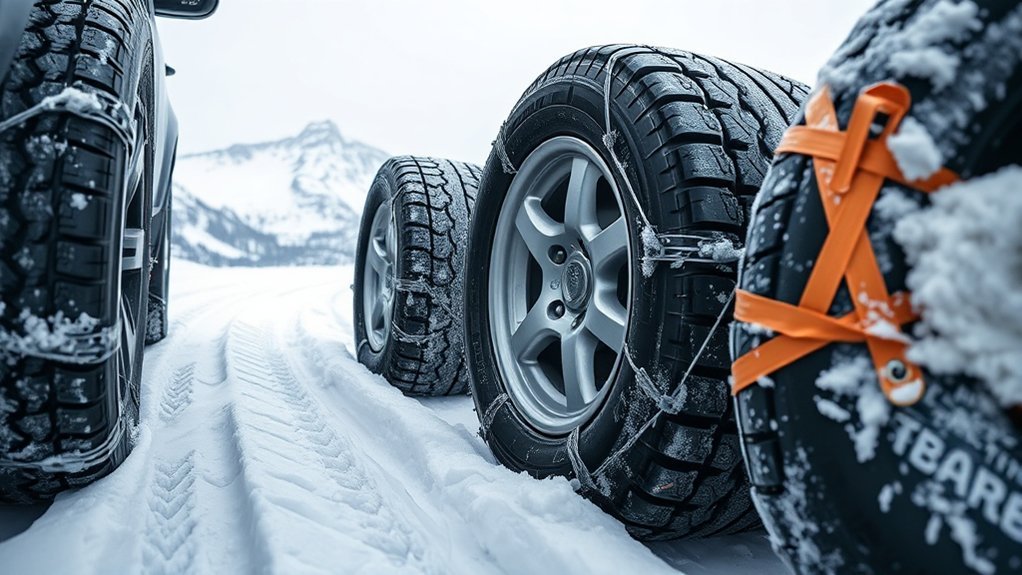
The biggest differences are durability, clearance, installation, legal approval, and how the device creates traction. Traditional chains use metal cross-links or similar hardware to create mechanical bite. Snow socks use a textile contact surface and are lighter and easier to store. Zip-tie-style products range from purpose-built emergency cleats to ordinary household cable ties, and those should not be treated as the same thing.
| Feature | Snow Chains | Snow Socks | Zip-Tie-Style Aids |
|---|---|---|---|
| Best use | Repeated severe snow/ice use when the vehicle permits chains | Temporary winter traction, especially where clearance is limited and the product is approved | Purpose-built products may be for emergency unsticking only; ordinary zip ties are not recommended |
| Traction | Strong mechanical bite; exact performance varies by design and surface | Product-specific; some approved devices are tested against a reference chain | Limited and product-specific; not a dependable category-wide substitute for chains |
| Durability | Generally better suited to repeated abrasive use | Textile can wear quickly on clear pavement | Emergency products may be short-lived; household ties can break or detach |
| Installation | Usually more involved; correct tension is important | Usually quicker and lighter; many textile designs self-center | Varies; improvised installation can interfere with vehicle components |
| Wheel clearance | Can be a problem on low-clearance vehicles | Often useful where conventional chains are restricted, if approved by the vehicle maker | Do not assume clearance simply because the device is thin |
| Legal status | Widely recognized, subject to local chain rules | Depends on jurisdiction and exact product approval | Do not assume legal compliance; check the exact product and jurisdiction |
Warning: Do not improvise winter traction with ordinary household zip ties, rope, or a makeshift repair to a damaged chain. A loose or poorly fitted device can contact brake hoses, ABS wiring, suspension, wheels, or bodywork. If a traction device is damaged, rubbing, or coming loose, stop in a safe place and follow the manufacturer’s instructions.
Which Winter Traction Option Grips Best?
There is no honest single ranking that applies to every chain and every snow sock. Traction changes with the product design, tire, vehicle weight, snow depth, ice condition, road grade, and testing method.
Metal chains remain an important benchmark because their cross-links create direct mechanical contact with snow and ice and are generally durable enough for repeated severe use. Historical traction testing reviewed by the California Department of Transportation also found substantial traction gains from steel tire chains compared with ordinary highway tires in winter conditions.
However, that does not mean every textile device is automatically inferior. Washington’s approval standard requires an alternative traction device to be tested against a reference tire chain and to meet or exceed the chain result under the applicable standard. You can review that requirement in WAC 204-24-035.
An approved alternative traction device can be required to meet or exceed a reference tire chain in standardized testing, so product approval matters more than assuming every fabric device performs the same way.
For practical buying, think of chains as the stronger durability and severe-use choice, not as an automatic winner over every certified alternative in every test.
How Snow Socks Perform on Ice
Snow socks are purpose-built textile traction devices, not simple fabric covers. Their actual ice performance depends on the product and certification. In Washington’s approval process, passenger-vehicle alternative traction devices are tested for acceleration and deceleration on both snow and ice, along with durability and snow-traction-force testing.
That makes an approved snow sock very different from an untested generic product. Before relying on one, check:
- Exact tire-size compatibility: use the manufacturer’s sizing chart.
- Vehicle compatibility: follow the owner’s manual, especially on vehicles with tight inner-wheel clearance.
- Legal approval: verify the exact brand/model if your route has chain-control requirements.
- Wear limits: inspect the textile before and after use.
- Speed limits: use the manufacturer’s maximum as an upper limit, not a target speed.
Textile devices also need protection from unnecessary pavement abrasion. The Caltrans traction-device research notes that extended operation on dry pavement can cause excessive wear. AutoSock likewise instructs users to remove its product before driving on cleared roads.
Note: “Snow sock” describes a product category, not a single performance level. A certified product with documented testing should not be judged the same way as an untested textile cover that merely looks similar.
[Products Worth Considering]

MORNYRAY universal tire covers help protect RV, truck, SUV, trailer, and camper tires from sun, rain, and snow with waterproof, anti-UV fabric and a soft inner lining. Elasticized bands and windproof buckle design help keep covers securely in place for easy on and off use. The set includes a storage bag for convenient handling when not in use.

Steelman white tire marking crayons provide high-contrast, semi-permanent marks for repairing and inspecting tires and equipment. They write on wet or dry, smooth or coarse surfaces including rubber, metal, glass, and wood, making them ideal for puncture location and damage outlining. The lead- and zinc-free crayons resist weather and fading yet wipe away when you no longer need the marks.

Monitor tire tread wear with a smart, color-coded depth gauge that shows clear condition ranges at a glance. The bar is range marked for fast, easy readings, helping you maintain safer traction and performance. Each gauge is portable with a pocket clip, and the set includes 20 units for daily use and sharing.
When Zip-Ties Make Sense: and When They Don’t
You should not use ordinary household zip ties as routine tire traction equipment or as a substitute for proper snow chains or approved snow socks. Standard cable ties are not designed, fitted, or certified as complete winter traction systems.
There have been purpose-built traction products that use a zip-tie-like attachment method and molded or cleated road-contact surfaces. A Caltrans research review described one such product, ZipGripGo, as intended to help a stuck vehicle in an emergency rather than replace chains when chains are required. That limited purpose should not be confused with wrapping ordinary plastic ties around a wheel.
Zip-Ties For Emergencies
If your vehicle is stuck, use the safest purpose-built recovery or traction equipment available. Instead of installing household zip ties around the tire, follow this order:
- Stop spinning the tires, because repeated wheelspin can make the surface underneath even slicker.
- Move only if you can do so without entering traffic or creating another hazard.
- Install your approved chain, cable, snow sock, or other manufacturer-approved traction device if conditions and local rules allow.
- If you carry a purpose-built emergency cleated traction product, use it only within that product’s instructions and legal limitations.
- Once mobile, replace an emergency-only aid with an approved road-use traction device before continuing through chain-control or severe winter conditions.
Do not route an improvised tie where it can contact brake hoses, ABS sensor wiring, suspension components, the wheel, or bodywork.
Why Zip-Ties Fail
Ordinary zip ties lack the road-contact structure, secure fit, controlled tension, and certification expected of a proper traction device. A rotating tire repeatedly loads and unloads anything attached to it, while pavement, ice, wheel openings, and sharp edges can cut or weaken plastic.
Even if a household tie produces a small amount of temporary surface disturbance, that does not make it a reliable braking, steering, or climbing aid. A broken or detached piece can also become debris inside the wheel area.
You also should not use zip ties to hold a loose snow chain together. If a chain loosens, stop safely, refit it according to its instructions, or remove it if it cannot be secured correctly.
Better Winter Alternatives
For dependable winter preparation, choose equipment designed and approved for the job:
- Traditional tire chains: strong mechanical bite and good durability for repeated severe use when the vehicle has sufficient clearance.
- Cable or low-profile traction devices: useful on some vehicles with tighter clearance, provided the owner’s manual permits them.
- Approved snow socks: light, compact, and easier to mount on many vehicles; legality depends on the exact product and jurisdiction.
- Winter tires: improve everyday cold-weather traction, but do not assume they replace chains or another device when a posted chain-control rule says otherwise.
For regular mountain travel, buy and practice with the equipment you expect to use before the storm arrives.
Why Snow Chains Remain the Severe-Use Benchmark
Traditional chains remain a strong choice for severe winter travel because metal cross-links provide direct mechanical bite and generally tolerate repeated abrasive use better than textile devices. Their strength also makes them an established reference device in traction-testing and regulatory systems.
That advantage is mainly about mechanical bite, repeated use, and durability. It should not be turned into a claim that every chain outperforms every certified alternative traction device under every condition.
Mechanical Bite on Ice and Packed Snow
Steel links concentrate load at multiple contact points and can cut into compacted snow or irregular ice more aggressively than a normal tire tread. This can improve acceleration and climbing traction when conditions are severe.
Chains do not restore dry-road braking or cornering ability, however. You still need low speed, smooth steering, gentle acceleration, and extra following distance on slippery roads.
Durable Harsh-Weather Grip
Durability is one of the clearest practical differences between metal chains and textile snow socks. Chains can still be damaged by excessive speed, poor fit, wheelspin, or bare pavement, but metal construction generally tolerates repeated severe use better than fabric.
| Device | Typical durability considerations |
|---|---|
| Snow chains | Generally the best choice for repeated severe use, but links and fasteners still require inspection. |
| Snow socks | Effective life depends heavily on road surface and wear; cleared pavement can accelerate textile abrasion. |
| Purpose-built emergency cleats | Use only for the duration and conditions specified by the manufacturer. |
| Ordinary zip ties | Not a dependable tire-traction system and not recommended as a chain substitute. |
How to Check Fit, Clearance, and Installation
Correct fit matters as much as the type of traction device. A device that is too large, too small, or incompatible with the wheel well can loosen, rub, or damage nearby components.
- Read the owner’s manual first. Look for tire-chain restrictions, approved chain types, axle placement, and clearance warnings.
- Confirm the tire size. Match the complete sidewall size to the chain or snow-sock manufacturer’s sizing chart.
- Inspect inner clearance. The critical area is not only between the tire and fender. Check the space around brake hoses, suspension parts, steering components, ABS wiring, and the inner body.
- Use the correct axle. FWD vehicles normally use the front drive tires and RWD vehicles normally use the rear drive tires. For AWD and 4WD vehicles, follow the owner’s manual and traction-device instructions instead of guessing.
- Practice before winter travel. Install the device at home in dry conditions so you know the attachment sequence before you need it roadside.
- Check the installation. Chains must be properly connected and tensioned. If the chain manufacturer tells you to stop and retension after a short distance, do so in a safe location.
- Follow the product’s operating limit. Never exceed the device’s stated maximum speed, and obey any lower posted chain-control speed.
- Remove the device when conditions no longer require it. Avoid unnecessary clear-pavement use, particularly with textile snow socks.
AutoSock’s current passenger-product instructions, for example, tell users to mount the product on the driving wheels, move the vehicle half a wheel turn to complete installation, drive carefully, and stay below the model’s stated speed limit. See the manufacturer’s instructions for an example.
Pro Tip: Do one complete practice installation in your driveway while wearing the gloves you plan to carry in winter. It is much easier to learn the fasteners and fit when your hands are dry and you are not parked beside a snowy road.
[Products Worth Considering]
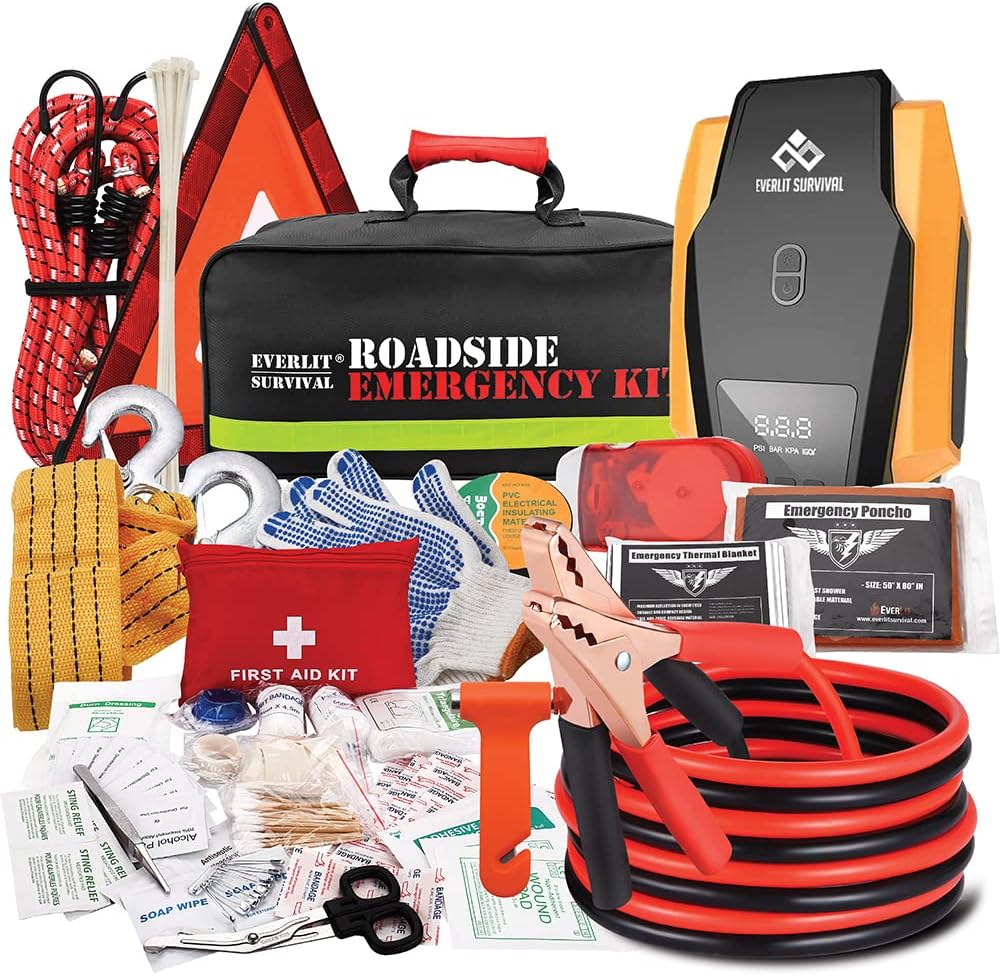
The Everlit Road Guardian emergency kit is designed for roadside breakdowns, combining essential safety gear and roadside tools in one compact bag. It includes a digital 12V auto tire inflator with preset and auto shutoff, plus 12-foot 8-gauge jumper cables to get you moving again. You also get a full 108-piece first aid kit, reflective warning tools, safety gloves, and emergency convenience items for safer travel.

Measure tire tread depth quickly and accurately with this LUMITECO dial gauge that reads in 1/32" increments up to 14/32". The color-coded green/yellow/red zones make it easy to judge tire wear and know when replacement is needed. A rugged, compact design with a protective pouch helps keep the gauge ready for use on cars, trucks, motorcycles, and more.

This roadside assistance kit helps drivers and passengers in urgent situations after an accident or breakdown, providing practical support while waiting for help. It includes a lightweight, compact tire inflator for fast inflation of standard vehicle tires, plus reinforced jumper cable protection for safer handling. Ideal for winter weather, road trips, camping, and travel, with everything stowed neatly in a trunk bag.
Which Traction Device Fits Your Driving Conditions?
Choose by the conditions you actually expect rather than by whichever device looks easiest to install.
- Frequent mountain driving, steep grades, hard-packed snow, or repeated storms: properly fitted chains are usually the most durable choice when your vehicle permits them.
- Limited wheel-well clearance: check your owner’s manual for an approved low-profile chain, cable device, or textile alternative.
- Occasional light-to-moderate snow: an approved snow sock can be convenient if it is legal on your route and compatible with the vehicle.
- Posted chain-control travel: carry the device required by the jurisdiction and make sure the exact alternative product is accepted where approval is product-specific.
- A stuck-vehicle emergency: use a purpose-built recovery or emergency-traction product according to its instructions; do not substitute ordinary household zip ties.
For severe conditions, choose the most robust traction device your vehicle manufacturer permits and your jurisdiction recognizes—not simply the easiest device to install.
Whatever you choose, traction equipment cannot make an icy road behave like dry pavement. Slow down, leave extra stopping room, and avoid abrupt steering, braking, or acceleration.
[Products Worth Considering]

The SAFELIFE dial tire tread depth gauge measures tread depth in 1/32 inch increments with clear, easy-to-read 2-inch dial face. Color zones using a traffic light system help you quickly judge whether tread is low, marginal, or ample for safer driving. Built with a durable zinc cast body and a metal detect probe for precise, comfortable use across cars, motorcycles, trucks, and buses.

Accurately measure tire tread depth with a calibrated gauge marked from 0 to 1 inch in 1/32 inch increments. The color-coded bar helps you quickly identify tread condition ranges, supporting safe driving for trucks, motorcycles, automobiles, and passenger vehicles.

This 1/2-inch drive breaker bar delivers powerful leverage for loosening and tightening stubborn lug nuts and automotive fasteners. The 180-degree flex head helps you reach tight spaces at the angle you need, making tire and brake jobs easier. A spring-loaded ball detent design holds 1/2-inch sockets securely while the chrome-moly head provides durable strength for everyday use.
Snow Chain and Snow Sock Legal Rules
Traction-device laws are jurisdiction-specific. A product that is accepted as a chain alternative in one state may not automatically satisfy another state’s posted requirement, so check the current transportation or enforcement authority before your trip.
Washington State
Washington allows approved alternative traction devices for applicable vehicles when “Chains Required” signs are posted. Under WAC 204-24-035, an alternative device seeking approval must be tested against a reference tire chain and meet or exceed the chain result under the applicable testing standard.
The Washington State Patrol vehicle-equipment page maintains information on approved alternative traction devices and advises drivers to consult the vehicle owner’s manual when conventional chains cannot be used because of clearance.
Washington also has separate rules for heavier commercial vehicles, so passenger-car guidance should not be applied to vehicles over 10,000 pounds GVW without checking the applicable requirements.
California
California uses chain-control levels and recognizes qualifying “tire traction devices,” not only traditional link chains. According to Caltrans chain-control guidance, R-2 generally requires chains or traction devices except for qualifying four-wheel/all-wheel-drive vehicles with snow-tread tires on all four wheels, while R-3 requires chains or traction devices on all vehicles.
Caltrans also tells drivers to check vehicle-manufacturer specifications because some vehicles cannot accommodate conventional link chains. Even when a nontraditional device is legal in principle, enforcement personnel may restrict a device if it does not satisfy applicable requirements or local conditions.
Note: A label such as “snow sock,” “textile chain,” or “alternative traction device” does not by itself prove that a product is legal where chains are required. Check the exact product approval, current road signs, and official local rules.
Frequently Asked Questions
Are Snow Socks as Effective as Snow Chains?
It depends on the exact products and test conditions. Metal chains are generally the more durable severe-use option, but you should not assume every snow sock performs below every chain. Washington, for example, requires an approved alternative traction device to meet or exceed a reference-chain result under its approval standard.
What Are the Disadvantages of Snow Socks?
Snow socks can wear quickly on clear pavement, their speed limits are product-specific, and their legal acceptance varies by jurisdiction and product. They also need the correct tire size and vehicle clearance. For repeated abrasive or severe use, metal chains are generally more durable.
How Fast Can You Drive With Snow Socks on Your Tires?
There is no universal snow-sock speed limit. Follow the exact product instructions and any lower posted road limit. For example, AutoSock lists a 30 mph maximum for some passenger-car products, while some commercial models have a 20 mph maximum. Drive more slowly whenever road conditions require it.
Can You Use Zip Ties as Snow Chains?
Do not use ordinary household zip ties as a substitute for snow chains. Purpose-built cleated products may use a zip-tie-like attachment method, but those products have their own instructions and legal limitations. If chains are required, use a traction device accepted by the jurisdiction and approved for your vehicle.
Do Snow Chains Go on the Front or Rear Tires?
They normally go on the drive tires: front for most front-wheel-drive vehicles and rear for most rear-wheel-drive vehicles. AWD and 4WD vehicles can have model-specific requirements, so follow the owner’s manual and traction-device instructions rather than assuming either axle is acceptable.
Should You Remove Snow Socks on Clear Pavement?
Yes, remove textile snow socks when the road is cleared or when the manufacturer tells you to remove them. Extended driving on dry pavement can accelerate textile wear and shorten the device’s useful life.
Conclusion
Snow chains, snow socks, and zip-tie-style aids solve different problems. Properly fitted metal chains are usually the most durable choice for repeated severe winter use. Approved snow socks can be an effective, legal alternative for many vehicles, especially when wheel clearance is limited. Ordinary household zip ties should not be treated as snow chains.
Before driving into snow or a chain-control area, check your tire size, owner’s manual, device instructions, current road rules, and product approval. Install the device before you lose traction, keep your speed low, and remove it when conditions or the manufacturer call for removal.
Sources
- Washington State Patrol — Vehicle & Equipment Requirements — approved traction devices, AWD/4WD rules, and alternative-device guidance.
- Washington Administrative Code 204-24-035 — testing and approval standard for alternative traction devices.
- Caltrans — Chain Controls / Chain Installation — chain-control levels, traction-device rules, and manufacturer-specification guidance.
- Caltrans — Evaluation of Devices for Improving Traction Control in Winter Conditions — research on traditional chains, textile traction devices, durability, testing, and emergency cleated systems.
- AutoSock — Passenger-vehicle product instructions — drive-wheel installation, self-centering procedure, and example operating-speed guidance.