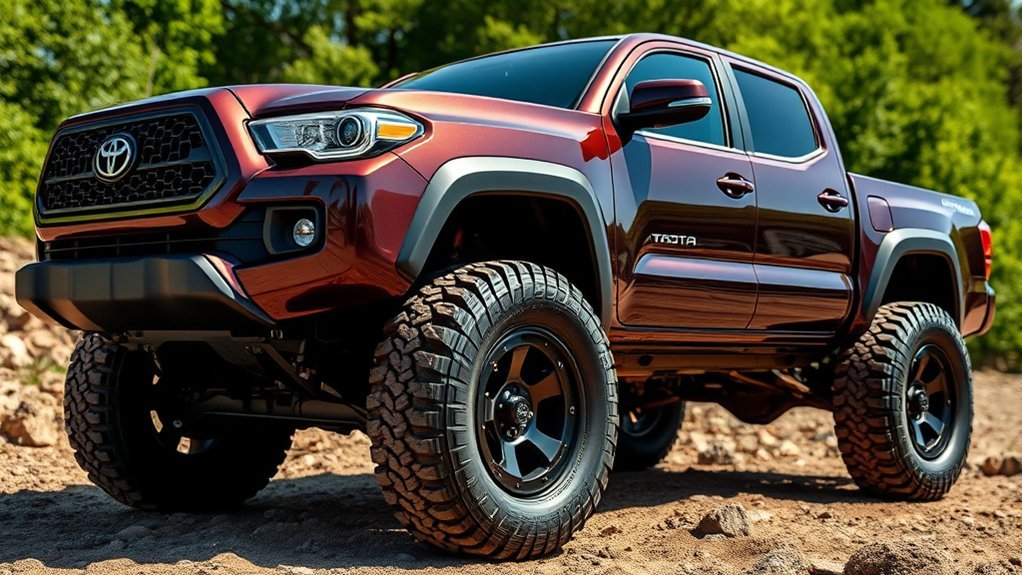
Fitting 33-inch tires on a stock Toyota Tacoma is possible in some setups, but it is not a simple yes-or-no upgrade. The answer depends on your Tacoma’s generation, trim, wheel offset, tire width, suspension height, alignment, and how much trimming you are willing to do.
Quick Answer
Yes, 33-inch-class tires can fit many Toyota Tacoma models, but most stock 2016–2023 trucks need trimming, careful wheel offset, or a small lift to avoid rubbing. Some 2024+ Tacoma trims, especially Trailhunter, are designed around factory 33-inch tires, so fitment is much easier.
Key Takeaways
- A common Tacoma “33” is 285/70R17, which usually measures about 32.7–32.8 inches depending on the tire model.
- On 2016–2023 Tacomas, 33s often rub the mud flaps, fender liners, cab mount, bumper edge, or upper control arm.
- On 2024+ Tacomas, Toyota’s Trailhunter comes with 33-inch tires from the factory, but lower trims still need fitment checks.
- Wheel offset matters as much as lift height. The wrong offset can fix one rub point while creating another.
- Re-gearing is not mandatory for every 33-inch setup, but it may help if you tow, run heavy LT tires, drive mountains, or dislike sluggish acceleration.
At a Glance
| Time Required | 30 minutes for measuring; 1–4 hours for minor trimming; longer if installing a lift, new wheels, or alignment parts. |
| Difficulty | Moderate. Test fitting, trimming, and alignment are usually more important than simply bolting on larger tires. |
| Tools Needed | Tape measure, jack and stands, torque wrench, trim tools, heat gun, cutting tool, marker, and access to a professional alignment rack. |
| Cost | From no-cost trimming to several thousand dollars for tires, wheels, lift parts, alignment, and possible re-gearing. |
Understanding Stock Tacoma Tire Sizes
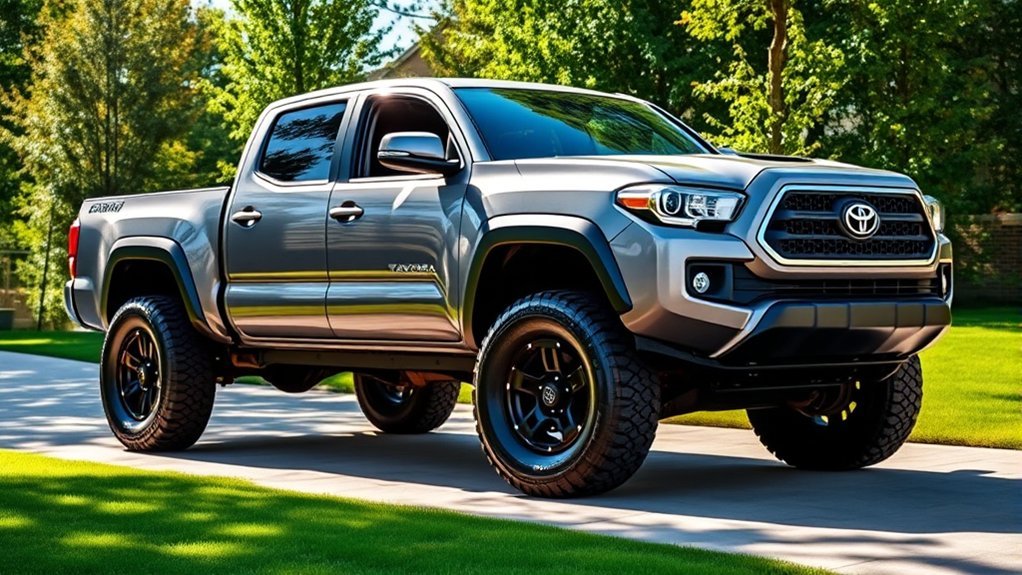
Before you choose a 33-inch tire, compare it with your Tacoma’s factory size. A 33-inch tire is usually 1–2.5 inches taller than many stock Tacoma tires, which means the tire moves closer to the fender liner, mud flap, cab mount, bumper edge, and upper control arm.
| Tacoma generation | Common stock tire sizes | Approx. diameter | What it means for 33s |
| 2016–2023 Tacoma | 245/75R16, 265/70R16, 265/65R17, 265/60R18 | About 30.5–30.6 in. | 33s are a noticeable jump and usually need clearance work. |
| 2024+ Tacoma | 245/70R17, 265/70R17, 265/65R18, 265/70R18 | About 30.5–32.6 in. | Some trims are already close to 33-inch territory. Trailhunter is factory-equipped with 33-inch tires. |
For current-generation Tacoma information, Toyota lists Trailhunter with 33-inch tires on 18-inch wheels. Toyota’s 2026 owner information also lists factory tire sizes such as 245/70R17, 265/70R17, and 265/65R18 for other Tacoma configurations.
What Counts as a 33-Inch Tire on a Tacoma?
Most Tacoma owners use “33s” to mean a 33-inch-class tire, not always a tire that measures exactly 33.0 inches. Actual diameter varies by brand, tread, load range, and inflation pressure.
| Tire size | Approx. diameter | Fitment note |
| 285/70R17 | About 32.7–32.8 in. | Most common Tacoma 33-inch-class upgrade. |
| 285/75R16 | About 32.8 in. | Similar height to 285/70R17, often used on 16-inch wheels. |
| 255/80R17 | About 33.1 in. | Tall and narrow; can clear better than wide 285s in some setups. |
| 265/70R18 | About 32.6 in. | Factory-style size on some 2024+ off-road trims. |
For example, Tire Rack lists the BFGoodrich All-Terrain T/A KO3 LT285/70R17 at 32.8 inches in overall diameter, so it is commonly treated as a 33-inch-class Tacoma tire.
Benefits of Upgrading to 33-Inch Tires
Upgrading to 33-inch tires can improve your Tacoma’s stance, ground clearance, and off-road traction. Taller tires lift the axle and differential slightly higher off the ground, which can help on ruts, rocks, snow, and uneven trails.
The biggest benefits are:
- More ground clearance: A taller tire raises the lowest axle-related points of the truck.
- Better obstacle rollover: A larger tire rolls over rocks and ledges more easily than a smaller tire.
- More aggressive appearance: 33s fill the wheel wells and give the Tacoma a more trail-ready stance.
- More tire options: Popular sizes like 285/70R17 have many all-terrain and mud-terrain choices.
Note: Bigger tires can also reduce fuel economy, add road noise, slow acceleration, and increase braking distance. The heavier the tire, the more noticeable these trade-offs become.
Essential Factors to Ensure Successful Fitment of 33s
Successful 33-inch tire fitment is about the full wheel-and-tire package, not just tire height. A narrow 33 on the right wheel may fit better than a wide 33 on the wrong offset.
- Generation: 2016–2023 Tacomas usually need more help than 2024+ trucks.
- Tire width: A 285-wide tire is more likely to rub than a narrower 255-wide tire of similar height.
- Wheel offset: Lower offset pushes the tire outward, which may clear the upper control arm but rub the fender or cab mount.
- Lift height: A lift improves vertical clearance but does not automatically fix front-to-back rubbing at full steering lock.
- Alignment: More positive caster can help move the tire away from the rear of the fender opening on many Tacoma setups.
- Load rating: Replacement tires should meet or exceed the load capacity required for your Tacoma.
Warning: Do not drive with tires that rub brake lines, ABS wiring, suspension parts, or sharp metal. Check clearance at full steering lock, during suspension compression, and in reverse before daily driving or trail use.
Necessary Modifications for Fitting 33-Inch Tires
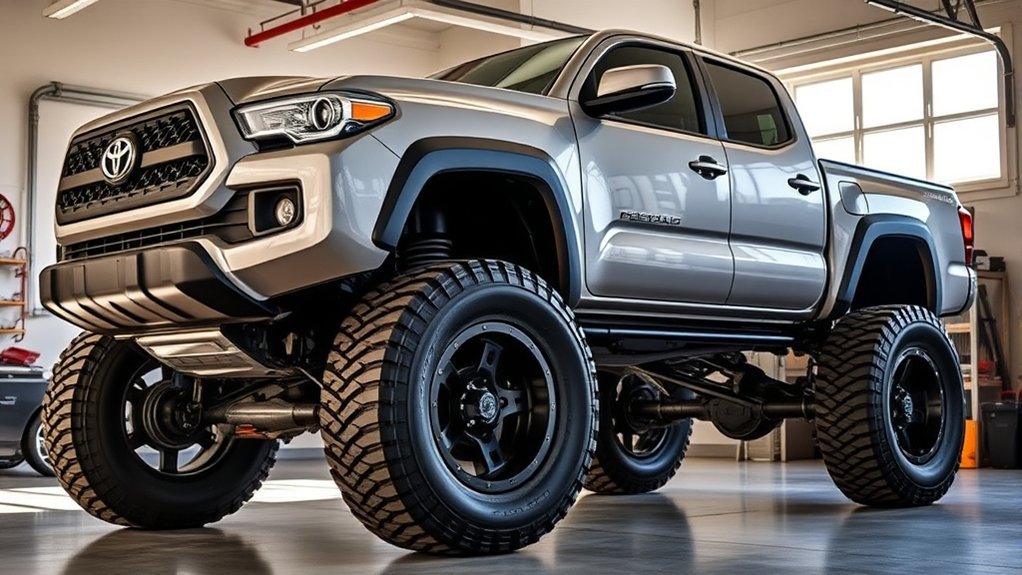
Some Tacoma owners fit 33-inch-class tires with only minor trimming, while others need a lift, aftermarket wheels, upper control arms, or cab mount work. Start with the least invasive changes and test after each step.
[Products Worth Considering]

Keep your tires properly inflated with this analog VONDIOR tire pressure gauge, designed for fast, easy readings without batteries. The swiveling, two-axis hose and large glow dial help you measure at any tire angle with instant visibility. Built with a protective rubber shield, it supports durable, low-maintenance use for cars and trucks.

These aluminum alloy tire valve stem caps with an O-ring seal help protect valve stems from corrosion while adding a clean, stylish look to your vehicle. The universal fit works across cars, trucks, motorcycles, bicycles, and more, making them an easy upgrade for everyday driving and off-road use. Installation is quick, and the included four-pack keeps all your tires dressed and protected.

The Ziopetru adjustable magnetic wheel alignment tool helps you check and restore camber and caster positioning after removing and reinstalling undercarriage components. With a clear leveling/bubble measurement system and an easy zeroing adjustment knob, it supports precise horizontal angle checking. The strong magnetic base mounts to metal surfaces for convenient use at home on cars, motorcycles, trucks, vans, and SUVs.
Necessary Modifications Overview
Common modifications include:
- Removing or trimming front mud flaps if the tire rubs while turning.
- Trimming or reshaping fender liners with a heat gun and push-back method.
- Trimming plastic bumper edges if the tire contacts the front of the wheel opening.
- Adjusting alignment to improve caster and move the tire forward slightly.
- Adding a leveling kit or lift for more vertical clearance.
- Changing wheels if the stock offset creates upper control arm contact.
- Cab mount chop or relocation only when simpler fixes do not solve rear wheel-well rubbing.
Wheel Spacers and Offset
Wheel spacers can help if the tire is too close to the upper control arm, but they are not a universal fix. Pushing the tire outward can increase rubbing at the fender liner, bumper, and cab mount. That is why many Tacoma owners choose wheels with a tested offset instead of adding large spacers to stock wheels.
For many 2016–2023 Tacoma 33-inch setups, wheels around 17×8 to 17×9 with modest positive, zero, or slight negative offset are common. Exact fitment still depends on tire width, alignment, lift height, and the specific tire’s true dimensions.
Pro Tip: Before buying spacers, test-fit one front tire and turn lock-to-lock. Mark every rub point with painter’s tape. This shows whether your problem is UCA clearance, bumper clearance, fender liner clearance, or cab mount clearance.
Trimming Techniques Required
Trimming should be careful and minimal. Start with plastic parts before cutting metal. The usual order is mud flap removal, fender liner push-back, bumper-edge trimming, then more serious cab mount work only if needed.
A heat gun can reshape plastic liners, while a rotary tool or sharp trim tool can cleanly remove excess plastic. After trimming, secure the liner so it cannot sag back into the tire. If metal cutting is required, cover bare metal with primer or paint to prevent rust.
Alignment and Caster
Alignment is one of the most overlooked parts of fitting 33s. On many Tacoma setups, adding positive caster helps pull the tire away from the rear of the wheel opening. Aftermarket upper control arms can make this easier on lifted trucks, but they are not always required for a mild setup.
After any lift, wheel change, or major tire-size change, get a professional alignment and ask the shop to check clearance at full lock in both directions.
Lifting Your Tacoma for 33-Inch Tires: Is It Necessary?
A lift is not always required, but it often makes 33-inch tire fitment easier. On 2016–2023 Tacomas, a 2–3 inch lift or level is common for 285/70R17 tires, especially if the truck is used off-road. Even with a lift, some trimming may still be needed because rubbing often happens at the front and rear of the wheel opening, not just at the top.
Toyota’s official Tacoma TRD Lift Kit is listed as a 2-inch front lift and 1-inch rear lift for eligible MY18+ Tacoma V6 4×4 models, with Toyota Safety Sense compatibility validation. It does not fit every Tacoma configuration, so verify compatibility before buying.
For 2024+ Tacomas, the answer depends heavily on trim. Toyota’s Trailhunter already comes with 33-inch tires, while lower trims may still need tire-size, wheel, and rubbing checks before copying that look.
[Products Worth Considering]

This tire inflator with pressure gauge delivers long-lasting performance with a durable rubber-protected gauge and sturdy build. The longer hose and 360 swivel air chuck help you seal the valve securely and keep your hands free while measuring, inflating, or deflating. It’s battery-free for reliable use and provides ±2 PSI accuracy in the mid-range for most typical tires, with universal compatibility for 1/4 NPT compressor outputs.

The Trivd Frol 1/2" air impact wrench delivers high performance torque up to 1500 ft-lbs with a twin hammer impact mechanism for strong, balanced blows. It features an ergonomic grip, compact lightweight design, and quick-stop control with 3 forward speeds up to 8000 RPM plus a reverse speed. Built for demanding automotive repair and tire shop work, the rear exhaust helps keep debris away from the surface.

Upgrade your 2024-2026 Tesla Model 3 Highland with REEVAA all-weather mud flaps designed for seamless fit along the original body lines. The set of four delivers strong splash protection against mud, gravel, and road debris while using OEM-grade durable materials. Installation is non-destructive with original hole positions and snap-in clips, and the aerodynamic design helps minimize impact on efficiency.
Troubleshooting Common Rubbing Issues With 33s
If your 33s rub, find the exact contact point before buying more parts. The location of the rub tells you what to fix.
| Rub location | Likely cause | Common fix |
| Upper control arm | Wheel offset too high or tire too wide | Different wheel offset, narrower tire, or small spacer installed correctly |
| Mud flap or rear liner | Tire sits too far rearward at steering lock | Mud flap removal, liner push-back, alignment caster adjustment |
| Front bumper edge | Tire pushed outward or too tall/wide | Minor bumper trimming or wheel/offset change |
| Cab mount / body mount | Wide tire and aggressive offset | More caster, narrower tire, less aggressive offset, or professional cab mount modification |
Always test in both forward and reverse. Some Tacoma setups clear while driving forward but rub in reverse because the tire loads differently.
[Products Worth Considering]

This spare tire tool kit is designed for the 2004 to 2018 Ford F-150 to help you loosen and tighten wheel lug nuts and manage the spare tire and provided jack functions from underneath the vehicle. It includes the lug nut wrench and extension pieces plus a convenient storage carrying case for organized transport. The jack itself is not included.

Replace worn or missing TPMS sensors with a pre-programmed 4-pack designed for compatible GM vehicles. These 315MHz sensors provide real-time tire pressure monitoring and alert you if pressure is too high, too low, or if a rapid air leak occurs. Most installations are ready with minimal relearn effort after mounting, helping improve safety and driving confidence.

Replace or upgrade your zero-turn lawn mower tires with a universal fit flat-free tire and wheel assembly in a convenient 2-pack. Smooth tread front-caster style helps turning with reduced turf damage, while flat-free design eliminates the maintenance and downtime of air-filled flats. The included adapter kit supports 5/8-inch axles and hub lengths from 3.4 to 5 inches for compatibility across most ZTR mowers.
Re-Gearing: Is It Necessary With 33s?
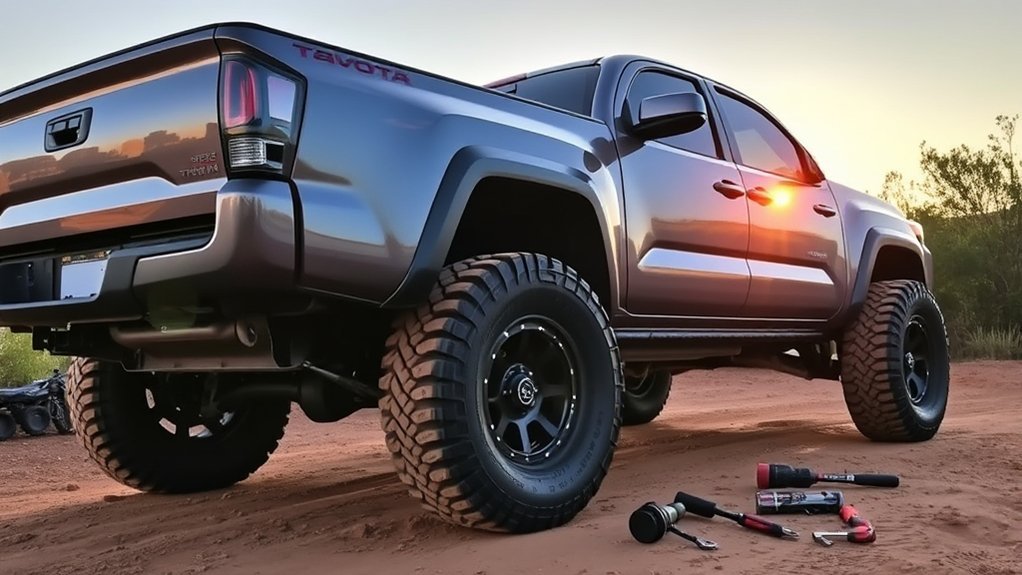
Re-gearing is not mandatory for every Tacoma running 33-inch tires, but it can improve drivability in certain setups. Larger and heavier tires effectively make the gearing taller, which can reduce throttle response and make the transmission hunt for gears more often.
Performance Impact
You may notice more performance loss if you drive a 2016–2023 automatic Tacoma, tow often, live at high elevation, carry armor or camping gear, or choose heavy LT-load-range tires. A lighter P-metric 33-inch-class all-terrain may feel much easier to live with than a heavy E-load mud-terrain.
If the truck still drives well, re-gearing can wait. If it feels sluggish, constantly downshifts, or struggles with towing, speak with a Toyota-focused drivetrain shop about ratio options.
Gear Ratio Recommendations
Many Tacoma owners consider 4.88 gears when moving into 33-inch or 34-inch-class tires, while 5.29 gears are more common for heavier builds or larger tires. The right answer depends on transmission, tire weight, terrain, towing needs, and how the truck is used.
Because re-gearing is expensive and changes both differentials on a 4WD Tacoma, treat it as a drivability upgrade rather than a required first step for 33s.
Spare, Speedometer, Load Rating, and Tire Pressure Checks
Do not stop the project after the four main tires fit. A safe 33-inch Tacoma setup also needs these checks:
- Spare tire fit: Confirm the spare fits under the bed or carry a matching spare another way. A smaller spare can be a problem on 4WD systems if used for long distances.
- Speedometer error: Taller tires travel farther per rotation, so your speedometer may read lower than your actual road speed.
- Load index: Make sure the new tires meet or exceed the load capacity required for your Tacoma.
- Tire pressure: Do not simply inflate to the tire’s maximum sidewall pressure. Use the door placard as a starting point and have a tire professional calculate pressure for the new tire size and load range.
- Torque checks: Re-torque wheels after installation and after the first short drive, especially if spacers or new wheels are installed.
NHTSA’s TireWise tire safety guidance explains that tire inflation affects load-carrying capacity and overall vehicle performance. NHTSA also notes that the vehicle tire placard provides critical information such as recommended inflation pressure and tire size designation.
Community Insights and Real-Life Experiences
Real-world Tacoma fitment varies because not all “33s” are the same. Two tires with the same printed size can have different tread width, shoulder shape, weight, and true diameter. Suspension condition also matters; older springs, extra front-end weight, and worn bushings can make rubbing worse.
The most common pattern is simple: narrower 33s fit easier, wider 33s look tougher but rub sooner. Stock wheels may keep the tire tucked in but can create upper control arm clearance problems. Lower-offset wheels can clear the control arm but often increase bumper and cab mount rubbing.
If you want the lowest-hassle setup, choose a conservative tire width, avoid extreme negative offset, plan for an alignment, and be realistic about minor trimming.
Frequently Asked Questions
Is a 285 a 33-inch tire size?
Usually, yes. A 285/70R17 tire is commonly called a 33-inch tire, but most measure about 32.7–32.8 inches depending on the tire model. A 285/75R16 is also about 32.8 inches.
Can I fit 33s on a stock 2016–2023 Tacoma?
Sometimes, but expect some trimming or fitment work. A stock 2016–2023 Tacoma with 285/70R17 tires commonly rubs at the mud flaps, fender liners, bumper edge, cab mount, or upper control arm depending on wheel offset and alignment.
Can I fit 33s on a stock 2024 or newer Tacoma?
It depends on the trim. Toyota’s Trailhunter is built with factory 33-inch tires, but other trims may use smaller stock tires and still need wheel, offset, and rubbing checks before moving to 33s.
Do I need a lift for 33-inch tires on a Tacoma?
Not always, but a lift or level often helps. A lift improves vertical clearance, but it may not solve rubbing at the front bumper, rear fender liner, or cab mount. Wheel offset and alignment still matter.
Will 33-inch tires hurt Tacoma gas mileage?
They can. Larger tires are usually heavier and create more rolling resistance. Aggressive all-terrain and mud-terrain tread patterns can also add road noise and reduce fuel economy compared with stock tires.
Do I need to re-gear my Tacoma for 33s?
Usually not right away. Re-gearing is helpful if the truck feels sluggish, hunts for gears, tows often, runs heavy LT tires, or carries extra weight. For many mild 33-inch daily-driver setups, owners install the tires first and re-gear later only if needed.
Conclusion
You can fit 33-inch tires on a Toyota Tacoma, but the cleanest setup depends on your truck. For 2016–2023 Tacomas, plan for careful wheel selection, alignment, and at least minor trimming. For 2024+ Tacomas, factory 33-inch fitment on Trailhunter shows the platform has more room, but non-Trailhunter trims still need the same basic clearance checks.
The best approach is to choose the tire size first, test fit before committing to major cutting, keep wheel offset conservative, and verify load rating, pressure, speedometer accuracy, and spare-tire fit. Done carefully, 33s can give your Tacoma a stronger stance and more trail capability without turning the upgrade into a frustrating rubbing problem.
Sources
- Toyota Trailhunter — confirms factory 33-inch tire positioning on Trailhunter models.
- Toyota Tacoma TRD Lift Kit PT84K-35221 — confirms 2-inch front / 1-inch rear lift and compatibility notes.
- Toyota 2026 Tacoma maintenance data — supports current-generation factory tire-size references.
- Toyota 2023 Tacoma eBrochure — supports previous-generation Tacoma factory tire-size references.
- Tire Rack BFGoodrich All-Terrain T/A KO3 specifications — supports 285/70R17 33-inch-class tire dimensions.
- NHTSA TireWise — supports tire pressure, load capacity, and tire safety guidance.