Cold weather can make your Toyota Tundra’s tire pressure drop even when there is no leak. As outside temperature falls, the air inside the tire contracts, the PSI reading goes down, and the Tire Pressure Monitoring System (TPMS) may warn you that one or more tires are low. The fix is simple: check the pressure when the tires are cold, inflate to the PSI on your Tundra’s driver-side tire placard, and recheck after big temperature swings.
Quick Answer
Tundra tire pressure drops in cold weather because cooler air contracts. A useful rule of thumb is about 1 PSI for every 10°F temperature drop. Check all tires when cold, use the PSI on the driver-side door placard, and do not use the maximum PSI printed on the tire sidewall as your target.
Key Takeaways
- Cold weather can lower tire pressure by about 1 PSI for every 10°F drop in temperature.
- The correct Tundra tire pressure is on the driver-side Tire and Loading Information label or in the owner’s manual, not on the tire sidewall.
- Check pressure when the tires are cold, ideally after the truck has been parked for at least three hours.
- A TPMS light that keeps returning after inflation may mean a leak, damaged tire, bad valve stem, or sensor issue.
- Nitrogen-filled tires still need regular pressure checks, and regular air can be added when nitrogen is not available.
At a Glance
| Time Required | 5–10 minutes for all four tires; a few extra minutes if you check the spare |
| Difficulty | Easy |
| Tools Needed | Accurate tire pressure gauge, air compressor or portable inflator, valve caps |
| Cost | Usually free to check; about $5–$20 for a basic gauge if you do not already have one |
How Cold Weather Affects Tire Pressure
Cold air makes tire pressure fall because the air inside the tire contracts as temperature drops. A common rule of thumb is that tire pressure changes by about 1 PSI for every 10°F change in ambient temperature. So if your Tundra’s tires were set on a 70°F afternoon and the next morning is 30°F, the pressure may read several PSI lower before you even drive.
This pressure loss is not always a leak. It is often normal physics. However, it still matters because your truck’s handling, braking, tire wear, fuel use, and TPMS warnings are based on the actual pressure in the tires, not the pressure they had last week.
Note: The PSI reading usually rises after you drive because the tires warm up. That does not mean the cold pressure was correct. Always use a cold reading when possible.
Effects of Low Tire Pressure in Cold Weather
Low tire pressure can create bigger problems in winter because cold roads already reduce available grip. When a Tundra tire is underinflated, the tire flexes more, builds more heat, and can wear unevenly. It can also make the truck feel slower to respond during braking, steering, and emergency maneuvers.
Reduced Traction and Stability
Proper pressure helps the tread sit on the road the way the tire and vehicle manufacturer intended. When pressure falls too far below the placard PSI, the tire can distort instead of keeping a stable contact pattern. That can reduce steering response and make the truck feel less planted on wet, snowy, or icy roads.
Tread condition matters too. The National Highway Traffic Safety Administration notes that tread provides the gripping action that helps keep a vehicle from slipping and sliding, especially when roads are icy or wet. Pressure checks and tread checks work together; do both during winter.
Increased Tire Wear
Underinflated tires tend to flex more and can wear unevenly, especially along the shoulders. That extra flexing also creates heat, which can damage a tire over time. Keeping your Tundra’s tires at the correct cold PSI helps the tread wear more evenly and can extend tire life.
Low pressure can also hurt fuel economy. FuelEconomy.gov reports that underinflated tires can lower gas mileage by about 0.2% for every 1 PSI drop in the average pressure of all tires. That may sound small, but it adds up during a full winter of cold starts, towing, commuting, and highway miles.
Compromised Braking Performance
Underinflation can make the tire less responsive during braking and steering. The risk grows as pressure falls farther below the recommended level, especially on slick roads where every bit of tire control matters. If the TPMS light comes on, slow down, avoid aggressive maneuvers, and check the tires as soon as it is safe.
Warning: Do not ignore a visibly low tire, a tire with sidewall damage, a bulge, exposed cords, or a TPMS alert that returns soon after inflation. Have the tire, valve stem, wheel, and sensor checked before relying on the truck for highway driving, towing, or heavy loads.
How to Accurately Check Tire Pressure in Winter
The most accurate winter tire pressure check is a cold-tire check. According to NHTSA tire-safety guidance, the vehicle manufacturer’s recommended PSI is the proper pressure when the tire is cold, meaning it has not been driven on for at least three hours.
- Park long enough for the tires to cool. Morning is usually best, before driving.
- Find your Tundra’s recommended PSI. Look at the Tire and Loading Information label on the driver-side door edge or door jamb, or check the Toyota Tundra owner’s manual tire inflation section.
- Use a reliable gauge. Press it squarely onto the valve stem so air does not hiss out during the reading.
- Check every tire. If your truck has a full-size spare, check it too, even if it is not monitored by TPMS.
- Add air if the tire is low. Inflate to the placard PSI, then recheck with the gauge.
- Release air slowly if the tire is high. Press the center of the valve stem briefly, then recheck.
- Reinstall the valve caps. Caps help keep dirt, moisture, and road salt out of the valve stem.
Pro Tip: Keep a digital or dial tire gauge in your Tundra during winter. Gas-station gauges can be abused, dropped, or hard to read in freezing weather.
Why Tire Pressure Checks Matter for Tundra Owners
A Toyota Tundra is often used for commuting, hauling, towing, off-road driving, and winter travel. Those jobs put more importance on proper tire pressure because the tires must support the truck, passengers, cargo, and any trailer tongue weight while still maintaining traction and control.
Impact on Safety
Correct cold PSI helps your Tundra brake, steer, and carry load as designed. The right pressure also helps the tread maintain a consistent footprint on the road. That is especially important in freezing rain, packed snow, and icy parking lots where a small loss of control can become a big problem.
TPMS is helpful, but it is not a replacement for checking with a gauge. NHTSA explains that TPMS warns when a tire is significantly underinflated, but drivers should still inspect tires and check pressure regularly.
Tire Longevity Benefits
Correct pressure helps reduce irregular wear and heat buildup. That can help your tires last longer, maintain better road feel, and avoid premature replacement. Pressure checks are also a good time to look for nails, cuts, cracking, uneven wear, or missing valve caps.
If you rotate your Tundra’s tires, use the schedule and pattern recommended for your truck and tire setup. If you have changed tire sizes, switched from P-metric to LT tires, installed aftermarket wheels, or regularly tow near the truck’s limits, ask a qualified tire professional to confirm the correct pressure for your exact load and tire rating.
How to Keep Your Tires Pumped in the Cold
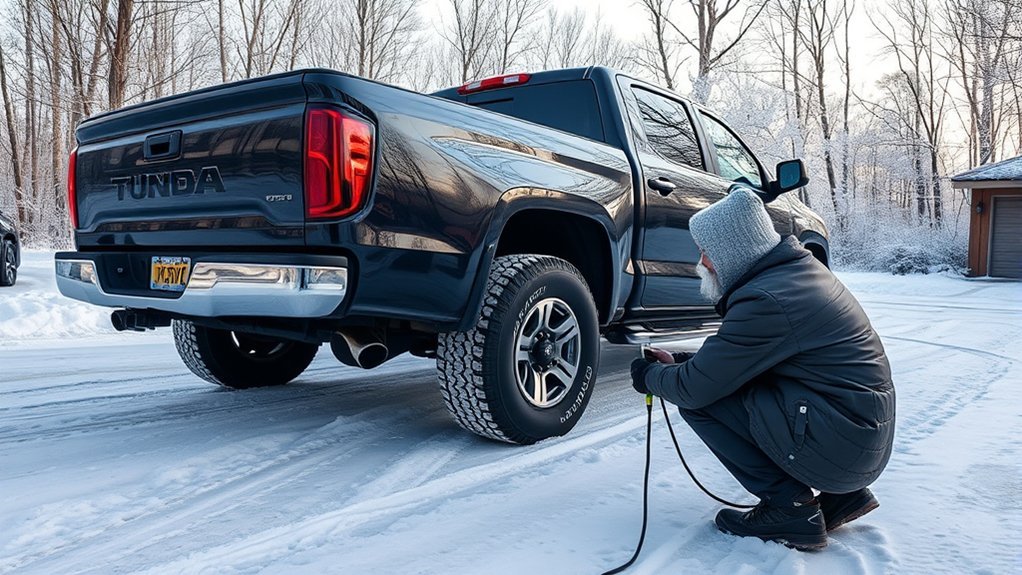
Winter tire pressure management is mostly about consistency. Check early, check cold, and adjust before the tires get far below the recommended PSI.
- Check at least once a month. During winter, every two to four weeks is even better, especially after a cold snap.
- Recheck after big temperature changes. A 30°F drop can mean roughly 3 PSI lower pressure.
- Inflate to the placard PSI. Use the driver-side label or owner’s manual for your exact Tundra, tire size, and original equipment setup.
- Do not chase warm readings. If you check after driving, the PSI may read higher. Recheck when cold as soon as practical.
- Do not use the sidewall max as your target. The sidewall number is a maximum tire rating, not the truck’s recommended cold inflation pressure.
A Tundra tire that was perfect in mild fall weather can be several PSI low after the first hard freeze. Check before the TPMS light has to remind you.
[Products Worth Considering]

The Tymate TM2 RV tire pressure monitoring system keeps you informed with a color LCD display, automatic backlight, and solar charging for dependable operation. It supports up to 10 tire positions with four pre-paired sensors, while offering multiple alarm modes for fast leak detection, pressure extremes, temperature alerts, and low-signal warnings. Built-in monitoring uses accurate readings and reliable 433.92MHz communication to help protect your RV, trailer, truck, or SUV.
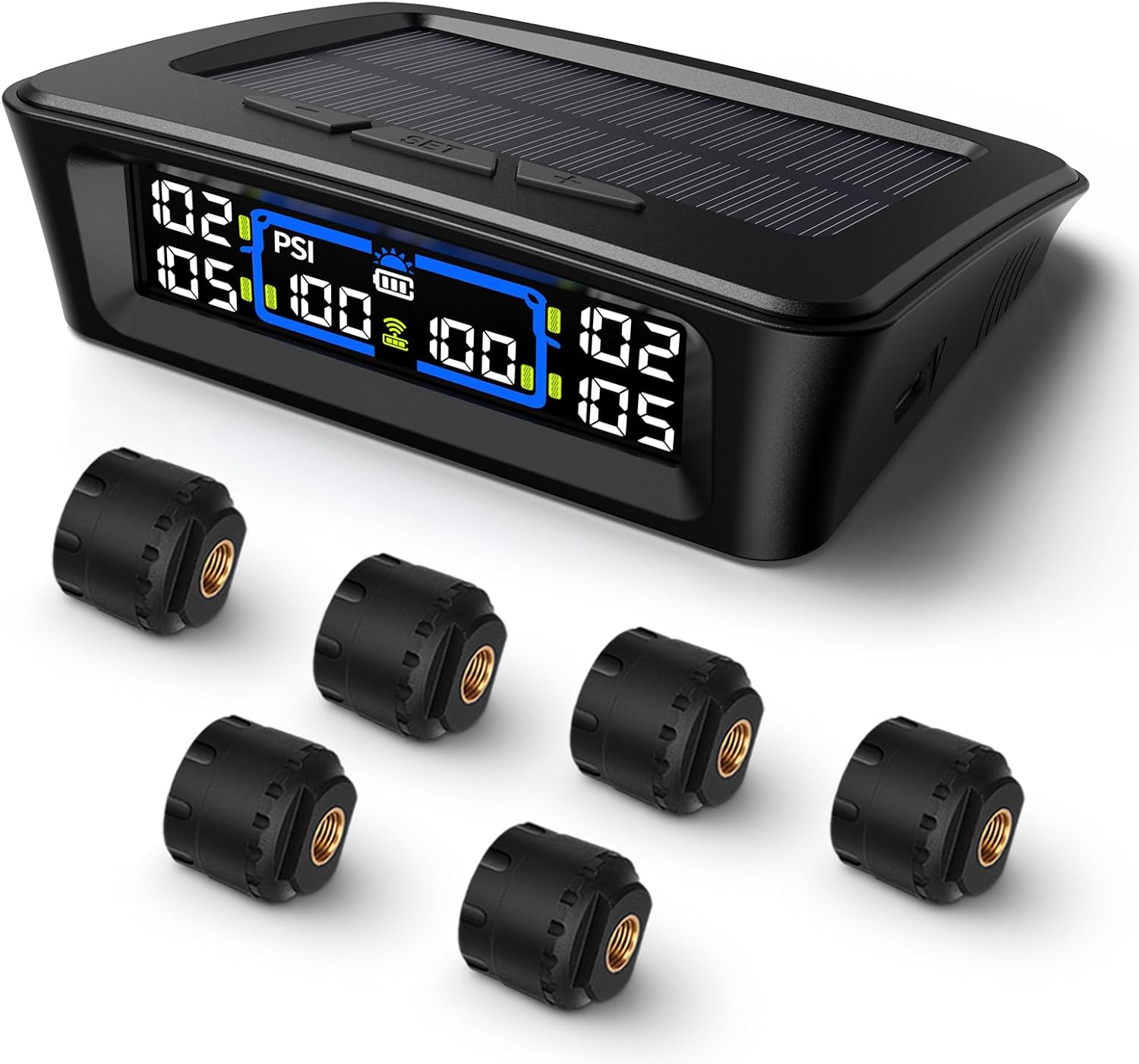
The Tymate TM12 RV TPMS delivers real-time tire pressure and temperature monitoring with a stable 433Hz display for safer long-distance driving. It supports simultaneous monitoring across vehicle and trailer zones, includes six alarm modes for pressure, temperature, leakage, battery, and signal loss, and features easy DIY installation with auto calibration. Power is supplied via USB-C charging or solar recharging, with a wide 0–144 PSI range and up to 50 ft signal coverage for RVs and towable trailers.

Milton S-921 pencil tire pressure gauge helps you maintain optimal tire pressure for passenger cars with accurate readings in PSI and kPa. It features a built-in deflator valve for convenient pressure adjustments, plus a single chuck head and nylon indicator bar for easy use on the go. Built from durable plated brass and designed for reliable performance, it’s a practical road trip and cold-weather maintenance tool.
Debunking Common Myths About Tire Pressure Management
Tire pressure sounds simple, but winter creates a few common mistakes. Clearing these up can prevent uneven wear, repeat TPMS warnings, and unsafe underinflation.
Myth: Set It Once and Forget It
Tire pressure changes with temperature and time. Even a healthy tire can lose pressure gradually, and a cold snap can drop the reading overnight. Check regularly instead of assuming last month’s setting is still correct.
Myth: The Sidewall PSI Is the Right PSI
The PSI molded into the tire sidewall is not your normal target. Use your Tundra’s Tire and Loading Information label or Toyota owner’s manual for the recommended cold PSI.
Myth: TPMS Replaces a Gauge
TPMS is a warning system, not a precision maintenance tool. A tire can be low before you notice it by sight, and TPMS may not alert until pressure is significantly low. Use a gauge for routine checks.
Myth: Extra Pressure Always Improves Winter Traction
Overinflating a tire can reduce ride comfort, change tread contact, and increase uneven center wear. Inflate to the recommended cold PSI unless your owner’s manual, tire manufacturer, or qualified tire professional gives a specific load-based adjustment.
TPMS Light in Cold Weather: What to Do
A cold-weather TPMS light is common, but it still deserves attention. Use the light pattern to decide your next step.
- Solid TPMS light: One or more tires may be significantly underinflated. Check all tires with a gauge and inflate to the placard PSI.
- Light turns off after driving: The tires warmed up and pressure rose, but the cold pressure may still be low. Recheck when the tires are cold.
- Light returns after inflation: Look for a puncture, slow leak, bad valve stem, wheel leak, or pressure loss from another tire.
- Flashing light, then solid: This can indicate a TPMS malfunction. Have the system inspected.
Warning: If the TPMS light comes on while towing, carrying heavy cargo, or driving on snow and ice, avoid sudden steering and hard braking. Pull over safely, inspect the tires, and correct the pressure before continuing.
[Products Worth Considering]

Keep your tires properly inflated with this analog VONDIOR tire pressure gauge, designed for fast, easy readings without batteries. The swiveling, two-axis hose and large glow dial help you measure at any tire angle with instant visibility. Built with a protective rubber shield, it supports durable, low-maintenance use for cars and trucks.

These universal tire valve stem caps help protect valve cores from dust, debris, and moisture while helping maintain stable tire pressure. The corrosion-resistant metal construction and sealed design provide reliable protection in road grime, mud, and winter conditions. Twist-on installation makes them quick to fit on cars, SUVs, trucks, and motorcycles.

ETENWOLF’s calibrated tire pressure gauge delivers accurate readings for cars, trucks, motorcycles, bikes, SUVs, RVs, and ATVs across a 0–75 PSI range. The large glow dial improves visibility in low light, while the 360° swivel chuck makes it easy to check valve pressure from any angle. It’s designed to stay accurate even in extreme hot or cold weather.
Nitrogen vs. Air: Which Is Better for Your Tires?
Nitrogen can reduce normal pressure loss slightly because it is dry and contains less oxygen than regular compressed air. That can be useful in some commercial, racing, or high-demand settings. For most Tundra owners, though, the most important factor is not whether the tire contains nitrogen or air; it is whether the tire is inflated to the correct cold PSI.
The U.S. Tire Manufacturers Association states that nitrogen is not a replacement for regular inflation-pressure maintenance. It also says nitrogen and air can be mixed, and air should be added to a nitrogen-filled tire whenever nitrogen is not readily available and pressure needs to be corrected.
- Choose air if you want convenience. It is widely available and usually free or inexpensive.
- Choose nitrogen if your tire shop includes it and you still plan to check pressure. It may slow pressure loss, but it does not eliminate checks.
- Do not drive low just to preserve nitrogen purity. Proper inflation is more important than keeping a nitrogen fill “pure.”
[Products Worth Considering]

This tire inflator with pressure gauge delivers long-lasting performance with a durable rubber-protected gauge and sturdy build. The longer hose and 360 swivel air chuck help you seal the valve securely and keep your hands free while measuring, inflating, or deflating. It’s battery-free for reliable use and provides ±2 PSI accuracy in the mid-range for most typical tires, with universal compatibility for 1/4 NPT compressor outputs.

The JACO FlowPro Tire Inflator measures, inflates, and airs down tires up to 100 PSI with battery-free operation and ±2% accuracy after calibration. It features a glowing pressure dial for night visibility, a heavy-duty steel build with a hybrid hose, and a precision push-to-inflate thumb trigger. The patented Lightning Air Chuck locks on for a secure seal, and the kit includes quick-connect hardware for easy inline use with your air compressor.

The SAFELIFE dial tire tread depth gauge measures tread depth in 1/32 inch increments with clear, easy-to-read 2-inch dial face. Color zones using a traffic light system help you quickly judge whether tread is low, marginal, or ample for safer driving. Built with a durable zinc cast body and a metal detect probe for precise, comfortable use across cars, motorcycles, trucks, and buses.
Frequently Asked Questions
What should I do when tire pressure drops in cold weather?
Check all tires with a gauge when they are cold, then inflate each tire to the PSI listed on your Tundra’s driver-side tire placard. If the same tire keeps dropping, have it inspected for a leak, puncture, valve-stem issue, or wheel-seal problem.
Should I add extra PSI to my Tundra tires in winter?
Inflate to the recommended cold PSI on the door placard unless your owner’s manual, tire manufacturer, or tire professional recommends a specific adjustment for your load, tire type, or towing setup. Do not inflate to the sidewall maximum as a winter shortcut.
Why does my TPMS light turn off after I drive?
Driving warms the tires, which temporarily raises pressure. If the light turns off after driving but returns the next cold morning, your cold pressure is probably near or below the warning threshold. Check and adjust the tires when they are cold.
Can I put regular air in nitrogen-filled Tundra tires?
Yes. If nitrogen is not available and a tire is low, add regular air to reach the proper cold PSI. Correct inflation is more important than maintaining a pure nitrogen fill.
What if the TPMS light flashes before staying on?
A flashing TPMS light followed by a solid warning can mean the TPMS system has a malfunction. Check your tire pressure first, then have the TPMS inspected if the flashing pattern continues.
Conclusion
Cold weather can lower your Tundra’s tire pressure quickly, but it is easy to manage with a good gauge and a regular routine. Check the tires when cold, inflate to the driver-side placard PSI, inspect for damage or uneven wear, and treat repeat TPMS alerts as a sign that something needs attention. Proper pressure helps your truck brake, steer, carry weight, and use fuel more efficiently through winter.
Sources
- National Highway Traffic Safety Administration: Tire Safety Ratings and Awareness — cold tire pressure, TPMS guidance, tread checks, and tire maintenance steps.
- FuelEconomy.gov: Keeping Your Vehicle in Shape — fuel-economy impact of underinflated tires.
- Toyota Owners: 2025 Tundra Tire Inflation Pressure — Toyota Tundra tire-pressure inspection and adjustment guidance.
- Bridgestone Americas: Tire Inflation — monthly pressure checks and temperature-related PSI changes.
- U.S. Tire Manufacturers Association: Using Nitrogen to Inflate Passenger and Light Truck Tires — nitrogen, air mixing, and continued pressure-maintenance guidance.