For safe highway driving in your Toyota Tundra, the best tire pressure is the cold PSI printed on your driver-side door placard, not a universal number from another truck. Some Tundras list 30 PSI front and 33 PSI rear, while other model years, trims, tire sizes, or replacement tires may require a different pressure. Use the placard first, then adjust only when your owner’s manual, tire load table, or tire professional supports it.
Quick Answer
The ideal Toyota Tundra tire pressure for highway driving is the recommended cold tire pressure on your driver-side door placard. Many Tundra owners see numbers such as 30 PSI front and 33 PSI rear, but your exact PSI can vary by year, trim, tire size, and load.
Key Takeaways
- Use the cold tire pressure on your Tundra’s door placard as the final authority.
- Check pressure when the tires are cold, ideally before driving or after the truck has been parked for at least three hours.
- Do not use the maximum PSI on the tire sidewall as your normal driving pressure unless a load calculation specifically supports it.
- For towing, heavy payloads, LT tires, or upsized tires, confirm pressure with the owner’s manual, axle weights, and the tire maker’s load/inflation table.
- Proper inflation can help tire life, handling, and fuel economy, but it does not replace regular tire inspections.
At a Glance
| Time Required | 5–10 minutes |
| Difficulty | Easy |
| Tools Needed | Accurate tire pressure gauge, air compressor, valve-cap storage spot |
| Cost | Free if you already own a gauge; usually low-cost if buying one |
What Is the Recommended Tire Pressure for Your Toyota Tundra?
The recommended tire pressure for your Toyota Tundra is the cold inflation pressure listed on the Tire and Loading Information label, usually on the driver-side door edge or door jamb. That label is based on the truck’s original tire size, load rating, and vehicle design. The National Highway Traffic Safety Administration also advises drivers to use the pressure listed by the vehicle manufacturer, not the number molded on the tire sidewall.
For some Tundra configurations, the placard may show a staggered pressure such as 30 PSI front and 33 PSI rear. Other Tundras, especially newer trucks or trucks with different factory tire packages, may show mid-30s PSI or another value. That is why a single online number should be treated as a starting clue, not the final answer.
Warning: Never use the tire sidewall’s maximum PSI as your everyday target unless the owner’s manual, load/inflation table, or a qualified tire professional confirms that pressure for your exact tire and load. The sidewall number is a limit, not the normal recommended pressure.
[Products Worth Considering]

The Ziopetru adjustable magnetic wheel alignment tool helps you check and restore camber and caster positioning after removing and reinstalling undercarriage components. With a clear leveling/bubble measurement system and an easy zeroing adjustment knob, it supports precise horizontal angle checking. The strong magnetic base mounts to metal surfaces for convenient use at home on cars, motorcycles, trucks, vans, and SUVs.

The Tymate TM12 RV TPMS delivers real-time tire pressure and temperature monitoring with a stable 433Hz display for safer long-distance driving. It supports simultaneous monitoring across vehicle and trailer zones, includes six alarm modes for pressure, temperature, leakage, battery, and signal loss, and features easy DIY installation with auto calibration. Power is supplied via USB-C charging or solar recharging, with a wide 0–144 PSI range and up to 50 ft signal coverage for RVs and towable trailers.
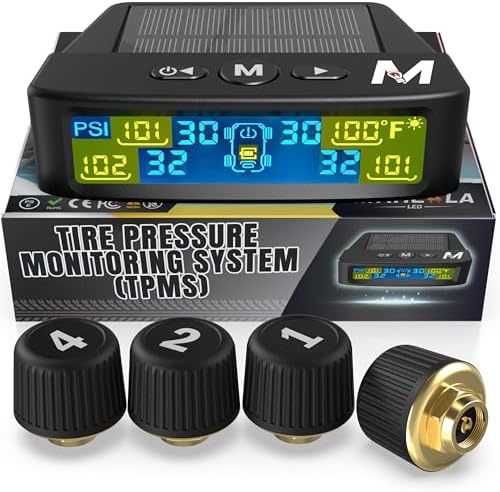
Marcala’s TPMS set of four sensors helps you monitor tire pressure and temperature in real time while driving, with updates every second. The bright color LCD uses auto-dimming for easy viewing, powered by dual solar and USB charging, and offers six alarm modes. Built for trailers, RVs, campers, trucks, and towing setups, the sensors support monitoring 1-4 wheels up to 98 PSI with IP67 waterproof protection.
How to Find the Exact PSI on Your Tundra
Use this quick process before adjusting your tires:
- Park the truck safely and let the tires cool for at least three hours if possible.
- Open the driver-side door and find the Tire and Loading Information label.
- Write down the front, rear, and spare tire PSI listed on the label.
- Confirm that your current tire size matches the size on the label.
- If your tires are a different size, load range, or type than the original tires, use a tire load/inflation table or ask a qualified tire shop to calculate the correct pressure.
Federal tire-label rules require vehicle placards to show the vehicle manufacturer’s recommended cold tire inflation pressure for the front, rear, and spare tires, along with the original tire size. That is why the placard is more reliable than a forum post or a generic tire-pressure chart.
How Load and Towing Conditions Affect Tire Pressure
Load and towing conditions matter because tires carry weight through air pressure. A lightly loaded Tundra on original tires may be fine at the door-placard pressure. A Tundra carrying heavy cargo, towing a trailer, or running replacement LT tires may need a different pressure to carry the load safely.
Do not automatically jump to a fixed towing number such as 40 PSI front and 48 PSI rear for every Tundra. Toyota lists a maximum towing capacity of up to 12,000 pounds for properly equipped 2026 Tundra models, but towing capacity is not the same thing as tire-pressure guidance. The right PSI depends on the truck’s axle loads, tire size, load index, load range, and the pressure limits printed on the tire.
For heavy towing or payload use, follow this safer order:
- Stay within the truck’s payload rating, GVWR, and GAWR shown on the labels.
- Account for trailer tongue weight, passengers, tools, cargo, and accessories.
- Use a public scale if you tow or haul near the truck’s limits.
- Check the tire maker’s load/inflation table for your exact tire size and load range.
- Never exceed the maximum cold inflation pressure molded on the tire sidewall.
Note: If your Tundra has LT tires, all-terrain tires, larger wheels, or a tire size that differs from the factory placard, the original placard PSI may not carry the same load. Use the tire manufacturer’s load/inflation table before changing pressure.
[Products Worth Considering]

Keep your tires properly inflated with this analog VONDIOR tire pressure gauge, designed for fast, easy readings without batteries. The swiveling, two-axis hose and large glow dial help you measure at any tire angle with instant visibility. Built with a protective rubber shield, it supports durable, low-maintenance use for cars and trucks.

These universal tire valve stem caps help protect valve cores from dust, debris, and moisture while helping maintain stable tire pressure. The corrosion-resistant metal construction and sealed design provide reliable protection in road grime, mud, and winter conditions. Twist-on installation makes them quick to fit on cars, SUVs, trucks, and motorcycles.

Measure tire tread depth quickly and accurately with this LUMITECO dial gauge that reads in 1/32" increments up to 14/32". The color-coded green/yellow/red zones make it easy to judge tire wear and know when replacement is needed. A rugged, compact design with a protective pouch helps keep the gauge ready for use on cars, trucks, motorcycles, and more.
Debunking Common Tire Pressure Myths for Tundra Owners
Good tire-pressure habits are simple, but several common myths can lead to poor handling, uneven wear, or unsafe heat buildup.
- Myth: The sidewall PSI is the best pressure. The sidewall number is a maximum limit. The normal target is the vehicle manufacturer’s recommended cold pressure.
- Myth: TPMS means you do not need a gauge. The tire pressure monitoring system warns when pressure is significantly low, but it does not replace regular manual checks.
- Myth: Warm tire pressure should be bled down to the placard number. Pressure rises as tires warm up during driving. If you bleed warm tires to a cold-pressure number, they may be underinflated when cold.
- Myth: Adding 2 PSI always improves handling. A small increase may help in some situations, but it can also reduce ride comfort or change tread contact. Start with the placard and adjust only for a known reason.
How Tire Pressure Adjustments Enhance Longevity
Correct tire pressure helps your Tundra’s tires keep a stable contact patch with the road. That can reduce uneven treadwear, improve steering feel, and help the tires run cooler on long highway drives. Incorrect pressure does the opposite: too little air can increase sidewall flex and heat, while too much air can concentrate wear near the center of the tread.
Key Factors Influencing Longevity
Pressure is only one part of tire life. Rotation, alignment, balancing, driving style, and load also matter. Use the table below to connect common tire-life problems with the most likely checks.
| Factor | Impact on Tire Life | What to Do |
|---|---|---|
| Correct cold PSI | Helps the tread wear evenly | Check monthly and before long highway trips |
| Load and towing weight | Can increase rear-axle tire load | Use axle weights and tire load tables for heavy towing |
| Wheel alignment | Can cause one-edge wear even when PSI is correct | Schedule an alignment if the truck pulls or one edge wears fast |
| Tire rotation | Helps even out front/rear wear differences | Follow Toyota’s maintenance schedule for your model year |
Recommended PSI Adjustments
For daily highway driving on factory-size tires, start with the door-placard pressure. If your placard says 30 PSI front and 33 PSI rear, use those cold numbers. If it says something different, use the numbers on your truck.
For heavy loads, towing, or aftermarket tires, avoid guessing. A qualified tire shop can compare your original tire’s load capacity at the placard pressure with your replacement tire’s load capacity at different pressures. Tire manufacturers such as Toyo Tires provide load and inflation table guidance for this type of calculation.
Monitoring Tire Wear Patterns
Check treadwear at least monthly. Look across the full tread width, not just the outside shoulder. Also check for nails, cuts, bulges, sidewall damage, and tread depth. Replace tires when the treadwear indicators are flush with the tread or when a tire professional says the tire is unsafe.
Pro Tip: Keep a small tire gauge in the glove box. Gas-station gauges can be inaccurate or damaged, so your own gauge gives you a more consistent reading.
How to Spot Tire Wear Patterns
Treadwear patterns can help you spot pressure, alignment, or suspension problems before they become expensive. Use this guide as a starting point:
| Wear Pattern | Possible Cause | Next Step |
|---|---|---|
| Both outer shoulders worn | Often underinflation or heavy cornering | Check cold PSI and inspect load habits |
| Center tread worn faster | Often overinflation | Return to placard PSI when cold |
| One edge worn faster | Alignment, camber, or toe issue | Schedule alignment and suspension inspection |
| Cupping or scalloping | Possible worn shocks, imbalance, or suspension wear | Have the tires, shocks, and suspension inspected |
The chalk test can give a rough idea of tread contact on flat pavement, but it should not replace a pressure gauge, alignment check, or load-table calculation.
Does Tire Pressure Affect Fuel Efficiency?
Yes. Proper tire pressure can improve fuel economy because underinflated tires increase rolling resistance. FuelEconomy.gov says keeping tires inflated to the proper pressure can improve gas mileage by about 0.6% on average and up to 3% in some cases. It also notes that underinflated tires can lower gas mileage by about 0.2% for every 1 PSI drop in the average pressure of all tires.
A few missing PSI may not feel dramatic from the driver’s seat, but it can increase rolling resistance, heat, and treadwear over thousands of highway miles.
Overinflating for fuel economy is not the solution. Too much pressure can reduce ride comfort, change traction, and create faster center treadwear. The better approach is simple: use the correct cold PSI, check it regularly, and keep the truck within its rated load limits.
How to Maintain Optimal Tire Pressure Year-Round

Tire pressure changes with temperature and use, so check it regularly instead of waiting for the TPMS light. The NHTSA tire safety guide recommends checking tire pressure when tires are cold and checking all tires, including the spare.
- Check tire pressure before driving, or after the truck has been parked for at least three hours.
- Remove the valve cap and press the gauge firmly onto the valve stem.
- Compare the reading with the door-placard PSI.
- Add air if the tire is low, or release air slowly if it is high.
- Recheck the pressure after each adjustment.
- Reinstall the valve cap.
- If your Tundra requires TPMS initialization after tire service or rotation, follow the owner’s manual procedure.
Check more often when the seasons change, before long highway trips, before towing, and after adding heavy cargo. If one tire repeatedly loses pressure, inspect it for a puncture, valve-stem leak, wheel damage, or bead leak.
[Products Worth Considering]

Monitor tire tread wear with a smart, color-coded depth gauge that shows clear condition ranges at a glance. The bar is range marked for fast, easy readings, helping you maintain safer traction and performance. Each gauge is portable with a pocket clip, and the set includes 20 units for daily use and sharing.

The TYAMATE TM8 solar-powered wireless TPMS delivers real-time tire pressure and temperature monitoring with six alarm modes for safer driving. A vibrant color LCD display shows readings clearly while windshield mounting keeps it hands-free and easy to read. With a wide 0–87 PSI range, strong 433.92 MHz signal transmission, and quick sensor pairing, it’s ideal for RV, sedan, SUV, MPV, and truck use.

ETENWOLF T300 is a calibrated digital tire pressure gauge for accurate readings from 3 to 200 PSI across light and heavy-duty vehicles. It includes thermal compensation for reliable performance in extreme cold or heat, with an auto shut-off to extend battery life and an LED for easier reading. The sturdy design supports rugged everyday use, making it ideal for pickups, RVs, and industrial applications.
Frequently Asked Questions
Is driving on the highway with 26 PSI bad?
It can be. If your Tundra’s placard calls for a higher cold pressure, 26 PSI is underinflated and can increase heat, sidewall flex, uneven wear, and fuel use. Pull over safely, check the tire with a gauge, and inflate it to the recommended cold pressure as soon as possible.
What is the ideal tire pressure for highway driving?
The ideal highway tire pressure is the cold PSI shown on your Tundra’s driver-side door placard. Do not use a generic 36–38 PSI target unless that matches your placard or a proper tire load calculation for your exact tires and load.
Should I increase Toyota Tundra tire pressure when towing?
Maybe, but do not guess. First check your placard and owner’s manual. For heavy towing, confirm axle weights and use the tire manufacturer’s load/inflation table for your exact tire size and load range. Never exceed the tire sidewall maximum pressure.
Is the tire sidewall PSI the same as the recommended PSI?
No. The sidewall PSI is the maximum cold inflation pressure for that tire. The recommended pressure for your Tundra is the vehicle manufacturer’s cold PSI on the door placard, unless a proper replacement-tire load calculation says otherwise.
How often should I check my Tundra tire pressure?
Check at least monthly, before long highway drives, before towing, and when outdoor temperatures change sharply. Always check when the tires are cold for the most accurate reading.
Conclusion
The best Toyota Tundra tire pressure is not one universal number. It is the cold PSI printed on your truck’s tire placard, adjusted only when your load, tire type, or tire-size change requires a verified calculation. For normal highway driving, start with the placard. For towing, heavy payloads, LT tires, or upsized tires, use axle weights and tire load/inflation tables. That approach gives you the safest balance of handling, tread life, fuel economy, and towing stability.
Sources
- Toyota Owners — 2025 Tundra tire inflation pressure — backs Toyota’s tire pressure measurement and adjustment procedure.
- NHTSA TireWise — backs cold-pressure checks, placard-first guidance, tire inspections, and TPMS limitations.
- 49 CFR 571.110 — backs federal tire placard requirements for recommended cold inflation pressure and tire size.
- FuelEconomy.gov gas mileage tips — backs the fuel-economy impact of proper tire inflation.
- Toyota USA Newsroom — 2026 Tundra — backs the properly equipped 12,000-pound maximum towing-capacity context.
- Toyo Tires load and inflation tables — backs load/inflation table use for replacement and optional tire sizes.