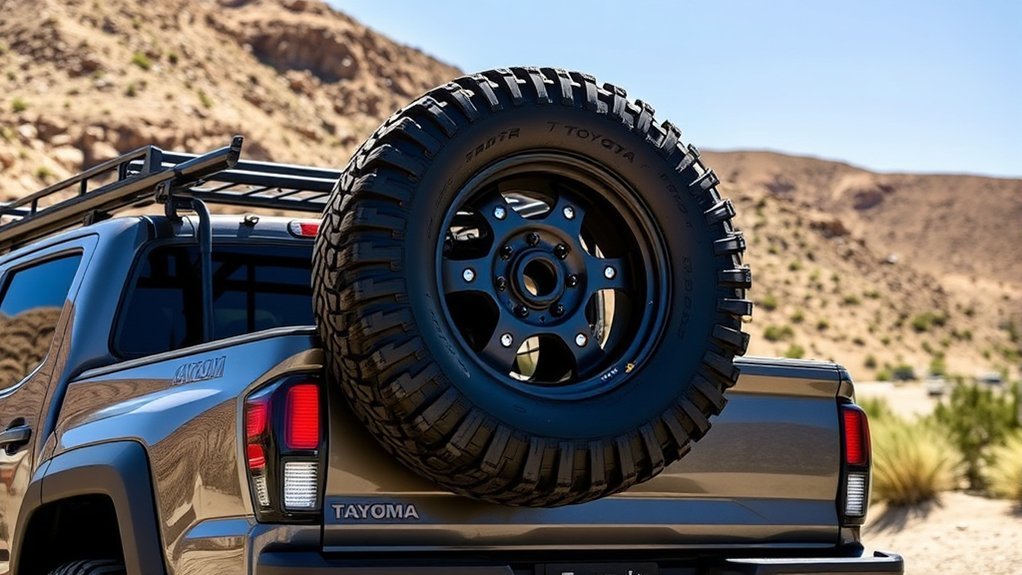
Mounting a spare tire on a modified Toyota Tacoma requires more than choosing the carrier that looks best. You need to match the carrier to your Tacoma’s model year, tire-and-wheel weight, payload, hitch use, bed setup, and available clearance. A properly selected mount keeps the spare secure and accessible without creating exhaust, sensor, handling, or departure-angle problems. Last updated: July 17, 2026.
Quick Answer
For a modified Toyota Tacoma, choose a spare tire carrier that matches your truck’s model year, tire-and-wheel weight, payload, hitch use, and clearance needs. Under-bed storage saves space, bed mounts improve access, and swing-outs help with oversized spares. Never assume a 33-inch tire fits; measure and test every clearance point.
Key Takeaways
- Factory under-bed storage keeps the bed open but may not clear an oversized tire, aftermarket hitch, exhaust, bumper, or suspension components.
- Bed-mounted carriers offer fast access, while hitch and bumper swing-outs preserve more bed space.
- The carrier, wheel, tire, fuel cans, tools, and accessories all count against vehicle payload or applicable hitch limits.
- Use the cold tire pressure listed for your exact configuration in the owner’s manual or on the driver-door label, not a universal 35 psi recommendation.
- Inspect carrier hardware, tire pressure, clearance, and security before remote trips and after rough trail use.
At a Glance
| Time Required | About 30 minutes for a simple bed tie-down to a full day or longer for a bumper-based system |
| Difficulty | Easy for rated bed tie-downs; moderate for bolt-on bed or hitch carriers; advanced for bumpers requiring cutting, wiring, or sensor changes |
| Tools Needed | Tape measure, tire-pressure gauge, socket set, torque wrench, and any model-specific tools listed by the carrier manufacturer |
| Cost | Low for rated tie-down hardware, moderate for bed or hitch carriers, and high for complete bumper-and-swing-out systems |
Warning: A large tire and steel wheel can place substantial force on a carrier during braking, cornering, or trail impacts. Never rely on light-duty straps, sheet-metal screws, damaged bed rails, or unrated mounting points. Follow the carrier manufacturer’s hardware, load, and torque instructions.
Why You Need a Spare Tire Carrier for Your Tacoma
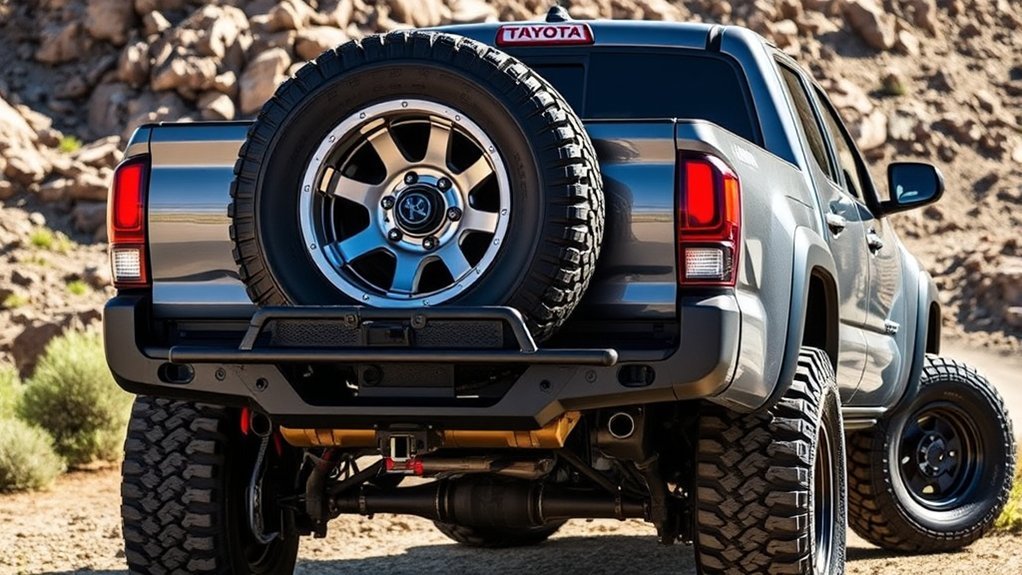
A modified Tacoma may no longer have enough room for its spare in the factory under-bed location. A larger exhaust, high-clearance bumper, receiver hitch, suspension component, or oversized tire can reduce the available space. Relocating the spare lets you retain usable emergency equipment instead of leaving the tire at home.
A well-designed carrier also improves access. You can reach a bed-, hitch-, or bumper-mounted spare without lying beneath the truck in mud, snow, sand, or traffic. This matters when the damaged road tire is difficult to remove or when the under-bed lowering mechanism is obstructed.
The carrier must do more than hold the tire while the truck is parked. It must control the combined tire-and-wheel weight during hard braking, sharp turns, washboard roads, and suspension movement. It should also protect the tire from exhaust heat, sharp metal edges, excessive movement, and contact with the road.
Continue checking your tire tread depth and the spare’s condition. A securely mounted spare still cannot help if it is flat, cracked, badly aged, or the wrong size for the truck.
[Products Worth Considering]

These aluminum alloy tire valve stem caps with an O-ring seal help protect valve stems from corrosion while adding a clean, stylish look to your vehicle. The universal fit works across cars, trucks, motorcycles, bicycles, and more, making them an easy upgrade for everyday driving and off-road use. Installation is quick, and the included four-pack keeps all your tires dressed and protected.

Secure a full-size spare on your trailer with this powder-coated steel spare tire mount bracket. It fits most 4-, 5-, and 6-lug wheel bolt patterns and mounts to trailer tongues up to 4 in wide and 5 in tall. Built for reliable carry with a max 150 lb load rating and includes zinc-plated hardware for straightforward installation.

Mount your spare tire directly to the inside wall of an enclosed trailer or garage to save space and keep your tire secure. This wall-mount spare tire carrier is designed for universal trailer tire fit and includes a fixed plate and chute for convenient screw replacement. Nylon insert hex lock nuts help prevent the tire from falling off, and wing hardware enables faster load and unload during maintenance.
Compatibility Checks Before Choosing a Carrier
Start with your exact Tacoma year, generation, cab, bed length, hitch, bumper, bed rack, and tire size. A carrier described simply as “Tacoma compatible” may support only one generation or require factory rails that your truck does not have.
- Confirm the model years: Separate 2005–2015, 2016–2023, and 2024-and-newer Tacoma applications unless the manufacturer specifically lists multiple generations.
- Measure the complete tire and wheel: Record actual mounted diameter, section width, backspacing, weight, and center-bore clearance.
- Check carrier capacity: The rated capacity must exceed the combined weight of the tire, wheel, mounting hardware, locks, fuel cans, tools, and other accessories attached to it.
- Check vehicle payload: Added bumper, carrier, spare, passengers, cargo, and trailer tongue weight all reduce remaining payload.
- Check mounting strength: Use only frame, receiver, rack, rail, or bed mounting points approved by the carrier manufacturer.
- Check rear visibility: The tire must not hide required lights, the license plate, rear camera, or other legally required equipment.
- Check electronic systems: Confirm compatibility with parking sensors, rear cross-traffic alert, blind-spot monitoring, and camera systems.
- Check normal access: Open the tailgate, tonneau cover, topper glass, drawers, and swing arm through their full range.
Note: A carrier’s advertised tire diameter is only one limit. The wheel offset, tire width, total mounted weight, tailgate shape, receiver position, and attached accessories can prevent fit even when the tire diameter is within the stated range.
Best Spare Tire Carrier Mounting Options for Your Modified Tacoma
The right mounting position depends on how you use the truck. A daily-driven Tacoma with an open bed has different needs from an overland truck carrying drawers, a topper, a rack, fuel, and recovery equipment.
| Mounting option | Best for | Main advantages | Main limitations |
| Factory under-bed location | Stock-size or carefully verified oversized spares | Keeps the bed and hitch open; low mounting position | May contact the hitch, exhaust, crossmember, differential, bumper, or road; harder emergency access |
| Bed-rail or vertical bed mount | Drivers who want quick access and still need part of the bed floor | Easy access; no receiver interference; can support a lock | Uses bed width; may require a factory rail; must clear racks and tonneau covers |
| Flat bed mount or three-way tie-down | Simple setups and occasional trail use | Low center of gravity; simple removal; usually less complex | Consumes bed-floor space and requires rated anchor points and straps |
| Bed-rack mount | Trucks already using a compatible modular rack | Preserves more floor space and can integrate with other equipment | Raises the center of gravity and adds load to the rack and bed rails |
| Hitch-mounted swing-away | Drivers wanting removable external storage without replacing the bumper | Easy transfer or removal; keeps most of the bed open | Uses receiver capacity, adds rear leverage, and may interfere with towing, sensors, or departure clearance |
| Bumper-mounted swing-out | Permanent overland builds with oversized tires and rear accessories | Strong integrated mounting; good access; can improve departure geometry | Heavy, expensive, generation-specific, and sometimes requires cutting or sensor changes |
[Products Worth Considering]

This side-mounted U-bolt spare tire bracket helps keep a trailer spare wheel secure and protected while you travel. It supports trailer frames up to 2–3 inches wide and fits up to 15-inch tires for 4- or 5-lug wheels. The galvanized steel threaded carrier is built for long-lasting corrosion resistance and installs easily with included lug nuts and U-bolt.

This universal spare tire mount fits 4, 5, and 6 lug trailer wheels with bolt patterns from 4" to 5.5" and helps keep your tire securely locked in place. Its reinforced triangular structure with a sturdy behind plate is designed to handle up to 150 lbs, making it suitable for boat, camper, and RV spare tire mounting. The angled raised design reduces wind resistance and installation is straightforward with different length bolts and no drilling required.
A concentrated tire and tube mounting compound designed to help simplify mounting rubber tires and tubes on passenger, semi truck, construction, and OTR applications. Its ultra-thick formula packs beads effectively and includes rust inhibitors to help protect against corrosion during use.
Factory Under-Bed Storage
Under-truck storage preserves the bed and keeps the spare low. However, an oversized spare may rub the hitch, exhaust, brackets, differential area, crossmember, bumper, or road. Check clearance with the suspension loaded and through its normal range of movement. Do not judge fit only while the unloaded truck is parked on level ground.
Bed-Mounted Carriers
A bed-rail carrier is a practical choice when you value fast access. For example, the current Wilco Offroad Bed Rail Tire Carrier is listed for 2014-and-newer Tacoma and Tundra applications. Wilco states that it requires the factory cab-mounted bed rail and supports up to a 35-inch tire on small trucks. Confirm that your rack, tonneau cover, topper, drawers, and cargo still operate normally.
Hitch-Mounted Carriers
A hitch-mounted carrier can be removed when you do not need it. The current Wilco Hitchgate Solo, for example, requires a compatible 2-inch Class III receiver, supports up to a 35-inch spare on midsize vehicles, and has a stated 150-pound total carrier load rating. Those carrier ratings do not increase the Tacoma’s own hitch, tongue-weight, payload, axle, or towing limits.
Bumper Swing-Out Carriers
A bumper swing-out is suitable for a permanent overland build, but fitment must be generation-specific. The C4 Fabrication Overland Series High Clearance Rear Bumper cited by many Tacoma owners is currently listed for 2016–2023 trucks. C4 states that the assembly weighs about 150 pounds without the swing arm and about 250 pounds with the arm and accessories. The installation requires body cutting, and blind-spot monitoring is not supported.
Whichever carrier you choose, combine it with tires that suit your actual terrain. This guide to off-road traction explains several general traction considerations, although Tacoma fitment must still be checked separately.
How Tire Size Affects Tacoma Spare-Tire Fit
Owner reports can help you identify possible setups, but they cannot guarantee fit on your truck. Two Tacomas using the same tire-size code may have different measured tire diameters, wheel offsets, hitches, bumpers, exhaust systems, suspension heights, and under-bed clearances.
A tire’s nominal diameter can be estimated from its size code:
Nominal diameter = wheel diameter + 2 × section width × aspect ratio ÷ 25.4
| Tire size | Approximate nominal diameter | Factory under-bed fit |
| 265/65R18 | 31.6 inches | Possible on some configurations, but not guaranteed |
| 285/70R17 | 32.7 inches | Often described as a 33-inch class tire; physical testing is required |
| 285/75R17 | 33.8 inches | More likely to need relocation or modification; never assume factory-location fit |
Actual measured diameter can differ from the nominal figure because tire construction, tread depth, inflation, rim width, and load vary. Check the tire manufacturer’s measured specifications and then measure the mounted spare yourself.
Pro Tip: Before buying a carrier, place the fully inflated spare in the proposed position and check the nearest obstruction on every side. Allow extra room for frame movement, suspension travel, tire flex, heat, mud, and imperfect trail conditions.
Use a full-size spare that matches the road tires as closely as practical in diameter, construction, load capability, and wheel fit. If your Tacoma has a temporary spare, follow the speed, distance, placement, and inflation limits printed on the spare and stated in the owner’s manual.
Tire category also affects road and trail behavior. This comparison of all-season and summer tires covers general compound differences, but an off-road Tacoma may require an all-terrain or mud-terrain tire designed for its load and operating conditions.
How to Install and Maintain Your Spare Tire Carrier
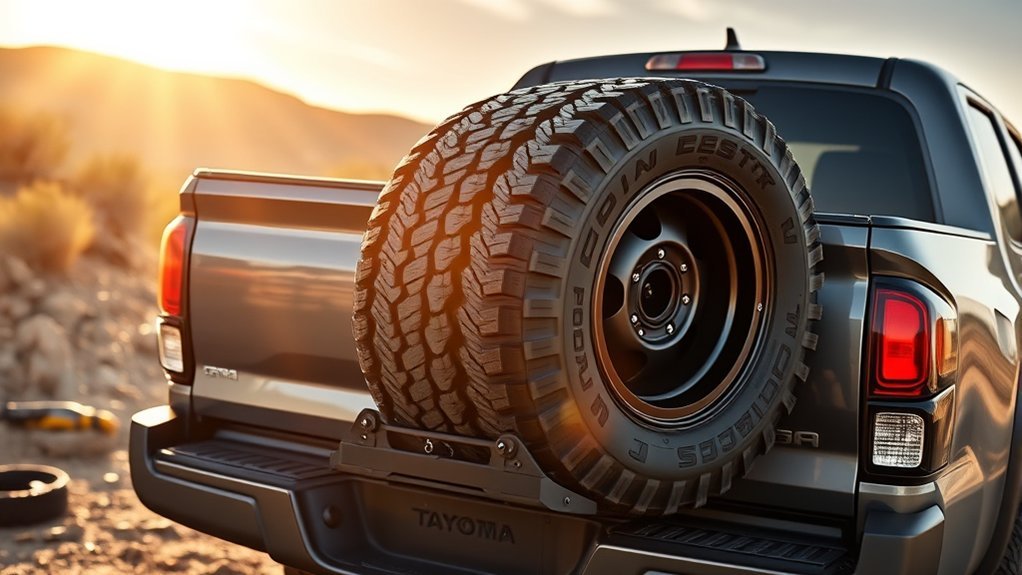
Every carrier has different hardware and torque requirements. Use the manufacturer’s installation manual as the controlling procedure. The following sequence helps you avoid common compatibility and safety problems without replacing the product-specific instructions.
- Park safely: Place the Tacoma on a hard, level surface, apply the parking brake, and remove loose cargo from the work area.
- Verify all components: Confirm the carrier, brackets, hardware, wheel plate, studs, and optional accessories match the product list and your Tacoma application.
- Inspect the mounting area: Look for rust, cracks, bent rails, previous drilling, damaged threads, loose hitch components, or weak sheet metal.
- Test the empty carrier position: Check tailgate, tonneau, topper, hitch, camera, license plate, lights, and sensor clearance before mounting the tire.
- Install the mounting hardware: Use the supplied bolt grades, washers, spacers, backing plates, locking hardware, and tightening sequence.
- Apply the specified torque: Use the carrier manufacturer’s torque values. Do not invent a value or substitute the Tacoma’s wheel-nut torque for carrier bolts.
- Mount the inflated spare: Center the wheel correctly, engage the full available thread, and tighten the wheel-retaining hardware in the specified pattern.
- Add a backup restraint when required: Use a rated safety strap, locking pin, cable, or secondary retention method approved for the carrier.
- Perform a movement test: Push and pull the tire in every direction. The carrier should not shift, unlatch, contact the body, or create excessive movement.
- Recheck after driving: Inspect the installation after the manufacturer’s stated break-in distance and after the first rough-road or trail trip.
Warning: Do not drill, cut body panels, relocate sensors, alter a receiver, or modify bumper structure unless the carrier’s verified instructions require it. Incorrect structural modification can weaken the mount or interfere with vehicle safety systems.
Post-Installation Clearance Test
- Open and close the tailgate and swing arm several times.
- Check that every latch fully engages and cannot release accidentally.
- Verify that the spare does not block brake lights, turn signals, the license plate, or required reflectors.
- Check the rear camera image and all parking, cross-traffic, and blind-spot warnings.
- Verify clearance from the exhaust and any hot metal surface.
- Check the tire against the bumper, hitch, rack, bed, topper, and body.
- Confirm that hitch pins, locks, stabilizers, and safety devices are installed.
- Load the truck as it will normally travel and repeat the clearance check.
- Drive slowly over a controlled uneven surface and inspect for new contact marks.
Most modern Tacoma road tires are tubeless. This explanation of inner-tube construction is useful background, but installing an inner tube is not a substitute for correctly repairing or replacing a damaged tubeless tire and wheel.
What Tacoma Owners Commonly Recommend
Owner communities commonly favor low or mid-height bed racks when they want to preserve access below the spare. This can work well when the rack manufacturer approves the tire weight and mounting position. Raising a heavy wheel also raises the truck’s center of gravity, so the rack’s static and dynamic limits matter.
Some owners fit a 33-inch-class spare beneath the bed after changing brackets, hitch components, or exhaust clearance. Treat those reports as examples rather than instructions. A setup that clears on one Tacoma can rub on another when the truck is loaded or the rear suspension compresses.
For a 2016–2023 Tacoma, the C4 Fabrication high-clearance bumper and optional swing arm provide an integrated carrier and accessory mount. However, the system is heavy, requires cutting, and does not support blind-spot monitoring. That trade-off may suit a dedicated trail build but not a lightly modified daily driver.
A three-way tire tie-down, including systems sold by SpeedStrap and similar manufacturers, can secure a spare flat in the bed when used with rated anchor points. Confirm the current strap working-load limit, tire-diameter range, hook compatibility, and replacement interval instead of relying only on an advertised maximum size.
No community setup replaces emergency preparation. Carry a suitable jack, wheel tools, pressure gauge, and a repair option appropriate for your tires. These broader emergency tire repair methods can help with minor tread punctures, but sidewall damage, a damaged wheel, or a large cut usually requires the spare or professional recovery.
Spare Tire Carrier Maintenance Schedule
A carrier is exposed to water, salt, dust, impact, vibration, and changing loads. Regular checks reduce rattles and help prevent a loose tire from becoming a road hazard.
| Interval | What to check |
| Before every remote or highway trip | Latch engagement, retaining hardware, hitch pin, secondary restraint, visible cracks, tire damage, and clearance |
| Monthly | Cold spare pressure, tread, sidewalls, valve stem, rust, locks, straps, hinges, and mounting bolts |
| After rough trail use | Loose hardware, fresh contact marks, bent brackets, latch movement, strap damage, and bumper or receiver movement |
| After changing the setup | Repeat the full payload, clearance, tailgate, lighting, camera, sensor, and movement checks |
The National Highway Traffic Safety Administration recommends checking all tires, including the spare, at least monthly when cold. Use the Tire and Loading Information label on the driver-side door area or your exact Tacoma owner’s manual for the recommended pressure.
Common Spare Tire Carrier Problems and Fixes
[Products Worth Considering]

Monitor tire tread wear with a smart, color-coded depth gauge that shows clear condition ranges at a glance. The bar is range marked for fast, easy readings, helping you maintain safer traction and performance. Each gauge is portable with a pocket clip, and the set includes 20 units for daily use and sharing.

The GADFISH spare tire carrier is built for reliable hauling with a reinforced welded triangular structure and a behind plate that securely holds the tire up to 150 lbs. It fits a wide range of trailer wheel lug setups, making it suitable for boat trailers as well, while the sloping design helps reduce wind resistance and provides low-ground clearance. Installation is designed to be straightforward with different length bolts and no drilling required.

Accurately measure tire tread depth with a calibrated gauge marked from 0 to 1 inch in 1/32 inch increments. The color-coded bar helps you quickly identify tread condition ranges, supporting safe driving for trucks, motorcycles, automobiles, and passenger vehicles.
The Carrier Rattles
Check the latch adjustment, hinge, receiver stabilizer, hitch pin, wheel-retaining hardware, and mounting bolts. Replace worn bushings or latch components with manufacturer-approved parts. Do not hide movement by adding random shims that prevent the latch from fully engaging.
The Spare Touches the Exhaust or Body
Stop using that position until you restore safe clearance. Heat can damage the tire, while repeated body or bracket contact can cut the sidewall. Relocate the carrier, use the approved offset adjustment, or choose another mounting system.
The Rear of the Tacoma Sags
Calculate the combined weight of the bumper, carrier, wheel, tire, accessories, cargo, passengers, and trailer tongue load. Compare the result with the vehicle labels and exact owner’s manual. Suspension upgrades do not increase the certified payload or axle ratings.
The Tailgate or Camera Is Blocked
Use an approved offset, relocation bracket, or different carrier design. Confirm that the license plate, lighting, rear camera, and sensors remain visible and functional before driving.
Mounting Bolts Keep Loosening
Confirm that the correct bolt grade, washers, locking method, backing plates, and torque values were used. Inspect the mounting surface for elongation, cracking, deformation, or rust. Stop using the carrier until damaged structural parts are repaired.
Frequently Asked Questions
What is the 50/50 rule for spare tires?
There is no universal rule saying a spare should be 50% of the original tire’s diameter. That would create an extreme size mismatch. Use the spare size and operating limits specified by Toyota and the spare-tire manufacturer. Temporary spares may have special pressure, speed, distance, and placement restrictions.
Is 35 psi too high for a Toyota Tacoma?
Not necessarily. The correct cold pressure depends on the Tacoma year, trim, tire configuration, load, and spare type. Toyota’s 2024 Tacoma data includes 30, 32, and 35 psi recommendations for different road-tire configurations, while one temporary spare requires 60 psi. Follow your driver-door label and exact owner’s manual.
Will a 33-inch spare fit under a Tacoma?
It may fit some Tacoma configurations, but size alone cannot confirm it. A 285/70R17 has a nominal diameter of about 32.7 inches, while a 285/75R17 is about 33.8 inches. Hitch design, exhaust position, bumper, brackets, wheel offset, actual tire dimensions, and suspension movement all affect clearance.
What is the best spare tire carrier for an oversized Tacoma tire?
A bed-rail mount works well when you want fast access and can spare some bed space. A hitch swing-away is useful when you want a removable external carrier. A bumper swing-out suits permanent overland builds but adds substantial weight and may require cutting or sensor changes. Choose by fitment, load rating, access, and payload rather than appearance alone.
Does a hitch-mounted spare carrier reduce towing capacity?
The carrier does not increase any towing or tongue-weight limit. Its weight and the weight of the spare apply load to the receiver and vehicle, leaving less capacity for other hitch loads, cargo, and trailer tongue weight. Follow the lowest applicable limit listed by Toyota, the hitch manufacturer, and the carrier manufacturer.
How often should I inspect a Tacoma spare tire carrier?
Check the latch, mounting hardware, straps, hitch pin, tire condition, and clearance before long or remote trips. Check the spare’s cold pressure at least monthly. Inspect the complete carrier again after rough trail use, a hard impact, a load change, or any new rattle or movement.
Can I drive without carrying a spare tire?
You can physically remove it, but doing so increases the risk of being stranded, especially off-road or far from tire service. If the factory position reduces departure clearance, relocating the spare to a secure bed, rack, hitch, or bumper carrier is safer than leaving it behind.
Sources
- Toyota Tacoma Manuals and Warranties — model-year-specific owner’s manuals, tire procedures, warnings, and vehicle information.
- Toyota 2024 Tacoma Maintenance Data — factory tire sizes, cold inflation pressures, spare pressures, wheel sizes, and wheel-nut torque data.
- NHTSA TireWise — tire-pressure, spare-tire, inspection, age, and vehicle-label guidance.
- Wilco Offroad Bed Rail Tire Carrier — current Tacoma/Tundra fitment, rail requirement, security features, and stated tire-size support.
- Wilco Offroad Hitchgate Solo — receiver requirements, total carrier rating, tire-size limits, and clearance information.
- C4 Fabrication Tacoma Overland Series High Clearance Rear Bumper — 2016–2023 fitment, swing-arm configuration, weight, cutting, suspension, and BSM limitations.
Conclusion
The best spare tire carrier for your modified Tacoma is the one that safely fits your exact truck, carries the complete tire-and-wheel weight, stays within vehicle and hitch limits, and preserves the access you need. Keep the factory under-bed position when verified clearance is adequate. Choose a bed mount for simple access, a hitch swing-away for removable external storage, or a generation-specific bumper swing-out for a permanent overland build. Measure first, follow the manufacturer’s installation instructions, and inspect the carrier and spare regularly.