A bed-mounted spare tire can solve a real problem on a Toyota Tacoma, especially when an oversized full-size spare no longer fits comfortably under the truck. It puts the tire within easier reach and may protect underbody clearance, but it also consumes bed space, adds weight, and can block your rear view. The right choice depends on your Tacoma’s year, bed layout, payload, tire size, rack, cover, and how often you use the bed.
Quick Answer
A bed-mounted spare tire can be a smart Tacoma upgrade when you carry an oversized full-size spare or need better underbody clearance. Mount it low, forward, and securely without blocking visibility, exceeding payload, or disabling your tonneau cover. Measure first, verify the carrier’s rating, and follow its installation instructions.
Key Takeaways
- A bed-mounted spare is easier to reach than an underbody spare, but it reduces usable cargo space.
- Your tire, wheel, carrier, lock, tools, passengers, and cargo all count toward the Tacoma’s payload.
- Tacoma tire and spare sizes vary by year, trim, wheel package, and modification level.
- Check rear visibility, cameras, sensors, tonneau movement, tailgate access, and rack compatibility before driving.
- Use a carrier designed for your truck and follow the manufacturer’s mounting and torque instructions.
Why Consider a Bed-Mounted Spare Tire for Your Tacoma?
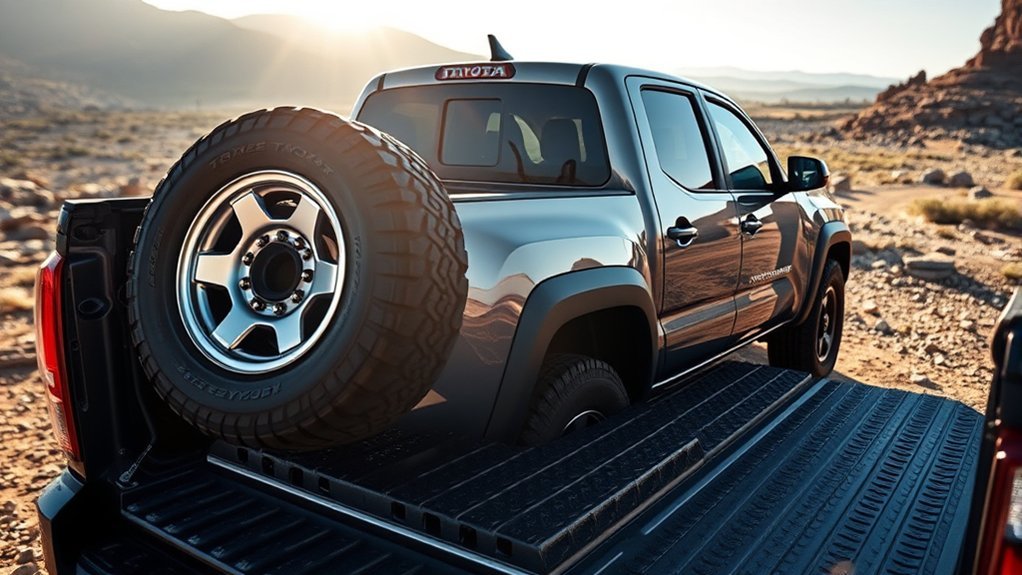
A factory underbody location works well for many Tacoma owners. It keeps the bed open, places the tire relatively low, and requires no additional carrier. Problems can appear when you install a larger tire, change the exhaust, add suspension components, or use the space beneath the bed for other equipment.
A bed-mounted carrier gives an oversized spare a dedicated location. It also keeps the tire away from mud, rocks, road salt, and components beneath the truck. Access is normally faster because you do not need to lower the tire from under the vehicle before beginning a roadside change.
The trade-off is that the tire moves into one of the truck’s most useful storage areas. A full-size wheel and tire assembly is bulky and heavy, so the carrier’s position affects bed access, visibility, payload, and handling.
Benefits of a Bed-Mounted Spare Tire
Faster Spare-Tire Access
A bed-mounted spare is normally easier to reach than an underbody spare. This matters when the truck is sitting in mud, snow, sand, deep ruts, or uneven terrain. You can release the carrier from beside the truck instead of crawling underneath it.
Faster access does not remove the need for safe tire-changing equipment. You still need a properly rated jack, a stable lifting point, a lug wrench, wheel chocks, and the procedure specified in your Tacoma owner’s manual.
Room for an Oversized Full-Size Spare
A modified Tacoma may use a tire that no longer fits the factory underbody location. A correctly sized bed carrier can accommodate a wider or taller spare without forcing it against the exhaust, differential, hitch, or surrounding components.
Do not assume that every carrier can hold every tire. Confirm the maximum tire diameter, tire width, wheel offset, wheel-center opening, assembly weight, and mounting orientation before buying.
Preserving Underbody Clearance
Relocating a low-hanging underbody spare may improve clearance around the rear of a modified truck. The actual benefit depends on where the original spare sits, the hitch design, suspension travel, exhaust routing, and the carrier you install.
A bed-mounted spare does not automatically improve the Tacoma’s departure angle, and it does not reduce the truck’s overall weight. It simply moves the wheel-and-tire assembly to a different location.
More Flexible Under-Truck Space
Moving the spare may free space for certain off-road, recovery, fuel, air, or storage modifications. Any added equipment must still be designed for the vehicle and installed without interfering with the exhaust, brake lines, fuel system, suspension, drivetrain, or safety equipment.
Drawbacks of a Bed-Mounted Spare Tire
Reduced Cargo Space
The most obvious drawback is lost bed space. A vertical carrier uses less floor area than a flat tire, but it can still prevent you from loading wide furniture, motorcycles, building materials, camping boxes, or other large cargo.
An angled carrier may make the tire easier to remove, but it normally uses more floor area. A rack-top carrier keeps the bed floor open while placing the tire higher and making removal more difficult.
Rear-Visibility Concerns
A large tire near the cab can block part of the rear window. A tire near the tailgate may interfere with the rear camera, brake light, rear cross-traffic sensors, or your view while reversing.
Toyota explains that the available Digital Rear-view Mirror can provide a rear image despite luggage or other obstructions. However, availability varies, and a camera system should not be used as an excuse to create an unsafe installation. Check the view from the driver’s seat and verify every rear camera and sensor before using the truck.
Warning: Do not drive if the carrier or tire blocks required lights, prevents safe rearward visibility, interferes with a camera or sensor, or can shift during braking, turning, or off-road travel. Reposition or remove the system before using the truck.
Payload and Handling Effects
The tire, wheel, carrier, mounting hardware, lock, recovery tools, passengers, cargo, accessories, and trailer tongue weight all consume payload. Do not use a maximum payload number from an advertisement or a different Tacoma configuration. Read the Tire and Loading Information label on your truck and follow its specific limit.
Placing the assembly behind the rear axle increases the load carried at the rear and can change steering and braking behavior. Placing it high also raises the center of gravity compared with an underbody location. Mounting the spare low and near the front of the bed generally minimizes these effects, provided the mounting structure is approved for that position.
Cover, Rack, and Toolbox Conflicts
A spare carrier can interfere with a retractable tonneau canister, folding cover panels, bed cap, crossbars, chase rack, rooftop tent rack, toolbox, bed divider, or slide-out storage system. Some combinations also use the same factory rail or mounting points.
Open and close every moving component during a dry fit. Check the full movement of the tonneau, tailgate, rack accessories, tie-downs, and cargo drawers before drilling or tightening the carrier.
Types of Tacoma Bed-Mounted Spare-Tire Carriers
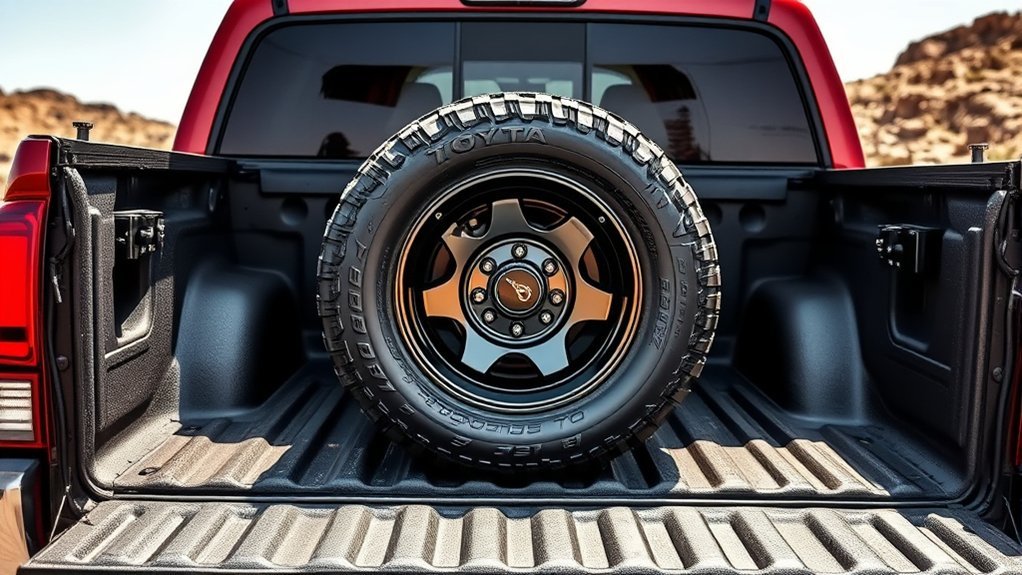
Bed-mounted spare carriers differ in position, removal method, required structure, and compatibility. The best design is the one that safely supports your complete wheel-and-tire assembly while preserving the bed functions you use most.
| Carrier Type | Main Advantage | Main Trade-Off | Best For |
|---|---|---|---|
| Vertical bed-rail carrier | Uses limited floor space and keeps the tire easy to reach. | May block the rear window or conflict with rail-mounted accessories. | Owners who want fast access and regularly carry smaller cargo. |
| Angled floor carrier | Keeps the assembly relatively low and may simplify removal. | Consumes more bed-floor space and may require drilling or reinforcement. | Off-road builds where low placement matters more than maximum cargo room. |
| Cross-bed bar carrier | Can preserve some floor space beneath the tire. | Raises the tire and may make lifting or visibility worse. | Owners already using a compatible cross-bed structure. |
| Rack-top carrier | Leaves most of the bed open. | Places substantial weight high and can be difficult to unload safely. | Specialized rack systems rated for the assembly’s dynamic load. |
| Removable modular carrier | Lets you reclaim bed space when the spare is not needed. | Requires secure attachment points and careful reinstallation. | Drivers who need the carrier mainly for trail trips. |
One manufacturer example is the Wilco Offroad Bed Rail Tire Carrier. Wilco lists it for 2014-and-newer Tacoma and Tundra applications, states that a factory cab-mounted bed rail is required, and rates the small-truck application for tires up to 35 inches. That does not guarantee compatibility with an aftermarket rack, cover, wheel, or modified bed layout, so confirm the complete setup before ordering.
Pro Tip: Make a cardboard profile using your tire’s actual diameter and width. Place it in the proposed mounting position, then test rear visibility, tonneau operation, tailgate access, toolbox clearance, and the largest cargo you normally carry.
[Products Worth Considering]

This spare tire tool kit is designed for the 2004 to 2018 Ford F-150 to help you loosen and tighten wheel lug nuts and manage the spare tire and provided jack functions from underneath the vehicle. It includes the lug nut wrench and extension pieces plus a convenient storage carrying case for organized transport. The jack itself is not included.

Secure a full-size spare on your trailer with this powder-coated steel spare tire mount bracket. It fits most 4-, 5-, and 6-lug wheel bolt patterns and mounts to trailer tongues up to 4 in wide and 5 in tall. Built for reliable carry with a max 150 lb load rating and includes zinc-plated hardware for straightforward installation.

These aluminum alloy tire valve stem caps with an O-ring seal help protect valve stems from corrosion while adding a clean, stylish look to your vehicle. The universal fit works across cars, trucks, motorcycles, bicycles, and more, making them an easy upgrade for everyday driving and off-road use. Installation is quick, and the included four-pack keeps all your tires dressed and protected.
Fitment Checklist Before Buying a Carrier
A carrier that fits one Tacoma may not fit another. Confirm every item below before purchasing or modifying your truck.
| Factor | What to Verify |
|---|---|
| Model and bed | Model year, cab, bed length, factory rail system, bed liner, and any previous modifications. |
| Tire dimensions | Measured overall diameter and section width, not only the size printed on the sidewall. |
| Wheel dimensions | Bolt pattern, center opening, wheel offset, backspacing, and mounting-face orientation. |
| Assembly weight | Combined tire, wheel, carrier, lock, hardware, and backup-retention weight. |
| Carrier rating | Maximum tire size, weight, wheel compatibility, mounting structure, and intended vehicle application. |
| Payload | Available capacity after accounting for occupants, accessories, cargo, and trailer tongue weight. |
| Accessory clearance | Tonneau, rack, cap, toolbox, drawer, bed mat, lights, tie-downs, and tailgate movement. |
| Driver visibility | Rear window, mirrors, camera view, brake lights, sensors, and reversing sightlines. |
[Products Worth Considering]

Mount your spare tire off the floor and onto your wall using an e-track spare tire carrier that helps you stay organized in trailers, garages, and warehouses. The upgraded double-fittings design improves stability versus single-fittings and supports greater load bearing. Install by snapping into e-track anchor points and securing the tire with a lug-nut style bolt setup for quick, secure storage.

This side-mounted U-bolt spare tire bracket helps keep a trailer spare wheel secure and protected while you travel. It supports trailer frames up to 2–3 inches wide and fits up to 15-inch tires for 4- or 5-lug wheels. The galvanized steel threaded carrier is built for long-lasting corrosion resistance and installs easily with included lug nuts and U-bolt.

The GADFISH spare tire carrier is built for reliable hauling with a reinforced welded triangular structure and a behind plate that securely holds the tire up to 150 lbs. It fits a wide range of trailer wheel lug setups, making it suitable for boat trailers as well, while the sloping design helps reduce wind resistance and provides low-ground clearance. Installation is designed to be straightforward with different length bolts and no drilling required.
Verify the Correct Tire Size
Do not treat 285/70R17 as a universal stock Tacoma size. Toyota’s official 2024 specifications list multiple tire and spare combinations, including 245/70R17, 265/70R17, and 265/65R18 configurations. Some versions use a temporary spare or a full-size spare that differs from the road tires.
Check the driver-door Tire and Loading Information label and the owner’s manual for your exact model. Toyota provides year-specific manuals through its Tacoma manuals and warranties portal.
If you use an oversized tire, confirm two separate questions:
- Will the tire fit the carrier and bed? Measure the physical assembly and surrounding clearance.
- Can the tire safely be used on the truck? Verify load rating, wheel fitment, brake clearance, suspension clearance, gearing, and any required vehicle modifications.
How to Install a Bed-Mounted Spare-Tire Carrier
The exact process depends on the carrier. Treat the steps below as a planning and inspection sequence, then follow the manufacturer’s vehicle-specific instructions for drilling, brackets, fasteners, torque, and maintenance.
At a Glance
| Time Required | Usually one afternoon for measuring, installation, and checks; custom fabrication takes longer. |
| Difficulty | Moderate for a compatible bolt-on kit; advanced if drilling, reinforcement, wiring relocation, or fabrication is required. |
| Tools Needed | Tape measure, sockets, wrenches, torque wrench, marker, protective equipment, and any manufacturer-specified drilling or corrosion-protection supplies. |
| Cost | Varies by carrier, lock, reinforcement, shipping, professional labor, and required rack or rail changes. |
[Products Worth Considering]

The Dr.Roc spare tire tool kit helps you release, lower, or raise your spare tire with reliable extension tools and a lug nut wrench. It is made from rustproof automotive-grade steel and includes an organized carry case for convenient storage. Designed for compatibility with select GM models from the late 1990s through 2019, it uses upgraded extension components to install and remove spare tires with less hassle.

Mount your spare tire directly to the inside wall of an enclosed trailer or garage to save space and keep your tire secure. This wall-mount spare tire carrier is designed for universal trailer tire fit and includes a fixed plate and chute for convenient screw replacement. Nylon insert hex lock nuts help prevent the tire from falling off, and wing hardware enables faster load and unload during maintenance.

This universal spare tire mount fits 4, 5, and 6 lug trailer wheels with bolt patterns from 4" to 5.5" and helps keep your tire securely locked in place. Its reinforced triangular structure with a sturdy behind plate is designed to handle up to 150 lbs, making it suitable for boat, camper, and RV spare tire mounting. The angled raised design reduces wind resistance and installation is straightforward with different length bolts and no drilling required.
1. Confirm Payload and Carrier Compatibility
Read the truck’s Tire and Loading Information label. Subtract the weight of occupants, existing accessories, tools, normal cargo, and trailer tongue weight from the stated capacity. The remaining amount must safely accommodate the complete spare and carrier.
Confirm that the carrier manufacturer approves your Tacoma year, bed, factory rail, and tire dimensions. Do not rely only on a product photo or a seller’s general “universal” description.
2. Measure the Complete Assembly
Measure the mounted spare’s actual diameter, width, wheel-center opening, and distance from the wheel mounting face to each sidewall. Published tire dimensions can differ slightly from the installed size because rim width and manufacturing tolerances affect the final shape.
3. Choose a Low, Forward Position
When the carrier design permits, position the assembly low and close to the front of the bed. This normally reduces its effect on rear visibility, cargo movement, and rearward weight bias.
Do not place the tire where it can contact the cab, rear glass, tailgate, bed cover, rack, or cargo as the truck flexes over uneven terrain.
4. Dry-Fit the Carrier
Assemble the brackets loosely and place the spare in position. Sit in the driver’s seat and check the rear window and mirrors. Then inspect the camera image, brake lights, sensors, tie-down points, cover movement, and tailgate operation.
Load a representative piece of your normal cargo before finalizing the location. A carrier that looks compact in an empty bed may still prevent you from carrying the equipment you bought the truck to transport.
5. Inspect the Mounting Structure
Use only the rail, bracket, reinforcement, backing plate, or structural attachment method specified by the carrier manufacturer. Do not assume that a thin bed panel, liner, or accessory rail can safely withstand the tire’s dynamic forces during braking or off-road impacts.
Before drilling, identify fuel-system components, wiring, brake lines, structural seams, drain paths, and other equipment on the opposite side. Professional installation is the safer choice when the mounting surface or required reinforcement is unclear.
6. Install and Torque the Hardware
Install every supplied washer, spacer, backing plate, locking feature, and bracket in the specified orientation. Tighten the fasteners in the recommended sequence and use the manufacturer’s torque values.
If drilling exposes bare metal, apply an appropriate corrosion-protection treatment before final assembly. Do not apply lubricants, threadlockers, or anti-seize to fasteners unless the instructions allow them, because these products can change the achieved clamping force.
7. Secure the Wheel and Add Backup Retention
Center the wheel on the carrier and tighten its primary retention mechanism. The wheel must not rock, slide, rotate, or contact sharp metal edges.
Where the carrier design allows it, use a separately rated backup strap or cable attached to an approved point. Theft protection and load retention are different functions, so a small security cable should not be treated as the primary safety restraint unless the manufacturer specifically rates it for that purpose.
8. Complete a Road Test and Inspection
Drive slowly over a short route with turns, braking, and mild bumps. Stop and inspect the carrier, tire, bed, brackets, and surrounding components. Look for movement, contact marks, loose fasteners, unusual noise, or blocked sensors.
Recheck the hardware after the first trip and at the intervals stated by the carrier manufacturer. Inspect it more frequently after rough trails, heavy braking, impacts, or changes to the tire and wheel assembly.
Appearance, Visibility, and Bed Proportions
A bed-mounted spare gives a Tacoma a purposeful off-road appearance, particularly when paired with a rack, recovery equipment, and larger tires. Appearance should remain secondary to securement, payload, and visibility.
A vertical spare near the cab can make the truck look taller and may fill much of the rear window. An angled spare has a lower profile but occupies more of the bed. A rack-top spare creates the most aggressive appearance while placing the heaviest option at the greatest height.
Choose a location that looks integrated without forcing the tire above the cab, beyond the bed sides, or into the normal path of cargo. Also account for the truck’s total height before entering a garage, parking structure, ferry, car wash, or low trail obstacle.
Common Owner Experience and Trade-Offs
The most common benefit owners notice is convenience. The spare is visible, accessible, and easier to inspect before a trip. The most common complaint is reduced bed utility, especially when a large tire sits near the center of a short bed.
Rattles and movement usually indicate that the wheel is not seated correctly, the carrier has loosened, a bushing has worn, or the mounting structure is flexing. Do not mask the noise with padding and continue driving. Stop, unload the assembly, and inspect the complete system.
Owners who frequently switch between work, home-improvement, and trail use may prefer a removable carrier. Those who carry a heavy oversized spare on every trip may benefit from a permanent carrier designed around that exact assembly.
The best carrier is not the one that holds the largest tire. It is the one that safely holds your actual spare without taking away the bed functions you use.
Cost Considerations
Do not compare carriers only by their advertised purchase price. The complete cost may include a lock, backing plates, upgraded rail hardware, reinforcement, shipping, professional installation, corrosion treatment, rack changes, or a replacement tonneau system.
A low-cost universal bracket can become expensive if it damages the bed, loosens on rough roads, or requires fabrication to support the tire safely. A more expensive bolt-on carrier may provide better fit, tested hardware, replacement parts, and clearer installation instructions.
Before purchasing, compare:
- Vehicle and tire compatibility.
- Static and dynamic load requirements.
- Included hardware and reinforcement.
- Installation and drilling requirements.
- Warranty and replacement-part availability.
- Locking and backup-retention options.
- Effects on your tonneau, rack, toolbox, and bed use.
- Ease of removing the tire safely.
Bed-Mounted vs. Under-Truck Spare: Which Is Better?
| Factor | Bed-Mounted Spare | Under-Truck Spare |
|---|---|---|
| Access | Usually faster and cleaner to reach. | May require kneeling or reaching under the truck. |
| Bed space | Reduces usable cargo space. | Keeps the bed fully available. |
| Oversized-tire fit | Can support larger tires when the carrier is rated for them. | Space may be limited by the chassis, exhaust, hitch, and surrounding parts. |
| Weight position | Higher and potentially farther rearward. | Normally lower and closer to the original engineered position. |
| Visibility | May obstruct the rear window, camera, or lights. | Normally does not affect rearward visibility. |
| Exposure | Exposed to sunlight and cargo contact unless covered. | Exposed to road dirt, water, salt, and possible underbody contact. |
Keep the factory underbody location if your spare fits, remains accessible, and does not interfere with modifications. Choose a bed-mounted system when an oversized spare will not fit underneath, rapid access matters, or the underbody space is needed for another properly engineered component.
Spare-Tire Maintenance After Installation
A bed-mounted spare is easy to see, but that does not guarantee it is ready to use. Inspect it as part of your normal tire-maintenance routine.
- Check pressure monthly while cold. NHTSA recommends checking all tires, including the spare, at least once a month.
- Use the correct pressure. Follow the Tire and Loading Information label or the owner’s manual, not the maximum pressure molded on the tire sidewall.
- Inspect both sidewalls. Look for cracks, cuts, bulges, punctures, exposed cords, weathering, and damage caused by the carrier.
- Check tread and age. A spare can age even when it has never been used. Read the DOT Tire Identification Number to determine its manufacturing date.
- Check for recalls. Use the complete tire identification information when searching for a safety recall.
- Inspect the valve stem. Make sure the carrier does not crush or hide it and that you can reach it with a pressure gauge.
- Protect it from movement. Confirm that the wheel remains tight and does not rub against the bed, rack, cab, or cargo.
- Follow tire-type restrictions. A temporary spare may have strict speed and distance limits printed on its sidewall or stated in the owner’s manual.
The NHTSA TireWise guidance explains that some vehicle and tire manufacturers recommend replacing tires after six to ten years regardless of remaining tread. Replace a spare sooner if it is damaged, cannot maintain pressure, has reached its manufacturer’s age limit, or no longer matches the vehicle’s requirements.
Note: A full-size spare is intended for emergencies and rotation only when its size, construction, load rating, wear level, and vehicle instructions permit it. Do not use an old spare as a permanent replacement for a worn road tire.
Frequently Asked Questions
What is the 50/50 rule for spare tires?
There is no widely recognized tire-safety rule requiring a spare to weigh 50% or less than the original tires. Use a spare size, load rating, wheel, inflation pressure, and operating restriction approved for your Tacoma. Check the driver-door label, owner’s manual, tire specifications, and carrier rating.
How long does a Tacoma spare tire last?
A spare does not have a universal 40,000- or 60,000-mile lifespan. Its usable life depends on tire type, age, pressure, tread, damage, storage, and manufacturer guidance. Check it monthly, inspect the DOT date code, and replace it when damaged, aged beyond the stated limit, or unable to hold pressure.
Will a 285/70R17 spare fit in a Tacoma bed?
It can fit many bed-carrier arrangements, but compatibility is not automatic. Measure the mounted tire’s actual diameter and width, then compare them with the carrier rating, bed length, rack, tonneau, rear-window view, and cargo needs. Also verify that the tire and wheel are safe for your exact Tacoma before using them on the road.
Does a bed-mounted spare reduce Tacoma payload?
It does not change the payload rating printed for the truck, but the spare, wheel, carrier, hardware, and lock consume part of that available capacity. Their combined weight must be included with passengers, cargo, accessories, and trailer tongue weight when checking the vehicle’s limit.
Can I use a tonneau cover with a bed-mounted spare?
Sometimes. Compatibility depends on the tire position and the cover design. Retractable covers need clearance for the canister and rails, folding covers need room for their panels, and roll-up covers need room for the rolled material. Dry-fit the complete system and test every movement before drilling.
Where is the best place to mount the spare?
A low position near the front of the bed is often the least disruptive, provided the carrier is designed for that attachment point. It helps limit rearward weight bias and visibility loss. The final position must also preserve cab clearance, cover movement, cargo access, lights, cameras, sensors, and safe tire removal.
Conclusion
A Tacoma bed-mounted spare tire is worthwhile when an oversized full-size spare will not fit beneath the truck or when faster access matters more than maximum cargo room. It is less appealing when you regularly need the full bed, depend on a tonneau cover, or cannot place the assembly without blocking visibility.
Measure the actual wheel and tire, confirm payload, select a carrier rated for your Tacoma and spare, and test every accessory before installation. Mount the assembly low and forward when the carrier permits, follow the specified torque procedure, add approved backup retention, and inspect the system after rough use. A secure, compatible installation improves readiness; an improvised bracket creates a new roadside hazard.
Sources
- Toyota 2024 Tacoma Owner’s Manual: Maintenance Data — Tacoma tire sizes, spare configurations, inflation specifications, and vehicle capacity data.
- Toyota 2024 Tacoma Owner’s Manual: Digital Rear-view Mirror — rearward visibility when luggage or other objects obstruct the optical view.
- NHTSA TireWise — pressure checks, tire size, aging, damage inspection, recalls, and spare-tire care.
- Wilco Offroad Bed Rail Tire Carrier — manufacturer fitment requirements and stated tire capacity.