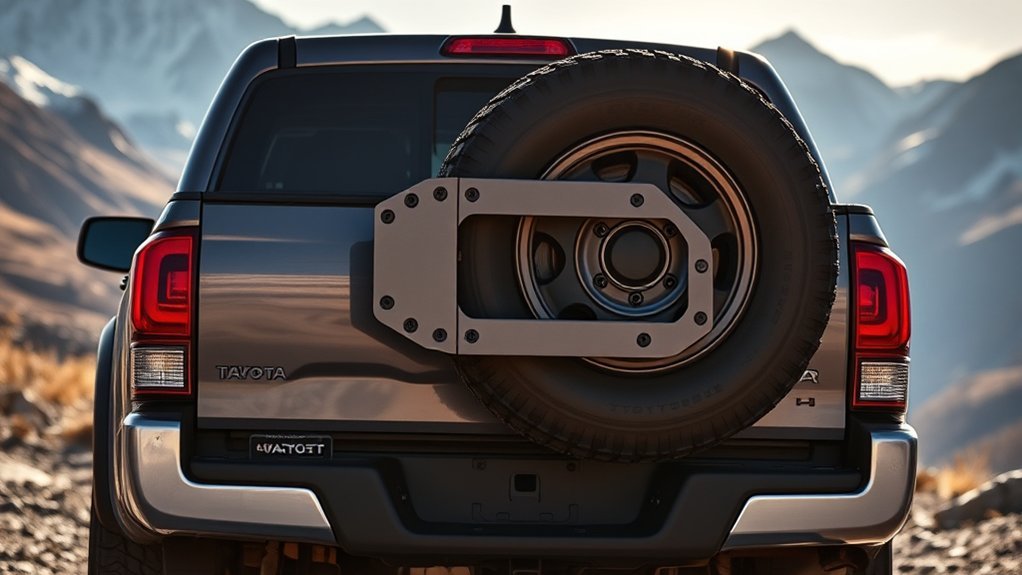
A Toyota Tacoma tailgate spare tire mount can move an oversized spare out from under the bed and make it easier to reach on the trail. However, many products described as “tailgate mounts” are actually hitch-mounted swing-away carriers. Before installation, confirm the carrier type, model-year fitment, weight limits, camera clearance, tire dimensions, and towing compatibility.
Quick Answer
Choose a Tacoma spare tire carrier only after verifying your model year, receiver size, bumper clearance, tire-and-wheel dimensions, combined carrier load, rear-camera view, and access to the tailgate. Install it with the manufacturer’s hardware and torque values, then test the latch, lights, sensors, plate visibility, and clearance before driving.
Key Takeaways
- “Tailgate mount” may refer to a hitch-mounted swing-away carrier, a bumper-mounted carrier, or a carrier attached to a reinforced rear structure. The installation method is not universal.
- A claimed 33-inch or 35-inch capacity does not guarantee fit. Tire width, wheel offset, mounting depth, bumper shape, and camera position also matter.
- The carrier, spare, wheel, fuel mounts, table, jack, and other accessories all add rear weight. Stay within every applicable carrier, hitch, axle, and vehicle limit.
- Never accept blocked lamps, an unreadable license plate, an obstructed camera, tire contact with the exhaust, or a latch that cannot fully engage.
- Check fasteners, the pivot, latch, corrosion, tire pressure, and wheel retention before trips and after rough-road use.
At a Glance
| Time Required | About 60–120 minutes for a typical bolt-on hitch carrier; longer when camera, sensor, light, or license-plate relocation is required |
| Difficulty | Intermediate; a helper is recommended when lifting the carrier, wheel, or tire |
| Tools Needed | Wheel chocks, socket and wrench set, torque wrench, tape measure, tire-pressure gauge, gloves, and the carrier’s supplied hardware |
| Cost | Varies by carrier design, load rating, finish, and required camera, light, or license-plate relocation parts |
Warning: A spare tire carrier is safety-critical equipment. Do not drive if the carrier is loose, the swing arm is unlatched, the wheel is not securely retained, the tire contacts the exhaust or body, or the carrier blocks required lighting and rearward visibility. Use the carrier manufacturer’s instructions and torque values, not generic figures.
What a Tacoma Tailgate Spare Tire Mount Actually Is
The phrase tailgate spare tire mount is used loosely. On a Tacoma, the most common removable option is a hitch-mounted swing-away carrier that slides into the receiver and swings away so you can lower or open the tailgate. Other designs attach to an aftermarket bumper, a bed rack, the bed rails, or a reinforced rear structure.
This difference controls nearly every installation step. A receiver-mounted carrier needs the correct receiver size, hitch-pin clearance, anti-rattle system, and available load capacity. A bumper-mounted system may require a compatible bumper, drilling, welding, or professional fabrication. Do not use instructions for one design on another.
Note: Tacoma equipment differs by model year and trim. Check the owner’s manual for your exact truck and the fitment guide for the exact carrier. Toyota provides model-year manuals through its Tacoma manuals and warranties portal.
Advantages of a Tailgate Spare Tire Mount for Tacoma Owners
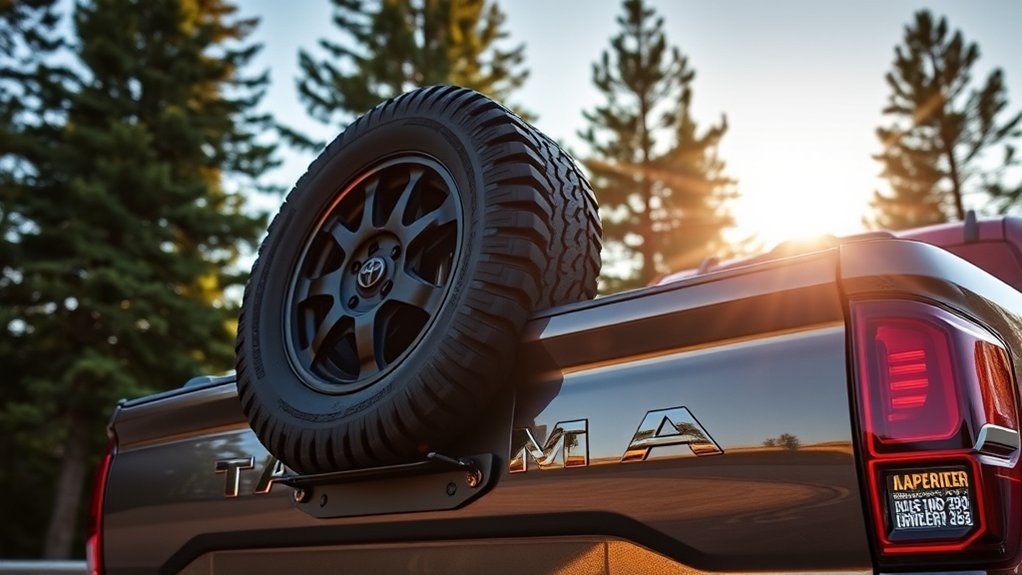
A correctly fitted carrier can give you faster access to a full-size spare, especially when an oversized tire no longer fits comfortably in the factory under-bed location. Moving the spare can also free space below the bed and prevent the tire from hanging too low on a modified trail truck.
Swing-away designs can preserve tailgate access while supporting compatible accessories such as a camp table, recovery-board mount, jack mount, or approved fuel-container bracket. Some systems are removable, which lets you return the truck to a lighter configuration when you do not need the carrier.
The tradeoff is added weight behind the rear axle. That weight can affect payload, rear suspension height, departure clearance, and handling. The carrier’s convenience is worthwhile only when the full setup remains within the truck’s and product’s limits.
Compatibility Checks Before You Buy
Do not buy a carrier based only on “fits Tacoma” or a maximum tire diameter. Confirm each item below with the product manufacturer and your truck’s documentation.
| Fitment Check | What to Verify |
|---|---|
| Truck configuration | Model year, trim, factory or aftermarket bumper, receiver size, hitch-pin position, tailgate type, and any rear sensors |
| Carrier fitment | Required clearance from the hitch pin hole to the bumper, swing direction, open angle, and tailgate clearance |
| Tire and wheel | Overall diameter, section width, wheel offset or backspacing, bolt pattern, center opening, mounting depth, and loaded weight |
| Weight limits | Carrier capacity, accessory capacity, receiver or hitch limits, vehicle payload, rear gross axle weight rating, and gross vehicle weight rating |
| Visibility and legal items | Rear camera view, parking sensors, tail lamps, reflectors, license plate, and plate illumination |
| Towing | Whether the carrier has a rated secondary receiver, what that receiver is approved to carry or tow, and which lower vehicle or product limit controls |
Official carrier fitment pages show why these measurements matter. For example, RIGd directs Tacoma owners to confirm fitment and offers camera-relocation options, while Wilco publishes receiver-clearance, load-position, sensor, and camera limitations for its hitch-mounted products. Those specifications apply only to the named products, but they illustrate the checks every buyer should make.
[Products Worth Considering]

Mount your spare tire off the floor and onto your wall using an e-track spare tire carrier that helps you stay organized in trailers, garages, and warehouses. The upgraded double-fittings design improves stability versus single-fittings and supports greater load bearing. Install by snapping into e-track anchor points and securing the tire with a lug-nut style bolt setup for quick, secure storage.

Secure a full-size spare on your trailer with this powder-coated steel spare tire mount bracket. It fits most 4-, 5-, and 6-lug wheel bolt patterns and mounts to trailer tongues up to 4 in wide and 5 in tall. Built for reliable carry with a max 150 lb load rating and includes zinc-plated hardware for straightforward installation.
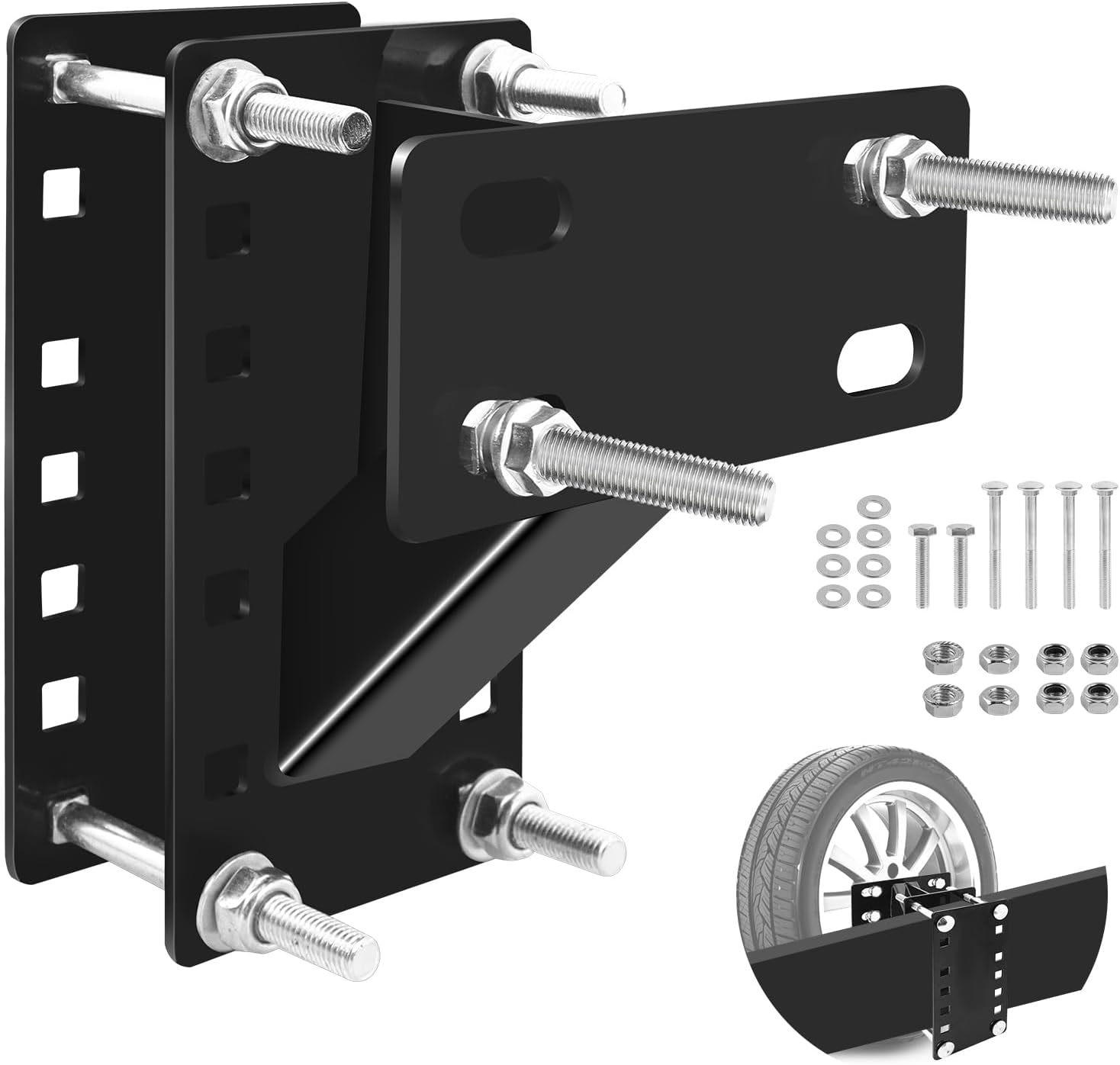
This universal spare tire mount carrier holder is built for utility trailers and boat trailers, offering a secure fit for 4, 5, and 6 lug wheels. It supports multiple bolt pattern sizes and a heavy-duty load capacity while resisting rust with a durable finish. The design allows easy installation and lets you choose the steel beam height for a better fit.
What to Watch Out for Before Installing Your Spare Tire Mount
[Products Worth Considering]

These aluminum alloy tire valve stem caps with an O-ring seal help protect valve stems from corrosion while adding a clean, stylish look to your vehicle. The universal fit works across cars, trucks, motorcycles, bicycles, and more, making them an easy upgrade for everyday driving and off-road use. Installation is quick, and the included four-pack keeps all your tires dressed and protected.

The GADFISH spare tire carrier is built for reliable hauling with a reinforced welded triangular structure and a behind plate that securely holds the tire up to 150 lbs. It fits a wide range of trailer wheel lug setups, making it suitable for boat trailers as well, while the sloping design helps reduce wind resistance and provides low-ground clearance. Installation is designed to be straightforward with different length bolts and no drilling required.

This side-mounted U-bolt spare tire bracket helps keep a trailer spare wheel secure and protected while you travel. It supports trailer frames up to 2–3 inches wide and fits up to 15-inch tires for 4- or 5-lug wheels. The galvanized steel threaded carrier is built for long-lasting corrosion resistance and installs easily with included lug nuts and U-bolt.
Rear Camera, Sensors, Lights, and License Plate
A tire or accessory can reduce the camera’s field of view and may interfere with rear-camera detection, parking support, trailer guidance, or other features, depending on your Tacoma. Toyota’s 2024 Tacoma guidance notes that rear-camera systems can become unavailable when visibility is poor or the tailgate is open. The Trailer Backup Guide on equipped models also depends on an unobstructed rear-camera view.
After installation, confirm that the camera still shows a useful rear view and that no carrier component blocks the tail lamps, center brake lamp, reflectors, license plate, or plate light. NHTSA guidance also warns against modifications that adversely affect rearward visibility or required lighting.
Rear Weight and Load Distribution
Add the weight of the carrier, wheel, tire, table, jack, fuel mounts, recovery gear, bike rack, hitch extension, and anything placed in a secondary receiver. Compare the total with every applicable rating. A carrier that is strong enough for the tire can still overload the truck, the original receiver, an accessory receiver, or the rear axle.
Weight mounted farther behind the hitch creates more leverage than the same weight placed close to the bumper. Use only combinations the carrier manufacturer approves, especially for rough roads or off-road driving.
Clearance and Contact Points
Check clearance with the carrier closed, fully open, and loaded. The tire and swing arm must not contact the bumper, tailgate, body, exhaust, trailer plug, leaf spring, shackles, or ground through the full range of expected movement. Also verify departure clearance on inclines and the space needed to open the tailgate.
Pro Tip: Measure the actual mounted tire, not the size printed on the sidewall alone. Real dimensions vary by tire model, wheel width, inflation, and load. Make a simple cardboard profile of the tire and swing path when bumper or tailgate clearance is tight.
Step-by-Step Installation Guide for Your Tacoma Tire Mount
The following process applies to a typical bolt-on, receiver-mounted swing-away carrier. Stop and follow the product manual when its instructions differ. Bumper-mounted, welded, or body-mounted carriers require their own procedures.
[Products Worth Considering]

Mount your spare tire directly to the inside wall of an enclosed trailer or garage to save space and keep your tire secure. This wall-mount spare tire carrier is designed for universal trailer tire fit and includes a fixed plate and chute for convenient screw replacement. Nylon insert hex lock nuts help prevent the tire from falling off, and wing hardware enables faster load and unload during maintenance.

This universal spare tire mount fits 4, 5, and 6 lug trailer wheels with bolt patterns from 4" to 5.5" and helps keep your tire securely locked in place. Its reinforced triangular structure with a sturdy behind plate is designed to handle up to 150 lbs, making it suitable for boat, camper, and RV spare tire mounting. The angled raised design reduces wind resistance and installation is straightforward with different length bolts and no drilling required.

This spare tire tool kit is designed for the 2004 to 2018 Ford F-150 to help you loosen and tighten wheel lug nuts and manage the spare tire and provided jack functions from underneath the vehicle. It includes the lug nut wrench and extension pieces plus a convenient storage carrying case for organized transport. The jack itself is not included.
Required Tools and Materials
- Wheel chocks and parking brake
- Socket set and combination wrenches in the sizes listed by the carrier manufacturer
- Calibrated torque wrench with the required range
- Tape measure or ruler
- Tire-pressure gauge
- Work gloves and eye protection
- Carrier, hitch pin or lock, anti-rattle hardware, wheel plate, lug hardware, and all supplied spacers or washers
- Camera, sensor, light, or license-plate relocation kit when required
- A helper for lifting heavy components
Installation Process Overview
- Park safely. Use a level surface, shift into Park or gear, set the parking brake, chock a wheel, and remove cargo that blocks access to the receiver.
- Inspect the truck and parts. Check the receiver for damage, heavy corrosion, bent metal, loose mounting hardware, or an obstructed pin hole. Compare every carrier part with the manufacturer’s packing list.
- Confirm dry fitment. Measure receiver depth, bumper clearance, tailgate clearance, and the carrier’s swing path before tightening anything. Confirm that the carrier seats fully and that the hitch pin passes through cleanly.
- Install the receiver section. Slide the carrier shank into the approved receiver. Install the supplied hitch pin or lock and the exact anti-rattle or wedge hardware specified by the manufacturer.
- Assemble the pivot and swing arm. Support the swing arm while fitting the pivot hardware, washers, bushings, latch, stop, and safety pin. Do not substitute hardware unless the manufacturer approves it.
- Set the wheel plate. Position the plate so the loaded tire clears the bumper, tailgate, ground, and accessories. Keep the tire as close to the carrier as the design allows to reduce movement.
- Mount the wheel and tire. Lift with a helper when needed. Use the correct lug hardware, thread engagement, washers, and tightening pattern. Torque only to the carrier manufacturer’s specification.
- Install required relocation equipment. Relocate the camera, sensors, license plate, plate light, or lamps only with a compatible kit and instructions. Protect wiring from heat, pinching, water, and the swing mechanism.
- Torque and mark fasteners. Tighten all fasteners in the specified sequence and to the specified values. Apply removable torque-mark paint if desired so movement is easy to spot during inspections.
- Run a full function test. Open and close the carrier several times. Confirm that the latch and safety pin engage, the tailgate opens, the tire cannot contact the truck, and all lights, cameras, sensors, and warning systems operate as expected.
- Complete a low-speed road test. Drive slowly on a smooth route, listen for movement, then recheck the carrier and fasteners. Re-torque at the interval stated in the product manual.
Compatibility With Overlanding Gear and Accessories
A swing-away carrier can support overlanding accessories only when the manufacturer rates the exact mounting point and combined load. A table, jack, fuel container, recovery board, bike rack, and hitch extension are not weight-free additions. Include every bracket and fastener in your total.
Keep accessories inside the carrier’s allowed envelope so they do not interfere with the latch, tailgate, lamps, camera, exhaust, or departure angle. Secure fuel only in a purpose-built container and mount approved by its manufacturer, away from heat and likely impact points. Never use an accessory receiver for towing unless the carrier manufacturer explicitly provides a towing rating and instructions for that use.
Real Tacoma Owner Experiences With Their Spare Tire Mount
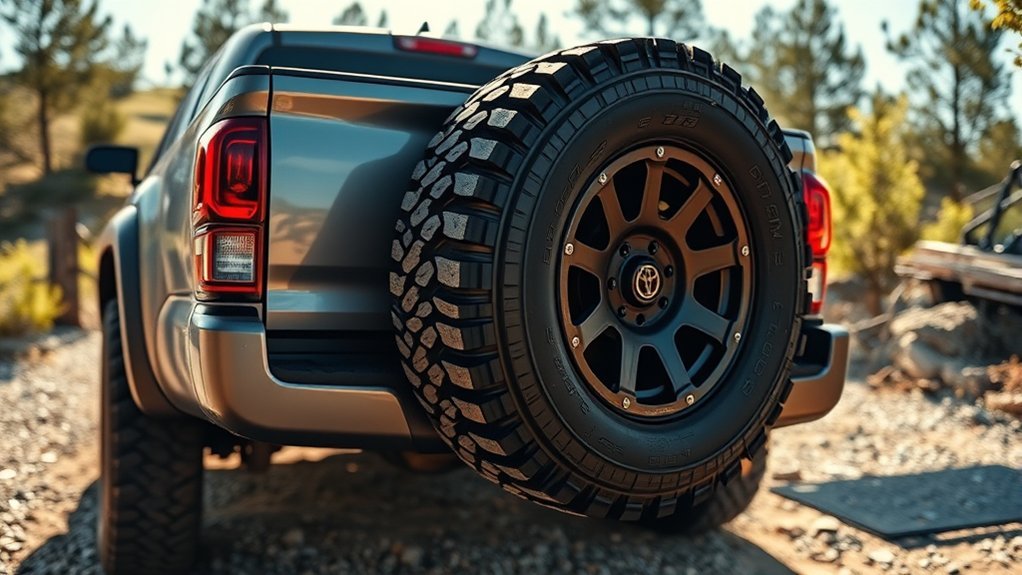
Owner reports can help you identify common annoyances, but they cannot prove that a carrier will fit your truck. Tacoma configurations vary, and aftermarket bumpers, receivers, suspension, wheels, tires, cameras, and exhaust systems create different results. Treat forum posts as leads for measurements, not as installation specifications.
Installation Challenges Encountered
| Challenge | Likely Cause | Safe Response |
|---|---|---|
| Carrier will not seat fully | Insufficient hitch-pin-to-bumper clearance, obstruction in receiver, wrong shank size, or under-bed spare interference | Stop and verify the fitment drawing; do not force or drill the receiver unless the manufacturer specifically instructs it |
| Tailgate contacts the tire | Wheel plate position, tire width, offset, or limited swing angle | Use approved adjustment positions or a compatible plate; do not operate with contact |
| Camera view is blocked | Tire or accessory sits in the camera’s field of view | Use a compatible relocation solution and test every affected system |
| Carrier rattles | Loose anti-rattle hardware, latch adjustment, pivot wear, incorrect torque, or poor wheel retention | Stop, unload if necessary, and inspect according to the product manual |
| Swing arm sags or is hard to latch | Overload, uneven accessory placement, pivot wear, truck parked off-level, or adjustment needed | Verify load and adjustment; replace worn parts and contact the manufacturer when alignment cannot be restored |
Tire Size Compatibility Issues
A label such as “up to 35 inches” describes only one part of fitment. A wide tire on a low-offset wheel may sit farther toward the truck or farther rearward than a narrower tire of the same diameter. The mounting plate must also match the wheel’s bolt pattern, center opening, lug-seat type, and required thread engagement.
Do not hammer brackets, bend a carrier, stack unapproved spacers, or allow the tire to rub the exhaust, suspension, tailgate, or body. Contact means the setup does not have adequate clearance. Use an approved adjustment, wheel plate, spacer, or different carrier instead.
Long-Term Performance Insights
Long-term reliability depends on load control and maintenance, not only steel thickness. Dust, road salt, water, vibration, and repeated opening can loosen fasteners and wear pivots, latches, bushings, or anti-rattle parts. Powder coat can also chip around contact points, allowing corrosion to begin.
Follow the manufacturer’s inspection, lubrication, and re-torque schedule. Wilco, for example, publishes periodic pivot tightening and maintenance guidance for its products, while other brands use different hardware and values. Never copy one brand’s torque figure to another carrier.
Troubleshooting Rattles, Sag, and Hard-to-Open Carriers
- Rattle at the receiver: Verify the hitch pin, wedge, clamp, or anti-rattle device is installed in the correct orientation and tightened to specification.
- Rattle at the wheel: Check lug hardware, wheel-plate position, thread engagement, and tire contact with the carrier.
- Latch will not close: Park on level ground, unload accessories, inspect alignment, and adjust only through manufacturer-approved points.
- Carrier drops when opened: Stop using it until the pivot, bearings or bushings, stop, and load distribution are inspected.
- Rust at chips or welds: Clean the area, follow the manufacturer’s coating-repair guidance, and replace structurally damaged parts rather than covering them with paint.
- Camera or sensor warning: Confirm the tailgate is fully latched, clean the camera and sensors, remove obstructions, and verify relocation wiring. Consult Toyota service guidance if the warning remains.
Essential Maintenance Tips for Your Tacoma Spare Tire Mount
- Before each trip: Confirm the primary latch, secondary safety pin, hitch pin, wheel retention, lights, plate, camera view, and accessory straps are secure.
- After initial installation: Recheck and re-torque fasteners at the interval stated by the carrier manufacturer.
- After rough roads: Inspect for shifted parts, fresh metal marks, loose hardware, cracked coating, bent brackets, tire contact, and wiring damage.
- At the manufacturer’s service interval: Clean and lubricate approved pivot and latch points, adjust the latch, and replace worn bushings, washers, seals, or anti-rattle parts.
- Monthly: Check the spare tire cold with a gauge. NHTSA recommends checking all tires, including the spare, at least once a month and using the pressure listed by the vehicle manufacturer or owner’s manual rather than the tire sidewall’s maximum figure.
- Seasonally: Remove dirt and road salt, inspect welds and high-stress areas, repair coating damage correctly, and confirm drain holes remain open.
For a stock-size spare, use the pressure specified for your exact Tacoma configuration. Toyota’s published 2024 Tacoma maintenance data shows that recommended pressures vary by tire and spare type, so a single universal PSI figure is not appropriate.
Can You Still Tow With a Hitch-Mounted Spare Tire Carrier?
Only some carriers include a secondary receiver that is approved for towing. Others allow only a bike rack or cargo accessory, and some prohibit particular rack types or extensions. The presence of a receiver tube does not prove that it has a towing rating.
When towing is permitted, follow the carrier manufacturer’s instructions and use the lowest applicable limit among the Tacoma, factory or aftermarket hitch, carrier, secondary receiver, ball mount, ball, and trailer components. Include the carrier and spare when checking payload, rear axle load, gross vehicle weight, and handling. Recalibration may also be required on equipped Tacoma models when the trailer connection geometry changes.
Frequently Asked Questions
What should you not tow with a Tacoma?
Do not tow any trailer that exceeds the limits for your exact Tacoma configuration or any component in the towing system. With a hitch-mounted tire carrier, do not tow unless the carrier’s secondary receiver is explicitly rated and approved for towing. Also avoid towing when the carrier, spare, or accessories cause overload, blocked lighting, poor visibility, unsafe clearance, or unstable handling.
Will every 35-inch tire fit a Tacoma spare tire carrier?
No. A maximum diameter claim does not account for tire width, actual measured diameter, wheel offset, mounting depth, bolt pattern, bumper shape, tailgate clearance, camera position, or total loaded weight. Confirm the exact tire-and-wheel combination with the carrier manufacturer.
Can a spare tire carrier block the Tacoma backup camera?
Yes. The tire, wheel plate, fuel container, jack, or bike rack can enter the camera’s field of view. Some Tacoma safety or trailer-assistance features also depend on the rear camera. Use a compatible relocation kit when required and test the camera, sensors, and warning systems before driving.
Does a hitch carrier reduce payload or towing capacity?
The carrier and everything mounted on it count as vehicle load and add weight behind the rear axle. They reduce the remaining payload available for people and cargo. Towing capability also depends on whether the carrier and any secondary receiver are rated for towing, plus the limits of every other component.
How often should you inspect a swing-away tire carrier?
Inspect the latch, safety pin, hitch connection, wheel retention, pivot, accessories, lights, camera, and visible structure before each trip. Recheck after installation and rough-road use, then follow the manufacturer’s specific lubrication, adjustment, part-replacement, and re-torque schedule.
Can you leave the carrier installed every day?
You can leave a properly fitted carrier installed if the manufacturer allows continuous use and it remains secure, legal, and within load limits. Remember that it adds length and weight, changes parking clearance, may affect camera visibility, and needs regular inspection even when you are not off-roading.
Conclusion
A Tacoma spare tire carrier can be a practical upgrade when a full-size spare no longer fits under the truck or you need faster trail access. The best setup is not simply the largest carrier. It is the one that matches your model year, receiver, tire and wheel, rear-camera system, load limits, and intended accessories.
Measure before buying, follow the exact installation manual, keep every latch and fastener maintained, and reject any setup that rubs, rattles, blocks safety equipment, or exceeds a rating. Those checks preserve the carrier’s convenience without turning extra rear storage into an avoidable safety problem.
Sources
- Toyota Tacoma Manuals and Warranties — model-year owner’s manuals, equipment guidance, maintenance data, and vehicle-specific instructions
- Toyota 2024 Tacoma: Warning Messages — rear-camera visibility, tailgate status, parking-assist, and sensor warnings
- Toyota 2024 Tacoma Hybrid: Trailer Backup Guide — camera dependence, tailgate requirements, obstructions, and trailer-system recalibration guidance for equipped models
- NHTSA TireWise — cold tire-pressure checks, spare-tire maintenance, and use of vehicle-specified inflation pressure
- NHTSA Rear-Camera Obstruction Interpretation — federal rear-visibility considerations for equipment installed behind a vehicle
- RIGd Toyota Tacoma UltraSwing Fitment Page and Wilco Hitchswing Specifications — examples of product-specific fitment, camera, receiver, accessory, and maintenance requirements