Disclosure: As an Amazon Associate, we earn from qualifying purchases. If you click a link on this page and make a purchase, we may receive a small commission at no extra cost to you.
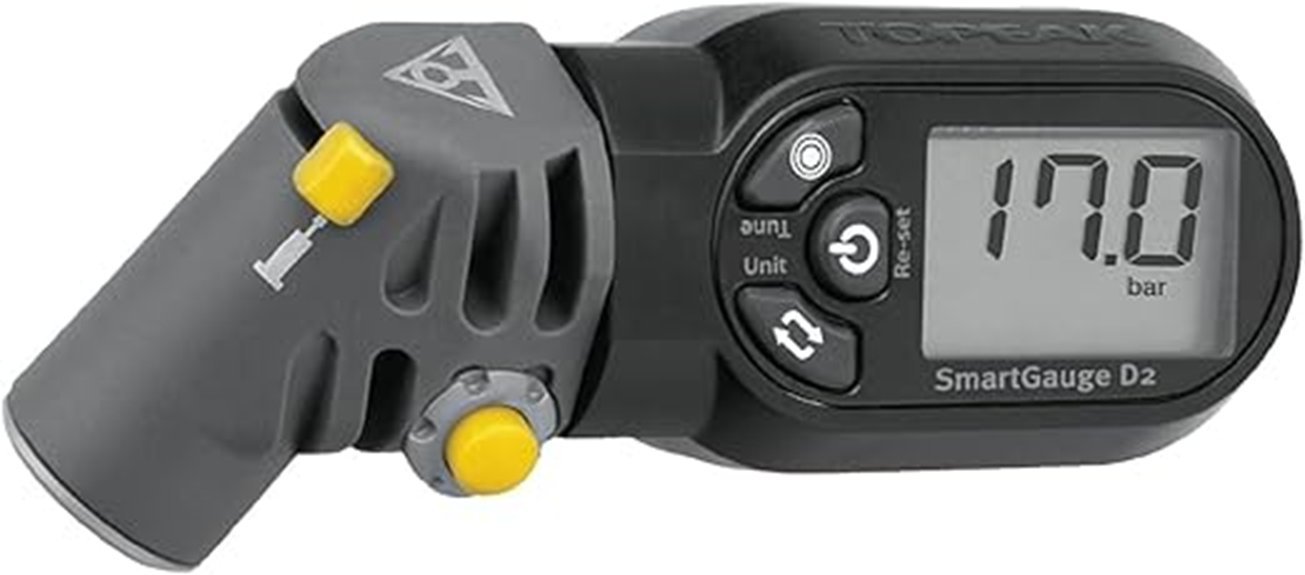
Small pressure changes can affect grip, comfort, rolling resistance, and suspension feel, yet many pump gauges are hard to read or awkward to use at the valve. The Topeak SmartGauge D2 is a compact digital gauge made for quick checks on Presta and Schrader valves, bicycle tires, suspension forks, and rear shocks. Its strongest features are the 250 PSI range, 180-degree rotating SmartHead, and air-release button for controlled pressure reduction. The main tradeoffs are a non-backlit screen and the small amount of air that can escape during each reading, which matters most on low-volume systems.
Quick Verdict
Rating: 8.6/10, recommended with caveats
Best For: Cyclists who want one portable gauge for road, gravel, mountain bike, and suspension pressure checks.
Bottom Line: The SmartGauge D2 gives you a broad pressure range, dual-valve support, and useful bleed control in a 65 g tool. It is less appealing if you need a backlit display, continuous live readings while bleeding, or the lowest possible air loss on tiny air chambers.
| Specification | Detail |
|---|---|
| Brand | Topeak |
| Model | SmartGauge D2 |
| Article number | TSG-02 |
| Product type | Digital pressure gauge |
| Valve compatibility | Presta and Schrader |
| Pressure range | Up to 250 PSI / 17 bar |
| Display units | psi, bar, and kg/cm² |
| Head movement | SmartHead rotates 180 degrees |
| Pressure adjustment | Built-in air-release button |
| Body material | Engineering-grade polymer |
| Dimensions | 10.2 x 4.5 x 3.5 cm / 4 x 1.8 x 1.4 in |
| Weight | 65 g / 2.29 oz |
| Battery | One CR2032 button cell, included |
| Auto-off | Screen turns off after 30 seconds of non-use |
| Warranty | Two years on mechanical components against manufacturing defects; battery excluded |
Key Takeaways
- The SmartGauge D2 reads pressures up to 250 PSI, so one tool can cover bicycle tires, suspension forks, and rear shocks.
- The SmartHead supports Presta and Schrader valves without a separate adapter, but you must slide the valve selector fully into position.
- The head rotates 180 degrees, not 360 degrees, which still helps when a valve sits close to a spoke, rotor, or frame part.
- The air-release button lets you reduce pressure in small steps after overinflating.
- Topeak states that each measurement may release about 1 to 1.5 PSI, an important limitation for low-volume tires and suspension chambers.
What Is the Topeak SmartGauge D2?
The Topeak SmartGauge D2 is a second-generation handheld digital pressure gauge. It is designed to measure bicycle tires, suspension forks, and rear shock units, rather than inflate them. You attach the SmartHead to the valve, wait for the reading, and use a separate pump when more pressure is needed.
The gauge combines a wide 250 PSI ceiling with a compact engineering-grade polymer body. At 65 g, it is light enough for a ride bag, travel case, or workshop drawer. The included CR2032 battery means it is ready to use after you remove the battery insulation tab.
Who Should Buy It?
Best For
- Road, gravel, and mountain bike riders who want repeatable pressure checks.
- Home mechanics who need one gauge for tires, forks, and rear shocks.
- Riders who overinflate slightly and then bleed down to a preferred setting.
Skip If
- You need a backlit screen for dark garages or nighttime adjustments.
- You want a gauge that adds air as well as measures it.
- You are checking very small air chambers where a 1 to 1.5 PSI loss is significant.
Before You Buy: The D2 has a 180-degree rotating SmartHead and a standard LCD. Do not confuse it with the newer SmartGauge D2X, which has a backlit 360-degree rotating display and a different pressure range.
[Products Worth Considering]

Tiakia’s mini high-pressure frame pump delivers up to 260 PSI for faster, more efficient inflations with an optimized intake volume. It features a double-head valve design compatible with Schrader and Presta, plus a conversion for Donlop, making it versatile for bikes and many inflatables. The lightweight anodized aluminum build includes a mounting bracket for convenient carry, while the flexible high-pressure hose and IPX4 waterproof body support outdoor use.

The Topeak SmartGauge D2 delivers precise digital tire pressure readings for bikes, motorcycles, and sports equipment up to 250 psi (17 bar). Its rotating SmartHead works with both Presta and Schrader valves, so you can check pressure quickly without adapters. The LCD display makes it easy to read results in psi, bar, or kg/cm² with an included CR2032 battery for immediate use.
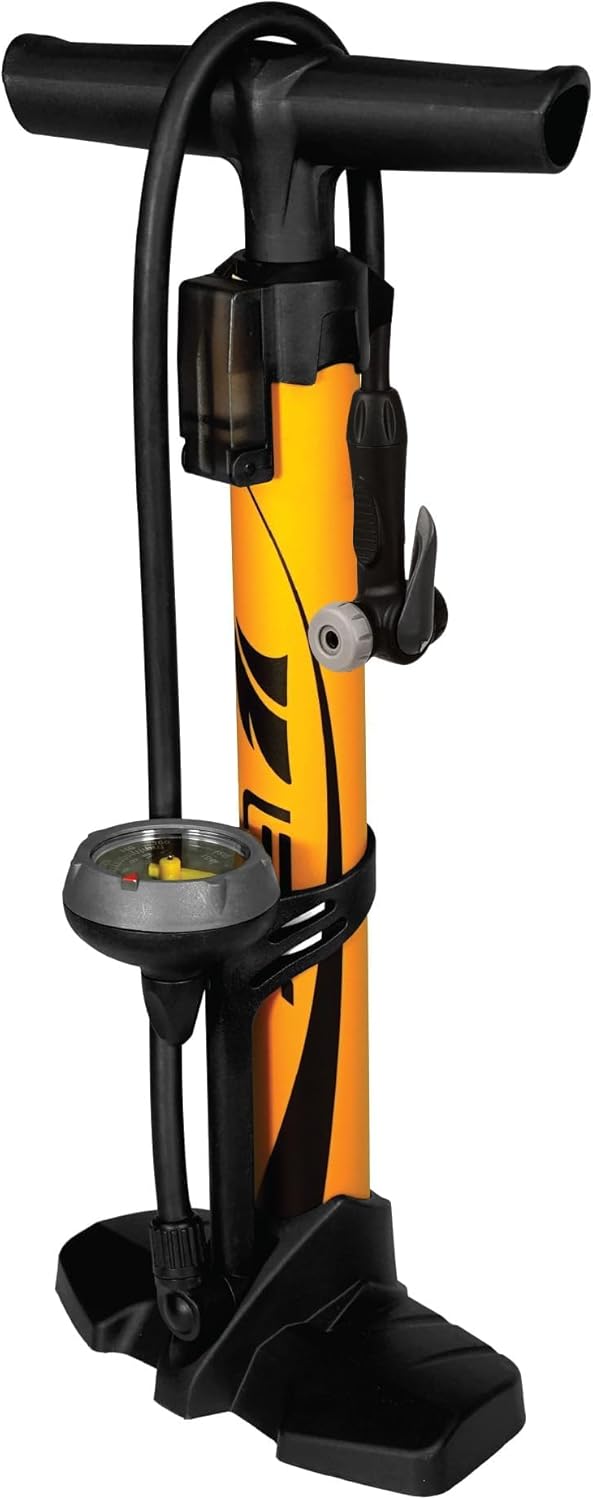
This durable BV floor pump delivers up to 160 PSI for confident inflation of bikes and other high-pressure uses. Its twin valve head lets you quickly switch between Presta and Schrader valves by reversing the components, with no compromise. The ergonomic handle makes pumping comfortable, and the compact size is easy to carry for rides and home storage.
Design and Build Quality
The 10.2 x 4.5 x 3.5 cm body is small enough to hold in one hand while you steady the wheel or suspension component with the other. Its engineering-grade polymer shell keeps weight down, though it does not turn the gauge into a drop-proof workshop tool. Topeak specifically warns against violent shaking, dropping, heavy pressure on the LCD, and exposure to sand or dirt.
The controls are arranged around the display and head. You get power/reset, pressure-unit selection, valve selection, an adjusting-mode control, and the air-release button. The layout is functional, but first-time use is easier after a quick look at the manual because the valve selector must be fully engaged.
Presta and Schrader Valve Compatibility
The SmartHead works with both common bicycle valve types without swapping an internal insert or carrying a loose adapter. Slide the selector to Presta or Schrader, then press the head squarely onto the valve. This is useful if your household has road bikes, mountain bikes, kids’ bikes, or equipment with mixed valve types.
The 180-degree rotating head improves access when the valve is close to a spoke or another obstruction. It does not spin through a full circle, but the available movement is enough to place the LCD in a more readable position for most bicycle wheels.
LCD Display and Measurement Units
The digital LCD shows pressure in psi, bar, or kg/cm². You can select the unit before measuring and change the displayed unit after a reading, which avoids manual conversion when you follow a suspension chart or tire recommendation written in a different format.
The screen shuts off after 30 seconds of non-use to preserve battery life. It is clear in normal lighting, but it is not backlit. That limitation matters if you often work in a dim garage, adjust pressure before sunrise, or want to read the display at a dark trailhead.
Pressure Range, Accuracy, and Air Release
With a maximum reading of 250 PSI / 17 bar, the D2 covers low-pressure mountain bike tires, higher-pressure road tires, and many bicycle suspension settings. The broad range is one reason it works well as a single household gauge instead of a tire-only tool.
The air-release button is more useful than it first appears. You can add slightly too much air with your pump, attach the gauge, enter adjusting mode, and release air in controlled steps. This method is often faster than repeatedly disconnecting the pump and guessing how much pressure was lost.
There is one important measurement effect to understand. Topeak’s manual states that about 1 to 1.5 PSI may be lost after each pressure measurement. That amount is minor at high road-tire or shock pressures, but it can be noticeable in a low-pressure mountain bike tire or a small suspension chamber. Reset the display to zero before the next measurement and avoid repeated checks when the air volume is small.
Pro Tip: Inflate a little above your target, switch the gauge to adjusting mode, release a short burst of air, and wait for the reading to settle before bleeding again. This reduces back-and-forth pumping and helps you approach the target gradually.
How It Performs in Real Use
For Road Bike Tires
The 250 PSI ceiling easily covers normal road-bike pressure ranges. The digital display is more precise to read than a small pump dial, and the unit selector is helpful when tire sidewalls, charts, and pump gauges use different units. The small measurement loss is usually a minor percentage of the total pressure.
For Gravel and Mountain Bike Tires
Low-pressure tires benefit from repeatable readings because a change of one or two PSI can affect grip and rim protection. The bleed button makes fine adjustments convenient, but the stated 1 to 1.5 PSI loss per check means you should minimize unnecessary reconnections. Seat the head firmly and read once whenever possible.
For Suspension Forks and Rear Shocks
The high pressure capacity allows the D2 to check many fork and shock settings. It is useful for confirming a setup after using a shock pump, especially when the pump’s built-in dial is difficult to read. Because suspension chambers can have low air volume, account for the air lost when connecting and measuring.
For Travel and Workshop Use
At 65 g, the gauge fits easily in a tool roll, race bag, or luggage. It is more practical as a setup and troubleshooting tool than as a stand-alone roadside solution because it cannot add air. Pair it with a suitable pump, and carry a spare CR2032 on longer trips where replacement batteries may be hard to find.
How to Use the SmartGauge D2 Correctly
- Remove the battery insulation tab before first use, then press the power button.
- Select psi, bar, or kg/cm² and rotate the head to a readable angle.
- Slide the valve selector fully to Presta or Schrader.
- For a Presta valve, loosen the small valve nut before attaching the gauge.
- Press the SmartHead straight onto the valve and hold the tire and gauge steady until the reading appears.
- Use adjusting mode and the air-release button when you need to lower pressure.
- Reset the display to zero before measuring another tire or suspension component.
If the head is difficult to engage, move the Presta/Schrader selector back and forth several times, set it fully in the correct position, reset the gauge, and try again. If the display shows “HI” during a measurement, the pressure is above the gauge’s range. A “HI” reading immediately after power-on can indicate damage.
Safety, Battery, and Care
The included CR2032 is a button-cell battery. Keep the battery and the gauge’s battery compartment away from children because swallowed button cells can cause severe internal injury. Install the battery with the correct polarity and secure the cover after replacement.
Keep the gauge dry, wipe moisture away promptly, and do not clean it with alcohol, paint thinner, or other solvents. Store it away from magnets, sand, and heavy dust. The two-year warranty covers mechanical components against manufacturing defects, while the battery is excluded, so keep your original receipt if warranty service may be needed.
Pros and Cons
Pros
- Wide 250 PSI range covers tires, forks, and rear shocks.
- Supports Presta and Schrader valves without loose adapters.
- Air-release button helps you fine-tune pressure.
- Compact 65 g body is easy to store or carry.
- Three selectable pressure units suit different charts and preferences.
Cons
- The LCD has no backlight.
- Each reading may release about 1 to 1.5 PSI.
- The gauge measures and bleeds pressure but cannot inflate.
Is It Worth the Price?
The SmartGauge D2 sits in the practical mid-range of bicycle pressure gauges. Its value comes from combining three jobs in one small device: checking tire pressure, checking suspension pressure, and bleeding excess air. That broad use is more valuable than a basic tire-only gauge if you maintain several bikes or tune suspension at home.
It is worth considering if you care about repeatable setup and want a portable tool that handles both valve types. It is not the best fit if a backlit screen, continuous pressure display while bleeding, or minimal air loss matters more than price and simplicity.
[Products Worth Considering]

Inflate Presta and Schrader bike and car tires with one compressor attachment, including tubeless setups. The digital gauge lets you monitor 2–200 PSI readings in 0.1 PSI increments with ±2 PSI accuracy, while the adjustable lever and built-in bleed button help you dial in precise pressure. Quick-connect coupler, hose, and a complete Presta service kit with spare cores and caps make it ready for fast maintenance.

The TOOLITIN floor bike pump delivers high pressure performance with an easy-to-read gauge so you can dial in the right tire pressure for safer rides. It is compatible with both Presta and Schrader valves and features a stable, durable design for efficient pumping. Suitable for road, MTB, and hybrid tires as well as inflating sports balls and other inflatables, it also includes ball and bladder needles and convenient accessory storage.

A portable bicycle repair bag built for on-the-go maintenance, pairing a scalable mini tire pump with a multi-tool, crank and bone wrenches, tire levers, and self-adhesive glueless patches. The included patch set helps you quickly seal punctures using the integrated prep/rasp step, while the waterproof nylon bag keeps tools organized and easy to access. Ideal for road, mountain, and home bike emergencies, repairs, and routine adjustments.
How It Compares to Alternatives
The newer Topeak SmartGauge D2X is the closer upgrade. It adds a backlit 360-degree rotating display, a 5 to 260 PSI range, and continuous readings in pressure-adjusting mode, so it is better for dark conditions and easier bleed-down tuning. The original D2 remains the simpler choice when you do not need those display upgrades.
The SKS Airchecker 2.0 is another digital option with a pressure-release function and a rotating multi-valve head, including support for the Schwalbe Clik Valve. A basic analog gauge such as the Planet Bike Dial Gauge avoids batteries, but it gives up the D2’s digital unit switching and high-pressure suspension range.
[Products Worth Considering]

This tire inflator with pressure gauge delivers long-lasting performance with a durable rubber-protected gauge and sturdy build. The longer hose and 360 swivel air chuck help you seal the valve securely and keep your hands free while measuring, inflating, or deflating. It’s battery-free for reliable use and provides ±2 PSI accuracy in the mid-range for most typical tires, with universal compatibility for 1/4 NPT compressor outputs.

The Vibrelli Air Master mini bike pump locks securely to both Presta and Schrader valves, so you can inflate tires without changing adapters. It delivers high-pressure inflation up to 120 PSI for road bikes, MTB, BMX, and kids’ bikes, while staying compact and lightweight for easy carry. A frame mounting bracket with a Velcro strap helps keep the pump firmly in place with no rattles.

AstroAI’s calibrated digital tire pressure gauge delivers precise readings across a 0–150 PSI range, with high clarity from a backlit LCD. Built for everyday road use, it features one-button operation, an anti-slip ergonomic grip, and support for multiple pressure units plus auto shutoff. Powered by AAA batteries, it’s an all-weather essential for checking tire health and TPMS warnings.
Frequently Asked Questions
Does the SmartGauge D2 work with tubeless tire valves?
Yes. It works with tubeless setups that use standard Presta or Schrader valve stems. Make sure the selector is fully set to the correct valve type and press the head on squarely to limit air loss.
Can it measure low-pressure mountain bike tires?
Yes, but use it carefully because Topeak states that a measurement may release about 1 to 1.5 PSI. On a low-pressure tire, avoid repeated checks and wait for the reading to stabilize before making another adjustment.
Does it work on suspension forks and rear shocks?
Yes. The D2 is designed for tires, suspension forks, and rear shock units, with readings up to 250 PSI. Remember that connecting any gauge can change pressure in a small air chamber, so account for the stated measurement loss.
Does the SmartGauge D2 inflate a tire?
No. It measures pressure and releases excess air, but it does not add air. You still need a floor pump, mini pump, compressor, or shock pump that suits the valve and pressure range.
How often should the CR2032 battery be replaced?
Replace it when the low-battery symbol appears, the screen becomes weak, or the gauge stops powering on reliably. Battery life depends on use and storage, and the 30-second auto-off feature helps reduce unnecessary drain.
Does the head rotate 360 degrees?
No. Topeak’s official D2 product page specifies a 180-degree rotating SmartHead. The newer D2X has the 360-degree rotating display, which is a common source of confusion between the two models.
Does the gauge need regular calibration?
The manual does not provide a routine user-calibration procedure. Reset the display to zero before each new measurement, protect the gauge from drops and contamination, and compare it with a known reference if readings become inconsistent.
What does the two-year warranty cover?
Topeak states that the two-year warranty covers mechanical components against manufacturing defects. The battery is excluded, and damage from crashes, abuse, modification, or unintended use can void coverage, so keep the original receipt.
The Bottom Line
The Topeak SmartGauge D2 is a strong choice for cyclists who want one compact gauge for Presta and Schrader tires plus bicycle suspension. Its broad range, 180-degree SmartHead, and bleed button are the main strengths, while the non-backlit screen and stated 1 to 1.5 PSI measurement loss are the key limitations. Skip it for frequent low-light work or ultra-low-volume systems, but consider it for reliable everyday setup and workshop checks.