
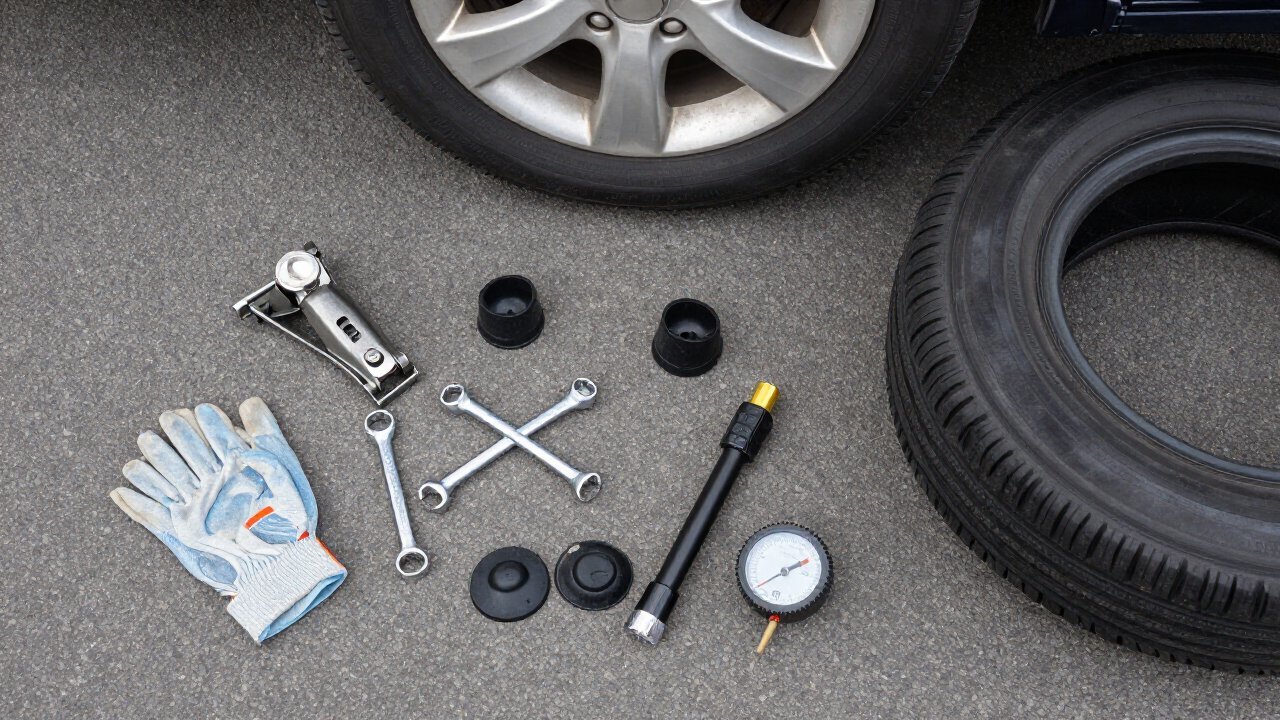
To change a tire you need four essentials: an inflated spare tire (or the sealant kit your car came with), a jack, a lug wrench and wheel wedges. If your wheels have locking lug nuts, add the wheel lock key. A flashlight, gloves, a tire pressure gauge, a small board for the jack and a portable inflator turn a stressful roadside job into a manageable one. This guide covers every tool, what each one does, which ones your car probably already has, and the upgrades worth buying.
Last updated: November 23, 2026
Quick Answer
The minimum tire replacement tools are a spare tire, a jack, a lug wrench and wheel wedges, plus the wheel lock key if your car uses locking lug nuts. Helpful extras include a flashlight or headlamp, work gloves, a tire pressure gauge, a kneeling mat, a rain poncho, a flat board to steady the jack, reflective warning triangles and a 12-volt portable inflator.
Key Takeaways
- Most cars that come with a spare also carry a jack and lug wrench, usually under the trunk floor or with the spare.
- Many newer cars have no spare at all and use a sealant and compressor kit instead, so check before you need it.
- A four-way cross wrench or breaker bar is the single most useful upgrade over the small factory wrench.
- A jack is only for lifting. At home, always support the car on jack stands before reaching under it.
- Finish with a torque wrench set to your vehicle’s lug nut specification and recheck after a short drive.
Essential Tools to Change a Tire
These items are required. Without any one of them, you can’t safely complete a roadside tire change.
| Tool | What it does | Usually included? |
|---|---|---|
| Spare tire | Replaces the flat. Can be full-size or a compact temporary spare (donut). | On many cars, but not all |
| Jack | Lifts the corner of the vehicle so the wheel can come off. Most cars carry a scissor jack; trucks often carry a bottle jack. | Yes, when a spare is supplied |
| Lug wrench | Loosens and tightens the lug nuts or wheel bolts. Some jacks have the wrench built into the handle. | Yes, when a spare is supplied |
| Wheel wedges (chocks) | Stop the car from rolling while it is lifted. | Sometimes |
| Wheel lock key | Removes the one locking lug nut on each wheel, if fitted. | Yes, if the car has wheel locks |
| Owner’s manual | Shows the jack points, spare location and lug nut torque. | Yes |
Products Worth Considering

This 1/2-inch drive breaker bar delivers powerful leverage for loosening and tightening stubborn lug nuts and automotive fasteners. The 180-degree flex head helps you reach tight spaces at the angle you need, making tire and brake jobs easier. A spring-loaded ball detent design holds 1/2-inch sockets securely while the chrome-moly head provides durable strength for everyday use.

This VEVOR tire bead breaker uses a slide-hammer impact and wedge tip to separate tire beads from rims quickly and efficiently without damaging hub surfaces. The long handle and sturdy steel construction help reduce user strain while providing reliable, portable tire changing for cars, trucks, and more. Ideal for home mechanics and repair shops handling multiple vehicle tire sizes.

The Dr.Roc spare tire tool kit helps you release, lower, or raise your spare tire with reliable extension tools and a lug nut wrench. It is made from rustproof automotive-grade steel and includes an organized carry case for convenient storage. Designed for compatibility with select GM models from the late 1990s through 2019, it uses upgraded extension components to install and remove spare tires with less hassle.
Spare tire or sealant kit
Check which one your car has before you need it. A full-size spare matches your other tires and can be driven normally if it is properly inflated. A compact spare is lighter and smaller but usually carries a lower speed and distance limit, often printed on the tire or in the manual. Many newer cars skip the spare entirely and supply a tire mobility kit with a bottle of sealant and a small compressor. Those kits handle small tread punctures but can’t fix sidewall damage or a blowout. See how to drive on a donut tire for compact spare limits.
Jack
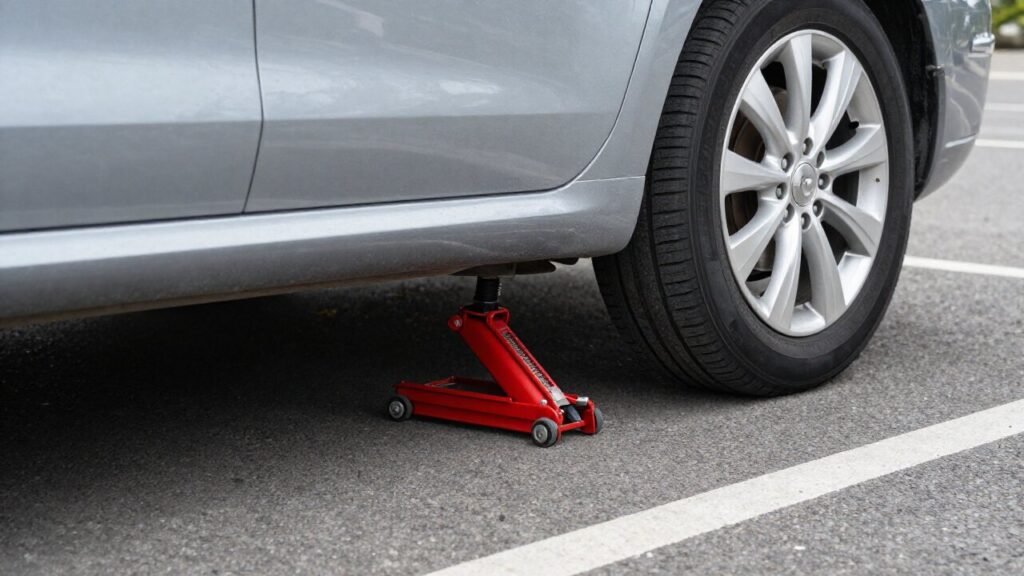
The factory jack is designed only to lift your specific vehicle at its marked jack points, on firm level ground. It is not designed to hold the car while you work underneath it. Use the jack points shown in your manual; placing a jack elsewhere can bend the body or let the car slip. Our guide to where to place a tire jack shows the common locations.
Lug wrench
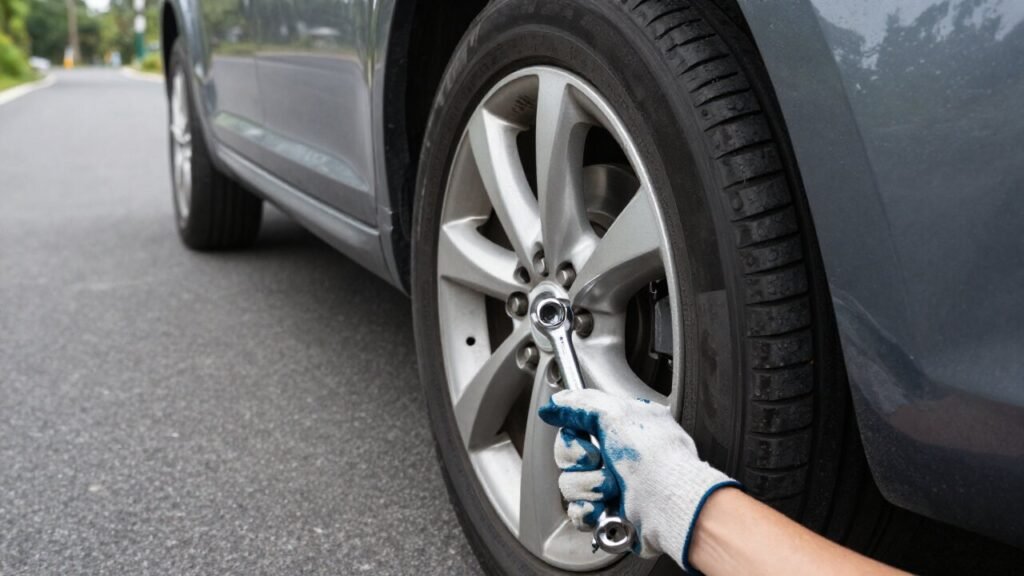
The wrench that comes with most cars is short, which makes tight or rusted lug nuts hard to break loose. It works, but it is the tool most worth upgrading.
Helpful Extras for a Roadside Tire Change
AAA lists several items that are not required but make changing a tire much easier. We agree with all of them and add a few of our own:
- Flashlight or headlamp: flats rarely happen in good light. A headlamp keeps both hands free.
- Work gloves: wheels and lug nuts are dirty, sharp-edged and sometimes hot.
- Tire pressure gauge: compact spares often need a higher pressure than your regular tires, and spares lose air in storage.
- Kneeling mat: a floor mat from the car works.
- Rain poncho: keeps you dry and visible.
- Small flat board: spreads the jack’s load on soft ground such as gravel or a grass shoulder.
- Portable 12-volt inflator: lets you top up a low spare or reinflate a tire after using sealant.
- Reflective warning triangles or flares: warn approaching traffic, especially at night or on a curve.
- High-visibility vest: makes you easier to see while you work.
- Wire brush or rag: clears mud, snow or rust from lug nuts and the hub before fitting the spare.
Upgrades Worth Buying
| Factory tool | Upgrade | Why upgrade |
|---|---|---|
| Short L-shaped lug wrench | Four-way cross wrench (star wrench) or a breaker bar with the right socket | Much more leverage and better grip on tight nuts |
| Scissor jack | Compact hydraulic bottle jack (rated above your vehicle weight) for trucks, or a low-profile floor jack at home | Faster, steadier lifting with less effort |
| No support stands | A pair of jack stands for home use | Required safety backup whenever you work under a lifted car |
| Hand tightening | Click-type torque wrench | Tightens lug nuts to the exact specification so wheels don’t loosen or warp brake rotors |
| Nothing | Tire plug kit and inflator | Permanent-style tread repairs for small punctures when you’re far from a shop |
AAA notes that the lug wrenches supplied with jacks can be difficult to use and suggests buying a good star wrench. A four-way wrench fits several common lug nut sizes, so confirm one end matches your lug nuts before you rely on it.
Tools for Changing Tires at Home
If you swap seasonal wheels yourself or rotate your own tires, a home kit is safer and quicker than using the roadside tools:
- Floor jack with a capacity above the weight you will lift.
- Two or four jack stands rated for your vehicle.
- Breaker bar and impact sockets in your lug nut size.
- Torque wrench covering your vehicle’s lug nut specification.
- Cordless impact wrench (optional) for removing nuts. Do the final tightening with the torque wrench, not the impact gun, to avoid over-tightening.
- Tire pressure gauge and inflator to set pressures after mounting.
- Tread depth gauge to check wear while the wheels are off.
- Wheel wedges for the wheels that stay on the ground.
Mounting a tire onto a wheel is a different job that needs a bead breaker, tire spoons or a tire machine, plus a way to balance the wheel. For most car and truck owners, that part is best left to a tire shop.
How the Tools Are Used: Quick Steps
- Pull off the road onto firm, level ground, turn on your hazard lights and apply the parking brake.
- Place wheel wedges against the tire diagonally opposite the flat.
- Remove the hubcap if fitted and loosen each lug nut about half a turn with the wrench while the tire is still on the ground.
- Position the jack at the correct jack point and lift until the flat tire clears the ground.
- Remove the lug nuts and the flat, fit the spare and thread the nuts on by hand.
- Lower the car until the tire touches the ground, then tighten the nuts in a star or crisscross pattern.
- Lower the car fully, remove the jack, and tighten again. Check the spare’s pressure as soon as you can.
For detailed instructions and photos, read our complete step-by-step guide to changing a car tire, and see how to loosen stubborn lug nuts if they won’t budge.
Never work under a car held only by a jack
A roadside jack is designed for lifting, not for supporting a vehicle while you reach underneath. Keep your body out from under the car, and use jack stands whenever you work on a lifted car at home.
Products Worth Considering

This 3-ton scissor car jack tire changing kit helps you lift cars and SUVs with a wide range to reach low sedans or higher vehicles. The set includes a ratchet wrench, multi-size lug wrench, gloves, a tire pressure gauge, and a storage bag for quick emergency repairs. Built for stable, secure lifting and universal compatibility, it’s ready for flat tires and roadside wheel changes.

This ecocstm ratchet wrench is designed to make emergency and routine tire changes faster with a 360° rotating head and quick forward/reverse switching. The extended handle provides extra leverage to reduce effort and hand fatigue, while the adapter helps fit many scissor jacks on cars, SUVs, trucks, and vans. Built for reliable performance with durable construction, it’s a practical travel essential for on-the-road preparedness.

The Gurduenon scissor car jack tire changing kit is designed for quick flat-tire replacement with a lifting capacity of 2.5 tons and a scissor-lift range sized for many vehicles. The complete emergency set includes a ratchet wrench, lug wrench, gloves, a pencil tire pressure gauge, and a storage bag for convenient trunk or garage use. Universal compatibility makes it suitable for cars, SUVs, and other vehicles roadside assistance needs.
How to Check Your Tire Change Kit
The worst time to discover a missing tool is on the shoulder of a highway. Check your kit twice a year, for example when you change your clocks or swap seasonal tires:
- Find the spare, jack, wrench and wheel lock key, and confirm you know how to release the spare (some trucks lower it from under the bed with a crank).
- Check the spare’s pressure and look for cracks; spares age even when unused.
- Make sure the lug wrench fits your lug nuts and the jack handle assembles correctly.
- Check sealant kit expiry dates if your car has one.
- Test your flashlight batteries and inflator.
Common Mistakes When Changing a Tire
- Jacking on soft or sloped ground. The jack can sink or tip.
- Loosening lug nuts after lifting. The wheel spins. Break them loose first.
- Using the wrong jack point. It can damage the body or let the car slide off.
- Over-tightening with an impact gun or your foot on the wrench. It can stretch studs and warp rotors.
- Forgetting to recheck torque. Many shops recommend rechecking lug nut torque after a short drive.
- Driving too far or too fast on a compact spare. Follow the limits printed on the spare.
Frequently Asked Questions
What tools do I need to change a tire?
You need a spare tire, a jack, a lug wrench and wheel wedges. Add the wheel lock key if your car has locking lug nuts. A flashlight, gloves and a tire pressure gauge are strongly recommended.
Do all cars come with a jack and lug wrench?
Most cars supplied with a spare tire include a jack and lug wrench. Cars that come with a sealant kit instead of a spare often do not include a jack, so check your trunk and owner’s manual.
What is the best lug wrench for changing a tire?
A four-way cross wrench or a breaker bar with the correct socket gives far more leverage than the short factory wrench. Make sure it fits your lug nut size.
Can I change a tire without a jack?
Not safely. You need to lift the wheel off the ground to remove it. If you don’t have a jack, use your sealant kit if it suits the damage, or call roadside assistance.
Do I need a torque wrench to change a tire?
Not at the roadside, where the factory wrench is enough to get you moving. Afterward, have the lug nuts tightened to the specified torque with a torque wrench at home or at a shop.
What should be in a roadside tire kit?
A spare or sealant kit, jack, lug wrench, wheel wedges, wheel lock key, flashlight, gloves, pressure gauge, portable inflator, warning triangles, a rain poncho and a small board for the jack.
Conclusion
A safe tire change comes down to having the right tools in the car before you need them. Confirm you have a spare or sealant kit, a jack, a lug wrench, wheel wedges and the wheel lock key, then add a flashlight, gloves, a gauge and a portable inflator. If you upgrade just one item, make it the lug wrench. And at home, pair your jack with jack stands and finish every wheel with a torque wrench.
Sources
- AAA: How to change a tire in 11 easy steps
- AAA Via: How to change a tire
- Kelley Blue Book: How to change a tire
- Chase Auto: How to change a flat tire
- Consumer Reports: How to change a car tire
- Firestone Complete Auto Care: How to change a flat tire
Products Worth Considering

This spare tire tool kit is designed for the 2004 to 2018 Ford F-150 to help you loosen and tighten wheel lug nuts and manage the spare tire and provided jack functions from underneath the vehicle. It includes the lug nut wrench and extension pieces plus a convenient storage carrying case for organized transport. The jack itself is not included.

This car D-wheel lock nut key provides an anti-theft solution for D-shaped wheel lock bolts, helping keep your wheels secure. It features a flower-shaped internal pattern that resists micro-adjustment theft while allowing removal and mounting of compatible locking nuts. Made for reliable performance under high torque, it’s easy to use with standard socket wrench turning for quick tire maintenance and emergency repairs.

The Trivd Frol 1/2" air impact wrench delivers high performance torque up to 1500 ft-lbs with a twin hammer impact mechanism for strong, balanced blows. It features an ergonomic grip, compact lightweight design, and quick-stop control with 3 forward speeds up to 8000 RPM plus a reverse speed. Built for demanding automotive repair and tire shop work, the rear exhaust helps keep debris away from the surface.