

You can drive on a donut tire only as a temporary emergency solution after a flat. Many compact spares carry a maximum speed around 50 mph, while about 50 miles is a common conservative distance guideline. However, those numbers are not universal. Always follow the limits printed on the spare tire and listed in your vehicle owner’s manual, and replace or repair the regular tire as soon as possible.
Quick Answer
Most donut tires are meant only to get you to a safe place or repair shop. A 50 mph maximum speed and roughly 50 miles of travel are common guidelines, but your spare tire’s label and vehicle owner’s manual are the final authority. Drive slower in poor conditions and replace the temporary spare promptly.
Key Takeaways
- Do not exceed the speed printed on your donut spare or specified in the owner’s manual; 50 mph is a common maximum.
- About 50 miles is a useful conservative rule of thumb, but the actual permitted distance varies by tire and vehicle.
- A donut is for temporary emergency use, not commuting, road trips, or replacing a worn regular tire.
- Check the spare’s required pressure before driving. Compact spares often require much higher pressure than normal road tires.
- Do not assume the donut belongs on the front or rear axle. Placement instructions can differ by vehicle.
- Drive smoothly and avoid high speeds, hard braking, sharp steering, rough roads, and difficult weather whenever possible.
What Is a Donut Tire and When Should You Use It?

A donut tire, also called a compact or temporary space-saver spare, is a smaller and lighter spare wheel-and-tire assembly designed for short-term emergency use. It takes up less storage space than a full-size spare but does not provide the same performance as your regular tires.
Use a donut when a flat tire prevents you from continuing safely and the temporary spare is approved for your vehicle. Once it is installed, your goal should be to reach a safe location or tire repair facility without unnecessary driving.
A matching full-size spare is different. If it matches the required tire size, load rating, wheel, and other vehicle specifications, the manufacturer may allow it to operate much more like a normal road tire. Do not apply donut-tire limits automatically to a matching full-size spare, and do not treat a compact donut as a full-size replacement.
Warning: Never assume a compact spare is compatible with your vehicle or can be mounted on any axle. Some vehicles have specific instructions because of the differential, AWD system, brakes, wheel size, or drivetrain. Check your owner’s manual before installation whenever possible.
How Fast Can You Drive on a Donut Tire?
Many compact spare tires are limited to 50 mph (80 km/h). For example, Honda instructs drivers of vehicles such as the HR-V to keep speed under 50 mph while its compact spare is installed. Temporary-spare safety information published through NHTSA also includes a 50 mph maximum for certain T-type spares.
That does not mean every temporary spare has exactly the same limit. Look for a speed warning molded or printed on the tire, then check your owner’s manual. If either gives a lower limit, follow the lower limit.
Even when 50 mph is permitted, you do not need to drive that fast. Slower speeds give you more time to react and place less demand on a smaller tire with different traction and handling characteristics.
Think of 50 mph as a common maximum for many compact spares, not a target cruising speed.
Accelerate gently, leave extra following distance, and avoid abrupt steering or hard braking. This matters even more on wet, snowy, icy, gravel, or damaged roads.
How Far Can You Drive on a Donut Tire?
About 50 miles is commonly recommended as a conservative maximum trip distance for a compact spare. Firestone, for example, advises drivers to use 50 miles as general compact-spare guidance while also checking the tire sidewall and vehicle owner’s manual for the actual limits.
The important distinction is that 50 miles is not a universal specification for every donut tire. Your vehicle or spare may have different instructions. Drive only as far as necessary to reach a suitable repair location, and never add unnecessary miles simply because you have not yet reached a generic 50-mile figure.
If the nearest safe repair facility is farther away than the permitted distance for your spare, use roadside assistance or a tow instead of knowingly exceeding the manufacturer’s limit.
Note: A distance limit and a speed limit are separate restrictions. Staying below 50 mph does not make unlimited driving safe, and staying within 50 miles does not make excessive speed acceptable.
How to Find Your Donut Tire’s Exact Limits
Before relying on a generic internet rule, check the information supplied for your specific vehicle. Look in these places:
- The temporary spare’s sidewall or warning label: Look for maximum-speed, pressure, and temporary-use markings.
- Your owner’s manual: Check the flat-tire, spare-tire, tire-pressure, and emergency sections.
- The vehicle manufacturer’s instructions: These may specify which axle can accept the compact spare.
- Your vehicle’s tire information: Use it together with the owner’s manual rather than assuming the normal road-tire PSI applies to the donut.
Manufacturer instructions should take priority over a generic 50-mph or 50-mile guideline because the manufacturer knows the vehicle’s drivetrain, brake system, tire sizes, and differential design.
[Products Worth Considering]

The TYAMATE TM8 solar-powered wireless TPMS delivers real-time tire pressure and temperature monitoring with six alarm modes for safer driving. A vibrant color LCD display shows readings clearly while windshield mounting keeps it hands-free and easy to read. With a wide 0–87 PSI range, strong 433.92 MHz signal transmission, and quick sensor pairing, it’s ideal for RV, sedan, SUV, MPV, and truck use.

The Continental Grand Prix 5000 is an allround road bike tire engineered for faster rolling, improved ride comfort, and enhanced puncture protection. It features a Vectran Breaker cut-protection layer, Lazer Grip micro-profile tread for confident cornering control, and Active Comfort Technology to damp vibration for smoother rides. BlackChili compound optimizes grip and speed for everyday performance and long-lasting confidence.
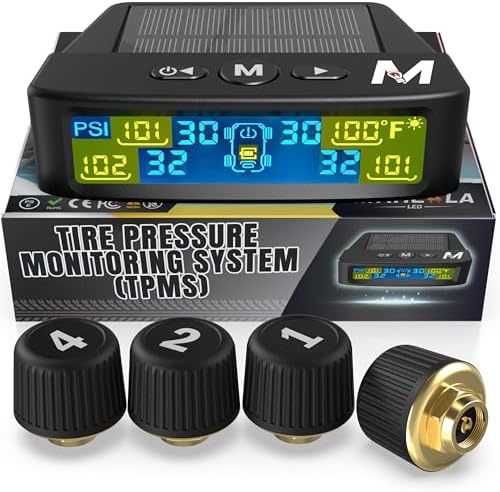
Marcala’s TPMS set of four sensors helps you monitor tire pressure and temperature in real time while driving, with updates every second. The bright color LCD uses auto-dimming for easy viewing, powered by dual solar and USB charging, and offers six alarm modes. Built for trailers, RVs, campers, trucks, and towing setups, the sensors support monitoring 1-4 wheels up to 98 PSI with IP67 waterproof protection.
What Pressure Should a Donut Tire Have?
A compact spare can require significantly more air pressure than your regular tires. For example, several current Honda applications specify 60 psi (420 kPa) for their compact spare tires. That is an example, not a universal setting.
Use the pressure specified for your spare and vehicle. Do not simply copy the pressure used in your four road tires.
NHTSA’s TireWise guidance recommends checking the pressure of all tires, including the spare, at least once a month when the tires are cold. A cold tire generally means the vehicle has not been driven for at least three hours.
Pro Tip: Check your compact spare before you need it. Because a donut may sit unused for years, discovering that it is badly underinflated after a roadside flat can leave you without a usable backup.
How a Donut Tire Affects Handling
Even when you stay within the permitted distance and speed, a donut tire changes how the vehicle behaves. A compact spare is usually narrower and may have a different rolling diameter, tread design, grip level, and construction from the regular tires.
Manufacturer guidance warns that compact spares can affect handling and traction. Steering may feel different, cornering grip may be reduced, and the vehicle may respond differently during braking or emergency maneuvers.
That is why smooth inputs matter. Increase following distance, brake earlier, steer progressively, and avoid sudden lane changes.
Do not assume that putting the donut on the rear axle is always safer. Placement is vehicle-specific. Some Honda applications, for example, warn against fitting a compact spare on the front because of differential concerns, while another Honda application instructs drivers not to install its compact spare on the rear. Follow the instructions for your exact model.
Can You Use a Donut on an AWD or 4WD Vehicle?
Possibly, but only if the vehicle manufacturer approves it. AWD and 4WD systems can be sensitive to differences in tire circumference or rotational speed.
Subaru, for example, notes in its owner guidance that use of a temporary spare may cause the AWD warning light to flash and says temporary-spare use should be restricted to the minimum time necessary.
If your AWD or 4WD owner’s manual does not approve a compact spare, or you are unsure whether your spare is the correct one, towing is safer than guessing. The same caution applies to vehicles with limited-slip differentials or unusual front/rear tire sizes.
Can You Drive on the Highway With a Donut Tire?
A highway is not the best place to drive on a donut because normal traffic may move faster than the spare’s permitted speed. If you can reach the repair facility safely by a slower route, that is usually the better option.
If highway travel is unavoidable and your manufacturer permits it, remain below the spare’s speed limit, stay in an appropriate slower lane, leave extra following distance, and exit as soon as practical. Do not increase your speed just to match vehicles traveling above the temporary spare’s limit.
Warning: If you cannot travel without exceeding the spare’s speed or distance limit, or traffic conditions make slow travel unsafe, call roadside assistance or arrange a tow.
Driving on a Donut in Rain, Snow, or Rough Roads
A compact spare already offers different traction and handling from the regular tires, so poor road conditions give you less margin for error.
- Rain: Reduce speed and increase following distance. Avoid standing water and abrupt steering.
- Snow or ice: Avoid driving if possible because traction is already limited and vehicle balance can differ from normal.
- Potholes and rough roads: Slow down and avoid impacts that could damage the smaller spare or wheel.
- Gravel or loose surfaces: Use gentle steering, braking, and acceleration.
Do not install tire chains on a compact spare unless the vehicle manufacturer specifically allows it. Many manufacturers prohibit chains on compact temporary spares.
Donut Tire Safety Tips and When to Replace It
To stay safe on a donut tire, use it for the shortest practical period and restore the vehicle to its correct full-size tire setup as soon as possible.
- Confirm that the spare is the correct one for your vehicle.
- Check for cracks, cuts, bulges, severe tread wear, damaged valve stems, or wheel damage.
- Set the tire to the specified pressure before driving.
- Follow the speed and distance restrictions on the spare and in the owner’s manual.
- Avoid hard acceleration, abrupt braking, and sharp turns.
- Use extra caution in rain, snow, ice, gravel, and rough-road conditions.
- Watch for new vibration, pulling, unusual noises, warning lights, or worsening handling.
- Have the damaged regular tire repaired or replaced promptly.
NHTSA notes that tires age even when they are not driven regularly. Some vehicle and tire manufacturers recommend replacement based on age—often within a range of six to 10 years regardless of remaining tread—so an old spare should not be assumed safe merely because it looks unused.
You can identify a tire’s manufacturing date from the last four digits of its DOT Tire Identification Number. Those digits indicate the production week and year. Follow your vehicle and tire manufacturer’s specific replacement guidance rather than using age alone as the only test.
[Products Worth Considering]
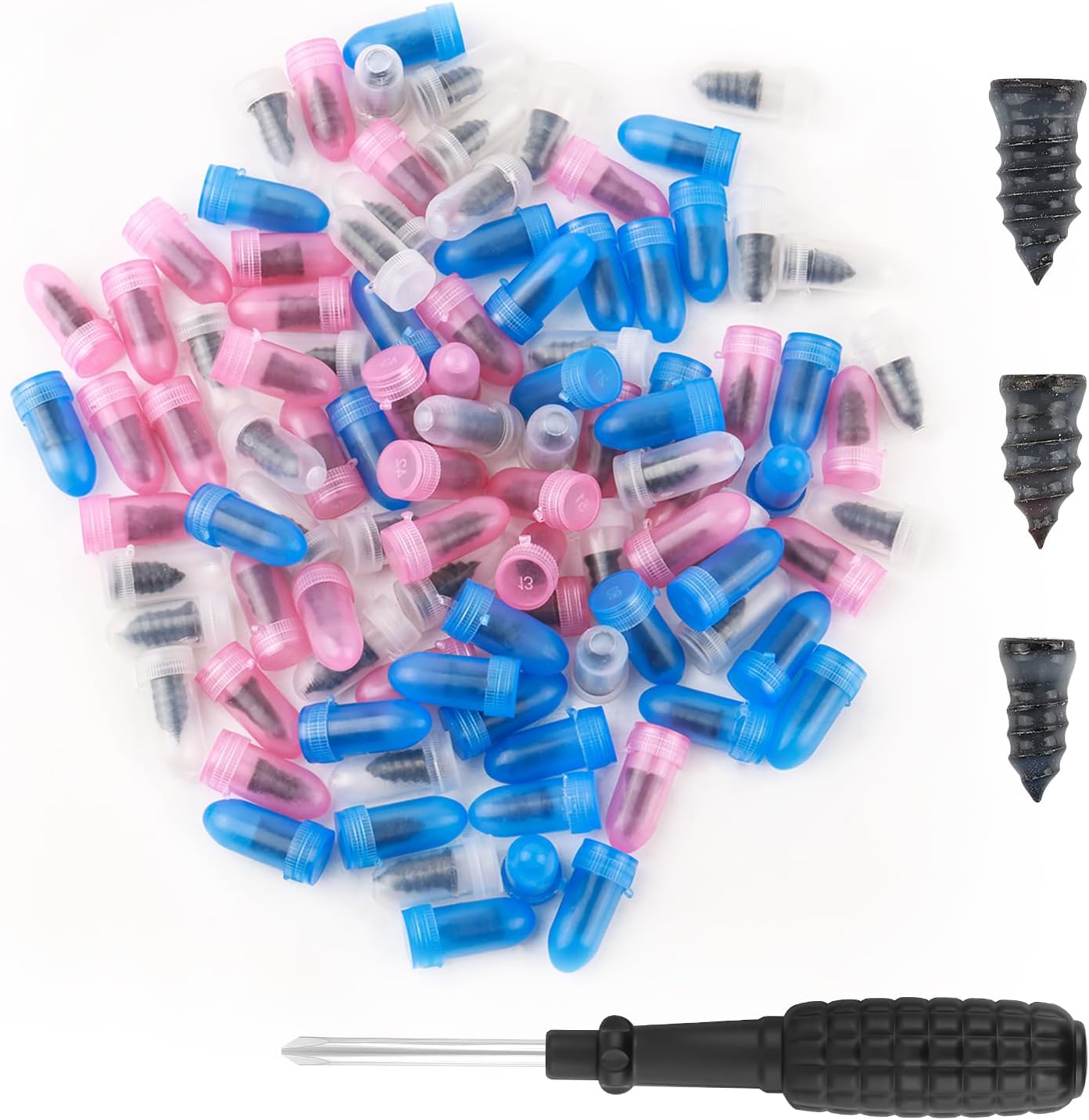
This 100-piece tire repair screw plug kit provides a fast, self-service solution for punctures on the road. Choose the correct plug size, insert it into the break, and screw it in to help seal the puncture and temporarily restore tire pressure. Thickened threads and rubber-wrapped plugs improve bite and sealing while remaining compact and easy to carry.

A concentrated tire and tube mounting compound designed to help simplify mounting rubber tires and tubes on passenger, semi truck, construction, and OTR applications. Its ultra-thick formula packs beads effectively and includes rust inhibitors to help protect against corrosion during use.

Secure a full-size spare on your trailer with this powder-coated steel spare tire mount bracket. It fits most 4-, 5-, and 6-lug wheel bolt patterns and mounts to trailer tongues up to 4 in wide and 5 in tall. Built for reliable carry with a max 150 lb load rating and includes zinc-plated hardware for straightforward installation.
When Should You Stop Driving and Call for a Tow?
Do not continue simply because the donut is still holding air. Stop in a safe place and seek roadside assistance if:
- the compact spare is visibly damaged or losing pressure;
- the vehicle shakes, pulls strongly, or becomes difficult to control;
- you would have to exceed the specified speed or distance limit to reach help;
- the owner’s manual says the compact spare cannot be used in your situation;
- an AWD, drivetrain, brake, or other serious warning appears and the manual tells you to stop;
- road or weather conditions make reduced-speed travel unsafe; or
- you are unsure that the spare is compatible with the vehicle.
A tow costs less than risking tire failure, wheel damage, drivetrain damage, or loss of vehicle control.
[Products Worth Considering]

The Tymate TM12 RV TPMS delivers real-time tire pressure and temperature monitoring with a stable 433Hz display for safer long-distance driving. It supports simultaneous monitoring across vehicle and trailer zones, includes six alarm modes for pressure, temperature, leakage, battery, and signal loss, and features easy DIY installation with auto calibration. Power is supplied via USB-C charging or solar recharging, with a wide 0–144 PSI range and up to 50 ft signal coverage for RVs and towable trailers.

The Airmoto portable tire inflator quickly and accurately fills car, truck, SUV, motorcycle, and bicycle tires up to 120 PSI with auto shut-off when your target pressure is reached. Its large LCD, multi-unit pressure display, and digital gauge make it easy to dial in settings and verify readings, while the built-in LED flashlight helps in low light. The included polyurethane hard carrying case and storage mesh pocket keep the inflator and accessories protected and organized.

This 100-piece set of snap-in tubeless tire valve stems is designed for standard 0.453 in (11.5 mm) rim holes and helps maintain reliable, steady tire pressure. Made with ozone-resistant rubber and brass cores, the valves are built for durability and long-term use. Easy to install by hand, they support safe driving and are suitable for cars, light trucks, trailers, and more.
Frequently Asked Questions
What speed limit should you drive with a donut tire?
Many compact spares have a maximum speed of 50 mph, but check the spare’s label and your owner’s manual. If either specifies a lower speed, follow that limit. Driving slower is sensible in rain, snow, rough-road conditions, or heavy traffic.
Can I drive 200 miles on a spare tire?
You generally should not plan to drive 200 miles on a compact donut. Temporary spares are intended for short emergency trips, and about 50 miles is a common conservative recommendation. Follow the actual distance limit supplied by your tire and vehicle manufacturer. A matching full-size spare may have different rules.
Can you go 70 mph on a donut spare tire?
Not when your temporary spare is marked with the common 50 mph maximum. Going 70 mph would exceed that limit. Read the tire and owner’s manual and never exceed the manufacturer’s stated speed.
How far can you realistically drive on a donut tire?
Drive only as far as necessary to reach a safe repair location. Around 50 miles is common general guidance for compact spares, but it is not universal. Your tire label and owner’s manual determine the limits for your vehicle.
What PSI should a donut tire have?
Use the pressure specified for your particular compact spare. Many compact spares use higher pressure than regular tires, and 60 psi is common on some vehicles, but you should not assume 60 psi applies to yours. Check the owner’s manual and spare-tire markings.
Should a donut tire go on the front or rear?
There is no universal answer. Some vehicles restrict compact-spare use on the front axle, while others have different instructions. Follow your exact vehicle owner’s manual instead of applying a general front-or-rear rule.
Can you reuse a donut tire?
A temporary spare may be reusable if the manufacturer permits it and the tire remains undamaged, correctly inflated, within its wear limits, and suitable for continued service. Have it inspected after use if you notice damage, pressure loss, unusual wear, or impact damage.
Sources
- National Highway Traffic Safety Administration — TireWise — tire pressure, spare-tire inspection, TPMS, tire condition, and tire-aging guidance.
- Honda HR-V Owner’s Manual — Changing a Flat Tire — compact-spare pressure, temporary use, and 50 mph guidance.
- Subaru Owner’s Manual — temporary-spare considerations involving AWD operation.
- Firestone Complete Auto Care — Spare Tire Guide — general compact-spare distance and speed guidance and differences between compact and full-size spares.
Conclusion
A donut tire is a short-term emergency solution, not a normal replacement tire. Many compact spares are limited to about 50 mph, and roughly 50 miles is common conservative distance guidance, but neither number should override the instructions supplied with your vehicle and spare.
Check the correct pressure, follow vehicle-specific axle and AWD instructions, drive smoothly, and repair or replace the regular tire as soon as possible. If the donut is damaged, incompatible, losing pressure, or cannot get you to help without exceeding its limits, stop driving and use roadside assistance or a tow.

