

You can calculate tire diameter from the tire size printed on the sidewall. The key is to find one sidewall height, double it, and add the wheel diameter. This gives you the tire’s nominal outside diameter, which helps you compare sizes before you buy.
Quick Answer
Tire diameter equals the wheel diameter plus two sidewalls. Use this formula: overall diameter = wheel diameter + 2 × (tire width × aspect ratio ÷ 100 ÷ 25.4). For example, a 225/45R17 tire is about 24.97 inches tall.
Key Takeaways
- Tire diameter is the tire’s total outside height, not the rim size alone.
- Sidewall height equals tire width multiplied by the aspect ratio.
- Convert the sidewall from millimeters to inches by dividing by 25.4.
- A 225/45R17 tire has a nominal diameter of about 24.97 inches.
- Before changing tire size, compare the new diameter with your OEM size and confirm fitment, load rating, clearance, and speedometer impact.
At a Glance
| Time Required | 2–5 minutes per tire size |
| Difficulty | Easy if you can read the tire size code |
| Tools Needed | Calculator, tire size code, OEM tire size from the placard or owner’s manual |
| Cost | Free |
What Tire Diameter Means
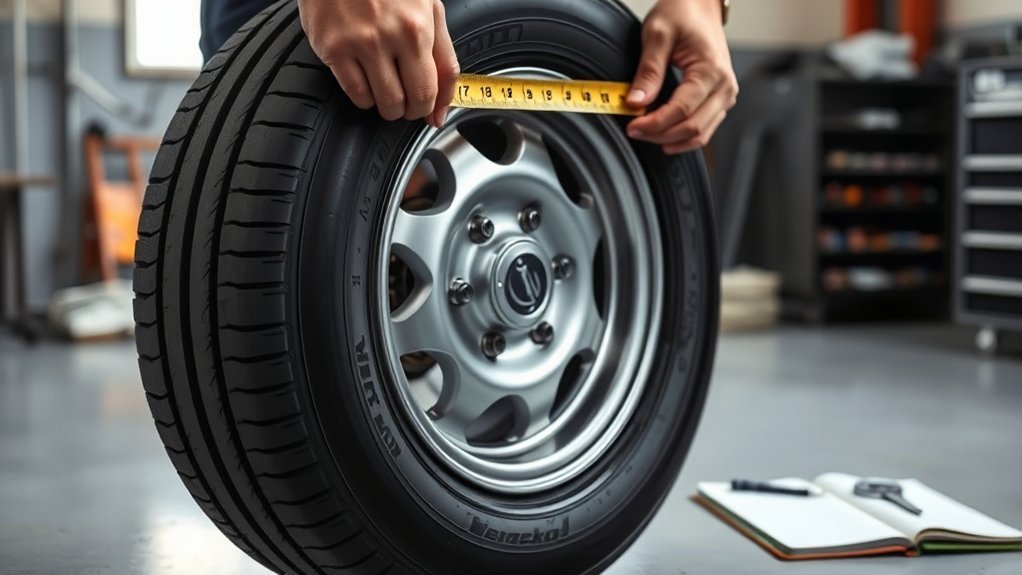
Tire diameter is the tire’s total outside height from the ground-facing tread to the top of the tread when viewed from the side. It includes the wheel diameter plus the tire sidewall above and below the wheel.
This number matters because it affects wheel-well clearance, ground clearance, gearing, speedometer readings, odometer readings, and how well the tire fits your vehicle. The vehicle manufacturer’s recommended tire size should always be your starting point. The National Highway Traffic Safety Administration advises using the original tire size or another size recommended by the vehicle manufacturer.
Tire Diameter Formula
Use this formula for metric passenger tire sizes such as 225/45R17:
Tire diameter in inches = wheel diameter + 2 × (section width × aspect ratio ÷ 100 ÷ 25.4)
Here is what each part means:
- Section width is the first number in the tire size, measured in millimeters.
- Aspect ratio is the second number, shown as a percentage of the tire width.
- Wheel diameter is the final number after the construction letter, measured in inches.
- 25.4 converts millimeters to inches.
Note: This formula gives the nominal unloaded tire diameter. Actual mounted diameter and rolling circumference can vary by brand, model, rim width, air pressure, load, and tread depth.
How to Read Tire Size Codes
A tire size such as 225/45R17 is not random. It tells you the tire’s width, sidewall profile, construction type, and wheel diameter. Michelin’s tire marking guide explains that tire sidewall markings include size, construction, load rating, speed rating, and other details that help confirm the correct replacement tire.
| Code Part | Example | Meaning |
|---|---|---|
| First number | 225 | Section width in millimeters |
| Second number | 45 | Sidewall height as a percentage of section width |
| Letter | R | Radial construction |
| Final number | 17 | Wheel diameter in inches |
The Tire Industry Association gives the same basic breakdown: the section width is the approximate width from sidewall to sidewall, the aspect ratio is sidewall height as a percentage of that width, and the rim or bead diameter is shown in inches.
[Products Worth Considering]

Monitor tire tread wear with a smart, color-coded depth gauge that shows clear condition ranges at a glance. The bar is range marked for fast, easy readings, helping you maintain safer traction and performance. Each gauge is portable with a pocket clip, and the set includes 20 units for daily use and sharing.

Measure tire tread depth quickly and accurately with this LUMITECO dial gauge that reads in 1/32" increments up to 14/32". The color-coded green/yellow/red zones make it easy to judge tire wear and know when replacement is needed. A rugged, compact design with a protective pouch helps keep the gauge ready for use on cars, trucks, motorcycles, and more.

The SAFELIFE dial tire tread depth gauge measures tread depth in 1/32 inch increments with clear, easy-to-read 2-inch dial face. Color zones using a traffic light system help you quickly judge whether tread is low, marginal, or ample for safer driving. Built with a durable zinc cast body and a metal detect probe for precise, comfortable use across cars, motorcycles, trucks, and buses.
Step-by-Step Example: 225/45R17
Here is the full tire diameter calculation for a 225/45R17 tire:
- Find the width: 225 mm.
- Convert the aspect ratio: 45% = 0.45.
- Calculate one sidewall: 225 × 0.45 = 101.25 mm.
- Convert to inches: 101.25 ÷ 25.4 = 3.99 inches.
- Double the sidewall: 3.99 × 2 = 7.98 inches.
- Add the wheel diameter: 7.98 + 17 = 24.97 inches.
So, a 225/45R17 tire is about 24.97 inches tall. Rounding it to 25 inches is fine for quick comparison, but use the full number when checking diameter change.
Convert Tire Width, Ratio, and Rim Size
To convert any common metric tire size, plug the three numbers into the same formula. For example, for 235/35R20:
- Sidewall height = 235 × 0.35 = 82.25 mm
- Sidewall height in inches = 82.25 ÷ 25.4 = 3.24 inches
- Overall diameter = 20 + 2 × 3.24 = 26.48 inches
For 285/70R17:
- Sidewall height = 285 × 0.70 = 199.5 mm
- Sidewall height in inches = 199.5 ÷ 25.4 = 7.85 inches
- Overall diameter = 17 + 2 × 7.85 = 32.71 inches
Metric Tire Sizes vs Inch Tire Sizes
Most passenger tire sizes use the metric pattern, such as 225/45R17. Some truck and off-road tires use flotation sizing, such as 35×12.50R17. In that format, the first number is already the approximate overall tire diameter in inches, the second number is section width in inches, and the final number is the wheel diameter in inches.
That means 35×12.50R17 is designed to be roughly 35 inches tall, 12.50 inches wide, and mounted on a 17-inch wheel. Still, the measured size can differ slightly by tire model, tread design, and mounting conditions.
How to Check Tire Diameter Change Before You Buy
After you calculate the new tire diameter, compare it with your original tire diameter. Use this formula:
Diameter change % = (new diameter − original diameter) ÷ original diameter × 100
For example, if your original tire is 24.97 inches tall and the new tire is 26.48 inches tall:
(26.48 − 24.97) ÷ 24.97 × 100 = 6.05%
That is a large change for many passenger vehicles. Tire Rack notes that staying within a 3% diameter change is desirable for cars and vans, but this is a guideline, not a replacement for your owner’s manual or vehicle placard.
Warning: Do not choose a tire size by diameter alone. Confirm load index, speed rating, rim width range, brake clearance, fender clearance, suspension clearance, and vehicle manufacturer approval before buying.
[Products Worth Considering]

Steelman white tire marking crayons provide high-contrast, semi-permanent marks for repairing and inspecting tires and equipment. They write on wet or dry, smooth or coarse surfaces including rubber, metal, glass, and wood, making them ideal for puncture location and damage outlining. The lead- and zinc-free crayons resist weather and fading yet wipe away when you no longer need the marks.

Accurately measure tire tread depth with a calibrated gauge marked from 0 to 1 inch in 1/32 inch increments. The color-coded bar helps you quickly identify tread condition ranges, supporting safe driving for trucks, motorcycles, automobiles, and passenger vehicles.

Upgrade your 2024-2026 Tesla Model 3 Highland with REEVAA all-weather mud flaps designed for seamless fit along the original body lines. The set of four delivers strong splash protection against mud, gravel, and road debris while using OEM-grade durable materials. Installation is non-destructive with original hole positions and snap-in clips, and the aerodynamic design helps minimize impact on efficiency.
How Tire Diameter Affects Your Speedometer
Tire diameter affects speedometer and odometer accuracy because the vehicle is calibrated around the original tire’s rolling circumference. A taller tire travels farther per revolution. A shorter tire travels less distance per revolution.
If the new tire is taller than the original, your speedometer can read lower than your actual speed. If the new tire is shorter, your speedometer can read higher than your actual speed. Discount Tire explains that upsizing to a taller tire causes the speedometer to display slower than actual speed, while downsizing to a shorter tire causes the opposite effect.
Use this quick estimate:
Actual speed = speedometer reading × (new tire diameter ÷ original tire diameter)
If your speedometer reads 60 mph, your original tire is 24.97 inches, and your new tire is 26.48 inches:
60 × (26.48 ÷ 24.97) = 63.6 mph actual speed
That means the vehicle may be traveling faster than the speedometer suggests.
Nominal Diameter vs Real-World Rolling Diameter
The formula gives a useful comparison number, but real tires are not perfectly rigid circles. Tire Rack explains that revolutions per mile cannot be calculated by simple math alone because the tire tread and sidewall deflect under vehicle load as the tire rolls.
This is why two tires with the same printed size can have slightly different measured diameters, tread widths, and revolutions per mile. For the most accurate fitment check, look up the tire manufacturer’s published specifications for the exact model and size.
Pro Tip: When comparing two sizes, use the same method for both: calculated nominal diameter for quick screening, then manufacturer specs for the final decision.
Fitment Checklist Before Changing Tire Size
Before you buy a different size, check these items:
- OEM size: Start with the tire placard, certification label, or owner’s manual.
- Overall diameter: Keep the change small unless the manufacturer, tire dealer, or fitment specialist confirms the setup.
- Load index: The new tire must meet or exceed the required load capacity.
- Speed rating: Match or exceed the vehicle’s required speed rating unless your tire professional advises otherwise for a specific seasonal setup.
- Rim width range: Confirm the tire is approved for your wheel width.
- Clearance: Check fenders, suspension, brake components, mud flaps, and full steering lock.
- AWD/4WD systems: Keep tires closely matched across all positions to avoid drivetrain stress.
- Speedometer and odometer: Recalibration may be needed after a meaningful diameter change.
[Products Worth Considering]

This 3-piece wheel and tire brush set makes it easy to clean light, medium, and heavy dirt from wheels, rims, tires, and exterior surfaces. It includes both soft and stiff bristle options for gentle scrubbing and tough grime removal, helping lift brake dust and road buildup. The long-handle design supports comfortable cleaning across cars, trucks, SUVs, RVs, motorcycles, and more, with simple care instructions to restore brush shape.

This wheel brush kit delivers pro-level cleaning at home, lifting dirt, grime, and brake dust to help restore wheel appearance. It includes multiple brush styles and applicator pads for tackling different wheel surfaces, with gentle, metal-free bristles designed to reduce scratching risk. The flat and double-ended brushes are built for comfort and reach, making wheel care easier for cars, trucks, and RVs.

This VEVOR tire bead breaker uses a slide-hammer impact and wedge tip to separate tire beads from rims quickly and efficiently without damaging hub surfaces. The long handle and sturdy steel construction help reduce user strain while providing reliable, portable tire changing for cars, trucks, and more. Ideal for home mechanics and repair shops handling multiple vehicle tire sizes.
Frequently Asked Questions
What is the diameter of a 235/35R20 tire?
A 235/35R20 tire has a nominal diameter of about 26.48 inches. The sidewall is 235 × 0.35 = 82.25 mm, which equals 3.24 inches. Add two sidewalls to the 20-inch wheel: 20 + 3.24 + 3.24 = 26.48 inches.
What does 700×25 mean on a tire?
On a bicycle tire, 700×25 usually means a 700C tire with an approximate 25 mm width. In modern ETRTO sizing, many 700×25 road tires are marked 25-622, where 25 is the tire width in millimeters and 622 is the bead-seat diameter in millimeters. The actual outside diameter can vary by tire and rim.
What is the 3% rule for tires?
The 3% rule is a common tire-sizing guideline that says a replacement tire’s overall diameter should stay within about 3% of the original size for many passenger cars and vans. It helps limit speedometer error, fitment problems, and system issues, but the vehicle manufacturer’s approved sizes should always come first.
What is the diameter of a 285/70R17 tire?
A 285/70R17 tire has a nominal diameter of about 32.71 inches. The sidewall is 285 × 0.70 = 199.5 mm, or 7.85 inches. Add two sidewalls to the 17-inch wheel: 17 + 7.85 + 7.85 = 32.71 inches.
Is tire diameter the same as rim diameter?
No. Rim diameter is only the wheel size, such as 17 inches in 225/45R17. Tire diameter is the full outside height of the tire and includes the rim plus the sidewall above and below the rim.
Why does my measured tire diameter differ from the calculation?
The calculation is based on nominal size markings. Real tire diameter can change with brand, tread design, rim width, inflation pressure, vehicle load, and tread wear. Use manufacturer specs when exact fitment matters.
Conclusion
Calculating tire diameter is simple once you know what the tire size code means. Find the sidewall height, convert it to inches, double it, and add the wheel diameter. Then compare the new diameter with your original size before buying.
For safe fitment, do not rely on diameter alone. Confirm the tire size against the vehicle placard or owner’s manual, check load and speed ratings, verify clearance, and use manufacturer specifications for the exact tire model.
Sources
- NHTSA TireWise — tire safety, tire-size selection, and manufacturer-recommended tire guidance
- Michelin Tire Markings Explained — tire sidewall code meanings, width, aspect ratio, construction, and wheel diameter
- Tire Industry Association: Reading a Tire Sidewall — section width, aspect ratio, radial construction, and bead/rim diameter definitions
- Tire Rack: How Do I Select the Right Tires? — overall diameter, 3% guideline, load capacity, and tire selection considerations
- Tire Rack: Revolutions Per Mile — why real-world rolling measurements differ from simple diameter math
- Discount Tire: Tire Size and Speedometer Accuracy — how taller and shorter tires affect speedometer readings

