

Most passenger cars use 4 or 5 lug nuts per wheel, so a four-wheel car usually has 16 or 20 total. Many SUVs and light trucks use 5 or 6 per wheel, while heavy-duty trucks commonly use 8 and some commercial wheels use 10. Lug nuts are technically mounted on the wheel, not the rubber tire. Always confirm the exact bolt pattern, thread size, seat type, and torque specification for your vehicle before replacing or tightening wheel hardware.
Last updated: August 18, 2026. Ford, Mitsubishi, Tire Rack, and McGard references were rechecked for this update.
Quick Answer
Most passenger cars have 4 or 5 lug nuts per wheel, so a four-wheel car usually has 16 or 20 total. Many SUVs and light trucks use 5 or 6 per wheel, and heavy-duty trucks often use 8. Count the lug nuts on your wheel and confirm the bolt pattern, size, seat, thread pitch, and torque in your owner’s manual.
Key Takeaways
- Lug nuts attach the wheel to the hub; they are not installed on the rubber tire itself.
- Most passenger cars use 4 or 5 lug nuts per wheel.
- Many SUVs and light trucks use 5 or 6 lug nuts, while heavy-duty trucks often use 8.
- Dual rear-wheel vehicles vary, so do not assume the count doubles just because there are two rear tires on one side.
- Always match the lug nut count, bolt pattern, thread pitch, seat type, wheel fitment, and torque specification before installing wheels.
At a Glance
| Time Required | 2 minutes to count lug nuts; 10–20 minutes to verify size, thread pitch, seat type, and torque. |
| Difficulty | Easy for counting; moderate if you need to measure thread pitch or confirm aftermarket wheel fitment. |
| Tools Needed | Owner’s manual, flashlight, caliper, thread pitch gauge, correct socket, and calibrated torque wrench. |
| Cost | Free if you only count the nuts; tool cost varies if you need a gauge, caliper, socket, or torque wrench. |
How Many Lug Nuts Are on a Tire?

Most passenger cars have 4 or 5 lug nuts per wheel. That means a typical four-wheel car usually has 16 or 20 total lug nuts. Many SUVs, crossovers, vans, and light trucks use 5 or 6 per wheel. Heavy-duty pickups often use 8, and some medium-duty or commercial wheels may use 10.
The exact number depends on the wheel’s bolt pattern. A bolt pattern uses two numbers. The first number tells you how many lug holes or studs the wheel uses, and the second number gives the bolt-circle diameter. For example, a 5×114.3 pattern has five lug positions on a 114.3 mm bolt circle.
What Does the Lug Count Tell You?
| Check | What It Tells You | What You Still Need to Verify |
| Lug count | How many studs, nuts, or bolt positions secure the wheel. | Bolt-circle diameter, thread size, seat type, center bore, offset, brake clearance, and load rating. |
| Bolt pattern | Lug count plus the diameter of the circle formed by the lug positions. | Center bore, offset, wheel width, brake clearance, load capacity, lug hardware, and tire clearance. |
| Thread size | Whether the nut correctly threads onto the vehicle’s stud. | Seat shape, nut length, hex size, thread engagement, and required torque. |
Warning: Do not drive normally if a wheel is missing one or more required lug nuts. A missing lug nut reduces clamping force and can overload the remaining studs. Stop in a safe place, replace the missing hardware, or have the vehicle towed if the wheel feels loose, vibrates, or makes noise.
Common Lug Nut Counts by Vehicle Type
The table below gives common counts, not a replacement for your owner’s manual. Automakers can change wheel hardware by model year, trim, brake package, payload rating, and wheel option.
| Vehicle Type | Common Lug Nuts Per Wheel | What to Check |
| Compact cars and small sedans | 4 or 5 | Bolt pattern, thread pitch, and factory torque. |
| Midsize cars, crossovers, and minivans | 5 is common | Wheel size, hub bore, seat type, brake clearance, and torque. |
| Light trucks and many SUVs | 5 or 6 | Load rating, bolt pattern, brake clearance, and wheel compatibility. |
| Heavy-duty pickups | 8 is common | Factory torque spec, clean mounting surfaces, load rating, and retorque interval. |
| Medium-duty and commercial vehicles | 8 or 10 | Service manual, wheel type, load rating, and commercial torque procedure. |
Passenger Car Counts
Passenger cars usually have 4 or 5 lug nuts per wheel. Smaller or older economy cars may use 4-lug wheels, while many modern sedans and hatchbacks use 5-lug wheels. You should still count the nuts on your actual wheel because the same vehicle name can change hardware across generations.
A 4-lug wheel has four evenly spaced nuts or studs. A 5-lug wheel has five. If you are buying replacement wheels, do not shop by lug count alone. You also need the exact bolt circle, center bore, offset, thread pitch, seat type, brake clearance, and load rating.
Truck and SUV Counts
Many SUVs and light trucks use 5 or 6 lug nuts per wheel. Heavy-duty pickups often use 8 because their wheel and hub systems are designed for higher vehicle and payload demands. The correct number and hardware still depend on the vehicle.
For example, Ford’s 2025 Super Duty owner’s manual lists a 150 lb-ft (204 N·m) wheel-fastener torque specification for M14 x 1.5 hardware. The exact specification can change by vehicle and model year, which is why copying a generic truck torque value can be unsafe.
Dual Rear Wheel Sets
Dual rear-wheel vehicles need extra care because the wheel assembly is different from a single rear-wheel setup. Do not assume a dually automatically has twice the number of lug nuts. Many heavy-duty pickups use one set of studs and nuts to clamp the rear wheel assembly, while larger commercial trucks may use different 8-lug or 10-lug systems.
Count the visible lug nuts on the wheel, then confirm the service procedure in the owner’s manual. Ford’s 2025 Super Duty manual calls for retightening the wheel nuts within 100 miles after wheel disturbance. For dual rear-wheel vehicles, it also specifies checks at 100 miles and again at 500 miles of new-vehicle operation. Those vehicle-specific instructions matter more than a generic lug-count rule.
How to Count Your Lug Nuts and Read the Bolt Pattern
You can count lug nuts without removing the wheel. Park on level ground, set the parking brake, and look at the center of the wheel. Count each visible lug nut or lug bolt head around the hub. If a cap covers the hardware, remove the cap only if the owner’s manual allows it.
- Count the lug nuts or lug bolts around the center of the wheel.
- Look for a wheel stamp, manual entry, or fitment label that lists the bolt pattern.
- Match the first bolt-pattern number to your lug count. A 5×114.3 wheel has 5 lug positions.
- Confirm the second number, which is the bolt-circle diameter.
- Check center bore, offset, brake clearance, load rating, and wheel width before buying aftermarket wheels.
Note: Some vehicles use lug bolts instead of lug nuts. A lug bolt threads into the hub, while a lug nut threads onto a fixed wheel stud. The count may look similar, but the replacement hardware is not interchangeable.
Why Trucks and SUVs Use More Lug Nuts
Trucks and SUVs often carry more weight than passenger cars. They may also tow trailers, use larger brakes, run heavier tires, and see rougher road loads. More lug positions can help distribute the wheel-clamping system across the hub, but lug count is only one part of the design.
The wheel must also match the correct bolt pattern, hub bore, offset, load rating, brake clearance, seat type, and torque specification. A wheel with the right number of holes can still be unsafe if the spacing, center bore, brake clearance, or lug nut seat does not match your vehicle.
A matching lug count is only the first check. Safe wheel fitment also depends on bolt pattern, thread pitch, seat shape, hub contact, brake clearance, load rating, and proper torque.
How to Check Lug Nut Size and Thread Pitch
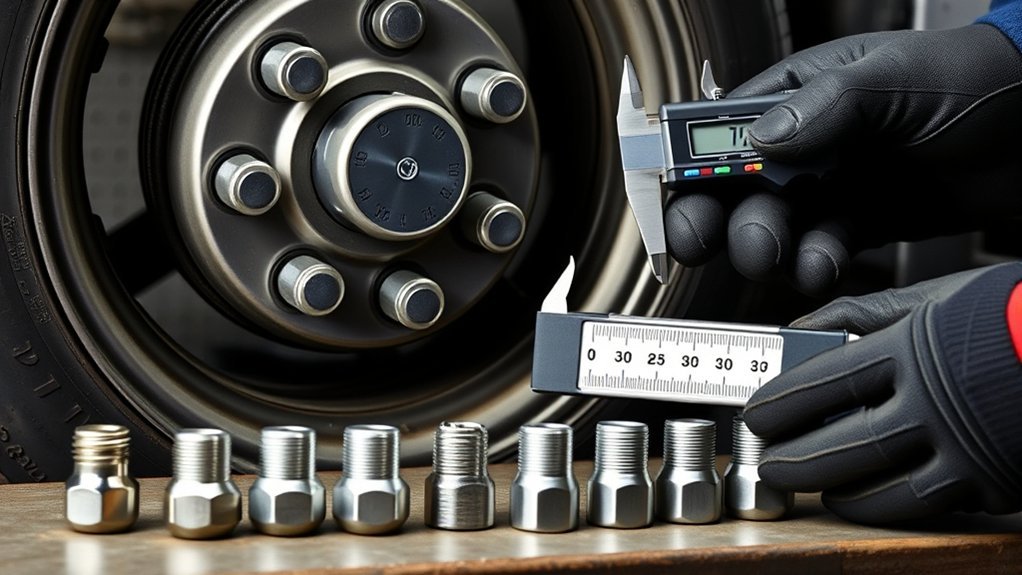
Start with the owner’s manual, service manual, or a trusted vehicle-specific fitment database. Then verify the actual hardware if you are replacing lug nuts or installing aftermarket wheels. Lug nut size usually includes the stud diameter and thread pitch, such as M12 x 1.5 or M14 x 1.5.
Use a caliper to measure stud diameter and a thread pitch gauge to confirm thread spacing. Do not force a nut that feels tight after only a few turns. Cross-threading can damage the stud, create false torque readings, and make the wheel unsafe.
- Thread size: Match the stud diameter and pitch exactly.
- Hex size: Match the socket size needed to tighten the nut.
- Seat type: Match the wheel’s seat shape, not just the vehicle make.
- Length: Make sure closed-end nuts do not bottom out before clamping the wheel.
- Thread engagement: Use hardware that fully engages the studs according to the wheel and vehicle requirements.
Pro Tip: Write your lug count, bolt pattern, thread size, seat type, and torque spec on a note in your glove box. It makes tire rotations, roadside repairs, and wheel shopping much easier.
[Products Worth Considering]

Upgrade your wheels with MIKKUPPA M12x1.5 mag seat lug nuts built for secure, corrosion-resistant performance. These closed-end chrome lug nuts are a direct replacement for select Toyota models, including Camry, Corolla, RAV4, Sienna, Avalon, Highlander, Matrix, Venza, and Prius. Triple-chromium plating and cold-forged, heat-treated steel help deliver strength for daily driving and replacement needs.

These M14x1.5 closed-end chrome lug nuts are a one-piece replacement designed for secure fitment on compatible GM, Ford, and select Chrysler/Dodge models. Featuring a 60-degree conical seat and anti-rust chrome plating, they help resist corrosion and maintain a bright look for everyday driving. Built for long-term durability, they include OEM-style part references and are backed by 12 months of support.

Upgrade your wheels with MIKKUPPA closed-end lug nuts designed for reliable fit and corrosion resistance. The one-piece, cold-forged and heat-treated steel construction helps resist rust and stripping, while the integrated finish delivers a durable black appearance. Built to OEM standards with a conical 60-degree seat, these nuts provide a secure solution for compatible Ford, Honda, Jeep, and Chevrolet models.
Which Lug Nuts Fit Aftermarket Wheels?
Aftermarket wheels may need different lug nuts than your original wheels. The most important match is the seat shape, which is the surface where the lug nut contacts the wheel. Many aftermarket wheels use a 60-degree conical seat, but you should never assume that without checking the wheel maker’s instructions.
McGard describes cone-seat lug nuts as hardware for wheels that use a 60-degree tapered cone seat. Other wheels may use a ball seat, mag seat, washer seat, flat seat, or small-diameter tuner nut. The wrong seat can damage the wheel and prevent proper clamping, even if the thread size fits.
| Seat Type | What It Looks Like | Main Fitment Risk |
| Conical / cone seat | Tapered cone, often 60 degrees | Wrong angle can reduce contact and damage the wheel seat. |
| Ball / spherical seat | Rounded contact surface | A cone nut will not seat correctly in a rounded pocket. |
| Mag / washer seat | Flat washer-style contact area | Wrong shank length or washer can prevent proper clamping. |
| Tuner / spline | Small-diameter body with special key | Requires the correct key and enough socket clearance. |
[Products Worth Considering]

The 22800 wheel stud installer makes replacing wheel studs quick and secure, saving time and effort during tire service. It uses a ratchet or impact wrench to pull new studs firmly into place, helping when existing studs are too long. Compatible with most automotive wheels and light-duty truck wheel studs, it’s designed for easy, tool-assisted installation.

This 1/2-inch drive breaker bar delivers powerful leverage for loosening and tightening stubborn lug nuts and automotive fasteners. The 180-degree flex head helps you reach tight spaces at the angle you need, making tire and brake jobs easier. A spring-loaded ball detent design holds 1/2-inch sockets securely while the chrome-moly head provides durable strength for everyday use.

The SEESII cordless impact wrench delivers high tightening and loosening power for fast wheel bolt and industrial bolt work. Its brushless motor and variable-speed 3 forward/2 reverse modes help you control precision installs and stubborn nut removal. A dual-battery system with rapid charging and an included storage case make it ready for home, car, and jobsite use.
Lug Nut Torque and Safe Installation Tips
Lug nut torque is not universal. Passenger cars, SUVs, trucks, aftermarket wheels, and commercial vehicles can use very different torque specifications. Check the owner’s manual or service data for your exact vehicle and wheel setup. For a broader lookup workflow, see our lug nut torque guide by vehicle.
For comparison, a 2023–2024 Mitsubishi Outlander owner’s manual lists wheel nut tightening torque as 73 to 93 ft-lb, while Ford’s 2025 Super Duty manual lists 150 lb-ft for its M14 x 1.5 wheel fasteners. Those examples show why a single “normal torque” number is not safe.
[Products Worth Considering]

This car D-wheel lock nut key provides an anti-theft solution for D-shaped wheel lock bolts, helping keep your wheels secure. It features a flower-shaped internal pattern that resists micro-adjustment theft while allowing removal and mounting of compatible locking nuts. Made for reliable performance under high torque, it’s easy to use with standard socket wrench turning for quick tire maintenance and emergency repairs.

The Trivd Frol 1/2" air impact wrench delivers high performance torque up to 1500 ft-lbs with a twin hammer impact mechanism for strong, balanced blows. It features an ergonomic grip, compact lightweight design, and quick-stop control with 3 forward speeds up to 8000 RPM plus a reverse speed. Built for demanding automotive repair and tire shop work, the rear exhaust helps keep debris away from the surface.

Protect tire valves from water, dust, and sand to help prevent leaks and support safe driving. These universal stem caps install quickly by hand and feature durable aluminum alloy construction with an inner sealing ring for better air retention. Compatible with cars, SUVs, trucks, motorcycles, and bicycles for everyday convenience.
Use the Factory Torque Spec
Use a calibrated torque wrench for final tightening. Impact tools are useful for removal and initial snugging, but they can easily over-tighten hardware if you use them for final torque. Over-tightening can stretch studs or damage wheels. Under-tightening can let the wheel loosen while driving.
Clean the Mounting Surfaces
Before installing a wheel, clean rust, dirt, grease, and loose debris from the wheel mounting face and hub. Toyota warns that foreign material on the wheel contact surface can let wheel nuts loosen while the vehicle is moving and allow the tire and wheel assembly to come off the vehicle.
Tighten in a Star Pattern
A star or crisscross pattern spreads clamping force evenly. Hand-start every lug nut first so you do not cross-thread it. Snug each nut lightly, then tighten in stages until you reach the final torque specification.
- Place the wheel flat against the hub.
- Start all lug nuts by hand.
- Snug the nuts in a star or crisscross pattern.
- Lower the vehicle until the tire touches the ground enough to stop rotation.
- Use a calibrated torque wrench to tighten to the exact specification.
- Recheck torque after the mileage interval recommended by the vehicle or wheel manufacturer.
Retorque After Wheel Service
After a tire rotation, flat repair, wheel change, or wheel removal, follow the retorque instructions for your exact vehicle and wheel setup. Ford’s 2025 Super Duty manual, for example, calls for retightening within 100 miles after wheel disturbance. Its dual-rear-wheel guidance also includes checks at 100 miles and again at 500 miles of new-vehicle operation.
What If a Lug Nut Is Missing?
If one lug nut is missing from a wheel that was designed to use more, treat it as a repair issue right away. The remaining nuts may hold the wheel temporarily, but the intended clamping system is no longer complete. That can stress the remaining hardware and increase the risk of vibration or loosening.
If you notice a missing lug nut while parked, do not continue normal driving. Install the correct replacement nut and torque it properly. If the wheel shakes, clicks, wobbles, has damaged studs, or has more than one missing nut, do not drive the vehicle. Call roadside assistance or a tow service.
Frequently Asked Questions
Is it okay to drive on 4 lug nuts?
Yes, if your vehicle was designed with 4 lug nuts per wheel and all four are correctly installed and torqued. If your vehicle normally uses 5, 6, or 8 and one or more are missing, do not treat the remaining four as “good enough.” Replace the missing hardware with the correct size, seat, and thread pitch before returning to normal driving.
What size are the lug nuts on a Mitsubishi Outlander?
It depends on the model year, market, trim, and wheel type. Confirm the hardware by VIN, owner’s manual, dealer, or direct fitment data before buying replacements. For torque, a 2023–2024 Mitsubishi Outlander owner’s manual lists wheel nut tightening torque as 73 to 93 ft-lb.
How many lug nuts are on a tire?
Lug nuts are actually on the wheel, not the tire. Most passenger cars have 4 or 5 per wheel. Many SUVs and light trucks use 5 or 6, heavy-duty pickups often use 8, and some commercial wheels may use 10.
Will 3 lug nuts hold a tire?
Do not rely on 3 lug nuts unless the vehicle was specifically designed as a 3-lug setup, which is uncommon. If a 4-, 5-, 6-, or 8-lug wheel is missing several required fasteners, do not drive it until the wheel hardware is repaired.
Do new tires come with new lug nuts?
Usually no. New tires are mounted on your existing wheels, and the shop normally reuses your existing lug nuts if they are safe and compatible. New wheels may require different lug nuts, especially if the seat type, length, or socket clearance changes.
Can I use aftermarket lug nuts on factory wheels?
You can only use aftermarket lug nuts if they match the factory wheel’s thread size, seat type, length, hex size, thread engagement, and torque requirement. A nut that threads on but has the wrong seat shape can still be unsafe.
How tight should lug nuts be?
Tighten lug nuts to the vehicle or wheel manufacturer’s exact torque specification, not a guessed number. Use a calibrated torque wrench and follow the recommended tightening sequence. Torque can vary widely between small cars, SUVs, heavy-duty trucks, and aftermarket wheel setups.
Are lug nuts and lug bolts the same?
No. A lug nut threads onto a wheel stud that is fixed to the hub. A lug bolt passes through the wheel and threads directly into the hub. They perform the same basic wheel-fastening job, but the hardware and replacement procedure are different and are not interchangeable.
Conclusion
Most passenger cars have 4 or 5 lug nuts per wheel, while many SUVs and trucks use 5, 6, or 8. Some commercial wheels use 10. The count is only the starting point. Safe wheel fitment also depends on the bolt pattern, thread pitch, seat type, center bore, offset, brake clearance, load rating, lug nut length, and torque specification. Count the hardware on your wheel first, then verify every fitment detail in the owner’s manual or wheel specifications before installing replacement hardware.
Sources
- NHTSA TireWise — tire safety, maintenance, and owner-label guidance.
- 2025 Ford Super Duty Owner’s Manual: Wheel Lug Nut Torque Specifications — current Super Duty M14 x 1.5 torque and retorque example used in this article.
- 2023–2024 Mitsubishi Outlander Owner’s Manual — Outlander wheel nut tightening torque example.
- Toyota/Scion Owner’s Manual — wheel installation, clean mounting surface, and torque safety warnings.
- Tire Rack: How to Measure Wheel Bolt Pattern — bolt-pattern meaning and wheel fitment basics.
- McGard Cone Seat Lug Nuts — 60-degree cone-seat lug nut reference.

