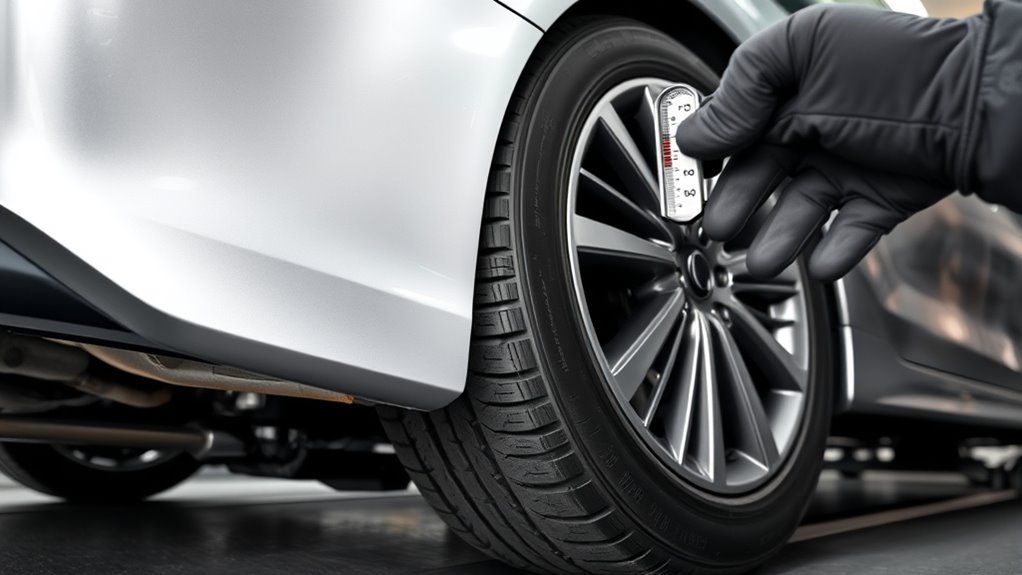
If your Toyota Camry’s rear tires are wearing faster than the front tires, do not assume the tires are simply “bad.” On a front-wheel-drive Camry, the front tires often wear faster because they steer, brake, and carry much of the drivetrain load. When the rear tires are disappearing first, the most likely causes are rear alignment error, worn suspension parts, incorrect tire pressure, heavy rear loading, a dragging brake, a bent wheel, or tire-rotation history that hides where the wear really started.
Quick Answer
Rear tires usually wear faster than the front on a Toyota Camry when rear toe or camber is out of spec, suspension bushings are worn, tire pressure is wrong, the trunk or rear seat is often loaded, a brake is dragging, or the tires were previously worn in another position before rotation.
Key Takeaways
- Inner-edge or feathered rear tire wear usually points to rear toe or camber problems.
- Cupping or scalloping can come from worn shocks, struts, bushings, wheel bearings, or balance problems.
- Check tire pressure cold and use the pressure on the driver-side door label, not the number molded on the tire sidewall.
- Ask for a four-wheel alignment printout before and after adjustment so you can see rear camber, rear toe, and thrust angle.
- If you replace only two tires, install the deeper-tread tires on the rear axle for better wet-road stability.
At a Glance
| Time Required | 15–30 minutes for a driveway inspection; 1–2 hours for a professional alignment and suspension check. |
| Difficulty | Easy for tread and pressure checks; professional-level for alignment, brake, bearing, and suspension diagnosis. |
| Tools Needed | Tread-depth gauge, tire-pressure gauge, flashlight, service records, and a shop alignment rack for final confirmation. |
| Cost | Pressure and tread checks are usually free; alignment, suspension, brake, or tire replacement costs vary by shop and model year. |
Why Camry Tires Wear Unevenly
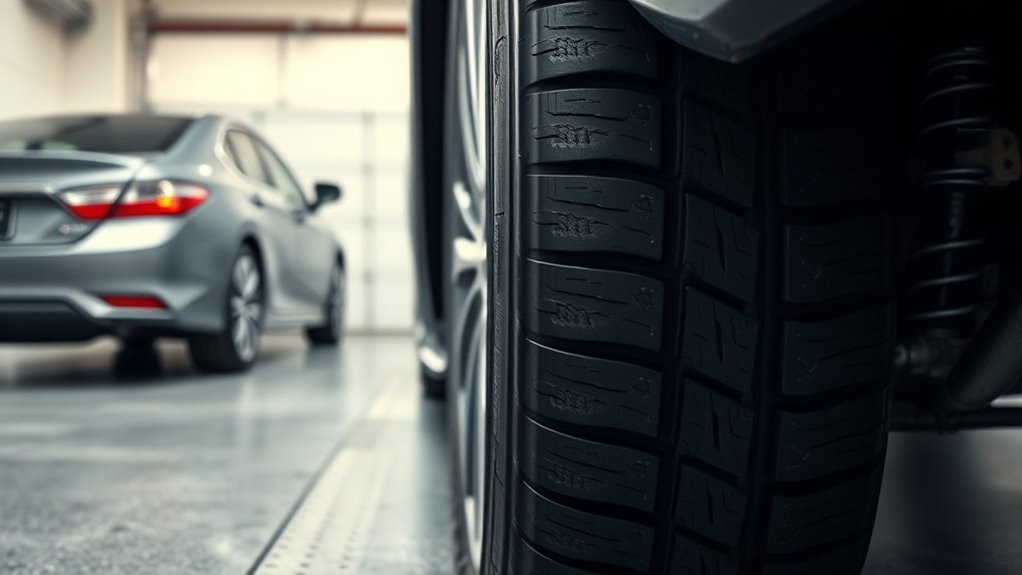
Camry tires wear unevenly when the tire is not rolling squarely on the road. That can happen from incorrect alignment, worn suspension bushings, bent parts after a pothole or curb hit, incorrect tire pressure, heavy loading, mismatched tires, or a brake that does not fully release.
On many front-wheel-drive Camry models, the front tires normally do more work because they steer, brake, and drive the car. So if the rear tires are wearing faster, look closely at the rear suspension and rear alignment instead of only checking the front end.
Toyota’s 2025 Camry maintenance guide lists tire rotation as a repeated maintenance item and says tires should be checked for damage and uneven wear during rotation. Follow your own Camry owner’s manual and maintenance guide for the exact interval for your model year.
Toyota’s 2025 Camry Warranty & Maintenance Guide also recommends scheduled maintenance every 5,000 miles or six months, whichever comes first. That makes tire checks easy to pair with routine service.
Warning: Do not keep driving on a tire with exposed cords, a sidewall bulge, a deep cut, sudden vibration, or tread worn to the wear bars. Have the tire inspected or replaced before highway driving.
Check the Rear Tire Wear Pattern First
Before you pay for parts, read the tread. A tire wear pattern often tells you where to start. Use a tread-depth gauge and measure the inside edge, center, and outside edge of each tire. Check several spots around the tire, not only one location.
| Rear Tire Wear Pattern | Most Likely Cause | What to Check Next |
|---|---|---|
| Inner edge worn faster | Too much negative camber, toe error, bent arm, or worn bushing | Four-wheel alignment and rear suspension inspection |
| Outer edge worn faster | Toe error, low pressure, hard cornering, or worn suspension | Pressure, alignment, bushings, and driving conditions |
| Feathered tread blocks | Toe-in or toe-out problem | Rear toe and thrust angle on alignment printout |
| Cupping or scalloping | Worn shock/strut, wheel imbalance, bearing play, or damaged tire | Suspension, balance, bearing noise, and tire condition |
| Center worn faster | Overinflation or tire shape/load mismatch | Cold pressure and tire size/load rating |
| Both edges worn faster | Underinflation or repeated heavy loading | Pressure, load label, slow leak, and valve stem |
| Only one rear tire wearing fast | Bent wheel, damaged suspension arm, dragging brake, bearing issue, or previous tire damage | Shop inspection before replacing tires again |
The federal tire inspection rule in 49 CFR §570.62 gives a useful safety reference for tread-depth inspection: tread should be measured in major grooves at multiple points around the tire. Local legal requirements can vary, but any tire near the wear bars deserves prompt attention.
Check Camry Alignment First
If the rear tires are wearing faster than the fronts, alignment should be near the top of the list. Ask for a four-wheel alignment, not only a front-end alignment. The rear toe, rear camber, and thrust angle matter because they control how straight the rear tires roll.
[Products Worth Considering]

Monitor tire tread wear with a smart, color-coded depth gauge that shows clear condition ranges at a glance. The bar is range marked for fast, easy readings, helping you maintain safer traction and performance. Each gauge is portable with a pocket clip, and the set includes 20 units for daily use and sharing.

Measure tire tread depth quickly and accurately with this LUMITECO dial gauge that reads in 1/32" increments up to 14/32". The color-coded green/yellow/red zones make it easy to judge tire wear and know when replacement is needed. A rugged, compact design with a protective pouch helps keep the gauge ready for use on cars, trucks, motorcycles, and more.

Steelman white tire marking crayons provide high-contrast, semi-permanent marks for repairing and inspecting tires and equipment. They write on wet or dry, smooth or coarse surfaces including rubber, metal, glass, and wood, making them ideal for puncture location and damage outlining. The lead- and zinc-free crayons resist weather and fading yet wipe away when you no longer need the marks.
Inspect Alignment Angles
Even a small toe error can scrub a tire every mile. Camber problems usually show up as inner-edge or outer-edge wear. Toe problems often create feathering, where each tread block feels smooth in one direction and sharp in the other when you run your hand across it.
Ask the shop for a printed before-and-after alignment report. Look for these items:
- Rear toe: Too much toe-in or toe-out can quickly chew through tread.
- Rear camber: Excess negative camber can wear the inner edge.
- Thrust angle: If this is off, the rear wheels are not tracking straight with the body.
- Cross-camber or side-to-side difference: Large differences can point to bent or worn parts.
Pro Tip: Do not pay for an alignment adjustment until the shop checks for worn bushings, loose joints, bent arms, and wheel bearing play. Aligning a loose suspension rarely holds for long.
Check Suspension Wear
Rear alignment can drift because the parts holding the wheel are worn or bent. Inspect the rear control arms, trailing arms, bushings, shocks, struts, wheel bearings, and mounting points. Look for cracked rubber, shiny metal where parts have been moving, rusted mounting points, leaking shock/strut bodies, or a wheel that has visible play when the car is safely lifted.
Toyota’s maintenance guidance includes inspection of suspension and steering-related parts such as ball joints, dust covers, steering linkage, boots, and chassis fasteners. A qualified technician should handle any inspection that requires lifting the vehicle or checking for looseness under load.
Measure Tire Wear Patterns
Measure tread depth at all four corners. Write down the inside, center, and outside tread depth for each tire. This helps you separate a true rear-axle problem from a tire that was already worn before it was rotated to the rear.
| Reading | What It Means |
|---|---|
| Rear inside edge is 3/32 lower than rear outside edge | Likely camber, toe, bent part, or worn bushing issue |
| Both rear tire centers are lower than both edges | Check overinflation and tire size/load rating |
| Both rear tire edges are lower than the center | Check underinflation, slow leaks, or heavy rear loading |
| One rear tire is much worse than the other | Inspect that corner for brake drag, bearing play, bent wheel, or suspension damage |
| Wear bars are flush or cords are visible | Replace the tire before normal driving |
Inspect Control Arms, Bushings, and Subframe
Start with the parts that locate the rear wheel. Control arms, bushings, and the rear suspension member keep the tire pointed at the correct angle. If a bushing is torn or a control arm is bent, the alignment numbers can change while you drive, even if the car looked fine on the rack.
During inspection, look for:
- Cracked, torn, or oil-soaked rubber bushings
- Loose or shifted mounting points
- Bent arms or impact marks after a pothole or curb hit
- Rust around mounting brackets
- Leaking shocks or struts
- Cupped tire wear that suggests bouncing or poor tire control
A tire can only wear evenly when the wheel is held at the right angle under real driving load, not just while the car is sitting still.
If a worn part is found, replace the faulty part first, then align the car. Replacing tires before fixing the cause usually means the new rear tires will start wearing the same way.
[Products Worth Considering]

The SAFELIFE dial tire tread depth gauge measures tread depth in 1/32 inch increments with clear, easy-to-read 2-inch dial face. Color zones using a traffic light system help you quickly judge whether tread is low, marginal, or ample for safer driving. Built with a durable zinc cast body and a metal detect probe for precise, comfortable use across cars, motorcycles, trucks, and buses.

Replace worn wheelchair rear tires with a universal 24x1 no-flat polyurethane foam option designed to mount tightly on 24-inch rims without the tire falling off. Installation is made easier with included tools and multiple methods, including using a pry bar or softening the tire in hot water to reduce resistance. The package includes two tires plus tie ropes for convenient fitting and handling.

The Ziopetru adjustable magnetic wheel alignment tool helps you check and restore camber and caster positioning after removing and reinstalling undercarriage components. With a clear leveling/bubble measurement system and an easy zeroing adjustment knob, it supports precise horizontal angle checking. The strong magnetic base mounts to metal surfaces for convenient use at home on cars, motorcycles, trucks, vans, and SUVs.
Compare Tire Pressure and Load
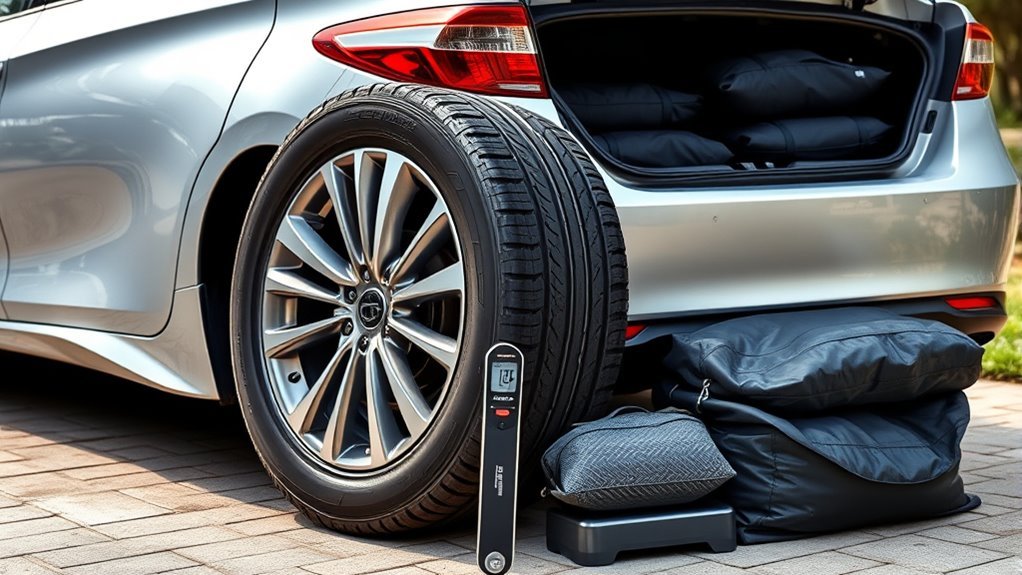
Check tire pressure when the tires are cold, ideally before driving or after the car has been parked for several hours. Use the tire and loading information label on the driver-side door jamb, or the owner’s manual, for the correct pressure. Do not use the maximum pressure molded into the tire sidewall as your normal target.
NHTSA TireWise says proper tire pressure affects safety, tire durability, and fuel consumption, and recommends checking all tires at least once a month when cold. Low rear pressure can make the tire flex too much and wear both shoulders. Too much pressure can wear the center faster.
Load matters too. If your Camry often carries passengers, tools, rideshare luggage, audio equipment, or heavy items in the trunk, the rear tires may be working harder than usual. Check the vehicle load limit on the door label and avoid carrying more weight than the vehicle and tires are rated to handle.
Note: If one rear tire keeps losing pressure, check for a nail, bead leak, cracked valve stem, corroded wheel, or previous plug/patch problem before blaming alignment.
Verify Tire Rotation History
Rotation history can make tire diagnosis confusing. A tire that is now on the rear may have developed its wear pattern while it was on the front. That old wear does not disappear after rotation, so you need service records, mileage notes, and tread-depth readings to understand where the damage started.
Check invoices, maintenance reminders, and tire shop records. Ask which rotation pattern was used. Directional tires, staggered tire sizes, and some AWD setups may limit how tires can be rotated. If your Camry is AWD, be extra careful with tire circumference differences and follow Toyota’s manual for your model year.
A good tire log includes:
- Date and mileage of each rotation
- Tread depth at each position
- Cold pressure readings
- Any alignment results
- Any repaired punctures, bent wheels, or replaced suspension parts
If the history is vague, start fresh: record the current tread depths, correct pressure, rotate only if the tires are safe to rotate, and recheck wear after 1,000–2,000 miles.
Check for Brake, Bearing, and Wheel Problems
Not every rear tire wear problem is alignment. A dragging brake can overheat one rear wheel and wear that tire faster. A worn wheel bearing can let the wheel move slightly out of position. A bent wheel can create vibration and patchy tread wear.
Look for these clues:
- Dragging brake: one rear wheel smells hot, has extra brake dust, or is much hotter than the other side after normal driving.
- Wheel bearing issue: humming, growling, or roughness that changes with speed or load.
- Bent wheel: vibration, visible rim damage, repeated balance problems, or one tire wearing in patches.
- Shock or strut wear: bouncing, cupped tread, poor ride control, or fluid leakage.
If you suspect brake drag or bearing play, have the car inspected before taking a long trip. These problems can become safety issues, not just tire-life issues.
[Products Worth Considering]

Upgrade your wheels with MIKKUPPA M12x1.5 mag seat lug nuts built for secure, corrosion-resistant performance. These closed-end chrome lug nuts are a direct replacement for select Toyota models, including Camry, Corolla, RAV4, Sienna, Avalon, Highlander, Matrix, Venza, and Prius. Triple-chromium plating and cold-forged, heat-treated steel help deliver strength for daily driving and replacement needs.

This professional wheel and rim brush kit makes it easy to lift brake dust, grime, and dirt from wheels and tires without scratching finishes. The brushes feature soft, metal-free wool heads and a flexible 360-degree rim brush design for reaching hard-to-clean areas. Includes multiple brush types plus accessories for thorough car, motorcycle, and general vehicle detailing.

Accurately measure tire tread depth with a calibrated gauge marked from 0 to 1 inch in 1/32 inch increments. The color-coded bar helps you quickly identify tread condition ranges, supporting safe driving for trucks, motorcycles, automobiles, and passenger vehicles.
Look for Bent Frame Damage
Look for bent frame or body-structure clues if rear tire wear started after a hard pothole hit, curb strike, collision, or suspension repair. A Camry does not need obvious body damage to have a rear alignment problem. A bent suspension arm, shifted subframe, or distorted mounting point can be enough.
Bent Frame Signs
Common warning signs include uneven body-panel gaps, a steering wheel that is off-center after alignment, a car that tracks sideways, one rear wheel sitting visibly different from the other, or rear tire wear that returns quickly after new tires and an alignment.
Also compare the left and right rear tire positions in the wheel openings. If one side looks pushed forward, backward, inward, or outward, stop guessing and get a professional inspection.
Chassis Alignment Checks
A proper chassis check should include a four-wheel alignment, visual inspection of rear suspension mounting points, wheel runout check if vibration is present, and measurement of thrust angle. Wheel balancing can fix vibration from weight imbalance, but it cannot correct a bent arm, shifted subframe, or incorrect rear toe.
If the alignment shop says a rear angle cannot be brought into specification, ask why. The answer may be a worn bushing, bent arm, damaged knuckle, shifted rear suspension member, or previous collision damage.
When to Replace the Tires
Replace a rear tire if it has exposed cords, a sidewall bulge, separation, deep cracking, puncture damage that cannot be safely repaired, or tread worn to the wear bars. Also consider replacement earlier if wet traction is poor, the tire is old, or the tread depth is much lower than the other tires on the car.
If you replace only two tires, install the tires with deeper tread on the rear axle. Michelin recommends placing the deeper-tread tires on the rear to help maintain stability and wet traction.
Frequently Asked Questions
Which tires wear faster, left or right, on a Toyota Camry?
Either side can wear faster. If only one rear tire is wearing quickly, look for a corner-specific problem such as a bent wheel, dragging brake, worn bearing, damaged suspension arm, or alignment angle that is different on that side.
Should tires with more wear be on the front or back?
The tires with deeper tread should go on the rear axle if you are replacing only two tires. The more-worn pair normally goes on the front only if the tires are still safe and compatible. This helps reduce the chance of rear traction loss in wet conditions.
Can bad rear alignment wear Camry rear tires faster than the front?
Yes. Rear toe or camber that is out of specification can scrub the rear tires every mile. Inner-edge wear, outer-edge wear, or feathered tread blocks are common signs that rear alignment should be checked.
Can tire pressure make rear tires wear out fast?
Yes. Low pressure can wear both outer shoulders, while high pressure can wear the center of the tread faster. Check pressure cold and use the driver-door tire label or owner’s manual for the correct setting.
Should I rotate the tires if the rear tires are already badly worn?
Only rotate them if they are safe and suitable for the new position. Do not rotate tires with exposed cords, bulges, severe cupping, or tread worn to the wear bars. Fix the cause of the wear before installing new tires.
Conclusion
If your Toyota Camry’s rear tires wear faster than the front, start with tread-depth measurements and wear-pattern clues. Then check cold tire pressure, load, rotation records, rear alignment, suspension bushings, shocks/struts, bearings, brakes, and wheel damage. A four-wheel alignment printout is the fastest way to confirm rear toe, camber, and thrust angle. Fix the mechanical cause before buying another set of tires, or the new rear tires may wear out the same way.
Sources
- Toyota 2025 Camry Warranty & Maintenance Guide — maintenance intervals, tire rotation, uneven-wear checks, and suspension inspection items.
- NHTSA TireWise — tire pressure, tire safety, treadwear ratings, and maintenance guidance.
- NHTSA Tire Safety: Everything Rides On It — tire pressure, load limits, road hazards, and regular tire inspection.
- 49 CFR §570.62 Tires — federal tire tread-depth and inspection reference.
- Michelin: Mixing Tires and Tread Depth — deeper-tread tires on rear axle guidance.