For a Toyota Camry, the safest wheel alignment target is always the factory specification for your exact model year, trim, tire size, ride height, and market. In practical terms, a stock Camry should show front toe very close to zero, mild camber within the allowed range, and positive caster that is nearly even from left to right. If your Camry pulls, wanders, or wears one edge of a tire faster than the rest, the alignment needs a proper inspection on a modern alignment rack.
Quick Answer
Toyota Camry alignment specs are not one universal number. Use the factory range for your exact year and trim. Most stock Camrys need front toe set very close to zero, camber kept within the allowed mild negative range, and caster kept positive and even side to side.
Key Takeaways
- Use the factory alignment range for your exact Camry, not a generic internet spec.
- Toe usually causes the fastest tire wear when it is out of range.
- Camber affects inside or outside shoulder wear, while caster affects steering return and straight-line feel.
- Check alignment after new tires, suspension work, hard pothole hits, collision repair, or visible uneven tread wear.
At a Glance
| Time Required | 30 to 60 minutes for a standard alignment check; longer if worn suspension parts or collision damage are found. |
| Difficulty | Basic for reading symptoms and reports; professional for final adjustment. |
| Tools Needed | Tire pressure gauge, tread depth gauge, flashlight, alignment printout, and a professional alignment rack for adjustment. |
| Cost | Often about $80 to $180 for a four-wheel alignment, with extra cost if parts are worn or damaged. |
Toyota Camry Wheel Alignment Specs
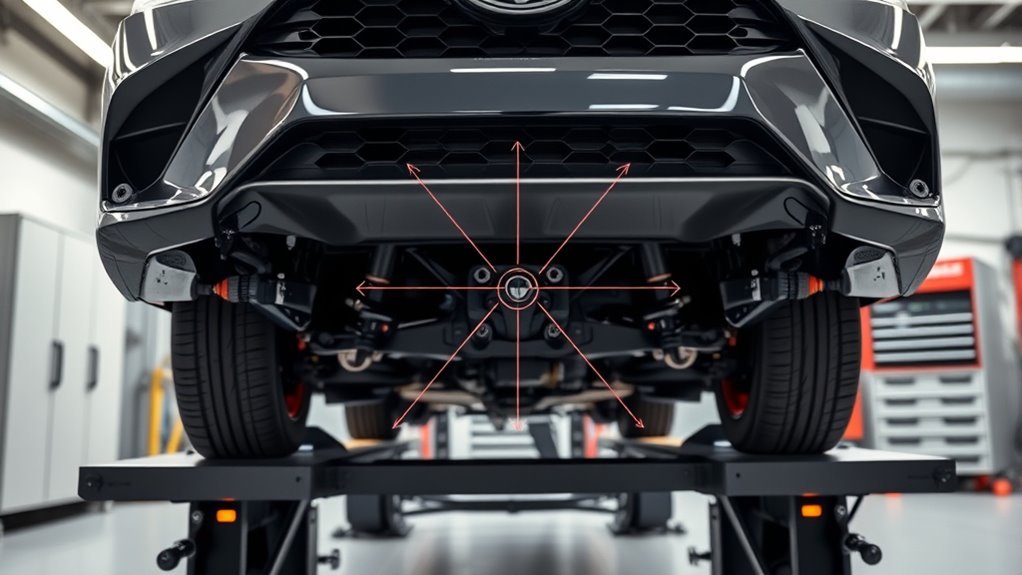
Toyota Camry wheel alignment specs should come from the factory service data for your exact vehicle. A shop usually pulls those specs from an alignment machine database after entering the year, model, trim, and sometimes wheel size. You can also check Toyota owner resources or service information for vehicle-specific guidance.
As a general guide, a stock Camry should have front toe very close to zero, front camber within a mild allowed range, rear camber within the rear suspension range, and caster positive and nearly even side to side. Do not treat one online number as correct for every Camry generation.
Note: Alignment numbers can change by model year, wheel size, suspension option, ride height, and market. The final pass/fail range on the alignment report should match the factory database for your exact Camry.
| Alignment angle | What you want to see | Why it matters |
|---|---|---|
| Front toe | Very close to the factory target, usually near straight ahead | Wrong toe scrubs the tread and can quickly create feathered wear. |
| Camber | Within the allowed factory range and close side to side | Too much negative or positive camber wears one shoulder of the tire. |
| Caster | Positive and balanced left to right | Caster affects steering return, stability, and pull correction. |
| Rear toe | Inside the rear factory range and even side to side | Rear toe can make the car track crooked even when the steering wheel looks straight. |
What Camber, Caster, and Toe Do
Those Camry alignment numbers make more sense once you know what each angle controls. Camber is the inward or outward tilt of the tire when you view the car from the front. Positive camber means the top of the tire leans outward. Negative camber means the top leans inward.
Caster is the steering-axis angle when viewed from the side of the vehicle. Positive caster helps the steering wheel return to center and helps the car feel stable on the highway. If caster is uneven from side to side, the Camry may pull even when toe is set correctly.
Toe describes whether the tires point inward or outward when viewed from above. Toe-in means the fronts of the tires point slightly toward each other. Toe-out means they point away from each other. On a daily driven Camry, toe is the angle most likely to be adjusted during a standard alignment.
Signs Your Camry Needs an Alignment
When your Camry’s alignment is off, the signs usually show up in the tires, steering wheel, or straight-line tracking. You may see uneven tire wear, such as one shoulder wearing faster than the rest of the tread. If the steering wheel sits off-center while driving straight, the toe setting or rear thrust angle may be off.
- Pulling left or right: The car drifts on a flat road when you loosen your grip.
- Off-center steering wheel: The wheel is crooked even though the car drives straight.
- Feathered tread: The tread feels smooth one way and sharp the other way when you run your hand across it.
- One-edge wear: The inner or outer shoulder wears faster than the center.
- New vibration: The issue may be balance, tire damage, or alignment, so inspect all three.
Pro Tip: Check tire pressure before blaming alignment. Low pressure, mismatched tires, tire conicity, dragging brakes, and worn suspension parts can mimic alignment problems.
[Products Worth Considering]

This universal wheel alignment tool helps you accurately restore tire tilt angles after tire or suspension repairs using an adjustable camber gauge. It features a powerful magnetic base that firmly attaches to brake rotors for stationary, slip-free readings, improving consistency during measurement. Built from durable PC plastic, it resists wear and corrosion and is compact enough for car, truck, RV, and motorcycle alignment tasks.

The Ziopetru adjustable magnetic wheel alignment tool helps you check and restore camber and caster positioning after removing and reinstalling undercarriage components. With a clear leveling/bubble measurement system and an easy zeroing adjustment knob, it supports precise horizontal angle checking. The strong magnetic base mounts to metal surfaces for convenient use at home on cars, motorcycles, trucks, vans, and SUVs.

Monitor tire tread wear with a smart, color-coded depth gauge that shows clear condition ranges at a glance. The bar is range marked for fast, easy readings, helping you maintain safer traction and performance. Each gauge is portable with a pocket clip, and the set includes 20 units for daily use and sharing.
How Camber Affects Camry Tire Wear
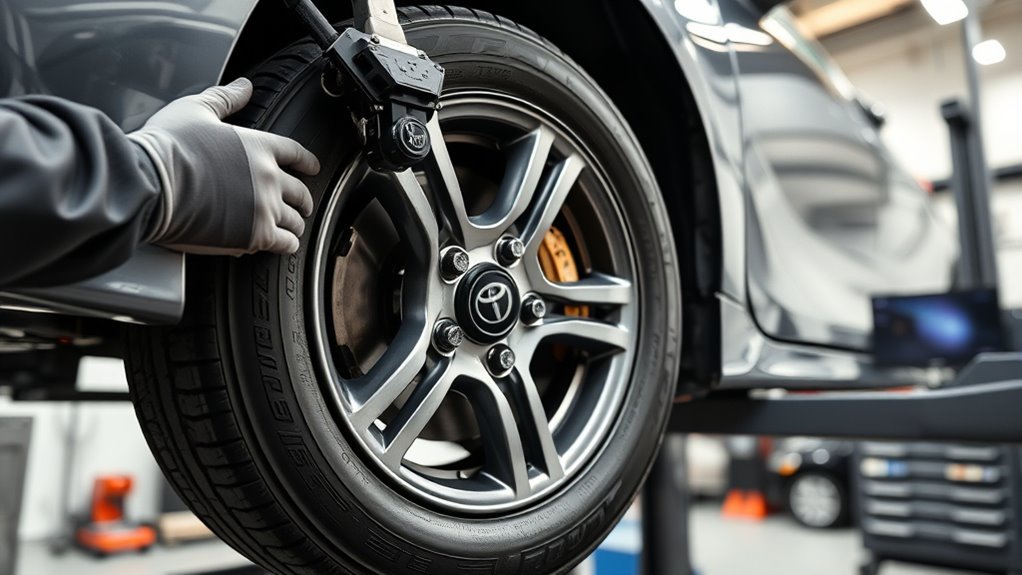
Camber changes where the tread loads the road. If your Camry has too much negative camber, the inner shoulder usually wears faster. If it has too much positive camber, the outer shoulder can wear faster. Camber that is within factory range helps the tread sit more evenly during normal driving.
Small camber differences can also affect pull. A Camry may drift toward the side with more positive camber or less negative camber, depending on the rest of the setup and road crown. That is why the left and right numbers matter as much as the individual readings.
| Wear pattern | Likely cause | What to check |
|---|---|---|
| Inner shoulder wear | Too much negative camber or toe-out | Camber, toe, ride height, worn bushings |
| Outer shoulder wear | Positive camber, underinflation, hard cornering | Pressure, camber, steering parts |
| Feathered tread | Toe out of range | Front and rear toe |
| Cupping or scalloping | Worn shocks, imbalance, loose parts | Struts, balance, bearings, suspension joints |
Why Toe Matters Most on a Camry
Toe often matters most because it decides whether the tires roll straight or scrub sideways as the Camry moves. Even a small toe error can drag the tread across the road for every mile you drive. That creates heat, feathering, faster wear, and sometimes a crooked steering wheel.
Front toe is commonly adjustable with the tie rods. Rear toe may also be adjustable on many Camry setups through the rear suspension links or eccentric hardware, depending on generation. The goal is not simply “zero at all costs.” The goal is to land inside the factory range and keep the left and right readings balanced.
Toe errors usually show up fast because the tire is no longer rolling cleanly in the direction the car is traveling.
How Caster Changes Steering Feel
Caster changes how the Camry steers, centers, and tracks at speed. Positive caster helps the steering wheel return toward center after a turn. It also helps the car feel stable on the highway. Caster is often not a normal adjustment on many stock Camry front suspensions, so an out-of-range reading may point to worn parts, bent parts, shifted subframe position, or collision damage.
Positive Caster Stability
Positive caster means the steering axis tilts rearward when viewed from the side. This helps the front wheels trail behind the steering axis and gives the steering wheel a stronger self-centering feel. When both sides are close to spec and close to each other, the Camry should feel more predictable at highway speed.
Negative Caster Lightness
Negative caster tilts the steering axis forward. On a street-driven Camry, that is usually not desirable because it can reduce straight-line stability and make the wheel feel vague. If an alignment report shows caster far outside the factory range, do not just adjust toe and ignore it. Ask the shop to inspect for damaged or shifted components.
Steering Return Center
Good caster helps the wheel return to center after a turn. If the wheel does not return smoothly, the cause may be caster, binding strut mounts, worn ball joints, steering rack issues, low tire pressure, or previous impact damage.
- More balanced positive caster: better return-to-center and highway stability.
- Uneven caster: possible pull, drift, or uneven steering feel.
- Out-of-range caster: possible bent or shifted suspension parts.
Which Camry Models Allow Adjustments?
Camry alignment adjustment depends on generation and suspension design. Toe is usually the main routine adjustment. Camber may need special bolts, eccentric hardware, subframe correction, or replacement of bent parts. Caster is often fixed unless the vehicle has service procedures or aftermarket hardware that allow correction.
| Model group | Common adjustment | Notes |
|---|---|---|
| Most stock Camry models | Front toe | Usually adjusted through tie rods. |
| Many later Camry models | Rear toe | May be adjustable through rear links or eccentric hardware. |
| Some Camry setups | Camber correction | May require approved bolts, hardware, subframe correction, or part replacement. |
| Many stock Camry setups | Caster | Often not a normal adjustment. Out-of-range caster needs inspection. |
Warning: Do not loosen steering or suspension fasteners unless the vehicle is safely supported and you have the correct service procedure and torque specs. A bad alignment or loose suspension part can make the car unsafe to drive.
How to Read a Camry Alignment Report
A Camry alignment report usually shows before and after readings for camber, caster, toe, and sometimes thrust angle. The “before” column shows how the car arrived. The “after” column shows the final measurement after adjustment.
- Confirm the vehicle data. Make sure the report matches your Camry’s year, model, trim, tire size, and suspension type.
- Check the color coding. Green usually means inside the factory range. Red means outside range. Yellow may mean near the edge, depending on the machine.
- Compare left and right. A reading can be technically green but still cause a pull if the side-to-side split is too large.
- Look at total toe. Individual toe and total toe both matter. A centered steering wheel needs the left and right front toe set correctly together.
- Review notes. If camber or caster remains red, the shop should explain whether the cause is worn parts, bent parts, ride height, or limited adjustment range.
Degrees vs. Mm or Inches on Alignment Reports
Some reports show toe in degrees. Others show toe in millimeters or inches. Degrees measure the angle of the wheel. Millimeters or inches measure the distance difference between the front and rear of the tire edges. Both can be correct, but you should not compare them directly unless you convert them for the same tire size and measurement method.
If you are comparing two alignment reports, check the units first. A toe value that looks small in inches may not mean the same thing as a small value in degrees.
How to Fix Camry Alignment Problems
Start with a basic inspection before paying for an alignment. Set tire pressure to the placard value, inspect tread depth, look for sidewall damage, and check that all four tires match in size and type. If the Camry has worn ball joints, loose tie rods, bad control-arm bushings, damaged struts, or bent suspension parts, an alignment alone will not hold.
- If toe is out: A shop usually adjusts tie rods in front and rear toe hardware where available.
- If camber is out: The fix may be approved camber bolts, subframe correction, replacement of bent parts, or ride-height repair.
- If caster is out: The shop should inspect for impact damage, shifted subframe position, worn bushings, or bent arms.
- If the steering wheel is off-center: The front toe must be centered with the steering wheel locked straight.
[Products Worth Considering]

Measure tire tread depth quickly and accurately with this LUMITECO dial gauge that reads in 1/32" increments up to 14/32". The color-coded green/yellow/red zones make it easy to judge tire wear and know when replacement is needed. A rugged, compact design with a protective pouch helps keep the gauge ready for use on cars, trucks, motorcycles, and more.

Upgrade your wheels with MIKKUPPA M12x1.5 mag seat lug nuts built for secure, corrosion-resistant performance. These closed-end chrome lug nuts are a direct replacement for select Toyota models, including Camry, Corolla, RAV4, Sienna, Avalon, Highlander, Matrix, Venza, and Prius. Triple-chromium plating and cold-forged, heat-treated steel help deliver strength for daily driving and replacement needs.

The SAFELIFE dial tire tread depth gauge measures tread depth in 1/32 inch increments with clear, easy-to-read 2-inch dial face. Color zones using a traffic light system help you quickly judge whether tread is low, marginal, or ample for safer driving. Built with a durable zinc cast body and a metal detect probe for precise, comfortable use across cars, motorcycles, trucks, and buses.
Alignment vs. Wheel Balancing
Alignment and wheel balancing are different services. Alignment sets the suspension angles so the tires point and sit correctly on the road. Balancing corrects weight imbalance in the tire and wheel assembly. If your Camry pulls or wears one edge, think alignment. If it shakes at certain speeds, think tire balance, bent wheel, tire damage, or loose suspension parts.
When to Check Camry Alignment
Check your Camry’s alignment whenever you install new tires, replace steering or suspension parts, hit a pothole hard, repair collision damage, or see uneven tire wear. Also check it if the steering wheel is off-center or the car pulls on a flat road.
- After new tires: protects the new tread from avoidable wear.
- After suspension work: restores the geometry disturbed by repairs.
- After impact: catches bent or shifted parts before they ruin tires.
- After uneven wear appears: prevents the same pattern from damaging the next set.
If the Camry tracks straight, the steering wheel is centered, and the tires wear evenly, you may only need alignment checks during tire service or when symptoms appear. If the car has been lowered, lifted, overloaded, or repaired after a crash, check it more carefully.
What If Your Camry Still Pulls After Alignment?
If your Camry still pulls after the report shows green numbers, do not assume the alignment machine is wrong. Other problems can create the same feel.
- Swap the front tires side to side if the tire shop recommends it, because tire conicity can cause pull.
- Recheck tire pressure when the tires are cold.
- Inspect brakes for a dragging caliper.
- Check ride height if springs, struts, or bushings are worn.
- Review caster and camber split even if the numbers are green.
- Consider road crown because many roads slope slightly for drainage.
[Products Worth Considering]

Accurately measure tire tread depth with a calibrated gauge marked from 0 to 1 inch in 1/32 inch increments. The color-coded bar helps you quickly identify tread condition ranges, supporting safe driving for trucks, motorcycles, automobiles, and passenger vehicles.

Replace or upgrade your zero-turn lawn mower tires with a universal fit flat-free tire and wheel assembly in a convenient 2-pack. Smooth tread front-caster style helps turning with reduced turf damage, while flat-free design eliminates the maintenance and downtime of air-filled flats. The included adapter kit supports 5/8-inch axles and hub lengths from 3.4 to 5 inches for compatibility across most ZTR mowers.

Measure tyre tread depth precisely with a digital gauge that reads in both MM and inches, helping you monitor safe driving conditions. The large LCD screen is easy to operate, and the compact tool fits for cars, trucks, and motorcycles. It provides high accuracy with a 0-25.4mm range and includes a 1-year warranty for added peace of mind.
Frequently Asked Questions
How bad is 3 degrees of camber on a Camry?
For a daily driven Camry, 3 degrees of positive or negative camber is usually severe unless the car has a special motorsport setup. It can wear one tire shoulder quickly and may reduce braking and straight-line grip. Have the shop confirm the sign, compare it with factory specs, and inspect for bent or worn parts.
What are the 5 basic alignment angles?
The five common alignment angles are camber, caster, toe, thrust angle, and steering axis inclination. Camber, caster, and toe are the readings most owners recognize on a standard printout. Thrust angle shows whether the rear wheels point straight with the vehicle centerline.
Can I align a Toyota Camry at home?
You can inspect tire wear, pressure, and obvious steering issues at home, but a final alignment should be done on a calibrated alignment rack. Home string methods can help with rough toe checks, but they do not replace a full four-wheel alignment with factory specs.
Do I need an alignment after replacing Camry tires?
Yes, it is smart to check alignment when installing new tires, especially if the old tires had uneven wear. New tires are expensive, and a small toe or camber problem can start damaging them right away.
Conclusion
If your Camry pulls, wanders, or wears tires unevenly, do not ignore it. Camber, caster, and toe all affect stability and tread life, but toe usually causes the quickest visible wear when it drifts out of range. Use the factory alignment specs for your exact Camry, ask for the before-and-after printout, and make sure any red readings are explained. A precise alignment keeps the car smoother, safer, and cheaper to run.
Sources
- Toyota Owners Manuals and Warranty Guides – vehicle-specific Toyota owner information and manual lookup.
- Toyota Technical Information System – official Toyota service information source for repair procedures and specifications.
- Bridgestone Tire Alignment Guide – camber, toe, caster definitions, alignment symptoms, and tire wear patterns.
- NHTSA Tire Safety – tire safety, tread, pressure, and maintenance information.