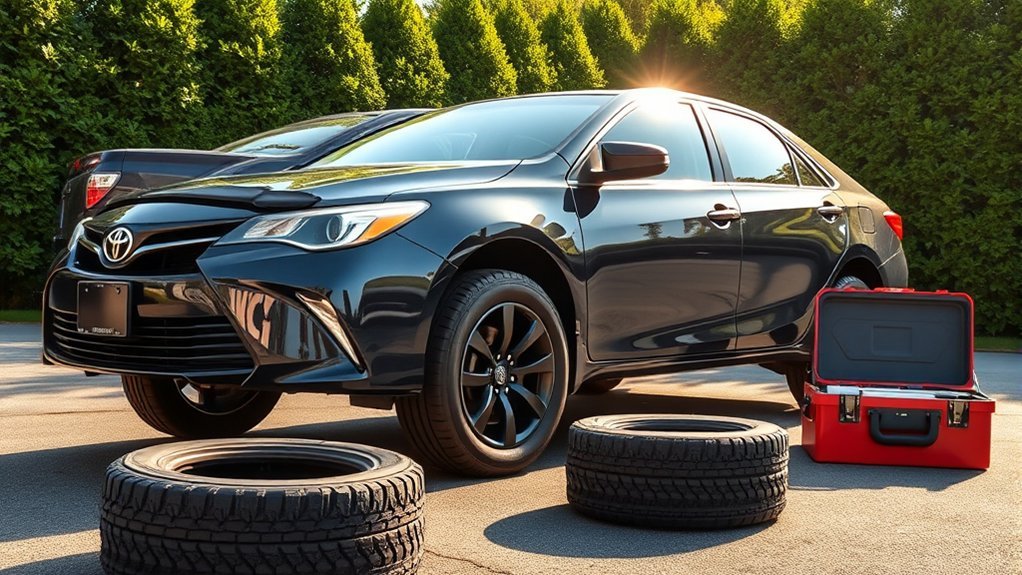
Yes, you can put bigger tires on a Toyota Camry, but you need to choose the size carefully. The safest upgrade keeps the overall tire diameter close to the original size, matches the proper load and speed rating, clears the fenders and suspension, and does not confuse the speedometer, ABS, traction control, or TPMS system.
Quick Answer
You can install bigger tires on a Toyota Camry if the new tire stays within about 3% of the original overall diameter, fits the wheel width and offset, and matches the correct load and speed rating. Check your driver-door tire placard first, then test for rubbing before daily driving.
Key Takeaways
- Do not pick a Camry tire size from a random chart. Start with the tire size on your driver-door placard or Toyota owner’s manual.
- Keep the new overall diameter close to stock. Within 3% is the usual maximum, and closer than 2% is better.
- A wider tire can rub even when the diameter looks correct, especially with the wrong wheel offset.
- The new tire should match or exceed the original load index and speed rating unless a qualified tire professional confirms a safe alternative.
- After installation, check clearance, alignment, tire pressure, TPMS function, and speedometer accuracy.
At a Glance
| Time Required | 30 to 90 minutes for size research, test fitting, installation, and post-installation checks |
| Difficulty | Moderate; safe sizing is more important than the installation itself |
| Tools Needed | Tire-size calculator, tire-pressure gauge, flashlight, torque wrench, jack and stands if checking clearance yourself, and alignment check after installation |
| Cost | Usually the cost of four tires, mounting, balancing, valve stems or TPMS service, and possible alignment |
Is Upgrading to Bigger Tires on Your Toyota Camry Safe and Beneficial?
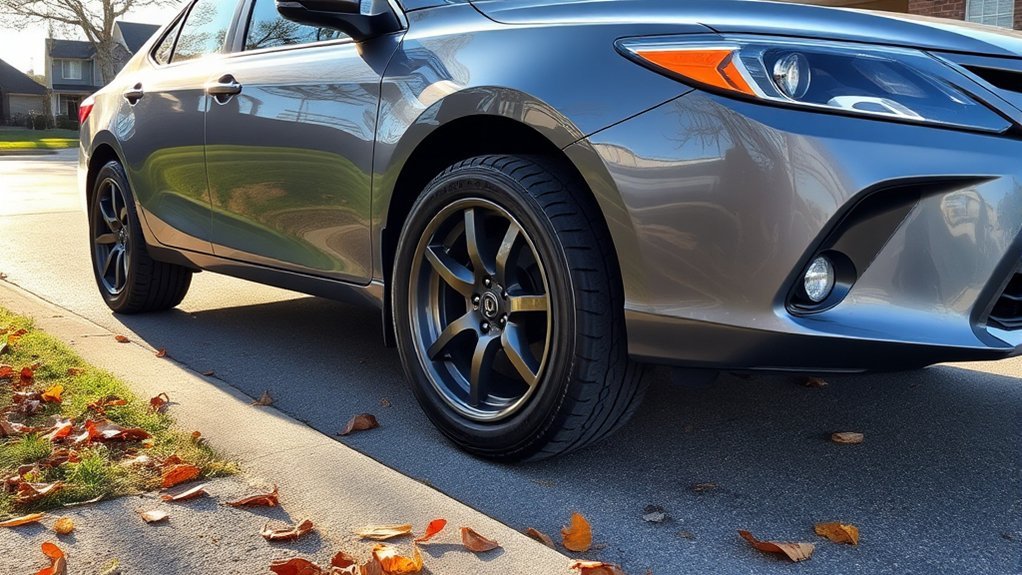
Upgrading to bigger tires on a Toyota Camry can be safe when the new size is close to the factory diameter and has enough clearance. A mild upgrade can improve the look of the car, add a wider contact patch, and sharpen steering feel when paired with the right wheel and tire. It can also make the ride worse if the sidewall gets too short or the tire becomes too heavy.
The biggest mistake is choosing a tire only because it looks better. Your Camry’s tire size affects gearing, speedometer readings, ABS, traction control, ride comfort, fuel economy, and suspension clearance. Before you buy anything, check the tire placard on the driver-side door jamb and compare the new size against the original size listed there. You can also confirm your model’s tire information through Toyota Owners manuals and warranty resources.
Warning: Never install a tire with a lower load index than the original equipment tire unless Toyota or a qualified tire professional confirms it is safe. A tire that cannot carry the required load can overheat, wear quickly, or fail.
What Size Bigger Tires Fit Your Toyota Camry Without Major Modifications?
The right bigger tire size depends on your Camry’s year, trim, factory wheel size, suspension condition, and wheel offset. Many Camry models use factory sizes around 16, 17, 18, or 19 inches, so there is no single “stock size” for every Camry.
As a general rule, keep the new tire’s overall diameter within about 3% of the original size. If you can keep the change under 2%, that is even better for speedometer accuracy and vehicle systems. Width also matters. A tire can have the right diameter and still rub because it is too wide for the wheel well or the wheel offset pushes it too far inward or outward.
[Products Worth Considering]

The TYAMATE TM8 solar-powered wireless TPMS delivers real-time tire pressure and temperature monitoring with six alarm modes for safer driving. A vibrant color LCD display shows readings clearly while windshield mounting keeps it hands-free and easy to read. With a wide 0–87 PSI range, strong 433.92 MHz signal transmission, and quick sensor pairing, it’s ideal for RV, sedan, SUV, MPV, and truck use.
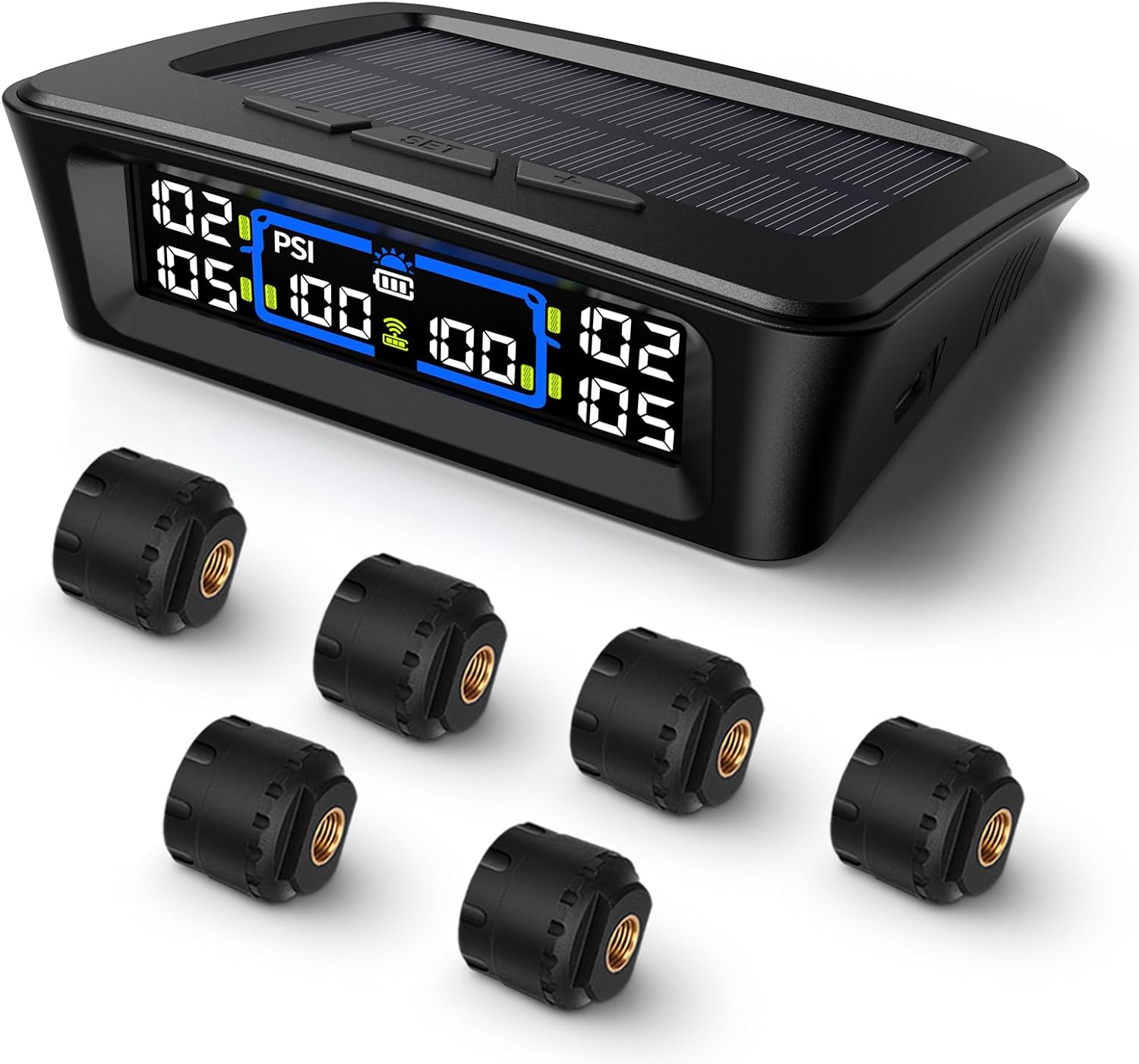
The Tymate TM12 RV TPMS delivers real-time tire pressure and temperature monitoring with a stable 433Hz display for safer long-distance driving. It supports simultaneous monitoring across vehicle and trailer zones, includes six alarm modes for pressure, temperature, leakage, battery, and signal loss, and features easy DIY installation with auto calibration. Power is supplied via USB-C charging or solar recharging, with a wide 0–144 PSI range and up to 50 ft signal coverage for RVs and towable trailers.

Keep your tires properly inflated with this analog VONDIOR tire pressure gauge, designed for fast, easy readings without batteries. The swiveling, two-axis hose and large glow dial help you measure at any tire angle with instant visibility. Built with a protective rubber shield, it supports durable, low-maintenance use for cars and trucks.
How to Find Your Original Camry Tire Size
Before choosing bigger tires, find the exact tire size your Camry came with. Use these sources in this order:
- Driver-door tire placard: This is the best starting point for your exact car.
- Owner’s manual: Use the tire and loading section for pressure and spare-tire guidance.
- Current tire sidewall: Useful only if the car still has the correct size installed.
- Wheel specs: Check wheel diameter, width, bolt pattern, and offset before changing tire width.
Note: The pressure printed on the tire sidewall is not the normal daily driving pressure. Use the cold tire pressure listed on the Camry’s tire placard unless a tire professional gives a specific reason to adjust it.
Recommended Tire Sizes
These are example size comparisons, not a guarantee for every Camry. Always compare against your actual factory size and test the tire for clearance before regular use.
| Original Size | Possible Upgrade | Diameter Change | Fitment Note |
| 215/60R16 | 225/55R16 | About -1.6% | Mild width increase; usually easier than a very wide tire, but still check clearance. |
| 215/60R16 | 215/55R17 | About +0.6% | Good plus-one style example when using the correct 17-inch wheel. |
| 215/60R16 | 225/45R18 | About -0.7% | Common sportier-style diameter match, but ride comfort may be firmer. |
| 205/65R16 | 235/45R18 | About -0.6% | Diameter is close, but the wider tire needs the right wheel width and offset. |
| 205/65R16 | 235/40R19 | About -0.3% | Close diameter, but lower sidewall means a firmer ride and more wheel-damage risk on potholes. |
Avoid using 205/50R17 or 215/45R17 as direct upgrades from 215/60R16 if your goal is to stay near factory diameter. Those sizes are much smaller than the 215/60R16 baseline and can create unnecessary speedometer error.
Impact on Speedometer Accuracy
Changing tire diameter changes how many times the tire rotates per mile. If the new tire is taller than stock, your Camry may be traveling faster than the speedometer shows. If the new tire is shorter than stock, the speedometer may read faster than your actual road speed.
For example, moving from 215/60R16 to 225/55R16 changes diameter by about -1.6%. That is usually manageable, but it can still make the speedometer read slightly high. Bigger changes can also affect odometer readings, traction control behavior, and transmission shift feel.
What Else Must Match Besides Tire Diameter?
Overall diameter is only one part of the fitment decision. A tire can be close in diameter and still be a poor fit for your Toyota Camry.
- Load index: The tire must be able to carry the vehicle’s required load.
- Speed rating: The rating should match or exceed the original equipment tire unless a safe alternative is confirmed.
- Wheel width: The tire must be approved for the wheel’s width range.
- Offset: The wheel offset controls how close the tire sits to the strut, fender, and inner liner.
- Brake clearance: Larger wheels must clear the brake calipers.
- Suspension clearance: Check struts, springs, control arms, and inner fender liners.
- TPMS compatibility: If you change wheels, the TPMS sensors may need to be transferred, replaced, or registered.
Pro Tip: If you want the Camry to look sportier without creating problems, choose a factory-style plus-size setup first. It is usually safer than jumping to the widest tire that physically fits.
[Products Worth Considering]

These universal tire valve stem caps help protect valve cores from dust, debris, and moisture while helping maintain stable tire pressure. The corrosion-resistant metal construction and sealed design provide reliable protection in road grime, mud, and winter conditions. Twist-on installation makes them quick to fit on cars, SUVs, trucks, and motorcycles.

These aluminum alloy tire valve stem caps with an O-ring seal help protect valve stems from corrosion while adding a clean, stylish look to your vehicle. The universal fit works across cars, trucks, motorcycles, bicycles, and more, making them an easy upgrade for everyday driving and off-road use. Installation is quick, and the included four-pack keeps all your tires dressed and protected.

The Trivd Frol 1/2" air impact wrench delivers high performance torque up to 1500 ft-lbs with a twin hammer impact mechanism for strong, balanced blows. It features an ergonomic grip, compact lightweight design, and quick-stop control with 3 forward speeds up to 8000 RPM plus a reverse speed. Built for demanding automotive repair and tire shop work, the rear exhaust helps keep debris away from the surface.
Impact of Bigger Tires on Performance and Handling
When you install bigger tires on your Toyota Camry, you may notice changes in steering, braking, fuel economy, ride comfort, and road noise. The exact result depends on tire weight, tread compound, tread pattern, sidewall height, and wheel size.
Handling Dynamics Changes
A wider tire can feel more planted on dry pavement, but it can also change steering effort and reduce clearance at full lock. A lower-profile tire can sharpen steering response because the sidewall flexes less, but it can also make the ride harsher.
- Steering feel: Wider tires may feel heavier and may follow road grooves more.
- Cornering: A quality performance tire can improve dry-road grip, but tire compound matters more than width alone.
- Turning radius: Extra width may rub at full steering lock.
- Suspension wear: Heavier wheel-and-tire setups can add stress to suspension and steering parts.
- Alignment sensitivity: Wider tires can show uneven wear faster if alignment is off.
Speedometer Accuracy Issues
Bigger tires can make your speedometer accuracy worse if the overall diameter changes too much. A taller tire travels farther per rotation, so your actual speed can be higher than the number shown on the dashboard. A shorter tire does the opposite.
Small changes may not require recalibration, but large changes should be checked. Use a GPS speed reading or a tire-size calculator after installation. If the difference is significant, ask a Toyota dealer or qualified shop whether recalibration is available for your specific Camry.
Ride Quality Impact
Ride quality depends mostly on sidewall height, tire construction, and tire pressure. A larger wheel with a lower-profile tire usually sends more road impact into the cabin. A slightly wider tire on the same wheel may feel similar if the diameter and sidewall stay close to stock.
- Comfort: Shorter sidewalls can make potholes and sharp bumps feel harder.
- Road noise: Wider or sportier tires may create more cabin noise.
- Wet traction: Wider tires can be more prone to hydroplaning if tread design and depth are poor.
- Snow traction: Wider tires are not automatically better in snow. A proper winter tire usually matters more than a wider tire.
- Fuel economy: Heavier tires and wheels can increase rolling resistance and reduce mpg.
Pros and Cons of Installing Larger Tires on Your Camry
Before buying larger tires, compare the benefits against the trade-offs. A Camry is a midsize sedan, so the goal should be better fit, appearance, and road feel, not off-road transformation.
| Pros | Cons |
| Sportier appearance and fuller wheel wells | Possible rubbing on fenders, liners, or suspension |
| Potential dry-road grip improvement with the right tire | Reduced fuel economy if the setup is heavier or has higher rolling resistance |
| Sharper steering with lower-profile tires | Harsher ride and more wheel-damage risk on rough roads |
| May allow a factory-style sport trim look | Can affect speedometer, odometer, TPMS, ABS, and traction control if the diameter changes too much |
What’s the Difference Between Plus-Sizing and Up-Sizing Tires?
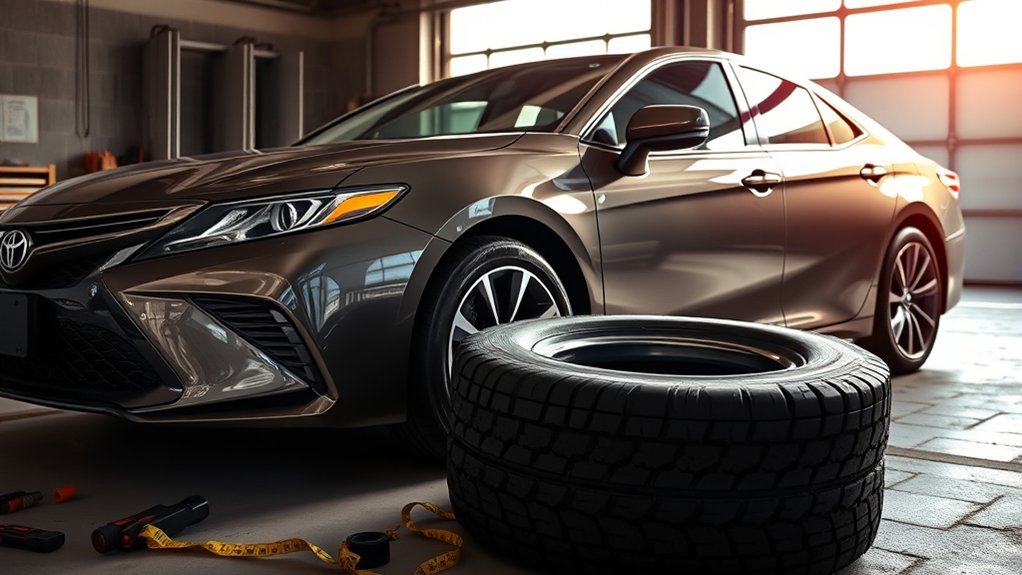
Plus-sizing means using a larger wheel with a lower-profile tire while keeping the overall tire diameter close to the original size. This is often the cleaner and safer way to make a Camry look sportier without upsetting the speedometer or vehicle systems.
Up-sizing usually means increasing the overall tire diameter or width beyond the factory range. That can create more clearance and accuracy problems. It may require different wheels, suspension changes, fender clearance work, or speedometer correction.
- Plus-zero: Same wheel diameter, slightly wider tire, similar overall diameter.
- Plus-one: Wheel diameter increases by 1 inch, tire sidewall gets shorter, overall diameter stays close.
- Plus-two: Wheel diameter increases by 2 inches, sidewall gets shorter again, ride may become firmer.
- Aggressive up-size: Larger diameter or much wider tire; test fitting becomes essential.
Essential Steps for Installing Bigger Tires on Your Camry
Use this process before installing bigger tires on your Toyota Camry:
- Read the original size: Use the driver-door placard or owner’s manual, not only the current tire.
- Compare overall diameter: Keep the new size within about 3% of stock, and closer than 2% when possible.
- Check load and speed rating: Match or exceed the original rating unless a qualified professional confirms otherwise.
- Confirm wheel width and offset: Make sure the tire is approved for the wheel width and that the offset will not cause rubbing.
- Test fit before committing: Turn the steering wheel fully left and right, check inner liners, struts, and fender edges, and inspect clearance with the suspension loaded.
- Install and torque correctly: Have the tires mounted, balanced, and the wheels torqued to the correct specification.
- Check TPMS: Make sure the tire-pressure monitoring system reads correctly after installation.
- Get alignment checked: This helps prevent uneven wear, especially with wider tires.
- Verify speedometer accuracy: Compare the dashboard speed with GPS at steady speeds.
[Products Worth Considering]

Upgrade your Toyota’s wheels with durable aluminum alloy valve stem caps that help protect valve cores from corrosion and direct exposure to road grime, clay, water, and snow. Rubber rings improve sealing to help prevent air leakage and maintain stable tire pressure for safer driving. These caps are easy to install or remove without tools and add a unique, stylish look to your car.

Replace worn or malfunctioning GM TPMS sensors with this 433MHz pre-programmed sensor set designed for compatibility with many Chevrolet, Buick, GMC, and Cadillac models. It includes guidance for proper OBDII relearning/pairing after installation and supports reliable long-term operation with a high-performance CR2032 battery. Quality tested for durability and performance to help restore accurate tire pressure monitoring.

Replace worn or missing TPMS sensors with a pre-programmed 4-pack designed for compatible GM vehicles. These 315MHz sensors provide real-time tire pressure monitoring and alert you if pressure is too high, too low, or if a rapid air leak occurs. Most installations are ready with minimal relearn effort after mounting, helping improve safety and driving confidence.
How to Ensure Accurate Speedometer Readings After Changing Tires?
To keep your speedometer accurate after changing tire size, compare the original and new tire diameter before buying. Then check the real result after installation.
- Use a tire-size calculator to compare overall diameter and revolutions per mile.
- Stay within about 3% of the original diameter, with under 2% preferred.
- Check GPS speed at 30, 50, and 70 mph on a safe road.
- Watch for odometer changes after a known-distance trip.
- Ask a Toyota dealer or qualified shop about recalibration if the difference is large.
If your Camry has AWD or hybrid systems, be extra conservative. Large tire-size differences can create unnecessary strain or confusing sensor readings. Keep all four tires the same size, brand, model, and wear level unless Toyota specifically approves a different setup.
When Bigger Tires Are a Bad Idea
Bigger tires are not worth it if they create rubbing, reduce load capacity, make the ride uncomfortable, or cause warning lights. Skip the upgrade or choose a milder size if you notice any of these red flags:
- The new size is more than 3% taller or shorter than stock.
- The load index is lower than the original tire.
- The tire rubs at full steering lock or over bumps.
- The wheel offset places the tire too close to the strut or fender.
- The tire shop cannot confirm the size is safe for your wheel width.
- You drive often in snow and are choosing width for appearance instead of winter performance.
- Your Camry is under warranty and the tire change could be blamed for a related suspension, driveline, or sensor issue.
Frequently Asked Questions
Will bigger tires affect my fuel efficiency?
Yes, bigger or wider tires can reduce fuel efficiency if they are heavier or have more rolling resistance. A mild plus-size setup may have a small effect, while aggressive wheel-and-tire changes can make the Camry feel slower and use more fuel.
Can I use my stock rims with larger tires?
Sometimes, but only if the larger tire is approved for the stock wheel width and clears the suspension and fenders. Do not install a tire that is too wide or too narrow for the rim. Check the tire manufacturer’s approved rim-width range before buying.
How do larger tires impact ride comfort?
A taller sidewall can soften some impacts, but many Camry upgrades use larger wheels with shorter sidewalls. That setup usually feels firmer over potholes and rough pavement. Tire construction and pressure also affect comfort.
Will bigger tires void my warranty?
Bigger tires do not automatically void the entire warranty, but a dealer may deny a related claim if the tire or wheel change caused the problem. For example, rubbing damage, wheel-bearing stress, suspension wear, or sensor issues may not be covered if they are linked to an unsafe tire change.
Is professional installation necessary for larger tires?
Professional installation is strongly recommended. A tire shop can confirm wheel width, balance the tires, service TPMS sensors, check clearance, torque the wheels, and recommend alignment. This is especially important if you are changing both wheel and tire size.
What is the safest bigger tire size for a Toyota Camry?
The safest bigger size is the one that stays close to your original diameter, fits your wheel width and offset, and matches the original load and speed rating. Because Camry sizes vary by year and trim, start with your door placard instead of copying another owner’s setup.
Conclusion
You can put bigger tires on a Toyota Camry, but the best upgrade is usually a mild plus-size setup, not the biggest tire that fits. Start with the tire size on your door placard, keep the overall diameter close to stock, match the correct load and speed rating, and test for rubbing before daily driving. When in doubt, choose the conservative size and have a qualified shop inspect the fitment.
Sources
- Toyota Owners Manuals and Warranty Resources — supports checking the owner’s manual and vehicle-specific tire information.
- NHTSA Tire Safety — supports tire safety, pressure, tire maintenance, and recall awareness.
- Michelin: How to Read Tire Size — supports tire-size code, load index, and speed rating basics.
- Bridgestone: How to Check Tire Pressure — supports cold tire-pressure checking and routine pressure maintenance.