
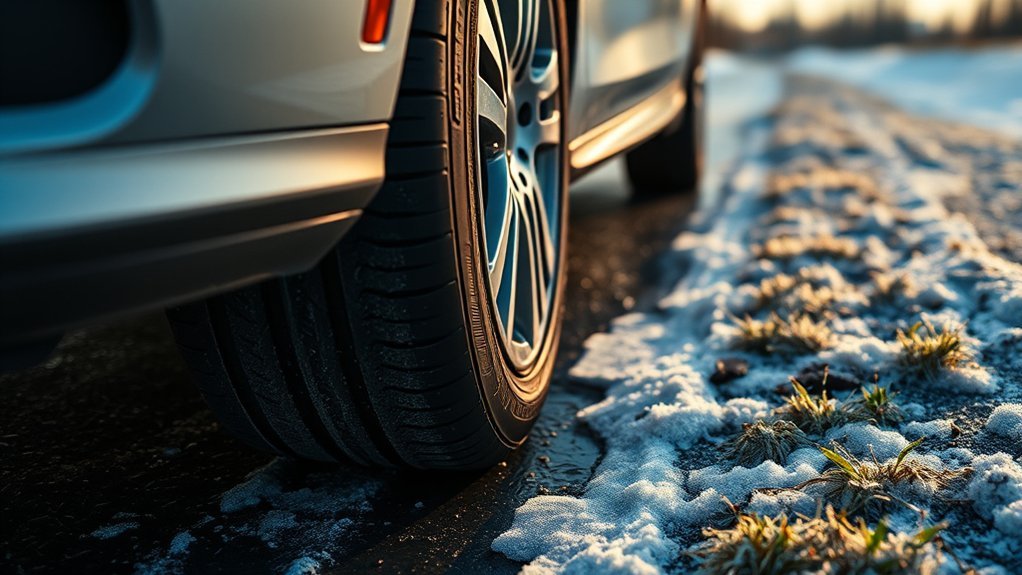
All-season tires do not suddenly stop working when the temperature reaches 45°F (7°C). Instead, that temperature is a widely used changeover guideline because many all-season compounds begin losing flexibility and cold-weather grip as temperatures fall. If cold weather becomes consistent—especially when frost, snow, freezing rain, or ice is likely—winter tires can provide better traction, braking, and control.
Quick Answer
All-season tires do not abruptly stop working at 45°F (7°C). Instead, many begin losing flexibility and cold-weather grip around that point. If daily temperatures stay near or below 45°F—especially with frost, snow, or ice—winter tires or suitable 3PMSF-rated tires provide better cold-weather traction.
Key Takeaways
- Treat 45°F (7°C) as a practical winter-tire changeover guideline, not a hard failure temperature.
- All-season rubber becomes less flexible as temperatures fall, which can reduce grip even on cold, dry pavement.
- Winter tires use compounds and tread designs intended to maintain better traction in sustained cold, snow, slush, and ice.
- For snow driving, tread condition matters as much as tire type; a tire can be legal yet still have limited useful snow traction.
- Look for the Three-Peak Mountain Snowflake symbol when severe-snow capability matters; an M+S marking alone is not the same certification.
- Check cold tire pressure, tire age, local winter-tire rules, and your vehicle manufacturer’s recommendations before seasonal driving.
When Do All-Season Tires Stop Working?

There is no single temperature at which every all-season tire suddenly becomes unusable. The more accurate answer is that many all-season tires begin losing cold-weather performance around 45°F (7°C).
Transport Canada states that below 7°C, all-season and summer tires begin to lose elasticity, resulting in reduced traction. Michelin likewise recommends installing winter tires when daily temperatures consistently fall below 45°F.
Think of 45°F as a changeover cue, not an on/off switch for tire safety.
You may notice less precise steering, weaker braking grip, or reduced confidence on cold wet pavement before snow appears. How noticeable the difference is depends on the exact tire, tread depth, inflation pressure, road surface, vehicle, and driving conditions.
Traditional all-season tires can still handle many mild winter conditions, but they are a compromise designed to cover a broad temperature range rather than excel in severe cold.
If your normal driving involves prolonged temperatures below 45°F, frequent frost, freezing rain, snow, or ice, dedicated winter tires are usually the stronger cold-weather choice.
Why 45°F Is the Tipping Point
The 45°F guideline comes from how tire compounds respond to temperature. As temperatures fall, traditional all-season rubber becomes less compliant, while winter compounds are formulated to remain useful at lower temperatures.
Rubber Becomes Less Flexible Below 45°F
Once temperatures move below roughly 45°F, the compound in many all-season tires begins to stiffen. A stiffer tread cannot conform to small road-surface irregularities as effectively as a more flexible one.
That matters even when the pavement is dry. Tire grip depends on the tread maintaining effective contact with the road, and temperature affects how easily the rubber deforms under braking, cornering, and acceleration.
The change is progressive rather than instantaneous. One cold morning at 43°F does not automatically make your tires unsafe, but weeks of colder driving indicate that you are operating outside the conditions where a traditional all-season tire performs best.
Grip Drops in Cold Conditions
As all-season rubber becomes less flexible, several parts of vehicle response can change:
- Braking can require more distance, especially as the road becomes wet, frosty, snowy, or icy.
- Steering response may feel less precise.
- Cornering grip can decrease.
- Emergency maneuvers may provide less traction margin.
Cold pavement is therefore relevant even before snow falls. Snow, slush, frost, and ice add another layer of difficulty by reducing the friction available between the tire and road.
Winter Tires Stay More Flexible
Winter tires use compounds designed to remain more flexible at low temperatures. Their tread patterns also commonly include deeper grooves and numerous sipes that create biting edges for snow and slippery surfaces.
This combination generally gives winter tires better cold-weather traction, braking, and steering than conventional all-season tires in true winter conditions.
The exact performance difference cannot be reduced to one universal percentage. Vehicle type, tire model, speed, road surface, temperature, tread depth, and test conditions all affect stopping distance.
What Cold Weather Does to Tire Grip
Cold weather affects both the tire compound and the air pressure inside the tire. That means winter performance depends on more than whether snow is visible.
How Cold Changes Tire Rubber
When an all-season compound becomes stiffer, the tread deforms less easily as it rolls over the pavement. This can reduce how effectively the contact patch follows the road’s small surface variations.
- Rubber flexibility decreases.
- The tread conforms less effectively to road texture.
- Steering and braking response can become less predictable.
- The performance gap between conventional all-season and winter tires becomes more important as winter conditions worsen.
That is why cold, dry pavement can expose a difference even before snow or ice appears.
Traction Drops on Cold Roads
Temperature is only one part of the traction equation. A cold dry road may offer far more grip than glare ice, while a worn winter tire may perform worse than a newer tire with adequate tread in some conditions.
For real-world safety, consider temperature together with tread depth, inflation pressure, precipitation, road treatment, hills, driving speed, and the amount of snow or ice you normally encounter.
Note: The 45°F guideline is useful for planning a seasonal change, but road conditions still determine how much traction is available on any individual trip.
Winter Tires vs. All-Season Tires
All-season and winter tires are designed around different compromises. Traditional all-season tires prioritize year-round convenience in moderate climates. Winter tires prioritize cold-weather traction.
| Feature | Traditional All-Season Tire | Winter Tire |
|---|---|---|
| Best use | Moderate year-round conditions | Sustained cold, snow, slush, and ice |
| Cold flexibility | Generally decreases as temperatures fall | Compound is designed to remain more flexible in the cold |
| Snow traction | Varies widely by model and certification | Designed specifically for winter conditions |
| Warm-weather use | Suitable for normal warm-weather driving | Not intended as the best year-round choice in hot weather |
Warning: If you use winter tires, install an appropriate set on all four wheel positions. Transport Canada recommends four winter tires to help maintain vehicle control and stability. Follow your vehicle and tire manufacturers’ fitment requirements.
[Products Worth Considering]

The Kurgo Seasonal Tire Tote helps protect your car interior, clothes, and garage from tire grime, brake dust, and residue during seasonal tire changes. Its universal design fits most passenger tires between 22" and 31" in diameter, making storage and transport simpler with less mess. Built for rugged, repeated use, it’s machine washable for easy care and comes with a lifetime warranty.

Monitor tire tread wear with a smart, color-coded depth gauge that shows clear condition ranges at a glance. The bar is range marked for fast, easy readings, helping you maintain safer traction and performance. Each gauge is portable with a pocket clip, and the set includes 20 units for daily use and sharing.

Measure tire tread depth quickly and accurately with this LUMITECO dial gauge that reads in 1/32" increments up to 14/32". The color-coded green/yellow/red zones make it easy to judge tire wear and know when replacement is needed. A rugged, compact design with a protective pouch helps keep the gauge ready for use on cars, trucks, motorcycles, and more.
What Do 3PMSF and M+S Tire Markings Mean?
Tire sidewall markings can tell you more than the words “all-season” or “winter.” Two markings are especially important when evaluating snow capability.
M+S
M+S, M/S, M&S, MS, and similar markings are commonly found on all-season tires. Under the USTMA snow-tire definition, the marking is based primarily on specified tread-design characteristics.
It should not be treated as the same thing as a tested severe-snow rating.
Three-Peak Mountain Snowflake
The Three-Peak Mountain Snowflake, often shortened to 3PMSF, identifies tires that meet defined severe-snow traction requirements. The U.S. Tire Manufacturers Association specifies a standardized snow-traction test for tires carrying the severe-snow symbol.
Some year-round tires marketed as all-weather, and some all-season tire models, carry the 3PMSF symbol. They can offer a useful middle ground for drivers who want year-round convenience with tested severe-snow capability.
Note: 3PMSF verifies performance in a standardized severe-snow test. It does not mean every 3PMSF tire performs identically on ice, wet pavement, deep snow, or extreme cold.
How to Tell It’s Time for a Swap
Temperature is the first signal, but tire condition and the weather you actually drive through should determine your final decision.
Temperature Signs
Consider changing from conventional all-season tires to winter tires when:
- Average daily temperatures are consistently around or below 45°F (7°C).
- Most of your driving happens during colder mornings or nights.
- Frost, freezing rain, snow, or ice is becoming common.
- Your route includes untreated roads, hills, mountain passes, or other locations where additional winter traction matters.
Use the forecast trend rather than one isolated cold morning. If the seasonal pattern has clearly changed, schedule the swap before the first major winter storm.
Tread and Traction Checks
Cold-weather performance also depends heavily on tread condition. NHTSA says tires should be replaced when tread is worn to 2/32 of an inch.
However, that minimum should not be confused with ideal snow-driving tread. Transport Canada advises against using tires with less than about 4 mm (5/32 inch) of tread on snow-covered roads.
Inspect for uneven wear, exposed cords, cuts, punctures, bulges, cracking, and other damage. In the United States, the penny test can help identify the 2/32-inch replacement point: insert a penny into a main tread groove with Lincoln’s head upside down. If the top of his head remains completely visible, the tread is at or below that basic threshold.
Age also matters, but there is no universal rule that every tire expires at exactly six years. NHTSA notes that some vehicle and tire manufacturers recommend replacement at six years, while other recommendations extend toward ten years. Check the DOT Tire Identification Number for the manufacture date and follow the tire maker’s and vehicle maker’s guidance.
When Should You Change Tires for Winter?
A useful rule is to plan the winter change once daily temperatures consistently settle near or below 45°F (7°C). Waiting for the first snowfall can leave you driving through cold mornings, frost, or freezing rain on tires that are already becoming less flexible.
You may also hear the 7-7 rule: switch when temperatures remain around or below 7°C for seven consecutive days, then consider changing back after a sustained period above that level in spring. Treat it as a convenient planning guideline rather than a universal law.
- Watch the multi-day forecast instead of one cold day.
- Install winter tires before recurring snow or ice arrives.
- Book service early if your area has a predictable seasonal tire rush.
- Check local winter-tire and traction-device laws before travel.
- Follow the tire and vehicle manufacturers’ size, load, pressure, and fitment requirements.
Pro Tip: If most of your driving happens before sunrise or late at night, base your tire-change decision on the temperatures you actually drive in rather than only the warmer afternoon high.
What to Check Before Winter Driving
Winter readiness goes beyond choosing the right tire type. Check the tires and the rest of the vehicle before cold weather becomes severe.
1. Tread and Tire Condition
Inspect tread depth, sidewalls, and the full circumference of each tire. Damage, irregular wear, and low tread can reduce traction regardless of the seasonal label on the sidewall.
2. Cold Tire Pressure
Air pressure falls as temperatures fall. Check each tire when cold and inflate it to the vehicle manufacturer’s recommended pressure shown on the driver’s door placard or in the owner’s manual—not the maximum pressure molded into the tire sidewall.
NHTSA’s winter-driving guidance recommends checking tires when they have not been driven for at least three hours. Transport Canada notes that pressure can decrease by about 1 psi for every 5°C drop in temperature.
3. Battery and Winter Equipment
Cold weather reduces battery performance and increases starting demands on gasoline and diesel vehicles. Have the battery and charging system checked if there are signs of weakness.
Make sure the windshield washer reservoir contains suitable winter fluid, the defroster works, and worn wiper blades are replaced.
4. Brakes, Fluids, and Cooling System
Check brakes, coolant, hoses, lights, and other routine maintenance items before severe winter weather. A qualified technician can identify leaks, worn components, or other problems that become more difficult to deal with in freezing conditions.
Common Tire Myths Drivers Still Believe
- “All-season” means every possible weather condition. False. Traditional all-season tires are designed as a year-round compromise, especially for moderate climates.
- Snow is the only reason to consider winter tires. False. Cold temperature alone changes rubber behavior, and frost, freezing rain, and ice can appear before heavy snow.
- 45°F is a hard failure temperature. False. It is a practical changeover guideline; performance changes progressively.
- AWD or 4WD makes winter tires unnecessary. False. AWD can help distribute power for acceleration, but every vehicle still depends on tire grip for braking and cornering.
- Two winter tires are enough. A mixed setup can create a large traction imbalance between axles. Use an appropriate set of four unless your vehicle or tire manufacturer explicitly specifies otherwise.
- M+S automatically means severe-snow certified. False. Look for the Three-Peak Mountain Snowflake symbol when tested severe-snow capability matters.
How to Choose Tires for Your Climate
Choose tires based on the conditions you actually encounter, not just the product category printed on a sales page. Temperature, snow frequency, ice, hills, road treatment, mileage, and local regulations all matter.
| Climate Pattern | Tire Option to Consider |
|---|---|
| Mild winters, little or no snow, temperatures usually above 45°F | Quality all-season tires may be appropriate |
| Mixed seasons with occasional snow and colder periods | Consider a 3PMSF-rated year-round tire if it meets your vehicle and driving needs |
| Frequent temperatures below 45°F with regular snow or freezing conditions | Dedicated winter tires are usually the stronger seasonal choice |
| Heavy snow, persistent ice, mountain driving, or severe winters | Dedicated winter tires suited to the vehicle and local conditions |
A 3PMSF rating is useful evidence of severe-snow traction, but compare the complete tire specifications and independent testing when ice, wet braking, noise, tread life, or warm-weather handling are also important.
[Products Worth Considering]

Steelman white tire marking crayons provide high-contrast, semi-permanent marks for repairing and inspecting tires and equipment. They write on wet or dry, smooth or coarse surfaces including rubber, metal, glass, and wood, making them ideal for puncture location and damage outlining. The lead- and zinc-free crayons resist weather and fading yet wipe away when you no longer need the marks.

Milton S-921 pencil tire pressure gauge helps you maintain optimal tire pressure for passenger cars with accurate readings in PSI and kPa. It features a built-in deflator valve for convenient pressure adjustments, plus a single chuck head and nylon indicator bar for easy use on the go. Built from durable plated brass and designed for reliable performance, it’s a practical road trip and cold-weather maintenance tool.

The SAFELIFE dial tire tread depth gauge measures tread depth in 1/32 inch increments with clear, easy-to-read 2-inch dial face. Color zones using a traffic light system help you quickly judge whether tread is low, marginal, or ample for safer driving. Built with a durable zinc cast body and a metal detect probe for precise, comfortable use across cars, motorcycles, trucks, and buses.
Seasonal Tire Swap Checklist
When colder weather becomes consistent, use a systematic tire check rather than simply changing tires by calendar date.
- Inspect tire condition: measure tread depth and check for uneven wear, cuts, cracking, bulges, punctures, or other damage.
- Verify fitment: use the correct tire size, load capability, and other specifications required by the vehicle manufacturer.
- Install the correct seasonal set: use four compatible winter tires when a dedicated winter setup is appropriate.
- Check inflation: set tire pressure according to the vehicle placard while the tires are cold.
- Confirm rotation and balance: address vibration, unusual wear, alignment problems, or other handling concerns.
- Store off-season tires correctly: keep them clean, dry, and protected from direct sunlight, excessive heat, moisture, and ozone-producing equipment.
- Record the service: note the mileage and date so rotations, tread wear, and tire age are easier to track.
Do not wait until traction feels obviously poor. By that point, cold weather or tire wear may already have reduced the safety margin available for braking and emergency maneuvers.
[Products Worth Considering]

Accurately measure tire tread depth with a calibrated gauge marked from 0 to 1 inch in 1/32 inch increments. The color-coded bar helps you quickly identify tread condition ranges, supporting safe driving for trucks, motorcycles, automobiles, and passenger vehicles.

The Big Rig Defense Tire Thumper is a truck tire pressure checker that lets you quickly check multiple tires by giving them a firm whack. Listen for a reassuring thump and feel the stick bounce when a tire is fully inflated, helping you get back on the road safely. It features a comfortable, glove-friendly handle and a secure wrist strap for confident use on busy routes.

The Continental Grand Prix 5000 is an allround road bike tire engineered for faster rolling, improved ride comfort, and enhanced puncture protection. It features a Vectran Breaker cut-protection layer, Lazer Grip micro-profile tread for confident cornering control, and Active Comfort Technology to damp vibration for smoother rides. BlackChili compound optimizes grip and speed for everyday performance and long-lasting confidence.
Frequently Asked Questions
At What Temperature Are All-Season Tires Ineffective?
There is no universal temperature at which all-season tires instantly become ineffective. Around 45°F (7°C), many traditional all-season compounds begin losing flexibility and cold-weather grip. Treat 45°F as a seasonal changeover guideline rather than a hard failure point.
What Is the 7-7 Rule for Winter Tires?
The 7-7 rule is a practical planning guideline that suggests installing winter tires after temperatures remain around or below 7°C (45°F) for roughly seven consecutive days. It is not a universal law, so also consider snow, ice, local regulations, and your tire manufacturer’s guidance.
At What Temperature Do Summer Tires Stop Working?
Summer tires become increasingly unsuitable as temperatures approach and fall below about 45°F (7°C). Their compounds are designed for warmer conditions and can lose flexibility and grip in the cold. Always follow the tire manufacturer’s specific temperature restrictions, especially for high-performance summer tires.
What Is the Coldest Temperature for All-Season Tires?
There is no single coldest safe temperature that applies to every all-season tire. Around 45°F (7°C), conventional all-season tires generally begin giving up some cold-weather performance. Whether they remain appropriate depends on the exact tire, tread condition, road surface, snow and ice, and manufacturer guidance.
Do All-Season Tires Become Unsafe the Moment It Drops Below 45°F?
No. The change is gradual. A brief dip below 45°F does not make an all-season tire instantly unsafe. The reason to watch this temperature is that sustained cold reduces the flexibility and traction of many conventional all-season compounds while winter tires are designed specifically for colder conditions.
What Does the Three-Peak Mountain Snowflake Symbol Mean?
The Three-Peak Mountain Snowflake, or 3PMSF, identifies a tire that meets defined severe-snow traction requirements. It is more meaningful for snow performance than an M+S marking alone. However, the symbol does not guarantee that every 3PMSF tire will perform equally well on ice or in every winter condition.
Conclusion
All-season tires do not suddenly fail at 45°F, but sustained temperatures around or below 45°F (7°C) are a useful signal to reassess your tire setup. Traditional all-season compounds become less flexible as conditions get colder, while winter tires are designed to maintain stronger cold-weather traction. Base your decision on temperature, snow and ice exposure, tread condition, tire pressure, local rules, and the specifications for your vehicle. If you regularly drive through true winter conditions, changing to four suitable winter tires before severe weather arrives gives you a larger traction margin for braking, steering, and emergency maneuvers.
Sources
- Transport Canada — Using Winter Tires — supports the 7°C cold-weather guideline, winter-tire flexibility, four-tire installation, and snow-driving tread guidance.
- National Highway Traffic Safety Administration — TireWise — supports tire-pressure, tread-depth, inspection, penny-test, and tire-age guidance.
- NHTSA — Winter Weather Driving Tips — supports cold-pressure checks, winter vehicle preparation, battery, wiper, and cooling-system guidance.
- Michelin — Preparing for Winter — supports the practical 45°F winter-tire changeover guideline.
- U.S. Tire Manufacturers Association — Severe Snow Tire Definition — supports the Three-Peak Mountain Snowflake severe-snow performance explanation.
- U.S. Tire Manufacturers Association — Replacing Tires — supports correct replacement-tire specifications and tire-fitment considerations.

