You should use winter tires when cold weather is regular, not just when snow is already on the road. Once daily temperatures stay near or below 7°C (45°F), winter-tire rubber stays more flexible than typical all-season rubber, helping your vehicle brake, turn, and regain control on cold pavement, slush, snow, and ice.
Quick Answer
Yes, you need winter tires if temperatures regularly drop below 7°C (45°F), or if you drive on snow, ice, frost, or untreated roads. A 3PMSF all-weather tire can work for mild winters, but dedicated winter tires are the safer choice for frequent snow, ice, rural roads, mountain routes, or long cold-weather commutes.
Key Takeaways
- Use winter tires once temperatures stay around or below 7°C (45°F), even before the first major snowfall.
- Winter tires are not just “snow tires”; they are built for cold pavement, ice, slush, frost, and packed snow.
- Choose tires with the Three-Peak Mountain Snowflake (3PMSF) symbol for severe snow service, not just an M+S marking.
- Install a full set of four winter tires. Mixing winter and non-winter tires can upset braking and cornering balance.
- Switch back to all-season, summer, or all-weather tires once warm weather is steady to avoid fast winter-tire wear.
At a Glance
| Best Time to Install | When daily temperatures stay near or below 7°C (45°F) |
| Best For | Cold pavement, snow, ice, slush, frost, mountain roads, and rural winter driving |
| What to Look For | Three-Peak Mountain Snowflake symbol, correct size, full set of four, healthy tread depth |
| Main Tradeoff | Extra cost and storage, but better braking and control in winter conditions |
Do You Need Winter Tires in Cold Weather?
You need winter tires if cold weather is a normal part of your driving season. The key trigger is not only snowfall; it is temperature. Transport Canada notes that all-season and summer tires begin to lose elasticity below 7°C, while winter tires are designed to keep their grip in cold conditions.
That extra grip matters because your tires are the only parts of the vehicle touching the road. Winter tires use softer cold-weather compounds, deeper tread blocks, wider channels, and many small cuts called sipes. Together, these features help the tire bite into snow, move slush away from the contact patch, and stay more predictable on icy or cold wet roads.
At temperatures just below freezing, winter tires can shorten stopping distances by as much as 30% compared with all-season tires, according to the Tire and Rubber Association of Canada.
If you live where winters are mild and snow is rare, a 3PMSF-rated all-weather tire may be enough. If you regularly drive through heavy snow, black ice, freezing rain, mountain passes, unplowed roads, or long cold commutes, dedicated winter tires are the safer choice.
Quick Decision Checklist: When to Swap to Winter Tires
Use this checklist before the first major cold snap. You should switch to winter tires when one or more of these conditions apply:
- Temperatures stay below 7°C (45°F): If your daily highs or commute-time temperatures are consistently around this level, winter tires are the better match.
- You see frost in the morning: Frost is a sign that the pavement can be colder and slicker than it looks.
- Snow or freezing rain is forecast for several days: Do not wait until the first storm, when tire shops are busiest.
- Your route includes hills, bridges, rural roads, or shaded areas: These spots freeze earlier and thaw later than open roads.
- You drive before sunrise or after dark: Overnight freezing can leave ice even when daytime weather feels manageable.
- You carry family, passengers, or heavy loads: Extra weight and responsibility make predictable braking more important.
Warning: Install winter tires as a full set of four. Putting winter tires on only the front or rear axle can create uneven grip, making the vehicle harder to control during braking, cornering, or emergency maneuvers.
Temperature Thresholds
The common rule is simple: when temperatures are consistently below 7°C (45°F), use winter tires. Below this range, many all-season compounds become harder, which reduces their ability to conform to the road surface. Winter tires are made to stay more flexible in the cold, giving them better grip on cold pavement, snow, and ice.
Do not treat the 7°C mark as an exact scientific cliff. It is a practical planning threshold. If your mornings are 3°C, afternoons are 9°C, and the forecast shows freezing nights, it is reasonable to switch before the weather turns severe.
Road Condition Triggers
Road conditions can justify winter tires even when the thermometer moves above and below 7°C. Watch for packed snow, slush, freezing rain, black ice, freeze-thaw cycles, and wet roads that refreeze overnight. Bridges, overpasses, shaded corners, and rural intersections are especially risky because they can ice over before the rest of the road.
If your area gets repeated snow or ice events, install winter tires early in the season and keep them on until temperatures are reliably warmer. Reacting after a storm starts usually means driving at the worst time with the wrong tires.
Winter Tires vs All-Season Tires: How They Behave in Cold
Winter tires are optimized for cold-weather grip. Their rubber compounds stay pliable, their tread blocks are deeper, and their siping creates more biting edges. That design helps the tire grip cold pavement, packed snow, and ice.
All-season tires are built as a compromise. They work well for many drivers in moderate weather, rain, and occasional light snow. But in sustained freezing temperatures, their rubber can harden and their tread pattern may not clear snow and slush as effectively as a true winter tire.
All-weather tires sit between the two. Many carry the 3PMSF symbol and are designed for year-round use, including light to moderate winter conditions. They are useful for drivers who want one set of tires and live where winters are not severe. They still do not match the cold-weather braking, ice grip, and deep-snow traction of dedicated winter tires.
| Tire Type | Best Use | Winter Limitation |
|---|---|---|
| Winter tires | Cold weather, snow, ice, slush, freezing rain | Wear faster in warm weather |
| All-season tires | Mild climates, dry and wet roads, occasional light snow | Reduced grip in sustained cold, snow, and ice |
| 3PMSF all-weather tires | Year-round use in mild to moderate winter areas | Less capable than dedicated winter tires in severe conditions |
Why Rubber Compounds Matter Below 7°C (45°F)
Tire grip depends heavily on how well the rubber can flex and conform to the road. In warm weather, that is easier. In cold weather, rubber stiffens. A stiff tire has less ability to press into the tiny texture of pavement, packed snow, or ice.
Winter tires use compounds designed for low temperatures. This helps them maintain traction when all-season or summer tires start to feel harder. The difference is most noticeable during braking, cornering, and starting from a stop on slick surfaces.
Note: Winter tires help with grip, but they do not cancel physics. You still need slower speeds, longer following distances, smooth steering, and gentle braking on snow or ice.
Tread Design: Sipes, Voids, and Biting Edges Explained
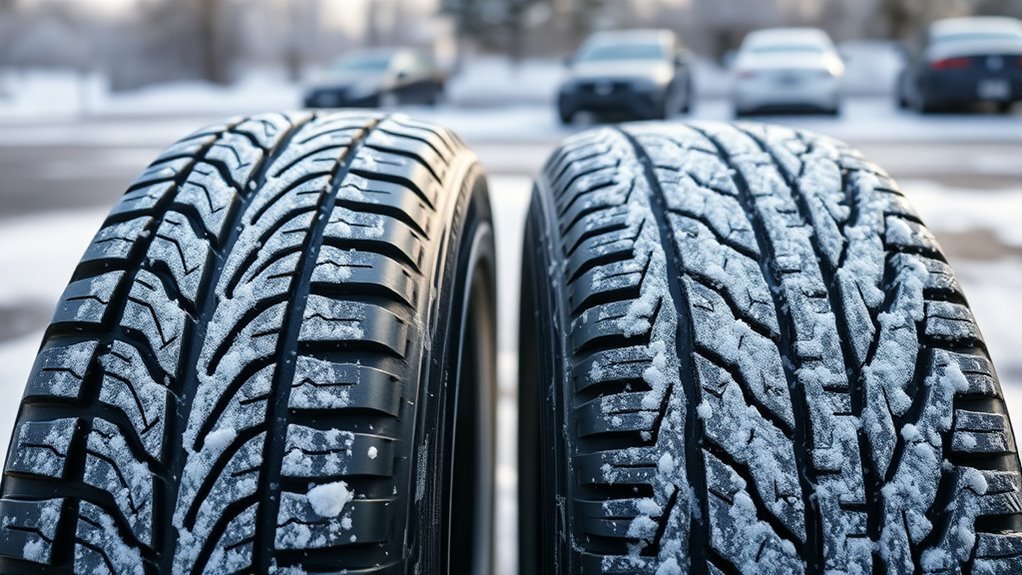
Winter tire tread is built to turn cold-weather rubber into useful grip. The most important features are sipes, voids, and biting edges.
- Sipes are small cuts in the tread blocks. They create extra edges that help grip snow and ice.
- Voids are the open channels between tread blocks. They move water, slush, and loose snow away from the tire.
- Biting edges are the sharp tread surfaces that dig into snow and help the tire hold direction.
- Deeper tread depth gives snow and slush more room to clear instead of packing under the tire.
This is why a winter tire can feel more stable in cold, messy conditions. It is not just softer rubber; the tread is also shaped to manage snow, slush, and water more effectively than a typical all-season pattern.
Braking and Cornering: Real-World Performance Gaps
The biggest safety difference between winter and all-season tires shows up when you need to stop or turn suddenly. On cold, slick surfaces, a small improvement in grip can mean stopping before an obstacle instead of sliding into it.
Shorter Stopping Distances
Winter tires can reduce stopping distance because they keep more usable grip under braking. The Tire and Rubber Association of Canada reports that winter tires can stop up to 30% shorter than all-season tires at temperatures just below freezing. Exact results vary by vehicle, tire model, tread depth, road surface, speed, and driver input, but the safety margin can be significant.
Anti-lock brakes and stability control help you manage a skid, but they cannot create traction the tire does not have. Better tires give those safety systems more grip to work with.
Cornering Grip Differences
Cornering is where many drivers first notice the weakness of all-season tires in winter. A vehicle may start, accelerate, and cruise normally, then slide wide in a turn or activate stability control when the road gets icy.
Winter tires improve cornering because their compound stays flexible and their siped tread creates more edges against the road. This helps the vehicle respond more predictably when you steer around a bend, change lanes through slush, or correct a small slide.
When a 3PMS All-Weather Tire Is Good Enough
A 3PMSF all-weather tire can be good enough if your winters are mild, your roads are usually plowed, and you rarely face deep snow or long stretches of ice. These tires are designed for year-round use and carry the Three-Peak Mountain Snowflake symbol, meaning they meet a defined severe-snow traction requirement.
Look for the 3PMSF symbol on the sidewall. The symbol matters because it is tied to snow-traction testing, while the older M+S marking mainly describes tread geometry and does not prove the same severe-snow performance.
Choose 3PMSF all-weather tires if you want one set of tires and your winter driving is mostly city or suburban commuting in light to moderate snow. Choose dedicated winter tires if you regularly face icy hills, heavy snowfall, rural roads, long highway commutes, or mountain travel.
Pro Tip: If you are comparing tire labels, prioritize the 3PMSF symbol for snow capability. The Ice Grip pictogram, used on some passenger-car tires in Europe, identifies tires tested for ice braking under specific conditions, but those tires are mainly intended for very cold Nordic-style climates.
[Products Worth Considering]

Keep your tires properly inflated with this analog VONDIOR tire pressure gauge, designed for fast, easy readings without batteries. The swiveling, two-axis hose and large glow dial help you measure at any tire angle with instant visibility. Built with a protective rubber shield, it supports durable, low-maintenance use for cars and trucks.

Measure tire tread depth quickly and accurately with this LUMITECO dial gauge that reads in 1/32" increments up to 14/32". The color-coded green/yellow/red zones make it easy to judge tire wear and know when replacement is needed. A rugged, compact design with a protective pouch helps keep the gauge ready for use on cars, trucks, motorcycles, and more.

Monitor tire tread wear with a smart, color-coded depth gauge that shows clear condition ranges at a glance. The bar is range marked for fast, easy readings, helping you maintain safer traction and performance. Each gauge is portable with a pocket clip, and the set includes 20 units for daily use and sharing.
Regional and Driving Scenarios That Require Winter Tires
Some drivers can safely use all-weather tires through winter. Others should treat winter tires as essential equipment. Your decision should be based on your local climate, road maintenance, route type, and risk tolerance.
You should strongly consider dedicated winter tires if you drive in any of these scenarios:
- Frequent snow or ice: Regular storms, packed snow, freezing rain, or black ice justify winter tires.
- Mountain or hilly routes: Climbing, descending, and turning on grades demand more traction.
- Rural or unplowed roads: Roads that are cleared late or treated lightly need better snow grip.
- Long commutes: More time on winter roads means more exposure to changing conditions.
- Early-morning driving: Ice is more common before sunlight and traffic warm the pavement.
- New drivers or family vehicles: Extra traction gives a bigger safety margin for less experienced drivers and passengers.
- EVs and heavier vehicles: Added weight can increase stopping demands, so correct load rating, pressure, and winter grip matter.
Also check local winter-tire, chain, and studded-tire rules before traveling. Some regions require winter-rated tires, chains, or traction devices during certain conditions, while studded tires may be restricted by date or banned on some roads.
[Products Worth Considering]

The SAFELIFE dial tire tread depth gauge measures tread depth in 1/32 inch increments with clear, easy-to-read 2-inch dial face. Color zones using a traffic light system help you quickly judge whether tread is low, marginal, or ample for safer driving. Built with a durable zinc cast body and a metal detect probe for precise, comfortable use across cars, motorcycles, trucks, and buses.

Steelman white tire marking crayons provide high-contrast, semi-permanent marks for repairing and inspecting tires and equipment. They write on wet or dry, smooth or coarse surfaces including rubber, metal, glass, and wood, making them ideal for puncture location and damage outlining. The lead- and zinc-free crayons resist weather and fading yet wipe away when you no longer need the marks.

Accurately measure tire tread depth with a calibrated gauge marked from 0 to 1 inch in 1/32 inch increments. The color-coded bar helps you quickly identify tread condition ranges, supporting safe driving for trucks, motorcycles, automobiles, and passenger vehicles.
Cost, Lifespan, and Logistics of a Second Tire Set
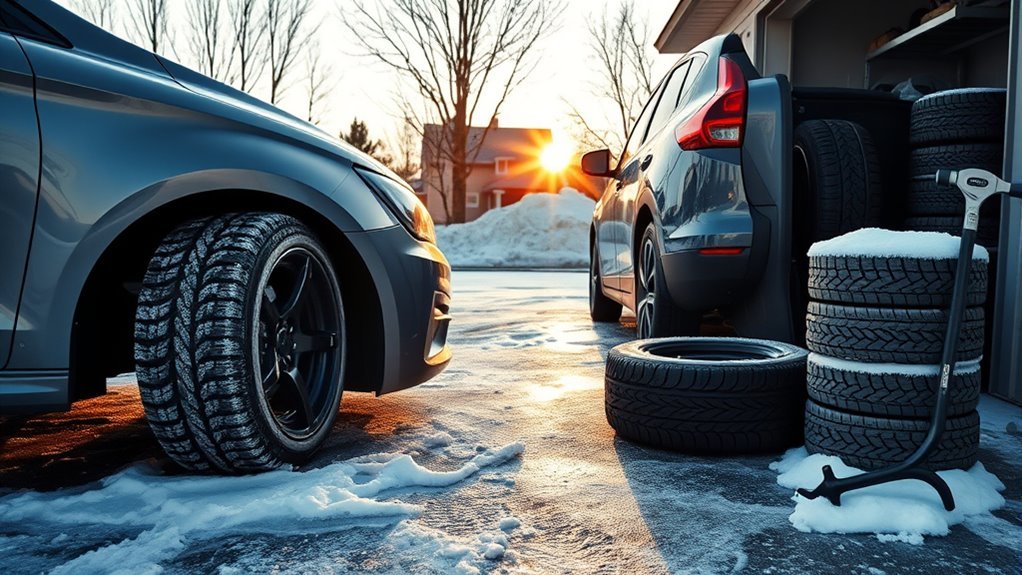
A second tire set costs more upfront, but it can make sense if you drive through real winter every year. You are not using both sets at the same time, so your all-season or summer tires also last longer because they rest during winter months.
The main costs are the winter tires, seasonal mounting or changeover, optional wheels, storage, and periodic balancing. Buying a separate set of wheels can reduce repeated mount-and-dismount labor and lower the chance of bead damage. It can also make seasonal swaps faster.
Winter tires often wear faster if used in warm weather because their softer compounds are not meant for hot pavement. Remove them once temperatures are consistently above 7°C (45°F), unless the forecast still shows freezing mornings or late-season snow.
[Products Worth Considering]

The Continental Grand Prix 5000 is an allround road bike tire engineered for faster rolling, improved ride comfort, and enhanced puncture protection. It features a Vectran Breaker cut-protection layer, Lazer Grip micro-profile tread for confident cornering control, and Active Comfort Technology to damp vibration for smoother rides. BlackChili compound optimizes grip and speed for everyday performance and long-lasting confidence.
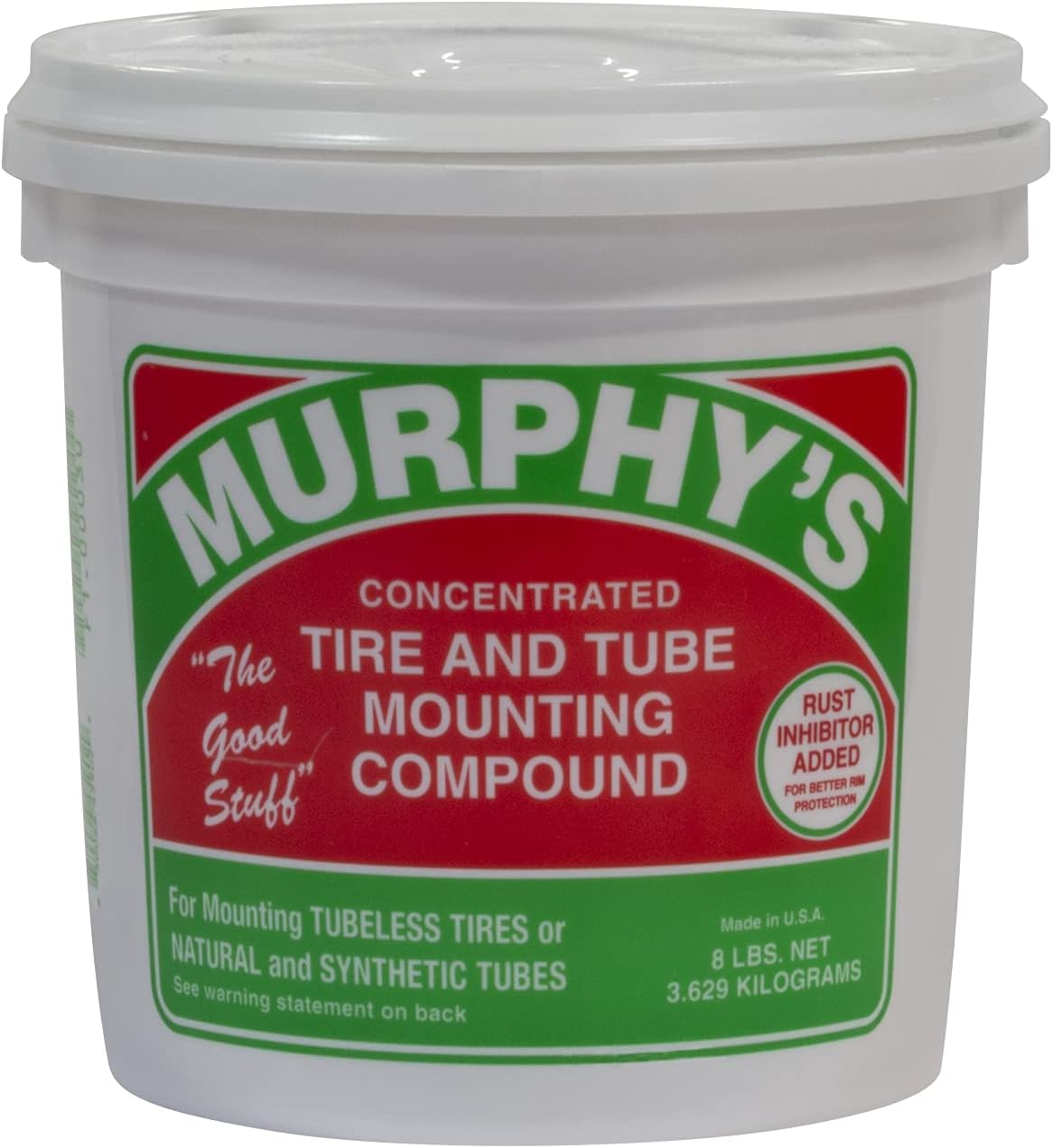
A concentrated tire and tube mounting compound designed to help simplify mounting rubber tires and tubes on passenger, semi truck, construction, and OTR applications. Its ultra-thick formula packs beads effectively and includes rust inhibitors to help protect against corrosion during use.

Measure tyre tread depth precisely with a digital gauge that reads in both MM and inches, helping you monitor safe driving conditions. The large LCD screen is easy to operate, and the compact tool fits for cars, trucks, and motorcycles. It provides high accuracy with a 0-25.4mm range and includes a 1-year warranty for added peace of mind.
How to Store Off-Season Tires
Good storage helps preserve tire life. Before storing a tire set, clean off road salt and debris, let the tires dry, and label each position so you can rotate them next season. Store them in a cool, dry, dark place away from direct sunlight, ozone sources, and chemicals.
- Tires on wheels: Stack them flat or hang them from the wheels.
- Tires without wheels: Store them upright and rotate their position occasionally.
- Avoid heat: Hot garages, sunlight, and nearby motors can speed rubber aging.
- Check pressure: Air pressure drops as temperatures fall, so inspect it regularly during use.
How to Identify Winter Tires and a Switching Checklist
The easiest way to identify a true winter tire is to look for the Three-Peak Mountain Snowflake symbol on the sidewall. ASTM F1805 describes a snow-traction test method used for passenger-car and light-truck tires, and the 3PMSF symbol is tied to severe snow service performance requirements.
Do not rely on M+S alone. M+S means “mud and snow,” but it does not guarantee the same winter performance as a 3PMSF-rated tire. Also make sure the tire size, load rating, and speed rating match your vehicle manufacturer’s requirements.
| Checkpoint | Action |
|---|---|
| Symbol | Confirm the Three-Peak Mountain Snowflake symbol for severe snow service |
| Set | Install four matching winter tires, not only two |
| Timing | Mount when temperatures consistently drop near or below 7°C (45°F) |
| Tread | Measure tread depth before the season; replace before grip becomes poor |
| Pressure | Check pressure often because cold temperatures reduce tire pressure |
| Age | Inspect the DOT date code and replace tires that are cracked, hardened, damaged, or too old |
The U.S. federal minimum tread depth standard for passenger-car tires is 2/32 inch, but that is a legal minimum, not a winter-safety target. Snow and slush performance can drop well before that point, so many tire experts recommend replacing winter tires earlier if you regularly drive in severe winter conditions.
Winter Tire Maintenance Mistakes to Avoid
Even good winter tires can underperform if they are neglected. Avoid these common mistakes:
- Running winter tires all year: Warm roads wear them quickly and can reduce handling precision.
- Ignoring tire pressure: Tire pressure falls as temperatures drop, which can hurt grip, fuel economy, and tire wear.
- Mixing tire types: Different grip levels between axles can make braking and steering unpredictable.
- Waiting for visible snow: Cold pavement and black ice can arrive before the first major storm.
- Using old or cracked tires: Rubber ages even when tread remains.
- Skipping rotation: Rotation helps even out wear and extend usable life.
Frequently Asked Questions
Can winter tires be used on summer roads without damage?
You can use winter tires briefly in warm weather, but you should not use them all summer. Their softer compound wears faster on hot pavement, can feel less precise in handling, and may reduce fuel economy. Switch back once warm temperatures are steady.
Do winter tires affect fuel economy year-round?
Yes, they can. Winter tires usually have deeper tread and softer rubber, which can increase rolling resistance compared with some all-season or summer tires. The difference varies by tire and vehicle, but using winter tires only in the cold season helps preserve both fuel economy and tire life.
Are studded tires legal in my area and when are they allowed?
Studded-tire laws vary by state, province, and country. Some places allow them only during specific winter dates, some restrict them, and some ban them because studs can damage pavement. Check your local transportation department before buying or installing studded tires.
Can winter tires reduce insurance premiums?
Sometimes. Some insurers offer winter-tire discounts, especially in regions where winter tires are promoted for road safety. The discount is not automatic everywhere, so ask your insurer what symbol, installation dates, proof of purchase, or inspection they require.
How do winter tires perform on electric vehicles?
Winter tires work well on electric vehicles when they are the correct size, load rating, and specification for the vehicle. EVs are often heavier and deliver quick torque, so proper winter grip, correct tire pressure, and regular rotation are especially important.
Are winter tires worth it if I have all-wheel drive?
Yes, winter tires can still be worth it. All-wheel drive helps you accelerate, but it does not shorten stopping distance by itself. Braking and cornering depend heavily on tire grip, which is why winter tires still matter on AWD vehicles.
When should I remove winter tires?
Remove winter tires when temperatures are consistently above 7°C (45°F) and the forecast no longer shows freezing mornings or late-season snow. Removing them at the right time prevents fast warm-weather wear.
Conclusion
You should switch to winter tires when temperatures regularly fall near or below 7°C (45°F), or whenever snow, ice, frost, freezing rain, or untreated winter roads are part of your normal driving. The advantage comes from cold-weather rubber, deeper tread, and high-density siping that help your vehicle stop, turn, and stay predictable in conditions where all-season tires lose grip.
For mild winters, a 3PMSF all-weather tire may be a practical year-round compromise. For frequent snow, ice, mountain roads, rural commutes, or long cold-weather driving, a dedicated winter tire set gives you the best safety margin. Install four matching tires, check pressure and tread depth, store the off-season set correctly, and switch back once warm weather is steady.
Sources
- Transport Canada — Using winter tires — backs the 7°C threshold, 3PMSF guidance, and full-set recommendation.
- Tire and Rubber Association of Canada — Why winter tires are the right choice — backs winter-tire stopping-distance and cold-weather performance claims.
- ASTM F1805-20 — backs standardized snow and ice traction testing for passenger-car and light-truck tires.
- NHTSA TireWise — supports tire safety, tire ratings, and consumer tire-maintenance guidance.
- 49 CFR § 570.9 — Tires — backs the 2/32-inch minimum tread-depth inspection standard.
- European Commission — Tyres — backs snow and ice grip pictogram explanations for EU tire labels.