Disclosure: As an Amazon Associate, we earn from qualifying purchases. If you click a link on this page and make a purchase, we may receive a small commission at no extra cost to you.
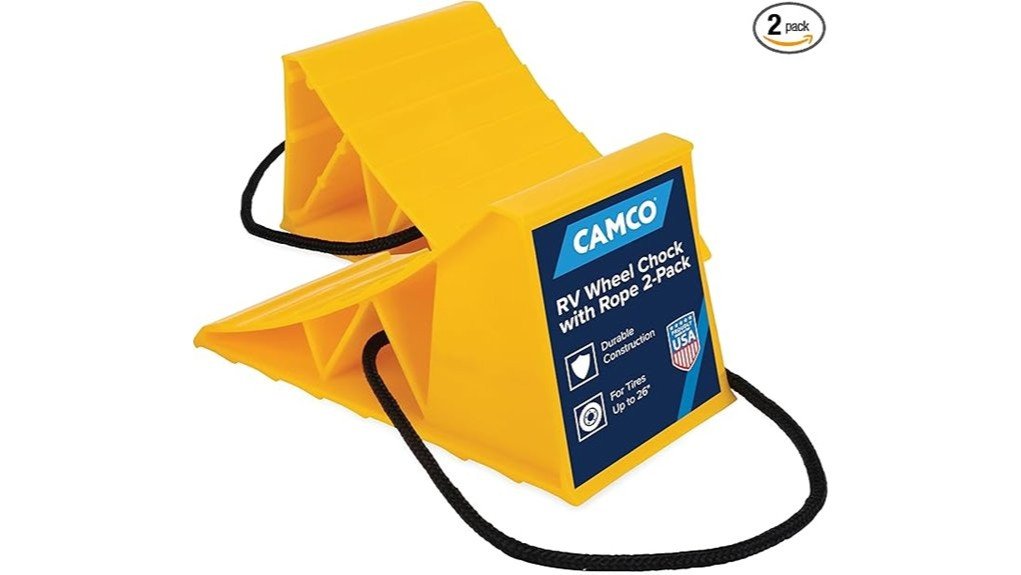
A parked trailer can move before you expect it, especially when you are unhitching on sloped, gravel-covered, or uneven ground. The Camco Camper & RV Wheel Chock with Rope, model 44471, gives you a lightweight way to help limit that movement before campsite setup begins. Its yellow hard-plastic body fits tires up to 26 inches in diameter, while the attached rope makes removal easier. This review explains where the chocks work well, how to use them safely, and when a heavier rubber or commercial-grade option makes more sense.
Quick Verdict
Rating: 8.4/10, recommended with limitations
Best For: RV and recreational trailer owners with tires up to 26 inches who want compact, lightweight chocks for routine parking and campsite setup.
Bottom Line: The Camco 44471 is easy to carry, simple to position, and resistant to routine outdoor exposure. Its main limitation is its lightweight plastic construction, which is not intended for commercial trucks, oversized tires, or every steep and slippery surface.
| Specification | Detail |
|---|---|
| Brand | Camco |
| Model | 44471 |
| Product type | RV and trailer wheel chocks with rope |
| Package quantity | Two chocks |
| Material | Heavy-duty hard plastic with UV inhibitors |
| Color | Yellow |
| Tire compatibility | Tires up to 26 inches in diameter |
| Manufacturer-listed size | 6 x 10.5 x 4.88 inches, listed length x width x height |
| Listed shipping weight | 1.75 pounds |
| Country of origin | United States |
| Manufacturer warranty | 12 months from purchase with receipt |
| Best use | Routine parking, campsite setup, storage, and unhitching of compatible recreational trailers |
Before You Buy: Measure the complete tire diameter, not only the wheel or rim. These chocks are intended for tires up to 26 inches and should not replace the tow vehicle’s parking brake, proper hitching procedures, stabilizer jacks, jack stands, or commercial-grade wheel restraints.
Key Takeaways
- The Camco 44471 includes two lightweight wheel chocks with a rope-assisted removal design.
- It is intended for RV and trailer tires measuring no more than 26 inches in overall diameter.
- Hard plastic with UV inhibitors supports repeated outdoor use without adding the weight of solid rubber chocks.
- The chocks work best when you place them firmly against compatible tires on stable ground before unhitching.
- You should consider heavier rubber chocks for larger vehicles, frequent steep-slope parking, or surfaces where lightweight plastic slides.
What Is the Camco 44471 Wheel Chock?
The Camco 44471 is a two-piece wheel chock set made for recreational trailers and RVs. Each molded chock sits against a tire to help resist rolling while your trailer is parked, stored, or being unhitched. The included rope gives you a more convenient removal point, so you do not need to reach as far behind the tire.
This is a basic roll-control accessory, not a leveling system or between-wheel stabilizer. It makes the most sense when you want chocks that are compact enough for a storage compartment and light enough to move during every campsite setup.
Who Should Buy It?
Best For
- Travel trailer and camper owners with tires up to 26 inches.
- Campers who need lightweight chocks that take up little storage space.
- Owners who want a rope-assisted design for easier placement and removal.
Skip If
- Your tires exceed the stated 26-inch compatibility limit.
- You need chocks for commercial trucks or heavy commercial trailers.
- You regularly park on steep, icy, oily, or very loose surfaces that require more weight and traction.
[Products Worth Considering]
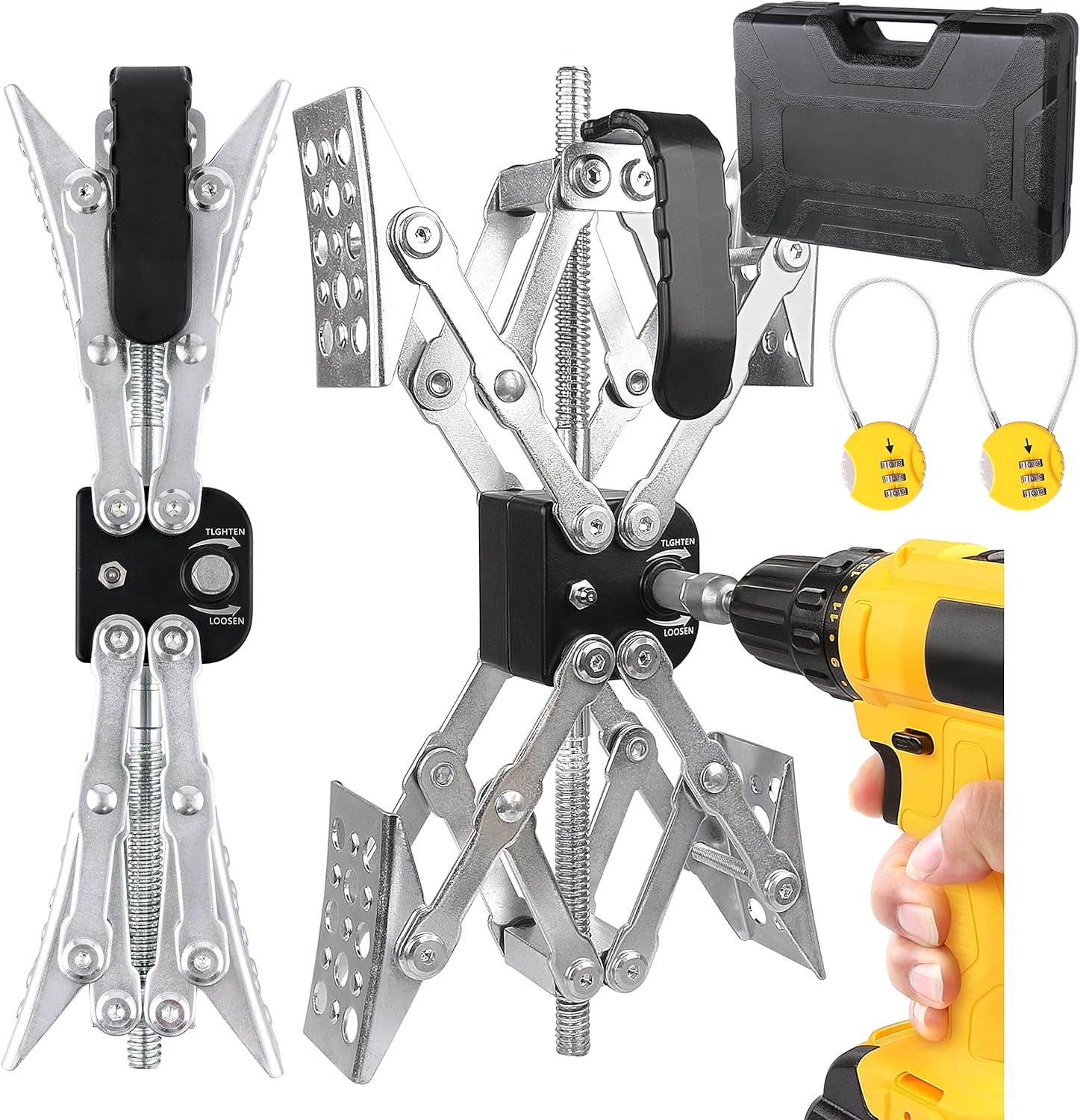
Lock the Maxchock X-style wheel stabilizers between tandem tires to reduce sway and keep your RV travel trailer secure while camping. The adjustable design fits a wide range of wheel gaps, and included hardware lets you install quickly with a power drill. Built from heavy-gauge steel with zinc plating, the chocks include locks and an organizer case for safer, more convenient use.

Camco’s RV wheel chocks with an attached rope help keep your travel trailer securely in place for safer unhitching or parking. This 2-pack is compatible with wheels up to 26-inch diameter and features durable UV-resistant construction for reliable outdoor performance. The rope enables quick, safe removal so you can prepare for your next trip with less hassle.

MaxxHaul solid rubber wheel chocks provide dependable vehicle stabilization for cars, trucks, trailers, and RVs across driveways, slopes, garages, and campsites. The molded non-slip traction surface helps prevent tire movement on pavement, gravel, and smooth floors, while the solid rubber resists cracking, crushing, deformation, and weather wear. A built-in handle enables quick, tool-free placement and removal for convenient use in all seasons.
Fit and Compatibility
The main buying limit is the 26-inch maximum tire diameter. Check the side-to-side measurement across the full inflated tire, including the rubber tread. Do not use the wheel or rim size as your measurement because a 15-inch or 16-inch wheel can carry a tire with a much larger overall diameter.
The chocks can work with many campers, utility trailers, boat trailers, and smaller recreational trailers when the tire size falls within that limit. However, tire size alone does not guarantee ideal performance. Trailer weight, slope, ground condition, and the number of wheels you need to secure also affect how many chocks and what type of chock you should use.
On a tandem-axle trailer, you may place these against accessible tires as conventional ground chocks. They do not fit between the tires or reduce suspension movement in the same way as an expanding tandem-wheel stabilizer.
Materials and Build Quality
Camco molds the 44471 from hard plastic and includes UV inhibitors in the material. This keeps the set lighter than most solid-rubber alternatives and helps the plastic tolerate routine sun exposure during camping and outdoor storage.
The yellow finish also makes the chocks easier to notice around a campsite. That visibility can help you remember to remove them before departure, although you should still include chock removal in your normal walk-around inspection.
Lightweight plastic has a tradeoff. It is easier to carry, but it does not provide the mass or naturally high-friction surface of a heavy rubber chock. Inspect the plastic for cracks, deep gouges, deformation, and excessive fading before each trip. Replace a damaged chock rather than relying on it during unhitching.
Compatibility and Safety
Set the tow vehicle’s parking brake and follow your trailer manufacturer’s parking and unhitching instructions before relying on any wheel chock. Position the chock firmly against the tire on the side where the trailer could roll. Depending on the slope and axle arrangement, you may need chocks on more than one side of a tire or additional chocks beyond the included pair.
Use the chocks only on firm, stable ground. Loose gravel, mud, wet grass, ice, oil, and smooth sloped pavement can reduce grip. Clear loose debris when possible and confirm that the chock remains seated before you disconnect the trailer.
Do not place your hands under a tire, stand in the trailer’s potential path, or use the rope as a substitute for proper placement. The rope helps you retrieve the chock after the trailer is secured and pressure has been removed from it.
A wheel chock does not lift, level, or support a trailer. Never use it as a jack stand, leveling block, stabilizer jack, or replacement for another required safety device.
Pro Tip: Before your first trip, label or mark your chocks as part of your arrival and departure checklist. Confirm “chocks installed” before unhitching and “chocks removed” only after the trailer is safely connected for departure.
How It Performs in Real Use
During Campsite Setup
The low weight makes the Camco set convenient when you arrive after a long drive and want to secure the trailer quickly. You can remove the pair from a storage compartment, position them against compatible tires, and use the rope to keep retrieval simple. The bright yellow body is also easier to see near steps, hoses, and leveling equipment.
While Unhitching
The chocks help reduce unwanted tire movement as you disconnect the trailer from the tow vehicle. Correct placement matters more than speed. Push each chock firmly against the tire and test that the trailer remains stable before continuing with the tongue jack or other unhitching steps.
For Driveway or Seasonal Storage
The UV-inhibited plastic suits routine outdoor storage better than untreated lightweight plastic. However, long-term exposure still requires inspection. Temperature changes, direct sunlight, and repeated loading can eventually affect any plastic chock, so check the body and rope before reuse.
On Gravel and Uneven Campsites
The molded body is easy to position, but loose stones can prevent full contact with the ground. Remove larger stones and find the firmest available surface. If the chock slides, rocks sideways, or cannot sit squarely against the tire, switch to a larger or heavier option instead of forcing the setup.
How to Use the Camco Wheel Chock Correctly
- Choose the parking position: Stop on the firmest and most level area available.
- Secure the tow vehicle: Keep the trailer connected and apply the parking brake before placing the chocks.
- Check the ground: Remove loose stones or debris that could let the chock tilt or slide.
- Position the chocks: Set them squarely and snugly against the tires in the likely direction of movement.
- Confirm contact: Make sure the base sits flat and the chock does not rock.
- Test stability: Follow your trailer’s instructions and confirm the trailer remains still before unhitching.
- Remove safely: Reconnect and secure the trailer before unloading and removing the chocks.
Common Mistakes to Avoid
- Measuring the rim instead of the full tire diameter.
- Using only one chock when the slope or axle layout requires more restraint.
- Placing a chock on loose material without checking whether it can slide.
- Unhitching before confirming that the chocks are firmly seated.
- Pulling hard on the rope while the tire is still pressing against the chock.
- Driving away without completing a final chock-removal check.
Maintenance and Storage
Brush away dirt, stones, and road debris after use. If the chocks become muddy, rinse them with water and allow them to dry before placing them in an enclosed storage compartment. Keeping grit away from the rope and molded edges makes damage easier to spot.
Store the chocks away from sharp tools and heavy equipment that could crush or cut the plastic. Inspect the rope attachment, body, base, and tire-contact surface before each trip. Stop using the set if you find a crack, split rope, severe deformation, or missing material.
Pros and Cons
Pros
- Two-chock package supports practical trailer setup.
- Lightweight design is easy to carry and store.
- Attached rope makes retrieval more convenient.
- UV inhibitors support repeated outdoor use.
- Yellow construction remains visible around a campsite.
Cons
- Limited to tires measuring no more than 26 inches.
- Light plastic may provide less grip than solid rubber on slippery or loose surfaces.
- Not intended for commercial trucks or heavy commercial trailers.
Is It Worth the Price?
The Camco 44471 sits in the basic, lightweight end of the wheel-chock category. Its value comes from the two-piece package, compact plastic construction, rope-assisted removal, and compatibility with many smaller recreational trailer tires.
It is a strong value for routine camping when your tires fit the stated limit and you normally park on stable surfaces. It is not the best fit when you need the extra mass, traction, or larger profile of a heavy-duty rubber chock.
[Products Worth Considering]

Keep your RV, travel trailer, or fifth wheel securely in place with these heavy-duty X-shaped wheel chock stabilizers. Designed to clamp between tires, they reduce side-to-side movement for a steadier, level camping setup. The package includes a ratchet wrench, socket adapter, gloves, and a storage bag for easy installation and transport.

CircleRoad RV wheel chocks are designed to be installed between two tires to prevent wheel movement and improve parking stability. Built with a rust-proof finish for weather resistance, they help keep your tire position secure during travel trailer and motorhome stops. The package includes a multi-functional ratchet wrench and hex socket for fast installation.

Secure your trailer or RV tires with a scissor-style wheel chock stabilizer that applies opposing force to help prevent wheel shift. It fits tight wheel gaps from 3.5 inches up to 12 inches and works for travel trailers, campers, fifth wheels, toy haulers, and heavy-duty trucks. The surface uses new electrophoretic technology to help prevent rust for reliable travel use.
How It Compares to Alternatives
The MaxxHaul 50012 uses solid rubber, measures 8 x 5 x 4 inches, and includes two chocks connected by a high-visibility rope. Its rubber construction may suit buyers who prioritize weight and surface grip over easy carrying.
The MaxxHaul 50011 is another solid-rubber pair with traction pads and built-in eyelets. A between-wheel stabilizer, such as an expanding tandem-wheel design, serves a different purpose by reducing movement between closely spaced tandem tires. The Camco 44471 makes more sense when you want simple, lightweight ground chocks for compatible RV or trailer tires.
[Products Worth Considering]

ROBLOCK rubber wheel chocks help prevent vehicle rolling with a non-slip grip for trucks, trailers, RVs, and small aircraft. The chocks include three yellow reflective strips to improve visibility in low-light parking and outdoor use. Lightweight and portable design makes them easy to place in front of or behind a tire during camping, loading, or maintenance.

Secure your parked vehicle quickly with AFA Tooling 4T rubber wheel chocks in a 4-pack for two dual-wheel sets. The ribbed design and textured base grip fast without pounding, so you can chock tires on trailers, RVs, ATVs, and work vehicles with confidence. EZ rustproof handles with rope ties keep the pair together for easy placement and removal, while nylon-reinforced rubber stands up to dirt, ice, salt, and harsh weather.

Upgrade your garden cart, wagon, trolley, or hand truck with solid puncture-guarded tires that help prevent flats for worry-free pushing. Textured tread improves stability, grip, and shock absorption for smoother, safer travel over outdoor surfaces. Built with strong polyurethane and durable bearing components for long-lasting performance and confident handling.
Frequently Asked Questions
What tire size fits the Camco 44471 wheel chocks?
Camco specifies compatibility with tires up to 26 inches in overall diameter. Measure across the complete inflated tire rather than using the wheel or rim size printed on the tire.
Does the package include one chock or two?
Model 44471 is sold as a two-chock package. Your trailer, slope, and axle arrangement may require more than two chocks for proper restraint.
Can you use these chocks on a tandem-axle trailer?
You can use them as conventional ground chocks when you have enough access around the tires. They do not expand between tandem tires or replace a dedicated tandem-wheel stabilizer.
Are plastic wheel chocks better than rubber chocks?
Plastic chocks are generally lighter and easier to store. Solid-rubber chocks are usually heavier and may grip smooth or uneven surfaces better, but they take up more carrying weight.
Can you use the rope to pull a loaded chock from under the tire?
Use the rope only after the trailer is safely connected and pressure has been removed from the chock. Pulling while the tire is pressing against it can damage the rope or cause an unsafe release.
Will these wheel chocks work on gravel or grass?
They can work when the ground is firm and the base sits flat. Loose gravel, wet grass, mud, or a steep slope can reduce grip, so check for movement and use a heavier alternative when the chock cannot stay seated.
Can you use the Camco 44471 with a commercial truck?
This model is intended for compatible recreational trailers and RVs, not commercial trucks or heavy commercial trailers. Choose a properly rated commercial-grade chock for heavier applications.
What warranty does Camco provide for model 44471?
Camco lists a 12-month warranty from the purchase date when you have the receipt. Review the current warranty and registration requirements before filing a claim.
The Bottom Line
The Camco 44471 is a practical choice when you need two compact wheel chocks for an RV or recreational trailer with tires up to 26 inches. Buy it for its low carrying weight, visible yellow body, UV-inhibited plastic, and rope-assisted handling. Skip it when you need commercial-grade restraint, support for larger tires, or the extra traction and mass of solid rubber.