Disclosure: As an Amazon Associate, we earn from qualifying purchases. If you click a link on this page and make a purchase, we may receive a small commission at no extra cost to you.
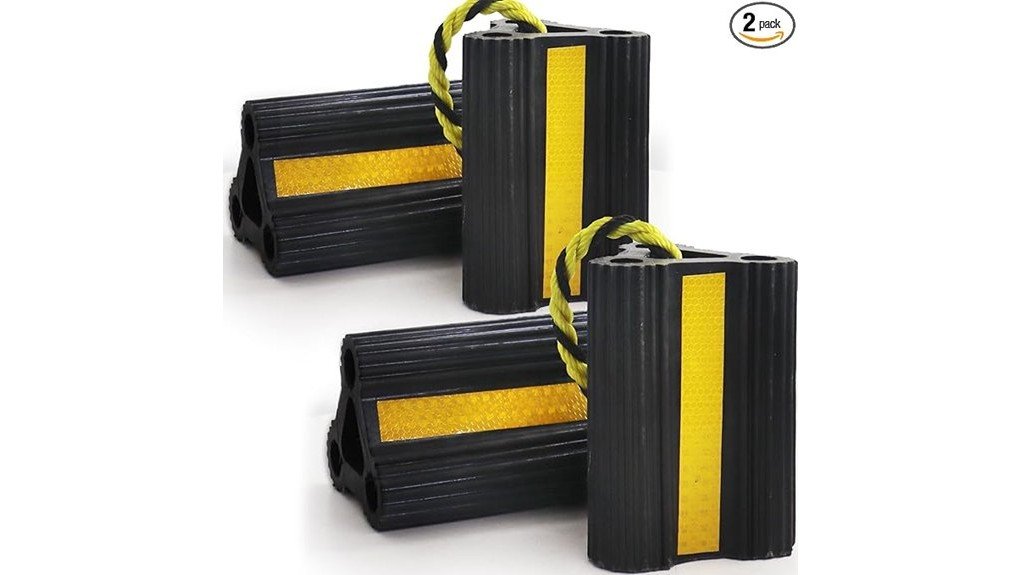
A parked RV or trailer can move when the ground slopes, settles, or becomes slick, so dependable wheel chocks are a basic safety item rather than an optional accessory. The WECARLLE Wheel Chocks, model 1.2-4, give you four compact rubber blocks with rope connections and reflective yellow strips. Their rubber construction and portable size suit campsites, driveways, garages, and routine trailer setup. The main tradeoff is that the available product information does not publish a maximum load rating, tire-size range, or safe slope angle, so you must confirm they fit your vehicle and use them with the parking brake and other required stabilization equipment.
Quick Verdict
Rating: 8.3/10, recommended with caveats
Best For: RV, travel-trailer, camper, truck, and car owners who want a compact four-chock rubber set for routine parking and storage
Bottom Line: These chocks offer useful grip, good visibility, and enough pieces to secure more than one wheel. They are less reassuring for unusually heavy vehicles, severe grades, or specialized work because no verified load capacity or maximum incline is listed.
Key Specifications
| Specification | Detail |
|---|---|
| Brand | WECARLLE |
| Model | 1.2-4 |
| Product type | Rubber wheel chocks |
| Quantity | Four chocks, listed as two pairs |
| Chock dimensions | 6.21 × 4.71 × 4.31 inches each |
| Material | Rubber |
| Visibility | Three yellow reflective strips on each chock |
| Handling | Rope connections for placement, retrieval, and carrying |
| Listed compatibility | RVs, travel trailers, campers, trucks, and cars |
| Common use areas | Campsites, driveways, garages, storage areas, and loading zones |
| Not published | Maximum load, tire-size range, maximum slope angle, certification, and warranty terms |
Key Takeaways
- The four-chock package gives you two pairs, which is more flexible than a basic two-chock set.
- Rubber can conform to small surface irregularities and usually provides better contact than smooth, rigid plastic.
- Three reflective strips on each chock make the blocks easier to see in dim campsites, garages, and storage areas.
- The rope connections make retrieval easier and reduce the need to reach close to the tire.
- No verified load capacity or maximum slope angle is published, so this set is best for routine parking rather than unknown or extreme-duty conditions.
What Are the WECARLLE Wheel Chocks?
The WECARLLE 1.2-4 set is a group of four wedge-shaped rubber blocks designed to help prevent a parked vehicle or trailer from rolling. You place the chocks snugly against the tire in the direction the vehicle could move. On level ground, using chocks on both sides of a tire can help limit movement in either direction.
Each chock measures 6.21 × 4.71 × 4.31 inches. That compact footprint makes the set easier to carry in an RV storage compartment, truck box, garage cabinet, or trailer tongue box than large commercial chocks. The tradeoff is that compact dimensions do not guarantee a correct fit for every tire, axle load, or grade.
Who Should Buy It?
Best For
- RV and travel-trailer owners who want four compact chocks for campsites and storage
- Drivers who prefer rubber contact surfaces over lightweight hard-plastic wedges
- Owners who value reflective markings and rope-assisted retrieval in low light
Skip If
- You need a documented load rating, certified industrial chock, or published maximum incline
- Your tire is too large for the chock to sit firmly against the tread
- You need aviation-approved equipment or a replacement for parking brakes, leveling blocks, or stabilizer jacks
[Products Worth Considering]

Camco’s RV wheel chocks with an attached rope help keep your travel trailer securely in place for safer unhitching or parking. This 2-pack is compatible with wheels up to 26-inch diameter and features durable UV-resistant construction for reliable outdoor performance. The rope enables quick, safe removal so you can prepare for your next trip with less hassle.

ROBLOCK rubber wheel chocks help prevent vehicle rolling with a non-slip grip for trucks, trailers, RVs, and small aircraft. The chocks include three yellow reflective strips to improve visibility in low-light parking and outdoor use. Lightweight and portable design makes them easy to place in front of or behind a tire during camping, loading, or maintenance.

Secure your trailer or RV tires with a scissor-style wheel chock stabilizer that applies opposing force to help prevent wheel shift. It fits tight wheel gaps from 3.5 inches up to 12 inches and works for travel trailers, campers, fifth wheels, toy haulers, and heavy-duty trucks. The surface uses new electrophoretic technology to help prevent rust for reliable travel use.
Materials and Build Quality
Rubber is the main advantage of this set. It can flex slightly and settle against textured pavement, packed gravel, or minor surface irregularities. This contact can help reduce sliding compared with a smooth plastic block, especially when the chock is clean and placed squarely against the tire.
The compact body also avoids thin walls or hollow-looking edges that are common on some light-duty plastic chocks. Still, the listing does not state rubber density, oil resistance, weather testing, or a load rating. Inspect each block for cracks, deformation, loose reflective strips, or rope damage before relying on it.
Fit and Compatibility
The listing identifies RVs, trailers, campers, trucks, and cars as intended applications. The 6.21-inch length and 4.31-inch height should work for many common vehicle tires, but compatibility depends on more than vehicle type. Tire diameter, tread shape, vehicle weight, slope, surface condition, and the direction of possible movement all affect how securely a chock sits.
A correct fit means the curved or angled face contacts the tire without leaving a large gap, while the base lies flat on the ground. A chock that looks tiny beside the tire, rocks on the surface, or cannot sit close to the tread is not a dependable choice for that setup.
Before You Buy: The available listing does not provide a maximum vehicle weight, tire diameter, or slope rating. Measure the space around your tire and choose a rated, larger, or specialized chock when your vehicle, worksite, or grade demands documented capacity.
How Wheel Chocks Improve Parking Safety
A wheel chock is a physical barrier that helps resist tire movement after the vehicle is stopped. It is especially useful for a trailer that may shift while unhitching, an RV parked on uneven ground, or a vehicle positioned for loading or maintenance. Four chocks let you secure more than one wheel or block movement in both directions when the setup calls for it.
Chocks do not replace the parking brake, transmission position, trailer brake system, leveling procedure, stabilizer jacks, or jack stands. They are one part of a safe setup. You should also keep people away from the downhill side and other pinch points until the vehicle is secured.
How It Performs in Real Use
Level Campsites and Driveways
On a firm, nearly level surface, the compact chocks are quick to position and easy to store after use. The four-piece count is helpful because you can block both sides of one tire or use a pair on each side of a trailer, based on the vehicle maker’s instructions.
Sloped or Uneven Sites
Rubber can maintain useful contact on lightly textured pavement or packed ground, but loose gravel, mud, ice, wet leaves, and steep grades can reduce grip. Clear debris, place the chock flat, and confirm full tire contact. Do not assume the chock is safe for a severe slope because the listing uses general terms such as non-slip.
Trailer Storage and Unhitching
For a stored or unhitched trailer, four chocks provide more placement options than a two-pack. Set the parking system first, position the chocks before disconnecting the tow vehicle, and follow the trailer manufacturer’s sequence for landing gear, tongue jack, and stabilizers.
Garage, Loading, and Maintenance Use
The reflective strips help you notice the blocks in dim areas, while the ropes make them easier to pull out after the vehicle is secured or moved away. For commercial loading, heavy equipment, or any task where people work under or inside a vehicle, use equipment that meets the site’s required rating and procedure. Wheel chocks are not substitutes for approved lifting stands or dock restraints.
How to Use Them Correctly
- Park on the firmest, flattest surface available and keep your foot on the brake.
- Apply the parking brake and place the transmission in the vehicle maker’s recommended position.
- Identify the direction the vehicle could roll. On a grade, place the chock firmly on the downhill side of the tire.
- For movement in both directions, use chocks on both sides of the tire when the setup and available space allow.
- Push each chock snugly against the tread with its base flat on the surface.
- Before unhitching or starting work, check that the vehicle remains stable and follow the RV, trailer, or vehicle manual.
- Remove the chocks only after the vehicle is ready to move and the driver has control of the brakes.
Pro Tip: Keep the tread-contact face and the bottom of each chock free of mud, oil, stones, and wet leaves. A clean base gives the rubber more direct contact with the parking surface.
Visibility, Carrying, and Storage
Each chock has three yellow reflective strips. These accents do not light the area, but they can return light from a flashlight or vehicle lamp and help reduce the chance that you overlook a chock before departure.
The rope connections are useful when a chock sits close to a bumper, fender, or trailer body. You can retrieve the pair without placing your hand directly beside the tire. Store the chocks dry and away from sharp tools, fuel spills, and direct heat. Do not drag them by the rope across rough ground if the connection shows wear.
Compatibility and Safety
Use these chocks only as an added restraint for a properly parked vehicle. OSHA guidance for loading areas recognizes wheel chocks as one measure used to prevent transport vehicles from moving, but workplace rules may require specific placement, ratings, or mechanical dock restraints. For commercial use, review the applicable procedure and OSHA dockboard requirements.
The seller’s product description mentions small airplanes, but the available information does not show an aviation approval, load rating, or aircraft-specific standard. For aircraft, use chocks approved by the operator, maintenance program, airport, or aircraft manufacturer rather than relying on a general automotive listing.
Pros and Cons
Pros
- Four chocks provide more placement options than a basic two-pack
- Rubber construction offers broad contact on common parking surfaces
- Three reflective strips per chock improve low-light visibility
- Rope connections help with carrying and retrieval
- Compact dimensions suit RV compartments, garages, and trailer storage boxes
Cons
- No verified load capacity, maximum slope, or tire-size range is published
- Compact size may be inadequate for very large tires or heavy-duty applications
- Reflective strips and ropes need routine inspection for wear or loosening
Is It Worth the Price?
This WECARLLE set can offer strong value for everyday RV and trailer use because the package includes four rubber chocks, reflective markings, and rope-assisted handling. Buyers who would otherwise purchase two separate pairs may appreciate getting a complete basic setup in one package.
Its value is weaker when documentation matters more than convenience. A fleet, workshop, aircraft operator, or owner of a very heavy vehicle may be better served by larger chocks with published load limits, material testing, or industry-specific approval. Check the current package details before ordering because similar listings may offer two-pack, four-pack, or larger variants.
[Products Worth Considering]

Keep your RV, travel trailer, or fifth wheel securely in place with these heavy-duty X-shaped wheel chock stabilizers. Designed to clamp between tires, they reduce side-to-side movement for a steadier, level camping setup. The package includes a ratchet wrench, socket adapter, gloves, and a storage bag for easy installation and transport.

CircleRoad RV wheel chocks are designed to be installed between two tires to prevent wheel movement and improve parking stability. Built with a rust-proof finish for weather resistance, they help keep your tire position secure during travel trailer and motorhome stops. The package includes a multi-functional ratchet wrench and hex socket for fast installation.

Secure your parked vehicle quickly with AFA Tooling 4T rubber wheel chocks in a 4-pack for two dual-wheel sets. The ribbed design and textured base grip fast without pounding, so you can chock tires on trailers, RVs, ATVs, and work vehicles with confidence. EZ rustproof handles with rope ties keep the pair together for easy placement and removal, while nylon-reinforced rubber stands up to dirt, ice, salt, and harsh weather.
How It Compares to Alternatives
The MaxxHaul 70472 is a larger solid-rubber two-pack with built-in handles, so it may suit buyers who prefer fewer but bulkier chocks. ROBLOCK also sells a four-pack with longer rubber bodies and reflective tape, which may appeal to buyers who want a heavier design. The WECARLLE set makes the most sense when you prioritize four compact pieces, reflective strips, and rope connections over documented heavy-duty capacity.
[Products Worth Considering]

MaxxHaul solid rubber wheel chocks provide dependable vehicle stabilization for cars, trucks, trailers, and RVs across driveways, slopes, garages, and campsites. The molded non-slip traction surface helps prevent tire movement on pavement, gravel, and smooth floors, while the solid rubber resists cracking, crushing, deformation, and weather wear. A built-in handle enables quick, tool-free placement and removal for convenient use in all seasons.
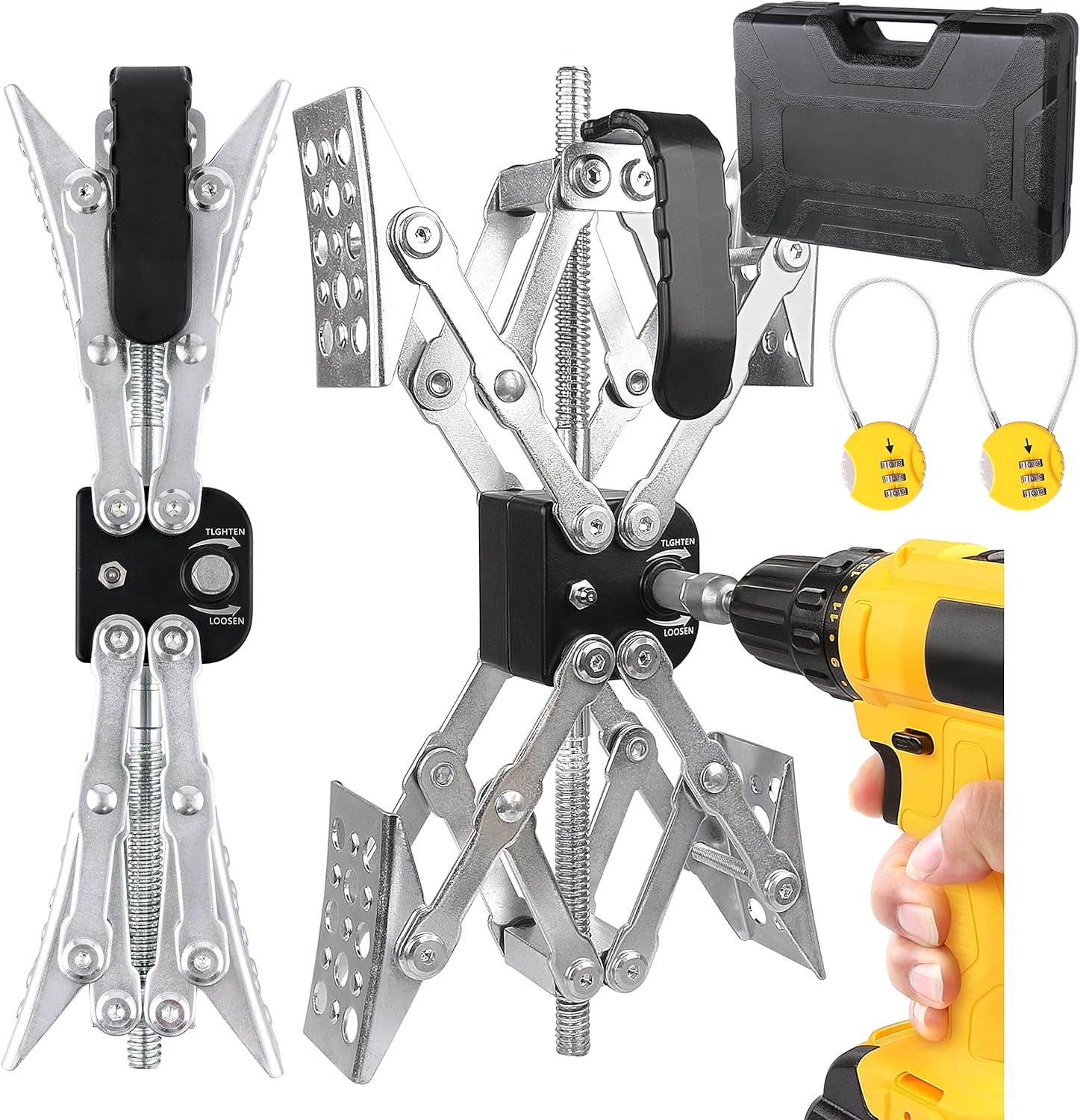
Lock the Maxchock X-style wheel stabilizers between tandem tires to reduce sway and keep your RV travel trailer secure while camping. The adjustable design fits a wide range of wheel gaps, and included hardware lets you install quickly with a power drill. Built from heavy-gauge steel with zinc plating, the chocks include locks and an organizer case for safer, more convenient use.

Protect your spare wheel with a waterproof, dustproof tire cover made to resist sun and harsh weather. The elastic band design makes it easy to install and remove without tools, while reinforced stitching helps it keep its shape. Available in multiple sizes, it fits common RV, trailer, Jeep, SUV, and truck spare tires.
Frequently Asked Questions
How many chocks come in the package?
The reviewed listing is a four-chock package described as two pairs. Because similar listings may show two-pack or larger variants, confirm the quantity shown on the Amazon page before checkout.
What are the dimensions of each wheel chock?
Each chock is listed at 6.21 × 4.71 × 4.31 inches. Compare those dimensions with your tire and the available clearance around the wheel before buying.
Where should you place wheel chocks on a slope?
Place the chock snugly on the downhill side of the tire, where the vehicle would roll. Use the parking brake first, and follow the vehicle or trailer maker’s instructions for the number and location of chocks.
Can these chocks replace the parking brake or stabilizer jacks?
No. Wheel chocks add a physical barrier at the tire, but they do not replace a parking brake, transmission setting, trailer brake, stabilizer jack, leveling system, or approved lifting stand.
Are they suitable for dual-axle trailers?
They can be used with many dual-axle trailers as standard tire chocks, but they are not the same as between-wheel X-chocks. Confirm that the block fits the tire and follow the trailer manufacturer’s chocking procedure.
Can these wheel chocks be used for aircraft?
The seller mentions small airplanes, but no aviation approval or aircraft-specific rating was found. Use aviation chocks accepted by the aircraft operator, maintenance program, airport, or manufacturer.
What is the most common chocking mistake?
A common mistake is leaving a gap between the chock and tire or placing the block on loose debris. Set the parking brake, clear the contact area, and press the chock firmly against the tread with the base flat.
The Bottom Line
The WECARLLE 1.2-4 wheel chocks are a practical choice for RV, trailer, camper, truck, and car owners who want four compact rubber blocks with reflective strips and rope connections. Their main strengths are simple placement, useful visibility, and flexible four-piece coverage, while the main limitation is the lack of a published load rating or maximum slope. Skip them for specialized or extreme-duty use unless you can confirm they meet the required capacity and safety standard.
Ready to Buy?
Check the latest package quantity, product details, and fit before you decide.