
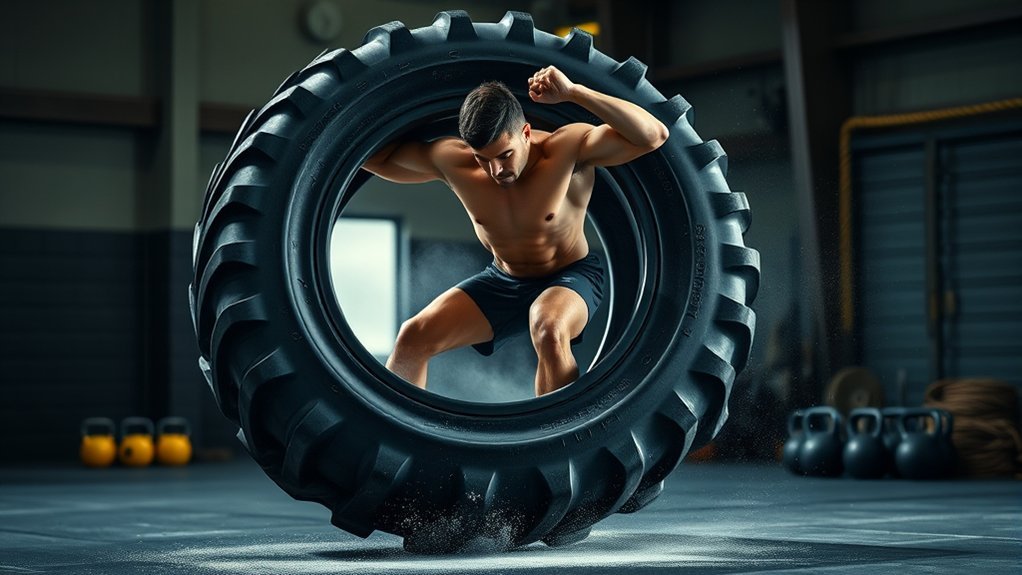
Tire flipping trains your legs, hips, core, back, shoulders, chest, arms, and grip in one explosive movement. You drive the tire from the ground with your lower body, brace through your trunk, then finish by pushing it over with your upper body. It can build strength, power, coordination, and conditioning, but it only works well when you use the right tire, a safe setup, and strict form.
Quick Answer
Tire flipping mainly works your quadriceps, hamstrings, glutes, core, upper back, shoulders, chest, forearms, and grip. Your legs and hips start the lift, your core keeps your spine stable, and your upper body guides and pushes the tire over. Start light, warm up first, and stop when your form breaks.
Key Takeaways
- Tire flips are a full-body strength and conditioning drill, not just a leg exercise.
- The main muscles worked are the quads, hamstrings, glutes, core, lats, traps, shoulders, chest, forearms, and hands.
- Good form depends on a neutral spine, braced core, strong leg drive, and a controlled push-over.
- Use lower reps and longer rest for power, or short timed rounds for conditioning.
- Beginners should master hip hinges, trap bar deadlifts, lunges, and medicine ball throws before using a heavy tire.
At a Glance
| Time Required | 10-20 minutes for a tire-flip block after a warm-up |
| Difficulty | Intermediate; beginners should practice hinge and deadlift patterns first |
| Tools Needed | Training tire, flat surface, closed-toe training shoes, and optional gloves |
| Cost | No required consumable cost if your gym already has a tire |
Warning: Tire flips are heavy, awkward, and explosive. Do not use them if you cannot keep a neutral spine, if you feel pain, or if you have an unresolved back, knee, hip, shoulder, or wrist issue. If you are unsure, learn the movement from a qualified coach first.
What Muscles Does Tire Flipping Work?
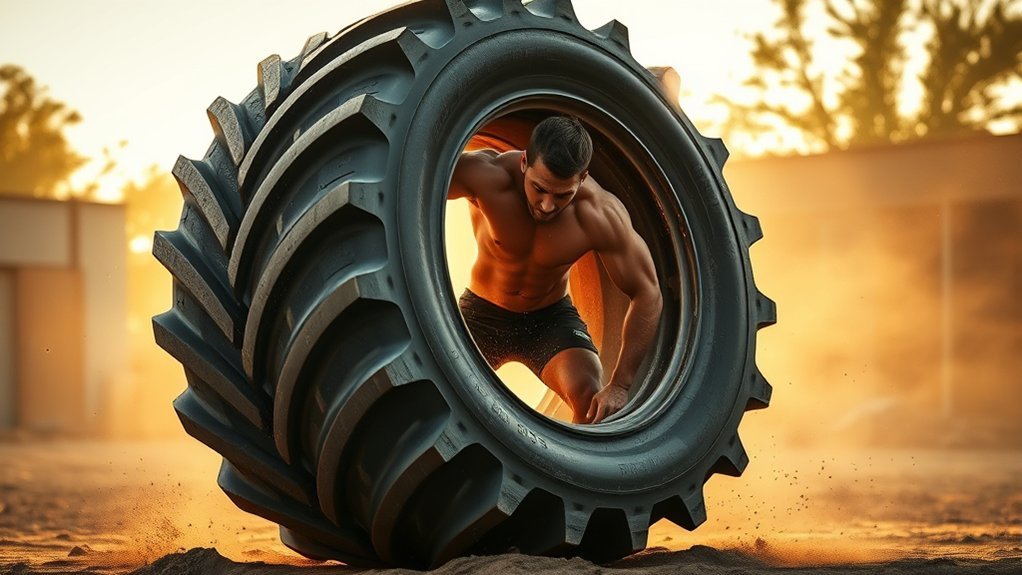
Tire flipping works as a true full-body lift. Your lower body starts the movement, your trunk transfers force, and your upper body finishes the flip. The biggest drivers are your quadriceps, hamstrings, and glutes because they create the first push from the ground. Your abs, obliques, and spinal stabilizers keep your torso organized so power can move from your legs into the tire.
Your upper back, lats, traps, shoulders, chest, arms, forearms, and hands also work hard. They help keep the tire close, guide it upward, and push it away once it reaches chest height. This makes the tire flip different from a simple deadlift or push. You are lifting, driving, bracing, and pushing in one continuous effort.
| Muscle Area | Role During Tire Flips |
| Quadriceps | Extend the knees and help break the tire from the ground. |
| Hamstrings and glutes | Drive hip extension and power the tire upward. |
| Core and spinal stabilizers | Brace the torso and help protect your spine under load. |
| Lats, traps, and upper back | Keep the tire close, control the pull, and stabilize the shoulders. |
| Shoulders, chest, and triceps | Finish the movement by pushing the tire over. |
| Forearms and grip | Hold the tread and control the tire through the transition. |
Tire Flip Muscles Worked: Lower Body
Your lower body does most of the early work in a tire flip. The tire starts low, so you need strong hip and knee extension to move it without yanking through your back. Your quadriceps help extend your knees, while your hamstrings and glutes help extend your hips and create the force that starts the flip.
- Quadriceps: Help you push through the ground and extend your knees during the first drive.
- Hamstrings: Assist hip extension and help stabilize the lift as the tire rises.
- Glutes: Create powerful hip drive so you can move the tire without relying only on your arms.
Because the movement repeats under load, tire flips can also build lower-body muscular endurance. The key is to stop the set before your hips shoot up, your back rounds, or your knees collapse inward.
Tire Flip Muscles Worked: Core Stability
Your core does not move the tire by itself, but it makes the movement safer and more efficient. As you drive the tire upward, your abs, obliques, deep trunk muscles, and spinal stabilizers brace to resist bending and twisting. That brace helps your legs transfer force into the tire without energy leaks.
Think of your trunk as the link between your lower body and upper body. If you lose tension, your back may round, the tire may drift away, and the rep becomes harder than it needs to be. Keep your ribs stacked over your hips, brace before you pull, and reset your position on every rep.
Note: A tire flip is not the same as lifting the tire’s full scale weight straight up. The tire pivots on its edge, but it can still feel very heavy because the shape is awkward and the starting position is low.
Tire Flip Muscles Worked: Upper Body
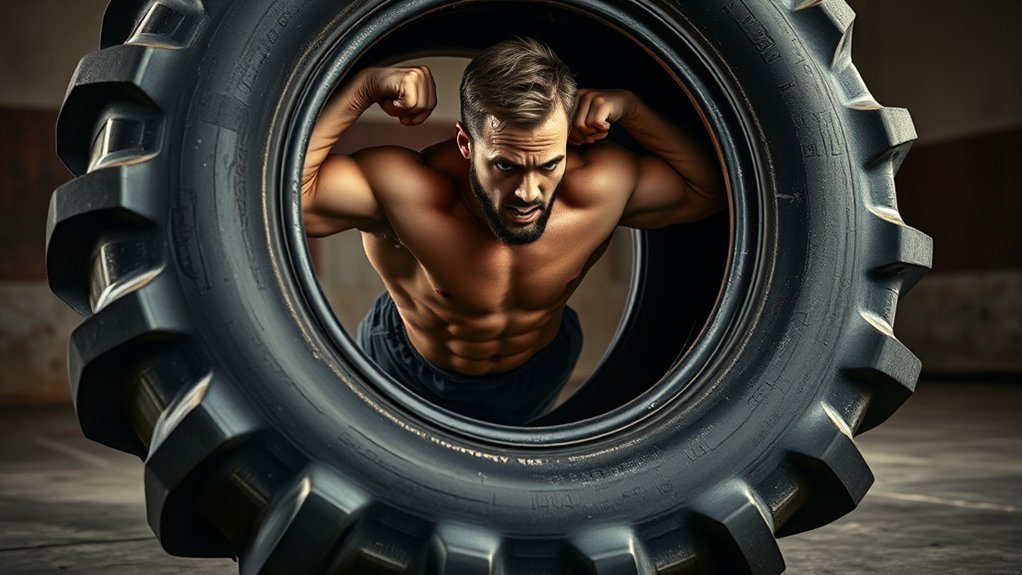
The upper body does more than hold the tire. Your lats and upper back help keep the tire close during the pull. Your traps and shoulders help control the tire as it rises. Once the tire reaches a high enough angle, your chest, shoulders, and triceps help push it over.
- Trapezius and upper back: Help stabilize the tire and keep your shoulders organized.
- Latissimus dorsi: Helps keep the tire close instead of letting it drift forward.
- Shoulders, chest, and triceps: Help finish the flip once the tire is high enough to push.
- Forearms and hands: Build grip strength because you must clamp the tread through the lift and transition.
Do not try to curl the tire with your arms. Your arms connect you to the tire, but your legs and hips should create most of the force. If your biceps feel like the main limiter, the tire is probably too heavy or your setup is too arm-dominant.
Why Tire Flips Build Strength and Power
Tire flips build strength and power because they combine a heavy hinge, a leg drive, a braced trunk, and an upper-body push. That makes them useful for people who want a more athletic strength drill than a standard machine exercise. They also challenge coordination because the tire changes angle as you move it.
For general health, adults should include muscle-strengthening work that trains major muscle groups at least two days per week, according to the CDC’s adult physical activity guidance. Tire flips can be one part of that plan, but they should not replace balanced training for your whole body.
Tire flips work best when you treat them as a power drill with clean reps, not a contest to see how long you can survive with poor form.
How Heavy Should a Tire Be for Flips?
Choose a tire you can move with clean form for several single reps. You should be able to brace, drive through your legs, keep your spine neutral, and finish the push without twisting or falling forward. If you cannot break the tire from the ground without rounding your back, it is too heavy for your current level.
A good beginner test is simple: perform 3-5 controlled singles with a full reset between reps. If every rep looks the same and you do not feel pain, the tire may be suitable. If your grip slips, your hips rise before your chest, or you have to jerk the tire off the ground, use a lighter tire or practice alternatives first.
Pro Tip: Pick the lightest tire that still lets you practice explosive leg drive. A clean fast rep teaches more than a slow ugly rep with a tire you are not ready for.
[Products Worth Considering]

This ALL-TOP auto-stop tire deflator valve kit lets you air down off-road tires quickly without watching pressure, automatically stopping when your preset PSI is reached. Each valve is individually calibrated for reliable performance with an acceptable +/- 2 PSI tolerance. The adjustable deflator range covers 10 to 30 PSI and includes four valves plus valve caps and a zipper pouch for easy setup on trucks, SUVs, RVs, UTVs, and powersports.

Secure your parked vehicle quickly with AFA Tooling 4T rubber wheel chocks in a 4-pack for two dual-wheel sets. The ribbed design and textured base grip fast without pounding, so you can chock tires on trailers, RVs, ATVs, and work vehicles with confidence. EZ rustproof handles with rope ties keep the pair together for easy placement and removal, while nylon-reinforced rubber stands up to dirt, ice, salt, and harsh weather.

Replace worn tires quickly with this universal 4.80/4.00-8 tire and inner tube set designed for wheelbarrows and outdoor utility carts. The ribbed tread helps reduce turf damage while the natural rubber construction supports longer service life. Compatible with 15.5-inch outer diameter, 4-inch width, and 8-inch rim diameter wheels, it uses a straight TR-13 valve stem for easy installation. For best results, inflate with a manual pump and do not exceed 25 PSI.
Warm Up Before Tire Flips
Warm muscles are better prepared for hard work. Mayo Clinic recommends warming up before weight training and using proper technique, suitable loading, and good footwear to reduce avoidable injury risk during lifting. You can review those basics in Mayo Clinic’s weight-training technique guide.
Before tire flips, use a short warm-up that raises body temperature and rehearses the movement pattern:
- 5-10 minutes of brisk walking, light jogging, cycling, or sled pushing.
- Bodyweight squats for hips, knees, and ankles.
- Hip hinges or light Romanian deadlifts to practice bracing.
- Planks or dead bugs to wake up your core.
- Two or three easy tire-lift practice reps before your work sets.
How to Flip a Tire With Proper Form
Good tire-flip form starts before you touch the tire. Set the tire on a flat, dry surface with enough open space around it. Wear shoes with traction, keep your hands clear of the landing area, and reset your stance before every rep.
- Set your feet: Stand close to the tire with your feet about hip-width to shoulder-width apart.
- Grip low: Hinge at your hips, bend your knees, and place your hands under the tread. Keep your chest up and your back neutral.
- Brace first: Tighten your core as if you are about to take a light punch to the stomach.
- Drive with your legs: Push through the ground and extend your hips and knees. Do not curl the tire with your arms.
- Step in and transition: As the tire rises, move one foot forward and switch from pulling to pushing.
- Push through: Use your chest, shoulders, and arms to drive the tire over until it falls safely to the other side.
- Reset: Let the tire settle, check your stance, and repeat only if your form is still sharp.
If your back rounds, your grip fails, or you feel pain, end the set. Better form with fewer reps will build more useful strength than sloppy reps done under fatigue.
Common Tire Flip Mistakes
Most tire-flip problems come from using a tire that is too heavy or rushing the setup. Watch for these common mistakes:
- Starting too far from the tire: This makes the tire drift and increases strain on your back.
- Rounding your spine: Reset and brace before each rep instead of pulling from a collapsed position.
- Curling with the arms: Drive from your legs and hips first.
- Letting the knees cave in: Push your knees in line with your toes.
- Rushing the transition: Step in, change from pull to push, and finish under control.
- Doing too many reps after fatigue hits: Stop when speed and form drop.
How to Program Tire Flips
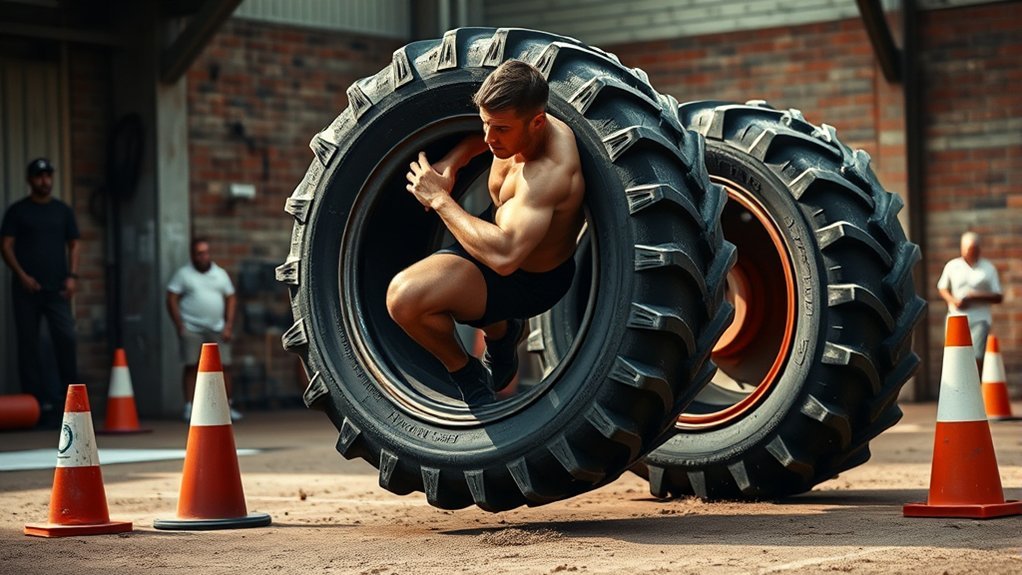
Program tire flips based on your goal. Because they are explosive and technical, place them early in your workout after the warm-up, not at the end when you are already exhausted. Keep your reps clean and stop before form failure.
| Goal | Sample Tire-Flip Plan |
| Power | 3-5 sets of 3-5 crisp reps with 90-180 seconds of rest. |
| Conditioning | 6-10 rounds of 15-20 seconds of work with 45-75 seconds of rest. |
| Technique practice | 5-8 single reps with a full reset between each rep. |
| Strength endurance | 3-4 sets of 6-10 reps with a tire you can move without form breakdown. |
Progress slowly. Add reps first, then sets, then tire weight. If your reps get slower and less controlled, use more rest or reduce the volume.
Who Should Avoid or Modify Tire Flips?
Tire flips are not the best first exercise for every person. You should avoid or modify them if you have pain during the setup, cannot hinge with a neutral spine, lack the grip to hold the tread, or have a current injury that affects your back, hips, knees, shoulders, elbows, or wrists.
If you are new to lifting, start with simpler patterns first. Trap bar deadlifts, kettlebell deadlifts, sled pushes, medicine ball throws, and landmine lunges can build the strength and coordination you need without the same awkward tire position.
[Products Worth Considering]

This tire inflator with pressure gauge delivers long-lasting performance with a durable rubber-protected gauge and sturdy build. The longer hose and 360 swivel air chuck help you seal the valve securely and keep your hands free while measuring, inflating, or deflating. It’s battery-free for reliable use and provides ±2 PSI accuracy in the mid-range for most typical tires, with universal compatibility for 1/4 NPT compressor outputs.

LiQuiTube Premium Heavy Duty Tire Sealant provides permanent flat tire protection to help maintain proper air pressure while sealing punctures and leaks. It seals bead, rim, and porosity weathering leaks and helps prevent flats in heavy ply industrial tires. Designed for versatile use on trailers and off-road equipment, it can be installed in tubeless tires and also inside tubes.

This 1/2-inch drive breaker bar delivers powerful leverage for loosening and tightening stubborn lug nuts and automotive fasteners. The 180-degree flex head helps you reach tight spaces at the angle you need, making tire and brake jobs easier. A spring-loaded ball detent design holds 1/2-inch sockets securely while the chrome-moly head provides durable strength for everyday use.
Beginner-Friendly Tire Flip Alternatives
If you are new to tire flips, use beginner-friendly alternatives to train the same movement qualities with more control. These drills build leg drive, hip extension, core bracing, upper-body coordination, and power without requiring a heavy tire.
[Products Worth Considering]

Replace worn pool cleaner tires with this all-purpose C10 tire set made to fit compatible Polaris automatic pool cleaners. The tires are designed for maximum traction while helping protect your pool finish, and they match Polaris OEM size and material. Each pack includes three new tires in sealed bags.

This dual power portable tire inflator lets you run from a 12V vehicle cigarette lighter or a 110V/120V wall outlet for flexible roadside and home use. It delivers up to 150 PSI with quick inflation, including a fast fill example from 0 to 36 PSI, and features auto shutoff with pressure memory plus a backlit LCD display with unit switching. Designed for multiple inflations, it includes extra nozzles for cars, motorcycles, bikes, sports equipment, and inflatables, while compact storage and a carry bag make it easy to keep on hand.

TheraTears Dry & Tired preservative-free eye drops provide all-day soothing comfort for dry, tired eyes. The formula contains twice the hydrating ingredient found in the original TheraTears blend, helping relieve discomfort from eye strain and screen fatigue. Convenient single-use vials make it ideal for sensitive eyes and daily eye care.
Landmine Back Lunge
The landmine back lunge builds lower-body strength, balance, and trunk control. It trains your glutes, hamstrings, and quadriceps while the landmine setup gives you a more stable loading path than a free barbell.
- Set one end of a barbell in a landmine attachment or secure corner.
- Hold the end of the bar at chest height.
- Step one foot back, lower under control, then drive through the front foot to stand.
Use 2-4 sets of 6-10 reps per side. Keep your torso tall, your front knee tracking over your toes, and your core braced.
Medicine Ball Squat Throws
Medicine ball squat throws train explosive leg drive with less technical risk than tire flips. You squat, brace, drive through the floor, and throw the ball upward or forward. This builds coordinated power through your legs, core, shoulders, and arms.
Use a ball you can throw fast. Try 3-5 sets of 3-6 powerful reps with full recovery between sets. Each throw should feel sharp, not slow or grindy.
Trap Bar Deadlifts
Trap bar deadlifts are one of the best strength builders for future tire flips because they train the quads, hamstrings, glutes, upper back, and grip in a stable position. The centered handles also let many lifters keep a more upright torso than a straight-bar deadlift.
- Stand inside the trap bar with your feet about hip-width apart.
- Brace your core, grip the handles, and keep your chest proud.
- Push through the floor and stand tall without leaning back at the top.
Start with a load you can lift for controlled reps while keeping your spine neutral. Add weight only when every rep looks consistent.
Frequently Asked Questions
How effective are tire flips?
Tire flips can be very effective for full-body strength, power, coordination, and conditioning. They work best when you use a tire that matches your ability, keep reps explosive, and stop before your form breaks down.
Is tire flipping better than deadlifts?
Tire flipping is not better than deadlifts for every goal. Deadlifts are usually better for controlled strength progression, while tire flips add speed, conditioning, coordination, and a push-over finish. Many lifters benefit from using both.
How many tire flips is a good workout?
A good starting workout is 3-5 sets of 3-5 clean reps for power or 3-4 sets of 6-10 reps for strength endurance. For conditioning, use short timed rounds such as 15-20 seconds of work with enough rest to keep your form sharp.
What muscles does tire flipping work?
Tire flipping works the quads, hamstrings, glutes, abs, obliques, spinal stabilizers, lats, traps, shoulders, chest, triceps, forearms, and grip. The legs and hips start the lift, the core stabilizes, and the upper body finishes the flip.
Are tire flips safe for beginners?
They can be safe for some beginners if the tire is light, the surface is stable, and a coach teaches proper form. If you cannot hinge, brace, and deadlift with control, build those skills first with trap bar deadlifts, sled pushes, and medicine ball throws.
Conclusion
Tire flips work your legs, hips, core, back, shoulders, chest, arms, and grip, making them a demanding full-body strength and conditioning exercise. Use them for power and athletic work, not sloppy fatigue reps. Choose a tire you can move cleanly, warm up first, brace hard, drive through your legs, and push the tire over with control. Done correctly, tire flips can build strength, power, coordination, and work capacity in one practical movement.
Sources
- CDC: Adult Activity: An Overview — supports weekly physical activity and muscle-strengthening guidance.
- Mayo Clinic: Weight training do’s and don’ts — supports proper form, warm-up, load selection, pain awareness, and footwear guidance.
- ODPHP: Physical Activity Guidelines for Americans — supports evidence-based physical activity recommendations.
- Schema.org: HowTo — supports the HowTo structured data format used for the tire-flip steps.
- Schema.org: FAQPage — supports the FAQ structured data format used for the FAQ section.

