

You should fit winter tires when daily temperatures consistently reach about 45°F (7°C) or lower, not when the first snow falls. At that point, summer and many all-season tires begin losing flexibility, while winter tires are designed to stay pliable for better cold-weather grip, braking, and control.
Quick Answer
Switch to winter tires once your local temperatures stay near or below 45°F (7°C), especially during your morning commute. Do not wait for snow. Install all four tires, check pressure when cold, and switch back only when temperatures stay above that range in spring.
Key Takeaways
- Use the 45°F / 7°C rule as your main trigger for winter tire installation.
- Temperature matters more than snowfall because tire rubber stiffens before roads look dangerous.
- Install winter tires on all four wheel positions for balanced braking, steering, and stability.
- Check tire pressure cold; pressure drops as outside temperatures fall.
- Switch back to all-season or summer tires when temperatures consistently rise above 45°F (7°C).
At a Glance
| Time Required | 30–90 minutes at a tire shop, or longer if you mount a wheel-and-tire set yourself |
| Difficulty | Easy if scheduled with a shop; moderate for a DIY wheel swap |
| Tools Needed | Tire pressure gauge, tread-depth gauge, torque wrench if doing a DIY wheel swap |
| Cost | Varies by vehicle, tire size, wheel setup, balancing, storage, and local labor rates |
The 45°F (7°C) Rule for Winter Tires
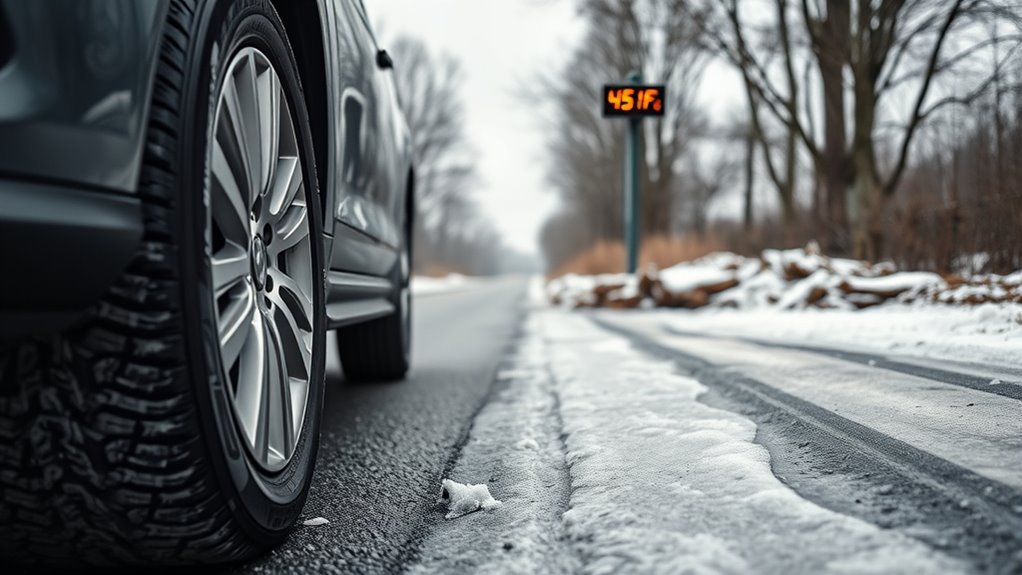
When average temperatures consistently hit about 45°F (7°C) or lower, switch to winter tires. Transport Canada notes that below 7°C, all-season and summer tires begin to lose elasticity, while winter tires keep their grip at much lower temperatures.
That makes temperature a better trigger than snowfall. Roads can be cold, damp, frosty, or icy before the first visible snow, especially early in the morning. Monitor your local forecast for a full week, pay attention to overnight lows, and book your changeover before tire shops are crowded by the first storm.
The best time to install winter tires is before winter driving feels urgent. Use consistent cold temperatures as your signal, not the first slippery commute.
Why Temperature, Not Snowfall, Determines the Switch
Rubber compounds react to cold. As temperatures drop, summer tires and many all-season tires become harder and less able to conform to the road surface. Winter tires use compounds and tread designs built for cold pavement, snow, slush, and ice.
| Condition | Best Action |
|---|---|
| Daytime temperatures stay above 50°F | Keep summer or all-season tires if winter weather is not expected |
| Daily temperatures consistently reach 45°F or lower | Install winter tires |
| Regular overnight frost or freezing rain | Prefer winter tires even before snow arrives |
| Forecast shows a sustained cold trend | Schedule the swap before shops fill up |
| First snowfall | You should already be covered if you used the temperature rule |
Warning: Do not install only two winter tires on a passenger vehicle. Mixing winter tires on one axle with non-winter tires on the other can create unbalanced grip and unpredictable handling. Use four matching winter tires whenever possible.
Use Commute and Ground Temperatures to Time the Change
Your commute matters more than the afternoon high. If you leave before sunrise, drive shaded roads, cross bridges, or travel through rural areas, you may hit colder pavement than the forecast headline suggests.
Use this practical timing method:
- Watch the seven-day forecast. If most days are near or below 45°F (7°C), plan the swap.
- Check overnight lows. Morning frost is a strong sign that pavement may be colder than the air temperature.
- Think about your route. Bridges, overpasses, hills, shaded roads, and lake-effect areas cool faster.
- Book early. Tire shops get busiest after the first cold snap or snow warning.
- Check pressure after installation. Cold air lowers inflation pressure, so use the vehicle placard PSI, not the number printed on the tire sidewall.
NHTSA TireWise recommends checking tire pressure when tires are cold and using the pressure listed on the vehicle’s tire information placard or owner’s manual.
Pro Tip: If your area has unpredictable fall weather, schedule your winter tire appointment as soon as the forecast shows several cold mornings in a row. A few warm afternoons are usually less risky than being caught on cold, slick roads with the wrong tires.
How Early Can You Safely Install Winter Tires?
You can safely install winter tires a little early if cold weather is close. The best window is when temperatures are trending toward 45°F (7°C) and colder nights are becoming common. This gives you a safety buffer against sudden freezes, early snow, and tire shop delays.
The downside is wear. Winter tires use softer compounds, so long stretches of warm pavement can wear them faster and make handling feel less crisp. If temperatures are still consistently above 50°F and no cold snap is forecast, wait a little longer.
| Timing | Pros | Cons |
|---|---|---|
| A few weeks before steady cold | Avoids the shop rush and sudden freezes | Slightly more wear if weather stays warm |
| When temps hover around 45°F | Best balance of safety and tire life | Appointments may be harder to find |
| After first snow | No warm-weather wear | Highest risk and longest shop waits |
What Happens If You Wait Too Long?
If you wait too long, you lose your safety margin. Cold-stiffened tires can reduce traction, increase stopping distance, and make the vehicle harder to control on frost, slush, packed snow, and ice. Even if the road looks dry, cold pavement can still reduce grip.
Longer Stopping Distance
Winter tires are designed to improve braking and control in cold winter conditions. Transport Canada’s winter tire testing found that winter tires reduced stopping distance compared with all-season tires in icy conditions, which is why they recommend winter tires for cold, snowy, and icy driving.
Reduced Steering Control
When tires lose flexibility, steering inputs may feel delayed or vague. This is especially noticeable during emergency lane changes, downhill braking, or turning on cold wet pavement.
Possible Tire Damage
Repeated cold exposure is especially hard on summer performance tires. If your vehicle uses dedicated summer tires, check the tire manufacturer’s instructions because some summer compounds should not be driven, flexed, or stored improperly in freezing temperatures.
Winter vs. All-Weather vs. All-Season Tires: Which Should You Choose?
The right tire depends on your climate, commute, and risk tolerance.
| Tire Type | Best For | Limitations |
|---|---|---|
| Winter tires | Regular snow, ice, slush, freezing rain, mountain roads, and long cold seasons | Need seasonal swaps and wear faster in warm weather |
| All-weather tires | Moderate winters, occasional snow, and drivers who want one set year-round | Usually not as strong as dedicated winter tires in severe ice and deep snow |
| All-season tires | Mild climates with little snow and mostly above-freezing roads | Not ideal for severe winter conditions |
If you regularly drive in freezing temperatures, winter tires give the strongest cold-weather grip. If your winters are mild and you want to avoid seasonal swaps, look for all-weather tires with the three-peak mountain snowflake symbol.
[Products Worth Considering]

Steelman white tire marking crayons provide high-contrast, semi-permanent marks for repairing and inspecting tires and equipment. They write on wet or dry, smooth or coarse surfaces including rubber, metal, glass, and wood, making them ideal for puncture location and damage outlining. The lead- and zinc-free crayons resist weather and fading yet wipe away when you no longer need the marks.

The Kurgo Seasonal Tire Tote helps protect your car interior, clothes, and garage from tire grime, brake dust, and residue during seasonal tire changes. Its universal design fits most passenger tires between 22" and 31" in diameter, making storage and transport simpler with less mess. Built for rugged, repeated use, it’s machine washable for easy care and comes with a lifetime warranty.

Measure tire tread depth quickly and accurately with this LUMITECO dial gauge that reads in 1/32" increments up to 14/32". The color-coded green/yellow/red zones make it easy to judge tire wear and know when replacement is needed. A rugged, compact design with a protective pouch helps keep the gauge ready for use on cars, trucks, motorcycles, and more.
Look for the Three-Peak Mountain Snowflake Symbol
When buying winter or all-weather tires, look for the three-peak mountain snowflake symbol on the sidewall. Tires with this mark meet specific snow-traction performance requirements for severe snow service. Transport Canada recommends looking for this symbol when shopping for winter tires.
The older M+S marking means “mud and snow,” but it does not prove the same severe snow performance as the three-peak mountain snowflake symbol. For real winter driving, the mountain snowflake mark is the clearer signal.
Note: All-weather tires may carry the three-peak mountain snowflake symbol, but that does not automatically make them equal to dedicated winter tires on glare ice or in deep snow. Compare test results, tread design, and your local driving conditions.
Studded or Studless Winter Tires: Grip, Limits, and Laws
Studded tires can help on hard-packed ice, but they are noisy, can reduce comfort on dry pavement, and are restricted or banned in some places because they can damage roads. Studless winter tires are more versatile for mixed winter driving, including cold dry pavement, snow, slush, and wet roads.
| Attribute | Studded Winter Tires | Studless Winter Tires |
|---|---|---|
| Best surface | Ice and hard-packed snow | Snow, slush, cold wet roads, and mixed winter conditions |
| Ride and noise | Noisier and rougher | Quieter and smoother |
| Legal status | Often restricted by date or location | Usually legal wherever winter tires are allowed |
| Best driver | Rural or mountain driver facing frequent ice | Most drivers facing normal winter roads |
Before buying studs, check your state, province, or local road authority. AAA’s Digest of Motor Laws is a useful starting point for checking vehicle equipment rules, but your local transportation department is the final authority.
[Products Worth Considering]

Monitor tire tread wear with a smart, color-coded depth gauge that shows clear condition ranges at a glance. The bar is range marked for fast, easy readings, helping you maintain safer traction and performance. Each gauge is portable with a pocket clip, and the set includes 20 units for daily use and sharing.

Milton S-921 pencil tire pressure gauge helps you maintain optimal tire pressure for passenger cars with accurate readings in PSI and kPa. It features a built-in deflator valve for convenient pressure adjustments, plus a single chuck head and nylon indicator bar for easy use on the go. Built from durable plated brass and designed for reliable performance, it’s a practical road trip and cold-weather maintenance tool.

The SAFELIFE dial tire tread depth gauge measures tread depth in 1/32 inch increments with clear, easy-to-read 2-inch dial face. Color zones using a traffic light system help you quickly judge whether tread is low, marginal, or ample for safer driving. Built with a durable zinc cast body and a metal detect probe for precise, comfortable use across cars, motorcycles, trucks, and buses.
When to Switch Winter Tires Back to All-Season Tires
Switch winter tires back to all-season or summer tires when temperatures consistently stay above about 45°F (7°C). Winter tires are not built for long stretches of warm pavement, and using them too late into spring can speed up wear, reduce responsiveness, and waste tread life.
Temperature Thresholds to Watch
Do not switch back after one warm afternoon. Wait until the forecast shows a stable warming trend and overnight lows are no longer near freezing. If late-season snow or freezing rain is common where you live, keep winter tires on a little longer.
Tire Wear and Efficiency
Warm pavement can make winter tires wear faster. Timely changeovers help protect tread life, preserve handling, and keep your winter set ready for the next cold season.
| Action | Benefit |
|---|---|
| Switch back above steady 45°F weather | Prevents unnecessary winter tire wear |
| Rotate during the seasonal change | Promotes even tread wear |
| Measure tread depth | Shows whether the set is ready for another season |
| Inspect for cracks, bulges, and uneven wear | Catches problems before storage |
Storage and Inspection Tips
Before storing winter tires, clean them, let them dry, inspect them, and label their wheel positions. Store them in a cool, dry location away from sunlight, ozone, petroleum products, and heat. If the tires are mounted on wheels, many tire manufacturers allow stacking; if they are unmounted, store them upright and rotate them periodically.
- Inspect: Look for cuts, punctures, cracks, bulges, exposed cords, or embedded objects.
- Measure: Use a tread-depth gauge. The legal minimum is commonly 2/32 inch, but winter performance can decline well before that.
- Clean: Wash off salt, grit, and brake dust before storage.
- Label: Mark front/rear and left/right positions so rotation is easier next season.
- Store: Keep tires in airtight bags or tire covers in a cool, dry space.
Seasonal Swap Checklist: Pressure, Alignment, Inspection, and Rotation
Use this checklist every time you change tires. It keeps the tire swap from becoming just a mount-and-go job.
- Confirm tire size and load rating against your vehicle placard or owner’s manual.
- Install four matching winter tires for balanced control.
- Check cold inflation pressure using the vehicle placard PSI.
- Inspect tread depth with a gauge, not a guess.
- Look for uneven wear that could point to alignment, suspension, or inflation problems.
- Torque wheel nuts properly if wheels are removed and reinstalled.
- Recheck torque after the short interval recommended by your installer or vehicle manual.
- Book alignment service if you see feathering, cupping, pulling, vibration, or uneven tread wear.
NHTSA recommends regular tire pressure checks and tire inspections for cuts, irregular wear, and other damage. These checks matter even more before winter because cold weather and rough roads make weak tires more obvious.
[Products Worth Considering]

Accurately measure tire tread depth with a calibrated gauge marked from 0 to 1 inch in 1/32 inch increments. The color-coded bar helps you quickly identify tread condition ranges, supporting safe driving for trucks, motorcycles, automobiles, and passenger vehicles.

The Trivd Frol 1/2" air impact wrench delivers high performance torque up to 1500 ft-lbs with a twin hammer impact mechanism for strong, balanced blows. It features an ergonomic grip, compact lightweight design, and quick-stop control with 3 forward speeds up to 8000 RPM plus a reverse speed. Built for demanding automotive repair and tire shop work, the rear exhaust helps keep debris away from the surface.

The 22800 wheel stud installer makes replacing wheel studs quick and secure, saving time and effort during tire service. It uses a ratchet or impact wrench to pull new studs firmly into place, helping when existing studs are too long. Compatible with most automotive wheels and light-duty truck wheel studs, it’s designed for easy, tool-assisted installation.
Storage and Post-Season Care
Good storage helps winter tires last longer. After removal, clean off road salt and grime, inspect each tire, document tread depth, and store the set away from heat and sunlight. If you use a tire shop’s storage service, ask whether they inspect, label, and track your set before the next season.
- Clean and dry: Moisture, salt, and brake dust can accelerate aging and corrosion on mounted wheels.
- Bag or cover: Airtight bags or tire covers help limit exposure to ozone and sunlight.
- Keep cool: A dry basement or climate-controlled garage is better than a hot shed.
- Avoid chemicals: Keep tires away from solvents, fuels, lubricants, and electric motors that produce ozone.
- Plan next season: If tread is low or wear is uneven, replace or service before cold weather returns.
Frequently Asked Questions
What temperature should you start using winter tires?
Start using winter tires when daily temperatures consistently reach about 45°F (7°C) or lower. That is when summer and many all-season tires begin losing flexibility, while winter tires are designed to maintain cold-weather grip.
Should I wait until it snows to install winter tires?
No. Install winter tires based on temperature, not snowfall. Cold pavement, frost, and freezing rain can reduce traction before snow appears, especially during early-morning commutes.
Should I put air in my tires when it is cold in the morning?
Yes. Check and adjust tire pressure when the tires are cold, preferably before driving or after the vehicle has been parked for several hours. Inflate to the vehicle manufacturer’s recommended cold PSI listed on the door placard or owner’s manual.
Can I use only two winter tires?
It is not recommended. Use winter tires on all four wheel positions for balanced traction, braking, and steering. Installing winter tires only on the front or rear can make the vehicle harder to control.
When should I switch winter tires back to all-season tires?
Switch back when temperatures consistently stay above about 45°F (7°C), including overnight lows. This helps prevent unnecessary wear on winter tires and restores the handling feel of your warmer-weather tires.
Are all-weather tires the same as winter tires?
No. All-weather tires are a year-round compromise and may carry the three-peak mountain snowflake symbol, but dedicated winter tires usually provide stronger performance in severe snow, ice, and long cold seasons.
Conclusion
Think of winter tires as cold-weather safety gear, not just snow gear. Once temperatures consistently fall to about 45°F (7°C), winter tires give your vehicle the flexible rubber, tread pattern, and cold-road control it needs. Time the change around your commute, install a matching set of four, check pressure when cold, and store the off-season set properly. Proper timing keeps your car safer, your tires lasting longer, and your winter driving far less stressful.
Sources
- Transport Canada — Using winter tires — supports the 7°C temperature guidance, winter tire elasticity, and mountain snowflake symbol.
- NHTSA TireWise — supports tire pressure, tire placard PSI, tread checks, and tire safety inspection guidance.
- NHTSA Winter Driving Tips — supports winter vehicle preparation and tire safety before cold-weather driving.
- U.S. Tire Manufacturers Association — Seasonal Tire Care Tips — supports seasonal tire care, inspection, and maintenance guidance.
- U.S. Tire Manufacturers Association — Tire Care and Safety Guide — supports tire storage, service, replacement, and care recommendations.
- Tire Rack — Three-Peak Mountain Snowflake Symbol — supports explanation of the 3PMSF severe snow service marking.

