
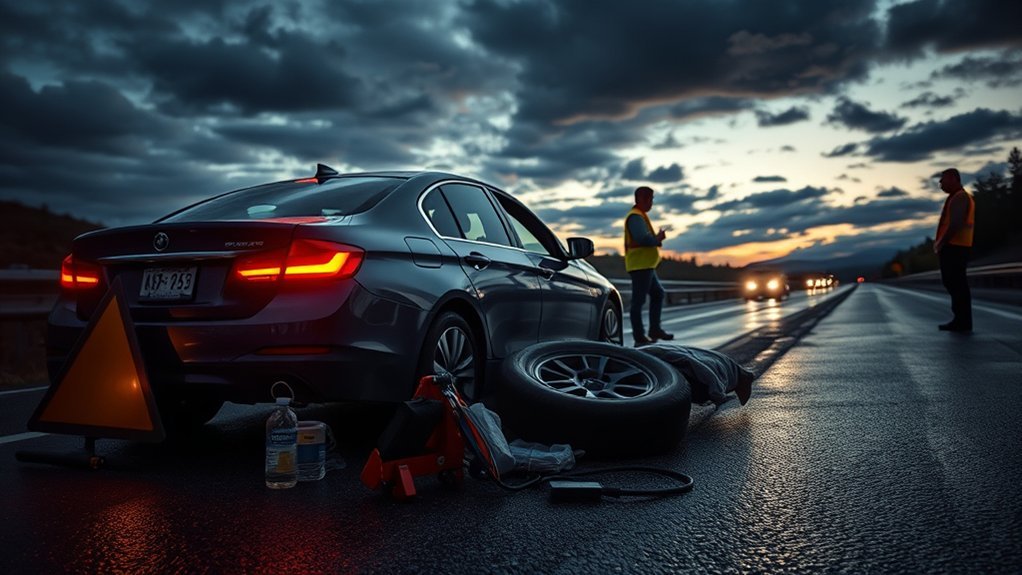
A roadside emergency is safest when you treat traffic exposure as the first problem and the disabled vehicle as the second. Turn on your hazard lights, keep control of the vehicle, and move to a safer location if you can. Once stopped, secure the vehicle, decide whether staying inside or getting out is safer, and call for help.
Quick Answer
If your car develops a roadside problem, turn on the hazard lights, keep control, and move as far from live traffic as you safely can. Secure the vehicle, then decide whether it is safer to stay buckled inside or exit away from traffic. Call 911 for immediate danger; otherwise request roadside assistance.
Key Takeaways
- Turn on your hazard lights as soon as you realize the vehicle is becoming a hazard, then move completely away from live traffic if the vehicle can still travel safely.
- Do not assume staying inside is always safest. Base the decision on traffic, your stopping location, barriers, fire or smoke, and whether you can exit without entering a live lane.
- Call 911 for immediate danger, injuries, fire, a vehicle blocking a high-speed lane, or another situation that needs police, fire, or medical help.
- Use warning triangles, reflective clothing, or other visibility equipment only when you can deploy them without exposing yourself to moving traffic.
- Keep a working emergency kit with a flashlight, first aid supplies, water, food, charging equipment, jumper cables, and weather-appropriate gear.
At a Glance
| Time Required | About 1–5 minutes for the first safety actions; assistance time varies by location and conditions. |
| Difficulty | Simple steps, but potentially high-risk surroundings. |
| Tools Needed | Phone, vehicle hazard lights, emergency kit, reflective vest, and warning devices when safe to use. |
| Cost | Immediate safety actions cost nothing; emergency-kit, towing, and roadside-service costs vary. |
Note: This is general U.S.-focused safety guidance. Roadside laws, warning-device rules, and recommended procedures can vary by state and road type. Follow police or dispatcher instructions, posted rules, and your vehicle owner’s manual when they differ.
Why Roadside Emergencies Turn Dangerous
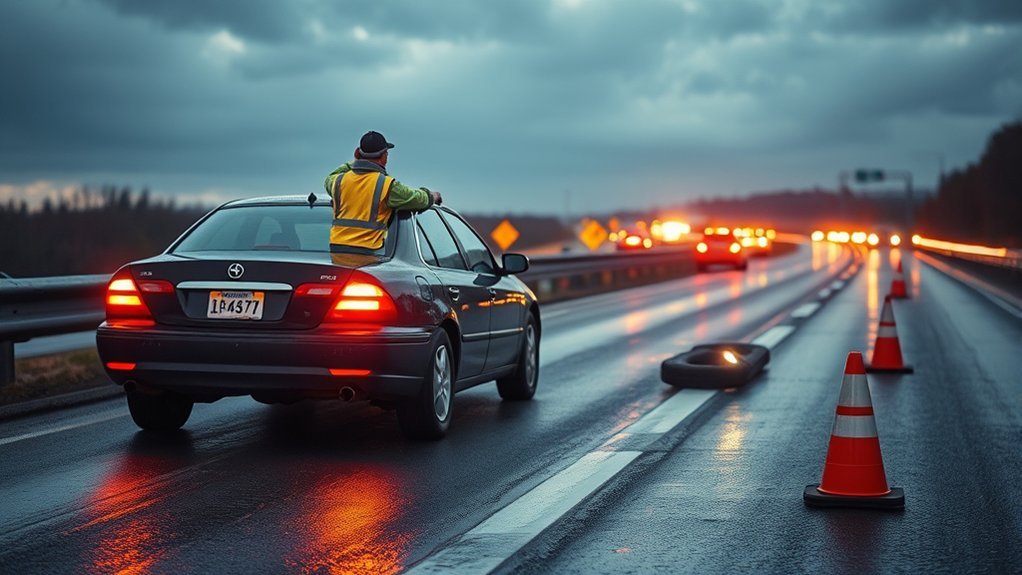
Roadside emergencies can become dangerous because a stopped vehicle and anyone standing near it are exposed to moving traffic. Risk increases on high-speed roads, blind curves, narrow shoulders, and at night or in poor visibility.
Breakdowns are also common. AAA reported more than 30 million roadside events in 2025, most commonly involving towing, batteries, and flat tires.
AAA responded to more than 30 million roadside events in 2025, showing how common breakdowns and other roadside problems remain.
Your goal is to avoid a secondary collision. Hazard lights, a safer stopping location, reflective equipment, and good decisions about whether to stay inside or exit all help reduce your exposure.
The biggest mistake is treating every roadside stop the same. A vehicle safely parked well beyond traffic creates a different risk than a car disabled in a live lane, on a narrow bridge, beside a blind curve, or with smoke coming from under the hood.
What to Do First on the Shoulder?
As soon as you know something is wrong, focus on controlling the vehicle and getting away from moving traffic. Do not start diagnosing the mechanical problem until your position is as safe as you can make it.
- Turn on the hazard lights. Warn nearby drivers that your vehicle is slowing or becoming disabled.
- Move to a safer location if possible. A parking lot, rest area, exit, or wide shoulder is generally better than stopping close to a high-speed lane.
- Stop smoothly. Avoid hard braking or abrupt steering unless needed to prevent an immediate crash.
- Secure the vehicle. Shift into Park or the appropriate gear and apply the parking brake.
- Assess the surroundings before opening a door. Check traffic, barriers, drop-offs, fire, smoke, leaking fluids, weather, and whether the vehicle is completely outside the travel lane.
- Call for help. Use roadside assistance for a normal breakdown and 911 when there is immediate danger.
When you call, give the road or highway name, direction of travel, nearest exit or mile marker, GPS location if available, vehicle make and color, and whether any part of the vehicle is blocking a traffic lane.
Pro Tip: Save your roadside-assistance number in your phone before a trip. If your provider has an app, install it in advance so you can send your location without trying to search for account information beside traffic.
Should You Stay Inside the Vehicle or Get Out?
There is no single answer for every breakdown. AAA roadside-safety guidance generally favors remaining buckled inside when your vehicle is safely away from traffic, but the safest choice changes when the vehicle itself is exposed to a likely impact or another immediate hazard.
When Staying Inside Is Usually Safer
- Your vehicle is fully outside the traffic lane on a reasonably wide, stable shoulder or other safe area.
- There is no fire, smoke, dangerous fluid leak, or other reason to evacuate.
- Getting out would force you or your passengers to walk close to fast-moving traffic.
- There is no safe barrier, sidewalk, or protected area to reach.
If you remain inside, keep your seat belt fastened, leave the hazard lights on, lock the doors if appropriate, and stay alert while waiting for help.
When Getting Out May Be Safer
- The vehicle is partly or fully in a live traffic lane and there is a safe way to reach a protected location.
- You are stopped where another vehicle is likely to strike you, such as near a blind curve, and you can safely move beyond a barrier or far from traffic.
- There is smoke, fire, a strong fuel smell, or another immediate hazard inside or around the vehicle.
If you exit, use the door farthest from moving traffic when possible. That is often the passenger-side door on a right-hand shoulder, but road layouts differ. Move well away from the roadway and avoid standing directly in front of or behind your vehicle. A guardrail or another protected area can provide additional separation when it is safe to reach.
When Should You Call 911?
Call 911 rather than relying only on normal roadside assistance when the situation presents an immediate danger. Examples include:
- Your vehicle is disabled in an active high-speed traffic lane and you cannot reach a safer location.
- Someone is injured or needs medical help.
- The vehicle is on fire, smoking heavily, or leaking fuel.
- A crash has occurred and traffic remains at risk.
- You are stranded in a place where you feel threatened or unsafe.
- Police, fire, or traffic control is needed to protect the scene.
For an ordinary flat tire, dead battery, lockout, or mechanical breakdown in a secure location, contact your roadside-assistance provider or a qualified towing service.
How to Pull Over Safely on Any Road
Signal your intention early, keep the vehicle predictable, and move toward the safest available location without making a sudden stop. If the vehicle still operates, an exit, parking lot, rest area, or wide shoulder is usually preferable to stopping inches from moving traffic.
Use your hazard lights when the vehicle has become a hazard or is moving unusually slowly because of a problem. Once stopped, secure the vehicle before deciding what to do next.
Signal Early
Give other drivers as much useful warning as conditions allow. Use your turn signal before moving toward the shoulder and activate the hazard lights when your vehicle is slowing abnormally or becoming disabled.
Do not rely on one universal “100-foot” signaling rule. State laws differ, and your main safety goal is to signal early enough that nearby drivers can recognize your movement without your making an abrupt lane change.
- Check mirrors and surrounding traffic.
- Activate your turn signal before changing position.
- Use hazard lights when the vehicle becomes a traffic hazard.
- Move smoothly toward the safest available stopping area.
A clear, predictable movement gives other motorists more time to slow down or change lanes safely.
Steer to Safety
If the vehicle is still controllable, steer toward the right shoulder, an emergency pull-off, parking area, or another place separated from moving vehicles. Avoid abrupt braking or steering unless an immediate collision requires it.
Once stopped, place the transmission in Park or the appropriate gear and apply the parking brake. On a grade, follow your owner’s manual and local parking rules for wheel position rather than relying on one universal wheel-angle rule.
If the vehicle cannot move safely, turn on the hazard lights and call for assistance. If you are stranded in an active high-speed lane or immediate danger exists, call 911.
Stop Visible, Secure
Your roadside position should make the vehicle easy to see without putting you in a more dangerous location. Keep the hazard lights operating and move as far from the travel lane as conditions safely allow.
- Shift into Park or the appropriate gear and set the parking brake.
- Check whether the vehicle is completely clear of the traffic lane.
- Keep the hazard lights on.
- Put on a reflective vest before exiting if you have one within easy reach.
- Exit through the side farthest from traffic only when you have confirmed that leaving is safer.
- Move to a protected area rather than waiting immediately beside, behind, or in front of the vehicle.
If a narrow shoulder leaves you exposed to traffic, do not attempt a roadside repair simply because the vehicle itself is off the lane.
Roadside Emergency Kit Checklist
Your roadside emergency kit should help with visibility, communication, basic first aid, weather exposure, and common vehicle problems. Store it where you can reach important items without standing beside traffic or unloading the entire trunk.
[Products Worth Considering]

CKAuto Universal Tire Repair Kit provides a complete emergency solution for fixing flat tire punctures using plug-style repairs without removing the tire from the rim. The kit includes insertion/probe tools, repair plugs, lubricant, valve accessories, and a convenient carry bag for quick roadside use. Designed for tubeless tires across cars, SUVs, trucks, motorcycles, RVs, and more, it’s easy enough for anyone to perform a proper repair.

This car emergency kit keeps essential roadside tools organized in a durable, portable bag so you can respond quickly during common driving emergencies. It includes battery jumper cables, a bright LED headlight, first aid supplies, a tire pressure gauge, and safety essentials like gloves and an emergency poncho. Designed for trunk or storage use, it helps you be prepared for dead batteries, minor malfunctions, and unexpected roadside issues.
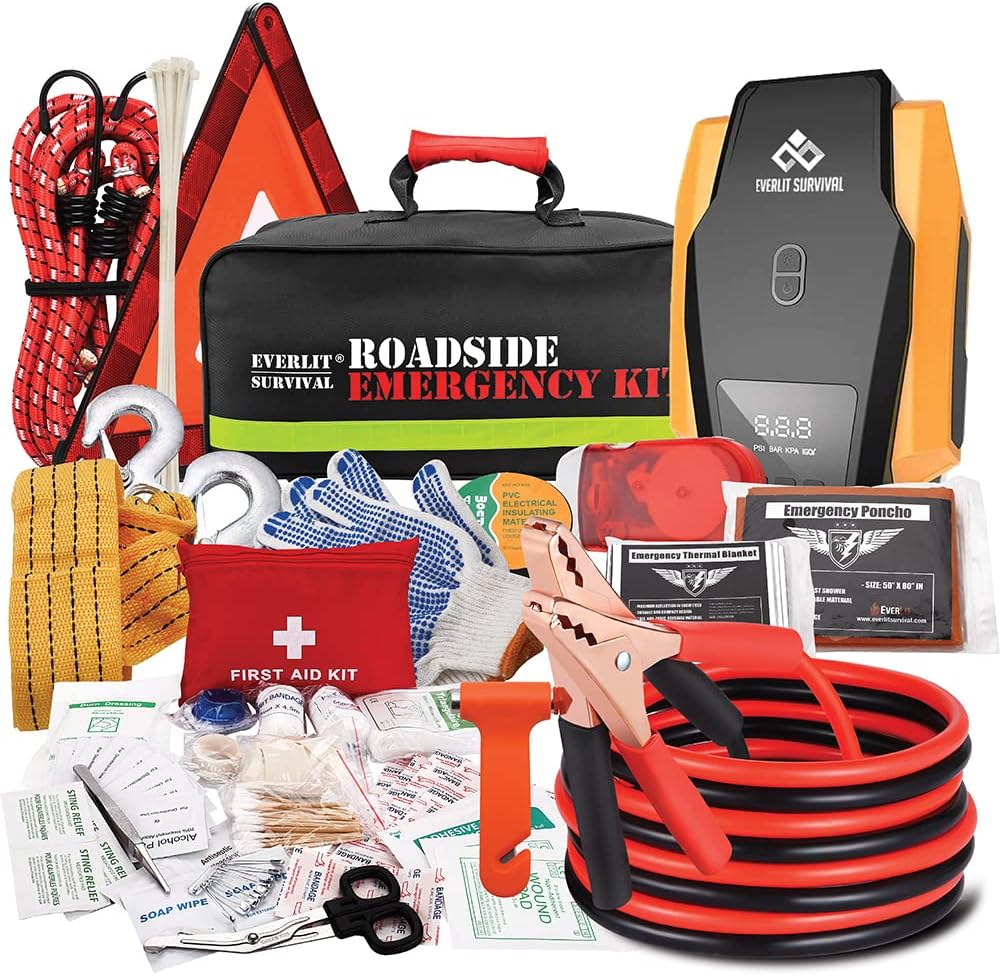
The Everlit Road Guardian emergency kit is designed for roadside breakdowns, combining essential safety gear and roadside tools in one compact bag. It includes a digital 12V auto tire inflator with preset and auto shutoff, plus 12-foot 8-gauge jumper cables to get you moving again. You also get a full 108-piece first aid kit, reflective warning tools, safety gloves, and emergency convenience items for safer travel.
Essential Kit Items
A practical kit can include:
- Flashlight or headlamp with spare batteries
- Reflective vest and reflective warning triangles
- First aid kit and essential medications
- Charged power bank and phone charging cable
- Jumper cables or a suitable portable jump starter
- Bottled water and non-perishable snacks
- Tire pressure gauge
- Work gloves
- Blanket or warm clothing
- Rain poncho or other weather protection
Adapt the kit to your climate and passengers. Cold-weather travel may call for an ice scraper, shovel, traction material, extra gloves, and warm layers. Hot-weather travel calls for additional water and sun protection. Carry necessary child, pet, or accessibility supplies when applicable.
Visibility And Warning Gear
Reflective clothing and warning devices can improve visibility, but they are useful only when you can deploy them safely.
For private passenger vehicles, there is no single nationwide federal rule requiring every driver to place triangles at exactly 10, 100, and 200 feet. The commonly quoted federal distances come from regulations governing certain commercial motor vehicles under 49 CFR 392.22, and even those distances change with road configuration.
Follow the warning device manufacturer’s instructions and applicable state law. Place devices far enough back to give approaching drivers useful notice, but never walk along or enter a high-speed traffic lane just to position a triangle.
Warning: Do not use a flare or any other flame-producing warning device near leaking gasoline, another flammable liquid, combustible gas, or a suspected vehicle fire.
Kit Checks And Refreshes
Check your roadside kit about every six months and before major trips. Test powered equipment and replace expired, damaged, or depleted supplies.
- Test the flashlight, jump starter, power bank, and other battery-powered equipment.
- Check your first aid supplies and essential medications for expiration dates.
- Replace old food and water.
- Inspect jumper cables, warning triangles, gloves, tire gauge, and charging cables.
- Update seasonal items before hot, cold, snowy, or wet-weather travel.
After using anything during a breakdown, restock it before your next trip.
How to Make Your Car Visible
If you have to stop on the roadside, activate your hazard lights and move the vehicle away from moving traffic as safely as possible. Visibility tools can then provide additional warning, but never sacrifice your own safety simply to place equipment farther down the road.
| Visibility Tool | How to Use It | Why It Helps |
|---|---|---|
| Hazard lights | Activate when the vehicle becomes disabled or creates a hazard | Alerts approaching drivers |
| Reflective vest | Put it on before exiting when it is within safe reach | Makes you easier to see in low light |
| Reflective triangle | Place behind the vehicle according to local law and device instructions, only when safe | Provides advance warning without an open flame |
| Additional triangles | Use farther back when road conditions, local rules, and personal safety allow | Extends warning distance |
| Road flare | Use only where legal and where no fuel, gas, or fire hazard exists | Can provide strong nighttime visibility |
Visibility equipment supplements a safe stopping position; it does not make an exposed shoulder or live lane safe enough for a repair.
[Products Worth Considering]

This roadside assistance kit helps drivers and passengers in urgent situations after an accident or breakdown, providing practical support while waiting for help. It includes a lightweight, compact tire inflator for fast inflation of standard vehicle tires, plus reinforced jumper cable protection for safer handling. Ideal for winter weather, road trips, camping, and travel, with everything stowed neatly in a trunk bag.

The GOOLOO A3 3000A 12V jump starter delivers fast, reliable starts for dead vehicles while also providing a built-in 150 PSI cordless tire inflator. It supports gas and diesel engines up to 9.0L/6.5L and includes multiple inflation modes with smart shutoff and an LED display for convenient pressure control. A high-efficiency BMS provides 10 safety protections, and the unit also functions as a flashlight and device-charging power bank.
![[2026NEW] 5000A Jump Starter with Air Compressor (150PSI)](https://m.media-amazon.com/images/I/71oG4PFNsmL._AC_SL1500_.jpg)
The 2026 Povasee 5000A jump starter is an all-in-one car power solution that jump-starts 12V vehicles and also inflates tires with a high-output air compressor. It supports multiple inflation presets with an LCD display, plus LED lighting and SOS signaling for safer roadside help. With secure protection systems, fast charging for phones, and 24-month standby, it’s built for reliable emergency performance in a wide temperature range.
Tire Blowouts and Flats: What to Do
A tire blowout can be startling, but sudden steering or hard braking can make the vehicle harder to control. NHTSA’s tire-safety guidance says the goal is to keep the vehicle balanced and controllable.
During a blowout, regain control first. The safest pull-over happens after the vehicle is stable enough to slow down predictably.
- Hold the steering wheel firmly with both hands.
- Avoid slamming on the brakes or making an abrupt steering correction.
- Maintain control and, if needed for stability, briefly maintain speed rather than reacting suddenly.
- Gradually release the accelerator.
- Correct the steering as needed and look where you want the vehicle to travel.
- Once the vehicle is stable, slow down and pull off the road where it is safe.
- Activate or keep the hazard lights on and assess whether it is safe to remain there.
Proper tire pressure, tread checks, and routine maintenance reduce the chance of tire trouble, but they cannot prevent every puncture or failure.
[Products Worth Considering]

Milton S-921 pencil tire pressure gauge helps you maintain optimal tire pressure for passenger cars with accurate readings in PSI and kPa. It features a built-in deflator valve for convenient pressure adjustments, plus a single chuck head and nylon indicator bar for easy use on the go. Built from durable plated brass and designed for reliable performance, it’s a practical road trip and cold-weather maintenance tool.

This 2-ton scissor car jack kit helps you lift vehicles quickly with a wide lifting range for low sedans and high SUVs. It includes a ratchet wrench, lug wrench, gloves, a tire pressure gauge, and a storage bag for faster flat-tire repairs. Designed for stable, secure use, it’s a universal emergency kit for cars, SUVs, and MPVs.

The Gurduenon scissor car jack tire changing kit is designed for quick flat-tire replacement with a lifting capacity of 2.5 tons and a scissor-lift range sized for many vehicles. The complete emergency set includes a ratchet wrench, lug wrench, gloves, a pencil tire pressure gauge, and a storage bag for convenient trunk or garage use. Universal compatibility makes it suitable for cars, SUVs, and other vehicles roadside assistance needs.
Can You Safely Change a Tire?
You can change a tire safely only when the location gives you enough separation from traffic and the vehicle can be supported on firm, level, stable ground. Your owner’s manual should provide the correct jack points, lifting procedure, spare-tire limits, and any vehicle-specific precautions.
Before starting:
- Move completely away from moving traffic whenever possible.
- Set the parking brake and place the transmission in Park or the appropriate gear.
- Turn on the hazard lights.
- Use wheel chocks if your vehicle’s procedure calls for them or you have suitable chocks available.
- Make sure the jack rests on firm, level ground.
- Use only the manufacturer-approved lifting points.
- Never place any part of your body underneath a vehicle supported only by a tire-changing jack.
If the flat tire is on the traffic side and passing vehicles are close, the shoulder is narrow, visibility is poor, the ground is soft or sloped, or severe weather makes the vehicle unstable, do not force the repair. Call roadside assistance or a towing service.
A quick tire change is never worth spending several minutes inches from high-speed traffic.
How to Protect Passengers
- Tell passengers to remain seated and buckled until you decide whether the vehicle or a protected area outside is safer.
- Keep children secured in their appropriate restraints while they remain in the vehicle.
- Keep pets restrained in a carrier, harness, or leash so they cannot run into traffic.
- If everyone must exit, use the door farthest from traffic when possible and move as a group.
- Wait well away from moving vehicles and, where safely accessible, behind a guardrail or other protective barrier.
Give one responsible adult or older teen the job of supervising children or pets so people do not wander toward the roadway during a stressful stop.
What to Do About Fire, Smoke, or a Fuel Leak
A vehicle fire is different from an ordinary breakdown. The U.S. Fire Administration advises drivers to pull over as quickly as safely possible, shut off the engine, get everyone out, move well away from the vehicle and traffic, and call 911.
- Pull over and stop as soon as you can do so safely.
- Turn off the engine.
- Get everyone out of the vehicle.
- Move at least 100 feet from a burning vehicle and stay away from traffic.
- Call 911.
- Do not return to the vehicle for belongings.
- Do not open the hood or trunk if you believe the fire is inside; opening it can provide more oxygen to the fire.
- Do not attempt to fight a growing vehicle fire yourself.
If you smell gasoline or see a fuel leak without visible fire, keep ignition sources away and do not light road flares. Tell the dispatcher or roadside provider about the suspected leak.
Roadside Mistakes That Put You at Risk
Small decisions can increase your exposure to passing traffic. Avoid these common roadside mistakes:
- Stopping sooner than necessary in a dangerous location. If the vehicle can still reach an exit, parking lot, or wider shoulder safely, that may give you more protection.
- Standing directly in front of or behind the vehicle. A secondary collision can push a stopped vehicle forward or sideways.
- Walking into a live lane to place a warning triangle. Visibility equipment is not worth entering dangerous traffic.
- Attempting a repair on a narrow highway shoulder. Call for professional help when traffic is too close.
- Assuming the passenger door is always the safe exit. Use whichever side is farthest from traffic and hazards.
- Using a road flare near leaking fuel. Choose a non-flame warning device instead.
- Leaving passengers or pets without instructions. Keep everyone controlled and away from the roadway.
- Giving a vague location when requesting help. Mile markers, exits, road direction, landmarks, and GPS coordinates can speed up dispatch.
Keep your focus on reducing exposure rather than fixing the car as quickly as possible.
How to Practice Roadside Safety Skills
Practice roadside procedures only in a controlled place such as an empty parking lot or driveway. Never rehearse exits, triangle placement, or tire-changing beside live highway traffic.
Know where your hazard switch, emergency kit, reflective vest, jack, wheel tools, spare tire, owner’s manual, and towing information are stored before an actual emergency.
Safe Pull-Off Drills
A short parking-lot drill can make your actions more automatic without putting anyone near traffic.
- Practice recognizing the hazard-light switch without searching for it.
- Simulate signaling and steering smoothly toward a safe stopping area.
- Shift into Park and apply the parking brake.
- Practice checking mirrors and surroundings before opening a door.
- Identify which door would be farthest from hypothetical traffic on either side of the vehicle.
During normal driving, you can also build the habit of noticing exits, rest areas, parking lots, and wide shoulders without actually performing an emergency stop.
Emergency Kit Practice
Review the emergency kit with family members so everyone knows what is inside and where important equipment is stored.
- Test the flashlight and power bank.
- Locate the reflective vest and warning triangles.
- Review how to request roadside assistance from your phone or provider’s app.
- Read the vehicle owner’s manual’s tire-changing and towing sections.
- Practice describing your location using a road name, direction, exit, mile marker, or map pin.
Keep practice calm and realistic. The goal is to reduce hesitation without encouraging anyone to perform unsafe roadside repairs.
Passenger Safety Scenarios
Include passengers in simple drills so everyone understands that the driver may tell them either to remain buckled inside or to move to a safer protected location depending on the situation.
- Tell passengers not to open doors until instructed.
- Assign one adult or capable teen to supervise children and pets.
- Practice identifying the side away from hypothetical traffic.
- Show everyone where reflective clothing, the first aid kit, and emergency supplies are stored.
- Role-play calm waiting so children stay secured and pets remain controlled.
Clear roles reduce confusion and help everyone respond faster during a real breakdown.
Frequently Asked Questions
What Are 10 Important Safety Tips for Driving?
Wear your seat belt, use the correct child restraints, follow speed limits, keep a safe following distance, avoid distracted driving, never drive impaired, signal before changing direction, adjust your speed for weather and visibility, maintain your tires and vehicle, and stay alert for pedestrians, cyclists, and changing traffic.
What Are 10 Items You Need for an Emergency Kit?
A useful basic kit includes a first aid kit, flashlight, spare batteries, reflective triangles, reflective vest, jumper cables or jump starter, bottled water, non-perishable food, a warm blanket, and a charged power bank with the correct phone cable. Add weather, child, pet, medication, and accessibility supplies as needed.
What Are 10 Safety Rules on the Road?
Wear your seat belt, obey traffic controls and speed limits, leave adequate following distance, avoid phone distractions, drive sober, signal before turning or changing lanes, yield when required, watch for vulnerable road users, slow down for poor conditions, and keep your vehicle in safe operating condition.
What Are the 10 Golden Rules for Road Safety?
A practical set of road-safety rules is to buckle up, follow speed limits, drive sober, avoid distractions, maintain safe following distance, use signals, adjust for weather, maintain your vehicle, use appropriate child restraints, and continuously watch for other road users and changing hazards.
Is It Safer to Stay in Your Car During a Roadside Emergency?
Often, yes, when the vehicle is fully out of traffic and there is no fire or other immediate danger. Stay buckled. However, if the vehicle is exposed to a likely impact and you can safely reach a protected area away from traffic, getting out may be safer. Never exit directly into moving traffic.
Where Should You Put Warning Triangles After a Breakdown?
For a private passenger vehicle, follow the triangle manufacturer’s directions and applicable state or local rules, and deploy them only when you can do so without walking into dangerous traffic. The 10-, 100-, and 200-foot pattern often quoted online comes from specific commercial-vehicle rules and should not be presented as a universal passenger-car requirement.
When Should You Call 911 Instead of Roadside Assistance?
Call 911 when there is immediate danger, an injury, fire or heavy smoke, a suspected fuel leak creating a serious hazard, a crash requiring emergency response, or a vehicle stranded in a dangerous live lane. Use ordinary roadside assistance for a routine breakdown in a secure location.
Conclusion
When you face a roadside emergency, protect people before worrying about the repair. Make the vehicle visible, move away from live traffic when possible, secure it, and judge whether remaining buckled inside or moving to a protected location is safer. Do not attempt a tire change or place warning equipment where passing traffic can reach you. For fire, injury, an active-lane stop, or another immediate danger, call 911. A stocked emergency kit and a few practiced habits can make those decisions faster when a real breakdown happens.
Sources
- AAA Newsroom — 2026 Car Care Month report — supports the current 2025 roadside-event statistic and preventive-maintenance context.
- AAA Club Alliance — How to Stay Safe in a Roadside Emergency — supports inside-versus-outside guidance, visibility equipment, emergency-kit preparation, and safe waiting practices.
- Mass.gov — In Case of a Roadside Emergency — supports hazard lights, safer positioning, location reporting, reflective clothing, and exiting away from traffic when appropriate.
- National Highway Traffic Safety Administration — TireWise — supports tire-maintenance and tire-blowout response guidance.
- Electronic Code of Federal Regulations — 49 CFR 392.22 — clarifies federal warning-device requirements for stopped commercial motor vehicles and why those distances should not be generalized to every passenger car.
- U.S. Fire Administration — Vehicle Fire Safety — supports evacuation, 100-foot separation, engine shutdown, and 911 guidance for vehicle fires.
