Tire sidewall markings tell you much more than a tire’s size. They identify its dimensions, construction, load capacity, speed capability, manufacturing date, maximum permissible pressure, quality grades, winter credentials, and special fitment requirements. Learning the main codes helps you compare replacement tires and check whether a tire matches your vehicle before it is installed.
Quick Answer
To read tire sidewall markings, start with the size code, such as P225/60R16, then read the load index and speed rating. Check the DOT Tire Identification Number for the manufacturing date, compare pressure with your vehicle placard, and look for UTQG, winter, OE, run-flat, rotation, and Outside/Inside markings.
Key Takeaways
- A size such as P225/60R16 identifies tire type, nominal section width, aspect ratio, radial construction, and wheel diameter.
- The number-and-letter pair after the size is the service description: the number is the load index and the letter is the speed rating.
- The last four digits of a modern DOT Tire Identification Number show the week and year of manufacture.
- The pressure molded on the tire is a maximum permissible tire pressure, not automatically the pressure your vehicle should use.
- UTQG grades compare treadwear, wet straight-line braking traction, and temperature resistance, but they do not describe every part of tire performance.
- 3PMSF, M+S, OE codes, run-flat labels, rotation arrows, and Outside/Inside markings can affect how a tire should be selected or installed.
At a Glance
| Time Required | About 5–10 minutes |
| Difficulty | Easy |
| Tools Needed | Flashlight if needed, vehicle tire placard, and owner’s manual |
| Cost | Free |
How to Read Tire Sidewall Markings
Tire sidewall markings are a compact description of what the tire is, what it can carry, and how it should be used. A practical way to read them is to work from the main size code outward instead of trying to understand every symbol at once.
For example, a tire marked P225/60R16 97H can be broken into two parts. P225/60R16 describes the tire type, nominal dimensions, construction, and wheel diameter. 97H is the service description, combining the load index and speed rating.
- Find the main tire-size code.
- Read the width, aspect ratio, construction letter, and rim diameter.
- Read the load index and speed symbol after the size.
- Look for SL, XL, Reinforced, or LT load information where applicable.
- Find the DOT Tire Identification Number and read its date code.
- Check maximum load and maximum permissible inflation pressure.
- Read UTQG grades if they apply to the tire.
- Check M+S, 3PMSF, OE, run-flat, rotation, and Outside/Inside markings.
- Compare the tire with your vehicle placard and owner’s manual before buying or installing it.
Pro Tip: Start with the tire-and-loading placard on the driver-side door area. The sidewall tells you what the tire is capable of, while the vehicle placard tells you the tire size and cold inflation pressure the vehicle manufacturer specifies for that vehicle.
Decode Tire Size, Type, and Construction
A tire size such as P225/60R16 looks complicated until you split it into individual parts:
- P — P-metric passenger tire.
- 225 — nominal section width in millimeters.
- 60 — aspect ratio; the nominal sidewall height is 60% of the section width.
- R — radial construction.
- 16 — wheel or rim diameter code in inches.
The tire’s section width is a nominal measurement, so it should not be treated as the exact tread width. Actual dimensions can vary somewhat with tire design and the wheel on which the tire is measured.
Tire Size Format
Prefixes and suffixes can add information about the tire’s intended application. Common examples include P for a P-metric passenger tire, LT for certain light-truck tires, and T for some temporary spare tires. Some passenger-car tire sizes begin directly with the width number and have no P prefix.
A tire size by itself is not enough to approve a replacement. You also need to compare the service description, load capacity, wheel requirements, vehicle placard, and any vehicle-manufacturer instructions.
Construction Symbols
The construction letter appears immediately before the rim-diameter code. R means radial construction, which is the common design for modern passenger and light-truck tires. D denotes diagonal or bias construction, while B denotes belted-bias construction.
You may also find words such as RADIAL or TUBELESS elsewhere on the sidewall. Some tires also list the number and material of the plies used in the tread and sidewall, such as polyester, steel, rayon, or nylon.
Understand Load Range and Other Service Markings
In addition to the load index, some tires carry markings such as SL, XL, Extra Load, or Reinforced. These describe the tire’s load category or reinforced load capability for its size and standard.
Light-truck tires can also use load-range designations. Do not assume that two tires are interchangeable simply because the dimensions printed on them look the same. The replacement still needs enough load capacity for the vehicle and must meet the vehicle manufacturer’s requirements.
Note: P-metric, Euro-metric, LT-metric, commercial, and specialty tires do not all use identical sizing and load conventions. When a replacement changes tire type or load category, confirm compatibility with the vehicle or tire manufacturer rather than relying only on the printed dimensions.
[Products Worth Considering]

Measure tire tread depth quickly and accurately with this LUMITECO dial gauge that reads in 1/32" increments up to 14/32". The color-coded green/yellow/red zones make it easy to judge tire wear and know when replacement is needed. A rugged, compact design with a protective pouch helps keep the gauge ready for use on cars, trucks, motorcycles, and more.

Monitor tire tread wear with a smart, color-coded depth gauge that shows clear condition ranges at a glance. The bar is range marked for fast, easy readings, helping you maintain safer traction and performance. Each gauge is portable with a pocket clip, and the set includes 20 units for daily use and sharing.

Vigorder rubber cement glue delivers superior adhesion and cures quickly within about 30 seconds for seamless rubber bonding. Once cured, it helps provide a strong, durable, waterproof seal that holds up to vehicle weight, pressure, and heat. Suitable for cars, motorcycles, trucks, bicycles, and off-road tires, it’s designed for emergency patch and maintenance repairs.
Decode Load and Speed Ratings
The number and letter following the tire size are commonly called the service description. The number is the load index, and the letter is the speed symbol or speed rating.
For example, in 225/55R17 97V, 97 is the load index and V is the speed rating. These values should meet the requirements specified for your vehicle.
[Products Worth Considering]

Steelman white tire marking crayons provide high-contrast, semi-permanent marks for repairing and inspecting tires and equipment. They write on wet or dry, smooth or coarse surfaces including rubber, metal, glass, and wood, making them ideal for puncture location and damage outlining. The lead- and zinc-free crayons resist weather and fading yet wipe away when you no longer need the marks.

Accurately measure tire tread depth with a calibrated gauge marked from 0 to 1 inch in 1/32 inch increments. The color-coded bar helps you quickly identify tread condition ranges, supporting safe driving for trucks, motorcycles, automobiles, and passenger vehicles.

Measure tyre tread depth precisely with a digital gauge that reads in both MM and inches, helping you monitor safe driving conditions. The large LCD screen is easy to operate, and the compact tool fits for cars, trucks, and motorcycles. It provides high accuracy with a 0-25.4mm range and includes a 1-year warranty for added peace of mind.
Load Index Meaning
The load index is a numerical code corresponding to the tire’s rated load-carrying capacity under the applicable tire standard. It is not the vehicle’s recommended inflation pressure.
As one common example, a load index of 95 corresponds to 1,521 lb of rated load per tire. A higher index represents a higher rated load, but you should use a recognized load-index chart and follow the vehicle manufacturer’s minimum requirements rather than assuming that any higher number is automatically the best replacement.
- Find the load index immediately after the tire size.
- Convert the index to its rated load using a reliable load-index chart.
- Compare it with your vehicle’s required tire specification.
- Confirm that the complete tire-and-wheel setup can support the vehicle’s load.
Speed Rating Symbols
The speed rating indicates a tire’s tested speed capability under specified conditions. It is not a recommendation to drive at that speed, and it does not override legal speed limits, road conditions, tire condition, inflation, vehicle limits, or load restrictions.
| Letter | Rated Speed | Common Context |
|---|---|---|
| H | 130 mph | Common passenger/performance rating |
| V | 149 mph | Higher-speed passenger applications |
| W | 168 mph | High-performance applications |
| Y | 186 mph | Very-high-performance applications |
A higher speed symbol does not by itself prove that a tire has better wet grip, snow grip, braking distance, or tread life. Treat the rating as one part of the tire specification.
Find the DOT Code and Date Markings
For tires certified for sale under applicable U.S. requirements, the DOT symbol indicates certification to the applicable Federal Motor Vehicle Safety Standard. Near it you can find the Tire Identification Number, or TIN.
Under the current standardized U.S. format for new tires, the TIN is 13 characters: a three-character plant code, a six-character manufacturer code, and a four-digit manufacturing-date code. NHTSA’s transition to this standardized format was required to be fully implemented by April 2025. Older tires can have shorter TIN formats.
The most useful part for many owners is still the final four digits. On tires made since 2000, the first two date digits identify the manufacturing week and the last two identify the year. For example, 2910 indicates the 29th week of 2010, while 2524 indicates the 25th week of 2024.
The last four digits of the modern DOT Tire Identification Number identify the tire’s manufacturing week and year.
Note: You may need to inspect both sidewalls to find the complete TIN and date code. NHTSA advises checking both sides because the complete identification number may not appear on both sidewalls.
How Old Is Too Old for a Tire?
The date code tells you when a tire was made, but it is not a universal expiration date. NHTSA notes that some vehicle and tire manufacturers recommend replacing tires that are roughly six to ten years old regardless of remaining tread. Individual manufacturers can give more specific inspection and replacement guidance.
Check the recommendations from both your vehicle manufacturer and the tire manufacturer. Age also deserves attention on spare tires because they may remain unused for many years.
Check Maximum Load and Inflation Pressure
The tire sidewall normally shows a maximum load rating and maximum permissible inflation pressure. These markings describe limits for the tire. They are not automatically the correct everyday pressure for your vehicle.
Warning: Do not inflate a tire to the sidewall maximum simply because that number is printed on the tire. Use the vehicle manufacturer’s recommended cold tire pressure on the tire-and-loading placard or in the owner’s manual unless the manufacturer provides different instructions for a specific condition.
The vehicle placard is commonly found on the driver-side door or door jamb. It identifies the specified tire size and recommended cold inflation pressure for the vehicle.
Too little pressure can increase flexing, heat, tire wear, and handling problems. Excess pressure can also change ride and handling and must never exceed the tire’s permissible limit. Check pressure when tires are cold and follow the pressure specification for your vehicle.
Check Treadwear, Traction, and Temperature Ratings
Many passenger-car tires sold in the United States carry Uniform Tire Quality Grading, or UTQG, markings for treadwear, traction, and temperature. These grades are useful for comparison, but each measures a specific controlled-test characteristic.
- Treadwear: a comparative rating based on controlled testing against a reference tire. A higher grade represents lower measured wear in that test, but it is not a mileage guarantee.
- Traction: grades are AA, A, B, and C, from highest to lowest. They measure straight-line braking performance on wet test surfaces. They do not directly rate cornering, acceleration, hydroplaning, dry grip, snow grip, or ice grip.
- Temperature: grades A, B, and C describe resistance to heat generation and the tire’s ability to dissipate heat during controlled testing, with A the highest grade.
UTQG does not apply to every tire category. Certain deep-tread tires, winter-type snow tires, temporary-use spares, and other excluded categories may not carry these grades.
Read Treadwear Indicators
Tires have raised treadwear-indicator bars molded across their main tread grooves. When the tread wears level with these bars, approximately 2/32 inch or 1.6 mm of tread remains. NHTSA says tires should be replaced when tread is worn to 2/32 inch.
Some sidewalls also use a small triangle, arrow, or TWI marking to help you find where the wear bars cross the tread.
Decode Winter, OE, and Special Markings
Once you understand the basic size and service description, check the sidewall for weather, vehicle-approval, and special-technology markings.
[Products Worth Considering]
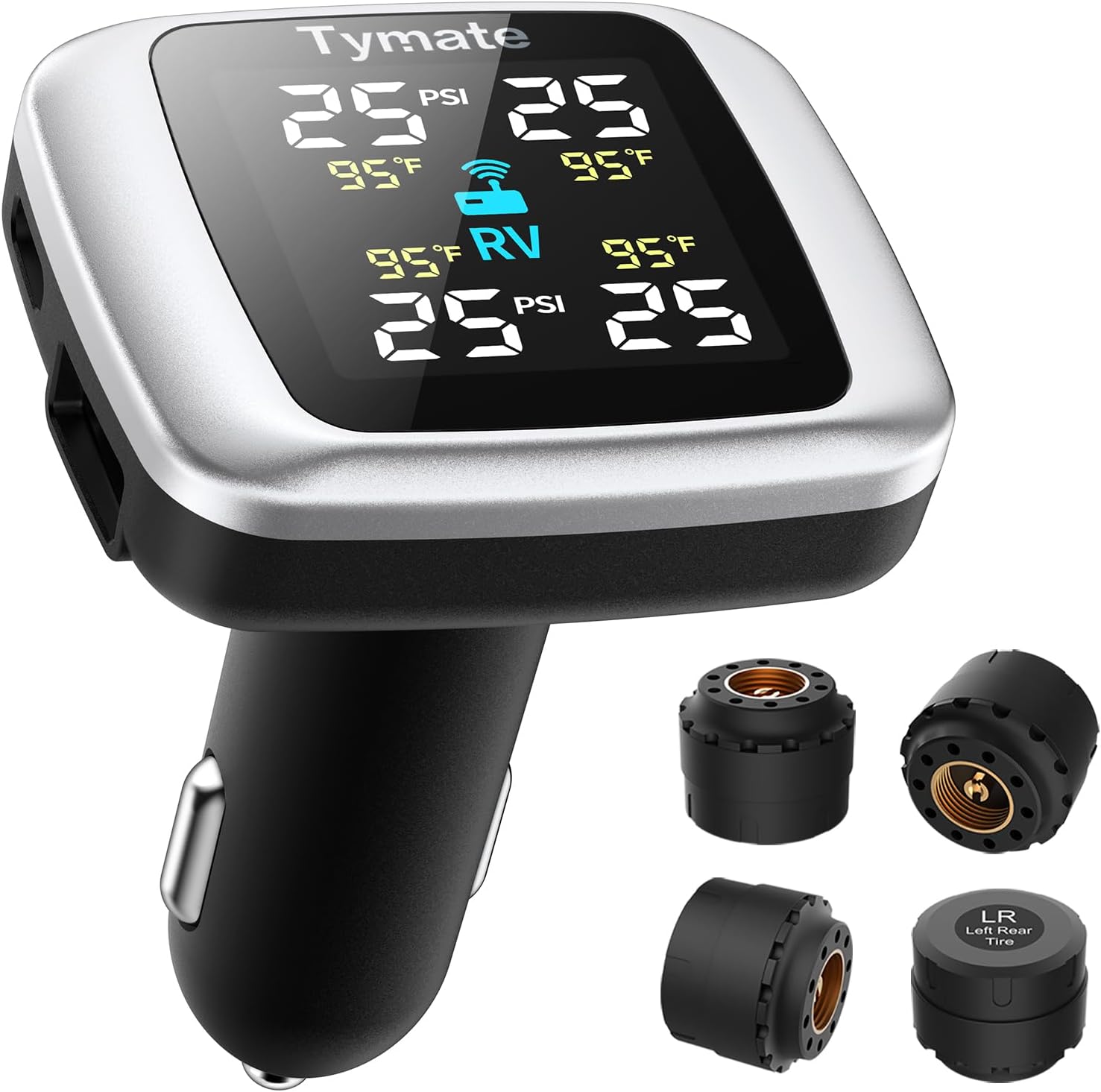
Tymate TM7 is a wireless tire pressure monitoring system that delivers real-time pressure and temperature readings for safer driving. It includes four external sensors, a bright color LCD display with adjustable backlight, and six alarm modes for high/low pressure, fast leakage, high temperature, and sensor signal or battery issues. The system covers a wide 0–144 PSI range and plugs into your vehicle’s cigarette lighter socket for quick DIY setup.

ETENWOLF T300 is a calibrated digital tire pressure gauge for accurate readings from 3 to 200 PSI across light and heavy-duty vehicles. It includes thermal compensation for reliable performance in extreme cold or heat, with an auto shut-off to extend battery life and an LED for easier reading. The sturdy design supports rugged everyday use, making it ideal for pickups, RVs, and industrial applications.
A concentrated tire and tube mounting compound designed to help simplify mounting rubber tires and tubes on passenger, semi truck, construction, and OTR applications. Its ultra-thick formula packs beads effectively and includes rust inhibitors to help protect against corrosion during use.
3PMSF vs. M+S
The Three-Peak Mountain Snowflake, or 3PMSF, symbol identifies a tire that has met a standardized snow-traction performance requirement. The test relates to traction on medium-packed snow.
The symbol should not be interpreted as proof of superior braking or grip on ice. Ice performance is a separate characteristic.
M+S, M/S, or similar Mud and Snow markings are based on tread-design criteria and do not represent the same standardized snow-performance test as 3PMSF. That is why a tire can carry M+S without qualifying for 3PMSF.
OE Markings
OE markings identify tire versions developed or approved for particular vehicle manufacturers or applications. There is no single universal OE symbol.
Examples include * for certain BMW-approved Michelin tires, MO for Mercedes-Benz applications, AO for Audi, and markings such as N0, N1, or other N-series codes for Porsche applications. Exact codes can vary by tire manufacturer, vehicle maker, and tire generation.
When your vehicle was originally equipped with an OE-marked tire, check the vehicle manufacturer’s replacement guidance before changing to a different specification.
Run-Flat and Other Special Markings
Run-flat technology does not use one universal sidewall abbreviation. Different manufacturers use their own markings. For example, Michelin uses ZP on some Zero Pressure run-flat tires.
You may also see markings for low-rolling-resistance technology, acoustic treatments, electric-vehicle applications, self-sealing designs, or other manufacturer-specific features. Check the tire maker’s documentation when a symbol or abbreviation is unfamiliar.
Read Directional and Asymmetrical Tire Marks
Directional and asymmetrical tires rely on sidewall markings to tell the installer how the tread must face.
- Directional tires: look for a rotation arrow and wording such as “ROTATION.” The arrow must point in the tire’s forward direction of rotation when the vehicle moves ahead.
- Asymmetrical tires: look for “OUTSIDE” and sometimes “INSIDE.” The side marked Outside must face away from the vehicle.
- Tires using both features: follow both the rotation direction and the inside/outside requirement.
Mounting a tire contrary to its required orientation can prevent the tread from performing as its manufacturer intended. Have directional or asymmetrical tires mounted by a qualified tire professional when you are unsure.
Match Tire Sidewall Markings to Your Vehicle
To match a tire to your vehicle, do not rely on a single sidewall number. Start with the vehicle tire placard and compare all important parts of the specification.
- Size: compare the width, aspect ratio, construction, and rim-diameter designation.
- Load capacity: make sure the replacement meets the vehicle manufacturer’s load-index or load-capacity requirement.
- Speed rating: meet the vehicle manufacturer’s required speed specification unless the manufacturer provides a specific exception, such as certain winter-tire applications.
- Load category: check SL, XL, LT, load range, or other applicable markings.
- Pressure: use the vehicle’s specified cold pressure rather than assuming the sidewall maximum is the correct setting.
- Special fitment: check OE codes, run-flat requirements, directional arrows, and Inside/Outside markings.
- Age and condition: check the TIN date, tread depth, cracks, bulges, cuts, uneven wear, and other visible damage.
Use the vehicle placard as your starting specification; use the tire sidewall to confirm that the tire can meet it.
Wheel clearance, suspension geometry, ABS, stability-control calibration, speedometer accuracy, and load capacity can also be affected when you change tire size. If you are considering a different size instead of a direct replacement, confirm the change with the vehicle manufacturer or a qualified tire professional.
Frequently Asked Questions
How do you read tire sidewall markings?
Start with the tire-size code, then read the load index and speed rating after it. Next, find the DOT/TIN date code, maximum load and pressure, UTQG grades if present, and any M+S, 3PMSF, OE, run-flat, rotation, or Outside/Inside markings. Compare the result with your vehicle placard.
What’s written on the sidewall of a tire?
Depending on the tire and market, the sidewall can show the brand and model, tire size, load index, speed rating, DOT Tire Identification Number, manufacturing date, maximum load, maximum permissible pressure, UTQG grades, construction materials, tubeless marking, winter symbols, and installation or OE markings.
What do the symbols on my tires mean?
Different symbols identify different features. R describes radial construction, a number such as 95 is a load index, a letter such as H is a speed rating, 3PMSF identifies tested snow-traction performance, M+S describes a mud-and-snow tread designation, and arrows or Outside/Inside wording control installation orientation.
What are the three types of tire marks?
There is no official system that limits tire markings to three types. For a simple explanation, you can group them into size and construction markings, service and capacity markings such as load and speed ratings, and compliance or special-use markings such as DOT/TIN, UTQG, winter, OE, and installation symbols.
Is the PSI on the tire sidewall the pressure I should use?
Usually, no. The PSI molded on the tire is the tire’s maximum permissible inflation pressure. For normal driving, use the vehicle manufacturer’s recommended cold pressure on the tire-and-loading placard or in the owner’s manual.
Conclusion
You can read tire sidewall markings confidently once you separate them into a few groups: size and construction, load and speed capability, DOT/TIN and date information, pressure and load limits, UTQG grades, and special-use markings.
The most important safety rule is to read those markings together with your vehicle’s specifications. A sidewall maximum is not automatically your recommended pressure, a speed rating is not a suggested driving speed, and a 3PMSF symbol does not certify ice grip. Before buying or mounting a replacement tire, compare its complete specification with the vehicle placard and manufacturer guidance.
Sources
- National Highway Traffic Safety Administration — TireWise — tire pressure, tread depth, tire age, DOT/TIN date-code, and safety guidance.
- NHTSA — Consumer Guide to Uniform Tire Quality Grading — treadwear, traction, temperature, and UTQG limitations.
- NHTSA — Report to Congress on Tire Identification Systems — standardized 13-character Tire Identification Number structure and implementation schedule.
- Tire Industry Association — Reading a Tire Sidewall — tire dimensions, construction, service description, load index, and speed symbol.
- Michelin USA — Tire Markings Explained — DOT date codes, M+S, 3PMSF, tire-age guidance, and common sidewall markings.
- Yokohama Tire — Passenger Tire Sidewall Branding — tubeless, ply materials, maximum load, pressure, construction, rotation, and compliance markings.