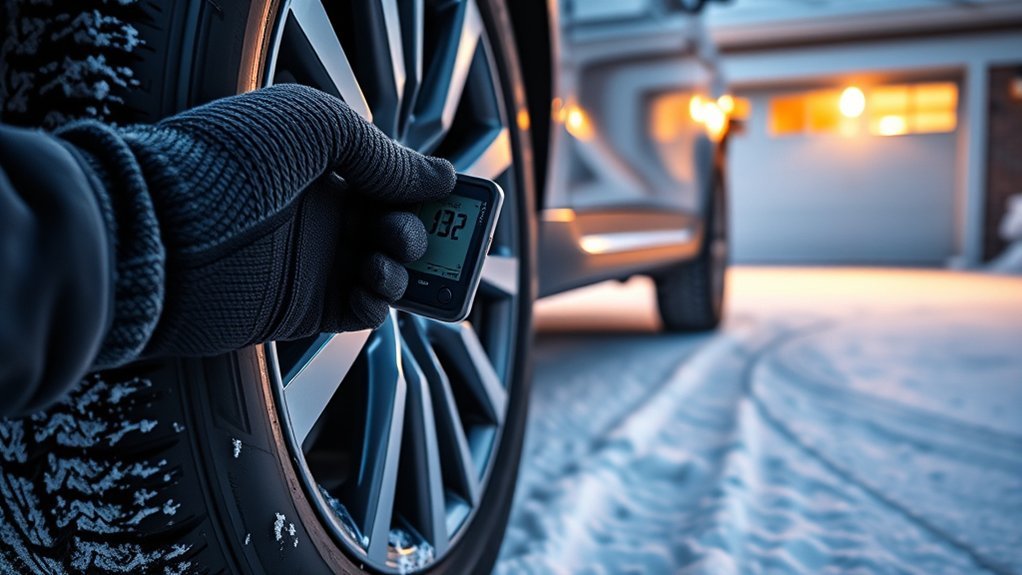
In winter, keep your tire pressure at the vehicle manufacturer’s recommended cold PSI, usually shown on the Tire and Loading Information label on the driver’s door jamb or in the owner’s manual. Cold weather can lower the pressure even when there is no leak, so check your tires regularly, especially after a major temperature drop. Correct inflation supports predictable steering, braking, tire wear, fuel efficiency, and winter safety.
Quick Answer
Your winter tire pressure should normally match the vehicle manufacturer’s recommended cold PSI. Check the driver’s door-jamb placard or owner’s manual rather than the maximum pressure printed on the tire. Because pressure commonly drops as temperatures fall, check it cold at least monthly and after major cold snaps.
Key Takeaways
- Use the vehicle manufacturer’s recommended cold tire pressure, not the tire sidewall’s maximum PSI.
- A temperature drop of about 10°F can lower tire pressure by roughly 1 PSI, although the exact change varies.
- For a reliable reading, check the tires before driving after the vehicle has been parked for at least about three hours.
- Do not bleed a warm tire down to the cold-pressure specification; driving naturally raises tire pressure.
- Check pressure at least monthly, before long trips, and after major temperature changes.
- A TPMS warning is useful, but it does not replace checking the tires with an accurate gauge.
At a Glance
| Time Required | About 5–10 minutes for four tires |
| Difficulty | Easy |
| Tools Needed | Reliable tire-pressure gauge; air compressor or inflator if pressure is low |
| Cost | No added cost if you already have a gauge and access to an inflator; equipment prices vary |
What Should Tire Pressure Be in Winter?
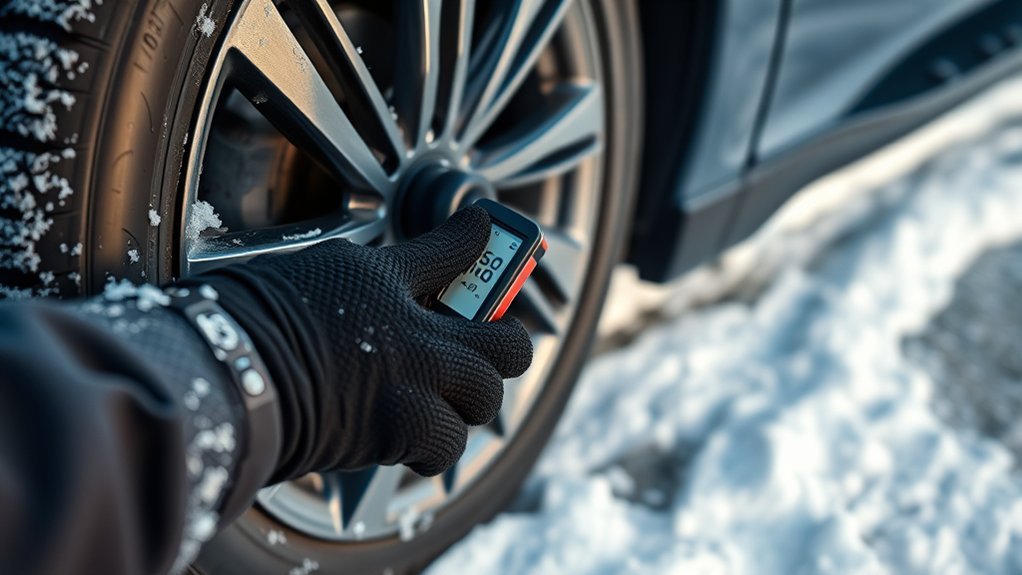
In winter, your tire pressure should normally match the vehicle manufacturer’s recommended cold PSI. There is not one universal winter pressure that works for every car, SUV, truck, or tire.
Check the Tire and Loading Information label, which is commonly located on the driver’s door jamb. The owner’s manual may also list normal-load, full-load, high-speed, or other vehicle-specific pressure recommendations.
The National Highway Traffic Safety Administration advises using the vehicle manufacturer’s recommended cold inflation pressure rather than the pressure molded into the tire sidewall.
A 30°F temperature drop can reduce tire pressure by roughly 3 PSI, based on the common rule of about 1 PSI for every 10°F decrease.
Front and rear tire pressures are not always identical. If your placard gives different front and rear values, follow those separate specifications instead of making all four tires equal.
Warning: Do not use the maximum PSI printed on the tire sidewall as your normal inflation target unless the vehicle manufacturer specifically calls for that pressure. The sidewall number describes a tire limit, while the vehicle placard gives the operating pressure selected for that vehicle.
If you installed a different winter wheel or tire size instead of the original-equipment size, do not automatically assume the original pressure is suitable in every case. Follow vehicle-manufacturer guidance for the approved alternate setup or consult a qualified tire professional.
Why Cold Weather Lowers Tire Pressure
As the air inside a tire gets colder, its pressure falls. This can make a properly inflated tire in mild weather read several PSI lower after a strong winter temperature drop even when no air has leaked through a puncture.
This temperature effect is normal, but the lower reading should not be ignored. If the tire is below the vehicle’s specified cold pressure at the temperature in which you are using the vehicle, add air until it reaches the correct specification.
Air Contracts In Cold
A simple way to understand the change is that cooler gas molecules move with less energy and exert less pressure against the inside of the tire. The tire’s volume does not need to change dramatically for the gauge reading to fall.
That is why winter weather can leave a tire underinflated even when it was correct a few weeks earlier.
- Let the tires reach a cold, stable temperature.
- Measure the pressure with a reliable gauge.
- Compare each reading with the vehicle’s specified cold PSI.
- Add air if the reading is below specification.
Do not judge pressure only by appearance. Modern radial tires may look normal even when their pressure is too low.
Pressure Drops As Temperature Falls
As a practical rule, tire pressure changes by roughly 1 PSI for every 10°F change in temperature. Michelin’s winter guidance uses this approximation to explain why seasonal pressure loss becomes noticeable.
For example, if the temperature falls from 60°F to 20°F, a tire may read around 4 PSI lower solely from the temperature change. The exact result can vary with the tire, starting pressure, and conditions, so use the rule as an estimate rather than a substitute for measuring.
A temperature-related pressure decrease still needs correction. The recommended cold PSI is the pressure the vehicle needs at its current cold operating temperature.
Low Temperatures Affect Tire PSI
Winter pressure can also seem confusing when a vehicle is stored in a heated garage. Tires checked in a 60°F garage may show a higher reading than they do after sitting outside in 20°F weather.
Pro Tip: If your garage is much warmer than the outdoor temperature, the most straightforward method is to check the tires after they have had time to equalize near the temperature in which the vehicle will be driven. If your owner’s manual gives a specific cold-weather correction, follow that vehicle-specific guidance.
Large overnight temperature drops can therefore produce lower morning readings. The change happens because the temperature is lower, not because nighttime itself has a special effect on tire pressure.
How to Check Tire Pressure in Winter
Check tire pressure before driving, ideally after the vehicle has been parked for at least about three hours. NHTSA uses this parked period as its practical definition of a cold tire for pressure checks.
You will need a reliable tire-pressure gauge and, if a tire is low, access to an air compressor or portable inflator.
[Products Worth Considering]

Milton S-921 pencil tire pressure gauge helps you maintain optimal tire pressure for passenger cars with accurate readings in PSI and kPa. It features a built-in deflator valve for convenient pressure adjustments, plus a single chuck head and nylon indicator bar for easy use on the go. Built from durable plated brass and designed for reliable performance, it’s a practical road trip and cold-weather maintenance tool.

ETENWOLF’s tire pressure gauge helps you quickly and accurately check tire PSI across cars, trucks, motorcycles, bikes, and more. It’s manually calibrated to ANSI B40.1 Grade A for reliable readings, includes a large glow dial for easy nighttime viewing, and features a 360-degree swivel chuck for use at any valve angle. The gauge also works consistently in extreme hot or cold weather.

The JACO FlowPro Tire Inflator measures, inflates, and airs down tires up to 100 PSI with battery-free operation and ±2% accuracy after calibration. It features a glowing pressure dial for night visibility, a heavy-duty steel build with a hybrid hose, and a precision push-to-inflate thumb trigger. The patented Lightning Air Chuck locks on for a secure seal, and the kit includes quick-connect hardware for easy inline use with your air compressor.
Check When Tires Are Cold
Driving warms the tires and temporarily increases pressure. Measuring after a commute can therefore give you a reading several PSI higher than the true cold reading.
- Park the vehicle and allow the tires to become cold.
- Find the recommended front and rear cold PSI on the door-jamb placard or in the owner’s manual.
- Remove the valve cap from the first tire.
- Press the gauge squarely onto the valve stem until you get a stable reading.
- Compare the result with the correct specification for that axle.
- Add air if pressure is low or release a small amount if the tire is genuinely overinflated while cold.
- Recheck the pressure after every adjustment.
- Replace the valve cap and repeat for the remaining tires.
Warning: Do not bleed a warm tire down to the cold placard pressure. Driving normally raises pressure. If you reduce a properly inflated warm tire to the cold target, it can become underinflated when it cools. If you must add air while the tire is warm, recheck and adjust it again when the tire is cold.
Use A Reliable Gauge
A dependable gauge is more useful than trying to estimate pressure by looking at the tire. Digital and good-quality analog gauges can both work well if they produce stable, repeatable readings.
| Check | Why it matters |
|---|---|
| Readability | Reduces reading mistakes |
| Seal fit | Limits air leakage while measuring |
| Valve contact | Helps produce a stable reading |
| Correct units | Lets you compare PSI or kPa correctly |
| Repeatability | Helps identify a gauge that gives inconsistent results |
If two immediate readings from the same tire differ substantially, reseat the gauge and try again. Replace a damaged or inconsistent gauge rather than guessing.
Recheck After Pressure Drop
If a cold snap lowers your readings, adjust the tires to the specified cold pressure and check them again later. A one-time seasonal decrease across several tires is different from one tire repeatedly losing pressure faster than the others.
- Measure all four road tires when cold.
- Correct each one to its specified pressure.
- Record the readings if you are troubleshooting a recurring problem.
- Recheck after several days or after another major temperature change.
If one tire repeatedly loses pressure, inspect it for a puncture, damaged valve stem, valve-core leak, bead leak, or wheel damage. A continuing loss should be inspected by a qualified tire service professional rather than blamed on winter weather.
How to Adjust Tire Pressure for Cold Weather
Adjust winter tire pressure by measuring the tires cold and adding enough air to reach the manufacturer’s specified pressure. Do not simply add a fixed number of PSI to every tire because winter has arrived.
| Step | Action | Result |
|---|---|---|
| 1 | Verify the placard or owner’s-manual specification | Establishes the correct target |
| 2 | Measure each tire cold | Provides an accurate baseline |
| 3 | Add air in small increments | Helps prevent overshooting the target |
| 4 | Recheck front and rear tires separately | Confirms each axle matches its specification |
If the pressure is slightly above specification when the tire is genuinely cold, release air in short bursts and remeasure. If the tire is warm from driving, wait for a cold reading before deciding that it contains too much air.
Also check any manufacturer instructions for heavy loads or sustained high-speed driving. Some vehicles specify different pressures for certain operating conditions.
Note: A compact spare may require a very different pressure from the four road tires. Check the spare’s own specification on the vehicle placard or in the owner’s manual instead of assuming it uses the same PSI.
[Products Worth Considering]

AstroAI’s heavy-duty digital tire pressure gauge delivers quick, accurate readings with 0.1 increments and a secure valve-stem seal. It features a green backlit LCD and built-in flashlight for easy use in low light, plus an ergonomic non-slip stainless-steel design. The wide 0–230 PSI range works across common vehicle tires, with unit selection and an auto shut-off to save battery.
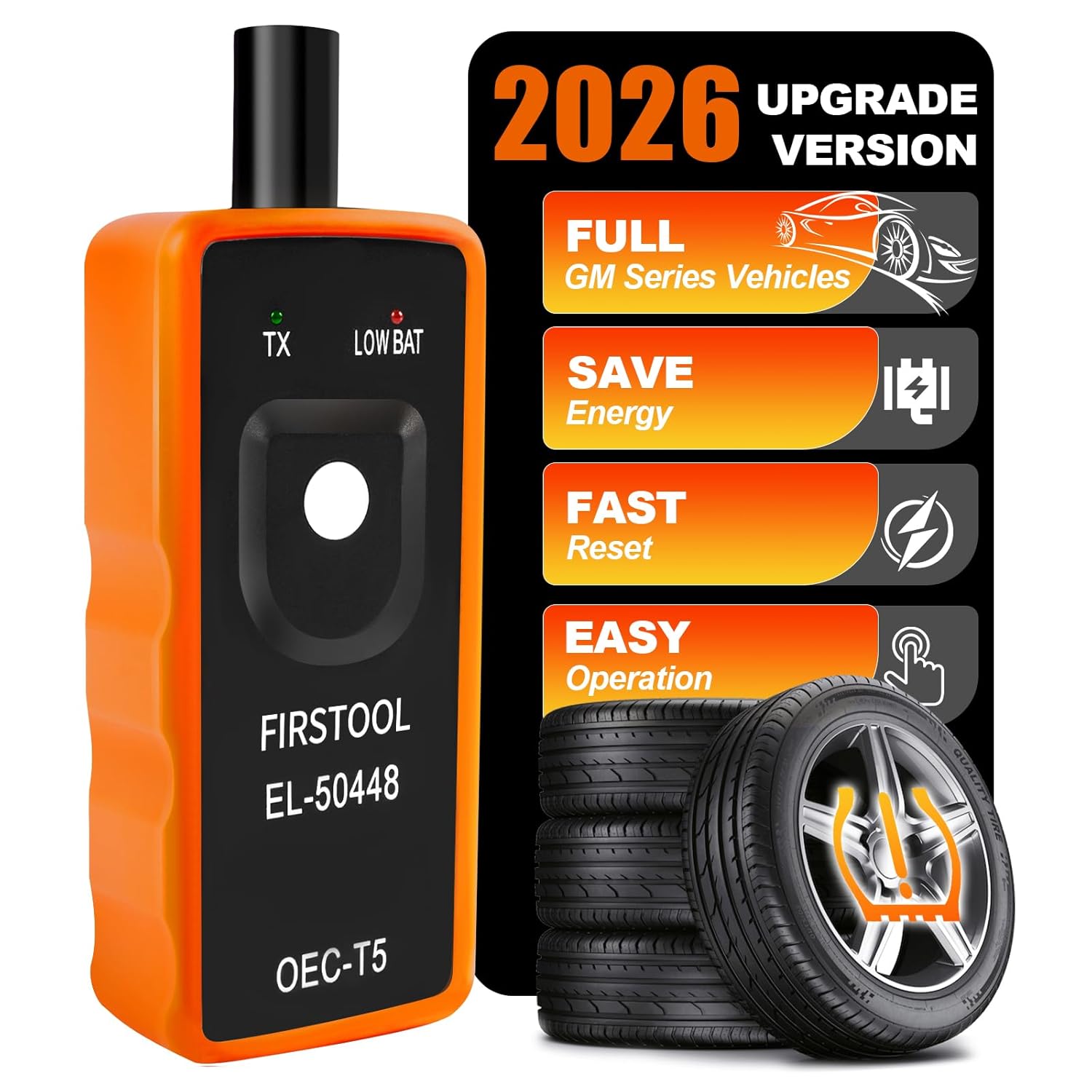
This TPMS relearn tool helps you quickly activate, match, and reset GM tire pressure sensors to keep the vehicle monitoring system working properly. It clears tire pressure alarms and dashboard warning lights after sensor replacement or tire rotation, and supports learning for common 315/433 MHz TPMS sensors. Designed for simple one-button operation, it can help you avoid unnecessary trips to repair shops.

Monitor tire tread wear with a smart, color-coded depth gauge that shows clear condition ranges at a glance. The bar is range marked for fast, easy readings, helping you maintain safer traction and performance. Each gauge is portable with a pocket clip, and the set includes 20 units for daily use and sharing.
Signs Your Tires Are Underinflated
The most reliable sign of underinflation is a gauge reading below the vehicle manufacturer’s specified cold pressure. A TPMS warning light can also alert you to significant pressure loss, but you should not wait for the light before checking your tires.
NHTSA explains that TPMS is a warning system and still recommends regular manual pressure checks. A tire can be below its ideal pressure before the warning threshold is reached.
- Gauge reading below specification: This is the clearest confirmation that air needs to be added.
- TPMS warning light: A cold morning may trigger the warning because the tire’s actual pressure has fallen.
- Sluggish or less precise steering: Significant underinflation can change vehicle response.
- Shoulder-heavy tread wear: Long-term underinflation can contribute to abnormal wear patterns.
- Reduced fuel efficiency: Low pressure increases rolling resistance and may increase fuel consumption.
- Visible sag: Severe pressure loss may make a tire look unusually low, but appearance alone is not a reliable pressure test.
If your TPMS light appears on a freezing morning and later turns off as the tires warm, do not assume the problem has disappeared. Check the tires cold and restore them to the placard specification if needed.
[Products Worth Considering]

This tire inflator with pressure gauge delivers long-lasting performance with a durable rubber-protected gauge and sturdy build. The longer hose and 360 swivel air chuck help you seal the valve securely and keep your hands free while measuring, inflating, or deflating. It’s battery-free for reliable use and provides ±2 PSI accuracy in the mid-range for most typical tires, with universal compatibility for 1/4 NPT compressor outputs.

The Topeak SmartGauge D2 delivers precise digital tire pressure readings for bikes, motorcycles, and sports equipment up to 250 psi (17 bar). Its rotating SmartHead works with both Presta and Schrader valves, so you can check pressure quickly without adapters. The LCD display makes it easy to read results in psi, bar, or kg/cm² with an included CR2032 battery for immediate use.
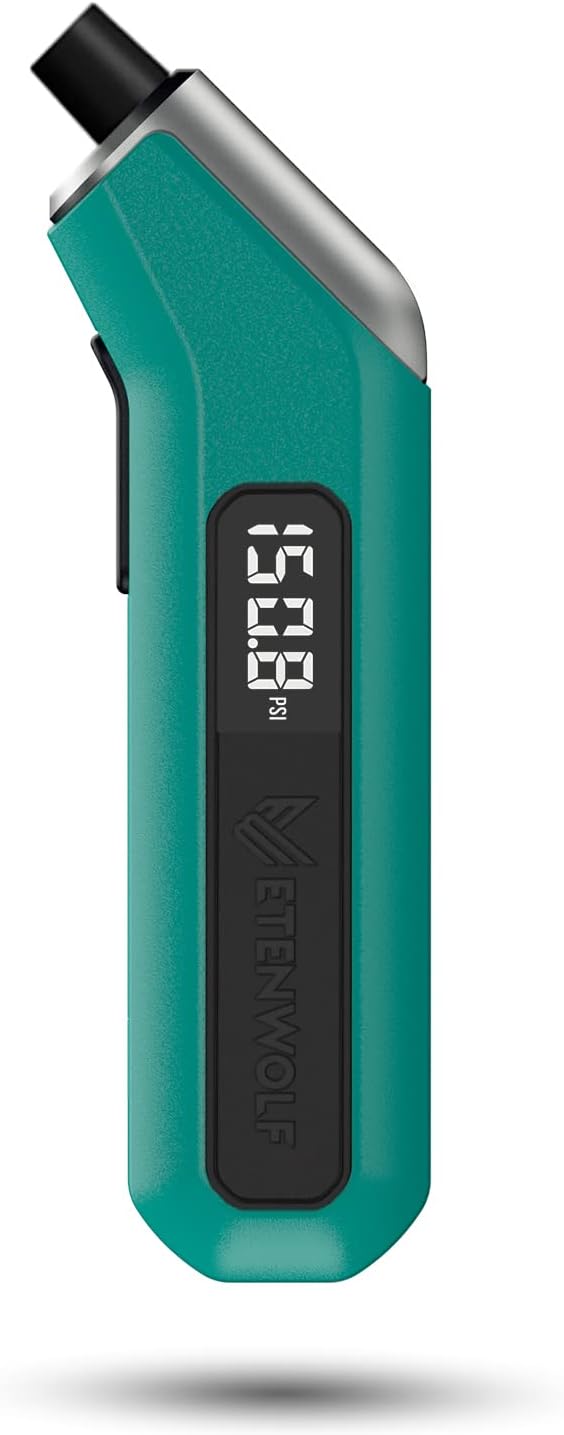
ETENWOLF T300 is a calibrated digital tire pressure gauge designed for reliable readings across low and high pressure ranges. It includes thermal compensation for stable performance in extreme cold or heat, an LED light for visibility, and an auto shut-off to help preserve battery life. Ideal for pickups, RVs, and heavy-duty vehicles, it delivers accurate PSI measurements with sturdy durability.
How to Maintain Tire Pressure in Winter
Check tire pressure at least once a month and before long trips, following NHTSA tire-maintenance guidance. Winter temperature swings make additional checks worthwhile after strong cold fronts.
Measure the tires when cold, compare the front and rear readings with the vehicle placard, and make small adjustments as needed. Keep valve caps installed to help keep dirt and moisture away from the valve area.
Include the spare tire in your maintenance routine and use the spare pressure specified by the vehicle manufacturer. Its required pressure may be substantially different from the road tires.
Do not treat every winter pressure loss as normal temperature change. If one tire drops repeatedly while the others remain stable, have it checked for a puncture, valve problem, bead leak, or wheel damage.
Consistent pressure checks help maintain predictable handling, proper load support, tread life, and fuel efficiency throughout winter.
Frequently Asked Questions
Should I Inflate Winter Tires Differently Than All-Season Tires?
No, not simply because they are winter tires. For an approved equivalent fitment, use the vehicle manufacturer’s recommended cold pressure. If your winter setup uses a different tire size, load range, or wheel package, follow the vehicle or tire manufacturer’s guidance for that approved configuration.
Does Tire Pressure Change More at Night in Winter?
Tire pressure changes with temperature, not because it is nighttime. Winter mornings often produce lower readings because overnight temperatures are lower. A large overnight temperature drop can therefore make the pressure noticeably lower by morning.
Can Overinflated Tires Be Dangerous in Cold Weather?
Yes. Both overinflation and underinflation can affect tire performance, ride, wear, and handling. Measure the tires cold and use the vehicle manufacturer’s specified pressure rather than intentionally overinflating them for snow or ice unless the manufacturer gives different instructions for your operating conditions.
Do Tire Pressure Sensors Work Accurately in Freezing Temperatures?
Cold weather does not automatically mean a TPMS warning is false. The tire’s actual pressure may have fallen enough to trigger the warning. Treat the light as a reason to check all tires manually with a reliable gauge. TPMS is a warning system and does not replace routine pressure checks.
Should Spare Tires Be Checked During Winter Too?
Yes. Check the spare as part of your tire-maintenance routine and follow its specific pressure requirement. Compact temporary spares often use a different pressure from the four road tires, so verify the number on the vehicle placard or in the owner’s manual.
Should I Add Extra PSI Before a Winter Cold Snap?
Do not add an arbitrary amount just because cold weather is coming. Check the tires at their cold temperature and adjust them to the vehicle’s recommended pressure. Because colder temperatures lower the reading, you may need to add air after the temperature drops to keep the tires at specification.
What If I Can Only Check Tire Pressure After Driving?
Do not release air simply because the warm reading is above the cold placard number. Driving naturally increases pressure. If a warm tire is clearly low, add enough air to avoid driving significantly underinflated, then check and make the final adjustment after the tires have cooled.
Why Does My TPMS Light Turn On During a Cold Morning and Go Off Later?
Cold temperatures lower the tire’s pressure, which may trigger the TPMS warning. Driving warms the tire and can raise the pressure enough for the warning to disappear. You should still check the tires cold because warming does not add air or correct an underinflated cold setting.
Conclusion
In winter, keep your tire pressure at the vehicle manufacturer’s recommended cold PSI rather than the maximum number molded into the tire sidewall. Expect pressure to fall as temperatures drop, with roughly 1 PSI of change for each 10°F temperature change being a useful rule of thumb. Check the tires cold at least monthly, do not bleed normal warm-pressure buildup, and investigate any tire that repeatedly loses pressure. These simple habits help protect tire life, fuel efficiency, steering response, and winter driving safety.
Sources
- National Highway Traffic Safety Administration — TireWise — recommended cold pressure, monthly pressure checks, TPMS limitations, and tire-maintenance guidance.
- National Highway Traffic Safety Administration — Winter Driving Tips — cold-weather tire pressure and manufacturer placard guidance.
- Michelin — Preparing for Winter — approximate 1 PSI pressure change for each 10°F decrease in temperature.
- Michelin — How to Properly Inflate Your Car Tires — cold versus warm pressure checks and avoiding warm-tire deflation.
- Continental Tires — Tire Pressure — manufacturer-recommended pressure, sidewall maximum pressure, and temperature effects.