
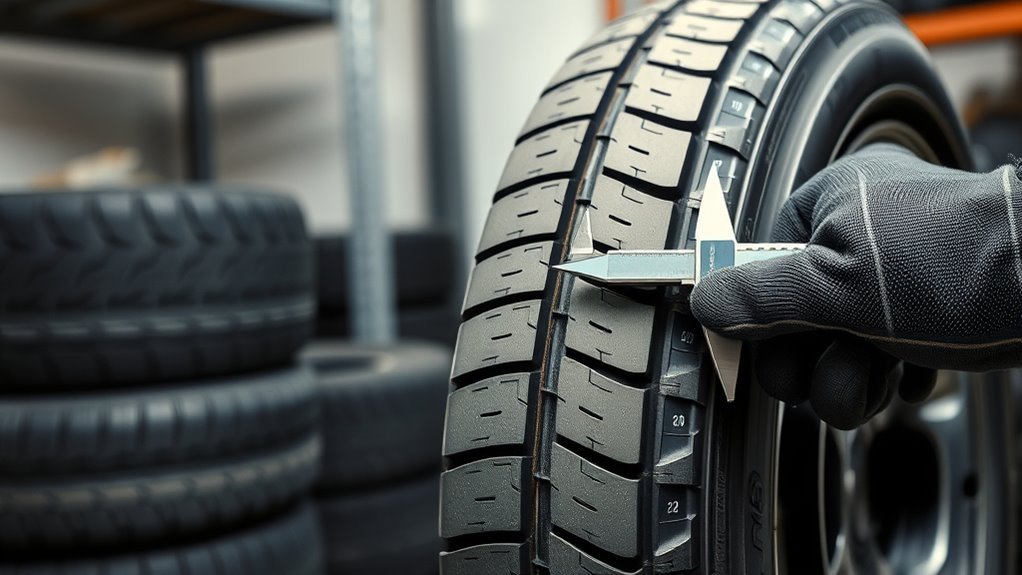
The tire load index is the two- or three-digit number in a tire’s service description that maps to the maximum load one tire can carry under specified conditions. For replacement tires, match or exceed the vehicle manufacturer’s required load rating, then use the vehicle placard or owner’s manual to confirm the approved tire size and cold inflation pressure. A higher tire load index does not increase the vehicle’s payload, GVWR, GAWR, or towing limit.
Last updated: August 18, 2026 — safety guidance and load-index examples rechecked against current NHTSA and tire-manufacturer references.
Quick Answer
A tire load index is the number immediately before the speed-rating letter, such as the 95 in 215/60R16 95H. It maps to a standardized maximum load per tire. For example, load index 94 equals 1,477 lb / 670 kg. Use the index to verify tire capacity, but use the vehicle placard and manufacturer limits to determine what the vehicle itself may safely carry.
Key Takeaways
- The load index is a coded number that converts to a specific weight capacity per tire.
- Replacement tires should meet or exceed the vehicle manufacturer’s required load rating. Start with the tire placard and owner’s manual, then verify the approved tire’s full service description and load index.
- Load index is not the same as load range, speed rating, GVWR, or GAWR.
- Load capacity and inflation pressure work together. For normal use, follow the vehicle manufacturer’s recommended cold pressure unless a different approved fitment instruction applies.
- Do not use a lower load index unless the vehicle manufacturer or a qualified tire professional confirms the fitment is safe.
At a Glance
| Time Required | 3–5 minutes to read the sidewall and check the chart |
| Difficulty | Easy |
| Tools Needed | Tire sidewall, vehicle placard or owner’s manual, tire load index chart, tire pressure gauge |
| Cost | Free to check |
What Does the Tire Load Index Mean?
The tire load index is an assigned number that shows the maximum weight one tire can support under its specified load-and-inflation conditions. The higher the index, the higher the charted load capacity.
You will usually find the load index in the tire’s service description, immediately after the tire size. In the example 215/60R16 95H, the load index is 95, and the speed rating is H. The load index tells you weight capacity; the speed rating tells you the tire’s tested speed capability under specified conditions. If you need to decode the rest of the sidewall code, see this guide to tire dimensions and tire-size markings.
A load index is useful because tire sizes alone do not tell the whole story. Two tires can look similar, fit the same wheel, and still have different load capacities. That is why you should compare the load index before buying replacement tires.
Warning: Never choose a tire with a lower load index than your vehicle’s original specification just because it fits the wheel. An underspecified tire can overheat, wear faster, handle poorly, or fail under load.
How to Read Load Index Numbers With a Load Chart
Reading a tire load index takes three steps: find the number on the sidewall, look it up on a load index chart, then compare it with your vehicle’s required tire specification. For U.S. passenger tires, the sidewall also lists the tire’s maximum load in pounds, but the chart makes it easier to compare different sizes and indexes.
- Find the tire size: Look for a code such as 225/50R17 94V.
- Identify the load index: In that example, 94 is the load index.
- Convert the number: Load index 94 equals 1,477 lb / 670 kg per tire.
- Compare with the vehicle specification: Check the tire placard, usually on the driver’s doorjamb, for the approved tire size and cold pressure. Use the owner’s manual or vehicle-manufacturer fitment information to confirm the required load rating or service description when it is not stated separately on the placard.
Note: Multiplying the per-tire capacity by four does not tell you how much cargo you can add to the vehicle. Your real limit is still controlled by the vehicle’s placard, payload rating, GVWR, GAWR, wheels, suspension, brakes, and towing limits.
Common Tire Load Index Chart
The table below covers many passenger, SUV, crossover, and light-truck tire indexes. Always confirm the final fitment against your vehicle placard and tire manufacturer’s data.
| Load Index | Max Load | Load Index | Max Load |
|---|---|---|---|
| 75 | 853 lb / 387 kg | 101 | 1,819 lb / 825 kg |
| 80 | 992 lb / 450 kg | 102 | 1,874 lb / 850 kg |
| 85 | 1,135 lb / 515 kg | 103 | 1,929 lb / 875 kg |
| 88 | 1,235 lb / 560 kg | 104 | 1,984 lb / 900 kg |
| 89 | 1,279 lb / 580 kg | 105 | 2,039 lb / 925 kg |
| 90 | 1,323 lb / 600 kg | 106 | 2,094 lb / 950 kg |
| 91 | 1,356 lb / 615 kg | 107 | 2,149 lb / 975 kg |
| 92 | 1,389 lb / 630 kg | 108 | 2,205 lb / 1,000 kg |
| 93 | 1,433 lb / 650 kg | 109 | 2,271 lb / 1,030 kg |
| 94 | 1,477 lb / 670 kg | 110 | 2,337 lb / 1,060 kg |
| 95 | 1,521 lb / 690 kg | 112 | 2,469 lb / 1,120 kg |
| 96 | 1,565 lb / 710 kg | 114 | 2,601 lb / 1,180 kg |
| 97 | 1,609 lb / 730 kg | 116 | 2,756 lb / 1,250 kg |
| 98 | 1,653 lb / 750 kg | 118 | 2,910 lb / 1,320 kg |
| 99 | 1,709 lb / 775 kg | 120 | 3,086 lb / 1,400 kg |
| 100 | 1,764 lb / 800 kg | 123 | 3,417 lb / 1,550 kg |
Chart note: Pound equivalents can differ slightly between manufacturer charts because of rounding conventions. For final fitment, use the current load-and-inflation data from the tire manufacturer.
Load index 94 does not mean 94 pounds or 94 psi. It means the tire is rated for 1,477 pounds of load when used and inflated as specified.
Tire Load Index vs Load Range vs GVWR: Which Matters for Your Vehicle?
Load index, load range, GVWR, and GAWR all matter, but they answer different questions. The safest approach is to follow the vehicle manufacturer’s tire specification first, then confirm any changes with a qualified tire professional.
| Term | What It Means | Why It Matters |
|---|---|---|
| Load Index | Number that converts to maximum load per tire. | Shows whether the tire can carry the required weight. |
| Load Range / Load Designation | Passenger tires may use designations such as SL or XL, while LT tires commonly use Load Range letters such as C, D, or E. | These markings relate to the tire’s load-and-inflation category and construction; they are not a direct count of physical plies. |
| GVWR | Gross Vehicle Weight Rating: the maximum allowed weight of the loaded vehicle. | Limits total vehicle weight, including passengers, cargo, fluids, and tongue weight. |
| GAWR | Gross Axle Weight Rating: the maximum allowed weight on each axle. | Important because front and rear axle loads are not always evenly split. |
| Tire Placard | Vehicle label listing approved tire size, recommended cold pressure, seating capacity, and vehicle-loading information. | Use it first for approved tire size and cold pressure, then confirm any remaining service-rating details in the owner’s manual or manufacturer fitment data. |
Load range is often misunderstood. Older “ply rating” language does not mean a modern tire literally has that many body plies. In LT applications, a Load Range E tire is commonly described as “10-ply rated,” but that is an equivalent strength category rather than a statement that the tire contains ten physical plies. Use the tire manufacturer’s load-and-inflation data instead of relying on ply-count shorthand alone.
Pro Tip: When changing tire size, tire type, or wheel size, compare the new tire’s load index, load range, speed rating, approved rim width, and inflation requirements—not just the outside diameter.
[Products Worth Considering]

The 22800 wheel stud installer makes replacing wheel studs quick and secure, saving time and effort during tire service. It uses a ratchet or impact wrench to pull new studs firmly into place, helping when existing studs are too long. Compatible with most automotive wheels and light-duty truck wheel studs, it’s designed for easy, tool-assisted installation.

The ETENWOLF T600 digital tire pressure gauge delivers precise, manually calibrated readings to ANSI B40.7 Grade 2A standards with ±0.5% PSI accuracy. Its 360° rotating nozzle and display hold make it easy to check pressures from any angle, while a bleed button helps dial tires to the perfect level. With a 0–250 PSI range and support for PSI, BAR, and KPA, it’s a convenient tool for maintaining tire performance across many vehicles and seasons.
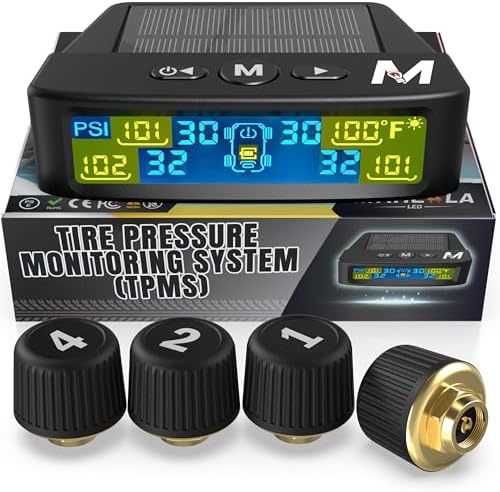
Marcala’s TPMS set of four sensors helps you monitor tire pressure and temperature in real time while driving, with updates every second. The bright color LCD uses auto-dimming for easy viewing, powered by dual solar and USB charging, and offers six alarm modes. Built for trailers, RVs, campers, trucks, and towing setups, the sensors support monitoring 1-4 wheels up to 98 PSI with IP67 waterproof protection.
When to Choose a Higher Tire Load Index and When Not To
A higher tire load index may be used in many replacement situations when the tire still meets the approved size, wheel, and inflation requirements. It does not raise the vehicle’s payload, GVWR, GAWR, or towing limit. Michelin’s current replacement guidance likewise notes that a higher load rating may be installed while the vehicle’s maximum allowable load remains limited by axle ratings and manufacturer specifications.
[Products Worth Considering]

The TYAMATE TM8 solar-powered wireless TPMS delivers real-time tire pressure and temperature monitoring with six alarm modes for safer driving. A vibrant color LCD display shows readings clearly while windshield mounting keeps it hands-free and easy to read. With a wide 0–87 PSI range, strong 433.92 MHz signal transmission, and quick sensor pairing, it’s ideal for RV, sedan, SUV, MPV, and truck use.
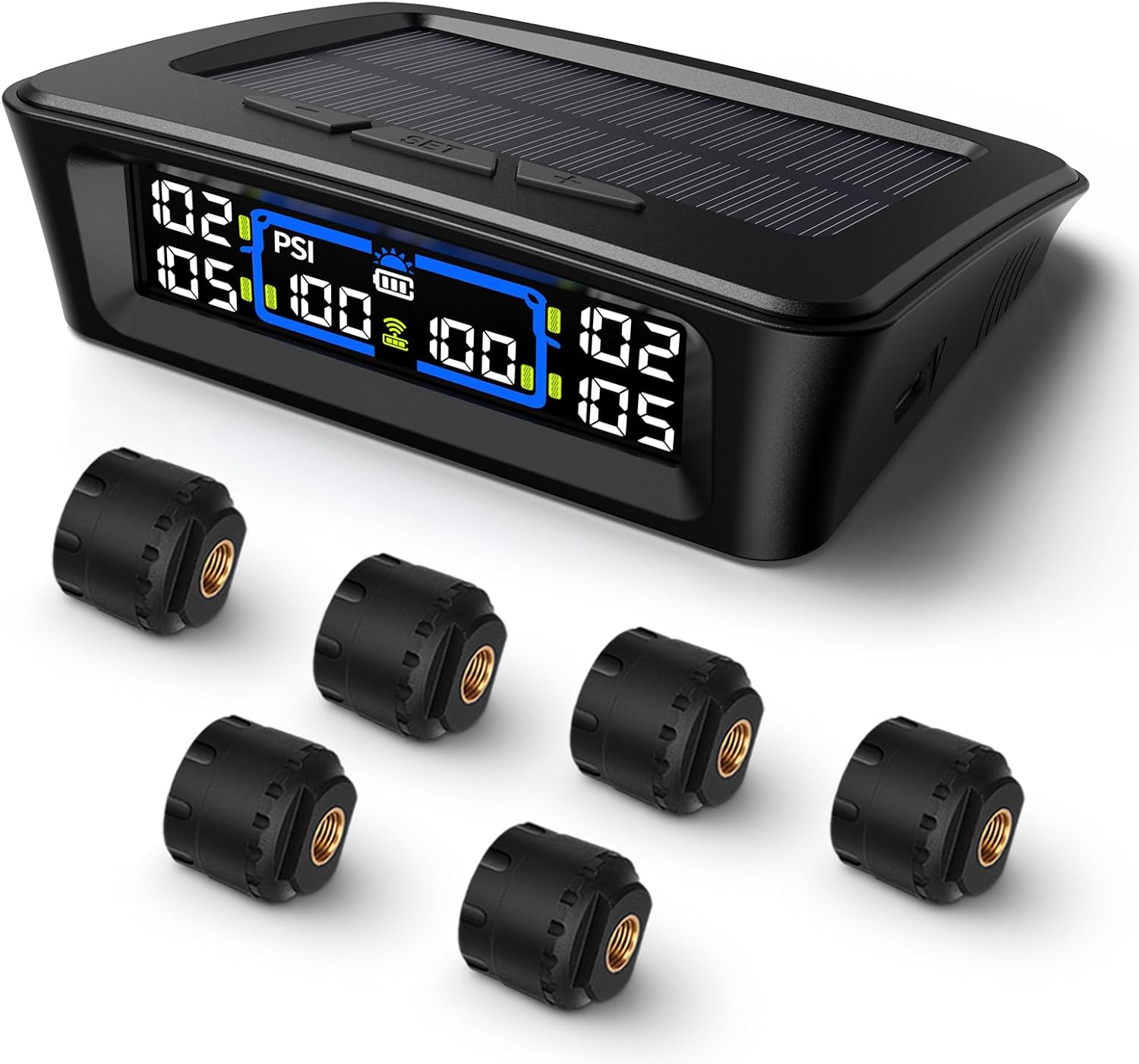
The Tymate TM12 RV TPMS delivers real-time tire pressure and temperature monitoring with a stable 433Hz display for safer long-distance driving. It supports simultaneous monitoring across vehicle and trailer zones, includes six alarm modes for pressure, temperature, leakage, battery, and signal loss, and features easy DIY installation with auto calibration. Power is supplied via USB-C charging or solar recharging, with a wide 0–144 PSI range and up to 50 ft signal coverage for RVs and towable trailers.

The Tymate TM2 RV tire pressure monitoring system keeps you informed with a color LCD display, automatic backlight, and solar charging for dependable operation. It supports up to 10 tire positions with four pre-paired sensors, while offering multiple alarm modes for fast leak detection, pressure extremes, temperature alerts, and low-signal warnings. Built-in monitoring uses accurate readings and reliable 433.92MHz communication to help protect your RV, trailer, truck, or SUV.
A Higher Load Index Can Make Sense When
- The approved replacement tire in your size is offered with a higher load index and still meets every fitment requirement.
- You tow or haul within the vehicle’s rated limits and the vehicle or tire manufacturer specifies a higher-capacity tire fitment for the actual axle loads.
- Added equipment such as bumpers, racks, winches, drawers, or camper hardware changes the vehicle’s real axle loads, and a qualified fitment check confirms the higher-rated tire is appropriate.
- You are switching between passenger and LT tire types under a manufacturer-approved fitment that accounts for the different load-and-inflation requirements.
Do Not Upsize Load Index Just for Looks
A higher load index by itself does not tell you how a tire will ride. Some higher-capacity versions are XL or LT designs with reinforced construction or different inflation requirements, but ride comfort, noise, rolling resistance, and handling also depend on the specific tire model, casing, tread, size, wheel, and pressure.
If your vehicle is unmodified and used normally, the simplest choice is usually a tire that matches the manufacturer-approved size, load rating, and speed rating. A higher load index can be acceptable when the complete fitment is correct; a lower load index should not be used unless the vehicle manufacturer or a qualified tire professional confirms that the tire still meets the required load capacity.
How Tire Load Index Affects Pressure, Safety, and Care
The load index is a maximum-capacity code under specified conditions, not a substitute for the vehicle’s everyday pressure recommendation. Safe use still depends on the right tire size, approved wheel, proper installation, and correct cold tire inflation pressure. Under-inflation increases flex and heat buildup and can reduce the tire’s safe load-carrying margin.
The maximum pressure printed on the tire sidewall is not automatically the pressure you should use every day. For an approved original-size fitment, start with the vehicle manufacturer’s cold pressure on the tire placard or in the owner’s manual. Use a different pressure only when the vehicle or tire manufacturer provides a specific instruction for that fitment, load, or operating condition.
- Check pressure cold: Measure before driving or after the vehicle has been parked for several hours.
- Use the placard: Follow the pressure listed on the driver’s doorjamb placard or in the owner’s manual.
- Adjust for heavy loads only when directed: Some vehicles list separate pressures for light load, full load, towing, or high-speed use.
- Inspect before trips: Look for cuts, bulges, uneven wear, embedded objects, and signs of heat damage.
- Do not rely only on TPMS: A tire pressure monitoring system usually warns after pressure is already low; it does not replace routine checks.
Warning: A tire can have the correct load index and still be unsafe if it is under-inflated, overloaded, damaged, aged, mismatched, or mounted on a wheel that is not rated for the load.
Special Cases: XL, HL, LT, P-Metric, and Dual Load Ratings
Some tire markings need extra care because they change how load capacity should be interpreted.
[Products Worth Considering]

Replace worn or malfunctioning GM TPMS sensors with this 433MHz pre-programmed sensor set designed for compatibility with many Chevrolet, Buick, GMC, and Cadillac models. It includes guidance for proper OBDII relearning/pairing after installation and supports reliable long-term operation with a high-performance CR2032 battery. Quality tested for durability and performance to help restore accurate tire pressure monitoring.

Replace your worn or missing TPMS sensors with pre-programmed, direct-fit sensors for compatible Ford, Lincoln, and select Mazda models. Each sensor comes ready to activate with a scan tool, helping restore accurate tire pressure monitoring and trouble-free installation. Built with a long-life CR2032 battery and tested before factory release, this set provides dependable performance with a one-year warranty.

The Milton S-693-12 straight foot dual head air chuck provides extended 12-inch reach for efficiently inflating inner dual tires on trucks and semi trucks. It has 1/4" female NPT threading and locks securely onto valve core threads for reliable sealing up to 150 PSI. Designed for use on an air line with a cushioned grip handle for comfortable operation.
SL vs XL Tires
SL means Standard Load. XL means Extra Load, sometimes called reinforced. XL tires can carry more load than a standard-load tire of the same size, but only when used at the proper inflation pressure. Do not install XL tires and keep the same pressure without checking the vehicle and tire manufacturer’s instructions.
HL (High Load) Tires
HL means High Load. Michelin describes HL as a newer designation for heavier vehicles, especially some EV fitments, that can support more load at the same inflation pressure than an XL tire of comparable size. If the vehicle came with an HL-rated tire, do not substitute SL or XL solely because the dimensions match; follow the vehicle manufacturer’s approved rating.
LT Tires and Load Range
LT tires are light-truck tires. They often use load range letters such as C, D, or E and may require higher pressures than passenger tires. If your vehicle came with P-metric tires, switching to LT tires can change ride, pressure needs, weight, and handling.
P-Metric Tires on Light Trucks
P-metric passenger tires are rated differently from LT tires. Toyo’s current safety guidance states that when a P-metric or metric passenger tire is installed on a light truck, including an SUV, pickup, or minivan in its guidance, the tire’s load capacity is reduced by a factor of 1.10. In practice, divide the passenger-tire load capacity by 1.10 for the adjusted light-truck value. Always confirm the exact tire manufacturer’s load-and-inflation table and the vehicle’s required capacity before substituting tire types.
Dual Load Ratings Such as 123/120
A marking such as 123/120 is common on some light-truck tires. The first number is the load index for a single tire position, and the second number is for a dual tire position. In this example, 123 equals 3,417 lb / 1,550 kg per tire in single use, while 120 equals 3,086 lb / 1,400 kg per tire in dual use.
Common Tire Load Index Mistakes to Avoid
- Confusing load index with PSI: Load index is a capacity code, not an inflation pressure.
- Assuming higher is always better: A higher index may be acceptable, but it does not increase the vehicle’s rated payload or towing limits, and ride changes depend on the complete tire design rather than the index alone.
- Using GVWR alone: Axle ratings and load distribution matter, especially when towing or hauling.
- Ignoring the wheel rating: A stronger tire does not make a weak or underrated wheel stronger.
- Mixing tire types: Mixing different load indexes, speed ratings, sizes, or constructions can affect handling and stability.
- Replacing by size only: The tire must also meet the correct service description, load capacity, and speed rating.
Frequently Asked Questions
What does tire load index 94 mean?
Load index 94 means one tire is rated to carry up to 1,477 lb / 670 kg when properly inflated and used according to the tire and vehicle manufacturer’s specifications.
What does load index 123/120 mean?
Load index 123/120 is a dual-service marking. The first number applies when the tire is used as a single tire, and the second applies when used in a dual-wheel setup. Index 123 equals 3,417 lb / 1,550 kg; index 120 equals 3,086 lb / 1,400 kg.
Can I use a lower load index than the original tire?
You should not use a lower load index unless the vehicle manufacturer or a qualified tire professional confirms the tire still meets the vehicle’s load requirements. A lower index reduces load capacity and can create a safety risk.
Is a higher tire load index better?
Not automatically. A higher load index may be an acceptable replacement when the tire also meets the approved size, wheel, speed-rating, and inflation requirements, but it does not increase the vehicle’s payload, axle, or towing limits. Match the manufacturer-approved fitment rather than choosing the highest index available.
What is better, H or V rating on tires?
Neither is automatically better. H and V are speed ratings, not load ratings. H is commonly rated up to 130 mph, while V is commonly rated up to 149 mph. Use the speed rating recommended by the vehicle manufacturer; a higher speed rating may improve response but can affect ride, wear, or cost.
Do I inflate tires to the max pressure on the sidewall?
Usually, no. The sidewall maximum pressure is the tire’s limit, not the everyday recommended pressure for your vehicle. Use the cold tire pressure on the vehicle placard or owner’s manual unless the manufacturer gives a different instruction for full load or towing.
Where do I find the correct load index for my car?
Start with the tire placard on the driver’s doorjamb and the owner’s manual. The placard reliably identifies the approved tire size and cold pressure; if it does not state the load index separately, use the vehicle manufacturer’s fitment information or the approved original tire’s service description to confirm the required rating. With aftermarket wheels, suspension changes, or towing-related modifications, confirm the full fitment with a qualified tire professional.
Does a higher load index mean I should use higher tire pressure?
Not automatically. The load index alone does not set your everyday tire pressure. For an approved original-size fitment, use the vehicle manufacturer’s recommended cold pressure. If you change tire size, move between SL, XL, or LT types, or use another approved fitment, follow the specific load-and-inflation guidance for that tire and vehicle.
Can I multiply tire load capacity by four to find my vehicle payload?
No. Multiplying the maximum load per tire by four gives only a theoretical tire-capacity total; it does not tell you how much cargo or tongue weight you may add. Vehicle payload, GVWR, GAWR, wheel ratings, suspension, brakes, and towing limits still control the allowable vehicle load.
Is load index the same as load range?
No. Load index is a number that converts to a weight capacity per tire. Load range is a letter-based strength and pressure category, used often on light-truck and trailer tires. You may need to check both when replacing tires.
Conclusion
The tire load index tells you the standardized maximum load assigned to one tire under specified conditions. Read the number before the speed-rating letter, convert it with a load chart, and confirm that the replacement tire meets or exceeds the vehicle manufacturer’s required load rating.
Do not use tire capacity to raise the vehicle’s payload or towing limits. Before buying, compare the tire size, load index, speed rating, tire type or load designation, wheel compatibility, and inflation requirements with the vehicle placard, owner’s manual, and manufacturer fitment data. Then keep the tires at the correct cold pressure and within the vehicle’s GVWR and GAWR.
Sources
- National Highway Traffic Safety Administration Tire Safety Brochure — tire inflation, load limits, tire placard, and safety guidance.
- NHTSA TireWise — approved replacement tire size, vehicle-recommended cold pressure, and TPMS guidance.
- Goodyear Tire Load Index Guide — definition of tire load index and how to find it on the sidewall.
- Continental Tire Sidewall Guide — tire sidewall markings, load index location, and service-description basics.
- Pirelli Tire Load Index & Chart — standardized load-index values, sidewall location, and single/dual load-rating explanation.
- Michelin Tire Load Rating & Speed Rating Guide — replacement load ratings, XL tires, speed ratings, and vehicle-load limits.
- Tire Rack Load Range and Ply Rating Guide — load range, ply-rating terminology, and replacement tire considerations.
- Goodyear Recommended Tire Pressure Guide — cold tire pressure, under-inflation, and vehicle-placard guidance.
- Toyo Tires Safety Information — P-metric versus LT-metric replacement guidance and the 1.10 light-truck load-capacity adjustment.


2 thoughts on “What Is Tire Load Index? Numbers, Chart & Meaning”