

A 305 tire has a nominal section width of 305 millimeters, which converts to about 12.0 inches from sidewall to sidewall. That number does not tell you the tire’s full height or the wheel it needs. For that, you must read the complete size—such as 305/35R20—and check the specific tire manufacturer’s approved rim-width range.
Quick Answer
A 305 tire is nominally 305 mm, or about 12.0 inches, wide at the section. Its overall height depends on the aspect ratio and wheel diameter. For example, a 305/35R20 is about 28.4 inches tall by calculation. Rim width also varies by the exact size and tire model.
Key Takeaways
- 305 means a nominal section width of 305 mm, or about 12.0 inches; it does not mean the tread itself is exactly 12 inches wide.
- A 305 tire’s total height depends on both its aspect ratio and wheel diameter.
- A 305/35R20 has about a 4.2-inch sidewall and a theoretical overall diameter of about 28.4 inches.
- There is no single rim width that fits every 305 tire. A 305/35R20 may approve a 10–12-inch wheel, while other 305 sizes can use different ranges.
- Wider does not automatically mean better grip. Compound, tread design, inflation, load, wheel fitment, alignment and road conditions all matter.
- Before changing tire size, verify vehicle specifications, load capacity, speed rating, wheel offset and clearance.
What Does a 305 Tire Size Mean?

A 305 tire size means the tire has a nominal section width of 305 millimeters. Section width is measured across the widest part of the inflated tire from sidewall to sidewall. Continental explains the same metric sizing system in its tire-size guide.
The 305 number is only one part of the complete tire designation. A size such as 305/35R20 breaks down like this:
- 305 — nominal section width in millimeters.
- 35 — aspect ratio; the sidewall height is approximately 35% of the section width.
- R — radial construction.
- 20 — wheel diameter in inches.
The numbers and letters that follow the tire size may also identify the load index and speed rating. Those ratings are important when choosing a replacement tire because width alone does not confirm that a tire is suitable for your vehicle.
Note: The 305 figure is nominal. Actual inflated section width can differ slightly between tire models and can change with the measuring wheel. Always use the manufacturer’s specification sheet when clearance is tight.
How Wide and Tall Is a 305 Tire?
A 305 tire is nominally 305 mm wide, or approximately 12.01 inches, at the section. Its total height cannot be determined from “305” alone because the aspect ratio and wheel diameter are also required.
305 Tire Width
A 305 tire is defined by its nominal section width rather than by its tread width. Converting 305 millimeters to inches is straightforward:
305 ÷ 25.4 = about 12.01 inches.
That means a 305 tire belongs to a section-width class of roughly 12 inches. The actual inflated width may be a little wider or narrower depending on the tire design and measuring rim.
For example, Nitto lists its 305/35R20 NT555RII with an inflated overall width of about 12.32 inches even though its nominal metric width is 305 mm. This is one reason you should not treat the size code as an exact physical measurement.
Section Width vs Tread Width
Section width and tread width are not interchangeable terms.
- Section width measures the widest sidewall-to-sidewall portion of the tire.
- Tread width refers to the tread area across the portion designed to contact the road.
A tire marked 305 therefore does not necessarily have 305 mm of tread touching the pavement. Tread width varies by manufacturer, tire category, shoulder design and intended use.
305 Tire Height
The tire’s aspect ratio determines the approximate sidewall height. Use this formula:
Sidewall height in mm = section width × aspect ratio ÷ 100.
Then convert the sidewall height to inches and use:
Overall tire diameter = wheel diameter + two sidewalls.
For a 305/35R20:
- 305 × 0.35 = 106.75 mm of sidewall.
- 106.75 ÷ 25.4 = about 4.20 inches.
- 20 + 4.20 + 4.20 = about 28.4 inches overall diameter.
A manufacturer’s measured diameter can vary slightly from this theoretical calculation because real tires differ in construction, tread depth and measuring conditions.
Common 305 Tire Size Examples
| Tire Size | Sidewall Height | Theoretical Diameter |
| 305/25R20 | About 3.0 in | About 26.0 in |
| 305/30R20 | About 3.6 in | About 27.2 in |
| 305/35R20 | About 4.2 in | About 28.4 in |
| 305/40R20 | About 4.8 in | About 29.6 in |
| 305/50R20 | About 6.0 in | About 32.0 in |
The table shows why calling something simply a “305 tire” does not tell you its height. A 305/25R20 and 305/50R20 share the same nominal section width but differ by about six inches in calculated overall diameter.
What Wheels Fit a 305 Tire?
There is no universal wheel width for every 305 tire. The approved range depends on the complete tire size, construction and model. Some 305/35R20 tires use a 10- to 12-inch wheel range with an 11-inch measuring rim, but other 305 sizes have different limits.
For a real manufacturer example, Nitto’s NT555RII specifications show:
| Size | Approved Rim Range | Measuring Rim | Listed Diameter |
| 305/30R20 | 10.5–11.5 in | 11 in | 27.24 in |
| 305/35R20 | 10–12 in | 11 in | 28.43 in |
| 305/50R20 | 8.5–11 in | 9.5 in | 32.05 in |
“305” tells you the width class, not the correct wheel width. Use the approved rim range for the exact tire model you intend to mount.
A correct wheel choice helps the tire maintain its designed bead seating, sidewall shape and tread behavior. Wheel width is only part of fitment, however. You must also check wheel offset, backspacing, brake clearance, suspension components and fender clearance.
Warning: Do not assume that a 305 tire is safe on a wheel simply because the tire can physically be mounted. Use a wheel inside the tire manufacturer’s approved rim-width range and verify that the complete tire-and-wheel assembly clears the vehicle throughout steering and suspension travel.
[Products Worth Considering]

Replace worn or malfunctioning GM TPMS sensors with this 433MHz pre-programmed sensor set designed for compatibility with many Chevrolet, Buick, GMC, and Cadillac models. It includes guidance for proper OBDII relearning/pairing after installation and supports reliable long-term operation with a high-performance CR2032 battery. Quality tested for durability and performance to help restore accurate tire pressure monitoring.

The Tymate TM12 RV TPMS delivers real-time tire pressure and temperature monitoring with a stable 433Hz display for safer long-distance driving. It supports simultaneous monitoring across vehicle and trailer zones, includes six alarm modes for pressure, temperature, leakage, battery, and signal loss, and features easy DIY installation with auto calibration. Power is supplied via USB-C charging or solar recharging, with a wide 0–144 PSI range and up to 50 ft signal coverage for RVs and towable trailers.

This professional wheel and rim cleaning brush set lifts brake dust, grime, and dirt with soft, scratch-free microfiber and synthetic wool fibers. The rim brush bends up to 360 degrees for easy access to hard-to-reach areas around spokes, lips, and faces. Ideal for thorough cleaning of car, truck, motorcycle, bicycle, RV, and more wheel and tire surfaces.
305 Tire Size Compared With Common Options
Comparing 285, 305 and 315 tires is easiest when you separate section width from overall diameter. The first number tells you nominal width; the aspect ratio and wheel diameter determine height.
| Nominal Width | Approx. Inches | Difference From 305 |
| 285 mm | 11.22 in | 20 mm narrower |
| 305 mm | 12.01 in | Reference size |
| 315 mm | 12.40 in | 10 mm wider |
[Products Worth Considering]

This metal-free wheel and tire cleaning brush uses dense, fluffy synthetic wool to safely clean rims, spokes, fenders, and engine areas without worrying about damaging surfaces. Its flexible, comfortable design helps you reach detailed areas while maintaining durability, and the extra absorbent fibers work well with wheel spray cleaners for faster cleanup. Reusable and washable performance helps prevent grime and build-up for cleaner vehicles and easier maintenance at home.

A concentrated tire and tube mounting compound designed to help simplify mounting rubber tires and tubes on passenger, semi truck, construction, and OTR applications. Its ultra-thick formula packs beads effectively and includes rust inhibitors to help protect against corrosion during use.

Replace your worn or missing TPMS sensors with pre-programmed, direct-fit sensors for compatible Ford, Lincoln, and select Mazda models. Each sensor comes ready to activate with a scan tool, helping restore accurate tire pressure monitoring and trouble-free installation. Built with a long-life CR2032 battery and tested before factory release, this set provides dependable performance with a one-year warranty.
305 Vs 285 Tires
A 305 tire is nominally 20 mm wider than a 285 tire, or about 0.79 inch wider in section-width designation.
That extra width can require more wheel and body clearance. It may also change steering response and the shape of the tire footprint, but it does not guarantee more traction by itself. Tire compound, tread design, load, inflation, alignment and road surface can matter as much as—or more than—the nominal width.
- 305: More section width and potentially less clearance around suspension and bodywork.
- 285: Narrower packaging and often easier fitment where wheel-well space is limited.
- Best choice: The size that maintains the vehicle’s required load capacity, diameter, wheel compatibility and intended handling balance.
305 Vs 315 Tires
A 315 tire is nominally only 10 mm wider than a 305 tire, a difference of about 0.39 inch in the size designation.
That difference can still matter when clearance is tight. A 315 may place its sidewall closer to a suspension component or fender, while a 305 may provide a little more room. Actual width must still be checked on the manufacturer’s specification sheet because two tires with the same nominal width can measure differently.
Neither size automatically offers better grip. If maximum performance is the goal, compare the exact tire models, compounds and recommended wheel widths rather than choosing by the first number alone.
305 Vs 35-Inch Tires
A 305 tire and a 35-inch tire describe different dimensions. “305” is normally a metric section-width designation, while “35-inch” in flotation-style sizes generally refers to nominal overall diameter.
For example, a theoretical 305/70R18 works out to about 34.8 inches in overall diameter, so some 305-width metric sizes can be close to a 35-inch tire. A low-profile 305/35R20, however, is only about 28.4 inches tall.
- 305: Tells you nominal section width.
- 35-inch: Tells you nominal tire diameter in a flotation-style size.
- Fitment: A taller tire can affect wheel-well clearance, gearing and speedometer accuracy even if its width is similar.
Always compare the complete dimensions and manufacturer specifications instead of assuming that every 305 tire is equivalent to a 35-inch tire.
How 305 Tires Affect Ride and Handling
A 305 tire can change ride and handling when it replaces a narrower tire, but the result depends on the complete tire size and construction. Width by itself does not determine whether the tire will feel firm, comfortable, responsive or heavy.
A wider tire used with an appropriately wide wheel can change steering feel and footprint shape. If the change also uses a shorter sidewall, you may notice quicker response and less sidewall movement. A taller 305 tire can behave very differently because it has more sidewall available to flex.
Ride comfort is influenced by:
- aspect ratio and sidewall height;
- tire construction and load range;
- inflation pressure;
- wheel diameter and wheel weight;
- tread and casing design;
- suspension tuning; and
- road surface.
A 305/25 tire and a 305/50 tire share the same nominal width, yet their sidewall heights and ride characteristics can be dramatically different.
For that reason, it is more accurate to compare complete sizes and specific tire models than to describe all 305 tires as automatically sportier or less comfortable.
What to Check Before Buying 305 Tires
Before buying 305 tires, start with your vehicle’s original specifications. Michelin recommends checking the vehicle’s tire placard and manufacturer requirements when choosing tire size and load capacity. See Michelin’s tire-size selection guidance.
Check all of the following rather than relying on width alone:
- Complete tire size: Compare section width, aspect ratio and wheel diameter.
- Approved rim width: Use the range specified for the exact tire model.
- Overall diameter: A major change can affect gearing, speedometer readings and clearance.
- Load index: The replacement must safely support the vehicle’s required load.
- Speed rating: Follow the vehicle and tire manufacturer’s replacement requirements.
- Wheel offset and backspacing: These determine where the tire sits relative to the suspension and fender.
- Steering clearance: Check both directions at full steering lock.
- Suspension clearance: Verify space during compression and normal suspension travel.
- Brake clearance: Wheel diameter and spoke design must clear the braking system.
- TPMS compatibility: Confirm that sensors and wheels work with the vehicle’s monitoring system.
[Products Worth Considering]

Monitor tire tread wear with a smart, color-coded depth gauge that shows clear condition ranges at a glance. The bar is range marked for fast, easy readings, helping you maintain safer traction and performance. Each gauge is portable with a pocket clip, and the set includes 20 units for daily use and sharing.

Measure tire tread depth quickly and accurately with this LUMITECO dial gauge that reads in 1/32" increments up to 14/32". The color-coded green/yellow/red zones make it easy to judge tire wear and know when replacement is needed. A rugged, compact design with a protective pouch helps keep the gauge ready for use on cars, trucks, motorcycles, and more.
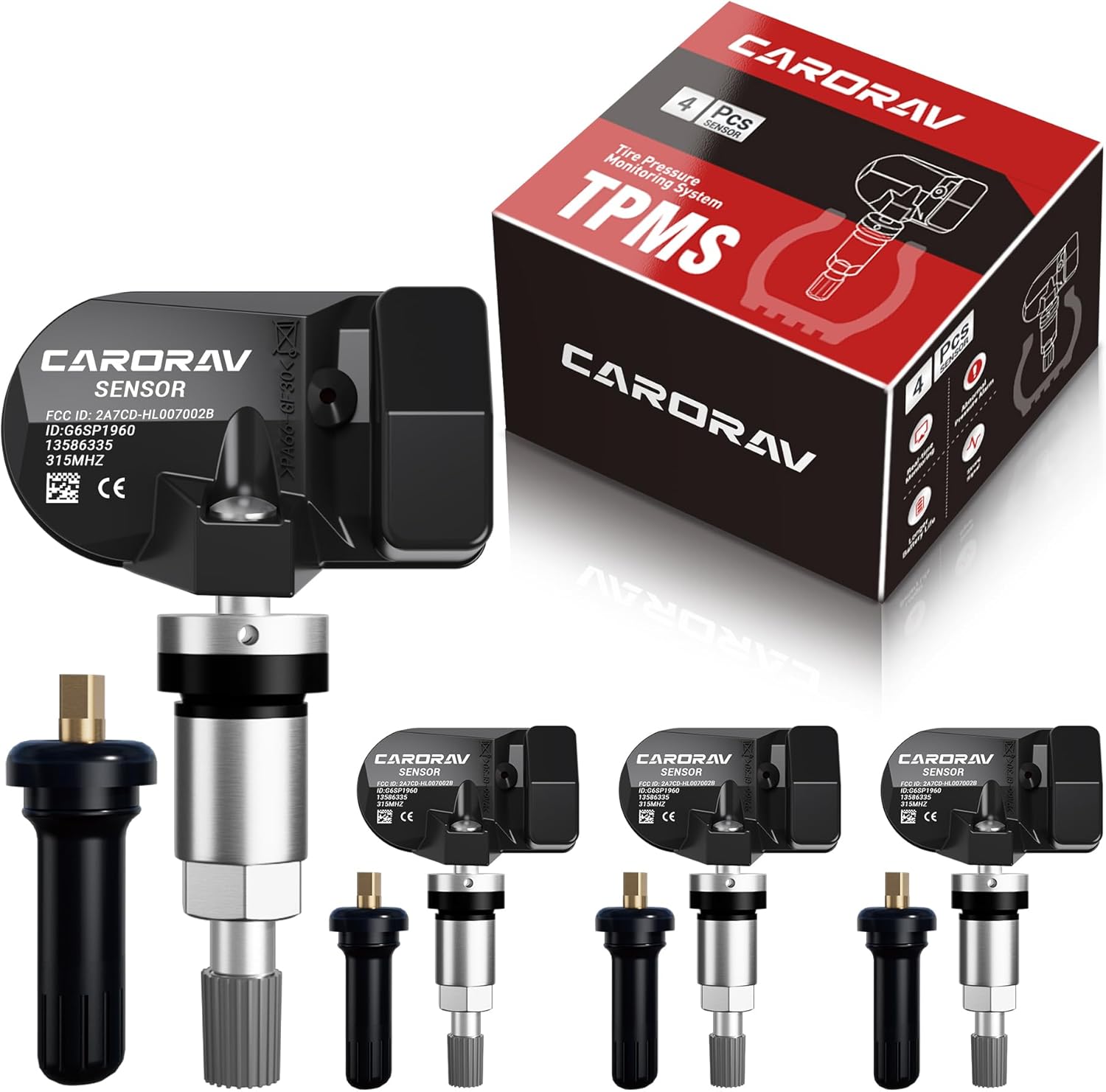
Replace worn or missing TPMS sensors with CARORAV pre-programmed GM-compatible sensors for a smoother installation experience. These 315MHz replacement sensors help monitor tire pressure in real time with long battery life, and they are designed to withstand harsh temperatures. Manual or OBDII relearn may be required to reset the system for proper recognition.
Check Tire Pressure Correctly
Use the vehicle manufacturer’s recommended cold inflation pressure, not the maximum pressure molded on the tire sidewall. The NHTSA TireWise guidance directs drivers to the vehicle tire-information placard for the recommended cold pressure.
Pro Tip: If you are changing from the factory tire size, compare the new tire’s real manufacturer-listed diameter and width—not only the calculated numbers. This is especially useful when suspension or fender clearance is close.
Consider AWD and Staggered Setups
If your vehicle uses all-wheel drive or a factory staggered tire setup, tire diameter differences between axles can matter. Follow the vehicle manufacturer’s requirements for matching tire sizes, rolling circumference, tread depth and axle placement rather than changing one axle independently.
Common Mistakes With 305 Tire Sizes
- Assuming 305 means a 12-inch tread: It refers to nominal section width.
- Assuming every 305 is the same height: Aspect ratio and wheel diameter determine overall diameter.
- Assuming every 305 fits an 11-inch wheel: Approved wheel range varies by exact tire.
- Choosing only by appearance: Load rating, diameter and clearance still have to work.
- Ignoring actual manufacturer dimensions: Nominal calculations and measured dimensions can differ.
- Assuming wider automatically means more grip: Tire design and operating conditions play major roles.
Frequently Asked Questions
Can 305 Tires Fit on Stock Suspension?
Sometimes. A 305 tire can fit stock suspension on vehicles designed with enough wheel-well space, while other vehicles may rub. The answer depends on the complete tire size, wheel width, offset, backspacing, suspension geometry and fender clearance. Check clearance at full steering lock and through suspension travel before using the size.
Are 305 Tires Good for Daily Driving?
They can be. Many performance vehicles use wide tires successfully for everyday driving. Comfort, noise, wet-weather performance, tread life and efficiency depend more on the exact tire model, aspect ratio, compound and vehicle setup than on the 305 width number alone.
Do 305 Tires Hurt Fuel Economy?
They can, especially if the change adds tire weight, rolling resistance or aerodynamic drag. Width alone does not determine fuel economy, however. Compound, construction, tread design, inflation, alignment and vehicle setup also affect rolling resistance. Bridgestone explains these factors in its rolling-resistance guide.
How Much Do 305 Tires Usually Cost?
Prices vary widely by the complete size, manufacturer, tire category and speed/load rating. Many 305-width performance tires cost several hundred dollars each, while value, competition, off-road and specialty models can fall outside that range. Compare prices using the exact size and service description rather than searching only for “305 tire.”
Are 305 Tires Available in All-Season Tread?
Yes. All-season tires are available in several 305 sizes. For example, Goodyear currently lists multiple 305/35R20 all-season options. Availability still depends on the complete size, so one 305 aspect ratio or wheel diameter may have more choices than another.
Is a 305 Tire Exactly 12 Inches Wide?
No. The 305 designation converts to about 12.01 inches, but it is a nominal section-width size. Actual inflated width can differ by manufacturer, tire construction and measuring wheel. Use the exact tire specification when clearance is important.
What Rim Width Fits a 305/35R20 Tire?
Many 305/35R20 performance tires specify a 10- to 12-inch approved wheel range with an 11-inch measuring rim, but you must confirm the specification for the exact tire model. Other 305 aspect ratios can use different wheel ranges.
Conclusion
A 305 tire has a nominal section width of about 12 inches, but width is only the starting point. The aspect ratio determines sidewall height, the wheel diameter helps determine total tire diameter, and the specific tire model determines its approved rim-width range. A 305/35R20, for example, is about 28.4 inches tall—not 34.4 inches—and many examples use a 10- to 12-inch wheel range.
For a safe fit, compare the complete size with your vehicle specifications, confirm load and speed ratings, use the tire manufacturer’s approved wheel range, and check wheel offset and clearance. That approach is far more reliable than choosing a 305 tire based on width or appearance alone.
Sources
- Continental — Tire Size Guide — explains section width, aspect ratio, radial construction and wheel diameter.
- Nitto Tire — NT555RII Technical Specifications — supports real 305/30R20, 305/35R20 and 305/50R20 dimensions and approved rim-width ranges.
- Michelin — Choosing the Right Tire Size — supports checking the vehicle placard, load requirements and complete tire size.
- NHTSA TireWise — supports using the vehicle manufacturer’s recommended cold inflation pressure and tire-safety practices.
- Bridgestone — Tire Rolling Resistance — explains rolling resistance and its relationship to energy use.
- Goodyear — 305/35R20 Tire Options — confirms current all-season availability in this 305 size.

