
A 305 tire is about 12 inches wide because 305 millimeters converts to 12.01 inches. That number describes the tire’s nominal section width, not its diameter, tread width, or sidewall height. For example, a 305/70R18 tire is about 12.0 inches wide, has an 8.4-inch sidewall, and stands close to 34.8 inches tall. The full tire size matters because aspect ratio and wheel diameter change height, clearance, gearing, speedometer accuracy, and fitment.
Quick Answer
A 305 tire is about 12 inches wide. The 305 means 305 millimeters of nominal section width, and 305 ÷ 25.4 = 12.01 inches. To know tire height, you still need the full size, such as 305/70R18.
Key Takeaways
- A 305 tire is about 12.0 inches wide because 305 mm ÷ 25.4 = 12.01 inches.
- The 305 number is nominal section width, not tread width, sidewall height, or overall diameter.
- A 305/70R18 is about 12.0 inches wide, 8.4 inches tall at the sidewall, and 34.8 inches tall overall.
- A 305 tire is not automatically a 33-inch or 35-inch tire. The aspect ratio and wheel size decide height.
- Always confirm wheel width, load rating, clearance, and vehicle-approved sizing before mounting 305 tires.
How Many Inches Is a 305 Tire?
A 305 tire is about 12 inches wide. More exactly, 305 millimeters equals 12.01 inches. When you see 305 tire width in a size such as 305/70R18, read the first number as the tire’s nominal section width in millimeters.
Section width is the sidewall-to-sidewall width measured on a specified wheel width. It is not the same as tread width, which is usually narrower and varies by tire design. BFGoodrich explains that tire width, also called section width, is measured in millimeters from the widest point of the outer sidewall to the widest point of the inner sidewall. You can use the 12-inch conversion as a fast fitment reference, but the exact mounted width can change with the wheel and tire model. See BFGoodrich’s tire sidewall guide for how tire width, ratio, construction, and wheel diameter are read.
If you are choosing parts for a truck, SUV, or off-road build, verify the complete size before buying. Width affects wheel clearance and stance, while height affects fender clearance, gearing, speedometer readings, and suspension travel. You should also consider the tire performance characteristics that match your vehicle and driving conditions.
305 Tire Width in Millimeters
At the metric core, a 305 tire has a nominal section width of 305 millimeters. In inches, that is just over 12 inches. This number helps you compare tire widths, but it should not be treated as the exact tread width or the exact mounted width on every wheel.
| Metric | Value | Meaning |
|---|---|---|
| Width | 305 mm | Nominal section width |
| Imperial | 12.01 in | Converted width reference |
| Measurement | Sidewall to sidewall | Not the tread face alone |
| Fitment | Wheel-dependent | Actual width can vary |
| Best use | Trucks/SUVs | Common for wider fitments |
You should treat 305 mm as a labeled size, not a promise that every mounted 305 tire will measure exactly 12.01 inches on your vehicle. Tire makers measure design dimensions on specified rim widths, and tire construction can shift the final real-world measurement. Selecting the right tire size can improve your vehicle’s overall performance, but only when the size also matches the wheel, load rating, and vehicle clearance.
Note: The printed tire size is a nominal size. Actual measured section width can vary by tire model, tread design, air pressure, and wheel width.
How to Convert 305 Tire Width to Inches
To convert a 305 tire width to inches, divide 305 millimeters by 25.4. The result is 12.01 inches.
| What You Want | Formula | Result |
|---|---|---|
| Width in inches | 305 ÷ 25.4 | 12.01 in |
| 305/70 sidewall height | 305 × 0.70 ÷ 25.4 | 8.41 in |
| 305/70R18 overall diameter | 18 + 2(8.41) | 34.82 in |
This is the cleanest way to separate width from height. The first number gives width. The second number, the aspect ratio, gives sidewall height as a percentage of that width. The wheel diameter then gets added to two sidewalls to estimate the tire’s full height.
If you are checking a build for off-road traction, towing, or daily driving, convert the metric width first, then evaluate the rest of the tire size separately. That keeps your measurements clear and helps you compare tire selection criteria such as tread pattern, load rating, and seasonal performance.
305/70R18 Tire Size in Inches
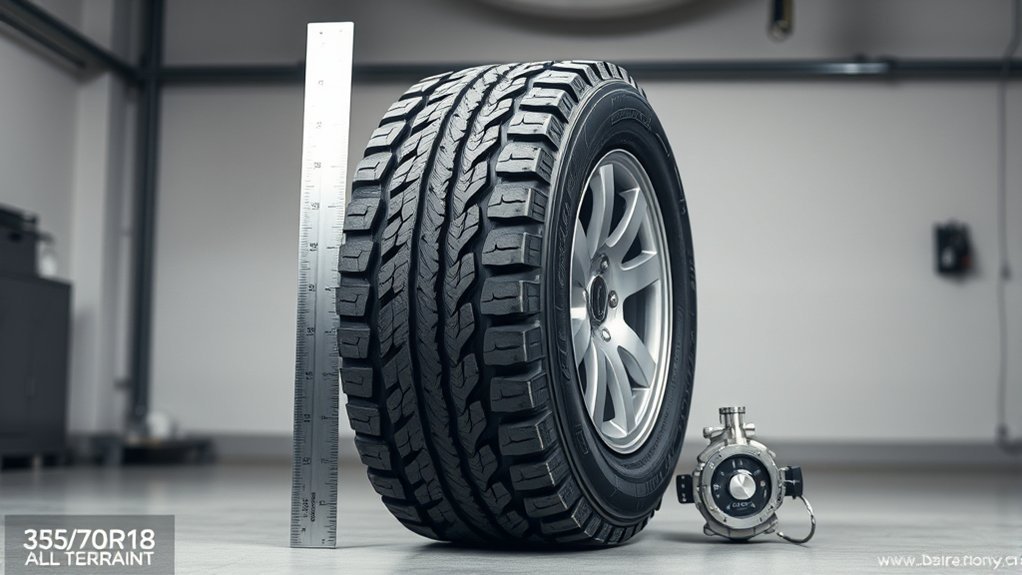
A 305/70R18 tire measures about 12.0 inches wide, has a sidewall height of about 8.4 inches, and has an overall diameter near 34.8 inches. The tire is designed for an 18-inch wheel because the final number in the size is the wheel diameter. Continental’s tire-size guide explains that the code shows width in millimeters, sidewall height percentage, construction type, rim diameter, load index, and speed index.
Here is the breakdown:
- 305 means 305 mm nominal section width.
- 70 means the sidewall is 70% of the 305 mm width.
- R means radial construction.
- 18 means the tire fits an 18-inch wheel.
These dimensions matter when you check suspension, fender clearance, wheel width, load capacity, and speedometer effects. Selecting the right tire can also affect ride comfort and fuel economy, especially when you move to a wider or heavier tire than stock.
How Tall Is a 305/70R18 Tire?
A 305/70R18 tire is about 34.8 inches tall overall. The math works like this: 305 mm × 0.70 = 213.5 mm of sidewall height. Convert that to inches and you get 8.41 inches. Since the tire has one sidewall above the wheel and one below it, double the sidewall height and add the 18-inch wheel: 18 + 8.41 + 8.41 = 34.82 inches.
A 305/70R18 is close to a 35-inch tire by overall diameter, but “305” by itself only tells you width.
The overall diameter affects ride height, gearing, braking feel, and speedometer readings. Before you buy, measure tire-to-fender space, check suspension travel, compare the new tire diameter with your current setup, and confirm the tire maker’s approved rim-width range.
How Wide Is a 305/70R18 Tire?
A 305/70R18 tire is about 12.0 inches wide because the 305 mm section width converts to 12.01 inches. You can use that width to compare fitment, clearance, and wheel compatibility on 18-inch rims. This 305 tire width is a key dimension when you are checking truck and SUV applications or comparing all-season tire options for year-round driving.
305 Tire Width Explained
The 305 label tells you the nominal sidewall-to-sidewall width in millimeters. It does not tell you the tread width, the contact patch width, or the overall height. Two 305 tires from different manufacturers can measure slightly differently because tread shape, casing design, and wheel width affect final dimensions.
- 305 mm = about 12.01 inches of nominal section width.
- 70% aspect ratio = about 8.4 inches of sidewall on a 305/70 tire.
- Radial construction is marked by the letter R.
- A 305/70R18 is about 34.8 inches tall overall.
When you check tire width, leave room for steering lock, suspension compression, fender liners, mud, snow buildup, and sidewall flex. Precise sizing helps you avoid rubbing, uneven wear, and poor handling.
305/70R18 Width In Inches
305/70R18 tires are about 12 inches wide because 305 mm converts to 12.01 inches. A common reference for this size is shown below.
| Spec | Approximate Value |
|---|---|
| Section width | 12.0 in |
| Aspect ratio | 70% |
| Sidewall height | 8.4 in |
| Overall diameter | 34.8 in |
| Wheel diameter | 18 in |
This size gives a broad footprint for trucks and SUVs, which can help with trail traction and stance. It can also add weight, rolling resistance, and clearance demands. If you are upgrading, confirm wheel width, offset, suspension space, and load capacity before mounting.
How Aspect Ratio Changes Tire Size
When you look at tire size, the aspect ratio is the sidewall height as a percentage of the tire’s width. A higher ratio gives you a taller sidewall, while a lower ratio gives you a shorter sidewall. Because the sidewall sits above and below the wheel, aspect ratio directly changes the tire’s total height.
Choosing the right tire can also affect hydroplaning resistance, steering response, ride comfort, and braking feel. Continental notes that lower aspect ratios usually sharpen steering because the sidewall flexes less, while higher aspect ratios can improve comfort by absorbing road impacts.
Aspect Ratio Basics
Aspect ratio tells you how tall the tire’s sidewall is compared with its width. With a 305/70R18, the 70 means the sidewall height is 70% of 305 mm.
- 305/70R18 uses a 70% aspect ratio.
- 305 × 0.70 = 213.5 mm of sidewall height.
- 213.5 mm ÷ 25.4 = 8.41 inches.
- Overall diameter = wheel diameter + two sidewalls.
Lower aspect ratios usually feel more responsive on pavement. Higher aspect ratios usually give more sidewall cushion and more flex on rough surfaces.
Sidewall Height Impact
A higher aspect ratio gives you a taller sidewall. In a 305/70R18 tire, that sidewall is about 8.4 inches high. The taller sidewall can help absorb impacts and flex over uneven ground, which is one reason 305/70R18 tires are common on trucks and off-road setups.
A lower aspect ratio shortens the sidewall. That can improve steering response, but it can also make the ride harsher and reduce cushion over potholes, rocks, and washboard roads. For your setup, judge aspect ratio as part of the full tire system, not as an isolated number.
Overall Diameter Changes
Because the aspect ratio controls sidewall height, it also changes overall diameter. When you run a 305 tire at a 70 aspect ratio on an 18-inch wheel, you get about 34.8 inches of total height. If you drop to a 305/55R20, the tire is still about 12 inches wide, but it is only about 33.2 inches tall.
- Higher aspect ratio = taller tire.
- Lower aspect ratio = shorter tire.
- Same width does not mean same height.
- Clearance, gearing, and speedometer readings can change when diameter changes.
Common 305 Tire Size Equivalents
Common 305 tire sizes are often compared with 12-inch-wide flotation sizes, but the height changes by aspect ratio and wheel diameter. A 305 tire is not automatically a 33-inch or 35-inch tire. Use the full code to compare width and height.
| Metric Size | Approx. Width | Approx. Diameter | Closest Common Label |
|---|---|---|---|
| 305/50R20 | 12.0 in | 32.0 in | 32×12 |
| 305/55R20 | 12.0 in | 33.2 in | 33×12 |
| 305/65R18 | 12.0 in | 33.6 in | 34×12 |
| 305/70R17 | 12.0 in | 33.8 in | 34×12 |
| 305/70R18 | 12.0 in | 34.8 in | 35×12 |
| 305/55R22 | 12.0 in | 35.2 in | 35×12 |
These are calculated reference sizes. Always check the tire maker’s spec sheet because real dimensions can vary by construction and measuring rim. You should also consider the tread life warranty, load range, and speed rating for the exact tire you plan to buy.
Best Uses for 305 Tires
When you need a tire that balances width, traction, and stability, 305 tires often fit trucks, SUVs, and lifted setups. Their 12-inch nominal width gives a broad footprint, but that footprint also needs enough clearance and the right wheel width.
- Off-road trails: A wider tread can help on dirt, rock, sand, and mud when the tire is matched to the vehicle.
- Lifted trucks: The size can fill wheel wells and support a more aggressive stance.
- Towing and hauling: Many 305 sizes are offered in LT load ranges, but you must match load index and pressure to the vehicle.
- Rough roads: A taller sidewall, such as the 8.4-inch sidewall on a 305/70R18, can add cushion over uneven surfaces.
A 305/70R18 gives you width and height, but it may also add weight, noise, fuel use, and rubbing risk. If you are comparing all-terrain tires, look beyond size and compare tread pattern, wet braking, snow rating, load range, and road manners.
[Products Worth Considering]

A concentrated tire and tube mounting compound designed to help simplify mounting rubber tires and tubes on passenger, semi truck, construction, and OTR applications. Its ultra-thick formula packs beads effectively and includes rust inhibitors to help protect against corrosion during use.

Keep your tires properly inflated with this analog VONDIOR tire pressure gauge, designed for fast, easy readings without batteries. The swiveling, two-axis hose and large glow dial help you measure at any tire angle with instant visibility. Built with a protective rubber shield, it supports durable, low-maintenance use for cars and trucks.

Black Magic Tire Wet delivers a deep wet-look shine that makes tires appear dark, rich, and freshly detailed. Its long-lasting formula helps resist rain, dust, and road grime for weeks of glossy protection, not days. Apply by spraying onto clean, dry tires—no buffing or wiping required—with a low-sling design to reduce splatter on paint and wheels.
How to Pick the Right 305 Tire
Choose the proper aspect ratio, match the tire to the correct wheel diameter, and check vehicle clearance against the tire’s full dimensions. Also confirm the tire’s load ratings, speed rating, and inflation requirements. NHTSA recommends using the owner’s manual or the Tire and Loading Information Label on the driver’s door edge or post to find the correct tire size for your car or truck.
Warning: Do not choose a 305 tire by width alone. The wrong diameter, load index, wheel width, or pressure can affect handling, braking, safety systems, and tire life. Use the vehicle placard, owner’s manual, tire maker specs, and a qualified tire professional before mounting a non-stock size.
[Products Worth Considering]

Slip the Powerbuilt tire step over your vehicle’s tire to reach roof racks, engine bays, truck boxes, and more without overreaching. Its adjustable, universal design fits tires with a cross tread width up to 13 inches, including car, truck, RV, and semi tires. The non-slip cheesegrater surface and anti-slip tape provide secure grip while the open design lets mud and debris pass through. Fold-flat storage with rubber bumpers helps keep your tire and the step protected between uses.

Cristal Products Untouchable Tire Shine Spray delivers a deep, wet-look gloss that enhances your vehicle’s tires. It’s quick-drying and spreads smoothly for consistent, streak-free coverage, while forming a protective coating against UV rays, road grime, and weather. Suitable for all tire types, it helps restore dull, faded tires to a showroom-quality finish.

The SAFELIFE dial tire tread depth gauge measures tread depth in 1/32 inch increments with clear, easy-to-read 2-inch dial face. Color zones using a traffic light system help you quickly judge whether tread is low, marginal, or ample for safer driving. Built with a durable zinc cast body and a metal detect probe for precise, comfortable use across cars, motorcycles, trucks, and buses.
Choose Proper Aspect Ratio
A tire’s aspect ratio tells you how tall the sidewall is relative to its width. A 305/70R18 has a sidewall height of about 8.4 inches. A 305/55R20 is the same width, but it has a shorter sidewall and a smaller overall diameter.
- Choose a lower ratio if you want sharper response and your roads are smooth.
- Choose a higher ratio if you want more sidewall cushion and rough-road compliance.
- Check the total diameter because it can affect speedometer accuracy and gearing.
- Compare the new tire diameter with the stock tire size before buying.
Match Rim Diameter
Match the rim diameter to the tire size exactly. A 305/70R18 is built for an 18-inch wheel. Do not mount it on a 17-inch, 18.5-inch, or 20-inch wheel. The tire code tells you which wheel diameter fits.
You also need the correct wheel width. A 305/70R18 is commonly listed around 8.5 to 10 inches of approved wheel width, but the exact range depends on the specific tire. Check the manufacturer’s spec sheet before mounting.
Check Vehicle Clearance
Before you buy a 305 tire, check wheel-well clearance against the tire’s overall diameter, section width, and sidewall bulge. A 305 tire is about 12 inches wide, but a 305/70R18 is also about 34.8 inches tall, and that height drives many fitment problems.
- Confirm static clearance at normal ride height.
- Turn the steering fully left and right and inspect fender, liner, and control-arm clearance.
- Account for suspension lift, leveling kits, wheel offset, and backspacing.
- Leave room for compression, articulation, mud, snow, and tire growth at speed.
- Confirm load index, speed rating, and inflation pressure for your vehicle.
Pro Tip: If you are upsizing from stock, compare the new tire’s diameter with your current tire first. A 3% or larger diameter change can make the speedometer read noticeably different and may require calibration on some vehicles.
305 vs 285 Tire Size
A 305 tire is wider than a 285 tire. A 305 is about 12.01 inches wide, while a 285 is about 11.22 inches wide. That makes the 305 about 0.79 inch wider in nominal section width.
| Size Width | Millimeters | Inches | Difference vs 305 |
|---|---|---|---|
| 285 tire | 285 mm | 11.22 in | 0.79 in narrower |
| 305 tire | 305 mm | 12.01 in | Baseline |
The wider tire may improve stance and traction in some conditions, but it can also increase rubbing risk, steering weight, rolling resistance, and tire cost. Compare complete sizes, not width alone.
[Products Worth Considering]

This digital tire pressure gauge with built-in inflator helps you accurately check and adjust tire pressure for safer driving and better fuel efficiency. It supports multiple units (PSI, KPA, BAR, KG/CM²) and reads within 1% for reliable results. The 3-in-1 design inflates, deflates, and measures, with a quick-connect air chuck and compatible hose setup for cars, trucks, SUVs, RVs, and motorcycles.

Protect your spare wheel with a waterproof, dustproof tire cover made to resist sun and harsh weather. The elastic band design makes it easy to install and remove without tools, while reinforced stitching helps it keep its shape. Available in multiple sizes, it fits common RV, trailer, Jeep, SUV, and truck spare tires.

ETENWOLF T300 is a calibrated digital tire pressure gauge for accurate readings from 3 to 200 PSI across light and heavy-duty vehicles. It includes thermal compensation for reliable performance in extreme cold or heat, with an auto shut-off to extend battery life and an LED for easier reading. The sturdy design supports rugged everyday use, making it ideal for pickups, RVs, and industrial applications.
Frequently Asked Questions
Is a 305 tire a 35 in inches?
A 305 tire is not automatically a 35-inch tire. The 305 only means the tire is about 12 inches wide. A 305/70R18 is close to 35 inches tall at about 34.8 inches, but other 305 sizes can be closer to 32, 33, or 34 inches.
Is a 305 tire equal to a 33?
Not by width alone. Some 305 sizes are near 33 inches tall, such as a 305/55R20 at about 33.2 inches. A 305/70R18 is closer to 35 inches tall. Always read the full tire size before comparing it with a 33-inch tire.
Is a 305 tire bigger than a 285?
Yes, a 305 tire is wider than a 285 tire. A 305 is about 12.01 inches wide, while a 285 is about 11.22 inches wide. Overall height still depends on the aspect ratio and wheel diameter, so compare the full tire size.
Will a 305 fit on a 9-inch rim?
Many 305/70R18 tires can fit a 9-inch-wide wheel, but you must check the tire maker’s approved rim-width range for the exact model. A 9-inch rim is often within range for 305/70R18, but fitment also depends on load rating, wheel offset, clearance, and intended use.
What does 305 mean on a tire?
The 305 means the tire’s nominal section width is 305 millimeters. It is the sidewall-to-sidewall width reference, not the tread width or total tire height.
How do you calculate the height of a 305/70R18 tire?
Multiply 305 mm by 0.70 to get 213.5 mm of sidewall height. Convert that to inches by dividing by 25.4, which gives 8.41 inches. Then add two sidewalls to the 18-inch wheel: 18 + 8.41 + 8.41 = about 34.8 inches.
Conclusion
You can think of a 305 tire as about 12.0 inches wide because 305 millimeters converts to 12.01 inches. That is only the width baseline. The full tire height depends on the aspect ratio and wheel diameter, which is why a 305/70R18 stands about 34.8 inches tall while other 305 sizes can be shorter or taller. For safe fitment, check the complete tire size, approved rim width, load rating, vehicle placard, owner’s manual, and real clearance before you buy or mount the tire.
Sources
- BFGoodrich: How to Read a Tire Sidewall — supports section width, aspect ratio, radial construction, wheel diameter, load index, and speed rating explanations.
- Continental Tires: Tire Size Guide — supports tire-size code structure, approved tire-size guidance, and how tire size affects handling, comfort, efficiency, and safety.
- NHTSA TireWise — supports checking the owner’s manual or Tire and Loading Information Label for the correct tire size and tire safety guidance.
- BFGoodrich All-Terrain T/A KO2 Product Notes — supports the warning that measured dimensions can vary by rim width and that tire mounting should be handled by professionals.

