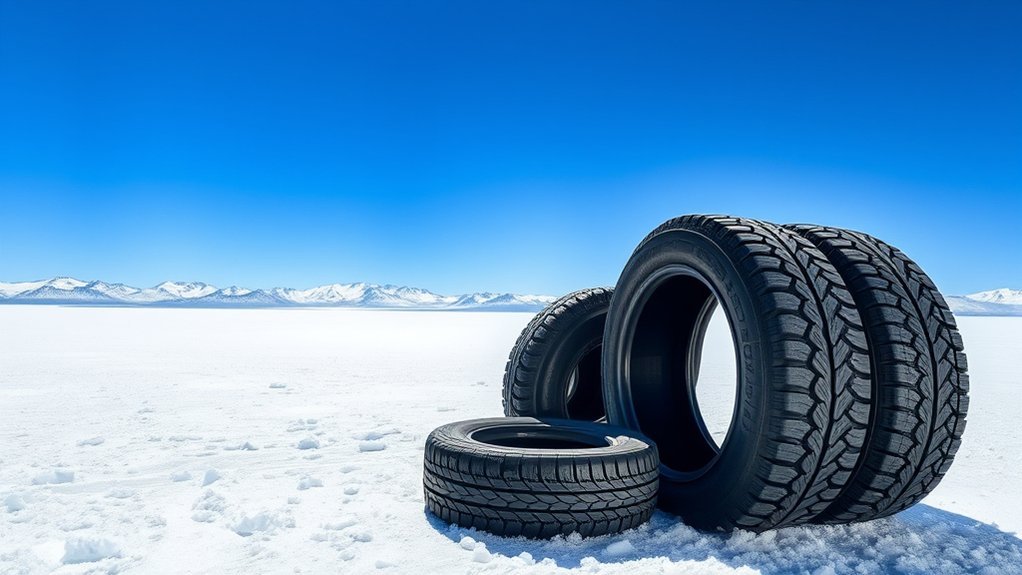
Choosing tires for a Toyota Tundra starts with one simple rule: match the tire to your exact truck and the way you drive it. A daily highway Tundra needs a different tire than a truck that tows, runs gravel roads, crawls through mud, or faces snow and ice every winter. Before comparing brands, check your year, trim, wheel size, tire size, load rating, and the tire-pressure label on the driver-side doorjamb.
Quick Answer
For most Toyota Tundra owners, the best tire is an all-terrain tire if you split time between pavement, gravel, towing, and light trails. Choose highway tires for quiet road comfort, mud-terrain tires for frequent mud or rocks, and dedicated winter tires for regular snow and ice.
Key Takeaways
- Start with the tire size and load rating listed on your Tundra’s doorjamb label or owner’s manual, not the maximum PSI printed on the tire sidewall.
- Highway tires are best for comfort, low noise, and fuel economy; all-terrain tires are the best middle ground for mixed use.
- Mud-terrain tires help in deep mud and rocks but usually add road noise, weight, and faster wear on pavement.
- For serious winter driving, choose a full set of winter tires or severe-snow-rated tires marked with the Three-Peak Mountain Snowflake symbol.
- Check cold tire pressure monthly, rotate as recommended, and replace tires when tread reaches 2/32 inch or if damage appears.
At a Glance
| Time Required | 10–20 minutes to check size, load rating, pressure label, and driving needs before shopping |
| Difficulty | Easy for stock-size tires; moderate if changing size, load range, or wheel diameter |
| Tools Needed | Tire-pressure gauge, tread-depth gauge or penny, owner’s manual, and doorjamb tire label |
| Cost | Varies by size, brand, load range, and tire type; larger all-terrain, LT, and mud-terrain tires usually cost more |
Start With Your Exact Tundra Fitment
Before you pick a tire type, confirm what fits your truck. The correct tire size and cold inflation pressure are listed on the Tire and Loading Information Label on the driver-side door edge or B-pillar and in the owner’s manual. The National Highway Traffic Safety Administration also advises using that label or the owner’s manual when choosing replacement tires.
Current Tundra trims use different wheel setups. For example, Toyota’s 2026 Tundra lineup includes 18-inch wheels on SR and SR5 trims, 20-inch wheels on several higher trims, 22-inch wheels on Capstone, and 18-inch BBS forged-aluminum wheels with Falken WildPeak all-terrain tires on TRD Pro. You can confirm current trim equipment on the official Toyota Tundra specs page.
Warning: Do not choose a tire only because it “fits” another Tundra online. Oversized tires can rub, affect braking and handling, change speedometer readings, reduce spare-tire fit, and create load-rating problems. If you change size, confirm clearance, load index, wheel width, and pressure requirements with a qualified tire professional.
Comparing Tire Types for Your Toyota Tundra
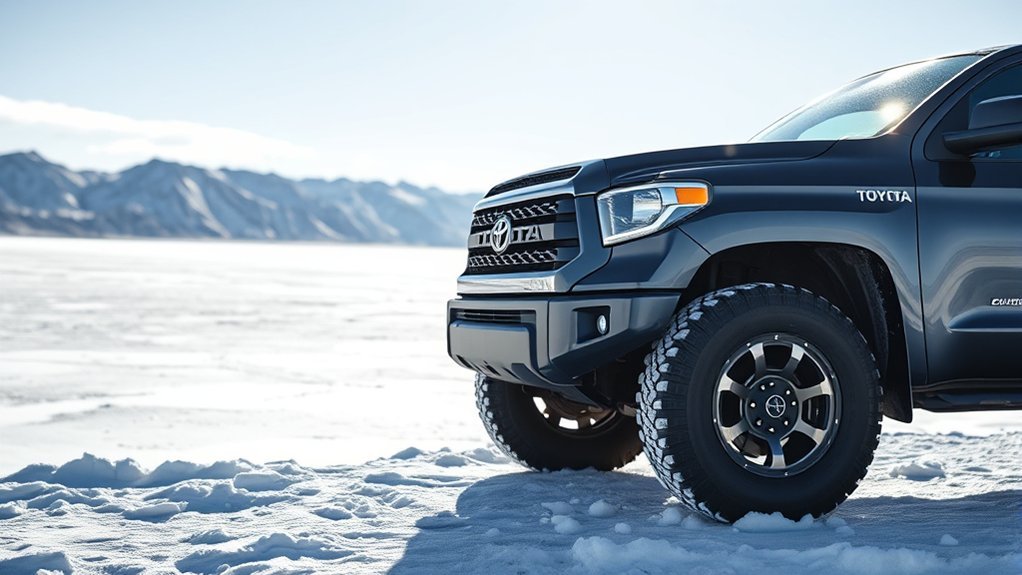
The best tire type for your Toyota Tundra depends on where you drive most, how often you tow or haul, and how much winter weather you face. A highway tire can make a daily commute quieter and smoother. An all-terrain tire gives you more grip on gravel, dirt, and light trails without giving up too much road comfort. A mud-terrain tire is more specialized and makes sense only if you regularly drive in deep mud, ruts, rocks, or loose off-road surfaces.
All-season tires work for mild climates and normal pavement use, but they are not the same as dedicated winter tires. If you often drive on snow, ice, or slush, a true winter tire or a severe-snow-rated tire with the Three-Peak Mountain Snowflake symbol gives better cold-weather confidence. Bridgestone notes that winter tires use tread rubber, deeper patterns, and biting edges designed for winter conditions, while all-season tires compromise across seasons.
| Tire Type | Best For | Main Tradeoff |
|---|---|---|
| Highway / H/T | Daily driving, long highway trips, quiet ride, fuel economy | Less grip on mud, rocks, and rough trails |
| All-Season | Mild climates, wet roads, light winter use | Not ideal for deep snow, ice, or hard off-road use |
| All-Terrain / A/T | Mixed pavement, gravel, dirt roads, camping, light trails, towing | More road noise and rolling resistance than highway tires |
| Mud-Terrain / M/T | Deep mud, ruts, rocks, loose trails, off-road-focused builds | Louder, heavier, rougher on pavement, and often weaker in wet braking |
| Winter / Snow | Frequent snow, ice, freezing rain, mountain roads | Faster wear in warm weather; should be used as a full set |
[Products Worth Considering]

Monitor tire tread wear with a smart, color-coded depth gauge that shows clear condition ranges at a glance. The bar is range marked for fast, easy readings, helping you maintain safer traction and performance. Each gauge is portable with a pocket clip, and the set includes 20 units for daily use and sharing.

These universal tire valve stem caps help protect valve cores from dust, debris, and moisture while helping maintain stable tire pressure. The corrosion-resistant metal construction and sealed design provide reliable protection in road grime, mud, and winter conditions. Twist-on installation makes them quick to fit on cars, SUVs, trucks, and motorcycles.

Keep your tires properly inflated with this analog VONDIOR tire pressure gauge, designed for fast, easy readings without batteries. The swiveling, two-axis hose and large glow dial help you measure at any tire angle with instant visibility. Built with a protective rubber shield, it supports durable, low-maintenance use for cars and trucks.
Essential Tire Features for Varying Terrains
Selecting the right tire type is only the first step. The details on the sidewall matter just as much, especially on a full-size truck like the Tundra.
- Correct size and load rating: Match the original tire size and load index unless a qualified tire professional confirms a safe alternative. This is especially important if you tow, haul, or drive with a loaded bed.
- Load range: Some Tundra owners choose LT tires for stronger construction during towing or off-road use. LT tires can feel firmer and weigh more, so they are not always the best choice for comfort-focused daily driving.
- Tread pattern: Tight tread blocks usually ride quieter on highways. Open tread voids help clear mud, snow, and gravel but can increase noise.
- Sidewall strength: Reinforced sidewalls help on rocky trails and job sites, but they may reduce ride softness.
- Wet traction: Look for strong wet-braking performance, siping, and channels that move water away from the contact patch.
- Severe-snow rating: For real winter use, look for the Three-Peak Mountain Snowflake symbol, not just an M+S marking.
Pro Tip: If your Tundra is mostly stock and you tow only occasionally, a quality all-terrain tire in the factory size is often the best balance of comfort, grip, tread life, and capability.
[Products Worth Considering]

These aluminum alloy tire valve stem caps with an O-ring seal help protect valve stems from corrosion while adding a clean, stylish look to your vehicle. The universal fit works across cars, trucks, motorcycles, bicycles, and more, making them an easy upgrade for everyday driving and off-road use. Installation is quick, and the included four-pack keeps all your tires dressed and protected.

Measure tire tread depth quickly and accurately with this LUMITECO dial gauge that reads in 1/32" increments up to 14/32". The color-coded green/yellow/red zones make it easy to judge tire wear and know when replacement is needed. A rugged, compact design with a protective pouch helps keep the gauge ready for use on cars, trucks, motorcycles, and more.

Adam’s Pro Tire Hex Grip applicators are molded foam sponges designed for precise, even tire dressing application. The ergonomic grip helps you spread product without overapplying, reducing sling that can splash onto paint and helping keep your hands clean during wheel and trim detailing. They’re durable, washable, and reusable for repeated detailing sessions.
How Driving Conditions Impact Tire Performance
Driving conditions shape tire performance more than brand names do. A tire that feels great on dry highways may struggle in clay mud. A mud-terrain tire that grips well off-road may feel noisy and heavy during a long commute. That is why your normal driving pattern should guide the final choice.
Here is a practical way to match common Tundra use cases with tire features:
| Condition | Best Tire Focus | Performance Impact |
|---|---|---|
| Highway commuting | H/T or quiet A/T | Better comfort, lower noise, and better fuel economy |
| Rain and wet pavement | Wet traction, siping, water channels | Improved braking and lower hydroplaning risk when tread is healthy |
| Gravel and dirt roads | All-terrain tread and stronger casing | Better cut resistance and traction on loose surfaces |
| Towing and hauling | Correct load index, heat resistance, stable tread | Improved stability and safer load support |
| Snow and ice | Winter tire or 3PMSF-rated tire | Better cold-weather grip, braking, and control |
Proper sizing also protects drivability. Staying close to the factory outside diameter helps preserve speedometer accuracy, transmission behavior, braking feel, and spare-tire compatibility. If you want a larger tire for appearance or ground clearance, confirm the fit before buying.
Recommended Tires for Your Toyota Tundra
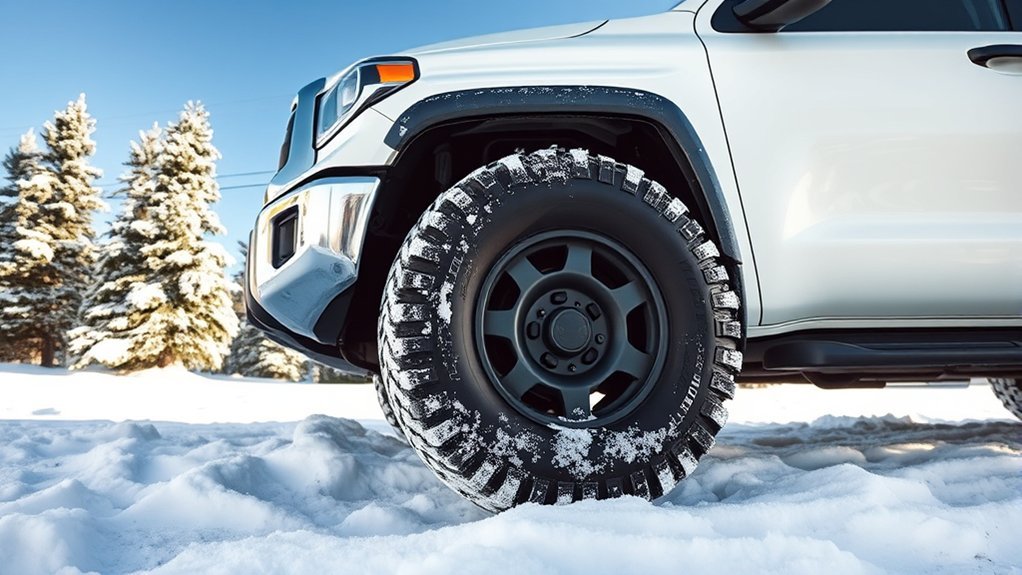
The strongest recommendation is not one single tire for every Tundra. It is the right tire category for your use case, in the right size and load rating for your truck.
- Best for mostly highway driving: Choose an H/T or touring-style truck tire. This is the best fit if you value quiet road manners, long tread life, smooth ride quality, and fuel economy more than trail traction.
- Best for mixed daily driving and light off-road use: Choose a balanced all-terrain tire. The Toyo Open Country A/T III is one sourced example because Toyo lists it as an on/off-road all-terrain tire with wet performance, durability, treadwear focus, and severe-snow qualification in many sizes.
- Best for factory-style off-road confidence: Use an all-terrain tire similar to the type fitted on off-road trims. Toyota lists the 2026 Tundra TRD Pro with Falken WildPeak all-terrain tires on 18-inch BBS forged-aluminum wheels.
- Best for mud and rocky trails: Choose a mud-terrain tire only if your truck spends real time off-road. Expect more tread noise, lower fuel economy, and less comfort on long pavement drives.
- Best for winter: Choose a full set of winter tires if you regularly drive in snow, ice, or freezing slush. If you want one tire for year-round use in a mild winter climate, look for an all-weather or all-terrain tire with the Three-Peak Mountain Snowflake symbol.
Note: If you tow often, do not buy only by tread style. Check load index, maximum load, speed rating, and pressure requirements. A tire with the right tread but the wrong load rating is the wrong tire for a Tundra.
[Products Worth Considering]

The SAFELIFE dial tire tread depth gauge measures tread depth in 1/32 inch increments with clear, easy-to-read 2-inch dial face. Color zones using a traffic light system help you quickly judge whether tread is low, marginal, or ample for safer driving. Built with a durable zinc cast body and a metal detect probe for precise, comfortable use across cars, motorcycles, trucks, and buses.

TIRESHIELD PRO RV tire covers in a set of four deliver year-round protection against UV rays, cracking, fading, water, and snow. The StormLock-System helps keep the covers securely fastened through high wind, while heavy-duty, double-stitched construction supports long-lasting performance. Designed for universal fit, they’re intended for RV, camper, truck, car, and trailer tires within the 26–28.75 inch diameter range, with easy wipe-clean care and storage in the included bag.

Upgrade your 2024-2026 Tesla Model 3 Highland with REEVAA all-weather mud flaps designed for seamless fit along the original body lines. The set of four delivers strong splash protection against mud, gravel, and road debris while using OEM-grade durable materials. Installation is non-destructive with original hole positions and snap-in clips, and the aerodynamic design helps minimize impact on efficiency.
Tips for Maintaining Tires for Optimal Performance
Good tires only perform well if you maintain them. Start by checking tire pressure at least once a month when the tires are cold. NHTSA defines a cold tire reading as one taken before driving or after the vehicle has been parked for at least three hours. Use the pressure on your Tundra’s tire label, not the maximum pressure printed on the tire sidewall.
Pressure also affects fuel economy. FuelEconomy.gov says proper inflation can improve gas mileage by 0.6% on average and up to 3% in some cases, while underinflated tires can lower mileage by about 0.2% for every 1 PSI drop in the average pressure of all tires.
Rotate your tires according to the owner’s manual. If Toyota recommends rotation for your setup, a common interval is about every 5,000 to 8,000 miles, or sooner if uneven wear appears. Tire rotation helps reduce irregular wear and keeps tread depth more even across the set.
Inspect tread depth, sidewalls, and shoulders before towing, highway trips, and off-road use. NHTSA says tires should be replaced when tread reaches 2/32 inch. Also replace tires with bulges, exposed cords, deep cuts, sidewall cracks, or repeated pressure loss.
Balance and alignment matter too. If your steering wheel shakes, the truck pulls, or the tread wears on one edge, have the tires and alignment checked. New tires should also be balanced when installed.
Your Tundra’s tires affect braking, steering, towing stability, fuel economy, and off-road traction. Size, load rating, pressure, and maintenance matter as much as the tread pattern.
Frequently Asked Questions
How often should I rotate my Tundra’s tires?
Check your owner’s manual first. If rotation is recommended for your wheel and tire setup, a common interval is about every 5,000 to 8,000 miles, or sooner if you notice uneven wear. Towing, off-road driving, and rough roads can make rotation more important.
What tire pressure is ideal for my Toyota Tundra?
Use the cold tire pressure printed on your Tundra’s driver-door Tire and Loading Information Label or in the owner’s manual. Do not use the maximum PSI printed on the tire sidewall as your normal pressure setting.
Can I mix different tire types on my Tundra?
Avoid mixing different tire types, sizes, tread patterns, or load ratings unless your owner’s manual specifically allows it. Mixing tires can affect braking, traction control, steering balance, and four-wheel-drive behavior. Winter tires should be installed as a full set.
When should I replace my Tundra’s tires?
Replace tires when tread reaches 2/32 inch, when treadwear indicators are level with the tread, or when you see unsafe damage such as bulges, exposed cords, deep cuts, cracking, or repeated air loss. Replace sooner if wet or winter traction has become poor.
How do I know if my tires are balanced?
Balanced tires should feel smooth at normal road speeds. If the steering wheel, seat, or floor vibrates, or if new tires shake after installation, have the tire balance checked. Uneven wear can also point to balance, alignment, suspension, or pressure problems.
Do I need LT tires on a Toyota Tundra?
Not always. LT tires can be helpful for heavier towing, hauling, gravel roads, and off-road use because they often have stronger construction. They can also ride firmer and weigh more. For daily driving, a properly rated P-metric or standard-load tire may be more comfortable.
Can I put larger tires on my Tundra?
You can in some cases, but larger tires must clear the fenders, suspension, mud flaps, brakes, and spare-tire area. They can also affect speedometer accuracy, gearing feel, fuel economy, braking, and warranty-related concerns. Confirm fitment before buying.
Are all-terrain tires good in snow?
Some all-terrain tires perform well in light snow, especially if they carry the Three-Peak Mountain Snowflake symbol. Still, dedicated winter tires are the better choice for regular ice, packed snow, freezing rain, and mountain winter driving.
Conclusion
The best tires for a Toyota Tundra are the tires that match your exact truck, load needs, and driving conditions. Choose highway tires for quiet pavement comfort, all-terrain tires for the best mixed-use balance, mud-terrain tires for frequent off-road work, and winter tires for regular snow and ice. Once they are installed, keep them properly inflated, rotated, balanced, and inspected. That combination gives your Tundra better traction, safer towing, longer tire life, and more confidence on every drive.
Sources
- Toyota Tundra official specs — current Tundra trim, wheel, capability, and TRD Pro tire context
- NHTSA TireWise tire safety guide — tire type, tire size, pressure, tread depth, rotation, balance, and alignment guidance
- FuelEconomy.gov tire inflation guidance — fuel-economy effect of proper tire pressure
- Toyo Open Country A/T III product page — all-terrain tire features, severe-snow qualification, and warranty information
- Bridgestone winter vs. all-season tire guide — winter tire construction, all-season limitations, and full-set winter tire guidance