
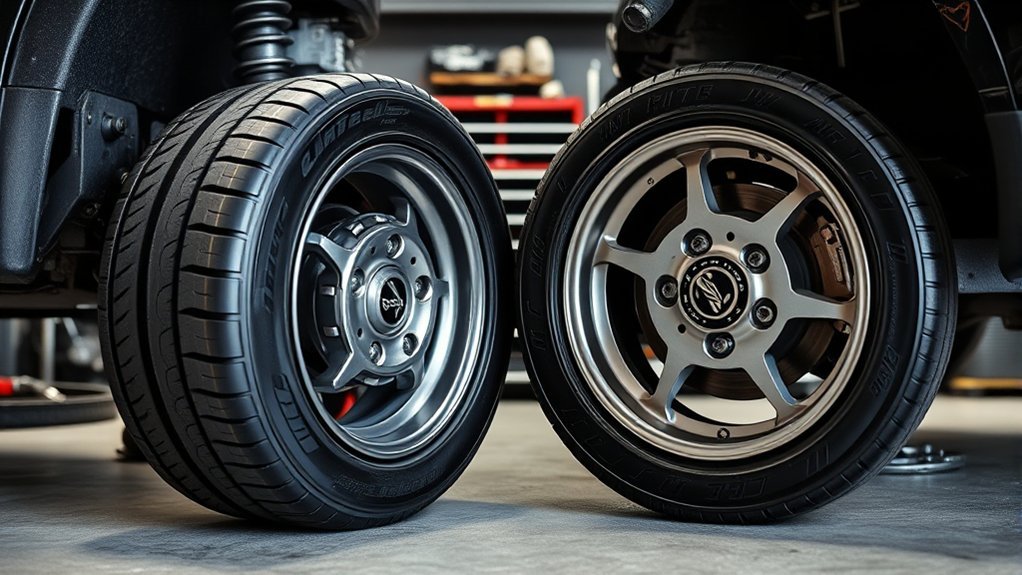
If you discover that a directional tire is mounted backwards, it usually does not mean the tire has been physically damaged. However, the tread is no longer rotating in the direction its manufacturer intended. That can reduce the performance benefits built into the tread, especially in rain, standing water, or snow. Check the sidewall rotation arrow and arrange to have the tire mounted correctly rather than treating reversed rotation as a normal setup.
Quick Answer
A directional tire mounted backwards usually will not suffer immediate structural damage, but it may not deliver its intended wet- or snow-road performance. Follow the rotation arrow on the sidewall. If the tire is installed in the wrong direction, have it remounted correctly as soon as practical.
Key Takeaways
- Running a directional tire backwards for a short period does not usually damage an otherwise sound tire, but that does not make reversed mounting the recommended setup.
- Directional tread is engineered to work in one forward rotation direction, often with a strong focus on water evacuation, hydroplaning resistance, and snow traction.
- Wet or snowy conditions are the main concern because incorrect rotation prevents the tread from working exactly as designed.
- Use the rotation arrow on the sidewall to confirm orientation instead of relying only on the tread’s appearance.
- For routine rotation, directional tires normally move front-to-rear on the same side unless they are professionally demounted and remounted while preserving the correct rolling direction.
Are Directional Tires Safe Backwards?
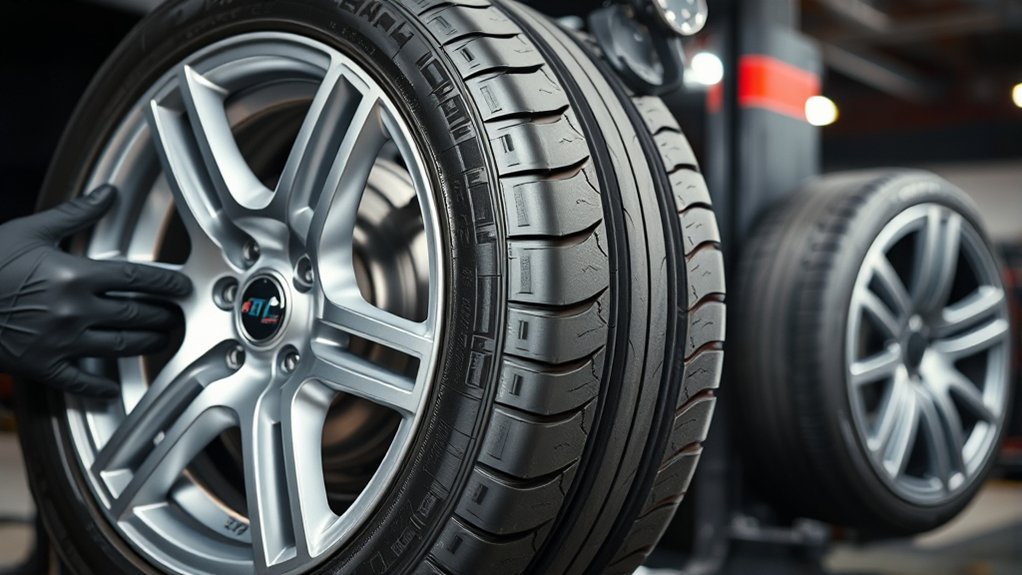
A directional tire mounted backwards will not normally suffer immediate structural damage simply because it rotates opposite its marked direction. Continental Tire says incorrectly mounted directional tires generally are not damaged by the orientation alone, assuming no other mechanical problem exists.
That does not mean you should leave the tire that way. Continental also says an incorrectly mounted directional tire should be demounted and remounted correctly as soon as possible.
A directional tread pattern is engineered to roll forward in one specific direction. Its grooves, blocks, and sipes are arranged to deliver the tire’s intended balance of traction, handling, water evacuation, noise, and wear. When the tire runs backwards, you cannot assume that it will provide the same performance.
Warning: Do not deliberately run directional tires backwards as a routine way to correct uneven wear. Follow the sidewall arrow and the tire or vehicle manufacturer’s approved rotation pattern.
What Happens When Tires Run Backwards?
When a directional tire runs backwards, the first issue is usually performance rather than immediate tire failure. The casing does not suddenly become unsafe merely because the wheel turns against the tread arrow, but the tread is no longer being used in its intended direction.
Incorrect directional mounting usually does not damage the tire by itself, but the tire may no longer deliver the performance its tread was designed to provide.
The difference can matter most where the tread design itself does important work, such as clearing water or creating traction in snow and slush. Continental’s tread guide explains that directional patterns commonly use V-shaped grooves to improve water displacement and hydroplaning resistance.
On a clean, dry road, you may not notice an obvious change during ordinary driving. That observation should not be turned into a blanket claim that backwards mounting is equally safe under every speed, load, temperature, tire model, or road condition.
Tire Rack also notes that directional tires can be run backwards briefly during a tire-pull diagnostic procedure without harming the tire. That is a short diagnostic exception, not a recommendation for routine reversed installation.
Are Backwards Tires Safe on Dry Roads?
Dry pavement generally places less demand on a directional tire’s water-management features, so a backwards-mounted tire may feel fairly normal in gentle dry-road driving. However, “it feels normal” is not the same as confirming that the tire is installed correctly.
The safest approach is to separate two questions:
- Will a short period of reverse rotation normally destroy the tire? No. Tire Rack states that a short diagnostic test with directional tires running backwards will not harm the tire.
- Should you intentionally leave the tire backwards? No. Tire manufacturers specify a rotation direction so the tread can deliver its intended performance.
Even in dry weather, correct the orientation when practical. You cannot predict how every directional design will respond under emergency braking, hard cornering, high speed, heavy load, cold temperatures, or a sudden change in weather.
Why Wet Roads Change the Risk
Wet roads make tread direction more important because the grooves must help move water away from the tire’s contact area. Directional patterns are often engineered specifically to improve this water displacement.
Running the tread in the wrong direction can prevent it from providing the water-management performance the manufacturer designed into it. That can reduce your safety margin in heavy rain or standing water.
The exact effect cannot be expressed as one universal percentage or stopping-distance increase because it varies with tire model, tread depth, water depth, speed, pressure, temperature, vehicle weight, and road surface.
Hydroplaning Risk in Wet Conditions
Hydroplaning occurs when a tire cannot move enough water away to maintain effective contact with the road. Speed, water depth, tire pressure, tread design, and remaining tread depth all influence the risk.
Directional tires often use angled or V-shaped grooves to improve water evacuation when rotating in their marked direction. Reversing the tire means those features are no longer operating in the orientation for which they were developed.
That is why you should not rely on a backwards-mounted directional tire for normal wet-weather driving when the problem can be corrected.
To reduce hydroplaning risk, slow down in heavy rain, leave additional following distance, avoid abrupt steering or braking, maintain correct tire pressure, and replace tires that have reached their wear limit.
Water Evacuation Changes Backwards
A directional tire does not simply become a different tire when reversed, but its groove network is being asked to work opposite its intended direction. It is therefore more accurate to say that water evacuation may be less effective than designed rather than claiming that every reversed tire literally pumps water toward the middle.
The effect becomes more important as conditions become demanding. Standing water, worn tread, higher speed, incorrect pressure, and heavy rain all reduce the margin available between normal grip and hydroplaning.
Pro Tip: Do not judge orientation only from the V-shape you see on the tread. Look for a sidewall arrow labeled “Rotation,” “Direction,” or a similar marking and follow that arrow.
Does Tire Type Affect Backwards Performance?
Yes. Tread design determines whether rotation direction matters and what sidewall markings you need to follow.
Directional, asymmetric, and symmetric tires do not all use the same mounting and rotation rules.
A directional tire is designed to roll in one direction and has a rotation arrow on its sidewall. A symmetric non-directional tire normally has much more flexibility in how it is mounted and rotated.
An asymmetric tire is different again. It has distinct inner and outer tread zones, so its sidewall is normally marked “Inside” and “Outside.” Once an asymmetric non-directional tire is mounted on the wheel with the correct side facing outward, the complete wheel can usually be used on either side of the vehicle unless another fitment restriction applies.
Some tires combine directional and asymmetric features. In that case, follow every relevant sidewall marking and the tire manufacturer’s instructions.
Do not assume that one tire model’s behavior applies to another. Rubber compound, groove shape, tread depth, block stiffness, tire size, pressure, vehicle load, and road conditions all affect performance.
How Backwards Tires Affect Braking and Cornering
There is no universal rule saying that every backwards directional tire will add a specific number of feet to a stop or cause a predictable amount of cornering loss. The effect depends on the tire and conditions.
| Area | What backwards mounting can mean |
|---|---|
| Dry braking | A difference may not be obvious in normal driving, but tire-specific emergency performance cannot be assumed. |
| Wet braking | The tire may not provide the wet-performance benefit intended by its directional grooves. |
| Cornering | Response can vary by tread design, road surface, load, pressure, and vehicle setup. |
| Standing water | Incorrect tread direction can reduce the intended water-evacuation advantage. |
| Driver feel | Subjective feel is not a reliable way to confirm correct installation. |
If a tire feels vague, noisy, unstable, or unusual after installation, inspect the sidewall markings, pressure, wheel fasteners, and tire condition rather than assuming orientation is the only possible cause.
How Directional Tires Wear When Reversed
Incorrect direction does not automatically mean the tire will develop structural damage or a specific wear pattern. Continental states that an incorrectly mounted directional tire generally will not be damaged by orientation alone.
More importantly, reversing a directional tire is not a proper repair for uneven wear. Shoulder wear, feathering, cupping, or rapid tread loss can point to incorrect inflation, alignment problems, worn suspension parts, imbalance, vehicle loading, aggressive driving, or an unsuitable rotation schedule.
NHTSA’s TireWise guidance recommends regular pressure and tread checks and notes that proper rotation, wheel balance, and alignment can help tires wear more evenly.
Check tread depth across several points on each tire rather than measuring only one groove. Also inspect for cracks, cuts, bulges, exposed cords, embedded objects, or other physical damage.
NHTSA says passenger tires should be replaced when tread is worn to 2/32 inch. A tire that has reached its wear bars should not be kept in service simply by changing its position on the vehicle.
When Rotating Directional Tires Makes Sense
Directional tires should still be rotated when the vehicle and tire manufacturers recommend rotation, but the pattern is more limited than it is with many non-directional tires.
Michelin’s current tire-rotation guidance says directional tires should stay on the same side of the vehicle and move front-to-rear.
If you want to move a directional tire to the opposite side, the tire may need to be removed from its wheel and remounted so the rotation arrow still points in the correct forward direction. Have that work performed by a qualified tire technician.
Rotation may also be restricted when the vehicle uses different front and rear tire sizes, commonly called a staggered fitment. Always check the owner’s manual before choosing a rotation pattern.
[Products Worth Considering]

This universal spare tire mount fits 4, 5, and 6 lug trailer wheels with bolt patterns from 4" to 5.5" and helps keep your tire securely locked in place. Its reinforced triangular structure with a sturdy behind plate is designed to handle up to 150 lbs, making it suitable for boat, camper, and RV spare tire mounting. The angled raised design reduces wind resistance and installation is straightforward with different length bolts and no drilling required.

Measure tire tread depth quickly and accurately with this LUMITECO dial gauge that reads in 1/32" increments up to 14/32". The color-coded green/yellow/red zones make it easy to judge tire wear and know when replacement is needed. A rugged, compact design with a protective pouch helps keep the gauge ready for use on cars, trucks, motorcycles, and more.

Monitor tire tread wear with a smart, color-coded depth gauge that shows clear condition ranges at a glance. The bar is range marked for fast, easy readings, helping you maintain safer traction and performance. Each gauge is portable with a pocket clip, and the set includes 20 units for daily use and sharing.
Dry-Weather Rotation Benefits
Regular, correctly performed rotation can help spread normal wear among usable wheel positions. The benefit comes from changing the tire’s position on the vehicle—not from intentionally making a directional tread run backwards.
| Check | Why it matters |
|---|---|
| Rotation arrow | Keeps the directional tread working as designed. |
| Tread depth | Shows whether wear is reasonably even and whether replacement is approaching. |
| Tire pressure | Incorrect pressure can accelerate uneven wear and change handling. |
| Alignment | Poor alignment can cause rapid shoulder wear or feathering. |
| Owner’s manual | Provides the correct interval and rotation pattern for the vehicle. |
NHTSA says that when the vehicle manufacturer recommends rotation, an interval of roughly 5,000 to 8,000 miles may be appropriate, but your owner’s manual and tire warranty should take priority.
Wear Balancing Strategies
If one shoulder is wearing faster than the other, do not simply reverse the tire and continue driving. First find out why the wear is occurring.
Check cold inflation pressure against the vehicle’s tire-information placard, measure tread depth across the full tread width, and inspect the tire for feathering, cupping, bulges, cuts, or other damage.
If the pattern suggests an alignment or suspension problem, have the vehicle inspected. Correcting the underlying cause gives you a better chance of preserving the remaining tread than using an incorrect rotation direction.
When cross-vehicle rotation is desirable, a tire shop can determine whether the directional tires can be professionally demounted and remounted while maintaining the specified direction. Staggered sizes or other vehicle restrictions may still prevent that strategy.
What to Do if a Directional Tire Is Mounted Backwards
If you notice a reversed directional tire after installation or rotation, use this checklist:
- Confirm that it is actually directional. Look for a sidewall arrow marked “Rotation,” “Direction,” or equivalent wording.
- Check all four tires. One incorrect wheel may mean the installation pattern should be reviewed as a set.
- Inspect pressure and condition. Look for visible damage and check cold pressure against the vehicle placard.
- Avoid unnecessary demanding driving. Until corrected, be especially cautious in heavy rain, standing water, snow, or other low-grip conditions.
- Have the tire remounted correctly. Continental recommends correcting an incorrectly mounted directional tire as soon as possible.
- Ask why it happened. If the error followed a rotation, confirm that the shop used an appropriate directional-tire rotation pattern.
Note: A directional tire and an asymmetric tire are not the same thing. Directional tires use a rotation arrow. Asymmetric tires normally use “Inside” and “Outside” markings. Follow every marking present on the tire.
[Products Worth Considering]

Malco tire mounting and demounting lubricant is a ready-to-use tire lube formulated to reduce friction during tire installation for passenger cars, light trucks, farm tires, and heavy-duty equipment. It provides rust-inhibiting protection to help reduce corrosion on rims and wheels, and helps support proper tire bead seating during inflation to reduce air leakage. The silicone-free, soap-free formula is whitewall safe to help prevent discoloration on whitewall tires and sensitive sidewall markings.

The SAFELIFE dial tire tread depth gauge measures tread depth in 1/32 inch increments with clear, easy-to-read 2-inch dial face. Color zones using a traffic light system help you quickly judge whether tread is low, marginal, or ample for safer driving. Built with a durable zinc cast body and a metal detect probe for precise, comfortable use across cars, motorcycles, trucks, and buses.

Accurately measure tire tread depth with a calibrated gauge marked from 0 to 1 inch in 1/32 inch increments. The color-coded bar helps you quickly identify tread condition ranges, supporting safe driving for trucks, motorcycles, automobiles, and passenger vehicles.
Can You Use a Backwards Tire as a Spare?
A full-size directional spare can create a practical problem: if it is already mounted on a wheel for one side of the vehicle, installing it on the opposite side may make the tread rotate against its arrow.
Do not assume that this is automatically approved simply because brief reverse rotation normally does not damage the tire. Spare-tire rules vary by vehicle, tire type, wheel size, drivetrain, and manufacturer.
Follow the vehicle owner’s manual and any instructions printed on the spare. If emergency use puts a directional full-size tire in the wrong rotation direction and the manufacturer permits that temporary use, treat it as a temporary measure and arrange proper mounting as soon as possible.
Compact temporary spares have their own pressure, speed, distance, and placement restrictions. Those instructions take priority over general advice about directional tread.
[Products Worth Considering]
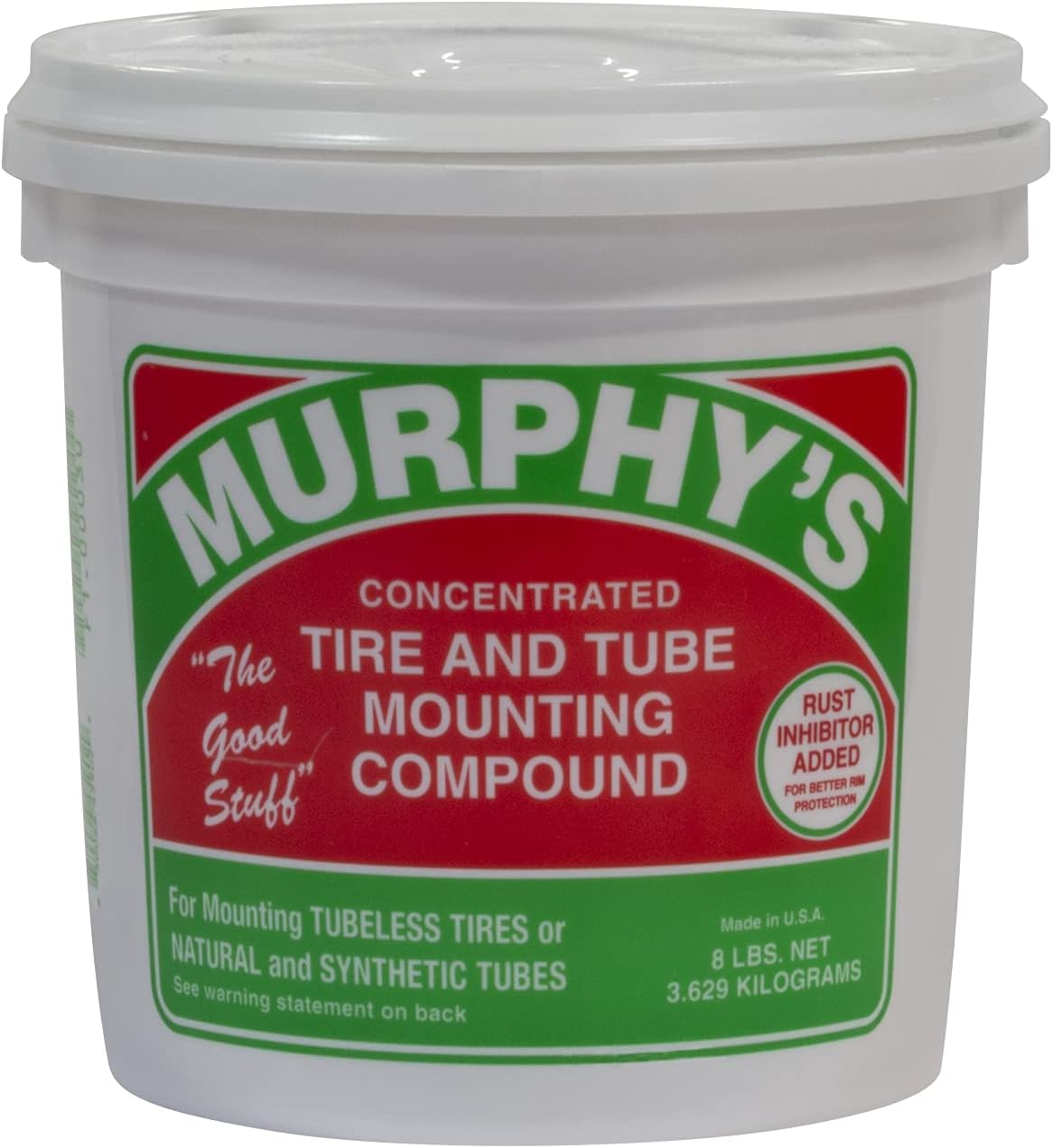
A concentrated tire and tube mounting compound designed to help simplify mounting rubber tires and tubes on passenger, semi truck, construction, and OTR applications. Its ultra-thick formula packs beads effectively and includes rust inhibitors to help protect against corrosion during use.

Measure tyre tread depth precisely with a digital gauge that reads in both MM and inches, helping you monitor safe driving conditions. The large LCD screen is easy to operate, and the compact tool fits for cars, trucks, and motorcycles. It provides high accuracy with a 0-25.4mm range and includes a 1-year warranty for added peace of mind.

Secure a full-size spare on your trailer with this powder-coated steel spare tire mount bracket. It fits most 4-, 5-, and 6-lug wheel bolt patterns and mounts to trailer tongues up to 4 in wide and 5 in tall. Built for reliable carry with a max 150 lb load rating and includes zinc-plated hardware for straightforward installation.
Signs a Tire Is Mounted the Wrong Way
The most reliable sign is not a change in handling—it is the sidewall marking.
Look at the upper half of the tire. The directional arrow should point in the direction that the tire moves when the vehicle travels forward. Check every tire individually.
Wet grip, noise, steering feel, or handling may change when a tire is installed incorrectly, but those symptoms are not dependable diagnostic tools because pressure, alignment, tire damage, wheel balance, road surface, and suspension condition can produce similar symptoms.
Tread Arrow Direction
Directional tires have an arrow that identifies the required forward rotation. Continental states that the arrow should point toward the front of the vehicle when viewed on the upper half of the tire.
Treat this arrow as the installation instruction. A V-shaped tread may help you recognize a directional design, but visual tread shape alone is not a substitute for reading the sidewall.
If the arrow points the wrong way when the vehicle is moving forward, the tire is installed incorrectly for its directional design.
Wet Grip Changes
A reversed directional tire may feel normal in mild conditions, which is one reason an installation mistake can go unnoticed. Rain can expose the problem because directional grooves are often optimized for water evacuation in their marked rotation direction.
You should not test a suspected backwards-mounted tire by intentionally driving quickly through standing water or performing emergency-braking experiments. Inspect the sidewall instead and correct the mounting.
If the vehicle still has poor wet grip after the tires are correctly mounted, check tread depth, pressure, alignment, tire age and condition, and whether the tire itself is suitable for the conditions in which you drive.
Frequently Asked Questions
Does It Matter if Directional Tires Are Put on Backwards?
Yes. A directional tread is designed to rotate one way. Backwards mounting usually does not immediately damage the tire, but it can prevent the tread from delivering its intended performance, particularly in wet or snowy conditions. Follow the sidewall rotation arrow and have an incorrectly mounted tire corrected.
What Happens if You Mount a Tire Backwards?
If the tire is truly directional, it will rotate opposite the direction intended by its tread design. Immediate structural damage is unlikely from orientation alone, but wet, snow, noise, handling, or other performance characteristics may not match the manufacturer’s design.
What Happens if Directional Tires Are on the Wrong Way?
The tire will normally continue to roll, but the directional grooves are no longer working in their specified forward orientation. This is especially important in rain, standing water, slush, or snow. Correct the installation rather than relying on normal-feeling dry-road handling.
Which Way Should Directional Tires Be Mounted?
Mount them so the rotation arrow on the sidewall points in the tire’s forward rolling direction. When viewed at the top of the tire while it is installed on the vehicle, the arrow should point toward the front of the vehicle.
Can Directional Tires Be Rotated Side to Side?
Not by simply moving the complete wheels across the vehicle if doing so reverses their rolling direction. Directional tires normally rotate front-to-rear on the same side. Crossing sides may require professional demounting and remounting so each tire continues to follow its arrow.
Will Driving a Directional Tire Backwards Damage It?
Incorrect rotation alone does not normally cause immediate structural damage to an otherwise sound tire. Tire Rack even permits brief reverse rotation during a tire-pull diagnostic test. However, manufacturers still specify correct orientation for performance, so an installation error should be corrected rather than left in place.
Sources
- Continental Tire — Mounting of Tires with Directional and Asymmetrical Tread Patterns — correct rotation-arrow orientation and guidance for incorrectly mounted tires.
- Continental Tires — Tire Tread — directional tread design, water displacement, hydroplaning resistance, and tread functions.
- Michelin USA — Tire Rotation Guide — same-side front-to-rear rotation guidance for directional tires.
- Tire Rack — How Do I Diagnose a Tire Pull? — confirms that brief reverse rotation during diagnostic testing will not harm a directional tire.
- NHTSA TireWise — tire pressure, tread, alignment, rotation, inspection, and replacement guidance.
Conclusion
You can usually move a car briefly with a directional tire mounted backwards without immediately damaging the tire, but that is different from saying the installation is correct. Directional tread is engineered to rotate one way, with wet- and snow-road performance often being an important part of the design. Check the sidewall arrow, keep directional tires rotating as specified, use the correct rotation pattern, and have an incorrectly mounted tire corrected as soon as practical.
