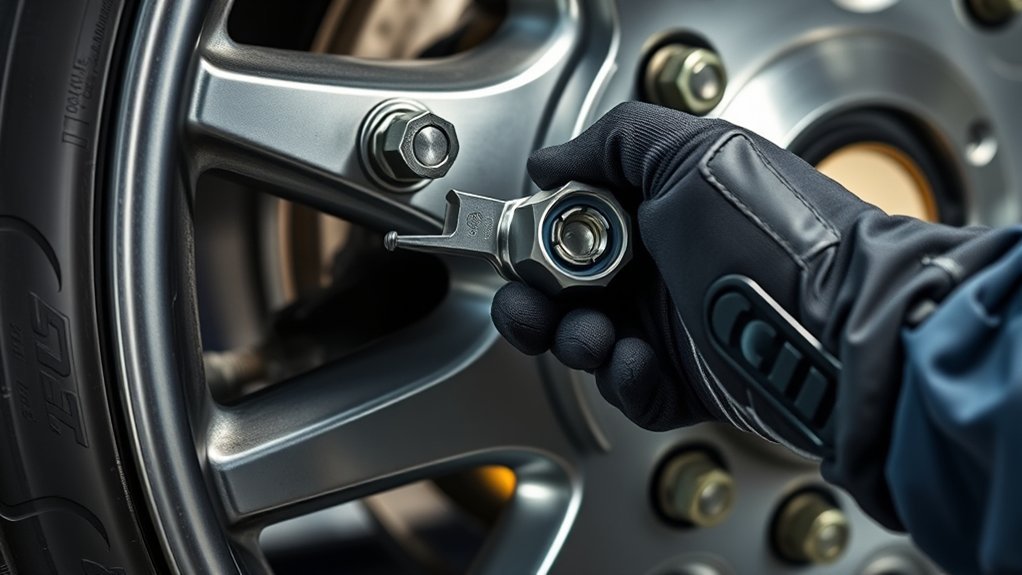
Loose lug nuts can let a wheel move against the hub, creating vibration, clicking or clunking and, in severe cases, wheel separation. The safest response depends on what you see and feel. If a wheel is visibly wobbling, a lug nut is missing, or strong clunking starts after wheel service, stop driving and have the wheel inspected before continuing.
Quick Answer
Possible signs of loose lug nuts include new wheel vibration, repetitive clicking or clunking, visible movement at the wheel, or a nut that is missing or backed away from its seat. Do not guess at the torque. Use the vehicle maker’s exact specification and have a wheel inspected if it has been driven while loose.
Key Takeaways
- New vibration or clunking after a tire rotation, brake job or wheel removal deserves immediate attention.
- Vibration alone does not prove lug nuts are loose; tire imbalance, wheel damage and brake problems can feel similar.
- A wheel that has actually moved can damage its studs, lug seats, holes and mounting surfaces, so tightening the nuts may not be enough.
- Always use the exact manufacturer torque specification rather than a generic ft-lb range.
- Use a calibrated torque wrench and the manufacturer’s cross or star sequence for final tightening.
- Follow the vehicle or wheel maker’s recheck interval after wheel removal; published instructions commonly vary from about 25 to 100 miles.
At a Glance
| Time Required | About 10–20 minutes for a basic torque check; longer if inspection or repair is needed |
| Difficulty | Beginner for checking known-good fasteners; professional inspection recommended after wheel movement or stud damage |
| Tools Needed | Owner’s manual or approved torque data, correct socket and calibrated torque wrench |
| Cost | Little or no cost for a torque check if you already have the correct tool; damaged studs, wheels or hubs require repair |
What Are the Warning Signs of Loose Lug Nuts?
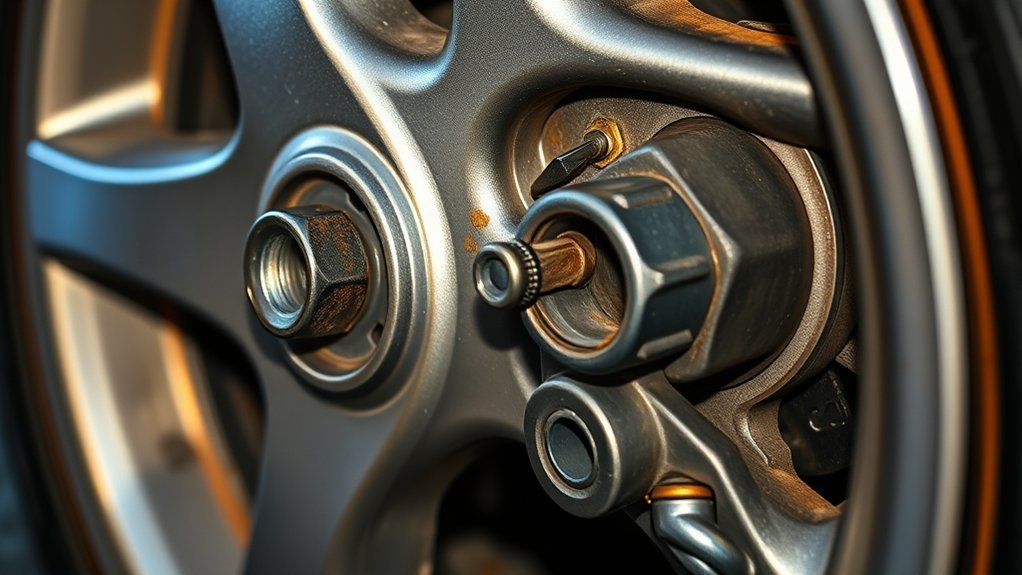
Loose lug nuts do not always create an obvious warning immediately. When symptoms do appear, you may notice a new vibration through the steering wheel, seat or floor, particularly if the wheel is beginning to move on the hub.
You may also hear a repetitive clicking, knocking or clunking sound that changes with vehicle speed. General Motors service information has documented wheel-area clicking associated with incorrect lug-nut torque, although similar noises can have other causes.
Visible clues are more concerning. A missing lug nut, a nut sitting noticeably farther outward than the others, fresh metal marks around a lug seat, or visible wheel movement should be treated as a potential wheel-fastener problem.
Note: Steering-wheel vibration is not proof that your lug nuts are loose. Tire imbalance, damaged tires, bent wheels, alignment problems and brake issues can produce similar symptoms. The timing matters: vibration that begins soon after a wheel was removed or serviced deserves especially prompt inspection.
Uneven tire wear by itself is not a reliable way to identify loose lug nuts. Alignment, tire pressure, balance and worn suspension components are much more common explanations for unusual tread wear.
A new vibration or clunk immediately after tire, brake or wheel service is a reason to inspect the wheel fasteners promptly—not a reason to keep driving until the symptom gets worse.
Warning: If the wheel visibly wobbles, one or more lug nuts are missing, or you hear severe repetitive clunking accompanied by unstable handling, pull over in a safe location. Do not continue driving merely after tightening the remaining nuts. Arrange professional inspection or towing because the studs, wheel holes or lug seats may already be damaged.
What Causes Lug Nuts to Loosen?
Loose lug nuts are especially concerning after a wheel has recently been removed. Incorrect initial torque, dirt or corrosion between the wheel and hub, damaged threads, incorrect fasteners or an improperly seated wheel can prevent the fasteners from producing the correct clamping force.
Ford specifically warns that corrosion, dirt or foreign material on wheel-to-hub mounting surfaces can prevent proper metal-to-metal contact and allow wheel nuts to loosen. Its current guidance also specifies that torque values apply to threads in the required condition for that application.
Other possible causes include damaged lug seats, stretched studs, incompatible aftermarket wheels, incorrect lug-nut seat styles, or failing to follow the required tightening sequence.
- Under-torque: The fastener may not create enough clamping force.
- Over-torque: Threads or studs can be stretched or damaged.
- Dirty mounting surfaces: Rust or debris can prevent the wheel from seating flat.
- Wrong fastener: A cone-seat, ball-seat or flat-seat nut must match the wheel design.
- Damaged hardware: Deformed threads or lug holes may prevent secure clamping.
- Improper installation: Tightening one fastener fully before the wheel is evenly seated can create uneven loading.
Why Loose Lug Nuts Are So Dangerous
Lug nuts do more than keep the wheel from falling off. Correctly tightened fasteners clamp the wheel securely against the hub. When that clamping force is lost, the wheel can begin moving where it should remain fixed.
The movement transfers abnormal forces into the remaining lug nuts, studs, wheel seats and mounting surfaces. If the condition continues, the damage can progress from vibration to elongated wheel holes, damaged studs or complete wheel separation.
Wheel Wobble Risks
A wheel that is no longer clamped firmly against its mounting surface can shift as the vehicle accelerates, brakes and turns. At first, you may feel only a faint vibration. More movement can produce stronger shaking or clunking and affect vehicle control.
Every shift can place extra load on the fasteners that remain tight. This is why an actively wobbling wheel should not be treated as a minor vibration problem.
The movement can also damage the wheel’s lug holes or seats. Once those areas are deformed, simply tightening the nuts may no longer restore a safe mounting surface.
Stud And Rotor Stress
Incorrectly tightened wheel fasteners can damage wheel studs. General Motors has also warned that improper wheel-nut tightening can contribute to brake pulsation and rotor damage on affected applications.
- Remaining fasteners can be forced to carry more load.
- Stud threads can stretch, deform or become damaged.
- Lug seats and wheel holes can become worn or elongated.
- Uneven mounting can contribute to brake vibration on some vehicles.
If you know a wheel was driven while loose, inspect more than the torque value. The wheel, studs, nuts, lug seats and mounting surfaces should all be checked for damage.
Wheel Detachment Danger
The worst outcome is complete wheel separation. Ford and other manufacturers explicitly warn that poor wheel mounting or incorrectly secured fasteners can allow a wheel to come off while the vehicle is moving.
You should therefore treat missing fasteners, visible wheel movement or severe clunking as an immediate safety concern rather than trying to reach your destination first.
What Should You Do if You Suspect Loose Lug Nuts?
If symptoms begin while driving, reduce speed smoothly and move to a safe location away from traffic. Avoid hard braking, aggressive steering and additional high-speed driving.
- Look at the wheel. Check for missing nuts, obvious gaps, a tilted wheel or fresh damage around the lug holes.
- Consider recent service. Note whether the wheel was recently removed for a tire rotation, flat repair, brake job or other work.
- Do not keep driving a visibly loose wheel. Arrange towing or roadside assistance if the wheel moves, fasteners are missing or severe symptoms are present.
- Have damaged parts inspected. A technician should check the studs, nuts, wheel seats, holes and hub contact surfaces if the wheel has been moving.
- Use the exact torque specification. Once the assembly is confirmed serviceable, torque it according to the vehicle or approved wheel manufacturer’s instructions.
[Products Worth Considering]

Upgrade your wheels with MIKKUPPA closed-end lug nuts designed for reliable fit and corrosion resistance. The one-piece, cold-forged and heat-treated steel construction helps resist rust and stripping, while the integrated finish delivers a durable black appearance. Built to OEM standards with a conical 60-degree seat, these nuts provide a secure solution for compatible Ford, Honda, Jeep, and Chevrolet models.

These M14x1.5 closed-end chrome lug nuts are a one-piece replacement designed for secure fitment on compatible GM, Ford, and select Chrysler/Dodge models. Featuring a 60-degree conical seat and anti-rust chrome plating, they help resist corrosion and maintain a bright look for everyday driving. Built for long-term durability, they include OEM-style part references and are backed by 12 months of support.

Upgrade your wheels with MIKKUPPA M12x1.5 mag seat lug nuts built for secure, corrosion-resistant performance. These closed-end chrome lug nuts are a direct replacement for select Toyota models, including Camry, Corolla, RAV4, Sienna, Avalon, Highlander, Matrix, Venza, and Prius. Triple-chromium plating and cold-forged, heat-treated steel help deliver strength for daily driving and replacement needs.
How Do You Tighten Lug Nuts Correctly?
Correct wheel installation starts before you touch the torque wrench. The wheel and hub contact surfaces must be properly seated and free of material that prevents full contact. The studs, nuts and wheel seats must also be undamaged and compatible.
Start each lug nut by hand. This helps prevent cross-threading and confirms that the nut turns normally on the stud. Snug the fasteners progressively using the cross or star sequence specified for the wheel pattern.
For final tightening, use a calibrated torque wrench set to the exact value listed by the vehicle manufacturer or approved aftermarket wheel manufacturer. Follow the service manual’s instructions about vehicle position during final torque.
[Products Worth Considering]

The Trivd Frol 1/2" air impact wrench delivers high performance torque up to 1500 ft-lbs with a twin hammer impact mechanism for strong, balanced blows. It features an ergonomic grip, compact lightweight design, and quick-stop control with 3 forward speeds up to 8000 RPM plus a reverse speed. Built for demanding automotive repair and tire shop work, the rear exhaust helps keep debris away from the surface.

This 1/2-inch drive breaker bar delivers powerful leverage for loosening and tightening stubborn lug nuts and automotive fasteners. The 180-degree flex head helps you reach tight spaces at the angle you need, making tire and brake jobs easier. A spring-loaded ball detent design holds 1/2-inch sockets securely while the chrome-moly head provides durable strength for everyday use.

This car D-wheel lock nut key provides an anti-theft solution for D-shaped wheel lock bolts, helping keep your wheels secure. It features a flower-shaped internal pattern that resists micro-adjustment theft while allowing removal and mounting of compatible locking nuts. Made for reliable performance under high torque, it’s easy to use with standard socket wrench turning for quick tire maintenance and emergency repairs.
Correct Torque Procedure
- Park on a stable, level surface and secure the vehicle according to its owner’s manual.
- Confirm the correct wheel, fastener type and torque specification.
- Inspect the studs, lug nuts, wheel seats and mounting surfaces.
- Remove dirt, loose rust or foreign material as directed by the manufacturer.
- Start every lug nut by hand to avoid cross-threading.
- Snug the fasteners evenly using the correct cross/star sequence.
- Set a calibrated torque wrench to the specified value.
- Tighten each fastener in the prescribed sequence until the wrench indicates the target torque.
- Do not add several extra pulls after the torque wrench reaches its setting.
- Follow the manufacturer’s required torque-recheck procedure after driving.
Pro Tip: Do not put oil, grease or anti-seize on wheel-stud threads unless the exact manufacturer procedure instructs you to. Many published torque specifications assume clean, dry threads. Lubrication changes friction and can change the clamping force produced by the same torque-wrench setting.
An impact wrench may be useful during professional service, but it should not replace the manufacturer’s required final torque procedure. A calibrated torque wrench gives you a controlled final value rather than relying on the feel or maximum output of a power tool.
Retorque After Driving
Many manufacturers require or recommend a torque recheck after a wheel has been removed and reinstalled, but the mileage is not universal.
For example, Ford’s current online guidance for one application says to retighten the lug nuts to specification within 100 miles after wheel disturbance. Toyota specifies a 100-mile recheck in the cited Tundra procedure, while another OEM manual hosted by NHTSA specifies a check after 25 miles.
Follow the instructions for your exact vehicle and wheel instead of assuming every car uses a 50–100-mile rule.
Note: A torque recheck is not the same as automatically tightening every lug nut farther. The goal is to verify that each fastener meets the specified torque without deliberately exceeding it.
What Torque Specs Should You Use?
There is no safe universal lug-nut torque number. Use the specification for your exact vehicle, wheel and fastener combination.
Current OEM examples show why guessing is unreliable. A 2024 Toyota Corolla lists a wheel-nut torque of 76 ft-lb (103 N·m), while a 2026 Toyota Land Cruiser lists 97 ft-lb (131 N·m). Ford’s current online manual for another application specifies 100 ft-lb (135 N·m).
Heavy-duty and commercial applications can require very different values, so broad ranges are not a substitute for the manual.
- Check the owner’s manual or official service information.
- For aftermarket wheels, verify the wheel maker’s approved fastener and torque requirements.
- Make sure locking lug nuts follow their manufacturer’s instructions.
- Use the required thread condition—normally whatever the OEM specifies for that torque value.
- Never increase torque simply because a nut “doesn’t feel tight enough.”
Under-tightening can leave inadequate clamping force. Excessive torque can stretch studs, damage threads or make roadside wheel removal difficult.
[Products Worth Considering]

The 22800 wheel stud installer makes replacing wheel studs quick and secure, saving time and effort during tire service. It uses a ratchet or impact wrench to pull new studs firmly into place, helping when existing studs are too long. Compatible with most automotive wheels and light-duty truck wheel studs, it’s designed for easy, tool-assisted installation.

The SEESII cordless impact wrench delivers high tightening and loosening power for fast wheel bolt and industrial bolt work. Its brushless motor and variable-speed 3 forward/2 reverse modes help you control precision installs and stubborn nut removal. A dual-battery system with rapid charging and an included storage case make it ready for home, car, and jobsite use.

Malco tire mounting and demounting lubricant is a ready-to-use tire lube formulated to reduce friction during tire installation for passenger cars, light trucks, farm tires, and heavy-duty equipment. It provides rust-inhibiting protection to help reduce corrosion on rims and wheels, and helps support proper tire bead seating during inflation to reduce air leakage. The silicone-free, soap-free formula is whitewall safe to help prevent discoloration on whitewall tires and sensitive sidewall markings.
When Should You Recheck Lug Nuts?
Check the manufacturer’s instructions whenever a wheel has been removed for a tire rotation, brake repair, flat-tire change or other service.
Some OEM procedures call for a follow-up within 25 miles, while others specify a check within 100 miles. That variation is why the owner’s manual or official service information should control the interval.
You should also inspect a wheel promptly if you develop new vibration, clicking or clunking after service, or if you notice a missing fastener.
A severe pothole or curb impact is primarily a reason to inspect the tire and wheel for damage. If the impact is followed by wheel-area noise, vibration or visible damage, have the complete wheel assembly checked rather than simply adding torque to the nuts.
How Do Tire Shops Prevent Loose Lug Nuts?
A good wheel-installation procedure controls several variables instead of relying on an impact wrench alone. The technician confirms the correct fasteners and torque specification, checks mounting surfaces, starts fasteners correctly, follows the required tightening sequence and verifies final torque with an appropriate calibrated tool.
- Check the vehicle or wheel manufacturer’s torque specification.
- Inspect studs, nuts, wheel seats and mounting surfaces.
- Start lug nuts without cross-threading.
- Use the required cross or star tightening sequence.
- Control final torque with a calibrated tool.
- Advise the customer of any manufacturer-required torque recheck.
Some shops also use written or electronic quality-control procedures, but practices differ by facility. You should not assume every tire shop follows the same documentation system.
If a shop has just removed your wheels, ask what torque specification was used and whether your vehicle or aftermarket wheel maker requires a follow-up check.
What Should Be Inspected After Lug Nuts Were Loose?
If you caught a slightly under-torqued fastener before the wheel moved, correcting the torque may be all the manufacturer requires. A wheel that has visibly shifted, clunked or been driven with missing fasteners deserves a more complete inspection.
A technician should check:
- Wheel studs for stretched, damaged or distorted threads.
- Lug nuts for damaged threads or seating surfaces.
- Wheel holes and lug seats for elongation, cracking or deformation.
- The wheel-to-hub mounting surfaces for rust, debris or damage.
- The wheel and hub for signs of abnormal movement.
- Brake components if vibration or damage developed while the wheel was loose.
Replacing damaged hardware is safer than trying to compensate by applying extra torque.
Frequently Asked Questions
Can You Over-Tighten Lug Nuts on a Tire?
Yes. Excessive torque can damage threads, stretch wheel studs and make the fasteners difficult to remove. Use the exact vehicle or approved wheel manufacturer’s torque specification and a calibrated torque wrench rather than tightening by feel.
How Tight Do You Need to Tighten Lug Nuts?
Tighten them to the exact specification for your vehicle, wheel and fastener combination. There is no universal ft-lb number. Check the owner’s manual or official service information and follow the required tightening sequence and thread condition.
What Happens if I Drive With Loose Lug Nuts?
The wheel can move against the hub, placing abnormal loads on the remaining fasteners and damaging studs, lug seats or wheel holes. Severe loosening can lead to wheel separation. If the wheel visibly wobbles, fasteners are missing or strong clunking is present, stop driving and arrange inspection or towing.
How Do I Tell if Someone Loosened My Lug Nuts?
Mechanical symptoms cannot tell you who loosened a fastener or whether it was intentional. Look for missing or visibly backed-off nuts and photograph anything unusual before repairs if you suspect tampering. Do not drive a wheel that appears insecure. Have the vehicle inspected, and contact law enforcement if you have specific evidence of deliberate tampering.
Can Loose Lug Nuts Cause Steering-Wheel Vibration?
They can if the wheel begins moving on the hub, but vibration has many other possible causes. Wheel imbalance, tire damage, brake problems and bent wheels can feel similar. A vibration that starts soon after wheel service deserves an immediate fastener and wheel inspection.
Should You Put Anti-Seize on Lug-Nut Threads?
Not unless the exact vehicle or wheel manufacturer specifically instructs you to. Lubrication changes thread friction, so a torque value intended for dry threads can produce a different clamping load when lubricant is added.
Do Lug Nuts Always Need to Be Rechecked After 50–100 Miles?
No single mileage applies to every vehicle. Published manufacturer instructions vary. Some call for a check after about 25 miles, while others specify within 100 miles after a wheel has been removed. Follow the procedure for your exact vehicle and wheels.
Conclusion
Loose lug nuts can progress from a minor fastening problem to damaged studs, a damaged wheel or complete wheel separation. Treat new vibration or clunking after wheel service as a reason to inspect—not as proof of the diagnosis. If a wheel is visibly moving or fasteners are missing, stop driving.
For installation, hand-start the fasteners, make sure the wheel and mounting surfaces are in proper condition, use the manufacturer’s tightening sequence and finish with a calibrated torque wrench set to the exact specification. Never substitute a generic torque range or add thread lubricant unless the manufacturer specifically calls for it.
Sources
- Ford Owner’s Manual — Wheel Nuts — backs correct torque, clean mounting surfaces and rechecking after wheel disturbance.
- Toyota 2024 Corolla Owner’s Manual — demonstrates vehicle-specific wheel-nut torque of 76 ft-lb.
- Toyota 2026 Land Cruiser Owner’s Manual — demonstrates a different vehicle-specific torque value of 97 ft-lb.
- OEM Owner’s Manual Documentation Hosted by NHTSA — supports calibrated torque-wrench use, clean fasteners, star-pattern tightening and a 25-mile torque check for the documented application.
- General Motors Service Bulletin Hosted by NHTSA — supports warnings about stud damage, wheel separation and brake/rotor effects from improper wheel-nut tightening.