Hub centric rings for a 4Runner are small adapters used when an aftermarket wheel’s center bore is larger than the Toyota hub pilot. They help center the wheel during installation and can reduce highway-speed vibration, but they are not a cure-all and they do not replace correct wheel fitment, lug nuts, balancing, or torque.
Quick Answer
A 4Runner needs hub centric rings only when the aftermarket wheel center bore is larger than the vehicle’s hub pilot. The ring’s outer diameter must match the wheel bore, and the inner diameter must match the 4Runner hub. Factory wheels and aftermarket wheels with the correct hub bore do not need rings.
Key Takeaways
- Hub centric rings fill the gap between a larger aftermarket wheel bore and the 4Runner’s hub pilot.
- They help center the wheel, but they do not carry vehicle load or fix incorrect bolt pattern, offset, balance, or damaged tires.
- For many 2010–2024 5th-gen 4Runners, 106.1 mm is commonly used as the hub-pilot reference, but you should verify your exact year, trim, and wheel specs before ordering.
- The safest way to order rings is to confirm two numbers: wheel center bore as the outer diameter and vehicle hub pilot as the inner diameter.
- After installation, tighten lug nuts by hand first, use the correct crisscross torque pattern, and recheck torque after the first 50–100 miles if new wheels were installed.
At a Glance
| Time Required | 15–30 minutes per wheel set if the wheels are already off |
| Difficulty | Easy to moderate; wheel removal and safe lifting add the most risk |
| Tools Needed | Floor jack, jack stands, wheel chocks, socket, torque wrench, wire brush, rag, caliper or wheel maker specs |
| Cost | Usually low-cost for a set of four; price varies by material and size |
What Is a Hub Centric Ring and Its Role in Your 4Runner?
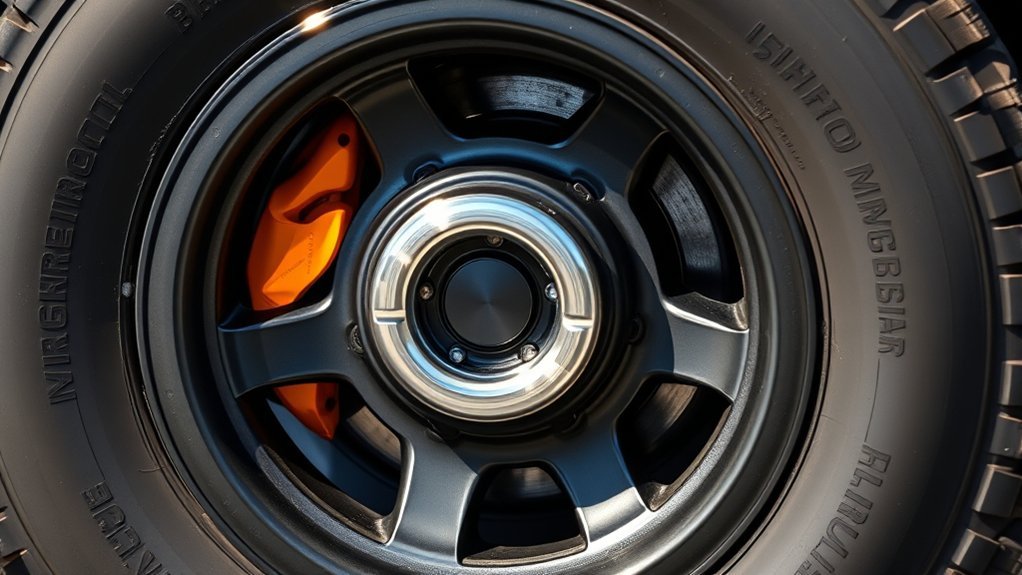
A hub centric ring, also called a hub ring or centering ring, is a plastic, nylon, polycarbonate, or aluminum insert that fits inside the center bore of an aftermarket wheel. Its job is simple: it adapts the wheel’s larger center bore to the smaller hub pilot on your 4Runner.
That centering support matters because many aftermarket wheels are built with a larger bore so the same wheel design can fit multiple vehicles. A correctly sized ring helps the wheel sit centered on the hub while you hand-thread and torque the lug nuts. This can help reduce highway-speed vibration caused by the wheel sitting slightly off center.
Hub rings are not suspension alignment parts, wheel spacers, or load-bearing parts. The lug hardware and wheel-to-hub clamping force secure the wheel. The ring simply helps center a compatible wheel during installation.
Note: For many 2010–2024 5th-generation 4Runners, 106.1 mm is commonly used as the hub-pilot reference. Do not order rings from that number alone. Verify your exact model year, trim, and wheel center bore first, especially if you have a 2025+ 4Runner or swapped wheels from another Toyota truck.
Do You Need Hub Centric Rings on a 4Runner?
You need hub centric rings only when the wheel center bore is larger than the 4Runner’s hub pilot. If the bore already matches the hub, the wheel is already hub centric and no ring is needed.
Use this quick decision check:
- Factory 4Runner wheels: Usually no rings are needed because OE wheels are made to fit the vehicle hub.
- Aftermarket wheels with a larger center bore: Rings are usually recommended to help center the wheel and reduce the chance of vibration.
- Aftermarket wheels with a center bore that matches the hub: Rings are not needed.
- Wheel bore smaller than the hub: Do not force the wheel on. That wheel is not compatible without proper machining by a qualified wheel specialist.
- Persistent vibration after rings: Check wheel balance, tire condition, bent wheels, lug-seat style, hub rust, brake rotor mounting, and suspension components.
Why Hub Centric Rings Help With Aftermarket Wheels
When you upgrade to aftermarket wheels on your 4Runner, the wheel may have a larger center bore than the hub. That small gap can make the wheel harder to center while tightening the lug nuts. A properly fitted hub ring fills that gap so the wheel sits more consistently on the hub pilot.
Here are the real benefits:
- Easier centering: The ring helps hold the wheel centered while you install it.
- Vibration reduction: It may reduce vibration caused by an off-center wheel installation.
- Cleaner installation: The wheel is less likely to shift as the lug nuts are tightened.
- Better diagnosis: If vibration remains after proper rings and torque, you know to inspect balance, tires, wheels, or suspension next.
- More confidence with universal-bore wheels: Rings adapt one wheel bore to your 4Runner’s hub size when the wheel maker approves the fitment.
Warning: Hub rings do not make an unsafe wheel safe. Never use rings to compensate for the wrong bolt pattern, wrong lug-seat type, too little thread engagement, cracked wheels, or wheels that do not fully seat against the hub.
[Products Worth Considering]

These M14x1.5 closed-end chrome lug nuts are a one-piece replacement designed for secure fitment on compatible GM, Ford, and select Chrysler/Dodge models. Featuring a 60-degree conical seat and anti-rust chrome plating, they help resist corrosion and maintain a bright look for everyday driving. Built for long-term durability, they include OEM-style part references and are backed by 12 months of support.

Upgrade your wheels with MIKKUPPA closed-end lug nuts designed for reliable fit and corrosion resistance. The one-piece, cold-forged and heat-treated steel construction helps resist rust and stripping, while the integrated finish delivers a durable black appearance. Built to OEM standards with a conical 60-degree seat, these nuts provide a secure solution for compatible Ford, Honda, Jeep, and Chevrolet models.

Upgrade your wheels with MIKKUPPA M12x1.5 mag seat lug nuts built for secure, corrosion-resistant performance. These closed-end chrome lug nuts are a direct replacement for select Toyota models, including Camry, Corolla, RAV4, Sienna, Avalon, Highlander, Matrix, Venza, and Prius. Triple-chromium plating and cold-forged, heat-treated steel help deliver strength for daily driving and replacement needs.
How to Choose the Best Hub Centric Rings for Your 4Runner
Choosing the right hub centric rings comes down to two measurements. The inner diameter must match your 4Runner’s hub pilot. The outer diameter must match the aftermarket wheel’s center bore.
Hub rings are usually listed as outer diameter to inner diameter. For example, a 110.0 mm to 106.1 mm ring would mean the wheel center bore is 110.0 mm and the vehicle hub pilot is 106.1 mm. Do not assume 110.0 mm is your wheel bore; aftermarket wheels vary widely.
[Products Worth Considering]

This 1/2-inch drive breaker bar delivers powerful leverage for loosening and tightening stubborn lug nuts and automotive fasteners. The 180-degree flex head helps you reach tight spaces at the angle you need, making tire and brake jobs easier. A spring-loaded ball detent design holds 1/2-inch sockets securely while the chrome-moly head provides durable strength for everyday use.

The Trivd Frol 1/2" air impact wrench delivers high performance torque up to 1500 ft-lbs with a twin hammer impact mechanism for strong, balanced blows. It features an ergonomic grip, compact lightweight design, and quick-stop control with 3 forward speeds up to 8000 RPM plus a reverse speed. Built for demanding automotive repair and tire shop work, the rear exhaust helps keep debris away from the surface.

This universal wheel alignment tool helps you accurately restore tire tilt angles after tire or suspension repairs using an adjustable camber gauge. It features a powerful magnetic base that firmly attaches to brake rotors for stationary, slip-free readings, improving consistency during measurement. Built from durable PC plastic, it resists wear and corrosion and is compact enough for car, truck, RV, and motorcycle alignment tasks.
How to Measure the Right Ring Size
- Confirm the vehicle hub pilot: Use your owner resources, wheel fitment documentation, a trusted tire shop, or a caliper on the hub lip.
- Confirm the wheel center bore: Check the wheel manufacturer’s spec sheet or measure the wheel’s center hole with a caliper.
- Order by outer-to-inner size: Wheel bore first, vehicle hub second.
- Test the fit before driving: The ring should sit flush and snug without forcing the wheel away from the hub face.
Plastic vs. Aluminum Hub Centric Rings
Both plastic and aluminum rings can work when sized correctly. The best choice depends on how you use your 4Runner.
| Material | Best For | Watch Out For |
|---|---|---|
| Plastic, nylon, or polycarbonate | Daily driving, easy installation, corrosion resistance | Can crack, deform, or loosen if damaged or overheated |
| Aluminum | Heavy use, frequent wheel changes, higher heat environments | Can seize from corrosion if neglected; fit must be precise |
Hub Centric Ring Installation Tips
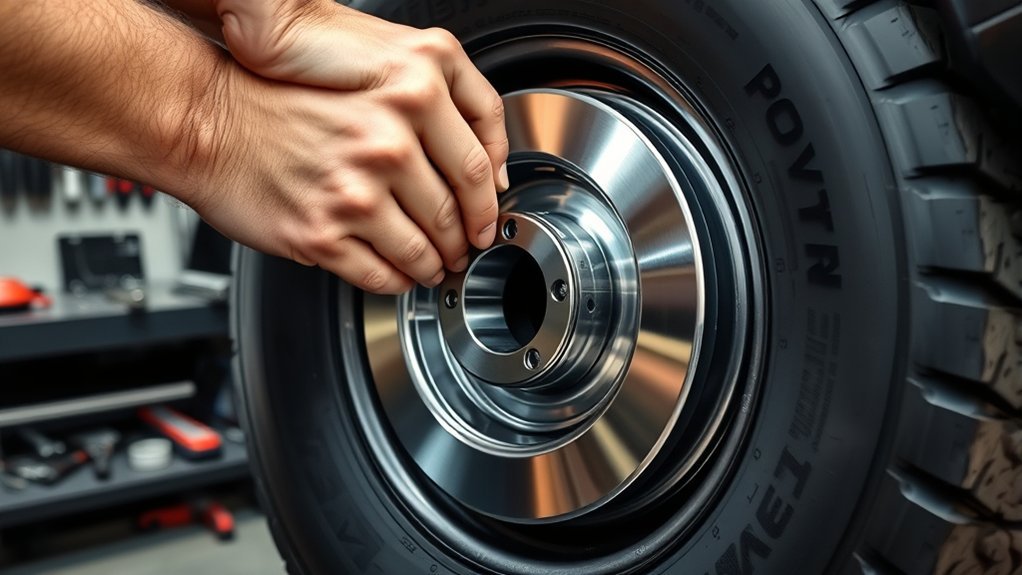
Installing hub centric rings is straightforward, but wheel installation is safety-critical. Work on level ground, chock the wheels, support the 4Runner with jack stands, and use the correct lifting points from your owner’s manual.
- Confirm fitment first. Check that the ring’s outer diameter matches the wheel bore and the inner diameter matches the 4Runner hub pilot.
- Clean the mounting surfaces. Remove dirt, rust flakes, and debris from the hub lip and wheel center bore with a wire brush and rag.
- Seat the ring fully. Press the ring into the wheel bore or onto the hub, depending on the ring style. It should sit flat without rocking.
- Mount the wheel carefully. The wheel must sit flush against the hub face. If it does not, remove it and inspect for a cocked ring, rust, or interference.
- Hand-thread every lug nut. This helps prevent cross-threading and confirms the hardware is correct.
- Torque in stages. Snug the lug nuts in a crisscross pattern, lower the vehicle enough for tire resistance, then torque to the vehicle-specific specification with a calibrated torque wrench.
- Recheck after driving. For new wheels or newly installed hardware, recheck lug torque after the first 50–100 driving miles when the wheels are cool.
Pro Tip: If a ring needs heavy hammering, grinding, or force to fit, stop. The size is likely wrong, the wheel bore has debris, or the ring is damaged.
[Products Worth Considering]

The 22800 wheel stud installer makes replacing wheel studs quick and secure, saving time and effort during tire service. It uses a ratchet or impact wrench to pull new studs firmly into place, helping when existing studs are too long. Compatible with most automotive wheels and light-duty truck wheel studs, it’s designed for easy, tool-assisted installation.

This car D-wheel lock nut key provides an anti-theft solution for D-shaped wheel lock bolts, helping keep your wheels secure. It features a flower-shaped internal pattern that resists micro-adjustment theft while allowing removal and mounting of compatible locking nuts. Made for reliable performance under high torque, it’s easy to use with standard socket wrench turning for quick tire maintenance and emergency repairs.

The Dr.Roc spare tire tool kit helps you release, lower, or raise your spare tire with reliable extension tools and a lug nut wrench. It is made from rustproof automotive-grade steel and includes an organized carry case for convenient storage. Designed for compatibility with select GM models from the late 1990s through 2019, it uses upgraded extension components to install and remove spare tires with less hassle.
Debunking Myths About Hub Centric Rings
Many 4Runner owners hear mixed advice about hub centric rings. The truth is more balanced than “always required” or “never useful.” They are a fitment aid for compatible aftermarket wheels, not a magic fix for every vibration.
Common Misunderstandings
- Myth: Factory wheels need hub rings. Most factory wheels are already made to match the vehicle hub, so rings are usually unnecessary.
- Myth: Hub rings carry vehicle weight. They do not carry load. Their job is centering, not supporting the 4Runner.
- Myth: Lug nuts alone always center every aftermarket wheel perfectly. Many lug-centric wheels can be installed safely, but a hub ring can help center a larger-bore wheel more consistently.
- Myth: Hub rings fix all highway vibration. They can help if the wheel is off center, but they will not fix imbalance, bent wheels, tire runout, wrong lug nuts, or worn suspension parts.
- Myth: Any ring close to the right size is fine. A loose ring will not center the wheel well, and an oversized ring can keep the wheel from seating flat.
Importance of Proper Fitment
Proper fitment starts with the wheel itself. The wheel must have the correct bolt pattern, offset/backspacing, load rating, lug-seat style, brake clearance, and center bore. A hub centric ring only addresses the center-bore-to-hub gap.
Here’s a practical comparison:
| Aspect | With Correct Hub Centric Rings | Without Rings When Bore Is Too Large |
|---|---|---|
| Wheel Centering | Wheel is easier to center on the hub pilot | Wheel may shift slightly during installation |
| Vibration Risk | May reduce off-center vibration | Higher chance of vibration if the wheel is not centered |
| Wheel Security | Still depends on correct lug hardware and torque | Still depends on correct lug hardware and torque |
| Tire Wear | Can help avoid vibration-related issues if centering was the cause | Uneven wear may continue if vibration, balance, or alignment problems remain |
| Best Use Case | Aftermarket wheel with larger center bore | Factory wheel or aftermarket wheel that already matches the hub |
How Hub Centric Rings Help Reduce Vibration
When an aftermarket wheel has a larger center bore, it can sit slightly off center while the lug nuts are being tightened. At highway speed, that small offset may feel like a steering wheel shake, seat vibration, or general wheel/tire vibration.
A correctly sized hub ring helps by keeping the wheel centered on the hub pilot during installation. That improves the chance that the wheel rotates around the same centerline as the hub.
Hub rings are most likely to help when:
- Vibration started immediately after installing aftermarket wheels.
- The wheel center bore is larger than the 4Runner hub pilot.
- The vibration is strongest at highway speed.
- The tires have already been balanced correctly.
- The wheels, tires, lug nuts, and suspension parts are otherwise in good condition.
If the vibration remains after installing the right rings and rechecking torque, do not keep driving and guessing. Have the wheel and tire assembly inspected for balance, runout, bent rims, tire defects, hub rust, brake rotor seating, and suspension wear.
Hub centric rings are a centering aid, not a shortcut. Correct wheel specs, clean mounting surfaces, proper lug hardware, and correct torque still matter most.
Maintaining Your Hub Centric Rings
Hub centric rings should be inspected any time the wheels are removed. During tire rotations, brake work, or seasonal wheel changes, check each ring before reinstalling the wheel.
Replace a ring if you notice:
- Cracks, chips, or missing pieces
- Heat damage, melting, or deformation
- A loose fit in the wheel bore or on the hub pilot
- Corrosion that prevents the ring from seating flat
- Any ring that stays stuck, warps, or breaks during removal
Do not rely on mileage alone. A clean, correctly fitted ring may last a long time, while a damaged or poorly fitted ring should be replaced immediately.
Common Issues With Hub Centric Rings and Their Solutions
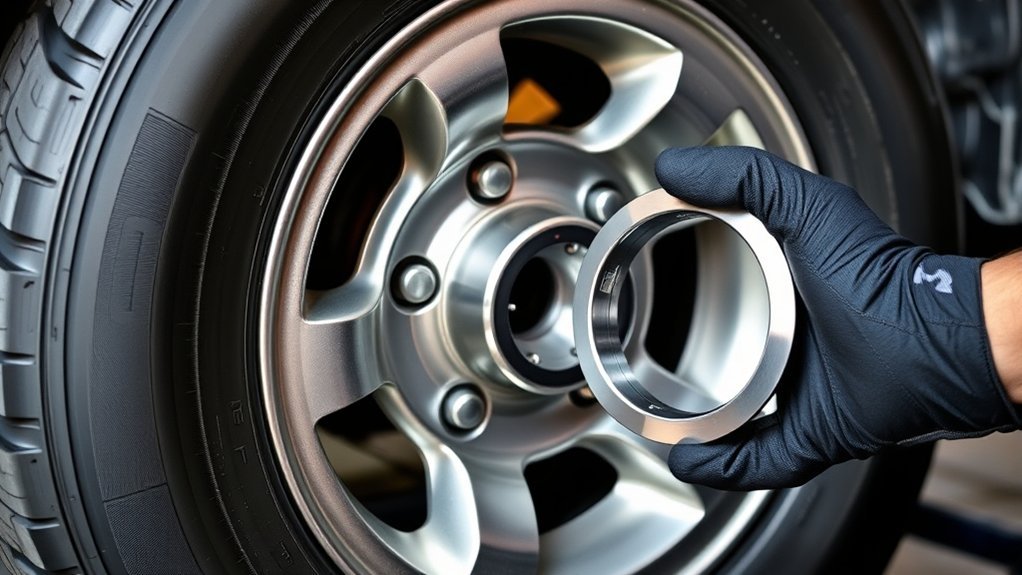
Regular inspections of your hub centric rings can reveal small problems before they turn into vibration, noise, or unsafe wheel installation. Use this troubleshooting guide:
| Issue | Likely Cause | Solution |
|---|---|---|
| Ring falls out of wheel | Outer diameter too small or ring worn | Re-measure wheel bore and replace with the correct size |
| Wheel will not sit flush | Ring cocked, wrong size, rust, or debris on hub | Remove wheel, clean surfaces, and reinstall only if the ring seats flat |
| Vibration continues | Balance, tire runout, bent wheel, incorrect lug nuts, torque issue, or suspension wear | Inspect wheel/tire balance, lug-seat match, torque, and suspension components |
| Aluminum ring stuck on hub | Corrosion or dirt buildup | Clean carefully during wheel service and replace damaged rings |
| Plastic ring cracked | Age, impact, heat, or forced installation | Replace the full set if wear is uneven or sizes no longer match |
What Hub Centric Rings Cannot Fix
Hub centric rings are useful only for one specific fitment issue: a larger wheel center bore on a smaller vehicle hub. They cannot fix every wheel problem.
- Wrong bolt pattern: The wheel must match the 4Runner’s bolt pattern.
- Wrong lug-seat style: Conical, ball, and shank-style lug seats are not interchangeable unless the wheel maker says so.
- Not enough thread engagement: The lug nuts must fully engage the studs to the proper depth.
- Bad balance or road-force issue: A balance problem can still shake even with perfect rings.
- Bent wheel or damaged tire: Rings cannot correct physical damage.
- Suspension or brake issues: Worn ball joints, tie rods, bearings, or improperly seated rotors can also cause vibration.
Frequently Asked Questions
What happens if you don’t use hub centric rings?
If your aftermarket wheel center bore is larger than the 4Runner hub pilot, skipping rings can make the wheel harder to center during installation. That may lead to highway-speed vibration. If the wheel bore already matches the hub, or if you are using factory wheels, rings are usually not needed.
How long do hub centric rings last?
There is no universal mileage life for hub centric rings. Inspect them whenever the wheels come off. Replace them if they crack, deform, loosen, corrode, melt, or no longer sit flat in the wheel bore or on the hub.
Are hub centric rings easy to put on?
Yes, they are usually easy to install when the size is correct and the hub and wheel bore are clean. The ring should sit snugly and flush. If it needs heavy force, the ring may be the wrong size or the mounting surface may be dirty.
Do hub centric rings carry the weight of a 4Runner?
No. Hub centric rings are centering adapters. They do not carry vehicle load. Correct wheel hardware, proper lug-nut seating, clean mounting surfaces, and the right torque secure the wheel.
Are aluminum hub rings better than plastic rings?
Aluminum rings can be more durable in high-heat or heavy-use situations, while plastic, nylon, or polycarbonate rings are corrosion-resistant and easy to install. The correct size and fit matter more than the material.
Will hub centric rings stop all steering wheel vibration?
No. They may help if the vibration is caused by a larger-bore aftermarket wheel sitting off center. If vibration remains, check tire balance, road force, wheel damage, lug hardware, torque, brake rotor seating, hub rust, and suspension wear.
Conclusion
Hub centric rings can be a smart upgrade for your 4Runner when aftermarket wheels have a center bore larger than the vehicle hub. The right rings help center the wheel and may reduce highway-speed vibration, but they are only one part of safe wheel fitment.
Before ordering, verify the wheel bore, hub pilot, model year, and lug hardware. During installation, clean the hub and wheel bore, seat the ring flat, hand-thread the lug nuts, torque in a crisscross pattern, and recheck after the first 50–100 miles when installing new wheels. If vibration continues, inspect the full wheel and tire assembly instead of assuming the rings are the only cause.
Sources
- Discount Tire: What Are Hub-Centric Rings? — hub ring definition, sizing, and use cases.
- Discount Tire: Hub-Centric vs. Lug-Centric Wheels — hub-centric and lug-centric wheel explanations.
- KMC Wheels: What Are Hub Centric Rings? — load-bearing caveat and when rings may be needed.
- Tire Rack: How Do I Properly Torque My Wheel Lug Nuts or Bolts? — torque tools, patterns, and re-torque guidance.
- NHTSA-hosted service bulletin: Proper Wheel Installation and Wheel Torque Techniques — wheel torque methods and vibration risk from improper mounting.
- Toyota Owners: 4Runner Manuals and Warranties — official owner-manual access for model-specific procedures and specifications.